REVIEW 5 major objections 5 minor 51 references
Active 3D reconstruction can choose viewpoints far more efficiently by fusing a feed-forward model's own uncertainty with a vision-language model's guesses about what is missing, rather than relying on geometric heuristics or expensive per-
Reviewed by Pith at T0; open to challenge. T0 means a machine referee read the full paper against a public rubric. the ladder, T0–T4 →
T0 review · deepseek-v4-flash
2026-08-03 19:36 UTC pith:WXS4VF4L
load-bearing objection Interesting dual-field framework for active 3D reconstruction with feed-forward confidence and VLM guidance, but the experimental numbers are internally inconsistent and the VLM ablation contradicts the paper's claims. the 5 major comments →
AREA3D: Active Reconstruction Agent with Unified Feed-Forward 3D Perception and Vision-Language Guidance
The pith
A machine-rendered reading of the paper's core claim, the machinery that carries it, and where it could break.
Core claim
The paper claims that active view selection can be reduced to reducing a fused uncertainty volume. A pretrained feed-forward reconstruction network provides per-pixel confidence, back-projected to a voxel grid to form a geometric uncertainty field; a vision-language model, prompted with a structured grid, names image regions likely to be occluded, ambiguous, or missing, and these suggestions are modulated by feature-level variability to form a semantic uncertainty field. The two fields are fused, and a greedy visibility-aware planner accumulates scores over precomputed frustum masks to pick the next viewpoint, then decays uncertainty inside the chosen frustum to push exploration elsewhere. T
What carries the argument
The central object is the dual-field 3D uncertainty volume: a voxel grid where each voxel carries a fused score from (1) a geometric uncertainty field obtained by back-projecting a feed-forward model's per-pixel predicted precision, and (2) a semantic uncertainty field obtained by parsing a vision-language model's region suggestions and modulating them with feature variance. This volume serves as the single 'where-to-look' map. All view-selection decisions are made by scoring candidate camera poses through precomputed frustum visibility masks against this volume, picking the pose that would reduce the most uncertainty, and decaying the volume inside the chosen frustum after committing to a v
Load-bearing premise
The load-bearing premise is that the feed-forward model's per-pixel confidence scores genuinely track where the reconstruction is likely to be wrong; if the pretrained confidence is overconfident on unseen or unusual surfaces, the geometric field will mislead the view planner.
What would settle it
Replace the confidence map of the feed-forward model with random noise (or a constant) while keeping everything else identical, and rerun the view-selection policy. If the selected viewpoints still yield reconstruction accuracy close to the full system's, then the geometric field is not doing the work attributed to it. Alternatively, measure whether the views the policy selects actually reduce novel-view error on targeted regions more than an equal number of randomly or uniformly chosen views.
If this is right
- View planning no longer requires per-scene optimization, so the cost of deciding where to look stays roughly constant as reconstruction quality improves.
- Under a fixed small view budget, reconstruction fidelity improves noticeably, enabling efficient exploration with just a handful of images.
- Semantic reasoning steers the planner to occluded or ambiguous regions that geometry confidence alone could miss, improving coverage of challenging surfaces.
- The unified benchmark and evaluation protocol allow side-by-side comparison of active reconstruction policies across object- and scene-level scales.
Where Pith is reading between the lines
- Because the fusion is model-agnostic, the same dual-field design should transfer to other feed-forward depth or reconstruction networks and other vision-language models, at the cost of recalibrating the weighting coefficients.
- The coarse grid used to query the vision-language model might be replaced by continuous semantic uncertainty maps, which could sharpen the semantic field; the paper's evidence suggests even the coarse grid already helps.
- A direct comparison on a dataset with ground-truth geometry could quantify how much of the gain comes from geometric versus semantic cues per region type (occlusion, textureless, reflection), which the current aggregate metrics do not separate.
- The method could be adapted to physical range-sensing setups where confidence maps come from sensor noise models instead of a learned network.
Editorial analysis
A structured set of objections, weighed in public.
Referee Report
Summary. AREA3D proposes an active 3D reconstruction agent that selects viewpoints under a fixed budget using a voxelized dual-field uncertainty: a geometric field derived from VGGT's per-pixel depth confidence and a semantic field from a VLM prompted to identify uncertain regions. View selection greedily maximizes fused, visibility-gated uncertainty, then decays uncertainty inside the selected frustum. Experiments on Replica (scene-level) and OmniObject3D (object-level), with PGSR as the downstream reconstructor, claim state-of-the-art PSNR/SSIM/LPIPS under sparse view budgets. An ablation studies the feed-forward and VLM components. The core idea is plausible, but the reported experimental numbers are internally inconsistent across the main tables and the supplementary material, and the ablation evidence for the VLM component is mixed.
Significance. If the results hold, AREA3D would be a practical alternative to optimization-based active reconstruction, since it decouples uncertainty estimation from the reconstructor and combines metric geometric cues with high-level semantic guidance. The proposed benchmark spanning object-level and room-scale scenes, the cached Monte-Carlo visibility masks, and the attempt to fuse two complementary uncertainty signals are all useful contributions. The paper does not ship machine-checked proofs or released code, but the method is algorithmically described in enough detail to be reimplemented. However, the empirical basis for the central state-of-the-art claim is currently unreliable because the same configurations are reported with materially different numbers in different parts of the manuscript, and the object-level ablation contradicts the claim that both components are complementary.
major comments (5)
- [§4.5, Table 2 vs Table 4 / Supp. Sec. 8] The scene-level numbers are internally inconsistent. Averaged over room0/office0/office2/office4, 'Ours' in Table 2 gives 30.68 PSNR, 0.861 SSIM, 0.116 LPIPS, but Table 4's scene-level full row and Supplement Sec. 8 both report 32.40/0.897/0.089. 'Ours w/o VLM' in Table 2 averages 29.59/0.849/0.129, whereas Table 4's scene-level feed-forward-only row is 31.26/0.884/0.097. The supplementary statement that the aggregates are 'consistent with the per-scene comparisons' is therefore incorrect. Please correct the tables and explain which numbers are the actual reported results.
- [§4.5, Table 3 vs Table 4 / Supp. Sec. 8] The object-level numbers also disagree. 'Ours' in Table 3 averages to 32.40 PSNR, 0.897 SSIM, 0.089 LPIPS over the four tabletop scenes, while Table 4's object-level full row and Sec. 8's aggregate report 32.09/0.886/0.102. 'Ours w/o VLM' in Table 3 averages 31.26/0.884/0.097, while Table 4's object-level feed-forward-only row is 31.56/0.896/0.091. These are not rounding differences; they are different experimental outcomes for the same configuration. This undermines the state-of-the-art claim until the correct per-scene numbers are provided.
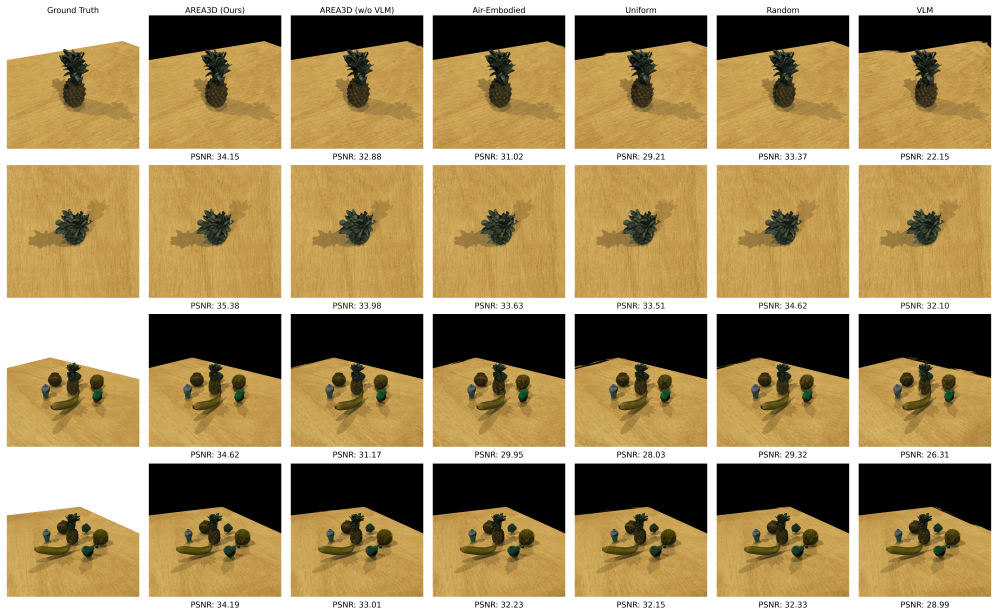
- [§4.6, Table 4] The claim that 'removing either component leads to a noticeable performance drop' is contradicted by the object-level ablation. Adding VLM guidance to feed-forward perception changes PSNR from 31.56 to 32.09 (+0.53) but degrades SSIM from 0.896 to 0.886 (-0.010) and LPIPS from 0.091 to 0.102 (+0.011). Thus the VLM component does not consistently improve reconstruction quality; at best it trades PSNR against SSIM/LPIPS. The text should be revised to report this trade-off and the 'complementary value' conclusion needs a consistent criterion rather than cherry-picking PSNR.
- [§3.2, Eq. (2)] The geometric field rests on the assumption that VGGT's pretrained per-pixel confidence is a calibrated proxy for the reconstruction error of the downstream PGSR model. No evidence is provided that this confidence correlates with actual depth or geometry error on held-out views. Since this uncertainty field drives view selection, please add a diagnostic (e.g., confidence vs depth-error scatter) or otherwise justify the proxy. Without this, it is unclear whether the reported improvements come from the view-selection policy or from VGGT's architecture.
- [§4.6 / Supp. Tables 5-7] The policy depends on many hand-set hyperparameters: γ (with different values for object-level and scene-level), η, β_HIGH/MED/LOW, s_small/medium/large, and λ. Yet no sensitivity analysis or error bars over runs are reported. With only four scenes per setting, the reported gains may be within tuning noise. Please add standard deviations across repeated runs or a sensitivity sweep for at least γ and η, and justify the per-benchmark choice of γ.
minor comments (5)
- [Abstract / §1] The phrase 'unified feed-forward 3D perception and vision-language guidance' suggests a single model, but the method is a modular fusion of separate components. Consider rephrasing to 'fusing' or 'integrating' to avoid overstating the architectural unity.
- [Figures 3 and 5] Figure 3 and Figure 5 appear to show the same scene-level PSNR-versus-frames curve with different captions. If they are duplicates, remove one; if they differ, clarify what is plotted in each.
- [Table 1] The table has a stray comma after '[12, 15, 20, 26],' in the Gaussian Splatting row. Also, the VLM Semantic Reasoning row lists key disadvantages that are not systematically compared in the experiments.
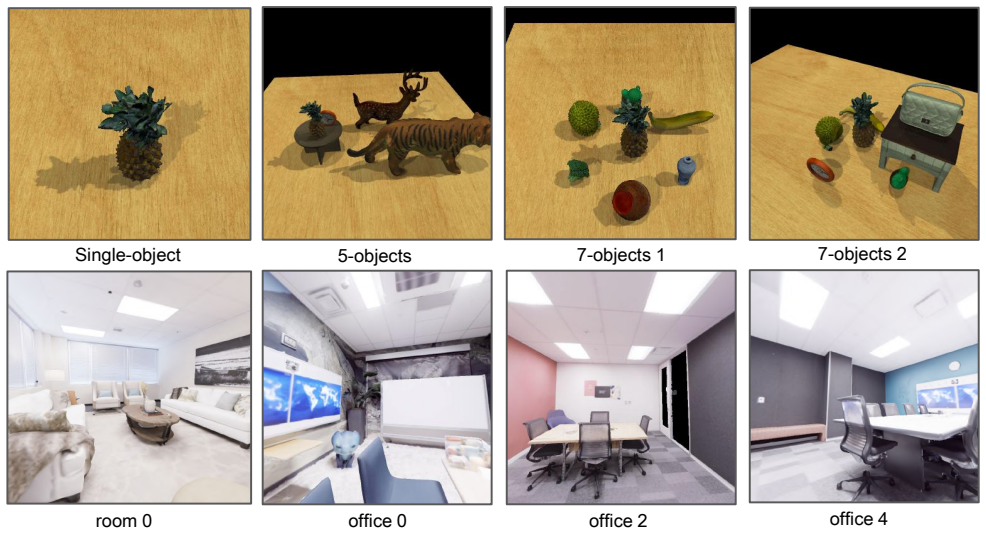
- [§4.1] The object-level setup mentions CoppeliaSim, but the data are described as rendered from OmniObject3D. Please clarify the role of CoppeliaSim in object-level data generation and whether all baselines use the same rendering pipeline.
- [§3.3 / Supp. Sec. 7] The fixed coefficients α_type and β_priority are not fully defined in the main text; α_type appears only in the supplementary. Define all coefficients in one place and state whether the VLM is queried once per episode or per iteration.
Circularity Check
No significant circularity: the view-selection policy is an algorithmic surrogate built from external pretrained signals, not a fit to the evaluation metric.
full rationale
AREA3D's central claim is that its active view-selection policy improves downstream 3DGS reconstruction accuracy. The policy maximizes a fused uncertainty field constructed from two external sources: VGGT's pretrained per-pixel confidence (trained with a heteroscedastic depth loss following Kendall & Gal) and VLM-generated semantic region masks. Neither source is defined in terms of the evaluation metrics PSNR, SSIM, or LPIPS, nor in terms of the final PGSR reconstruction. The paper's equations (Eq. 1-4 in the main text, and Algorithm 1) specify a greedy, frustum-aware selection procedure with fixed decay and weighting coefficients; the selected views are then fed into PGSR for evaluation. No fitted parameter is renamed as a prediction, and no quantity that appears in the loss or in the selection objective is equal by construction to the reported benchmark numbers. The hyperparameters γ, η, λ, α, and β are manually chosen constants, and γ is separately set per benchmark; this is a standard implementation choice and, even if it influences the reported numbers, it is not a circular derivation. There are no load-bearing self-citations: the references to VGGT, Kendall & Gal, PGSR, and other methods are external prior work, not prior papers by these authors, and no uniqueness theorem or imported ansatz is used to force the method. The internal inconsistencies between the per-scene tables and the supplementary aggregate numbers are a serious empirical validity concern, but they are evidence that the reported SOTA claim may be unreliable, not evidence that the claim holds by construction. The derivation chain is therefore substantially self-contained, and no circular step meeting the evidentiary bar is present.
Axiom & Free-Parameter Ledger
free parameters (5)
- γ (global initial uncertainty weight) =
0.01 (object), 0.005 (scene)
- η (frustum uncertainty decay factor) =
0.3
- VLM priority coefficients (β_HIGH, β_MED, β_LOW) =
3.0, 1.5, 0.5
- VLM size coefficients (s_small, s_medium, s_large) =
0.8, 1.0, 1.2
- λ (semantic modulation strength) =
1.0
axioms (4)
- domain assumption VGGT per-pixel confidence is a valid proxy for aleatoric reconstruction uncertainty ('predictive precision').
- domain assumption VLM structured region outputs (categories, priorities, sizes) map deterministically to informative uncertainty regions.
- ad hoc to paper The multiplicative frustum decay and global weight γ provide sufficient exploration-exploitation balance.
- domain assumption PSNR/SSIM/LPIPS on novel views of PGSR reconstruction faithfully reflect geometric reconstruction quality.
read the original abstract
Active 3D reconstruction enables an agent to autonomously select viewpoints to efficiently obtain accurate and complete scene geometry, rather than passively reconstructing scenes from pre-collected images. However, existing active reconstruction methods often rely on hand-crafted geometric heuristics, which can lead to redundant observations without substantially improving reconstruction quality. To address this limitation, we propose AREA3D, an active reconstruction agent that leverages feed-forward 3D reconstruction models and vision-language guidance. Our framework decouples view-uncertainty modeling from the underlying feed-forward reconstructor, enabling precise uncertainty estimation without expensive online optimization. In addition, an integrated vision-language model provides high-level semantic guidance, encouraging informative and diverse viewpoints beyond purely geometric cues. Extensive experiments on both scene-level and object-level benchmarks demonstrate that AREA3D achieves state-of-the-art reconstruction accuracy, particularly in the sparse-view regime. Code will be made available at: https://github.com/TianlingXu/AREA3D .
Figures



Reference graph
Works this paper leans on
-
[1]
Qwen technical report.arXiv preprint arXiv:2309.16609, 2023
Jinze Bai, Shuai Bai, Yunfei Chu, Zeyu Cui, Kai Dang, Xiaodong Deng, Yang Fan, Wenbin Ge, Yu Han, Fei Huang, et al. Qwen technical report.arXiv preprint arXiv:2309.16609, 2023. 3
Pith/arXiv arXiv 2023
-
[2]
Shuai Bai, Keqin Chen, Xuejing Liu, Jialin Wang, Wenbin Ge, Sibo Song, Kai Dang, Peng Wang, Shijie Wang, Jun Tang, et al. Qwen2. 5-vl technical report.arXiv preprint arXiv:2502.13923, 2025. 3
Pith/arXiv arXiv 2025
-
[3]
Pgsr: Planar-based gaussian splatting for ef- ficient and high-fidelity surface reconstruction.IEEE Trans- actions on Visualization and Computer Graphics, 2024
Danpeng Chen, Hai Li, Weicai Ye, Yifan Wang, Weijian Xie, Shangjin Zhai, Nan Wang, Haomin Liu, Hujun Bao, and Guofeng Zhang. Pgsr: Planar-based gaussian splatting for ef- ficient and high-fidelity surface reconstruction.IEEE Trans- actions on Visualization and Computer Graphics, 2024. 6
2024
-
[4]
Gennbv: Generalizable next-best-view policy for active 3d reconstruction
Xiao Chen, Quanyi Li, Tai Wang, Tianfan Xue, and Jiang- miao Pang. Gennbv: Generalizable next-best-view policy for active 3d reconstruction. InProceedings of the IEEE/CVF Conference on Computer Vision and Pattern Recognition, pages 16436–16445, 2024. 2
2024
-
[5]
A volumetric method for building complex models from range images
Brian Curless and Marc Levoy. A volumetric method for building complex models from range images. InProceedings of the 23rd annual conference on Computer graphics and interactive techniques, pages 303–312, 1996. 2
1996
-
[6]
Palm-e: An embodied multimodal language model
Danny Driess, Fei Xia, Mehdi SM Sajjadi, Corey Lynch, Aakanksha Chowdhery, Ayzaan Wahid, Jonathan Tompson, Quan Vuong, Tianhe Yu, Wenlong Huang, et al. Palm-e: An embodied multimodal language model. 2023. 3
2023
-
[7]
Naruto: Neural active reconstruction from uncertain target observations
Ziyue Feng, Huangying Zhan, Zheng Chen, Qingan Yan, Xi- angyu Xu, Changjiang Cai, Bing Li, Qilun Zhu, and Yi Xu. Naruto: Neural active reconstruction from uncertain target observations. InProceedings of the IEEE/CVF Conference on Computer Vision and Pattern Recognition, pages 21572– 21583, 2024. 2, 3
2024
-
[8]
Bayes’ rays: Uncertainty quan- tification for neural radiance fields
Lily Goli, Cody Reading, Silvia Sell ´an, Alec Jacobson, and Andrea Tagliasacchi. Bayes’ rays: Uncertainty quan- tification for neural radiance fields. InProceedings of the IEEE/CVF Conference on Computer Vision and Pattern Recognition, pages 20061–20070, 2024. 1
2024
-
[9]
Mobin Habibpour and Fatemeh Afghah. History-augmented vision-language models for frontier-based zero-shot object navigation.arXiv preprint arXiv:2506.16623, 2025. 3
Pith/arXiv arXiv 2025
-
[10]
V olumetric next best view by 3d oc- cupancy mapping using markov chain gibbs sampler for pre- cise manufacturing.IEEE Access, 7:121949–121960, 2019
Lei Hou, Xiaopeng Chen, Kunyan Lan, Rune Rasmussen, and Jonathan Roberts. V olumetric next best view by 3d oc- cupancy mapping using markov chain gibbs sampler for pre- cise manufacturing.IEEE Access, 7:121949–121960, 2019. 2, 3
2019
-
[11]
Wenlong Huang, Chen Wang, Ruohan Zhang, Yunzhu Li, Jiajun Wu, and Li Fei-Fei. V oxposer: Composable 3d value maps for robotic manipulation with language models.arXiv preprint arXiv:2307.05973, 2023. 3
Pith/arXiv arXiv 2023
-
[12]
Fisherrf: Ac- tive view selection and mapping with radiance fields using fisher information
Wen Jiang, Boshu Lei, and Kostas Daniilidis. Fisherrf: Ac- tive view selection and mapping with radiance fields using fisher information. InEuropean Conference on Computer Vision, pages 422–440. Springer, 2024. 1, 2, 3, 7
2024
-
[13]
Multimodal llm guided exploration and active map- ping using fisher information
Wen Jiang, Boshu Lei, Katrina Ashton, and Kostas Dani- ilidis. Multimodal llm guided exploration and active map- ping using fisher information. InProceedings of the IEEE/CVF International Conference on Computer Vision, pages 5392–5404, 2025. 3
2025
-
[14]
Neu-nbv: Next best view planning using uncer- tainty estimation in image-based neural rendering
Liren Jin, Xieyuanli Chen, Julius R ¨uckin, and Marija Popovi´c. Neu-nbv: Next best view planning using uncer- tainty estimation in image-based neural rendering. In2023 IEEE/RSJ International Conference on Intelligent Robots and Systems (IROS), pages 11305–11312. IEEE, 2023. 2, 3
2023
-
[15]
Activegs: Active scene re- construction using gaussian splatting.IEEE Robotics and Automation Letters, 2025
Liren Jin, Xingguang Zhong, Yue Pan, Jens Behley, Cyrill Stachniss, and Marija Popovi ´c. Activegs: Active scene re- construction using gaussian splatting.IEEE Robotics and Automation Letters, 2025. 2, 3
2025
-
[16]
What uncertainties do we need in bayesian deep learning for computer vision?Advances in neural information processing systems, 30, 2017
Alex Kendall and Yarin Gal. What uncertainties do we need in bayesian deep learning for computer vision?Advances in neural information processing systems, 30, 2017. 4
2017
-
[17]
3d gaussian splatting for real-time radiance field rendering.ACM Trans
Bernhard Kerbl, Georgios Kopanas, Thomas Leimk ¨uhler, and George Drettakis. 3d gaussian splatting for real-time radiance field rendering.ACM Trans. Graph., 42(4):139–1,
-
[18]
Uncertainty guided pol- icy for active robotic 3d reconstruction using neural radiance fields.IEEE Robotics and Automation Letters, 7(4):12070– 12077, 2022
Soomin Lee, Le Chen, Jiahao Wang, Alexander Liniger, Suryansh Kumar, and Fisher Yu. Uncertainty guided pol- icy for active robotic 3d reconstruction using neural radiance fields.IEEE Robotics and Automation Letters, 7(4):12070– 12077, 2022. 1, 2, 3
2022
-
[19]
Ground- ing image matching in 3d with mast3r
Vincent Leroy, Yohann Cabon, and J´erˆome Revaud. Ground- ing image matching in 3d with mast3r. InEuropean Confer- ence on Computer Vision, pages 71–91. Springer, 2024. 2
2024
-
[20]
Activesplat: High-fidelity scene reconstruction through active gaussian splatting.IEEE Robotics and Automation Letters, 2025
Yuetao Li, Zijia Kuang, Ting Li, Qun Hao, Zike Yan, Guyue Zhou, and Shaohui Zhang. Activesplat: High-fidelity scene reconstruction through active gaussian splatting.IEEE Robotics and Automation Letters, 2025. 2, 3
2025
-
[21]
Zhichen Lou, Kechun Xu, Zhongxiang Zhou, and Rong Xiong. Explorevlm: Closed-loop robot exploration task planning with vision-language models.arXiv preprint arXiv:2508.11918, 2025. 3
Pith/arXiv arXiv 2025
-
[22]
Nerf: Representing scenes as neural radiance fields for view syn- thesis.Communications of the ACM, 65(1):99–106, 2021
Ben Mildenhall, Pratul P Srinivasan, Matthew Tancik, Jonathan T Barron, Ravi Ramamoorthi, and Ren Ng. Nerf: Representing scenes as neural radiance fields for view syn- thesis.Communications of the ACM, 65(1):99–106, 2021. 2
2021
-
[23]
Ac- tivenerf: Learning where to see with uncertainty estimation
Xuran Pan, Zihang Lai, Shiji Song, and Gao Huang. Ac- tivenerf: Learning where to see with uncertainty estimation. InEuropean Conference on Computer Vision, pages 230–
-
[24]
Next best view estima- tion for volumetric information gain.IFAC-PapersOnLine, 55(15):160–165, 2022
Alexandru Pop and Levente Tamas. Next best view estima- tion for volumetric information gain.IFAC-PapersOnLine, 55(15):160–165, 2022. 2, 3
2022
-
[25]
Habitat 3.0: A co-habitat for humans, avatars and robots.arXiv preprint arXiv:2310.13724, 2023
Xavier Puig, Eric Undersander, Andrew Szot, Mikael Dal- laire Cote, Tsung-Yen Yang, Ruslan Partsey, Ruta Desai, Alexander William Clegg, Michal Hlavac, So Yeon Min, et al. Habitat 3.0: A co-habitat for humans, avatars and robots.arXiv preprint arXiv:2310.13724, 2023. 6 9
Pith/arXiv arXiv 2023
-
[26]
Zhenghao Qi, Shenghai Yuan, Fen Liu, Haozhi Cao, Tianchen Deng, Jianfei Yang, and Lihua Xie. Air-embodied: An efficient active 3dgs-based interaction and reconstruc- tion framework with embodied large language model.arXiv preprint arXiv:2409.16019, 2024. 2, 3, 7
Pith/arXiv arXiv 2024
-
[27]
Habitat: A platform for embodied ai research
Manolis Savva, Abhishek Kadian, Oleksandr Maksymets, Yili Zhao, Erik Wijmans, Bhavana Jain, Julian Straub, Jia Liu, Vladlen Koltun, Jitendra Malik, et al. Habitat: A platform for embodied ai research. InProceedings of the IEEE/CVF international conference on computer vision, pages 9339–9347, 2019. 6
2019
-
[28]
Scene exploration by vision-language models,
Venkatesh Sripada, Samuel Carter, Frank Guerin, and Amir Ghalamzan. Scene exploration by vision-language models,
-
[29]
The replica dataset: A digital replica of indoor spaces.arXiv preprint arXiv:1906.05797,
Julian Straub, Thomas Whelan, Lingni Ma, Yufan Chen, Erik Wijmans, Simon Green, Jakob J Engel, Raul Mur-Artal, Carl Ren, Shobhit Verma, et al. The replica dataset: A digital replica of indoor spaces.arXiv preprint arXiv:1906.05797,
Pith/arXiv arXiv 1906
-
[30]
Habitat 2.0: Training home assistants to rearrange their habitat.Advances in neural information processing systems, 34:251–266, 2021
Andrew Szot, Alexander Clegg, Eric Undersander, Erik Wi- jmans, Yili Zhao, John Turner, Noah Maestre, Mustafa Mukadam, Devendra Singh Chaplot, Oleksandr Maksymets, et al. Habitat 2.0: Training home assistants to rearrange their habitat.Advances in neural information processing systems, 34:251–266, 2021. 6
2021
-
[31]
Vggt: Vi- sual geometry grounded transformer
Jianyuan Wang, Minghao Chen, Nikita Karaev, Andrea Vedaldi, Christian Rupprecht, and David Novotny. Vggt: Vi- sual geometry grounded transformer. InProceedings of the Computer Vision and Pattern Recognition Conference, pages 5294–5306, 2025. 2, 3, 4
2025
-
[32]
Continuous 3d per- ception model with persistent state
Qianqian Wang, Yifei Zhang, Aleksander Holynski, Alexei A Efros, and Angjoo Kanazawa. Continuous 3d per- ception model with persistent state. InProceedings of the Computer Vision and Pattern Recognition Conference, pages 10510–10522, 2025. 2
2025
-
[33]
Dust3r: Geometric 3d vi- sion made easy
Shuzhe Wang, Vincent Leroy, Yohann Cabon, Boris Chidlovskii, and Jerome Revaud. Dust3r: Geometric 3d vi- sion made easy. InProceedings of the IEEE/CVF Conference on Computer Vision and Pattern Recognition, pages 20697– 20709, 2024. 2
2024
-
[34]
Weiyun Wang, Zhangwei Gao, Lixin Gu, Hengjun Pu, Long Cui, Xingguang Wei, Zhaoyang Liu, Linglin Jing, Shenglong Ye, Jie Shao, et al. Internvl3. 5: Advancing open-source multimodal models in versatility, reasoning, and efficiency. arXiv preprint arXiv:2508.18265, 2025. 3
Pith/arXiv arXiv 2025
-
[35]
Image quality assessment: from error visibility to structural similarity.IEEE transactions on image processing, 13(4):600–612, 2004
Zhou Wang, Alan C Bovik, Hamid R Sheikh, and Eero P Si- moncelli. Image quality assessment: from error visibility to structural similarity.IEEE transactions on image processing, 13(4):600–612, 2004. 6
2004
-
[36]
Omniobject3d: Large-vocabulary 3d object dataset for realistic perception, reconstruction and generation
Tong Wu, Jiarui Zhang, Xiao Fu, Yuxin Wang, Jiawei Ren, Liang Pan, Wayne Wu, Lei Yang, Jiaqi Wang, Chen Qian, et al. Omniobject3d: Large-vocabulary 3d object dataset for realistic perception, reconstruction and generation. InPro- ceedings of the IEEE/CVF Conference on Computer Vision and Pattern Recognition, pages 803–814, 2023. 6
2023
-
[37]
Worldmem: Long- term consistent world simulation with memory.arXiv preprint arXiv:2504.12369, 2025
Zeqi Xiao, Yushi Lan, Yifan Zhou, Wenqi Ouyang, Shuai Yang, Yanhong Zeng, and Xingang Pan. Worldmem: Long- term consistent world simulation with memory.arXiv preprint arXiv:2504.12369, 2025. 5
arXiv 2025
-
[38]
Active implicit object reconstruction us- ing uncertainty-guided next-best-view optimization.IEEE Robotics and Automation Letters, 8(10):6395–6402, 2023
Dongyu Yan, Jianheng Liu, Fengyu Quan, Haoyao Chen, and Mengmeng Fu. Active implicit object reconstruction us- ing uncertainty-guided next-best-view optimization.IEEE Robotics and Automation Letters, 8(10):6395–6402, 2023. 1, 2
2023
-
[39]
Active neu- ral mapping
Zike Yan, Haoxiang Yang, and Hongbin Zha. Active neu- ral mapping. InProceedings of the IEEE/CVF International Conference on Computer Vision, pages 10981–10992, 2023. 2, 3
2023
-
[40]
Vlfm: Vision-language frontier maps for zero-shot semantic navigation
Naoki Yokoyama, Sehoon Ha, Dhruv Batra, Jiuguang Wang, and Bernadette Bucher. Vlfm: Vision-language frontier maps for zero-shot semantic navigation. In2024 IEEE In- ternational Conference on Robotics and Automation (ICRA), pages 42–48. IEEE, 2024. 2, 3
2024
-
[41]
The unreasonable effectiveness of deep features as a perceptual metric
Richard Zhang, Phillip Isola, Alexei A Efros, Eli Shecht- man, and Oliver Wang. The unreasonable effectiveness of deep features as a perceptual metric. InProceedings of the IEEE conference on computer vision and pattern recogni- tion, pages 586–595, 2018. 6
2018
-
[42]
Flare: Feed-forward geometry, appearance and camera estimation from uncalibrated sparse views
Shangzhan Zhang, Jianyuan Wang, Yinghao Xu, Nan Xue, Christian Rupprecht, Xiaowei Zhou, Yujun Shen, and Gor- don Wetzstein. Flare: Feed-forward geometry, appearance and camera estimation from uncalibrated sparse views. In Proceedings of the Computer Vision and Pattern Recognition Conference, pages 21936–21947, 2025. 2
2025
-
[43]
Xinxin Zhao, Wenzhe Cai, Likun Tang, and Teng Wang. Imaginenav: Prompting vision-language models as embod- ied navigator through scene imagination.arXiv preprint arXiv:2410.09874, 2024. 3
Pith/arXiv arXiv 2024
-
[44]
In-place scene labelling and understanding with implicit scene representation
Shuaifeng Zhi, Tristan Laidlow, Stefan Leutenegger, and An- drew J Davison. In-place scene labelling and understanding with implicit scene representation. InProceedings of the IEEE/CVF International Conference on Computer Vision, pages 15838–15847, 2021. 6
2021
-
[45]
Jinguo Zhu, Weiyun Wang, Zhe Chen, Zhaoyang Liu, Shen- glong Ye, Lixin Gu, Hao Tian, Yuchen Duan, Weijie Su, Jie Shao, et al. Internvl3: Exploring advanced training and test-time recipes for open-source multimodal models.arXiv preprint arXiv:2504.10479, 2025. 3, 4
Pith/arXiv arXiv 2025
-
[46]
Rt-2: Vision-language-action models transfer web knowledge to robotic control
Brianna Zitkovich, Tianhe Yu, Sichun Xu, Peng Xu, Ted Xiao, Fei Xia, Jialin Wu, Paul Wohlhart, Stefan Welker, Ayzaan Wahid, et al. Rt-2: Vision-language-action models transfer web knowledge to robotic control. InConference on Robot Learning, pages 2165–2183. PMLR, 2023. 3 10 AREA3D: Active Reconstruction Agent with Unified Feed-Forward 3D Perception and V...
2023
-
[48]
4.1 of the main paper, we introduce our unified benchmark for active 3D reconstruction
Dataset and Benchmark In Sec. 4.1 of the main paper, we introduce our unified benchmark for active 3D reconstruction. Here we provide the complete details of the dataset configuration and scene construction. As illustrated in Fig. 6, we include eight scenes in total: four single-room scenes that capture diverse indoor layouts, and four tabletop scenes fea...
-
[49]
left-top
Implementation Details Systematic Prompt for VLM.In Sec. 3.3 we describe how the VLM output is fused with geometric uncertainty. Here we detail the concrete prompt used in practice. At the beginning of each episode, the agent collectsO 0 ini- tial RGB views, and we query the VLM once with all O0 frames. For each image, the field of view is divided into a ...
-
[50]
Averaged over all object-level scenes, our policy attains 32.09 PSNR, 0.886 SSIM, and 0.102 LPIPS
More Quantitative Results Overall Aggregate Performance.To summarize per- formance on our benchmark, we aggregate the per-scene PSNR, SSIM, and LPIPS reported in the main paper, sep- arately for the object-level and scene-level configurations. Averaged over all object-level scenes, our policy attains 32.09 PSNR, 0.886 SSIM, and 0.102 LPIPS. On the scene- ...
-
[51]
Here we provide additional visualiza- tions covering both scene-level and object-level settings
More Visualization Results Due to space constraints in the main paper, we only show three qualitative examples of novel view synthesis results obtained with 3D Gaussian Splatting under our active re- construction policy. Here we provide additional visualiza- tions covering both scene-level and object-level settings. Each row compares our method with basel...
-
[246]
Springer, 2022. 2, 3
2022
discussion (0)
Sign in with ORCID, Apple, or X to comment. Anyone can read and Pith papers without signing in.