Spurious Strange Correlators in Symmetry-Protected Topological Phases
Pith reviewed 2026-05-17 01:28 UTC · model grok-4.3
The pith
An ill-chosen reference state creates spurious long-range strange correlators in trivial phases.
A machine-rendered reading of the paper's core claim, the machinery that carries it, and where it could break.
Core claim
An ill-chosen reference state can induce spurious long-range strange correlators in trivial SPT phases. Focusing on 1D gapped bosonic/spin systems described by matrix product states, the origin of these spurious signals is traced to the magnitude-degeneracy of the transfer matrix. Three distinct mechanisms are classified: the presence of high-dimensional irreducible representations in the entanglement spectrum, a phase mismatch in symmetry representations between the target and reference states, and long-range order arising from symmetry breaking.
What carries the argument
Magnitude-degeneracy of the transfer matrix in the matrix product state description, which permits non-decaying strange correlators to appear in trivial phases.
Load-bearing premise
The systems are one-dimensional gapped bosonic or spin chains represented by matrix product states.
What would settle it
A numerical or analytic calculation in a known trivial 1D MPS phase that still shows long-range strange correlators after the reference state is chosen to eliminate all three listed sources of transfer-matrix degeneracy.
Figures

read the original abstract
Strange correlator is a powerful tool widely used in detecting symmetry-protected topological (SPT) phases. However, the result of strange correlator crucially relies on the adoption of the reference state. In this work, we report that an ill-chosen reference state can induce spurious long-range strange correlators in trivial SPT phases, leading to false positives in SPT diagnosis. Focusing on 1D gapped bosonic/spin systems described by matrix product states (MPS), we trace the origin of these spurious signals in trivial SPT phases to the magnitude-degeneracy of the transfer matrix. We systematically classify three distinct mechanisms responsible for such degeneracy, each substantiated by concrete examples: (1) the presence of high-dimensional irreducible representations (abbreviated as \emph{irrep}) in the eigenspace corresponding to the entanglment spectrum (entanglement space); (2) a phase mismatch in symmetry representations between the target and reference states; and (3) long-range order arising from symmetry breaking. Our findings clarify the importance of the choice of proper reference states, providing a guideline to avoid pitfalls and correctly identify SPT order using strange correlators.
Editorial analysis
A structured set of objections, weighed in public.
Referee Report
Summary. The manuscript claims that strange correlators, a common diagnostic for symmetry-protected topological (SPT) phases, can produce spurious long-range signals in trivial phases when an inappropriate reference state is chosen. Restricting to 1D gapped bosonic/spin systems represented by matrix product states (MPS), the authors trace these artifacts to magnitude degeneracy of the transfer matrix and partition the degeneracy into three mechanisms—high-dimensional irreducible representations in the entanglement spectrum, phase mismatch between symmetry representations of target and reference states, and symmetry-breaking long-range order—each illustrated by explicit examples.
Significance. If the central claim holds, the work is significant for the field because strange correlators are widely used to detect SPT order in both numerical and analytical studies; identifying concrete mechanisms that generate false positives and supplying explicit MPS examples provides a practical guideline for reference-state selection that can reduce diagnostic errors in 1D systems.
minor comments (2)
- [Abstract] Abstract: 'entanglment spectrum' is a typographical error and should read 'entanglement spectrum'.
- The manuscript would benefit from a short table or flowchart summarizing the three mechanisms, their signatures in the transfer-matrix spectrum, and the corresponding reference-state choices that avoid them.
Simulated Author's Rebuttal
We thank the referee for the positive assessment of our work and the recommendation for minor revision. The referee's summary accurately reflects our central claim that ill-chosen reference states can induce spurious long-range strange correlators in trivial SPT phases via magnitude degeneracy of the MPS transfer matrix, along with the three classified mechanisms supported by explicit examples.
Circularity Check
No significant circularity detected
full rationale
The paper's analysis of spurious strange correlators in trivial SPT phases is self-contained within its stated scope of 1D gapped bosonic/spin systems represented by MPS. It directly traces the issue to magnitude degeneracy of the transfer matrix and partitions this degeneracy into three concrete, independently illustrated mechanisms (high-dimensional irreps in the entanglement spectrum, phase mismatch between symmetry representations, and symmetry-breaking long-range order), each backed by explicit examples. No load-bearing step reduces a claimed result to a fitted input, self-definition, or unverified self-citation chain; the central claim follows from the enumerated mechanisms without circular reduction.
Axiom & Free-Parameter Ledger
axioms (2)
- domain assumption 1D gapped bosonic and spin systems admit faithful matrix product state representations
- domain assumption Strange correlators require a reference state whose symmetry representation interacts with the target state
Reference graph
Works this paper leans on
-
[1]
Spurious Strange Correlators in Symmetry-Protected Topological Phases
Introduction——Symmetry-protected topological (SPT) phases in strongly interacting systems are short-range entan- gled (SRE) states that cannot be adiabatically connected to a trivial product state without breaking a specific protecting symmetry [1]. The Affleck–Kennedy–Lieb–Tasaki (AKLT) model serves as a paradigmatic example for understanding SPT phases ...
work page internal anchor Pith review Pith/arXiv arXiv 2026
-
[2]
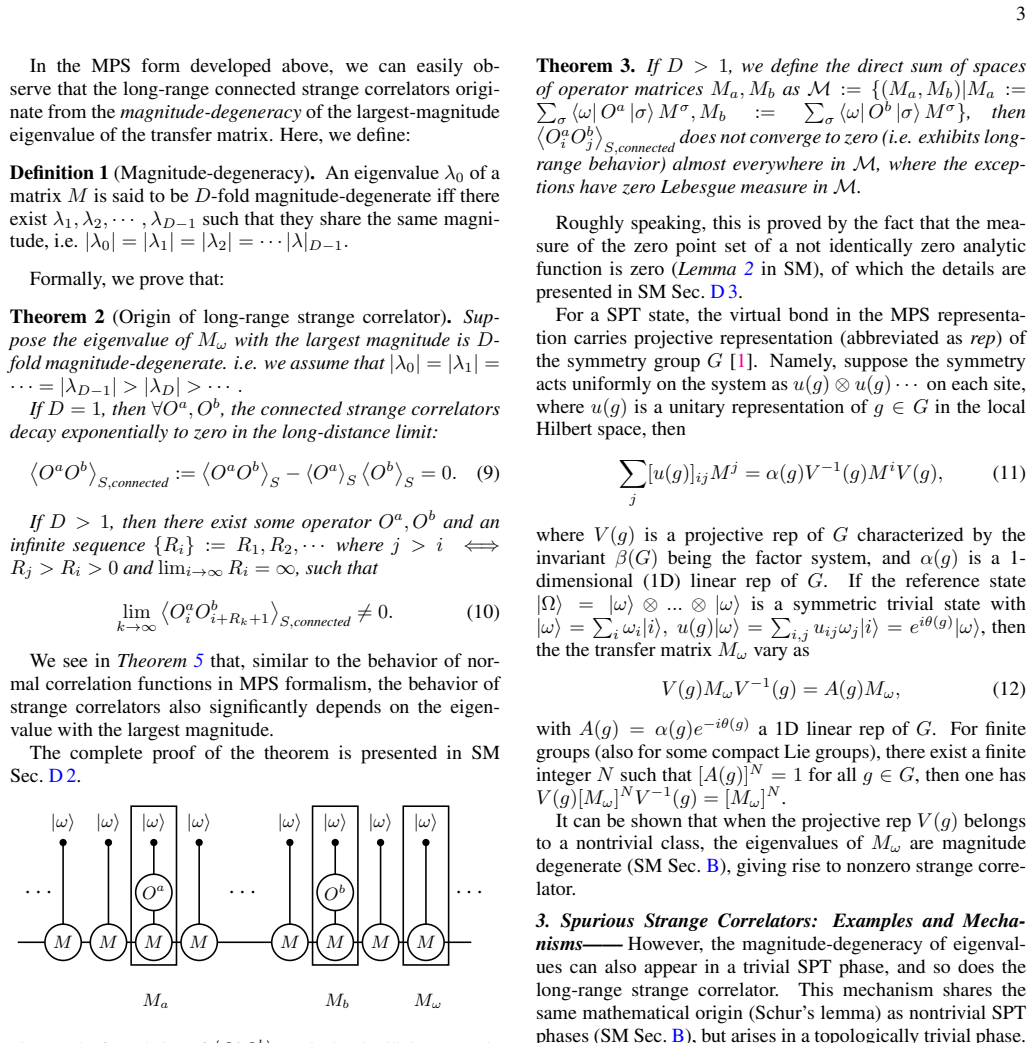
Origin of long-range strange correlators——In this sec- tion, we aim to establish the analytical nature of the long- range strange correlator. We first write all correlators in the form of matrix product states (MPS), then prove that the long- range behavior of the connected strange correlator can be at- tributed to what we name as magnitude-degeneracy (ex...
-
[3]
This mechanism shares the same mathematical origin (Schur’s lemma) as nontrivial SPT phases (SM Sec
Spurious Strange Correlators: Examples and Mecha- nisms——However, the magnitude-degeneracy of eigenval- ues can also appear in a trivial SPT phase, and so does the long-range strange correlator. This mechanism shares the same mathematical origin (Schur’s lemma) as nontrivial SPT phases (SM Sec. B), but arises in a topologically trivial phase. Example 1(SO...
-
[4]
Discussion and Outlook——The strange correlator is a widely used probe for SPT order, but its outcome depends cru- cially on the choice of reference state. Within the MPS frame- work, we show that a long-range strange correlator stems di- rectly from a magnitude-degeneracy in the transfer matrix’s leading eigenvalues. To avoid false positives, a valid refe...
-
[5]
X. Chen, Z.-C. Gu, and X.-G. Wen, Complete classification of one-dimensional gapped quantum phases in interacting spin systems, Phys. Rev. B84, 235128 (2011)
work page 2011
-
[6]
I. Affleck, T. Kennedy, E. H. Lieb, and H. Tasaki, Rigorous re- sults on valence-bond ground states in antiferromagnets, Phys. Rev. Lett.59, 799 (1987)
work page 1987
-
[7]
F. D. M. Haldane, Continuum dynamics of the 1-D Heisenberg antiferromagnet: Identification with the O(3) nonlinear sigma model, Phys. Rev. A93, 464 (1983)
work page 1983
-
[8]
D. Perez-Garcia, F. Verstraete, M. M. Wolf, and J. I. Cirac, Matrix product state representations (2007), arXiv:quant- ph/0608197 [quant-ph]
-
[9]
S. Moudgalya, N. Regnault, and B. A. Bernevig, Entanglement of exact excited states of Affleck-Kennedy-Lieb-Tasaki mod- els: Exact results, many-body scars, and violation of the strong eigenstate thermalization hypothesis, Phys. Rev. B98, 235156 (2018)
work page 2018
-
[10]
S. ¨Ostlund and S. Rommer, Thermodynamic Limit of Density Matrix Renormalization, Phys. Rev. Lett.75, 3537 (1995)
work page 1995
-
[11]
H. Tasaki,Physics and Mathematics of Quantum Many-Body Systems, Graduate Texts in Physics (Springer International Pub- lishing, 2020)
work page 2020
-
[12]
I. Affleck, T. Kennedy, E. H. Lieb, and H. Tasaki, Valence bond ground states in isotropic quantum antiferromagnets, Commu- nications in Mathematical Physics115, 477 (1988)
work page 1988
-
[13]
D. P. Arovas, A. Auerbach, and F. D. M. Haldane, Extended Heisenberg models of antiferromagnetism: Analogies to the fractional quantum Hall effect, Phys. Rev. Lett.60, 531 (1988)
work page 1988
- [14]
-
[15]
D. P. Arovas, A. Auerbach, and F. D. M. Haldane, Extended heisenberg models of antiferromagnetism: Analogies to the fractional quantum hall effect, Phys. Rev. Lett.60, 531 (1988)
work page 1988
-
[16]
M. den Nijs and K. Rommelse, Preroughening transitions in crystal surfaces and valence-bond phases in quantum spin chains, Phys. Rev. B40, 4709 (1989)
work page 1989
-
[17]
D. Perez-Garcia, M. M. Wolf, M. Sanz, F. Verstraete, and J. I. Cirac, String order and symmetries in quantum spin lattices, Phys. Rev. Lett.100, 167202 (2008)
work page 2008
-
[18]
S. M. G. Girvin and D. P. A. Arovas, Hidden topological order in integer quantum spin chains, Phys. Scr.1989, 156 (1989)
work page 1989
-
[19]
Q.-R. Wang and P. Ye, Sign structure and ground-state proper- ties for a spin-s t-j chain, Phys. Rev. B90, 045106 (2014)
work page 2014
- [20]
-
[21]
D. V . Else, S. D. Bartlett, and A. C. Doherty, Hidden symmetry- breaking picture of symmetry-protected topological order, Phys. Rev. B88, 085114 (2013)
work page 2013
-
[22]
T. Kennedy and H. Tasaki, Hidden symmetry breaking and the Haldane phase inS= 1quantum spin chains, Commun. Math. Phys.147, 431 (1992)
work page 1992
-
[23]
T. Kennedy and H. Tasaki, HiddenZ 2 ∗Z 2 symmetry breaking in Haldane-gap antiferromagnets, Phys. Rev. B45, 304 (1992)
work page 1992
-
[24]
Oshikawa, HiddenZ 2∗Z2 symmetry in quantum spin chains with arbitrary integer spin, J
M. Oshikawa, HiddenZ 2∗Z2 symmetry in quantum spin chains with arbitrary integer spin, J. Phys.: Condens. Matter4, 7469 (1992)
work page 1992
-
[25]
F. Pollmann, A. M. Turner, E. Berg, and M. Oshikawa, En- tanglement spectrum of a topological phase in one dimension, Phys. Rev. B81, 064439 (2010)
work page 2010
-
[26]
X. Chen, Z.-C. Gu, Z.-X. Liu, and X.-G. Wen, Symmetry pro- tected topological orders and the group cohomology of their 7 symmetry group, Phys. Rev. B87, 155114 (2013)
work page 2013
-
[27]
Symmetry Protected Topological Phases, Anomalies, and Cobordisms: Beyond Group Cohomology
A. Kapustin, Symmetry protected topological phases, anomalies, and cobordisms: Beyond group cohomology, arXiv:1403.1467
work page internal anchor Pith review Pith/arXiv arXiv
-
[28]
A. Kapustin, R. Thorngren, A. Turzillo, and Z. Wang, Fermionic symmetry protected topological phases and cobor- disms, Journal of High Energy Physics2015, 1 (2015)
work page 2015
-
[29]
Z. Bi, A. Rasmussen, K. Slagle, and C. Xu, Classification and description of bosonic symmetry protected topological phases with semiclassical nonlinear sigma models, Phys. Rev. B91, 134404 (2015)
work page 2015
-
[30]
Y . You and Y .-Z. You, Geometry defects in bosonic symmetry- protected topological phases, Phys. Rev. B93, 245135 (2016)
work page 2016
- [31]
-
[32]
P. Ye and Z.-C. Gu, V ortex-line condensation in three dimen- sions: A physical mechanism for bosonic topological insula- tors, Phys. Rev. X5, 021029 (2015)
work page 2015
-
[33]
Z.-C. Gu, J. C. Wang, and X.-G. Wen, Multikink topolog- ical terms and charge-binding domain-wall condensation in- duced symmetry-protected topological states: Beyond chern- simons/bf field theories, Phys. Rev. B93, 115136 (2016)
work page 2016
-
[34]
P. Ye and Z.-C. Gu, Topological quantum field theory of three- dimensional bosonic abelian-symmetry-protected topological phases, Phys. Rev. B93, 205157 (2016)
work page 2016
-
[35]
J. Wang, K. Ohmori, P. Putrov, Y . Zheng, Z. Wan, M. Guo, H. Lin, P. Gao, and S.-T. Yau, Tunneling topological vacua via extended operators: (spin-)tqft spectra and boundary deconfine- ment in various dimensions, Progress of Theoretical and Exper- imental Physics2018, 053A01 (2018)
work page 2018
- [36]
- [37]
-
[38]
B. Han, A. Tiwari, C.-T. Hsieh, and S. Ryu, Boundary confor- mal field theory and symmetry-protected topological phases in 2 + 1dimensions, Phys. Rev. B96, 125105 (2017)
work page 2017
-
[39]
X. Chen, Y .-M. Lu, and A. Vishwanath, Symmetry-protected topological phases from decorated domain walls, Nature Com- munications5, 3507 EP (2014)
work page 2014
-
[40]
P. Ye and X.-G. Wen, Projective construction of two- dimensional symmetry-protected topological phases with u(1), so(3), or su(2) symmetries, Phys. Rev. B87, 195128 (2013)
work page 2013
-
[41]
Y .-M. Lu and D.-H. Lee, Spin quantum hall effects in feature- less nonfractionalized spin-1 magnets, Phys. Rev. B89, 184417 (2014)
work page 2014
- [42]
-
[43]
P. Ye and X.-G. Wen, Constructing symmetric topological phases of bosons in three dimensions via fermionic projective construction and dyon condensation, Phys. Rev. B89, 045127 (2014)
work page 2014
-
[44]
P. Ye, T. L. Hughes, J. Maciejko, and E. Fradkin, Composite particle theory of three-dimensional gapped fermionic phases: Fractional topological insulators and charge-loop excitation symmetry, Phys. Rev. B94, 115104 (2016)
work page 2016
-
[45]
C. Wang, A. Nahum, and T. Senthil, Topological paramag- netism in frustrated spin-1 mott insulators, Phys. Rev. B91, 195131 (2015)
work page 2015
-
[46]
M. Cheng and Z.-C. Gu, Topological response theory of abelian symmetry-protected topological phases in two dimensions, Phys. Rev. Lett.112, 141602 (2014)
work page 2014
-
[47]
L.-Y . Hung and X.-G. Wen, Quantized topological terms in weak-coupling gauge theories with a global symmetry and their connection to symmetry-enriched topological phases, Phys. Rev. B87, 165107 (2013)
work page 2013
-
[48]
X.-G. Wen, Classifying gauge anomalies through symmetry- protected trivial orders and classifying gravitational anomalies through topological orders, Phys. Rev. D88, 045013 (2013)
work page 2013
- [49]
-
[50]
M. F. Lapa, C.-M. Jian, P. Ye, and T. L. Hughes, Topological electromagnetic responses of bosonic quantum hall, topological insulator, and chiral semimetal phases in all dimensions, Phys. Rev. B95, 035149 (2017)
work page 2017
-
[51]
J. C. Wang, Z.-C. Gu, and X.-G. Wen, Field-theory represen- tation of gauge-gravity symmetry-protected topological invari- ants, group cohomology, and beyond, Phys. Rev. Lett.114, 031601 (2015)
work page 2015
-
[52]
B. Han, H. Wang, and P. Ye, Generalized wen-zee terms, Phys. Rev. B99, 205120 (2019)
work page 2019
-
[53]
M. Levin and Z.-C. Gu, Braiding statistics approach to symmetry-protected topological phases, Phys. Rev. B86, 115109 (2012)
work page 2012
-
[54]
C. Wang and M. Levin, Braiding statistics of loop excitations in three dimensions, Phys. Rev. Lett.113, 080403 (2014)
work page 2014
- [55]
-
[56]
A. P. O. Chan, P. Ye, and S. Ryu, Braiding with borromean rings in (3 + 1)-dimensional spacetime, Phys. Rev. Lett.121, 061601 (2018)
work page 2018
-
[57]
X. Chen, Z.-X. Liu, and X.-G. Wen, Two-dimensional symmetry-protected topological orders and their protected gap- less edge excitations, Phys. Rev. B84, 235141 (2011)
work page 2011
-
[58]
X. Chen, Z.-C. Gu, Z.-X. Liu, and X.-G. Wen, Symmetry- protected topological orders in interacting bosonic systems, Science338, 1604 (2012)
work page 2012
-
[59]
S.-Q. Ning, Z.-X. Liu, and P. Ye, Symmetry enrichment in three-dimensional topological phases, Phys. Rev. B94, 245120 (2016)
work page 2016
-
[60]
Y .-Z. You, Z. Bi, A. Rasmussen, K. Slagle, and C. Xu, Wave function and strange correlator of short-range entangled states, Phys. Rev. Lett.112, 247202 (2014)
work page 2014
- [61]
-
[62]
K. Wierschem and P. Sengupta, Strange correlations in spin-1 heisenberg antiferromagnets, Phys. Rev. B90, 115157 (2014)
work page 2014
- [64]
- [65]
- [66]
- [67]
-
[68]
Strange Corre- lation Function for Average Symmetry-Protected Topo- logical Phases,
J.-H. Zhang, Y . Qi, and Z. Bi, Fidelity Strange Correlators for Average Symmetry-Protected Topological Phases, arXiv e-prints , arXiv:2210.17485 (2022), arXiv:2210.17485 [cond- mat.str-el]
-
[70]
J.-Y . Zhang, M.-Y . Li, and P. Ye, Higher-Order Cellular Automata Generated Symmetry-Protected Topological Phases and Detection Through Multi Point Strange Correlators, PRX Quantum5, 030342 (2024)
work page 2024
-
[71]
C. Zhou, M.-Y . Li, Z. Yan, P. Ye, and Z. Y . Meng, Detect- ing subsystem symmetry protected topological order through strange correlators, Phys. Rev. B106, 214428 (2022)
work page 2022
-
[72]
R. Penrose, A generalized inverse for matrices, Mathemati- cal Proceedings of the Cambridge Philosophical Society51, 406–413 (1955)
work page 1955
- [73]
-
[74]
E. O’Brien, E. Vernier, and P. Fendley, “not-a”, representa- tion symmetry-protected topological, and potts phases in anS3- invariant chain, Phys. Rev. B101, 235108 (2020)
work page 2020
-
[75]
K. Wierschem and K. S. D. Beach, Detection of symmetry- protected topological order in aklt states by exact evaluation of the strange correlator, Phys. Rev. B93, 245141 (2016)
work page 2016
-
[76]
Giuli, Theory of Complex Spectra
R. Giuli, Theory of Complex Spectra. II, Phys. Rev. Lett.62, 438 (1942)
work page 1942
-
[77]
W. Rudin,Principles of Mathematical Analysis, International series in pure and applied mathematics (McGraw-Hill, 1976)
work page 1976
-
[78]
The Zero Set of a Real Analytic Function
B. Mityagin, The zero set of a real analytic function (2015), arXiv:1512.07276 [math.CA]. 9 A. BRIEF REVIEW: CLASSIFICATION OF GAPPED PHASES IN 1D In Ref. [1], a complete classification of 1D gapped phases is presented using the group cohomology theory. In the framework of Matrix Product States (MPS), these phases are characterized by the projective repre...
work page internal anchor Pith review Pith/arXiv arXiv 2015
-
[79]
Theorem 1 In the main text, we focus on theconnected strange correlator. Analytic analysis (Theorem5,Mechanism4) has shown that it is the connected strange correlator that reflects the contribution from the nontrivial SRE state. Since we are discussing spurious signature of the original strange correlator, we show in this section that the connected strang...
-
[80]
Theorem 2 Theorem 5(Magnitude-degeneracy implies long-range strange correlator).Suppose the eigenvalue ofM ω with the largest magnitude isD-fold magnitude-degenerate. i.e. we assume that|λ 0|=|λ 1|=· · ·=|λ D−1|>|λ D|>· · ·. IfD= 1, then∀O a, Ob, the connected strange correlator is zero: OaOb S,connected := OaOb S − ⟨Oa⟩S Ob S = 0.(D5) IfD >1, then there ...
-
[81]
Theorem 3 Theorem 6.IfD >1, we define the direct sum of spaces of operator matricesM a, Mb asM:={(M a, Mb)|Ma := P σ ⟨ω|O a |σ⟩M σ, Mb := P σ ⟨ω|O b |σ⟩M σ}, then Oa i Ob j S,connected does not converge to zero (i.e. exhibits long-range behavior) almost everywhere inM, where the exceptions have zero Lebesgue measure inM. Theorem 3claims that if the larges...
-
[82]
Symmetry Breaking Case In the main text, we claim that if the MPS target state is the symmetric ground state of a symmetry breaking Hamiltonian (this state can be selected by linear combining bases of all ground state subspaces), then we can always choose the reference state |Ω⟩= N i |ω⟩i, such that the largest-magitude eigenvalue of the transfer matrixM ...
discussion (0)
Sign in with ORCID, Apple, or X to comment. Anyone can read and Pith papers without signing in.