REVIEW 3 major objections 6 minor 1 cited by
A tool-use agent with two linked memories lifts multi-turn task accuracy by up to 50 percent.
Reviewed by Pith at T0; open to challenge. T0 means a machine referee read the full paper against a public rubric. the ladder, T0–T4 →
T0 review · deepseek-v4-flash
2026-08-03 17:57 UTC pith:GTTGL57W
load-bearing objection A well-ablated, plausible memory method for tool-use agents, with an under-specified RL evaluation that needs fixing before the headline numbers can be trusted. the 3 major comments →
Experience-Evolving Multi-Turn Tool-Use Agent with Hybrid Episodic-Procedural Memory
The pith
A machine-rendered reading of the paper's core claim, the machinery that carries it, and where it could break.
Core claim
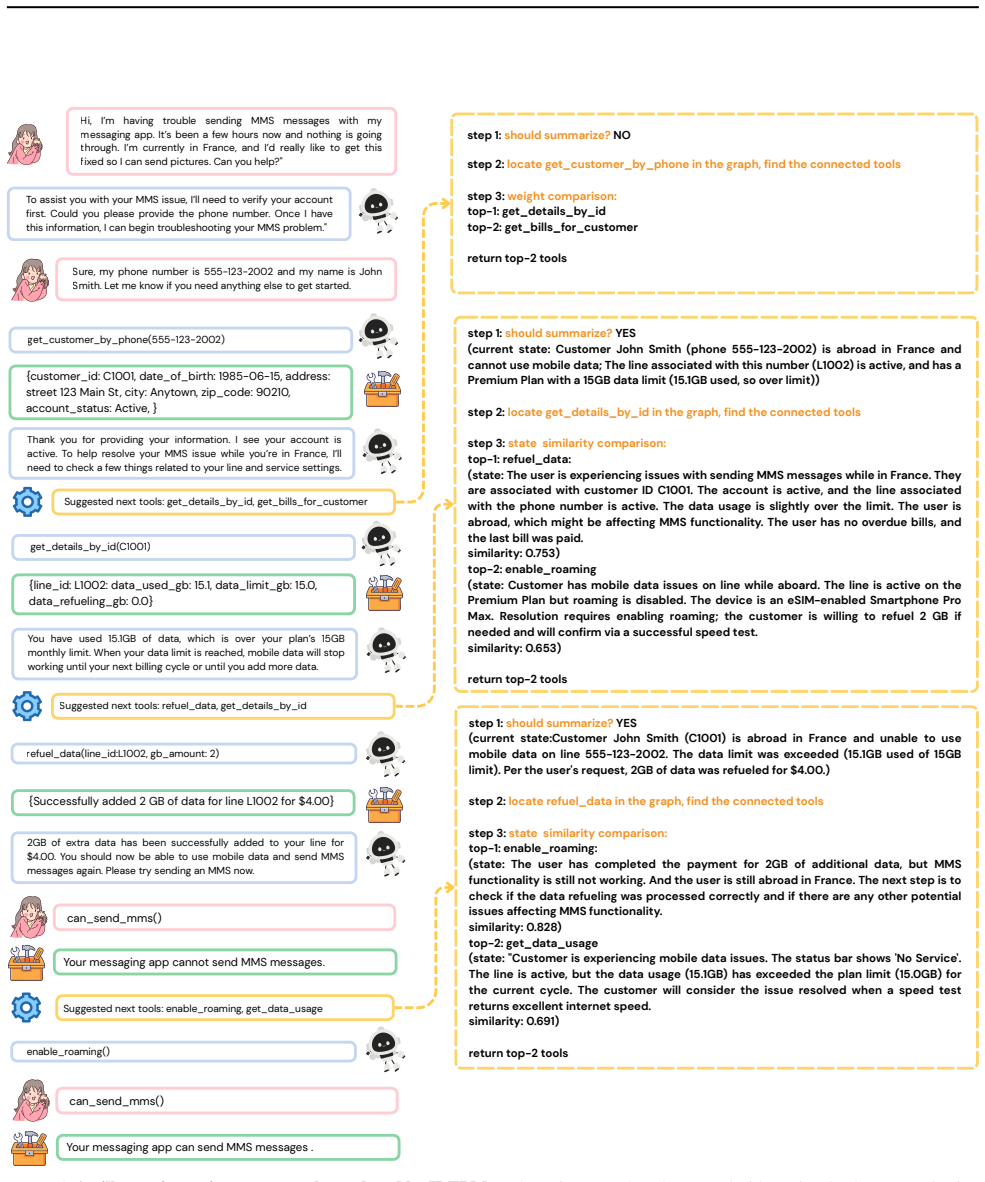
The central discovery is that decomposing past successful trajectories into state-annotated tool transitions lets an agent reuse experience without suffering from over-specificity. The paper constructs a directed tool graph whose edges carry both a weight, combining transition frequency with an efficiency bonus, and, when a summarization tool was invoked, compact state summaries of the context in which the transition succeeded. During inference the agent decides whether to summarize the current state; if it does, it compares the new summary against stored ones and suggests the top-2 tools by similarity, and if not, it follows the top-2 edge weights. The same mechanism is used inside RL rollo
What carries the argument
The state-annotated tool-transition graph: nodes are tools, and each directed edge from one tool to another stores a normalized weight combining how often the transition appears in successful trajectories and how few steps those trajectories took, plus zero or more episodic state summaries observed at that transition. At decision time the agent locates its last tool in the graph, then either matches its current summarized state against the edge summaries (episodic memory) or ranks outgoing edges by weight (procedural memory), and feeds the top-k tools into the system prompt as suggestions. During RL, the same graph biases rollouts toward historically successful transitions, with a skip proba
Load-bearing premise
The episodic-memory path depends on the summarization tool producing state summaries whose embedding similarity tracks decision-relevant similarity—two similar summaries should call for the same next tool—and the paper does not provide a direct validation of that correspondence.
What would settle it
Take decision points from test trajectories, hide the true next tool, and measure whether the top-2 tools chosen by summary similarity match the next tool in matched successful trajectories. If agreement is near chance once the most common transition is controlled for, or if paraphrasing a summary while preserving its meaning changes the suggested tools, the episodic memory is not carrying the claimed signal.
If this is right
- Weaker or smaller reasoners gain the most from the method, suggesting memory can substitute for some reasoning capacity at inference time.
- Using both state summaries and transition weights beats either alone; ablations show removing either component costs several points across benchmarks.
- Efficiency-aware edge weights matter: accuracy-only weights underperform the full weighting on all three main benchmarks.
- Adaptive switching between memory types beats always using episodic retrieval or a learned graph-planning traversal, and top-2 suggestions beat top-1 or top-3.
- Integrating the same memory into RL rollouts improves the learned policy on out-of-distribution tasks, with gains up to 40%+ over standard policy optimization.
Where Pith is reading between the lines
- If the summaries are faithful, the approach naturally extends to other sequential decision domains—code editing, database troubleshooting, web navigation—where the 'tools' are actions and the summaries are concise task states; the memory could then transfer across tasks with different surface wording.
- The 'should I summarize now?' decision is effectively a meta-controller; a cheaper alternative the paper does not explore would be a small classifier trained on when summarization improved the next-tool match, replacing the LLM's self-judgment.
- The RL gains suggest the memory graph acts like shaped reward without explicit reward shaping; this could be tested directly by comparing memory-guided rollouts against a reward-shaped policy optimization baseline of similar complexity.
- A testable extension for the episodic path: use a domain-specific state encoder instead of a generic sentence embedding; if gains grow, the bottleneck is state representation rather than retrieval.
Editorial analysis
A structured set of objections, weighed in public.
Referee Report
Summary. The paper proposes H-EPM, a hybrid episodic–procedural memory for multi-turn tool-use agents. H-EPM builds a directed tool-transition graph from successful historical trajectories: nodes are tools, edges encode procedural statistics (transition frequency and efficiency), and edges are annotated with compact state summaries produced by an agent-invoked summarization tool. At inference, the agent decides whether to summarize the current state; if yes, it retrieves the top-k next-tool candidates by cosine similarity between the current summary and stored summaries (episodic memory); if no, it uses normalized edge weights (procedural memory). The same mechanism is integrated into GRPO rollouts, with a skip rate p_skip to modulate procedural guidance and encourage exploration. The method is evaluated on τ-Bench, τ²-Bench, ToolSandbox, and ACEBench across several base models, and for RL with Qwen3-4B. The paper reports inference-time gains up to 50%+ and RL gains up to 40%+.
Significance. If the reported results are reliable, H-EPM is a meaningful contribution to experience reuse in multi-turn tool-use agents. The paper has clear strengths: it evaluates on diverse benchmarks and multiple base models, provides informative ablations (e.g., the 'w/o memory' variant isolates the effect of the summarization tool, and 'w/o state' vs. 'w/o weight' separates the episodic and procedural contributions), includes a case study, and appends a limitation statement. The RL integration is a novel way to use memory to shape exploration. However, the manuscript currently lacks code, reports only point estimates, and leaves the RL evaluation protocol ambiguous, which prevents the headline quantitative claims from being fully verified.
major comments (3)
- [§5.1, Appendix E.1, Table 3] The RL evaluation protocol is ambiguous, which undermines the claim in the abstract of up to 40% policy improvement. Section 5.1 says that except for the rollout stage, all settings are identical to standard GRPO, but Appendix E.1 states that additional guidance and summarization content are 'excluded during training' using a masking strategy. Masking only prevents those tokens from contributing to the loss; the model still conditions on them during the forward pass. Table 3 never states whether H-EPM memory is used at evaluation. If the numbers are obtained with memory prompts at inference, the gains conflate policy learning with test-time memory retrieval. If the policy is evaluated without memory, that should be stated explicitly and the train/inference distribution mismatch should be discussed. Please report both 'policy-only' and 'policy+memory' evaluations for each checkpoint.
- [Tables 1 and 3; §5.2; Appendix C.2] All performance tables report single point estimates with no standard deviations, no number of evaluation episodes, and no multiple seeds. Several headline differences are small (e.g., Table 3 ToolSandbox: H-EPM(p_skip=0.8) 0.522 vs. GRPO 0.503; τ-Bench: H-EPM(p_skip=1.0) 0.544 vs. H-EPM(p_skip=0.9) 0.558), so the claim of 'consistently' outperforming baselines is not statistically supported. Moreover, the 'up to 40%' figure comes from selecting p_skip=1.0 on τ²-Bench; the text in §5.2 states that p_skip is adjusted per domain, and the coefficient c is tuned on τ-Bench (Table 7). This test-set tuning of hyperparameters makes the quantitative gains optimistic. Please report mean±std over at least three seeds and validate hyperparameter choices on a held-out split.
- [§4.3, Appendix E.1, Table 4(A)] The episodic retrieval mechanism assumes that cosine similarity between all-MiniLM-L6-v2 embeddings of state summaries is a reliable proxy for decision-relevant state similarity. The paper provides no validation of this assumption—no correlation with task outcomes, no sensitivity to the embedding model, and no error analysis of retrieved candidates. Since the 'w/o state' ablation in Table 4(A) shows that removing state information degrades performance, the episodic component is essential to the method; without validating the similarity measure, the mechanism's reliability and its generalizability to new tasks are not established. Please add evidence that similar summaries lead to correct next-tool choices, or at least analyze the sensitivity of the results to the choice of embedding model.
minor comments (6)
- [§1 title] The section title 'Instruction' should be 'Introduction'.
- [Table 4(D)] The sub-labels for K=2 and K=3 are both '(II)'; the K=3 row should be labeled '(III)'.
- [Table 4(A)] Typo: 'W/O WIGHT' should be 'W/O WEIGHT'.
- [Appendix C.5] Typo in the appendix title: 'Foward Strategy' should be 'Forward Strategy'.
- [Appendix E.1] The sentence 'all results for RL except those in Table 6 are obtained with the masking strategy' references Table 6, which is an ACEBench inference table, not an RL table. It likely should refer to Table 10 in Appendix C.5.
- [§5.1 and elsewhere] Inconsistent model naming: 'Qwen3-4B-Instruct-2507' and 'Qwen3-4B-Instruction' are used interchangeably; 'τ-bench Retail' in §5.1 likely refers to τ²-Bench. Also 'Multi-turn tool use is challenges' in §2.1 should be 'is challenging'.
Circularity Check
No construction-level circularity in the held-out inference results, but the RL 'up to 40%+ policy gain' (Table 3) is unverified because the paper never states whether test-time memory was used—and on τ2-Bench the inference-only H-EPM already exceeds the RL result—while c and p_skip are selected using evaluation-benchmark scores.
specific steps
-
other
[Table 3 (§5.2); §5.1 RL settings; Appendix C.5; Appendix E.1]
"To ensure stable policy learning, the additional information introduced during rollout is removed during training. Specifically, we consider two strategies: (i) masking the extra information when computing the loss or (ii) directly discarding it prior to policy gradient computation. ... All additional guidance and summarization content are excluded during training using two strategies (Appendix C.1), and all results for RL except those in Table 6 are obtained with the masking strategy."
Masking excludes guidance tokens only from the loss, not from the conditioning context, so the policy trains and acts with 'Suggested next tools' in context. The paper never states whether Table 3 was run with H-EPM guidance at test time. Quantitatively, on τ2-Bench the inference-only H-EPM (Table 1: 0.232, +46.8%) already exceeds the best RL H-EPM (Table 3: 0.223, +41.1%), so the headline 'up to 40%+ on out-of-distribution tasks' is fully reproduced by the §4.3 inference mechanism alone. If Table 3 was evaluated with memory (the natural reading of 'for RL training, we use an implicit strategy'), the claim that the policy 'internalizes effective decision strategies' reduces to the already-established inference-time memory effect, and the RL attribution has missing support—an omitted protoc
-
fitted input called prediction
[§5.2 skip-rate analysis; Appendix C.2 (Table 7)]
"The effectiveness of H-EPM further depends on the skip rate pskip, which controls the extent to which procedural tool-transition suggestions are utilized. ... Finally, tasks in τ 2-Bench primarily involve state-dependent error checking. In this case, entirely skipping weight-based tool suggestions (pskip = 1.0) is most effective. ... Table 7 reports the performance of GPT-4.1 on τ-Bench. Parameter c should strike a balance between efficiency and accuracy."
The two free parameters are chosen using the evaluation benchmarks' own scores: c=1 is selected from Table 7's τ-Bench test accuracies (0.660/0.710/0.695/0.678), and p_skip is set per benchmark as the best cell of the Table 3 grid ('entirely skipping weight-based tool suggestions (pskip = 1.0) is most effective' for τ2-Bench). The headline 'up to 40%+' is exactly that best cell (τ2-Bench, p_skip=1.0, +41.1%). This is mild fitting to the test distribution rather than construction-level circularity—the full grid is reported and the memory itself is fit only on training trajectories—but the strongest claimed improvement is partly selected, not predicted.
full rationale
The core inference-time claim is not circular: the memory graph (§4.2) is constructed from training-set trajectories (τ-Bench/τ2-Bench have separate train/test sets; ToolSandbox is split 800/200), edge weights encode counts and step-efficiency of those training successes, and Table 1 reports held-out test accuracy against ReasoningBank, ToolNet, and Top-3 retrieval. The ablations (Table 4) isolate summarization, weight, and state components, and the full method exceeds the 'w/o memory' variant, so the components carry independent weight. ACEBench's online-memory setting is a deliberate self-evolution protocol (memory built from test-time successes), not a reuse of test labels. There is no load-bearing self-citation: the only overlapping-author reference (Huang et al. 2025, cited in §1) is generic motivation; no uniqueness theorem or ansatz-by-citation is invoked. Two concerns keep the score above 2. First, the RL evaluation protocol for Table 3 is omitted: Appendix E.1 says guidance and summarization content are 'excluded during training' via masking, but masking removes tokens from the loss, not from the conditioning context, and the paper never states whether the trained policy was evaluated with or without H-EPM memory. On τ2-Bench the pure-inference H-EPM (0.232, +46.8%) already exceeds the best RL H-EPM (0.223, +41.1%), so the headline 'up to 40% on out-of-distribution tasks' is numerically subsumed by the §4.3 inference mechanism; unless Table 3 was evaluated policy-only, the 'policy internalizes strategies' claim reduces to the inference-time memory effect. Second, c (Appendix C.2, Table 7) and p_skip (§5.2) are selected using evaluation-benchmark scores, and the headline percentage is the best cell of that grid—mild fitting rather than construction-level circularity. Neither issue is a definitional equivalence, so the score is 3 rather than 6+.
Axiom & Free-Parameter Ledger
free parameters (4)
- c (efficiency coefficient) =
1 (selected from {0,1,5,10} on τ-Bench)
- p_skip (procedural skip rate) =
0.8, 0.9, or 1.0 per benchmark
- top-k (number of suggested tools) =
2
- Embedding model for state similarity =
all-MiniLM-L6-v2
axioms (3)
- domain assumption A tool-transition graph built from successful trajectories encodes transferable procedural knowledge across tasks.
- domain assumption State summaries produced by the summarization tool capture decision-relevant information, and cosine similarity in the embedding space reflects task-relevant state similarity.
- domain assumption The LLM agent reliably decides when to invoke the summarization tool and adheres to the suggested top-2 tool list.
invented entities (1)
-
State-summarization tool
no independent evidence
read the original abstract
As intents unfold and environments change, multi-turn agents face continuously shifting decision contexts. Although reusing past experience is intuitively appealing, existing approaches remain limited: full trajectories are often too context-specific to transfer, while tool-level reuse ignores the surrounding context and environment. In this paper, we introduce a hybrid episodic-procedural memory strategy (H-EPM) that enables experience-induced self-evolution of multi-turn tool-use policies by adaptively reusing partially overlapping successful experiences during both inference and training. Inspired by human episodic-procedural integration, we construct a tool graph from accumulated trajectories, where recurring tool-to-tool dependencies capture procedural routines and each edge is augmented with compact episodic summaries of relevant context. At inference time, the agent dynamically balances episodic recall for contextual reasoning with procedural execution for routine steps. Beyond inference, H-EPM introduces a memory-guided reinforcement learning paradigm that directly addresses a core challenge in multi-turn agent reinforcement learning, namely ineffective exploration over long trajectories. By biasing exploration toward historically successful tool transitions, H-EPM learns a stronger policy that generalizes at inference time without relying on domain-specific experience collection. Experiments show that H-EPM consistently delivers substantial inference-time gains over strong baselines across multi-turn tool-use benchmarks, reaching improvements of up to fifty percent. It also improves reinforcement learning policy performance, achieving gains of up to forty percent on out-of-distribution tasks.
Figures


Forward citations
Cited by 1 Pith paper
-
EvoMemBench: Benchmarking Agent Memory from a Self-Evolving Perspective
EvoMemBench evaluates 15 memory methods for LLM agents and finds long-context baselines competitive with no single memory approach working consistently across settings.
Reference graph
Works this paper leans on
-
[1]
Agashe, S., Han, J., Gan, S., Yang, J., Li, A., and Wang, X. E. Agent s: An open agentic framework that uses computers like a human.arXiv preprint arXiv:2410.08164,
-
[5]
Dong, G., Chen, Y ., Li, X., Jin, J., Qian, H., Zhu, Y ., Mao, H., Zhou, G., Dou, Z., and Wen, J.-R. Tool-star: Empow- ering llm-brained multi-tool reasoner via reinforcement learning.arXiv preprint arXiv:2505.16410,
-
[6]
Group-in-group policy optimization for llm agent training.arXiv preprint arXiv:2505.10978,
Feng, L., Xue, Z., Liu, T., and An, B. Group-in-group policy optimization for llm agent training.arXiv preprint arXiv:2505.10978,
-
[7]
Guan, S., Xiong, H., Wang, J., Bian, J., Zhu, B., and Lou, J.-g. Evaluating llm-based agents for multi-turn conversa- tions: A survey.arXiv preprint arXiv:2503.22458,
-
[8]
X., Song, Y ., Zhu, C., Zhu, H., and Wen, J.-R
Jiang, J., Zhou, K., Zhao, W. X., Song, Y ., Zhu, C., Zhu, H., and Wen, J.-R. Kg-agent: An efficient autonomous agent framework for complex reasoning over knowledge graph. InProceedings of the 63rd Annual Meeting of the Association for Computational Linguistics (V olume 1: Long Papers), pp. 9505–9523, 2025a. Jiang, X., Li, F., Zhao, H., Qiu, J., Wang, J.,...
-
[9]
Jiang, Y ., Zhou, H., GU, L., Han, A., and Li, T. Naviagent: Bilevel planning on tool dependency graphs for function calling.arXiv preprint arXiv:2506.19500, 2025b. Lee, K.-H., Chen, X., Furuta, H., Canny, J., and Fischer, I. A human-inspired reading agent with gist memory of very long contexts.arXiv preprint arXiv:2402.09727,
-
[10]
Liu, X., Peng, Z., Yi, X., Xie, X., Xiang, L., Liu, Y ., and Xu, D. Toolnet: Connecting large language mod- els with massive tools via tool graph.arXiv preprint arXiv:2403.00839, 2024a. Liu, Y ., Zhang, G., Wang, K., Li, S., and Pan, S. Graph-augmented large language model agents: Cur- rent progress and future prospects.arXiv preprint arXiv:2507.21407,
-
[11]
Controlllm: Augment language models with tools by searching on graphs
Liu, Z., Lai, Z., Gao, Z., Cui, E., Li, Z., Zhu, X., Lu, L., Chen, Q., Qiao, Y ., Dai, J., et al. Controlllm: Augment language models with tools by searching on graphs. In ECCV (12), 2024b. Lu, J., Holleis, T., Zhang, Y ., Aumayer, B., Nan, F., Bai, F., Ma, S., Ma, S., Li, M., Yin, G., et al. Toolsand- box: A stateful, conversational, interactive evaluati...
-
[12]
T., Daruki, S., Tang, X., et al
9 Ouyang, S., Yan, J., Hsu, I., Chen, Y ., Jiang, K., Wang, Z., Han, R., Le, L. T., Daruki, S., Tang, X., et al. Rea- soningbank: Scaling agent self-evolving with reasoning memory.arXiv preprint arXiv:2509.25140,
-
[13]
Patil, A. and Jadon, A. Advancing reasoning in large lan- guage models: Promising methods and approaches.arXiv preprint arXiv:2502.03671,
-
[14]
Rezazadeh, A., Li, Z., Wei, W., and Bao, Y . From iso- lated conversations to hierarchical schemas: Dynamic tree memory representation for llms.arXiv preprint arXiv:2410.14052,
-
[15]
Shao, Z., Wang, P., Zhu, Q., Xu, R., Song, J., Bi, X., Zhang, H., Zhang, M., Li, Y ., Wu, Y ., et al. Deepseekmath: Push- ing the limits of mathematical reasoning in open language models.arXiv preprint arXiv:2402.03300,
-
[17]
Tang, X., Hu, T., Ye, M., Shao, Y ., Yin, X., Ouyang, S., Zhou, W., Lu, P., Zhang, Z., Zhao, Y ., et al. Chemagent: Self-updating library in large language models improves chemical reasoning.arXiv preprint arXiv:2501.06590,
-
[18]
Wang, B., Liang, X., Yang, J., Huang, H., Wu, S., Wu, P., Lu, L., Ma, Z., and Li, Z. Enhancing large language model with self-controlled memory framework.arXiv preprint arXiv:2304.13343,
-
[20]
Wang, Z., Wang, K., Wang, Q., Zhang, P., Li, L., Yang, Z., Jin, X., Yu, K., Nguyen, M. N., Liu, L., et al. Ragen: Understanding self-evolution in llm agents via multi-turn reinforcement learning.arXiv preprint arXiv:2504.20073, 2025b. Wise, S. P. The role of the basal ganglia in procedural memory. InSeminars in Neuroscience, volume 8, pp. 39–46. Elsevier,
-
[21]
Xiong, Z., Lin, Y ., Xie, W., He, P., Tang, J., Lakkaraju, H., and Xiang, Z. How memory management impacts llm agents: An empirical study of experience-following behavior.arXiv preprint arXiv:2505.16067,
-
[22]
A-mem: Agentic memory for llm agents.arXiv preprint arXiv:2502.12110,
Xu, W., Mei, K., Gao, H., Tan, J., Liang, Z., and Zhang, Y . A-mem: Agentic memory for llm agents.arXiv preprint arXiv:2502.12110,
-
[23]
Yao, S., Shinn, N., Razavi, P., and Narasimhan, K. τ-bench: A benchmark for tool-agent-user interaction in real-world domains.arXiv preprint arXiv:2406.12045,
-
[24]
Easytool: Enhancing llm-based agents with concise tool instruction.arXiv preprint arXiv:2401.06201,
Yuan, S., Song, K., Chen, J., Tan, X., Shen, Y ., Kan, R., Li, D., and Yang, D. Easytool: Enhancing llm-based agents with concise tool instruction.arXiv preprint arXiv:2401.06201,
-
[25]
Agentevolver: To- wards efficient self-evolving agent system.arXiv preprint arXiv:2511.10395,
Zhai, Y ., Tao, S., Chen, C., Zou, A., Chen, Z., Fu, Q., Mai, S., Yu, L., Deng, J., Cao, Z., et al. Agentevolver: To- wards efficient self-evolving agent system.arXiv preprint arXiv:2511.10395,
-
[26]
Lightthinker: Thinking step- by-step compression.arXiv preprint arXiv:2502.15589, 2025a
Zhang, J., Zhu, Y ., Sun, M., Luo, Y ., Qiao, S., Du, L., Zheng, D., Chen, H., and Zhang, N. Lightthinker: Thinking step- by-step compression.arXiv preprint arXiv:2502.15589, 2025a. Zhang, Y ., Wang, H., Feng, S., Tan, Z., Han, X., He, T., and Tsvetkov, Y . Can llm graph reasoning generalize beyond pattern memorization?arXiv preprint arXiv:2406.15992,
-
[27]
Memengine: A unified and modular library for develop- ing advanced memory of llm-based agents
Zhang, Z., Dai, Q., Chen, X., Li, R., Li, Z., and Dong, Z. Memengine: A unified and modular library for develop- ing advanced memory of llm-based agents. InCompanion Proceedings of the ACM on Web Conference 2025, pp. 821–824, 2025b. 10 Zhao, W., Wang, X., Ma, C., Kong, L., Yang, Z., Tuo, M., Shi, X., Zhai, Y ., and Cai, X. Mua-rl: Multi-turn user- interac...
Pith/arXiv arXiv 2025
-
[28]
Pro: Process
11 Table 6.Performance comparison across two evaluation metrics in agent multi-turn task ACEBench (process accuracy and end-to-end accuracy). Pro: Process. EtoE: end-to-end. RB: Reasoning Bank. RT: Retrieval Top-1. METRIC MODEL BASERB TOOLNETRT H-EPM PROACC GPT-4.1-MINI 0.633 0.701 0.627 0.6410.719 GPT-4.1 0.653 0.703 0.664 0.6010.765 GPT-4O 0.664 0.684 0...
2025
-
[29]
encode expert knowledge to guide LLMs in executing multi-step toolchains in scientific domains. Finally, approaches supporting dynamic updates, such as ToolNet (Liu et al., 2024a) and SGC (Wu et al., 2024), organize massive tool collections into weighted directed graphs and update them adaptively based on usage, enabling more efficient navigation and plan...
2024
-
[30]
Suggested next tools: Tool 1, Tool 2
Guidance from episodic and procedural memory is injected as a system prompt in the form of“Suggested next tools: Tool 1, Tool 2”when the top-2 tools satisfy the selection criteria, which is illustrated in the Appendix B. Details for RL.We specify several key parameters. The Kullback–Leibler (KL) divergence loss coefficient is set to β= 0.001 . The trainin...
1985
-
[2004]
Barres, V ., Dong, H., Ray, S., Si, X., and Narasimhan, K. τ2-bench: Evaluating conversational agents in a dual- control environment.arXiv preprint arXiv:2506.07982,
-
[2008]
Beyond browsing: Api-based web agents.arXiv preprint arXiv:2410.16464,
Song, Y ., Xu, F., Zhou, S., and Neubig, G. Beyond browsing: Api-based web agents.arXiv preprint arXiv:2410.16464,
-
[2023]
Wang, H., Huang, W., Wang, Y ., Xi, Y ., Lu, J., Zhang, H., Hu, N., Liu, Z., Pan, J. Z., and Wong, K.-F. Rethinking stateful tool use in multi-turn dialogues: Benchmarks and challenges.arXiv preprint arXiv:2505.13328, 2025a. Wang, Z., Zeng, X., Liu, W., Li, L., Wang, Y ., Shang, L., Jiang, X., Liu, Q., and Wong, K.-F. Toolflow: Boosting llm tool-calling t...
-
[2024]
Anokhin, P., Semenov, N., Sorokin, A., Evseev, D., Kravchenko, A., Burtsev, M., and Burnaev, E. Arigraph: Learning knowledge graph world models with episodic memory for llm agents.arXiv preprint arXiv:2407.04363,
-
[2025]
Acebench: Who wins the match point in tool usage?arXiv preprint arXiv:2501.12851, 2025a
Chen, C., Hao, X., Liu, W., Huang, X., Zeng, X., Yu, S., Li, D., Wang, S., Gan, W., Huang, Y ., et al. Acebench: Who wins the match point in tool usage?arXiv preprint arXiv:2501.12851, 2025a. Chen, W., Li, W., Yao, D., Meng, X., Gong, C., and Bi, J. Gtool: Graph enhanced tool planning with large language model.arXiv preprint arXiv:2508.12725, 2025b. Chhik...
discussion (0)
Sign in with ORCID, Apple, or X to comment. Anyone can read and Pith papers without signing in.