REVIEW 2 major objections 4 minor 14 cited by
LZ's 5.7-tonne-year search finds no light dark matter but 4.5σ solar-neutrino signal
Reviewed by Pith at T0; open to challenge. T0 means a machine referee read the full paper against a public rubric. the ladder, T0–T4 →
T0 review · deepseek-v4-flash
2026-08-03 17:46 UTC pith:WCPUVWJJ
load-bearing objection A careful, genuinely new LZ result with world-leading light-DM limits and a plausible 4.5σ CEνNS signal, but the headline significance is not yet shown to be robust against the prior-dominated low-energy NR model. the 2 major comments →
Searches for Light Dark Matter and Evidence of Coherent Elastic Neutrino-Nucleus Scattering of Solar Neutrinos with the LUX-ZEPLIN (LZ) Experiment
The pith
A machine-rendered reading of the paper's core claim, the machinery that carries it, and where it could break.
Core claim
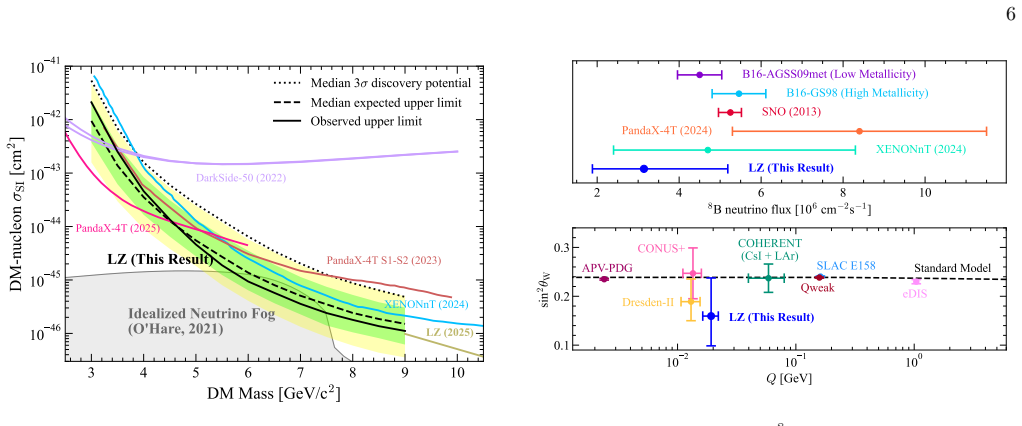
Using 417 live days of data from a 5.09-tonne fiducial volume, LZ observes 19 events in the 1–6 keV nuclear-recoil window, all consistent with a background-only model of accidental coincidences, detector neutrons, and 8B CEνNS. With dark matter not included, the best fit yields 12.3 CEνNS events, rejecting zero CEνNS at 4.5σ observed significance (6.7σ median expected) and matching the Standard Model prediction within uncertainties. No dark matter component is required: 90% confidence limits reach 2.1×10⁻⁴² cm² at 3 GeV/c² and 1.1×10⁻⁴⁶ cm² at 9 GeV/c², the most restrictive for masses above 5 GeV/c². The same signal yields measurements of the 8B neutrino flux, the CEνNS cross-section on xeno
What carries the argument
The central object is the dual-phase liquid-xenon time projection chamber, which records each nuclear recoil as a prompt scintillation pulse (S1) and a delayed ionization pulse (S2). The analysis hinges on the nuclear-recoil response model, NEST tuned to a dedicated deuterium-deuterium neutron calibration, which converts recoil energy into predicted S1/S2 distributions, and on a data-driven accidental-coincidence model normalized with unphysical-drift-time events. These models feed an unbinned profile likelihood in the {S1,S2} space, with a single nuisance parameter σeff carrying the combined rate uncertainty from yields, fluctuations, and detection efficiency.
Load-bearing premise
The result rests on the extrapolated nuclear-recoil response model: light and charge yields and their fluctuations below about 2.5 keV come from higher-energy calibration plus priors from other measurements, so if those yields are wrong, both the CEνNS significance and the dark matter limits shift.
What would settle it
A direct low-energy neutron calibration that pins the yields below 2.5 keV would settle it: if the measured yields differ from the posterior-envelope curves by more than the quoted band, the CEνNS significance and DM limits must be recomputed and may not survive. Alternatively, an independent measurement of the accidental-coincidence rate in a sideband with different electron/photon rates that disagrees with the model would undermine the background subtraction.
If this is right
- If the signal is real, 8B solar neutrinos have been positively detected as nuclear recoils in a xenon detector, confirming CEνNS at the lowest energy scale yet and validating the predicted neutrino background for light dark matter searches.
- LZ sets the current best 90% limits on spin-independent dark matter-nucleon scattering for masses above 5 GeV/c², covering a region other xenon experiments have constrained less strongly at these masses.
- The measured 8B neutrino flux from the CEνNS rate agrees with solar-model predictions and the earlier SNO measurement, adding a new way to probe the Sun with neutrinos.
- The CEνNS signal can be used to measure the weak mixing angle at low momentum transfer; the value obtained is consistent with the Standard Model but with large uncertainty, and more exposure will sharpen it.
- A planned 1000-day exposure should push the CEνNS significance higher and further improve the light dark matter limits into the neutrino-fog region.
Where Pith is reading between the lines
- If CEνNS remains visible as LZ accumulates its planned 1000-day exposure, it should transition from a background to a standard candle that calibrates the low-energy nuclear-recoil response in situ, reducing reliance on extrapolated yield models.
- A natural next step is to use the same {S1,S2} accidental-coincidence and response-model machinery to search for non-standard neutrino interactions, since new physics would appear as a distortion of the CEνNS spectrum rather than as an excess.
- The 19-event dataset is statistically thin: the observed 4.5σ significance is below the 6.7σ median expected, so a repetition with more exposure will be the cleanest test of whether the low best-fit CEνNS rate is a fluctuation or a sign of underestimated background or yields.
- Combining LZ's low-energy nuclear-recoil data with electron-recoil calibrations could produce a measurement of the 8B neutrino flux that is independent of solar-model assumptions, complementing radiochemical and water-Cherenkov detectors.
Editorial analysis
A structured set of objections, weighed in public.
Referee Report
Summary. This paper reports an LZ search for 3–9 GeV/c^2 dark matter and a measurement of 8B solar-neutrino CEνNS in the same 5.7 tonne-year dataset (546 live days, 417 after selections). The analysis uses an unbinned profile likelihood in {S1c, S2c} with a data-driven accidental background, an in-situ neutron constraint, and a NEST-based NR response model tuned with DD calibrations. The authors find no DM excess and set 90% CL limits that are world-leading above 5 GeV/c^2 for SI and SD-neutron couplings. In the no-DM hypothesis they observe a best-fit 8B CEνNS signal of 12.3+7.0−5.4 events against 20.6+8.9−6.8 expected, with a quoted 4.5σ statistical significance, leading to a 8B flux measurement consistent with SNO and a weak-mixing-angle measurement consistent with the SM.
Significance. If correct, this is the first >3σ evidence for solar CEνNS on xenon and a significant step into the neutrino fog. The analysis has important strengths: blind injection of artificial events, a synthetic accidental-coincidence model normalized to unphysical-drift-time data and validated in several sidebands, MCMC response-model tuning with explicit treatment of yield fluctuations, and world-leading DM limits. However, the CEνNS evidence claim is only as strong as the low-energy NR response model, which the paper itself states is prior-dominated below ~2.5 keV; the 8B recoil spectrum peaks at 1.5 keV. The requested robustness tests are therefore essential before the evidence claim can be considered established.
major comments (2)
- [Response Modeling / Supp. Table S1] The central evidence claim relies on the NR response model below ~2.5 keV, exactly the regime where the paper concedes 'The DD dataset has limited ability to constrain the low-energy-specific yield parameters (≲2.5 keV)' and where Gaussian NEST priors are imposed. Table S1 shows that for ζ, η, θ, ι the posterior is largely prior-dominated. Because the 8B CEνNS recoil spectrum peaks at 1.5 ± 0.5 keV (main text), the signal shape is strongly influenced by these priors. The final likelihood reduces all yield/fluctuation/efficiency systematics to a single Gaussian rate nuisance σeff; a rate rescaling cannot change the spectral shape. The Supplemental statement that shape effects are 'negligible' is not demonstrated quantitatively. To support the 4.5σ evidence claim, please show a posterior-predictive or profile-likelihood scan in which the low-energy yield modes are included as shape nuisanc
- [Boron-8 CEνNS Measurement / Abstract] The abstract and text call the 4.5σ result a 'statistical significance.' It is not clear whether this number includes all systematic uncertainties that enter the likelihood (σeff, accidental normalization, neutron rate, 8B flux constraint). The paper should state explicitly which uncertainties are profiled in the q0 calculation and give the systematic-only contribution, e.g., the significance obtained with all nuisance parameters fixed to their best-fit values. This distinction is important because the largest systematic (NR response) is much larger than the statistical uncertainty on the 8B rate alone. If 4.5σ already includes all systematics, the text should say so; if not, the evidence claim should be based on the total significance.
minor comments (4)
- [Table I] The last column reports σeff = 0 ± 1 for the 8B-unconstrained fit; clarify whether σeff is fixed or fitted in that scenario and why it is not pulled to accommodate the lower 8B rate.
- [Experiment / Selections] The S2 range statement '3.5–14.5 electrons (44.5 phd per extracted electron)' conflicts with g2 = 34.0 phd/electron cited earlier; please reconcile.
- [Figure 1] The gray uncertainty band includes 'yields and fluctuations,' but it would be useful to state explicitly that it includes the NEST-prior-dominated low-energy parameters; this relates to the main evidence claim.
- [Supplemental Table S1] The LZ posterior for ζ is 0.44 ± 0.15 while the prior is 0.3 ± 0.1; this is consistent but also illustrates that the low-energy parameters are not constrained independently by DD data. A note in the main text would help.
Circularity Check
No significant circularity: the 8B CEνNS rate is a free profile-likelihood parameter against independently calibrated backgrounds, not an input renamed as a prediction.
full rationale
The derivation chain is self-contained in the relevant sense. The 8B CEνNS expectation (20.6 +8.9/−6.8 events) is built from the SM CEνNS cross-section, the literature 8B solar-neutrino flux, the 5.7 tonne-year exposure, and a NEST v2.4.5 NR response model tuned to a dedicated DD-neutron calibration dataset; the measured 8B rate (12.3 +7.0/−5.4) is then left free in the q0 profile-likelihood fit, so the signal is not defined by its own expectation. The accidental background is normalized using unphysical-drift-time sideband events rather than the signal ROI, and the detector-neutron component is subdominant and constrained in situ. The DM limits treat 8B CEνNS as a constrained background and are compared to external XENONnT/PandaX/DarkSide limits. The one genuine limitation flagged by the paper — 'The DD dataset has limited ability to constrain the low-energy-specific yield parameters (≲2.5 keV), motivating our choice to enforce nest priors derived from other existing measurements' (Response Modeling) — is a systematic/prior-dependence concern: the priors come from independent LUX and NEST yield measurements, not from the CEνNS rate/spectrum being fitted, so the evidence claim does not reduce by construction to those priors. The blinded injection of 8B-like events is a bias check; the single injected event that passed cuts was removed. No fitted parameter is renamed as a prediction, and no uniqueness theorem or ansatz from the authors' prior work is used to force the result. The absence of a separate systematic-only significance is a reporting/robustness limitation, not a circular step.
Axiom & Free-Parameter Ledger
free parameters (5)
- NEST NR yield parameters (α, β, γ, ε, ζ, η, θ, ι) =
See Table S1 (e.g., α=11.6±1.1, β=1.084+0.024-0.021, γ=(5.29+0.05-0.06)e-2, ε=8.0+1.8-1.7, ζ=0.44±0.15, η=1.1+0.5-0.3, θ
- NR fluctuation parameters (Fi, Fex slope, λ) =
Fi≈1.1+0.3-0.4, Fex slope=(2.2±0.6)e-2, λ=0.29+0.22-0.17
- σeff (combined rate uncertainty nuisance) =
0±1 (constrained)
- 8B CEνNS rate =
12.3+7.0-5.4 (unconstrained fit)
- Accidental coincidence normalization =
6.6±0.3 events
axioms (5)
- domain assumption Standard Model CEνNS cross-section with sin^2θ_W as predicted
- domain assumption 8B solar neutrino flux from SNO and solar models
- domain assumption NEST model adequately describes xenon NR yields and fluctuations after tuning
- ad hoc to paper Synthetic accidental model recreates real accidental coincidences
- standard math Profile likelihood ratio test statistic is asymptotically chi-square distributed
read the original abstract
We present searches for light dark matter (DM) with masses 3-9 GeV/$c^2$ in the presence of coherent elastic neutrino-nucleus scattering (CE$\nu$NS) from $^{8}$B solar neutrinos with the LUX-ZEPLIN experiment. This analysis uses a 5.7 tonne-year exposure with data collected between March 2023 and April 2025. In an energy range spanning 1-6 keV, we report no significant excess of events attributable to dark matter nuclear recoils, but we observe a significant signal from $^{8}$B CE$\nu$NS interactions that is consistent with expectation. We set world-leading limits on spin-independent and spin-dependent-neutron DM-nucleon interactions for masses down to 5 GeV/$c^2$. In the no-dark-matter scenario, we observe a signal consistent with $^{8}$B CE$\nu$NS events, corresponding to a $4.5\sigma$ statistical significance. This is the most significant evidence of $^{8}$B CE$\nu$NS interactions and is enabled by robust background modeling and mitigation techniques. This demonstrates LZ's ability to detect rare signals at keV-scale energies.
Figures



Forward citations
Cited by 14 Pith papers
-
Sub-keV energy calibration of CONUS+ via 71Ge M-shell neutron activation
Neutron activation resolves the 71Ge M-shell X-ray line at 158.7 eVee in a CONUS+ germanium detector, reducing CEvNS signal prediction uncertainty below 4%.
-
Probing Solar Symmetrons with Direct Detection
Solar tachocline production of symmetrons yields a keV-scale flux at Earth whose absorption in xenon detectors provides new complementary bounds on symmetron parameter space.
-
Ubiquitous Corotation of Dark Matter Halos: Implications for Direct Detection
Dark matter in simulated Milky Way analogues preferentially corotates with the baryonic disk, suppressing predicted direct-detection rates for light WIMPs, reducing directional modulation, and producing a 21% astrophy...
-
Light Antinuclei Coalescence: Femtoscopic Constraints via Neural-Flow Surrogates
A neural-flow emulator of the CECA femtoscopic source, fit to 49 ALICE pp correlation functions, reduces claimed uncertainties on antinuclei coalescence parameters B2 and B3 to a few percent and ~10% respectively.
-
Probing the Solar $^8$B Neutrino Fog with XENONnT
XENONnT measures solar 8B neutrino coherent scattering at 3.3 sigma, finds no light dark matter, and constrains the weak mixing angle at low momentum transfer.
-
High Negative Ion Gain MMThGEM-Micromegas Detector for Directional Dark Matter Searches
A MMThGEM-Micromegas detector in 40 Torr SF6 achieves the highest negative-ion gas gain reported to date (1.22e5) and reconstructs alpha tracks and candidate nuclear recoils.
-
Light Dark Matter Search with 7.8 Tonne-Year of Ionization-Only Data in XENONnT
An S2-only analysis of 7.83 tonne-years of XENONnT data finds no dark matter excess and sets 90% CL limits, e.g. 6.0e-45 cm^2 for spin-independent scattering at 5 GeV/c^2.
-
Phenomenological implications of the high-precision COHERENT germanium CE$\nu$NS data
High-precision COHERENT germanium CEνNS data yields state-of-the-art constraints on the weak mixing angle, neutrino charge radii, germanium neutron radius, and non-standard neutrino interactions via global analysis wi...
-
Phenomenological implications of the high-precision COHERENT germanium CE$\nu$NS data
Analysis of new COHERENT germanium CEνNS data yields updated constraints on the weak mixing angle, neutrino charge radii, germanium neutron rms radius, and bounds on neutrino non-standard interactions via global fits.
-
Searching for UFOs from the early universe: direct detection prospects for relativistically decoupling dark matter
Ultrarelativistically decoupling dark matter in Z' portal models has direct detection cross sections that existing experiments like LZ and XENONnT have already excluded over large regions, leaving testable space above...
-
Elastic neutrino-electron scattering perspectives at nuclear reactors
Projections show CLOUD and TAO could improve low-energy weak mixing angle measurements to 8-11% via elastic neutrino-electron scattering, with competitive magnetic moment and NSI limits.
-
Serendipitous supersymmetric solution to the strong CP problem
Anomaly-free discrete R-symmetries plus Kim-Nilles regeneration of the mu term force an accidental U(1)_PQ whose spontaneous breaking yields a SUSY DFSZ axion that solves strong CP.
-
Simulations of 3-Dimensional Recoil Response to Coherent Elastic Neutrino-Nucleus Scattering Events in Directional Direct Dark Matter Detectors
Simulations of solar CEvNS events produce annually varying ring-like 3D recoil distributions in directional detectors that lack target dependence and contrast with fixed WIMP signals.
-
Shifting the neutrino fog: studying the Isospin-violating Dark Matter case
Isospin-violating dark matter shifts the neutrino fog: in xenon, a Z-portal model (f_n/f_p ≈ -22) lowers the discovery limit while the Scotogenic model (f_n/f_p = 0) raises it.
Reference graph
Works this paper leans on
-
[1]
D. S. Akerib et al. , Snowmass 2021 , (2022), arXiv:2203.08084 [hep-ex]
Pith/arXiv arXiv 2021
-
[2]
J. Billard et al. , Rept. Prog. Phys. 85, 056201 (2022), arXiv:2104.07634 [hep-ex]
Pith/arXiv arXiv 2022
-
[3]
J. Aalbers et al. (LZ Collaboration), Phys. Rev. Lett. 135, 011802 (2025), arXiv:2410.17036 [hep-ex]
Pith/arXiv arXiv 2025
-
[4]
D. E. Kaplan, M. A. Luty, and K. M. Zurek, Phys. Rev. D 79, 115016 (2009), arXiv:0901.4117 [hep-ph]
Pith/arXiv arXiv 2009
-
[5]
T. Cohen, D. J. Phalen, A. Pierce, and K. M. Zurek, Phys. Rev. D 82, 056001 (2010), arXiv:1005.1655 [hep- ph]
Pith/arXiv arXiv 2010
-
[6]
J. Billard, L. Strigari, and E. Figueroa-Feliciano, Phys. Rev. D 89, 023524 (2014), arXiv:1307.5458 [hep-ph]
Pith/arXiv arXiv 2014
-
[7]
F. Ruppin, J. Billard, E. Figueroa-Feliciano, and L. Stri- gari, Phys. Rev. D 90, 083510 (2014), arXiv:1408.3581 [hep-ph]
Pith/arXiv arXiv 2014
-
[8]
C. A. J. O’Hare, Phys. Rev. Lett. 127, 251802 (2021), arXiv:2109.03116 [hep-ph]
Pith/arXiv arXiv 2021
-
[9]
J. N. Bahcall, A. M. Serenelli, and S. Basu, Astrophys. J. Lett. 621, L85 (2005), arXiv:astro-ph/0412440
Pith/arXiv arXiv 2005
-
[10]
Z. Bo et al. (PandaX), Phys. Rev. Lett. 133, 191001 (2024), arXiv:2407.10892 [hep-ex]
Pith/arXiv arXiv 2024
-
[11]
E. Aprile et al. (XENON), Phys. Rev. Lett. 133, 191002 (2024), arXiv:2408.02877 [nucl-ex]
arXiv 2024
-
[12]
E. Aprile et al. (XENON), Phys. Rev. Lett. 134, 111802 (2025), arXiv:2409.17868 [hep-ex]
Pith/arXiv arXiv 2025
-
[13]
M. Zhang et al. (PandaX), Phys. Rev. Lett. 135, 211001 (2025), arXiv:2507.11930 [hep-ex]
arXiv 2025
-
[14]
B. J. Mount et al., (2017), arXiv:1703.09144 [physics.ins- det]
Pith/arXiv arXiv 2017
-
[15]
D. S. Akerib et al. (LZ), Nucl. Instrum. Meth. A 953, 163047 (2020), arXiv:1910.09124 [physics.ins-det]
Pith/arXiv arXiv 2020
-
[16]
J. Aalbers et al. (LZ Collaboration), Nucl. Instrum. Methods Phys. Res. Sect. A 1068, 169712 (2024), 2405.14732
Pith/arXiv arXiv 2024
-
[17]
J. Aalbers et al. (LZ), JINST 19 (08), P08027, arXiv:2406.12874 [physics.ins-det]
-
[18]
J. Aalbers et al. (LZ), Phys. Rev. D 108, 012010 (2023), arXiv:2211.17120 [hep-ex]
Pith/arXiv arXiv 2023
-
[19]
D. S. Akerib et al., (2025), arXiv:2510.06500 [physics.ins- det]
arXiv 2025
-
[20]
Bradski, Dr
G. Bradski, Dr. Dobb’s Journal of Software Tools (2000)
2000
-
[21]
N. Hansen, Y. Akimoto, and P. Baudis, CMA-ES/pycma on Github, Zenodo, DOI:10.5281/zenodo.2559634 (2019)
-
[22]
J. A. Klein and A. Roodman, Annual Review of Nuclear and Particle Science 55, 141 (2005)
2005
-
[23]
Szydagis et al., Noble Element Simulation Technique, v2.4.5 beta (2025)
M. Szydagis et al., Noble Element Simulation Technique, v2.4.5 beta (2025)
2025
-
[24]
M. Szydagis et al. , Front. Detect. Sci. Tech. 2, 1480975 (2024), arXiv:2211.10726 [hep-ex]
Pith/arXiv arXiv 2024
-
[25]
D. S. Akerib et al. (LUX), (2016), arXiv:1608.05381 [physics.ins-det]
Pith/arXiv arXiv 2016
-
[26]
D. S. Akerib et al. (LUX), Phys. Rev. Lett. 134, 061002 (2025), arXiv:2210.05859 [physics.ins-det]
Pith/arXiv arXiv 2025
-
[27]
D. Foreman-Mackey, D. W. Hogg, D. Lang, and J. Good- man, PASP 125, 306 (2013), arXiv:1202.3665 [astro- ph.IM]
Pith/arXiv arXiv 2013
-
[28]
Lenardo et al., (2019), arXiv:1908.00518 [physics.ins- det]
B. Lenardo et al., (2019), arXiv:1908.00518 [physics.ins- det]
Pith/arXiv arXiv 2019
-
[29]
D. S. Akerib et al. , (2021), arXiv:2101.08753 [astro- ph.IM]
Pith/arXiv arXiv 2021
-
[30]
Baker and R
S. Baker and R. D. Cousins, Nuclear Instruments and Methods in Physics Research 221, 437 (1984)
1984
-
[31]
G. Cowan, K. Cranmer, E. Gross, and O. Vitells, Eur. Phys. J. C 71, 1554 (2011), [Erratum: Eur.Phys.J.C 73, 2501 (2013)], arXiv:1007.1727 [physics.data-an]
Pith/arXiv arXiv 2011
-
[32]
D. Baxter et al. , Eur. Phys. J. C 81, 907 (2021), arXiv:2105.00599 [hep-ex]
Pith/arXiv arXiv 2021
-
[33]
D. S. Akerib et al. (LZ), Astropart. Phys. 125, 102480 (2021), arXiv:2001.09363 [physics.ins-det]
Pith/arXiv arXiv 2021
-
[34]
W. Ma et al. (PandaX Collaboration), Phys. Rev. Lett. 9 130, 021802 (2023), arXiv:2207.04883 [hep-ex]
Pith/arXiv arXiv 2023
-
[35]
P. Agnes et al. (DarkSide-50 Collaboration), Phys. Rev. D 107, 063001 (2023), arXiv:2207.11966 [hep-ex]
arXiv 2023
-
[36]
N. Vinyoles, A. M. Serenelli, F. L. Villante, S. Basu, J. Bergstr¨ om, M. C. Gonzalez-Garcia, M. Maltoni, C. Pe˜ na-Garay, and N. Song, Astrophys. J. 835, 202 (2017), arXiv:1611.09867 [astro-ph.SR]
Pith/arXiv arXiv 2017
-
[37]
B. Aharmim et al. (SNO), Phys. Rev. C 88, 025501 (2013), arXiv:1109.0763 [nucl-ex]
Pith/arXiv arXiv 2013
-
[38]
C. S. Wood, S. C. Bennett, D. Cho, B. P. Masterson, J. L. Roberts, C. E. Tanner, and C. E. Wieman, Science 275, 1759 (1997)
1997
-
[39]
P. L. Anthony et al. (SLAC E158), Phys. Rev. Lett. 95, 081601 (2005), arXiv:hep-ex/0504049
Pith/arXiv arXiv 2005
-
[40]
D. Androi´ c et al. (Qweak), Nature 557, 207 (2018), arXiv:1905.08283 [nucl-ex]
Pith/arXiv arXiv 2018
-
[41]
V. De Romeri, O. G. Miranda, D. K. Papoulias, G. Sanchez Garcia, M. T´ ortola, and J. W. F. Valle, JHEP 04, 035, arXiv:2211.11905 [hep-ph]
-
[42]
D. Aristizabal Sierra, V. De Romeri, and D. K. Papoulias, JHEP 09, 076, arXiv:2203.02414 [hep-ph]
-
[43]
M. Alp ´ ızar-Venegas, L. J. Flores, E. Peinado, and E. V´ azquez-J´ auregui, Phys. Rev. D111, 053001 (2025), arXiv:2501.10355 [hep-ph]
Pith/arXiv arXiv 2025
-
[44]
V. De Romeri, D. K. Papoulias, and G. Sanchez Garcia, Phys. Rev. D 111, 075025 (2025), arXiv:2501.17843 [hep- ph]
Pith/arXiv arXiv 2025
-
[45]
Prescott et al
C. Prescott et al. , Physics Letters B 84, 524 (1979)
1979
-
[46]
Navas et al
S. Navas et al. (Particle Data Group), Phys. Rev. D 110, 030001 (2024)
2024
-
[47]
Faulkner et al
P. Faulkner et al. , J. Phys. G 32, N1 (2006)
2006
-
[48]
Britton et al
D. Britton et al. , Philos. Trans. R. Soc. A 367, 2447 (2009)
2009
-
[49]
J. Aalbers et al. (LZ Collaboration), Phys. Rev. Lett. 131, 041002 (2023), arXiv:2207.03764 [hep-ex]
Pith/arXiv arXiv 2023
-
[50]
M. Hoferichter, J. Men´ endez, and A. Schwenk, Phys. Rev. D 102, 074018 (2020), arXiv:2007.08529 [hep-ph]
Pith/arXiv arXiv 2020
-
[51]
Pirinen, J
P. Pirinen, J. Kotila, and J. Suhonen, Nucl. Phys. A 992, 121624 (2019)
2019
-
[52]
B. S. Hu, J. Padua-Arg¨ uelles, S. Leutheusser, T. Miyagi, S. R. Stroberg, and J. D. Holt, Phys. Rev. Lett. 128, 072502 (2022), arXiv:2109.00193 [nucl-th]
Pith/arXiv arXiv 2022
-
[53]
C. Amole et al. (PICO), Phys. Rev. D 100, 022001 (2019), arXiv:1902.04031 [astro-ph.CO]
Pith/arXiv arXiv 2019
-
[54]
E. Aprile et al. (XENON Collaboration), Phys. Rev. Lett. 131, 041003 (2023), arXiv:2303.14729 [hep-ex]
Pith/arXiv arXiv 2023
-
[55]
C. Rhyne, Development of Tagged Low Energy D- and H- Based Scintillator Reflector Neutron Sources and Char- acterizations of a D-D Neutron Generator for Calibra- tions of the LZ Detector , PhD Thesis, Brown University (2024)
2024
-
[56]
Mendoza, D
E. Mendoza, D. Cano-Ott, T. Koi, and C. Guerrero, IEEE Transactions on Nuclear Science 61, 2357 (2014)
2014
-
[57]
Chadwick, M
M. Chadwick, M. Herman, P. Obloˇ zinsk´ y,et al., Nuclear Data Sheets 112, 2887 (2011), special Issue on ENDF/B- VII.1 Library
2011
-
[58]
Szydagis et al., Noble Element Simulation Technique, v2.4.0 (2023)
M. Szydagis et al., Noble Element Simulation Technique, v2.4.0 (2023)
2023
-
[59]
J. Aalbers et al. (LZ Collaboration), (2025), arXiv:2509.16281 [physics.ins-det]
arXiv 2025
-
[60]
E. Aprile et al. (XENON Collaboration), (2024), arXiv:2412.10451 [physics.ins-det]
Pith/arXiv arXiv 2024
-
[61]
E. Aprile, M. Anthony, Q. Lin, Z. Greene, P. De Perio, F. Gao, J. Howlett, G. Plante, Y. Zhang, and T. Zhu, Phys. Rev. D 98, 112003 (2018), arXiv:1809.02072 [physics.ins-det]
Pith/arXiv arXiv 2018
-
[62]
T. Pershing et al. , Phys. Rev. D 106, 052013 (2022), arXiv:2207.08326 [physics.ins-det]
Pith/arXiv arXiv 2022
-
[63]
Huang, Ultra-Low Energy Calibration of the LUX and LZ Dark Matter Detectors , Ph.D
D. Huang, Ultra-Low Energy Calibration of the LUX and LZ Dark Matter Detectors , Ph.D. thesis, Brown U. (2020). 1 Supplemental Materials Details of the Accidental Coincidence Model and V alidation We construct the accidental coincidence model with two major ingredients: a high statistics synthetic dataset generated from real data and a sideband of single ...
2020
discussion (0)
Sign in with ORCID, Apple, or X to comment. Anyone can read and Pith papers without signing in.