REVIEW 3 major objections 6 minor 2 cited by
CluCERT claims that clustering-guided denoising smoothing certifies LLM robustness against word-substitution attacks, yielding both tighter certified radii and greater computational efficiency than prior randomized-smoothing approaches.
Reviewed by Pith at T0; open to challenge. T0 means a machine referee read the full paper against a public rubric. the ladder, T0–T4 →
T0 review · deepseek-v4-flash
2026-08-03 19:02 UTC pith:WEDNWF3B
load-bearing objection The engineering is new and the GSM8K experiments fill a gap, but the certificate is unsound: Theorem 1's proof is algebraically false and gamma is fitted, not bounded. the 3 major comments →
CluCERT: Certifying LLM Robustness via Clustering-Guided Denoising Smoothing
The pith
A machine-rendered reading of the paper's core claim, the machinery that carries it, and where it could break.
Core claim
On its own terms, the paper establishes a certified-robustness bound for smoothed LLM classifiers: for any input w' differing from w in at most d tokens, the smoothed class probability changes by at most gamma * Delta_t, where Delta_t measures the sampling shift induced by the d-token perturbation and gamma is a 'semantic recovery stability' factor. Corollary 1 turns this into a certification rule: if the top class's lower confidence bound exceeds every other class's upper bound by more than 2 gamma * Delta_t, then the smoothed classifier is certified to return the top class for all such w' with probability at least 1-alpha. Theorem 2 states that the clustering-guided denoising step, by shif
What carries the argument
The central object is the denoised smoothed classifier: refine the input to its most informative tokens, generate perturbed copies via mask-plus-synonym substitution, embed every copy, cluster the embeddings with DBSCAN, keep only the largest cluster, and have the LLM vote over that filtered set. The load-bearing identity is the drift bound |p_c(w) - p_c(w')| <= gamma * Delta_t, where gamma is meant to upper-bound how often denoising maps two versions of the input to different predictions when the retained positions avoid the changed words. Clustering is the mechanism that purportedly lowers prediction variance (Lemma 1) and enlarges the certified radius (Theorem 2) by projecting the perturb
Load-bearing premise
The certificate depends on gamma being a worst-case bound on how often denoising makes two versions of the input disagree when the retained positions avoid the changed words, but Appendix A sets gamma approximately equal to p_c(w), an estimate from clean samples rather than a proven cap; if that estimate is not a true upper bound, the certified radius has no formal justification.
What would settle it
Compute an empirical worst-case value of |p_c(w) - p_c(w')| over many adversarial w' with ||w - w'||_0 <= d and compare it with gamma * Delta_t, using the gamma the paper would estimate as p_c(w). If any sampled w' violates the inequality, the certificate's formal bound fails; a direct check would enumerate mask sets with T ∩ I = empty and count how often the two denoised versions of the input disagree, then compare that disagreement rate to gamma.
If this is right
- LLM robustness can be certified in a black-box setting, making guarantees applicable to closed APIs without weight access.
- Because the certificate holds for any adversary that changes up to d tokens, it applies to attacks not seen during evaluation, not just TextBugger and DeepWordBug.
- The refine-and-fast-synonym pipeline lowers the cost of sampling, which could allow larger sampling budgets or broader deployment of certification in practice.
- Extending certification to math word problems suggests the method can handle tasks where small semantic changes flip deterministic outputs, a new domain for certified LLM robustness.
Where Pith is reading between the lines
- If gamma is truly a worst-case bound, the same drift framework could extend to coarser perturbations such as paraphrase-level changes by redefining the recovery factor, though that extension is not proved in the paper.
- The clustering step's gain depends on the model's semantic consistency; on models with noisy embeddings, the largest cluster may not be the meaningful one, which would erode the radius improvement.
- The reported 6.8x speedup assumes LLM calls dominate the cost; on cheap local models, the BERT-similarity scoring and DBSCAN overhead could consume a larger share of the budget.
- A testable corollary is that the certified-radius gain from clustering should be largest exactly when the probability mass on the majority class is already concentrated; sampling more perturbed copies would sharpen this prediction.
Editorial analysis
A structured set of objections, weighed in public.
Referee Report
Summary. CluCERT proposes a randomized-smoothing certification framework for LLM text classifiers under L0 word substitutions. It adds a Refine operation to truncate inputs, a fast WordNet/embedding synonym-substitution scheme, and DBSCAN clustering over Sentence-BERT embeddings to filter perturbed samples before majority vote. The main theoretical contribution is Theorem 1, asserting |p_c(w)-p_c(w')|≤γΔ_t for all w' with L0 distance ≤d, with Δ_t the hypergeometric sampling shift and γ∈[0,1] a 'semantic recovery stability factor'; Corollary 1 turns this into a certificate requiring p_c(w)-p_j(w)>2γΔ_t. Theorem 2 claims that clustering, if it shifts class probabilities by some ε>0, strictly increases the certified radius. Experiments report average certified radii up to 3.51, lower ASR under TextBugger/DeepWordBug, and a 6.8× speedup vs SelfDenoise.
Significance. If the certificate were sound, CluCERT would be a meaningful step toward practical certified robustness for black-box LLMs, with the first certified evaluation on GSM8K and a concrete efficiency story. However, the central bound is not established. The Appendix A proof contains an algebraically false final step; the γ term is then estimated by the very smoothed probability the certificate controls; and Theorem 2 assumes the positive shift it needs to prove. These are not presentation issues: Algorithm 1's certified radii are computed from the unsound inequality. The empirical results, while potentially interesting, cannot compensate for the lack of a valid certificate. I credit the authors for a clear experimental design and for attempting to formalize semantic denoising, but the theoretical core needs fundamental reworking.
major comments (3)
- [Appendix A / Theorem 1 (Eq. 3)] The proof of Theorem 1 derives |p_c(w)-p_c(w')| ≤ γ_R · C(n-d,s)/C(n,s) + 1 - C(n-d,s)/C(n,s) and then claims this is ≤ γ Δ_t with γ=max(1,γ_R) and Δ_t = 1 - C(n-d,s)/C(n,s). This inequality is false for any γ_R>0 when γ_R≤1: the left side equals γ_R q + 1 - q > 1 - q = γ Δ_t. For example, n=10, s=5, d=2, γ_R=0.5 gives q=2/9, left side 8/9, right side 7/9. If instead γ_R>1, then γ=max(1,γ_R)>1, contradicting the stated γ∈[0,1]. Thus Eq. (3) is not established; since Algorithm 1 line 18 uses 2γΔ_t as the certification margin, every reported certified radius rests on an invalid inequality.
- [Appendix A / Algorithm 1] Even if the algebra were repaired, the paper replaces γ with γ≈p_c(w), claiming the difference becomes negligible as the number of samples grows. No proof, quantitative bound, or empirical validation on adversarial inputs is given. A worst-case instability factor for arbitrary w' within the L0 ball cannot be estimated by the benign smoothed probability p_c(w); using it is circular because Corollary 1's certificate controls p_c(w) after γ has been set from it. This is not merely a fitted-parameter concern: Algorithm 1 therefore has no formal soundness argument, and the certified radii it outputs have no worst-case guarantee.
- [Theorem 2 / Appendix C] Theorem 2's premise is an assumption that semantic clustering induces ε>0 probability shifts in both the top and non-top classes. The paper never shows such ε exists nor gives a lower bound from the DBSCAN parameters, embedding, or cluster diameter; the proof uses the assumption directly. It is therefore a conditional statement, not a proof that clustering increases the certified radius. Moreover, even under the assumption, the derivation concludes \tilde r* = r* + floor((n-s/2)(δ+2ε)/(2γs)). Since the floor of a positive quantity less than 1 is 0, the claimed strict inequality \tilde r* > r* does not follow for integer radii. The asymptotic Δ_t ≈ st/(n-s/2) is also invoked without verifying t≪min(s,n-s).
minor comments (6)
- [Theorem 1 attribution] Theorem 1 is presented as '(Levine and Feizi 2020)' even though the bound and the γ factor appear to be new to this paper. Please clarify the attribution or cite the original result precisely.
- [Appendix A] The line '= γ_R q + (1-q)' treats P[A] as equal to q, whereas the earlier calculation only gives P[A] ≥ q. The equality should be an upper bound, and the proof would need a different γ to make the subsequent inequality valid.
- [Algorithm 1] The Predict procedure returns both \hat c and \tilde p_{\hat c}, but \tilde p_{\hat c} is unused in Certify. The BinomPValue test used for abstention is also not described or justified.
- [Section 5.1 / Appendix D] Key hyperparameters are missing: mask ratio m, refine output length L, semantic similarity threshold τ, DBSCAN eps and min_samples, number of samples N and N′, and the exact γ estimation procedure. Without these, the results in Tables 1–2 and Figures 3–4 cannot be reproduced.
- [Table 1 / Section 5.2] Coe is reported as a stability metric but never defined precisely; it is unclear whether it is the coefficient of variation of certified radii across examples or across repeated runs, and no formula is given.
- [Appendix C] The proof uses δ and ϵ but never explains how either is measured or bounded in practice. The passage 'Following prior work on estimating semantic stability factors such as β' gives no citation or formal analogy.
Circularity Check
Certified radius is computed with γ≈p_c(w), putting the estimated smoothed probability on both sides of the certification margin; Theorem 1's bound is not an independent worst-case bound.
specific steps
-
fitted input called prediction
[Appendix A (Proof of Theorem 1), used in Corollary 1 and Algorithm 1 (line 18)]
"Following prior work on estimating semantic stability factors such as β, we approximate the recovery factor γ in Theorem 1 using the smoothed prediction probability p_c(x). ... Hence, we adopt: γ≈p_c(x) This approximation simplifies computation and remains stable in practice."
γ is presented as a worst-case stability factor bounding |p_c(w)-p_c(w')| by γΔ_t, and the certificate accepts radius t only when p_c(w)-p_j(w)>2γΔ_t. Setting γ≈p_c(w) inserts the very quantity being certified into the bound's coefficient: the margin condition becomes p_c(w)-p_j(w)>2p_c(w)Δ_t. No argument shows that the benign-sample estimate p_c(w) upper-bounds γ_R (the semantic-recovery instability), so the certified radii reported by Algorithm 1 are not derived from a first-principles bound; they are produced by a fitted value of γ taken from the same data, making the prediction partially self-referential.
full rationale
The central circular step is the replacement of γ, the purported worst-case recovery-stability bound in Theorem 1, with the empirical smoothed probability p_c(w). Because p_c(w) also appears in the certification margin, the radius condition is not an external certificate but an inequality in which the same estimated quantity controls both sides. The proof of Theorem 1 also has an independent algebraic gap: from |p_c(w)-p_c(w')| ≤ γ_R q + (1-q), with q=C(n-d,s)/C(n,s), the paper concludes the bound ≤ γΔ_t for γ=max(1,γ_R), which is false in general (e.g., γ_R=0.5,q=2/9 gives LHS≈0.888>7/9≈0.778). That is a correctness defect, not itself a circular reduction, but it removes any formal justification for treating γ as a true upper bound, leaving the empirical γ≈p_c(w) as the only operative definition. Theorem 2 is explicitly conditional on the existence of ε>0 and is therefore not circular, though it does not prove that clustering produces such an ε. No load-bearing self-citation chain is used; the citations to prior randomized-smoothing work are standard external evidence. Overall, the reported radii are partially constructed from the same probability estimates they purport to certify, so the claim is substantially circular, though not a pure definitional identity.
Axiom & Free-Parameter Ledger
free parameters (6)
- gamma (semantic recovery stability factor) =
≈ p_c(w), per instance
- tau (semantic similarity threshold) =
task-specific, not reported
- L (refine output length) =
not reported
- m (mask ratio) / retention set size s =
not reported
- DBSCAN eps and min_samples =
not reported
- epsilon (clustering-induced probability shift) =
assumed >0, unknown
axioms (5)
- ad hoc to paper gamma can be replaced by the smoothed class probability p_c(w) and treated as a uniform worst-case bound for all adversarial w' within L0 distance d.
- ad hoc to paper Semantic clustering (largest DBSCAN cluster in Sentence-BERT space) shifts all non-top class probabilities by at least epsilon > 0 and increases the top class by epsilon.
- domain assumption WordNet/GloVe/BERT-similarity filtering with threshold tau fully characterizes meaning-preserving perturbations for the L0 certification guarantee.
- domain assumption LLM-generated word importance rankings (Refine) preserve the true label of the sentence.
- domain assumption Clopper-Pearson confidence intervals remain valid after clustering-filtered sampling.
read the original abstract
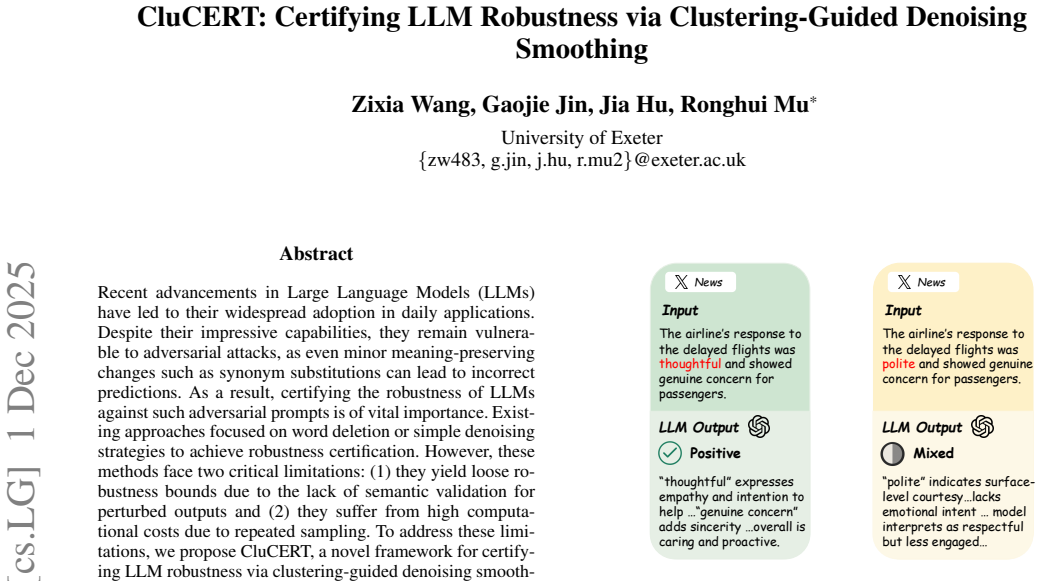
Recent advancements in Large Language Models (LLMs) have led to their widespread adoption in daily applications. Despite their impressive capabilities, they remain vulnerable to adversarial attacks, as even minor meaning-preserving changes such as synonym substitutions can lead to incorrect predictions. As a result, certifying the robustness of LLMs against such adversarial prompts is of vital importance. Existing approaches focused on word deletion or simple denoising strategies to achieve robustness certification. However, these methods face two critical limitations: (1) they yield loose robustness bounds due to the lack of semantic validation for perturbed outputs and (2) they suffer from high computational costs due to repeated sampling. To address these limitations, we propose CluCERT, a novel framework for certifying LLM robustness via clustering-guided denoising smoothing. Specifically, to achieve tighter certified bounds, we introduce a semantic clustering filter that reduces noisy samples and retains meaningful perturbations, supported by theoretical analysis. Furthermore, we enhance computational efficiency through two mechanisms: a refine module that extracts core semantics, and a fast synonym substitution strategy that accelerates the denoising process. Finally, we conduct extensive experiments on various downstream tasks and jailbreak defense scenarios. Experimental results demonstrate that our method outperforms existing certified approaches in both robustness bounds and computational efficiency.
Figures


Forward citations
Cited by 2 Pith papers
-
TrajRS: Towards Certified Robustness in Pedestrian Trajectory Prediction
TrajRS adapts randomized smoothing to provide certified robust radii for trajectory predictors, with tailored definitions for robustness of the optimal prediction and for all possible predictions.
-
Position: A Three-Layer Probabilistic Assume-Guarantee Architecture Is Structurally Required for Safe LLM Agent Deployment
A three-layer probabilistic assume-guarantee architecture is structurally required for safe LLM agent deployment.
Reference graph
Works this paper leans on
-
[1]
Please classify each word in the sentence into one of four levels based on its importance to the overall sentiment: Very Important, Important, Less Important, or Not Important
-
[2]
Assign an importance level (Very Important, Important, Less Important, Not Important) to each word depending on how strongly it affects the sentiment of the sentence
-
[3]
For every word in the sentence, evaluate its influence on the emotional tone and categorize it as either Very Important, Important, Less Important, or Not Important
-
[4]
Which words carry the core sentiment of the sentence? Please group all words into four categories according to their emotional contribution
-
[5]
Label each word in the sentence as Very Important, Important, Less Important, or Not Important, based on how necessary it is for understanding the sentence’s meaning
-
[6]
positive
Which words in this sentence are the least meaningful or most negligible in terms of semantic contribution? Please assign all words to four importance levels accordingly. Table 3: Examples of prompts used to elicit 4-level word importance judgments from a language model. B.2 Downstream prompts Below are the actual prompts and instructions we used in downs...
-
[42]
Chen, T.; Liu, S.; Chang, S.; Cheng, Y .; Amini, L.; and Wang, Z
IEEE. Chen, T.; Liu, S.; Chang, S.; Cheng, Y .; Amini, L.; and Wang, Z. 2020. Adversarial robustness: From self- supervised pre-training to fine-tuning. InProceedings of the IEEE/CVF conference on computer vision and pattern recognition, 699–708. Chen, Y .; Hu, Z.; Zhi, C.; Han, J.; Deng, S.; and Yin, J
2020
-
[2020]
Denoised smoothing: A provable defense for pre- trained classifiers.Advances in Neural Information Process- ing Systems, 33: 21945–21957. Shayegani, E.; Mamun, M. A. A.; Fu, Y .; Zaree, P.; Dong, Y .; and Abu-Ghazaleh, N. 2023. Survey of vulnerabilities in large language models revealed by adversarial attacks.arXiv preprint arXiv:2310.10844. Socher, R.; P...
Pith/arXiv arXiv 2023
-
[2021]
Certified Robustness to Text Adversarial Attacks by Randomized [MASK]. arXiv:2105.03743. Zhang, J.; Chen, Z.; Zhang, H.; Xiao, C.; and Li, B
-
[2023]
importance
DiffSmooth: Certifiably Robust Learning via Diffu- sion Models and Local Smoothing. In32nd USENIX Secu- rity Symposium (USENIX Security 23). USENIX Associa- tion. Zhang, T.; Zhang, Y .; Mu, R.; Liu, J.; Fieldsend, J.; and Ruan, W. 2024a. PRASS: probabilistic risk-averse robust learning with stochastic search. InProceedings of the Thirty- Third Internation...
2015
-
[2024]
Chatunitest: A framework for llm-based test gener- ation. InCompanion Proceedings of the 32nd ACM Interna- tional Conference on the Foundations of Software Engineer- ing. Cheng, Y .; Jiang, L.; Macherey, W.; and Eisenstein, J. 2020. Advaug: Robust adversarial augmentation for neural ma- chine translation.arXiv preprint arXiv:2006.11834. Clopper, C. J.; an...
Pith/arXiv arXiv 2020
discussion (0)
Sign in with ORCID, Apple, or X to comment. Anyone can read and Pith papers without signing in.