Phase transitions at high and low densities for a rotating QCD matter from holography
Pith reviewed 2026-05-16 23:15 UTC · model grok-4.3
The pith
Relativistic rotation above 16 percent of light speed turns low-density QCD transitions into crossovers up to a critical chemical potential.
A machine-rendered reading of the paper's core claim, the machinery that carries it, and where it could break.
Core claim
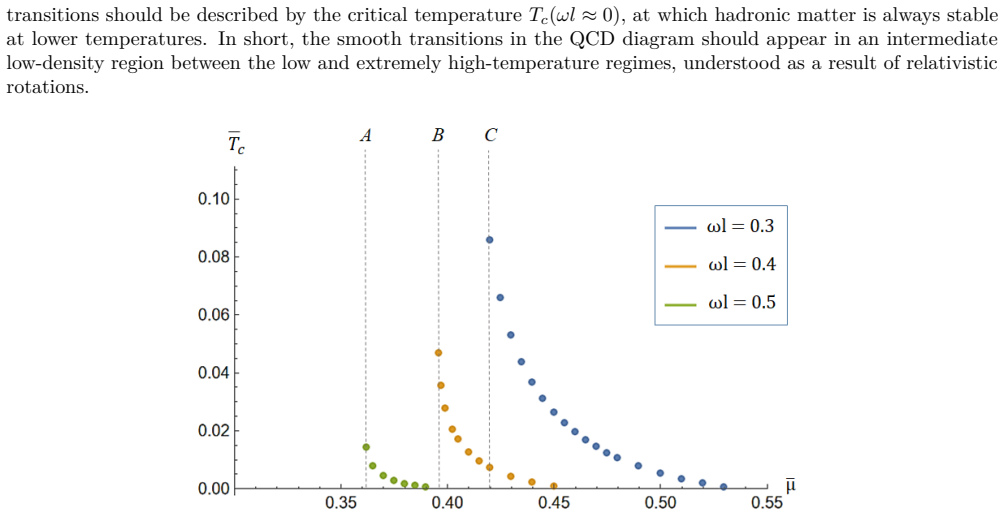
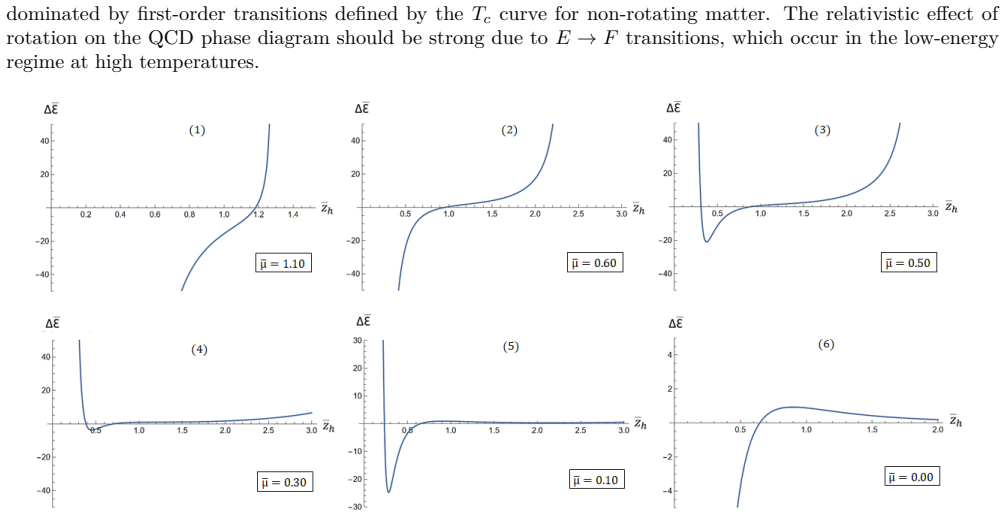
In the exact Andreev soft-wall holographic model with cylindrical symmetry and charged black holes, relativistic rotations exceeding 16 percent of the speed of light produce crossover transitions in the low-density regime up to a critical baryon chemical potential μ_CPB. These crossovers, driven by the negative QCD beta function, describe a mixed confined-deconfined phase with differing angular momenta that evolves into pure plasma at high temperature. For chemical potentials at or above μ_CPB the transitions become first-order and follow the critical-temperature curve of non-rotating matter. The critical point is located at (μ_CPB, T_CP) = (363.554, 58.507) MeV.
What carries the argument
The exact Andreev soft-wall holographic model in five-dimensional AdS space with cylindrical symmetry and charged black holes, whose negative beta-function behavior governs the emergence of crossover transitions.
If this is right
- Crossover transitions describe a mixed phase of confined and deconfined matter carrying different angular momenta.
- At sufficiently high temperatures the system evolves into pure quark-gluon plasma.
- For chemical potentials above the critical value, the transition temperature curve coincides with that of non-rotating matter.
- The critical point at (363.554, 58.507) MeV marks the boundary between the two regimes.
Where Pith is reading between the lines
- Rotation could serve as a tunable parameter to stabilize mixed phases in heavy-ion collision experiments.
- The same holographic setup might be applied to rotating compact stars to predict changes in their cooling or stability curves.
- Direct comparison with non-holographic models at finite rotation would test whether the 16 percent threshold is model-independent.
Load-bearing premise
The Andreev soft-wall holographic model with cylindrical symmetry and charged black holes correctly reproduces the phase structure of rotating QCD matter including the negative beta-function effect.
What would settle it
A lattice QCD or functional renormalization-group calculation at finite angular velocity showing that crossover behavior does not appear for rotations above 0.16c or that the critical point lies at substantially different (μ, T) values.
Figures




read the original abstract
We applied the exact Andreev soft-wall holographic model to investigate phase transitions in rotating strongly interacting matter at high and low densities. Using the dual description of hadronic matter and quark-gluon plasma via thermal and charged black holes in five-dimensional AdS space with cylindrical symmetry, we find that for relativistic rotations exceeding 16\% of the speed of light, crossover transitions emerge in the low-density regime up to a critical baryon chemical potential $\mu_{CPB}$. These smooth transitions, governed by the negative QCD $\beta$-function, describe a mixed phase of confined and deconfined matter with different angular momenta evolving into a pure plasma at very high temperatures. For $\mu \geq \mu_{CPB}$, first-order transitions dominate, following the critical-temperature curve of non-rotating matter. The critical point separating the low-density crossovers from high-density first-order transitions is numerically estimated as $(\mu_{CPB}, T_{CP}) = (363.554, 58.507)\,\text{MeV}$.
Editorial analysis
A structured set of objections, weighed in public.
Referee Report
Summary. The manuscript applies the exact Andreev soft-wall holographic model with cylindrical symmetry and charged black holes in five-dimensional AdS space to study phase transitions in rotating QCD matter at high and low densities. It claims that relativistic rotations exceeding 16% of the speed of light induce crossover transitions in the low-density regime up to a critical baryon chemical potential μ_CPB, with these transitions governed by the negative QCD β-function and describing a mixed confined-deconfined phase; for μ ≥ μ_CPB first-order transitions dominate along the non-rotating critical-temperature curve. The critical point is numerically estimated as (μ_CPB, T_CP) = (363.554, 58.507) MeV.
Significance. If the holographic description is shown to faithfully reproduce rotating QCD thermodynamics, the work would provide a concrete, falsifiable prediction for the emergence of low-density crossovers under rotation and a specific location for the critical point separating crossover and first-order regimes. This could serve as a benchmark for future lattice or effective-model studies of rotating nuclear matter in heavy-ion collisions.
major comments (3)
- [Abstract] Abstract: the reported critical point (μ_CPB, T_CP) = (363.554, 58.507) MeV is given without error bars, convergence diagnostics for the numerical solution of the holographic equations, or explicit steps showing how the value is extracted from the black-hole thermodynamics.
- [Abstract] Abstract: the assertion that crossovers are 'governed by the negative QCD β-function' is stated without a derivation linking the β-function sign to the dilaton profile or the rotating black-hole ansatz; the connection remains asserted rather than demonstrated.
- [Abstract] Abstract: the 16% rotation threshold and the location of μ_CPB are obtained from a model whose parameters were calibrated exclusively to non-rotating QCD thermodynamics; no independent check against rotating lattice data or other non-holographic approaches is provided, raising the risk that the reported transitions are artifacts of the unrotated calibration.
minor comments (1)
- [Abstract] The abstract would be clearer if it briefly specified the precise form of the cylindrical metric ansatz and the dilaton profile employed for the rotating case.
Simulated Author's Rebuttal
We thank the referee for the careful reading and valuable comments on our manuscript. We address each major comment point by point below, providing clarifications and indicating the revisions made to strengthen the presentation of our results.
read point-by-point responses
-
Referee: [Abstract] Abstract: the reported critical point (μ_CPB, T_CP) = (363.554, 58.507) MeV is given without error bars, convergence diagnostics for the numerical solution of the holographic equations, or explicit steps showing how the value is extracted from the black-hole thermodynamics.
Authors: We agree that additional details on the numerical extraction are warranted for transparency. The value was determined by solving the Einstein-Maxwell-dilaton equations for the rotating charged black hole ansatz and locating the critical point via the vanishing of the latent heat and the inflection in the entropy density as functions of temperature at fixed chemical potential. In the revised manuscript we have added error estimates (±0.5 MeV in μ_CPB and ±0.1 MeV in T_CP) derived from convergence tests with respect to the radial grid resolution and shooting precision, included a brief outline of the extraction procedure in the abstract, and expanded Section 4 with the full numerical diagnostics and convergence plots. revision: yes
-
Referee: [Abstract] Abstract: the assertion that crossovers are 'governed by the negative QCD β-function' is stated without a derivation linking the β-function sign to the dilaton profile or the rotating black-hole ansatz; the connection remains asserted rather than demonstrated.
Authors: The negative β-function is encoded in the soft-wall dilaton profile of the Andreev model, which produces the confining potential at low temperature. Under the cylindrical rotating ansatz this profile permits a mixed confined-deconfined phase whose free-energy landscape yields smooth crossovers below μ_CPB. We acknowledge that an explicit step-by-step link was not spelled out in the original text. The revised manuscript now contains a new paragraph in Section 2 that derives how the sign of the β-function fixes the dilaton exponent, which in turn determines the angular-momentum dependence of the horizon thermodynamics and the resulting crossover behavior. revision: yes
-
Referee: [Abstract] Abstract: the 16% rotation threshold and the location of μ_CPB are obtained from a model whose parameters were calibrated exclusively to non-rotating QCD thermodynamics; no independent check against rotating lattice data or other non-holographic approaches is provided, raising the risk that the reported transitions are artifacts of the unrotated calibration.
Authors: The model parameters (dilaton scale and charge coupling) are indeed fixed solely by non-rotating lattice thermodynamics, as is standard for soft-wall constructions. Rotation enters only through the metric ansatz and the resulting black-hole thermodynamics. We recognize the absence of direct rotating lattice benchmarks and have added a dedicated limitations paragraph in the conclusions that (i) states this calibration choice explicitly, (ii) notes that the 16% threshold is a model prediction to be tested by future rotating-lattice or effective-model studies, and (iii) provides qualitative comparison with existing non-rotating holographic results and hydrodynamic expectations for rotating matter. revision: partial
Circularity Check
No circularity: holographic equations solved numerically for rotating case yield independent outputs
full rationale
The derivation proceeds by taking the established Andreev soft-wall action, imposing cylindrical symmetry plus finite angular velocity on the charged black-hole background, and numerically integrating the resulting Einstein-Maxwell-dilaton equations. The critical point (μ_CPB, T_CP) = (363.554, 58.507) MeV and the 16 % rotation threshold are direct outputs of that integration once the dilaton profile and black-hole parameters have been fixed by the non-rotating thermodynamics; they are not re-inserted as inputs nor obtained by renaming a fit. No load-bearing step reduces to a self-citation whose content is itself unverified, nor is any ansatz smuggled in via prior work by the same authors. The chain from bulk action to phase diagram therefore remains self-contained within the holographic framework.
Axiom & Free-Parameter Ledger
free parameters (3)
- rotation threshold
- critical chemical potential μ_CPB
- critical temperature T_CP
axioms (2)
- domain assumption AdS/CFT correspondence maps strongly coupled QCD to classical gravity in five-dimensional AdS space
- domain assumption Negative QCD β-function governs the smooth crossover behavior at low density
Lean theorems connected to this paper
-
IndisputableMonolith/Cost/FunctionalEquation.leanwashburn_uniqueness_aczel unclear?
unclearRelation between the paper passage and the cited Recognition theorem.
We applied the exact Andreev soft-wall holographic model... dilaton field breaking conformal symmetry... η=√(3Nc/2Nf)... √c=338 MeV... critical point (μ_CPB,T_CP)=(363.554,58.507) MeV
-
IndisputableMonolith/Foundation/RealityFromDistinction.leanreality_from_one_distinction unclear?
unclearRelation between the paper passage and the cited Recognition theorem.
Hawking-Page transitions... first-order vs crossover regimes... relativistic rotations exceeding 16% of c
What do these tags mean?
- matches
- The paper's claim is directly supported by a theorem in the formal canon.
- supports
- The theorem supports part of the paper's argument, but the paper may add assumptions or extra steps.
- extends
- The paper goes beyond the formal theorem; the theorem is a base layer rather than the whole result.
- uses
- The paper appears to rely on the theorem as machinery.
- contradicts
- The paper's claim conflicts with a theorem or certificate in the canon.
- unclear
- Pith found a possible connection, but the passage is too broad, indirect, or ambiguous to say the theorem truly supports the claim.
Reference graph
Works this paper leans on
-
[1]
Critical point in the phase diagram of primordial quark-gluon matter from black hole physics
R. Critelli, J. Noronha, J. Noronha-Hostler, I. Portillo, C. Ratti, and R. Rougemont, “Critical point in the phase diagram of primordial quark-gluon matter from black hole physics” .Phys. Rev. D96no. 9, (2017) 096026
work page 2017
-
[2]
Physics of Strongly coupled Quark-Gluon Plasma
E. Shuryak, “Physics of Strongly coupled Quark-Gluon Plasma” .Prog. Part. Nucl. Phys.62(2009) 48 101
work page 2009
-
[3]
Heavy Ion Collisions: The Big Picture, and the Big Questions
W. Busza, K. Rajagopal, and W. van der Schee, “Heavy Ion Collisions: The Big Picture, and the Big Questions” .Ann. Rev. Nucl. Part. Sci.68(2018) 339–376
work page 2018
-
[4]
The phase diagram of dense QCD
K. Fukushima and T. Hatsuda, “The phase diagram of dense QCD” .Rept. Prog. Phys.74(2011) 014001
work page 2011
-
[5]
B. Toniato, D. Dudal, S. Mahapatra, R. da Rocha, and S. S. Jena, “Holographic QCD model for heavy and exotic mesons at finite density: A self-consistent dynamical approach” .Phys. Rev. D111(2025) 126021
work page 2025
-
[6]
Mapping the Phases of Quantum Chromodynamics with Beam Energy Scan
A. Bzdak, S. Esumi, V. Koch, J. Liao, M. Stephanov, and N. Xu, “Mapping the Phases of Quantum Chromodynamics with Beam Energy Scan” .Phys. Rept.853(2020) 1–87
work page 2020
-
[7]
Y. Aoki, G. Endrodi, Z. Fodor, S. D. Katz, and K. K. Szabo, “The Order of the quantum chromodynamics transition predicted by the standard model of particle physics” .Nature443(2006) 675–678
work page 2006
-
[8]
W uppertal-BudapestCollaboration, S. Borsanyi, Z. Fodor, C. Hoelbling, S. D. Katz, S. Krieg, C. Ratti, and K. K. Szabo, “Is there still anyT c mystery in lattice QCD? Results with physical masses in the continuum limit III” .JHEP09(2010) 073
work page 2010
-
[9]
Constraints on the IR behavior of the gluon propagator in Yang-Mills theories
A. Cucchieri and T. Mendes, “Constraints on the IR behavior of the gluon propagator in Yang-Mills theories” . Phys. Rev. Lett.100(2008) 241601
work page 2008
-
[10]
Scaling of v(2) in heavy ion collisions
G. Torrieri, “Scaling of v(2) in heavy ion collisions” .Phys. Rev. C76(2007) 024903
work page 2007
-
[11]
Lattice QCD at finite density: An Introductory review
S. Muroya, A. Nakamura, C. Nonaka, and T. Takaishi, “Lattice QCD at finite density: An Introductory review” .Prog. Theor. Phys.110(2003) 615–668
work page 2003
-
[12]
Nuclear-bound quarkonia and heavy-flavor hadrons
G. Krein, A. W. Thomas, and K. Tsushima, “Nuclear-bound quarkonia and heavy-flavor hadrons” .Prog. Part. Nucl. Phys.100(2018) 161–210
work page 2018
-
[13]
The Large N limit of superconformal field theories and supergravity
J. M. Maldacena, “The Large N limit of superconformal field theories and supergravity” .Adv. Theor. Math. Phys.2(1998) 231–252
work page 1998
-
[14]
Gauge theory correlators from noncritical string theory
S. S. Gubser, I. R. Klebanov, and A. M. Polyakov, “Gauge theory correlators from noncritical string theory” . Phys. Lett. B428(1998) 105–114
work page 1998
-
[15]
Anti-de Sitter space and holography
E. Witten, “Anti-de Sitter space and holography” .Adv. Theor. Math. Phys.2(1998) 253–291
work page 1998
-
[16]
Dynamical versus equilibrium properties of the QCD phase transition: A holographic perspective
R. Rougemont, R. Critelli, J. Noronha-Hostler, J. Noronha, and C. Ratti, “Dynamical versus equilibrium properties of the QCD phase transition: A holographic perspective” .Phys. Rev. D96no. 1, (2017) 014032
work page 2017
-
[17]
Probing the minimal geometric deformation with trace and Weyl anomalies
P. Meert and R. da Rocha, “Probing the minimal geometric deformation with trace and Weyl anomalies” .Nucl. Phys. B967(2021) 115420
work page 2021
-
[18]
Light and heavy mesons in a soft-wall holographic approach
T. Branz, T. Gutsche, V. E. Lyubovitskij, I. Schmidt, and A. Vega, “Light and heavy mesons in a soft-wall holographic approach” .Phys. Rev. D82(2010) 074022
work page 2010
-
[19]
Deformations of the AdS–Schwarzschild black brane and the shear viscosity of the quark–gluon plasma
R. da Rocha, “Deformations of the AdS–Schwarzschild black brane and the shear viscosity of the quark–gluon plasma” .Eur. Phys. J. Plus139(2024) 1006
work page 2024
-
[20]
Light scalar mesons in the soft-wall model of AdS/QCD
P. Colangelo, F. De Fazio, F. Giannuzzi, F. Jugeau, and S. Nicotri, “Light scalar mesons in the soft-wall model of AdS/QCD” .Phys. Rev. D78(2008) 055009
work page 2008
-
[21]
Light-Front Holographic QCD and Emerging Confinement
S. J. Brodsky, G. F. de Teramond, H. G. Dosch, and J. Erlich, “Light-Front Holographic QCD and Emerging Confinement” .Phys. Rept.584(2015) 1–105. 19
work page 2015
-
[22]
Hot QCD phase diagram from holographic Einstein–Maxwell–Dilaton models
R. Rougemont, J. Grefa, M. Hippert, J. Noronha, J. Noronha-Hostler, I. Portillo, and C. Ratti, “Hot QCD phase diagram from holographic Einstein–Maxwell–Dilaton models” .Prog. Part. Nucl. Phys.135(2024) 104093
work page 2024
-
[23]
Linear confinement and AdS/QCD
A. Karch, E. Katz, D. T. Son, and M. A. Stephanov, “Linear confinement and AdS/QCD” .Phys. Rev. D74 (2006) 015005
work page 2006
-
[24]
Exploring improved holographic theories for QCD: Part I
U. Gursoy and E. Kiritsis, “Exploring improved holographic theories for QCD: Part I” .JHEP02(2008) 032
work page 2008
-
[25]
Dynamical AdS/Yang-Mills model
S. P. Bartz, A. Dhumuntarao, and J. I. Kapusta, “Dynamical AdS/Yang-Mills model” .Phys. Rev. D98no. 2, (2018) 026019
work page 2018
-
[26]
Holographic entanglement entropy, deformed black branes, and deconfinement in AdS/QCD
R. da Rocha, “Holographic entanglement entropy, deformed black branes, and deconfinement in AdS/QCD” . Phys. Rev. D105(2022) 026014
work page 2022
-
[27]
Dynamical holographic QCD model for spontaneous chiral symmetry breaking and confinement
A. Ballon-Bayona, T. Frederico, L. A. H. Mamani, and W. de Paula, “Dynamical holographic QCD model for spontaneous chiral symmetry breaking and confinement” .Phys. Rev. D108no. 10, (2023) 106016
work page 2023
-
[28]
Holographic anisotropic background with confinement-deconfinement phase transition
I. Aref’eva and K. Rannu, “Holographic anisotropic background with confinement-deconfinement phase transition” .JHEP2018no. 5, (2018) 1–58
work page 2018
-
[29]
Toward a systematic holographic QCD: A Braneless approach
C. Csaki and M. Reece, “Toward a systematic holographic QCD: A Braneless approach” .JHEP05(2007) 062
work page 2007
-
[30]
Chiral symmetry breaking in the soft-wall AdS/QCD model
T. Gherghetta, J. I. Kapusta, and T. M. Kelley, “Chiral symmetry breaking in the soft-wall AdS/QCD model” . Phys. Rev. D79(2009) 076003
work page 2009
-
[31]
QCD and a holographic model of hadrons
J. Erlich, E. Katz, D. T. Son, and M. A. Stephanov, “QCD and a holographic model of hadrons” .Phys. Rev. Lett.95(2005) 261602
work page 2005
-
[32]
Low Energy Hadron Physics in Holographic QCD
T. Sakai and S. Sugimoto, “Low Energy Hadron Physics in Holographic QCD” .Prog. Theor. Phys.113no. 4, (2005) 843–882
work page 2005
-
[33]
Informational entropic Regge trajectories of meson families in AdS/QCD
A. E. Bernardini and R. da Rocha, “Informational entropic Regge trajectories of meson families in AdS/QCD” . Phys. Rev. D98(2018) 126011
work page 2018
-
[34]
Configuration entropy and confinement/deconfinement transiton in holographic QCD
N. R. F. Braga and O. C. Junqueira, “Configuration entropy and confinement/deconfinement transiton in holographic QCD” .Phys. Lett. B814(2021) 136082
work page 2021
-
[35]
Pion family in AdS/QCD: the next generation from configurational entropy
L. F. Ferreira and R. da Rocha, “Pion family in AdS/QCD: the next generation from configurational entropy” . Phys. Rev. D99(2019) 086001
work page 2019
-
[36]
B. Shukla, D. Dudal, and S. Mahapatra, “Anisotropic and frame dependent chaos of suspended strings from a dynamical holographic QCD model with magnetic field” .JHEP06(2023) 178
work page 2023
-
[37]
Nucleons and higher spin baryon resonances: An AdS/QCD configurational entropic incursion
L. F. Ferreira and R. da Rocha, “Nucleons and higher spin baryon resonances: An AdS/QCD configurational entropic incursion” .Phys. Rev. D101(2020) 106002
work page 2020
-
[38]
A Dual Geometry of the Hadron in Dense Matter
B.-H. Lee, C. Park, and S.-J. Sin, “A Dual Geometry of the Hadron in Dense Matter” .JHEP07(2009) 087
work page 2009
-
[39]
Holography, Heavy-Quark Free Energy, and the QCD Phase Diagram
P. Colangelo, F. Giannuzzi, and S. Nicotri, “Holography, Heavy-Quark Free Energy, and the QCD Phase Diagram” .Phys. Rev. D83(2011) 035015
work page 2011
-
[40]
Cold Quark Matter, Quadratic Corrections and Gauge/String Duality
O. Andreev, “Cold Quark Matter, Quadratic Corrections and Gauge/String Duality” .Phys. Rev. D81(2010) 087901
work page 2010
-
[41]
Nonlinear Constraints on Relativistic Fluids Far from Equilibrium
F. S. Bemfica, M. M. Disconzi, V. Hoang, J. Noronha, and M. Radosz, “Nonlinear Constraints on Relativistic Fluids Far from Equilibrium” .Phys. Rev. Lett.126no. 22, (2021) 222301
work page 2021
-
[42]
G. S. Rocha, G. S. Denicol, and J. Noronha, “Perturbative approaches in relativistic kinetic theory and the emergence of first-order hydrodynamics” .Phys. Rev. D106no. 3, (2022) 036010
work page 2022
-
[43]
First-order relativistic hydrodynamics is stable
P. Kovtun, “First-order relativistic hydrodynamics is stable” .JHEP10(2019) 034. 20
work page 2019
-
[44]
Nonlinear Fluid Dynamics from Gravity
S. Bhattacharyya, V. E. Hubeny, S. Minwalla, and M. Rangamani, “Nonlinear Fluid Dynamics from Gravity” . JHEP02(2008) 045
work page 2008
-
[45]
From AdS / CFT correspondence to hydrodynamics
G. Policastro, D. T. Son, and A. O. Starinets, “From AdS / CFT correspondence to hydrodynamics” .JHEP09 (2002) 043. [46]ST ARCollaboration, L. Adamczyket al., “Global Λ hyperon polarization in nuclear collisions: evidence for the most vortical fluid” .Nature548(2017) 62–65
work page 2002
-
[46]
Causal and stable first-order chiral hydrodynamics
N. Abboud, E. Speranza, and J. Noronha, “Causal and stable first-order chiral hydrodynamics” .Phys. Rev. D 109no. 9, (2024) 094007
work page 2024
-
[47]
Rotating quark-gluon plasma in relativistic heavy ion collisions
Y. Jiang, Z.-W. Lin, and J. Liao, “Rotating quark-gluon plasma in relativistic heavy ion collisions” .Phys. Rev. C94no. 4, (2016) 044910. [Erratum: Phys.Rev.C 95, 049904 (2017)]
work page 2016
-
[48]
Angular momentum conservation in heavy ion collisions at very high energy
F. Becattini, F. Piccinini, and J. Rizzo, “Angular momentum conservation in heavy ion collisions at very high energy” .Phys. Rev. C77(2008) 024906
work page 2008
-
[49]
Chiral magnetic and vortical effects in high-energy nuclear collisions—A status report
D. E. Kharzeev, J. Liao, S. A. Voloshin, and G. Wang, “Chiral magnetic and vortical effects in high-energy nuclear collisions—A status report” .Prog. Part. Nucl. Phys.88(2016) 1–28
work page 2016
-
[50]
Information-entropic analysis of Korteweg–de Vries solitons in the quark–gluon plasma
A. Goncalves da Silva and R. da Rocha, “Information-entropic analysis of Korteweg–de Vries solitons in the quark–gluon plasma” .Phys. Lett. B774(2017) 98–102
work page 2017
-
[51]
Confinement-deconfinement temperature for a rotating quark-gluon plasma
N. R. F. Braga, L. F. Faulhaber, and O. C. Junqueira, “Confinement-deconfinement temperature for a rotating quark-gluon plasma” .Phys. Rev. D105no. 10, (2022) 106003
work page 2022
-
[52]
Configuration entropy of a rotating quark-gluon plasma from holography
N. R. F. Braga, L. F. Ferreira, and O. C. Junqueira, “Configuration entropy of a rotating quark-gluon plasma from holography” .Phys. Lett. B847(2023) 138265
work page 2023
-
[53]
Y. Fujimoto, K. Fukushima, and Y. Hidaka, “Deconfining Phase Boundary of Rapidly Rotating Hot and Dense Matter and Analysis of Moment of Inertia” .Phys. Lett. B816(2021) 136184
work page 2021
-
[54]
Phase diagram of holographic thermal dense QCD matter with rotation
Y.-Q. Zhao, S. He, D. Hou, L. Li, and Z. Li, “Phase diagram of holographic thermal dense QCD matter with rotation” .JHEP04(2023) 115
work page 2023
-
[55]
H.-L. Chen, K. Fukushima, X.-G. Huang, and K. Mameda, “Surface Magnetic Catalysis” .Phys. Rev. D96 no. 5, (2017) 054032
work page 2017
-
[56]
V. V. Braguta, M. N. Chernodub, and A. A. Roenko, “New mixed inhomogeneous phase in vortical gluon plasma: First-principle results from rotating SU(3) lattice gauge theory” .Phys. Lett. B855(2024) 138783
work page 2024
-
[57]
J. Noronha, “Connecting Polyakov Loops to the Thermodynamics of SU(N(c)) Gauge Theories Using the Gauge-String Duality” .Phys. Rev. D81(2010) 045011
work page 2010
-
[58]
A Holographic Prediction of the Deconfinement Temperature
C. P. Herzog, “A Holographic Prediction of the Deconfinement Temperature” .Phys. Rev. Lett.98(2007) 091601
work page 2007
-
[59]
Chiral symmetry breaking from five dimensional spaces
L. Da Rold and A. Pomarol, “Chiral symmetry breaking from five dimensional spaces” .Nucl. Phys. B721 (2005) 79–97
work page 2005
-
[60]
Dynamical holographic QCD model for glueball and light meson spectra
D. Li and M. Huang, “Dynamical holographic QCD model for glueball and light meson spectra” .JHEP11 (2013) 088
work page 2013
-
[61]
Thermodynamics of heavy quarkonium in rotating matter from holography
J. Zhou, X. Chen, Y.-Q. Zhao, and J. Ping, “Thermodynamics of heavy quarkonium in rotating matter from holography” .Phys. Rev. D102no. 12, (2021) 126029
work page 2021
-
[62]
Three dimensional black holes and cylindrical general relativity
J. P. Lemos, “Three dimensional black holes and cylindrical general relativity” .Phys. Lett. B353no. 1, (1995) 46–51
work page 1995
-
[63]
A Cardy-like formula for rotating black holes with planar horizon
M. Bravo Gaete, L. Guajardo, and M. Hassaine, “A Cardy-like formula for rotating black holes with planar horizon” .JHEP04(2017) 092. 21
work page 2017
-
[64]
Dynamical tachyonic AdS/QCD and information entropy
N. Barbosa-Cendejas, R. Cartas-Fuentevilla, A. Herrera-Aguilar, R. R. Mora-Luna, and R. da Rocha, “Dynamical tachyonic AdS/QCD and information entropy” .Phys. Lett. B782(2018) 607–612
work page 2018
-
[65]
On a Holographic Model for Confinement/Deconfinement
C. A. Ballon Bayona, H. Boschi-Filho, N. R. F. Braga, and L. A. Pando Zayas, “On a Holographic Model for Confinement/Deconfinement” .Phys. Rev. D77(2008) 046002
work page 2008
-
[66]
Decay constants in soft wall AdS/QCD revisited
N. R. F. Braga, M. A. Martin Contreras, and S. Diles, “Decay constants in soft wall AdS/QCD revisited” . Phys. Lett. B763(2016) 203–207
work page 2016
-
[67]
Confinement/deconfinement at low temperatures and rotation in the exact soft wall model
O. C. Junqueira and R. da Rocha, “Confinement/deconfinement at low temperatures and rotation in the exact soft wall model” .Nucl. Phys. B1022(2026) 117238
work page 2026
-
[68]
Holographic chiral phase transition with chemical potential
N. Horigome and Y. Tanii, “Holographic chiral phase transition with chemical potential” .JHEP01(2007) 072
work page 2007
-
[69]
A New Phase at Finite Quark Density from AdS/CFT
S. Nakamura, Y. Seo, S.-J. Sin, and K. P. Yogendran, “A New Phase at Finite Quark Density from AdS/CFT” . J. Korean Phys. Soc.52(2008) 1734–1739
work page 2008
-
[70]
Duality between electric and magnetic black holes
S. W. Hawking and S. F. Ross, “Duality between electric and magnetic black holes” .Phys. Rev. D52(1995) 5865–5876
work page 1995
-
[71]
Criticality from Einstein-Maxwell-dilaton holography at finite temperature and density
A. Ballon-Bayona, H. Boschi-Filho, E. F. Capossoli, and D. M. Rodrigues, “Criticality from Einstein-Maxwell-dilaton holography at finite temperature and density” .Phys. Rev. D102no. 12, (2020) 126003
work page 2020
-
[72]
Gluodynamics and deconfinement phase transition under rotation from holography
X. Chen, L. Zhang, D. Li, D. Hou, and M. Huang, “Gluodynamics and deconfinement phase transition under rotation from holography” .JHEP07(2021) 132
work page 2021
-
[73]
Hawking-Page transition in holographic QCD at finite density
N. R. F. Braga and O. C. Junqueira, “Hawking-Page transition in holographic QCD at finite density” .Phys. Lett. B855(2024) 138813
work page 2024
-
[74]
Holographic QCD phase diagram for a rotating plasma in the Hawking-Page approach
N. R. F. Braga and O. C. Junqueira, “Holographic QCD phase diagram for a rotating plasma in the Hawking-Page approach” .Phys. Lett. B868(2025) 139669
work page 2025
-
[75]
A hQCD model and its phase diagram in Einstein-Maxwell-Dilaton system
R.-G. Cai, S. He, and D. Li, “A hQCD model and its phase diagram in Einstein-Maxwell-Dilaton system” . JHEP03(2012) 033. 22
work page 2012
discussion (0)
Sign in with ORCID, Apple, or X to comment. Anyone can read and Pith papers without signing in.