Explicit Control Barrier Function-based Safety Filters and their Resource-Aware Computation
Pith reviewed 2026-05-16 22:56 UTC · model grok-4.3
The pith
CBF safety filters admit closed-form algebraic solutions after the state space is partitioned into regions.
A machine-rendered reading of the paper's core claim, the machinery that carries it, and where it could break.
Core claim
The solution to the CBF quadratic program can be expressed in closed form by partitioning the state space according to the active barrier constraints and the sign of the Lie derivatives; each region yields either the nominal input, a scaled correction, or a projected input that lies on the boundary of the safe set. The resulting piecewise expression is evaluated directly once the current region is identified, removing the need to call a numerical solver at runtime.
What carries the argument
State-space partition into regions, each supplying a distinct closed-form algebraic expression for the safety-corrected control input.
If this is right
- The safety filter reduces to a handful of arithmetic operations once the region is known.
- Region detection is performed by evaluating a finite set of inequalities on the barrier functions.
- Forward invariance of the safe set is retained exactly as in the quadratic-program version.
- Higher sampling rates become feasible on processors where QP solvers exceed timing budgets.
- The method extends directly to multiple barrier functions, as demonstrated in the aerospace and reinforcement-learning examples.
Where Pith is reading between the lines
- Precomputing the partition boundaries offline would further reduce online detection cost.
- The algebraic form may simplify formal verification of the closed-loop system.
- Combining the filter with learned nominal policies could certify safety for trained controllers without retraining.
- Similar partitioning ideas could apply to other online optimization-based controllers beyond CBFs.
Load-bearing premise
The state space can be divided so that every region has an exact algebraic solution that still enforces the original CBF safety condition.
What would settle it
A trajectory on which the closed-form controller leaves the safe set or requires more floating-point operations than the original quadratic program.
Figures


read the original abstract
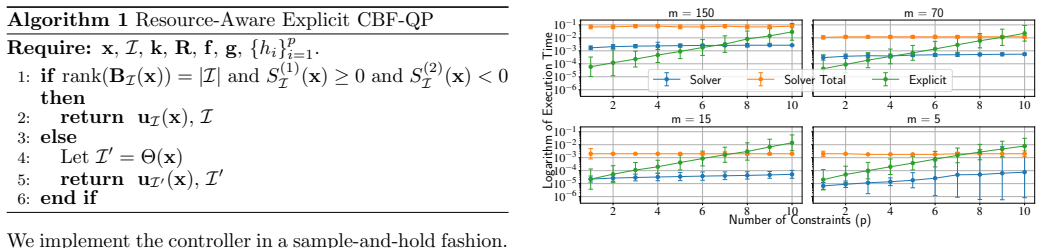
This paper studies the efficient implementation of safety filters that are designed using control barrier functions (CBFs), which minimally modify a nominal controller to render it safe with respect to a prescribed set of states. Although CBF-based safety filters are often implemented by solving a quadratic program (QP) in real time, the use of off-the-shelf solvers for such optimization problems poses a challenge in applications where control actions need to be computed efficiently at very high frequencies. In this paper, we introduce a closed-form expression for controllers obtained through CBF-based safety filters. This expression is obtained by partitioning the state-space into different regions, with a different closed-form solution in each region. We leverage this formula to introduce a resource-aware implementation of CBF-based safety filters that detects changes in the partition region and uses the closed-form expression between changes. We showcase the applicability of our approach in examples ranging from aerospace control to safe reinforcement learning.
Editorial analysis
A structured set of objections, weighed in public.
Referee Report
Summary. The paper proposes an explicit closed-form expression for CBF-based safety filters obtained by partitioning the state space into regions, each admitting a different closed-form controller, and leverages this to develop a resource-aware implementation that recomputes only upon detected region changes, with demonstrations on aerospace and safe RL examples.
Significance. If the closed-form expressions exactly preserve the original CBF safety guarantees and the region-detection overhead is strictly lower than a QP solve, the approach would enable high-frequency safety filtering on resource-limited hardware without sacrificing correctness.
major comments (2)
- [Resource-aware implementation] The resource-aware implementation relies on efficient region detection via the sign of a(x)^T u_nom(x) - b(x). For general nonlinear systems this scalar is itself a nonlinear function whose evaluation cost is comparable to the single projection performed by the original QP; the manuscript must therefore supply either a complexity analysis or hardware benchmarks demonstrating net savings (see skeptic note on switching-surface evaluation).
- [Partition construction and safety preservation] It is unclear how the state-space partition is constructed so that each region's closed-form solution exactly reproduces the QP solution while safety is retained at region boundaries; a formal argument that the switched closed-form controller remains a valid CBF filter (i.e., satisfies the barrier condition everywhere) is required.
minor comments (1)
- [Abstract] The abstract states that the closed-form expression is 'obtained by partitioning the state-space' but does not indicate whether the partition is computed offline or online; clarifying this distinction would aid readability.
Simulated Author's Rebuttal
We thank the referee for their insightful comments on our manuscript. We believe the proposed explicit CBF safety filters offer significant advantages for resource-constrained systems, and we address the concerns regarding implementation efficiency and safety guarantees below. We will incorporate the suggested clarifications and additions in the revised version.
read point-by-point responses
-
Referee: [Resource-aware implementation] The resource-aware implementation relies on efficient region detection via the sign of a(x)^T u_nom(x) - b(x). For general nonlinear systems this scalar is itself a nonlinear function whose evaluation cost is comparable to the single projection performed by the original QP; the manuscript must therefore supply either a complexity analysis or hardware benchmarks demonstrating net savings (see skeptic note on switching-surface evaluation).
Authors: We agree that a detailed complexity analysis is necessary to substantiate the resource savings. In the manuscript, the region detection is based on evaluating the sign of a scalar function, which for many practical systems (such as those with polynomial or simple nonlinearities in aerospace and RL examples) is significantly cheaper than solving the full QP. However, to address the general case, we will add a section providing operation counts for the detection versus QP solve and include hardware benchmarks on an embedded processor demonstrating the net savings in the revised manuscript. revision: yes
-
Referee: [Partition construction and safety preservation] It is unclear how the state-space partition is constructed so that each region's closed-form solution exactly reproduces the QP solution while safety is retained at region boundaries; a formal argument that the switched closed-form controller remains a valid CBF filter (i.e., satisfies the barrier condition everywhere) is required.
Authors: The partition is constructed by dividing the state space into regions corresponding to different active sets in the underlying QP, where the closed-form solution is derived from the KKT conditions for that active set. Within each region, the closed-form controller is identical to the QP solution by construction. Safety at boundaries is preserved because the QP solution is continuous with respect to the state, and the barrier condition is satisfied with equality or strict inequality as per the CBF definition. We will include a formal theorem and proof in the appendix of the revised manuscript demonstrating that the switched controller satisfies the CBF inequality everywhere, including across region boundaries. revision: yes
Circularity Check
Algebraic derivation of closed-form CBF filter via state-space partition is self-contained
full rationale
The paper derives explicit closed-form controllers for CBF safety filters by partitioning the state space into regions defined by the sign of the CBF constraint violation a(x)^T u_nom(x) - b(x) (and input bounds), with a distinct algebraic expression in each region. This follows directly from the standard QP solution structure without any fitted parameters, self-referential definitions, or load-bearing self-citations. Region detection is presented as an implementation detail whose cost is claimed to be lower than repeated QP solves, but the core derivation chain does not reduce to its inputs by construction. No enumerated circularity pattern is exhibited.
Axiom & Free-Parameter Ledger
Forward citations
Cited by 2 Pith papers
-
Local Safety Filters for Networked Systems via Two-Time-Scale Design
A two-time-scale dynamic implementation enables locally computable approximations of networked control barrier function safety filters with explicit bounds on trajectory mismatch and safety degradation.
-
Learned Lyapunov Shielding for Adaptive Control
Learned Lyapunov functions, residual SAC policies, and PINNs are combined with a Slotine-Li controller and a closed-form safety filter to improve tracking on uncertain Euler-Lagrange systems while retaining stability ...
Reference graph
Works this paper leans on
-
[1]
Alshiekh, M., Bloem, R., Ehlers, R., Könighofer, B., and Niekum, S. (2018). Safe reinforcement learning via shielding. In Proceedings of the T hirty- S econd AAAI C onference on A rtificial I ntelligence , 2669--2678
work page 2018
-
[2]
Ames, A.D., Coogan, S., Egerstedt, M., Notomista, G., Sreenath, K., and Tabuada, P. (2019). Control barrier functions: theory and applications. In Eur. Control Conf., 3420--3431
work page 2019
-
[3]
Ames, A.D., Grizzle, J.W., and Tabuada, P. (2014). Control barrier functions based quadratic programming with application to adaptive cruise control. In IEEE Conf. Decis. Control, 6271--6278
work page 2014
-
[4]
Ames, A.D., Xu, X., Grizzle, J.W., and Tabuada, P. (2017). Control barrier function based quadratic programs for safety critical systems. IEEE Trans. Automat. Control, 62(8), 3861--3876
work page 2017
-
[5]
Bansal, S., Chen, M., Herbert, S., and Tomlin, C.J. (2017). Hamilton- J acobi R eachability: A B rief O verview and R ecent A dvances. In IEEE Conf. Decis. Control, 2242--2253
work page 2017
-
[6]
Bejarano, F.P., Brunke, L., and Schoellig, A.P. (2025). Safety filtering while training: improving the performance and sample efficiency of reinforcement learning agents. IEEE Robot. Autom. Lett., 10(1), 788--795
work page 2025
-
[7]
Bemporad, A., Morari, M., Dua, V., and Pistikopoulos, E. (2002). The explicit linear quadratic regulator for constrained systems. Automatica, 38(1), 3--20
work page 2002
-
[8]
Breeden, J., Garg, K., and Panagou, D. (2022). Control barrier functions in sampled-data systems. IEEE Control Syst. Lett., 6, 367--372
work page 2022
-
[9]
Cheng, R., Orosz, G., Murray, R.M., and Burdick, J.W. (2019). End-to-end safe reinforcement learning through barrier functions for safety-critical continuous control tasks. In Proc. AAAI Conf. Artif. Intell., 3387--3395
work page 2019
-
[10]
Cohen, M.H., Lavretsky, E., and Ames, A.D. (2025). Compatibility of multiple control barrier functions for constrained nonlinear systems. In IEEE Conf. Decis. Control. To appear
work page 2025
-
[11]
Garone, E., Cairano, S.D., and Kolmanovsky, I. (2017). Reference and command governors for systems with constraints: a survey on theory and applications. A utomatica , 75, 306--328
work page 2017
-
[12]
Heemels, W.P.M.H., Donkers, M.C.F., and Teel, A.R. (2008). Periodic event-triggered control for linear systems. IEEE T ransactions on A utomatic C ontrol , 58(4), 847--861
work page 2008
-
[13]
Heemels, W.P.M.H., Johansson, K.H., and Tabuada, P. (2012). An introduction to event-triggered and self-triggered control. In IEEE Conf. Decis. Control, 3270--3285. Maui, HI
work page 2012
-
[14]
Hsu, S., Xu, X., and Ames, A.D. (2015). Control barrier function based quadratic programs with applications to bipedal robot walking. In Amer. Control Conf
work page 2015
-
[15]
Huang, B. and Vaidya, U. (2022). Adaptive control barrier functions. IEEE Trans. Automat. Control, 67(5), 2267--2281
work page 2022
- [16]
-
[17]
Lavretsky, E. and Wise, K.A. (2024). Robust and A daptive C ontrol with A erospace A pplications . Springer
work page 2024
-
[18]
Lee, J., Kim, J., and Ames, A.D. (2023). Hierarchical relaxation of safety-critical controllers: mitigating contradictory safety conditions with application to quadruped robots. In IEEE/RSJ I nternational C onference on I ntelligent R obots and S ystems , 2384--2391
work page 2023
-
[19]
Lindemann, L. and Dimarogonas, D.V. (2019). Control barrier functions for signal temporal logic tasks. IEEE Control Syst. Lett., 3(1), 96--101
work page 2019
-
[20]
Mahony, R., Kumar, V., and Corke, P. (2012). Multirotor aerial vehicles: Modeling, estimation, and control of quadrotor. IEEE Robot. Autom. Mag., 19(3), 20--32
work page 2012
- [21]
- [22]
-
[23]
Molnar, T.G. and Ames, A.D. (2023). Composing control barrier functions for complex safety specifications. IEEE Control Syst. Lett., 7, 3615--3620
work page 2023
-
[24]
Morris, B.J., Powell, M.J., and Ames, A.D. (2015). Continuity and smoothness properties of nonlinear optimization-based feedback controllers. In IEEE Conf. Decis. Control, 151--158
work page 2015
-
[25]
Nguyen, Q. and Sreenath, K. (2016). Exponential control barrier functions for enforcing high relative-degree safety-critical constraints. In Amer. Control Conf., 322--328. Boston, MA
work page 2016
-
[26]
Rawlings, J.B., Mayne, D.Q., and Diehl, M.M. (2017). Model Predictive Control: Theory, Computation, and Design. Nob Hill Publishing
work page 2017
-
[27]
Robinson, S.M. (1980). Strongly regular generalized equations. Mathematics of Operations Research, 5(1), 43--62
work page 1980
-
[28]
Schulman, J., Wolski, F., Dhariwal, P., Radford, A., and Klimov, O. (2017). Proximal policy optimization algorithms. arXiv preprint arXiv:1707.06347
work page internal anchor Pith review Pith/arXiv arXiv 2017
-
[29]
Singletary, A., Chen, Y., and Ames, A.D. (2020). Control barrier functions for sampled-data systems with input delays. In IEEE Conf. Decis. Control, 804--809
work page 2020
-
[30]
Sontag, E.D. (1998). Mathematical Control Theory: Deterministic Finite Dimensional Systems, volume 6 of TAM. Springer
work page 1998
-
[31]
Stellato, B., Banjac, G., Goulart, P., Bemporad, A., and Boyd, S. (2020). OSQP: an operator splitting solver for quadratic programs. Math. Program. Comput., 12, 637--672
work page 2020
-
[32]
Tabuada, P. (2007). Event-triggered real-time scheduling of stabilizing control tasks. IEEE Trans. Automat. Control, 52(9), 1680--1685
work page 2007
-
[33]
Tan, X. and Dimarogonas, D.V. (2024). On the undesired equilibria induced by control barrier function based quadratic programs. Automatica, 159, 111359
work page 2024
-
[34]
Taylor, A.J., Dorobantu, V.D., Cosner, R.K., Yue, Y., and Ames, A.D. (2022). Safety of sampled-data systems with control barrier functions via approximate discrete time models. In IEEE Conf. Decis. Control, 7127--7134
work page 2022
-
[35]
Wang, L., Ames, A., and Egerstedt, M. (2017). Safety barrier certificates for collisions-free multirobot systems. IEEE Trans. Robot., 33(3), 661--674
work page 2017
-
[36]
Wang, L., Ames, A.D., and Egerstedt, M. (2016). Multi-objective compositions for collision-free connectivity maintenance in teams of mobile robots. In IEEE Conf. Decis. Control, 2659--2664
work page 2016
-
[37]
Wang, X. and Lemmon, M. (2011). Event triggering in distributed networked control systems. IEEE Trans. Automat. Control, 56(3), 586--601
work page 2011
-
[38]
Xiao, W. and Belta, C. (2022). High-order control barrier functions. IEEE Trans. Automat. Control, 67(7), 3655--3662
work page 2022
-
[39]
Xu, X., Tabuada, P., Grizzle, J.W., and Ames, A.D. (2015). Robustness of control barrier functions for safety critical control. IFAC-PapersOnLine, 48(27), 54--61
work page 2015
- [40]
discussion (0)
Sign in with ORCID, Apple, or X to comment. Anyone can read and Pith papers without signing in.