REVIEW 3 major objections 4 minor 2 cited by
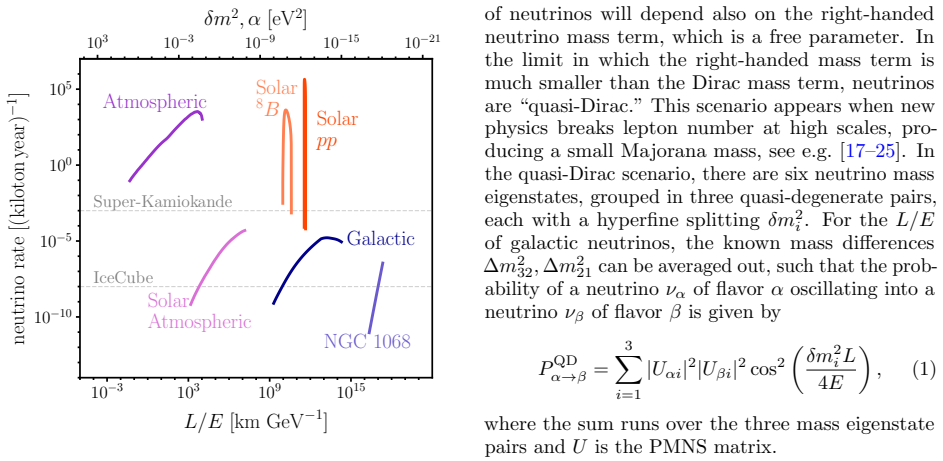
A joint IceCube–KM3NeT analysis of Galactic neutrinos is forecast to be sensitive to quasi-Dirac mass-squared splittings in [3e-14, 1e-12] eV^2 and to nu3->nu1 decays with alpha3 > 5e-13 eV^2 at 90% confidence.
Reviewed by Pith at T0; open to challenge. T0 means a machine referee read the full paper against a public rubric. the ladder, T0–T4 →
T0 review · deepseek-v4-flash
2026-08-03 17:02 UTC pith:U2RGG7FY
load-bearing objection Useful and genuinely new sensitivity forecast for Galactic neutrinos to quasi-Dirac and decay, but the headline numbers rest on an unpublished TANDEM model and the paper reports inconsistent central values. the 3 major comments →
Exploring New Propagation Scales With Galactic Neutrinos
The pith
A machine-rendered reading of the paper's core claim, the machinery that carries it, and where it could break.
Core claim
On the paper's own terms, the central claim is that the diffuse Galactic neutrino flux, measured with cascade events at IceCube and track events at KM3NeT/ARCA, probes new propagation physics at L/E around 10^13 km/GeV. A combined analysis would exclude quasi-Dirac mass-squared splittings in [3e-14, 1e-12] eV^2 and nu3-to-nu1 decays with alpha3 > 5e-13 eV^2 at 90% confidence, while invisible nu3 decay remains out of reach at that significance. The signal is a direction- and energy-dependent disappearance of the flux, produced by the wide spread of source baselines inside the Galaxy. The two detector channels are complementary because cascades offer good energy resolution but poor angular res
What carries the argument
The machinery is the TANDEM emission model: a spatial-spectral model of diffuse Galactic neutrino emissivity that gives the expected neutrino production rate per unit volume along any line of sight. The paper integrates this emissivity against the quasi-Dirac oscillation probability (cos^2 of the L/E-dependent phase) and the exponential decay survival probability, yielding a direction-dependent weighting that smears what would otherwise be a clean L/E oscillation into a spectral distortion. The analysis then uses a binned Poisson likelihood with a profiled overall flux normalization; this profiled normalization is what makes the track-cascade complementarity essential for detecting decay.
Load-bearing premise
The forecasts rest on TANDEM, a still-unpublished model by the same group that determines where and how brightly the Galaxy emits neutrinos; if the cosmic-ray source distribution, gas maps, or absolute normalization are wrong, the direction-dependent smearing that produces the sensitivity changes, and the paper varies only gas maps, not the cosmic-ray distribution or the overall normalization.
What would settle it
The cleanest check is the direction-resolved energy spectrum of the Galactic plane: if, in the combined 2035 sample, no spectral distortion appears at the level predicted for delta m^2 = 1e-13 eV^2 or alpha3 = 1e-13 eV^2 (per-bin deviations of order the statistical uncertainty shown in Figs. 3-5), the central sensitivity claim is falsified. An independent map of the Galactic cosmic-ray distribution from gamma-ray or radio data would also settle whether the assumed emission geometry is correct before invoking new physics.
If this is right
- A 2035 combined analysis would place the first competitive constraints on quasi-Dirac splittings in the band between solar bounds and SN1987A constraints, reaching down to about 3e-14 eV^2.
- The same data would probe nu3-to-nu1 decay with alpha3 above about 5e-13 eV^2, overlapping the solar 3-sigma bound and testing the quasi-degenerate limit of Majoron models.
- Invisible nu3 decay is not expected to be detectable at 90% confidence with the assumed exposures.
- Because the signal is direction- and energy-dependent, a measurement of the Galactic plane's spectral shape with good angular and energy resolution is itself the physics test; the combined analysis exploits each detector's strengths.
- The sensitivity holds up across the four gas-map models tested in the appendix, even though the three-dimensional emission profiles differ substantially.
Where Pith is reading between the lines
- If gamma-ray observations could anchor the overall Galactic flux normalization, the analysis would extend into the regime where BSM effects become pure normalization shifts (delta m^2, alpha above about 1e-11 eV^2), broadening the probe beyond shape distortions.
- A discovery of individual Galactic neutrino point sources would provide well-defined baselines and far less L/E smearing, potentially sharpening the same quasi-Dirac and decay signatures beyond what the diffuse flux can offer.
- In the quasi-degenerate visible-decay limit, the nu3-to-nu1 channel predicts a low-energy bump in the nu1 flux; a dedicated low-energy analysis could test this prediction independently of the 90% sensitivity projection.
- The same spatially resolved emission model could be applied to other distance- and energy-dependent propagation effects, such as neutrino secret interactions or Lorentz-violating oscillations, which would imprint different direction-dependent spectra.
Editorial analysis
A structured set of objections, weighed in public.
Referee Report
Summary. The paper forecasts the sensitivity of IceCube and KM3NeT/ARCA to two beyond-Standard-Model propagation effects—quasi-Dirac (QD) neutrino oscillations and neutrino decay—using the upcoming TANDEM model of diffuse Galactic neutrino emission. The authors compute direction- and energy-dependent survival probabilities, build a binned Poisson likelihood with an unconstrained Galactic-flux normalization pull, and present Asimov 90% CL sensitivities for a projected 2035 analysis (23 years of IceCube cascades and 5 years of KM3NeT tracks). They report sensitivity to QD squared-mass splittings around δm^2 ∈ [3×10^-14, 10^-12] eV^2 and to ν3→ν1 visible decay for α3 > 5×10^-13 eV^2, while invisible ν3 decay is not sensitive. The analysis emphasizes complementarity between cascade and track channels for decay scenarios.
Significance. If the reported sensitivities are correct, Galactic neutrinos would open a new L/E window near 10^13 km/GeV, complementary to solar, atmospheric, supernova, and diffuse astrophysical constraints, and could discriminate among neutrino mass models. The paper's strengths include a physically motivated direction-resolved treatment of propagation, a standard likelihood framework with a profiled normalization, explicit use of realistic detector responses, and a robustness check over four gas maps (Appendix B). The claimed complementarity between IceCube cascades and KM3NeT tracks in the decay case is well illustrated and is a useful contribution. However, the central numerical results are stated inconsistently across the abstract, introduction, and main text, and the entire forecast rests on an unpublished, same-group emission model (TANDEM) whose spatial and spectral degrees of freedom are only partially varied.
major comments (3)
- [Abstract; Introduction; Section V] The paper reports three different sets of central sensitivities. The abstract gives δm^2 ∈ (10^-13.6, 10^-12.3) eV^2 and m/τ > 10^-12.8 eV^2; the introduction gives δm^2 ∈ (10^-13.5, 10^-11.9) eV^2 and m/τ > 10^-12.3 eV^2; Section V gives δm^2 ∈ [3×10^-14, 10^-12] eV^2 for the combined analysis and α3 > 5×10^-13 eV^2 for ν3→ν1 decay. These differ by up to ~0.5 dex in the upper end of the QD range and in the decay limit (10^-12.3 vs 10^-12.8). The body's numbers should be taken as definitive; the abstract and introduction must be reconciled with them. This is not a cosmetic issue because the claimed discovery/exclusion reach is the paper's central result.
- [Section III, Eq. (3); Appendix B; Ref. [64]] The entire signal prediction is built on the TANDEM model, which provides the four-dimensional emissivity Fβ integrated in Eq. (3). Ref. [64] is cited as 'upcoming' and is authored by the same group; no code or tabulated model is provided. Appendix B varies only the gas maps, not the cosmic-ray source distribution, CR propagation/magnetic-field model, or hadronic interaction model. These are precisely the inputs that set the direction-dependent baseline distribution and spectral shape—the quantities that drive the L/E smearing and, hence, the sensitivity contours in Fig. 6 and B.2. The profile pull ξ in Eq. (4) only rescales the total normalization and cannot correct for a wrong spatial or spectral shape. I request a quantitative validation of TANDEM against the observed IceCube Galactic plane data (e.g., Ref. [14]) or a comparison with at least one independent CR distribution and CR pro
- [Appendix A; Section V] The ν3→ν1 visible-decay analysis is restricted to the quasi-degenerate limit, where the decay-product energy spectrum is a delta function (Eq. A2). This is acknowledged, but the sensitivity quoted in Section V (α3 > 5×10^-13 eV^2) is derived entirely in this limit. Since the absolute neutrino mass scale is not known (KATRIN only provides an upper bound), the analysis should either quantify how the sensitivity degrades for lower mass scales or clearly state that the quoted reach applies only to this corner of parameter space. As written, a reader could overinterpret the bound as general for ν3→ν1 decay.
minor comments (4)
- [Figure 3 caption] The caption says 'Galactic latitude ℓ and longitude b'; ℓ and b are conventionally Galactic longitude and latitude, respectively. Please correct the ordering.
- [Appendix B, text] The sentence 'our sensitivities to do not vary greatly' contains an extra 'to' and should read 'our sensitivities do not vary greatly'.
- [Ref. [64]] Since TANDEM is the central input, the paper should state whether a preprint or public code release is planned and, ideally, include a link or a version identifier. This is important for reproducibility.
- [Section IV, Eq. (4)] The notation N_i^G versus μ_i^G is a little confusing: N is used for the BSM signal prediction while μ is the SM signal. A short sentence explicitly defining 'N' and 'μ' in the text would improve readability.
Circularity Check
No circular reduction: the BSM sensitivity is a nontrivial likelihood-ratio calculation; the TANDEM same-author emission model is the main model-dependence caveat but is not a circular input.
full rationale
The paper's claimed result is a forecasted sensitivity, not a measurement. The BSM survival probabilities (Eqs. 1 and 2) are standard quantum-mechanical expressions: the quasi-Dirac cos^2 term and the decay exp term are not defined in terms of the TANDEM emissivity. Eq. (3) convolves an assumed 4D Galactic emissivity F_beta (from TANDEM) with these independent probabilities; the output test statistic (Eq. 4) is a likelihood-ratio function of delta m^2 or alpha, so the sensitivity intervals in Section V are not equal by construction to the emission model input. No BSM parameter is fitted to data; the flux normalization is fixed to the observed IceCube cascade count and then profiled via xi, so the 'fitted input called prediction' pattern does not apply. The main legitimate caveat is that the diffuse emission model TANDEM (Ref. [64]) is cited as 'upcoming' and is authored by the present group; it is the central input to all signal predictions, and Appendix B varies only gas maps, not the CR source distribution or spectral shape. This is a model-dependence and reproducibility limitation, not circularity: the paper does not derive TANDEM from the BSM parameters or from its own sensitivity conclusions, and the forecast is explicitly conditional on the chosen emission model. The comparison to external solar bounds (Refs. [27,50]) and the use of public detector responses provide independent anchors. Thus no circular step is exhibited, and the score is low.
Axiom & Free-Parameter Ledger
free parameters (2)
- xi: Galactic neutrino flux normalization pull =
unconstrained, profiled
- Nominal Galactic flux normalization =
650 cascade events per 10 years at IceCube
axioms (8)
- domain assumption TANDEM model suite accurately predicts the 3D spatial-spectral distribution of diffuse Galactic neutrino emission.
- domain assumption Production flavor ratio is (nu_e : nu_mu : nu_tau) = (1 : 2 : 0).
- domain assumption Normal neutrino mass ordering and PMNS matrix from NuFit 6.0.
- domain assumption Detector response models for IceCube and KM3NeT/ARCA represent the future 2035 instruments.
- domain assumption Atmospheric neutrino background is described by the H3a SIBYLL23C model with the muon self-veto.
- domain assumption Quasi-degenerate limit for visible decays, making the daughter spectrum a delta function.
- domain assumption Unresolved Galactic point sources share approximately the same spatial distribution as the diffuse emission and are captured by the normalization pull xi.
- domain assumption BSM physics modifies only neutrino propagation, not production or detection.
read the original abstract
The recent observation of high-energy Galactic neutrinos by IceCube allows for searches of new physics affecting neutrino propagation on scales of $O(10^9-10^{15})\,\mathrm{km/GeV}$ in distance over energy. We assess the sensitivity of upcoming measurements of Galactic neutrinos by IceCube and KM3NeT to such new phenomena. We focus on two scenarios: quasi-Dirac neutrinos and neutrino decays. In the quasi-Dirac scenario, we find that joint measurements by IceCube and KM3NeT are sensitive to the mass-squared differences $\delta m^2 \in \left(10^{-13.6}~\mathrm{eV^2}, 10^{-12.3}~\mathrm{eV^2}\right)$ at the $90\%$ confidence level. For neutrino decays, the same measurements are sensitive to mass over lifetime ratios $m / \tau > 10^{-12.8}~\mathrm{eV^2}$ at the same significance. Our results demonstrate that measurements of Galactic neutrinos by a global network of neutrino telescopes can probe signatures of neutrino mass models.
Figures


Forward citations
Cited by 2 Pith papers
-
Astrophysical Neutrino Sources as Colliders
Neutrino point-source observations (IceCube, KM3NeT) can bound inelastic pp and pγ cross sections from √s ≈ 1 GeV to ~10^5 GeV, extending beyond LHC/HERA and sometimes below unitarity limits.
-
Probing Scalar Non-Standard Neutrino Interactions using High-Energy Astrophysical Neutrinos
IceCube astrophysical neutrino data is analyzed for flavor ratios and spectral shapes to constrain scalar non-standard neutrino interactions via induced pseudo-Dirac behavior.
Reference graph
Works this paper leans on
-
[1]
S. Fukuda et al. (Super-Kamiokande), Solar B-8 and hep neutrino measurements from 1258 days of Super- Kamiokande data, Phys. Rev. Lett. 86, 5651 (2001), arXiv:hep-ex/0103032
Pith/arXiv arXiv 2001
-
[2]
Q. R. Ahmad et al. (SNO), Direct evidence for neu- trino flavor transformation from neutral current inter- actions in the Sudbury Neutrino Observatory, Phys. Rev. Lett. 89, 011301 (2002), arXiv:nucl-ex/0204008
Pith/arXiv arXiv 2002
-
[3]
C. Arpesella et al. (Borexino), Direct Measurement of the Be-7 Solar Neutrino Flux with 192 Days of Borexino Data, Phys. Rev. Lett. 101, 091302 (2008), arXiv:0805.3843 [astro-ph]
Pith/arXiv arXiv 2008
-
[4]
Y. Fukuda et al. (Super-Kamiokande), Evidence for oscillation of atmospheric neutrinos, Phys. Rev. Lett. 81, 1562 (1998), arXiv:hep-ex/9807003
Pith/arXiv arXiv 1998
-
[5]
M. G. Aartsen et al. (IceCube), Determining neu- trino oscillation parameters from atmospheric muon neutrino disappearance with three years of IceCube DeepCore data, Phys. Rev. D 91, 072004 (2015), arXiv:1410.7227 [hep-ex]. 9
Pith/arXiv arXiv 2015
-
[6]
S. Aiello et al. (KM3NeT), Measurement of neu- trino oscillation parameters with the first six de- tection units of KM3NeT/ORCA, JHEP 10, 206, arXiv:2408.07015 [hep-ex]
-
[7]
Wolfenstein, Different Varieties of Massive Dirac Neutrinos, Nucl
L. Wolfenstein, Different Varieties of Massive Dirac Neutrinos, Nucl. Phys. B 186, 147 (1981)
1981
-
[8]
S. T. Petcov, On Pseudodirac Neutrinos, Neutrino Oscillations and Neutrinoless Double beta Decay, Phys. Lett. B 110, 245 (1982)
1982
-
[9]
J. W. F. Valle and M. Singer, Lepton Number Vi- olation With Quasi Dirac Neutrinos, Phys. Rev. D 28, 540 (1983)
1983
-
[10]
M. Kobayashi and C. S. Lim, Pseudo Dirac scenario for neutrino oscillations, Phys. Rev. D 64, 013003 (2001), arXiv:hep-ph/0012266
Pith/arXiv arXiv 2001
-
[11]
Nussinov, Some Comments on Decaying Neutrinos and the Triplet Majoron Model, Phys
S. Nussinov, Some Comments on Decaying Neutrinos and the Triplet Majoron Model, Phys. Lett. B 185, 171 (1987)
1987
-
[12]
Bertolini and A
S. Bertolini and A. Santamaria, The Doublet Ma- joron Model and Solar Neutrino Oscillations, Nucl. Phys. B 310, 714 (1988)
1988
-
[13]
G. M. Fuller, R. Mayle, and J. R. Wilson, The Ma- joron model and stellar collapse, Astrophys. J. 332, 826 (1988)
1988
-
[14]
R. Abbasi et al. (IceCube), Observation of high- energy neutrinos from the Galactic plane, Sci- ence 380, adc9818 (2023), arXiv:2307.04427 [astro- ph.HE]
arXiv 2023
-
[15]
S. Adrian-Martinez et al. (KM3Net), Letter of intent for KM3NeT 2.0, J. Phys. G 43, 084001 (2016), arXiv:1601.07459 [astro-ph.IM]
Pith/arXiv arXiv 2016
-
[16]
S¨ oding, G
L. S¨ oding, G. Edenhofer, T. A. Enßlin, P. Frank, R. Kissmann, V. H. M. Phan, A. Ram ´ ırez, H. Zandinejad, and P. Mertsch, Spatially coherent 3d distributions of hi and co in the milky way, As- tronomy & Astrophysics 693, A139 (2025)
2025
-
[17]
Z. K. Silagadze, Neutrino mass and the mirror uni- verse, Phys. Atom. Nucl. 60, 272 (1997), arXiv:hep- ph/9503481
arXiv 1997
-
[18]
A. S. Joshipura, S. Mohanty, and S. Pakvasa, Pseudo- Dirac neutrinos via a mirror world and depletion of ultrahigh energy neutrinos, Phys. Rev. D 89, 033003 (2014), arXiv:1307.5712 [hep-ph]
Pith/arXiv arXiv 2014
-
[19]
P.-H. Gu and H.-J. He, Neutrino Mass and Baryon Asymmetry from Dirac Seesaw, JCAP 12, 010, arXiv:hep-ph/0610275
-
[20]
E. Ma and R. Srivastava, Dirac or inverse seesaw neutrino masses with B − L gauge symmetry and S3 flavor symmetry, Phys. Lett. B 741, 217 (2015), arXiv:1411.5042 [hep-ph]
Pith/arXiv arXiv 2015
-
[21]
J. W. F. Valle and C. A. Vaquera-Araujo, Dynamical seesaw mechanism for Dirac neutrinos, Phys. Lett. B 755, 363 (2016), arXiv:1601.05237 [hep-ph]
Pith/arXiv arXiv 2016
-
[22]
S. Centelles Chuli´ a, R. Srivastava, and J. W. F. Valle, Seesaw Dirac neutrino mass through dimension- six operators, Phys. Rev. D 98, 035009 (2018), arXiv:1804.03181 [hep-ph]
Pith/arXiv arXiv 2018
-
[23]
T. D. Lee and C.-N. Yang, Question of Parity Con- servation in Weak Interactions, Phys. Rev. 104, 254 (1956)
1956
-
[24]
R. Foot, H. Lew, and R. R. Volkas, Possible conse- quences of parity conservation, Mod. Phys. Lett. A 7, 2567 (1992)
1992
-
[25]
Z. G. Berezhiani and R. N. Mohapatra, Reconciling present neutrino puzzles: Sterile neutrinos as mirror neutrinos, Phys. Rev. D 52, 6607 (1995), arXiv:hep- ph/9505385
arXiv 1995
-
[26]
A. de Gouvˆ ea, W.-C. Huang, and J. Jenkins, Pseudo- Dirac Neutrinos in the New Standard Model, Phys. Rev. D 80, 073007 (2009), arXiv:0906.1611 [hep-ph]
Pith/arXiv arXiv 2009
-
[27]
S. Ansarifard and Y. Farzan, Revisiting pseudo-Dirac neutrino scenario after recent solar neutrino data, Phys. Rev. D 107, 075029 (2023), arXiv:2211.09105 [hep-ph]
Pith/arXiv arXiv 2023
-
[28]
J. Franklin, Y. F. Perez-Gonzalez, and J. Turner, JUNO as a probe of the pseudo-Dirac nature using solar neutrinos, Phys. Rev. D 108, 035010 (2023), arXiv:2304.05418 [hep-ph]
Pith/arXiv arXiv 2023
-
[29]
I. Martinez-Soler, Y. F. Perez-Gonzalez, and M. Sen, Signs of pseudo-Dirac neutrinos in SN1987A data, Phys. Rev. D 105, 095019 (2022), arXiv:2105.12736 [hep-ph]
Pith/arXiv arXiv 2022
-
[30]
K. Carloni, Y. Porto, C. A. Arg¨ uelles, P. S. B. Dev, and S. Jana, Signatures of quasi-Dirac neutrinos in diffuse high-energy astrophysical neutrino data (2025), arXiv:2503.19960 [hep-ph]
arXiv 2025
-
[31]
A. De Gouvˆ ea, I. Martinez-Soler, Y. F. Perez- Gonzalez, and M. Sen, Fundamental physics with the diffuse supernova background neutrinos, Phys. Rev. D 102, 123012 (2020), arXiv:2007.13748 [hep-ph]
Pith/arXiv arXiv 2020
-
[32]
L. P. S. Leal, D. Naredo-Tuero, and R. Z. Fun- chal, Cosmogenic neutrinos as probes of new physics, JHEP 08, 057, arXiv:2504.10576 [hep-ph]
-
[33]
J. F. Beacom, N. F. Bell, D. Hooper, J. G. Learned, S. Pakvasa, and T. J. Weiler, PseudoDirac Neutrinos: A Challenge for Neutrino Telescopes, Phys. Rev. Lett. 92, 011101 (2004), arXiv:hep-ph/0307151
Pith/arXiv arXiv 2004
-
[34]
K. Carloni, I. Mart ´ ınez-Soler, C. A. Arguelles, K. S. Babu, and P. S. B. Dev, Probing pseudo-Dirac neutri- nos with astrophysical sources at IceCube, Phys. Rev. D 109, L051702 (2024), arXiv:2212.00737 [astro- ph.HE]
Pith/arXiv arXiv 2024
-
[35]
J. N. Bahcall, N. Cabibbo, and A. Yahil, Are neu- trinos stable particles?, Phys. Rev. Lett. 28, 316 (1972)
1972
-
[36]
Shrock, Decay l0 —> nu(lepton) gamma in gauge theories of weak and electromagnetic interactions, Phys
R. Shrock, Decay l0 —> nu(lepton) gamma in gauge theories of weak and electromagnetic interactions, Phys. Rev. D 9, 743 (1974)
1974
-
[37]
S. T. Petcov, The Processes µ → e + γ, µ→ e + e, ν′ → ν + γ in the Weinberg-Salam Model with Neutrino Mixing, Sov. J. Nucl. Phys. 25, 340 (1977), [Erratum: Sov.J.Nucl.Phys. 25, 698 (1977), Erratum: Yad.Fiz. 25, 1336 (1977)]
1977
-
[38]
W. J. Marciano and A. I. Sanda, Exotic Decays of the Muon and Heavy Leptons in Gauge Theories, Phys. Lett. B 67, 303 (1977)
1977
-
[39]
G. T. Zatsepin and A. Y. Smirnov, Neutrino Decay in Gauge Theories, Yad. Fiz. 28, 1569 (1978). 10
1978
-
[40]
Chikashige, R
Y. Chikashige, R. N. Mohapatra, and R. D. Peccei, Spontaneously Broken Lepton Number and Cosmo- logical Constraints on the Neutrino Mass Spectrum, Phys. Rev. Lett. 45, 1926 (1980)
1926
-
[41]
G. B. Gelmini and M. Roncadelli, Left-Handed Neu- trino Mass Scale and Spontaneously Broken Lepton Number, Phys. Lett. B 99, 411 (1981)
1981
-
[42]
P. B. Pal and L. Wolfenstein, Radiative Decays of Massive Neutrinos, Phys. Rev. D 25, 766 (1982)
1982
-
[43]
Schechter and J
J. Schechter and J. W. F. Valle, Neutrino Decay and Spontaneous Violation of Lepton Number, Phys. Rev. D 25, 774 (1982)
1982
-
[44]
R. E. Shrock, Electromagnetic Properties and Decays of Dirac and Majorana Neutrinos in a General Class of Gauge Theories, Nucl. Phys. B 206, 359 (1982)
1982
-
[45]
G. B. Gelmini and J. W. F. Valle, Fast Invisible Neutrino Decays, Phys. Lett. B 142, 181 (1984)
1984
-
[46]
J. N. Bahcall, S. T. Petcov, S. Toshev, and J. W. F. Valle, Tests of Neutrino Stability, Phys. Lett. B 181, 369 (1986)
1986
-
[47]
J. A. Frieman, H. E. Haber, and K. Freese, Neutrino Mixing, Decays and Supernova Sn1987a, Phys. Lett. B 200, 115 (1988)
1988
-
[48]
C. W. Kim and W. P. Lam, Some remarks on neu- trino decay via a Nambu-Goldstone boson, Mod. Phys. Lett. A 5, 297 (1990)
1990
-
[49]
J. M. Berryman, A. de Gouvea, and D. Hernandez, Solar Neutrinos and the Decaying Neutrino Hypothe- sis, Phys. Rev. D 92, 073003 (2015), arXiv:1411.0308 [hep-ph]
Pith/arXiv arXiv 2015
-
[50]
R. Picoreti, D. Pramanik, P. C. de Holanda, and O. L. G. Peres, Updating ν3 lifetime from solar an- tineutrino spectra, Phys. Rev. D 106, 015025 (2022), arXiv:2109.13272 [hep-ph]
Pith/arXiv arXiv 2022
-
[51]
V. B. Valera, D. F. G. Fiorillo, I. Esteban, and M. Bustamante, New limits on neutrino decay from high-energy astrophysical neutrinos, Phys. Rev. D 110, 043004 (2024), arXiv:2405.14826 [astro-ph.HE]
Pith/arXiv arXiv 2024
-
[52]
P. Iv´ a˜ nez-Ballesteros and M. C. Volpe, SN1987A and neutrino non-radiative decay, Phys. Lett. B 847, 138252 (2023), arXiv:2307.03549 [hep-ph]
arXiv 2023
-
[53]
P. Mart ´ ınez-Mirav´ e, I. Tamborra, and M. T´ ortola, The Sun and core-collapse supernovae are leading probes of the neutrino lifetime, JCAP 05, 002, arXiv:2402.00116 [astro-ph.HE]
-
[54]
M. Escudero and M. Fairbairn, Cosmological Con- straints on Invisible Neutrino Decays Revisited, Phys. Rev. D 100, 103531 (2019), arXiv:1907.05425 [hep- ph]
Pith/arXiv arXiv 2019
-
[55]
G. Barenboim, J. Z. Chen, S. Hannestad, I. M. Old- engott, T. Tram, and Y. Y. Y. Wong, Invisible neu- trino decay in precision cosmology, JCAP 03, 087, arXiv:2011.01502 [astro-ph.CO]
Pith/arXiv arXiv 2011
-
[56]
M. MacDonald, P. Mart ´ ınez-Mirav´ e, and I. Tam- borra, The Unknowns of the Diffuse Supernova Neu- trino Background Hinder New Physics Searches, JCAP 01, 062, arXiv:2409.16367 [astro-ph.HE]
-
[57]
P. Ivanez-Ballesteros and M. C. Volpe, Neutrino nonradiative decay and the diffuse supernova neu- trino background, Phys. Rev. D 107, 023017 (2023), arXiv:2209.12465 [hep-ph]
arXiv 2023
-
[58]
A. Abramowski et al. (H.E.S.S.), Acceleration of petaelectronvolt protons in the Galactic Centre, Nature 531, 476 (2016), arXiv:1603.07730 [astro- ph.HE]
Pith/arXiv arXiv 2016
-
[59]
Cao et al
Z. Cao et al. (LHAASO), Ultrahigh-energy photons up to 1.4 petaelectronvolts from 12 γ-ray Galactic sources, Nature 594, 33 (2021)
2021
-
[60]
G. Schwefer, P. Mertsch, and C. Wiebusch, Diffuse Emission of Galactic High-energy Neutrinos from a Global Fit of Cosmic Rays, Astrophys. J. 949, 16 (2023), arXiv:2211.15607 [astro-ph.HE]
Pith/arXiv arXiv 2023
-
[61]
K. Fang, J. S. Gallagher, and F. Halzen, The Milky Way revealed to be a neutrino desert by the IceCube Galactic plane observation, Nature Astron. 8, 241 (2024), arXiv:2306.17275 [astro-ph.HE]
Pith/arXiv arXiv 2024
-
[62]
P. De La Torre Luque, D. Gaggero, D. Grasso, A. Marinelli, and M. Rocamora, The cosmic-ray sea explains the diffuse Galactic gamma-ray and neutrino emission from GeV to PeV (2025), arXiv:2502.18268 [astro-ph.HE]
Pith/arXiv arXiv 2025
-
[63]
P. D. Marinos, T. A. Porter, G. P. Rowell, I. V. Moskalenko, and G. J´ ohannesson, Simulating the Diffuse Neutrino Emission from the Milky Way with GALPROP (2025), arXiv:2511.09777 [astro-ph.HE]
arXiv 2025
-
[64]
Carloni, C
K. Carloni, C. A. Arguelles, M. MacDonald, I. Mart ´ ınez-Soler, and R. Alves Batista, TANDEM: A New Model of Galactic Neutrino Emission Using CR-Propa, upcoming, 2025
2025
-
[65]
R. Alves Batista et al. (CRPropa), CRPropa 3.2 — an advanced framework for high-energy particle prop- agation in extragalactic and galactic spaces, JCAP 09, 035, arXiv:2208.00107 [astro-ph.HE]
-
[66]
H. P. Dembinski, R. Engel, A. Fedynitch, T. Gaisser, F. Riehn, and T. Stanev, Data-driven model of the cosmic-ray flux and mass composition from 10 GeV to 10 11 GeV, PoS ICRC2017, 533 (2018), arXiv:1711.11432 [astro-ph.HE]
Pith/arXiv arXiv 2018
-
[67]
S. Koldobskiy, M. Kachelrieß, A. Lskavyan, A. Neronov, S. Ostapchenko, and D. V. Semikoz, Energy spectra of secondaries in proton-proton interactions, Phys. Rev. D 104, 123027 (2021), arXiv:2110.00496 [astro-ph.HE]
Pith/arXiv arXiv 2021
-
[68]
M. Kachelrieß, I. V. Moskalenko, and S. Ostapchenko, AAfrag: Interpolation routines for Monte Carlo results on secondary production in proton-proton, proton-nucleus and nucleus-nucleus interactions, Comput. Phys. Commun. 245, 106846 (2019), arXiv:1904.05129 [hep-ph]
Pith/arXiv arXiv 2019
-
[69]
R. Abbasi et al. (IceCube), The IceCube high-energy starting event sample: Description and flux charac- terization with 7.5 years of data, Phys. Rev. D 104, 022002 (2021), arXiv:2011.03545 [astro-ph.HE]
arXiv 2021
-
[70]
S. Aiello et al. (KM3NeT), Astronomy potential of KM3NeT/ARCA, Eur. Phys. J. C 84, 885 (2024), arXiv:2402.08363 [astro-ph.HE]
Pith/arXiv arXiv 2024
-
[71]
I. Esteban, M. C. Gonzalez-Garcia, M. Mal- toni, I. Martinez-Soler, J. P. Pinheiro, and 11 T. Schwetz, NuFit-6.0: updated global analysis of three-flavor neutrino oscillations, JHEP 12, 216, arXiv:2410.05380 [hep-ph]
-
[72]
Margiotta (KM3NeT), The KM3NeT infrastruc- ture: Status and first results, SciPost Phys
A. Margiotta (KM3NeT), The KM3NeT infrastruc- ture: Status and first results, SciPost Phys. Proc. 13, 030 (2023), arXiv:2208.07370 [astro-ph.IM]
Pith/arXiv arXiv 2023
-
[73]
C. A. Arg¨ uelles, S. Palomares-Ruiz, A. Schneider, L. Wille, and T. Yuan, Unified atmospheric neutrino passing fractions for large-scale neutrino telescopes, JCAP 07, 047, arXiv:1805.11003 [hep-ph]
-
[74]
Unger and G
M. Unger and G. R. Farrar, The coherent magnetic field of the milky way, The Astrophysical Journal 970, 95 (2024)
2024
-
[75]
Gonzalez-Garcia and M
M. Gonzalez-Garcia and M. Maltoni, Status of oscil- lation plus decay of atmospheric and long-baseline neutrinos, Physics Letters B 663, 405–409 (2008)
2008
-
[76]
A. D. Avrorin et al. (Baikal-GVD), Baikal-GVD: status and prospects, EPJ Web Conf. 191, 01006 (2018), arXiv:1808.10353 [astro-ph.IM]
Pith/arXiv arXiv 2018
-
[77]
M. Agostini et al. (P-ONE), The Pacific Ocean Neu- trino Experiment, Nature Astron. 4, 913 (2020), arXiv:2005.09493 [astro-ph.HE]
Pith/arXiv arXiv 2020
-
[78]
Z. P. Ye et al. (TRIDENT), A multi-cubic-kilometre neutrino telescope in the western Pacific Ocean, Na- ture Astron. 7, 1497 (2023), arXiv:2207.04519 [astro- ph.HE]
arXiv 2023
-
[79]
Huang, Z
T.-Q. Huang, Z. Cao, M. Chen, J. Liu, Z. Wang, X. You, and Y. Qi, Proposal for the High Energy Neutrino Telescope, PoS ICRC2023, 1080 (2023)
2023
-
[80]
A. Abdullahi and P. B. Denton, Visible Decay of Astrophysical Neutrinos at IceCube, Phys. Rev. D 102, 023018 (2020), arXiv:2005.07200 [hep-ph]
Pith/arXiv arXiv 2020
discussion (0)
Sign in with ORCID, Apple, or X to comment. Anyone can read and Pith papers without signing in.