REVIEW 3 major objections 6 minor 94 references
Rotating the boundary of a bilayer graphene hexagon by a fraction of a degree drives its electron dynamics from near-integrable to quantum-chaotic, as seen in spectral statistics and eigenstate structure.
Reviewed by Pith at T0; open to challenge. T0 means a machine referee read the full paper against a public rubric. the ladder, T0–T4 →
T0 review · deepseek-v4-flash
2026-08-03 16:57 UTC pith:KC3YAJQ7
load-bearing objection The rotation-driven chaos result is real and well-supported, but the Discussion's '0.1° to Wigner-Dyson' overstates their own SI data. the 3 major comments →
Shaping chaos in bilayer graphene cavities
The pith
A machine-rendered reading of the paper's core claim, the machinery that carries it, and where it could break.
Core claim
The central claim is that boundary–lattice misalignment is a switch for quantum chaos in bilayer graphene cavities. Rotating a hexagonal cavity boundary relative to the underlying lattice—while leaving the physical geometry essentially unchanged—drives the spectrum from pseudointegrable (semi-Poisson) statistics to Wigner–Dyson (GOE/GUE) statistics, and collapses the eigenstate correlation length to the wavelength scale, signalling random-wave eigenstates. Semiclassically, the transition is attributed to the loss of commensurability between the trigonally warped Fermi surface and the polygonal boundary: the warped reflection rule becomes incommensurate with the boundary, producing quasi-ergo
What carries the argument
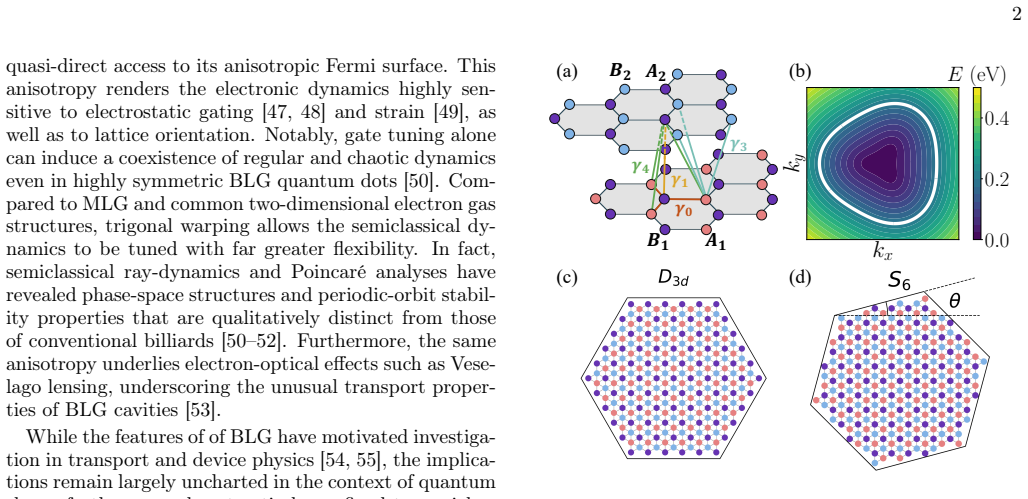
The trigonally warped Fermi surface of AB-stacked bilayer graphene—arising from the γ3 skew interlayer hopping—gives a strongly anisotropic group velocity, together with a reflection rule that conserves energy and tangential momentum in a Minkowski billiard. The paper's machinery is the interplay between this warped reflection map and the hexagonal boundary's orientation: at alignment the map is commensurate and effectively specular, while upon rotation it becomes incommensurate, spreading trajectories quasi-ergodically over phase space. This classical restructuring is then linked to the quantum observables: level-spacing ratio, spectral rigidity, eigenstate correlation length, and momentum-
Load-bearing premise
The semiclassical explanation assumes that the relevant classical limit of the atomistic tight-binding model is a Minkowski billiard whose boundary reflection conserves energy and tangential momentum, with zero Berry curvature; if the true atomistic edge reflection law deviates substantially from this rule at E ≈ 0.2 eV, the quasi-ergodic phase-space filling and the resulting quantum transition would need a different explanation.
What would settle it
Measure the spectral statistics of a single hexagonal bilayer graphene quantum dot as a function of edge rotation angle at E ≈ 0.2 eV: if the mean level-spacing ratio does not move from the semi-Poisson regime toward GOE/GUE values for rotations of ~0.1°–1°, or if monolayer graphene (which has an isotropic Fermi surface and no trigonal warping) shows the same chaotic transition, the claim that trigonal-warping commensurability loss drives the effect is falsified. Alternatively, an atomistic calculation of the edge reflection probability for zigzag–armchair mixed edges that shows tangential mom
If this is right
- Rotation angle becomes a robust, experimentally accessible knob for switching a bilayer graphene cavity between pseudointegrable and chaotic regimes, with no need for strong magnetic fields or external potentials.
- The transition should be observable in low-temperature transport: Coulomb blockade and excited-state spectroscopy of rotated cavities should reveal level statistics approaching Wigner–Dyson (GOE for the A sector, GUE for the E sector).
- Eigenstate profiles become random-wave-like with correlation length near the Fermi wavelength, meaning scanning probe imaging of the density should show spatially uncorrelated patterns distinct from the standing waves of aligned cavities.
- The semiclassical quasi-ergodic filling explains GOE/GUE statistics without classical Lyapunov chaos, so bilayer graphene cavities join the class of systems where ergodicity alone yields random-matrix spectral universality.
- Device designs must avoid the commensurate 30° armchair orientation, where edge-dominated physics restores quasi-integrable behaviour and the bulk-mismatch mechanism is not captured by the simple semiclassical model.
- The robustness of the transition across cavity sizes (r = 400–500 nm) and with or without point-group symmetry indicates the effect is generic to the warped Fermi-surface geometry rather than a fine-tuned resonance.
Where Pith is reading between the lines
- The mechanism should generalise to any two-dimensional material with a stacked, warped Fermi surface and hard-wall confinement; materials with stronger trigonal warping, or the ability to tune warping via an electric field, might exhibit the chaos transition at even smaller misalignments or with an electrically controllable threshold.
- Beyond spectral statistics, rotation angle could tune magnetotransport and interference phenomena such as conductance fluctuations and weak (anti)localisation, since chaotic and regular classical dynamics produce qualitatively different quantum interference corrections.
- The quasi-ergodic, non-hyperbolic phase space at intermediate rotations shows filamentary streaks that could support superscars or other structured eigenstates in a controlled way, offering a testbed for predictions about pseudointegrable-to-chaotic crossover.
- A direct experimental extension would be to map the momentum-space inverse participation ratio of individual eigenstates via Fourier-transform scanning tunnelling spectroscopy, tracking its decrease as a function of rotation angle to confirm the plane-wave-composition mechanism.
Editorial analysis
A structured set of objections, weighed in public.
Referee Report
Summary. This paper studies quantum chaos in hexagonal AB-stacked bilayer graphene cavities using large-scale tight-binding simulations. The authors rotate the hexagonal boundary relative to the underlying lattice through 0°–30° and analyze symmetry-resolved level statistics (r-ratio, spectral rigidity), eigenstate correlation lengths, and momentum-space IPR. For the aligned case they report Poisson-like A1u/A2g sectors and semi-Poisson pseudointegrable sectors; after rotation by 15°, ⟨r⟩ rises to 0.516 (A) and 0.558 (E), approaching Wigner–Dyson values, and correlation lengths drop toward the wavelength scale. A semiclassical Minkowski-billiard ray model with kt-conserving reflection shows Poincaré sections collapsing to invariant curves at alignment and spreading quasi-ergodically after rotation. Control calculations with artificial kinks, monolayer graphene, and different sizes support the interpretation that trigonal-warping-induced incommensurability, rather than edge roughness alone, drives the transition. The Discussion further claims that a rotation as small as 0.1° already drives the spectrum to Wigner–Dyson statistics.
Significance. If the result holds, the paper identifies a simple, experimentally accessible control knob—boundary-lattice orientation—for engineering quantum chaos in bilayer graphene cavities, and it provides an atomistic quantum treatment with semiclassical context. Strengths include large-scale tight-binding simulations, explicit symmetry resolution of sectors, use of a realistic lattice model that avoids continuum discretization artifacts, and multiple control calculations (kinks, monolayer graphene, system size). These are substantial and go beyond prior continuum-based semiclassical studies. However, the headline small-angle claim is not supported by the paper's own SI data, and no statistical uncertainties accompany the reported r-values and fit parameters. The semiclassical mechanism is heuristic and does not fully account for intervalley scattering at real edges, as the authors partly acknowledge. The central qualitative transition at moderate angles is credible, but the manuscript's strongest quantitative claims need correction and uncertainty quantification.
major comments (3)
- [Sec. V; SI Sec. IV.B, Fig. 5] The Discussion states that 'A rotation as small as 0.1° ... is already sufficient to drive the spectrum to Wigner–Dyson statistics.' This is contradicted by the paper's own Supplementary Fig. 5. At θ=0.1° the A subspace is described as semi-Poisson with ⟨r⟩ between Poisson (0.386) and GOE (0.531), and the E subspace as intermediate between GOE (0.531) and GUE (0.600); the rigidity in A 'closely follows GOE' and in E lies between GOE and GUE. Neither sector reaches Wigner–Dyson. The same wording also conflicts with the kink-control data (SI Fig. 4), which show that one kink is far from sufficient. Please correct the claim to describe a partial crossover at 0.1° and report the actual ⟨r⟩ and ⟨∆3⟩ values there. This is load-bearing because the advertised rapid small-angle control rests on it.
- [Sec. III.A; Fig. 2 and Fig. 3] All spectral statistics are reported as single numbers with no statistical uncertainties, fit-quality measures, or sensitivity checks. The energy window (0.18–0.25 eV) contains 2,978 levels total, split among symmetry sectors; ⟨r⟩ differences as small as 0.02–0.03 are used to classify sectors as Poisson, semi-Poisson, GOE, or GUE (e.g., A-sector 0.516 vs GOE 0.531; E-sector 0.558 vs GUE 0.600). Without bootstrap errors, finite-size dependence, or variation over unfolding choices, these classifications are not quantitatively secure. Please add error bars (e.g., bootstrap over levels or over independent window sub-blocks) and state the number of levels in each sector.
- [Sec. IV; SI Eqs. (9)–(10)] The causal claim that the transition 'originates from loss of commensurability between the warped Fermi surface and the polygonal boundary' rests on a continuum ray model (SI Eqs. (9)–(10)) that enforces kt-conserving reflection and ignores intervalley scattering and edge termination. The paper's own 30° case is an admitted edge-dominated exception, showing that edge physics can override the bulk mismatch criterion. The kink and MLG controls help, but the semiclassical model is never quantitatively connected to the quantum observables—no comparison of classical phase-space filling with quantum Husimi functions, no prediction of the θ-dependence of ⟨r⟩. I recommend either softening the causal language to 'consistent with' or adding a direct quantum-classical comparison; without it, the mechanism is suggestive rather than established.
minor comments (6)
- [SI Sec. I.C, Eq. (4)] The second sub-sublattice vector is written as (√3 a, 0), parallel to the first. Presumably it should be (0, √3 a) or similar. Please correct, as the sub-sublattice construction is used in the main-text eigenstate analysis.
- [Introduction] Grammatical typos: 'This paradigm have played' and 'features of of BLG' should be corrected.
- [Sec. VI.B] 'we are able to to resolve fully quantum spectrum' contains a duplicated 'to'.
- [SI Sec. IV.E] The sentence 'Further results show that the These results show that rotation does not drive MLG cavities...' is garbled and should be rewritten.
- [Conclusion] The statement that the rotated cavity 'produces Wigner–Dyson distribution of level spacing' is too strong; at θ=15° the A sector ⟨r⟩=0.516 lies below GOE (0.531) and the E sector ⟨r⟩=0.558 lies between GOE and GUE (0.600). Qualify this claim.
- [Fig. 4 caption] The statistical panels (c1)–(c5) are not fully described: it is unclear whether the curves are histograms, kernel densities, or fits, and what the error bars (if any) represent. Please clarify.
Circularity Check
No significant circularity: the quantum transition is computed directly from the tight-binding Hamiltonian; the semiclassical ray model is an explicitly separate heuristic.
full rationale
The central claim — that rotating the BLG cavity boundary relative to the lattice drives a near-integrable-to-chaotic quantum transition — is derived directly from diagonalization of the atomistic tight-binding Hamiltonian (Eq. 1) for each orientation angle. The spectral statistics, spectral rigidity, and correlation lengths are descriptive diagnostics of the computed eigenstates, not fitted constraints used to produce the transition. The semiclassical ray model (Sec. IV and SI Sec. II) is introduced explicitly as a continuum heuristic that 'intentionally omits atomistic edge details and serves as a heuristic tool' and is not used to generate the quantum spectra; it is an independent visualization of the classical phase-space structure. The semi-Poisson and GOE–GUE fits are characterizations, not predictions. The only self-citations (e.g., Ref. 22 by co-authors) are motivational and non-load-bearing, so they do not raise the circularity score. The Discussion's statement that 'a rotation as small as 0.1° ... is already sufficient to drive the spectrum to Wigner–Dyson statistics' is inconsistent with the paper's own SI Fig. 5, which shows intermediate statistics (semi-Poisson for A, GOE–GUE intermediate for E) at 0.1°; this is a quantitative overstatement or correctness concern, not a circularity.
Axiom & Free-Parameter Ledger
free parameters (4)
- Energy window ΔE =
0.18–0.25 eV
- Scaling factor s =
3
- Correlation length l (per eigenstate) =
e.g., 39.2 nm (A sector), 23.3 nm (E sector) at θ=15°
- Semi-Poisson β and GOE-GUE γ fit exponents =
β=0.83 and 0.57 for unrotated sectors; γ values not tabulated
axioms (6)
- domain assumption Hard-wall confinement approximates lithographically defined or grown BLG flakes.
- domain assumption Trigonal warping from γ3 dominates the relevant physics and the Fermi contour is convex in the chosen energy window.
- domain assumption The semiclassical reflection rule conserves energy and tangential momentum, with zero Berry curvature.
- standard math Bohigas-Giannoni-Schmit / Berry random-wave correspondence applies: Wigner-Dyson statistics and wavelength-scale correlations diagnose quantum chaos.
- domain assumption The scaling method with s=3 preserves the low-energy spectrum and spectral correlations of the unscaled lattice.
- domain assumption Edge roughness contributions are subdominant to trigonal-warping-induced incommensurability for intermediate rotation angles.
read the original abstract
Bilayer graphene cavities where electrons are confined within finite graphene flakes provide an alluring platform not only for the future nanoelectronic devices owing to the tunable energy gap but also for investigating the quantum nature of chaos due to the trigonal warping of their Fermi surface. Here we demonstrate that rotating the cavity boundary relative to the underlying lattice structure drives a quantum transition from nearly integrable dynamics to chaotic regime, observed as a concomitant crossover of eigenvalue statistics and eigenstate profiles. Complementing the full quantum treatment, we examine the classical backbone of this onset of chaos by employing semiclassical ray dynamics. Our results position bilayer graphene cavities as a promising venue for investigating and engineering quantum-chaotic behavior in graphene-based devices.
Figures


Reference graph
Works this paper leans on
-
[1]
Ott, Chaos in Dynamical Systems (Cambridge Uni- versity Press, 2002)
E. Ott, Chaos in Dynamical Systems (Cambridge Uni- versity Press, 2002)
2002
-
[2]
Chernov and R
N. Chernov and R. Markarian, Chaotic Billiards , Mathe- matical surveys and monographs (American Mathemati- cal Society, 2006)
2006
-
[3]
Stöckmann, Quantum Chaos: An Introduction (Cambridge University Press, 1999)
H.-J. Stöckmann, Quantum Chaos: An Introduction (Cambridge University Press, 1999)
1999
-
[4]
E. J. Heller, The Semiclassical Way to Dynamics and Spectroscopy (Princeton University Press, 2018)
2018
-
[5]
Gutzwiller, Chaos in Classical and Quantum Mechan- ics, Interdisciplinary Applied Mathematics (Springer New York, 1991)
M. Gutzwiller, Chaos in Classical and Quantum Mechan- ics, Interdisciplinary Applied Mathematics (Springer New York, 1991)
1991
-
[6]
Haake, Quantum Signatures of Chaos , Springer series in synergetics (Springer-Verlag, 1991)
F. Haake, Quantum Signatures of Chaos , Springer series in synergetics (Springer-Verlag, 1991)
1991
-
[7]
Tabor, Chaos and integrability in nonlinear dynamics , Vol
M. Tabor, Chaos and integrability in nonlinear dynamics , Vol. 3 (Wiley New York, 1989)
1989
-
[8]
Casati and B
G. Casati and B. Chirikov, Quantum Chaos: Between Order and Disorder (Cambridge University Press, 1995)
1995
-
[9]
Nakamura and T
K. Nakamura and T. Harayama, Quantum Chaos and Quantum Dots , Mesoscopic physics and nanotechnology (Oxford University Press, 2004)
2004
-
[10]
Mehta, Random Matrices , 3rd ed., Pure and Applied Mathematics (Academic Press, 2004)
M. Mehta, Random Matrices , 3rd ed., Pure and Applied Mathematics (Academic Press, 2004)
2004
-
[11]
Bohigas, M
O. Bohigas, M. J. Giannoni, and C. Schmit, Character- ization of chaotic quantum spectra and universality of level fluctuation laws, Phys. Rev. Lett. 52, 1 (1984)
1984
-
[12]
M. V. Berry, Regular and irregular semiclassical wave- functions, J. Phys. A: Math. Gen. 10, 2083 (1977)
2083
-
[13]
M. V. Berry and R. J. Mondragon, Neutrino bil- liards: time-reversal symmetry-breaking without mag- netic fields, Proc. Royal Soc. London. A. Math. Phys. Sci. 412, 53 (1987)
1987
-
[14]
L. A. Ponomarenko, F. Schedin, M. I. Katsnelson, R. Yang, E. W. Hill, K. S. Novoselov, and A. K. Geim, Chaotic dirac billiard in graphene quantum dots, Science 320, 356 (2008)
2008
-
[15]
D. Condado and E. Sadurní, An exactly solvable tight- binding billiard in graphene (2025), arXiv:2502.06092 [quant-ph]
Pith/arXiv arXiv 2025
-
[16]
Huang, H.-Y
L. Huang, H.-Y. Xu, C. Grebogi, and Y.-C. Lai, Rela- tivistic quantum chaos, Phys. Reports 753, 1 (2018)
2018
-
[17]
C. W. J. Beenakker, Colloquium: Andreev reflection and klein tunneling in graphene, Rev. Mod. Phys. 80, 1337 (2008)
2008
-
[18]
Y. Zhao, J. Wyrick, F. D. Natterer, J. F. Rodriguez- Nieva, C. Lewandowski, K. Watanabe, T. Taniguchi, L. S. Levitov, N. B. Zhitenev, and J. A. Stroscio, Cre- ating and probing electron whispering-gallery modes in graphene, Science 348, 672 (2015)
2015
-
[19]
A. K. Geim and K. S. Novoselov, The rise of graphene, Nat. Mater. 6, 183 (2007)
2007
-
[21]
A. R. Akhmerov and C. W. J. Beenakker, Boundary con- ditions for dirac fermions on a terminated honeycomb lattice, Phys. Rev. B 77, 085423 (2008)
2008
-
[22]
Z. Ge, A. M. Graf, J. Keski-Rahkonen, S. Sli- zovskiy, P. Polizogopoulos, T. Taniguchi, K. Watanabe, R. Van Haren, D. Lederman, V. I. Fal’ko, E. J. Heller, and J. Velasco, Direct visualization of relativistic quan- tum scars in graphene quantum dots, Nature 635, 841 (2024)
2024
-
[23]
A. H. Castro Neto, F. Guinea, N. M. R. Peres, K. S. Novoselov, and A. K. Geim, The electronic properties of graphene, Rev. Mod. Phys. 81, 109 (2009)
2009
-
[24]
Das Sarma, S
S. Das Sarma, S. Adam, E. H. Hwang, and E. Rossi, Electronic transport in two-dimensional graphene, Rev. Mod. Phys. 83, 407 (2011)
2011
-
[25]
D. N. Basov, M. M. Fogler, A. Lanzara, F. Wang, and Y. Zhang, Colloquium: Graphene spectroscopy, Rev. Mod. Phys. 86, 959 (2014)
2014
-
[26]
McCann and M
E. McCann and M. Koshino, The electronic properties of bilayer graphene, Reports on Prog. Phys. 76, 056503 (2013)
2013
-
[27]
C. Tong, R. Garreis, A. Knothe, M. Eich, A. Sacchi, K. Watanabe, T. Taniguchi, V. Fal’ko, T. Ihn, K. Ensslin, et al. , Tunable valley splitting and bipolar operation in graphene quantum dots, Nano Lett. 21, 1068 (2021)
2021
-
[28]
Banszerus, A
L. Banszerus, A. Rothstein, T. Fabian, S. Moller, E. Ick- ing, S. Trellenkamp, F. Lentz, D. Neumaier, K. Watan- abe, T. Taniguchi, et al. , Electron–hole crossover in gate- controlled bilayer graphene quantum dots, Nano Lett. 20, 7709 (2020)
2020
-
[29]
Banszerus, K
L. Banszerus, K. Hecker, S. Möller, E. Icking, K. Watan- abe, T. Taniguchi, C. Volk, and C. Stampfer, Spin re- 11 laxation in a single-electron graphene quantum dot, Nat. Commun. 13, 3637 (2022)
2022
-
[30]
Garreis, A
R. Garreis, A. Knothe, C. Tong, M. Eich, C. Gold, K. Watanabe, T. Taniguchi, V. Fal’ko, T. Ihn, K. Ensslin, and A. Kurzmann, Shell filling and trigonal warping in graphene quantum dots, Phys. Rev. Lett. 126, 147703 (2021)
2021
-
[31]
Garreis, C
R. Garreis, C. Tong, J. Terle, M. J. Ruckriegel, J. D. Gerber, L. M. Gächter, K. Watanabe, T. Taniguchi, T. Ihn, K. Ensslin, et al. , Long-lived valley states in bi- layer graphene quantum dots, Nat. Phys. 20, 428 (2024)
2024
-
[32]
Garreis, J
R. Garreis, J. D. Gerber, V. Stará, C. Tong, C. Gold, M. Röösli, K. Watanabe, T. Taniguchi, K. Ensslin, T. Ihn, et al. , Counting statistics of single electron trans- port in bilayer graphene quantum dots, Phys. Rev. Res. 5, 013042 (2023)
2023
-
[33]
Kurzmann, Y
A. Kurzmann, Y. Kleeorin, C. Tong, R. Garreis, A. Knothe, M. Eich, C. Mittag, C. Gold, F. K. de Vries, K. Watanabe, et al. , Kondo effect and spin–orbit cou- pling in graphene quantum dots, Nat. Commun. 12, 6004 (2021)
2021
-
[34]
Kurzmann, M
A. Kurzmann, M. Eich, H. Overweg, M. Mangold, F. Her- man, P. Rickhaus, R. Pisoni, Y. Lee, R. Garreis, C. Tong, et al. , Excited states in bilayer graphene quantum dots, Phys. Rev. Lett. 123, 026803 (2019)
2019
-
[35]
C. Tong, F. Ginzel, A. Kurzmann, R. Garreis, L. Os- tertag, J. D. Gerber, W. W. Huang, K. Watanabe, T. Taniguchi, G. Burkard, J. Danon, T. Ihn, and K. En- sslin, Three-carrier spin blockade and coupling in bilayer graphene double quantum dots, Phys. Rev. Lett. 133, 017001 (2024)
2024
-
[36]
McCann and V
E. McCann and V. I. Fal’ko, Landau-level degeneracy and quantum hall effect in a graphite bilayer, Phys. Rev. Lett. 96, 086805 (2006)
2006
-
[37]
H. Min, B. Sahu, S. K. Banerjee, and A. H. MacDon- ald, Ab initio theory of gate induced gaps in graphene bilayers, Phys. Rev. B 75, 155115 (2007)
2007
-
[38]
E. V. Castro, K. S. Novoselov, S. V. Morozov, N. M. R. Peres, J. M. B. L. dos Santos, J. Nilsson, F. Guinea, A. K. Geim, and A. H. C. Neto, Biased bilayer graphene: Semiconductor with a gap tunable by the electric field effect, Phys. Rev. Lett. 99, 216802 (2007)
2007
-
[39]
Zhang, T.-T
Y. Zhang, T.-T. Tang, C. Girit, Z. Hao, M. C. Martin, A. Zettl, M. F. Crommie, Y. R. Shen, and F. Wang, Direct observation of a widely tunable bandgap in bilayer graphene, Nature 459, 820 (2009)
2009
-
[40]
D. C. Bell, M. C. Lemme, L. A. Stern, J. R. Williams, and C. M. Marcus, Precision cutting and patterning of graphene with helium ions, Nanotechnology 20, 455301 (2009)
2009
-
[41]
C. Cong, T. Yu, Z. Ni, L. Liu, Z. Shen, and W. Huang, Fabrication of graphene nanodisk arrays us- ing nanosphere lithography, J. Phys. Chem. C 113, 6529 (2009)
2009
-
[42]
Rubio-Verdú, G
C. Rubio-Verdú, G. Sáenz-Arce, J. Martinez-Asencio, D. Milan, M. Moaied, J. Palacios, M. J. Caturla, and C. Untiedt, Graphene flakes obtained by local electro- exfoliation of graphite with a stm tip, Phys. Chem. Chem. Phys. 19, 8061 (2017)
2017
-
[44]
C. Gold, A. Knothe, A. Kurzmann, A. Garcia-Ruiz, K. Watanabe, T. Taniguchi, V. Fal’ko, K. Ensslin, and T. Ihn, Coherent jetting from a gate-defined channel in bilayer graphene, Phys. Rev. Lett. 127, 046801 (2021)
2021
-
[45]
Kechedzhi, V
K. Kechedzhi, V. I. Fal’ko, E. McCann, and B. L. Alt- shuler, Influence of trigonal warping on interference ef- fects in bilayer graphene, Phys. Rev. Lett. 98, 176806 (2007)
2007
-
[46]
Kaladzhyan, F
V. Kaladzhyan, F. Joucken, Z. Ge, E. A. Quezada-Lopez, T. Taniguchi, K. Watanabe, J. Velasco, and C. Bena, Quasiparticle interference patterns in bilayer graphene with trigonal warping, Phys. Rev. B 104, 235425 (2021)
2021
-
[47]
T. Ohta, A. Bostwick, T. Seyller, K. Horn, and E. Roten- berg, Controlling the electronic structure of bilayer graphene, Science 313, 951 (2006)
2006
-
[48]
J. B. Oostinga, H. B. Heersche, X. Liu, A. F. Morpurgo, and L. M. Vandersypen, Gate-induced insulating state in bilayer graphene devices, Nat. Mater. 7, 151 (2008)
2008
-
[49]
Mucha-Kruczyński, I
M. Mucha-Kruczyński, I. L. Aleiner, and V. I. Fal’ko, Strained bilayer graphene: Band structure topology and landau level spectrum, Phys. Rev. B 84, 041404 (2011)
2011
-
[50]
Seemann, A
L. Seemann, A. Knothe, and M. Hentschel, Gate-tunable regular and chaotic electron dynamics in ballistic bilayer graphene cavities, Phys. Rev. B 107, 205404 (2023)
2023
-
[51]
Seemann, J
L. Seemann, J. Lukin, M. Häßler, S. Gemming, and M. Hentschel, Complex dynamics in circular and deformed bilayer graphene-inspired billiards with anisotropy and strain, Symmetry 17 (2025)
2025
-
[52]
F. Schoeppl, A. Mrenca-Kolasinska, M.-H. Liu, K. Schwarzmaier, K. Richter, and A. Knothe, Anisotropic transport in ballistic bilayer graphene cavities (2025), arXiv:2512.08588 [cond-mat.mes-hall]
arXiv 2025
-
[53]
V. V. Cheianov, V. Fal’ko, and B. L. Altshuler, The fo- cusing of electron flow and a veselago lens in graphene p-n junctions, Science 315, 1252 (2007)
2007
-
[54]
J. W. González, H. Santos, M. Pacheco, L. Chico, and L. Brey, Electronic transport through bilayer graphene flakes, Phys. Rev. B 81, 195406 (2010)
2010
-
[55]
San-Jose, R
P. San-Jose, R. V. Gorbachev, A. K. Geim, K. S. Novoselov, and F. Guinea, Stacking boundaries and transport in bilayer graphene, Nano Lett. 14, 2052 (2014)
2052
-
[56]
Hentschel, S
M. Hentschel, S. Schlötzer, and L. Seemann, Ray–wave correspondence in anisotropic mesoscopic billiards, En- tropy 27 (2025)
2025
-
[57]
Richens and M
P. Richens and M. Berry, Pseudointegrable systems in classical and quantum mechanics, Phys. D: Nonlinear Phenom. 2, 495 (1981)
1981
-
[58]
Lozej and E
Č. Lozej and E. Bogomolny, Intermediate spectral statis- tics of rational triangular quantum billiards, Phys. Rev. E 110, 024213 (2024)
2024
-
[59]
M. V. Berry and M. Robnik, Semiclassical level spac- ings when regular and chaotic orbits coexist, J. Phys. A: Math. Gen. 17, 2413 (1984)
1984
-
[60]
Cheon and T
T. Cheon and T. D. Cohen, Quantum level statistics of pseudointegrable billiards, Phys. Rev. Lett. 62, 2769 (1989)
1989
-
[61]
E. B. Bogomolny, U. Gerland, and C. Schmit, Models of intermediate spectral statistics, Phys. Rev. E 59, R1315 (1999)
1999
-
[62]
Giraud, J
O. Giraud, J. Marklof, and S. O’Keefe, Intermediate statistics in quantum maps, J. Phys. A: Math. Gen. 37, L303 (2004)
2004
-
[63]
Biswas and S
D. Biswas and S. R. Jain, Quantum description of a pseu- dointegrable system: The π/3-rhombus billiard, Phys. Rev. A 42, 3170 (1990). 12
1990
-
[64]
Bogomolny, U
E. Bogomolny, U. Gerland, and C. Schmit, Short-range plasma model for intermediate spectral statistics, The Eur. Phys. J. B 19, 121–132 (2001)
2001
-
[65]
T. A. Lima, R. B. do Carmo, K. Terto, and F. M. de Aguiar, Time-reversal-invariant hexagonal billiards with a point symmetry, Phys. Rev. E 104, 064211 (2021)
2021
-
[66]
E. J. Heller, Bound-state eigenfunctions of classically chaotic hamiltonian systems: Scars of periodic orbits, Phys. Rev. Lett. 53, 1515 (1984)
1984
-
[67]
M. V. Berry, Regularity and chaos in classical mechanics, illustrated by three deformations of a circular ‘billiard’, Eur. J. Phys. 2, 91 (1981)
1981
-
[68]
Gutkin and S
E. Gutkin and S. Tabachnikov, Billiards in finsler and minkowski geometries, J. Geom. Phys. 40, 277 (2002)
2002
-
[69]
J. Wang, G. Benenti, G. Casati, and W.-g. Wang, Statis- tical and dynamical properties of the quantum triangle map, J. Phys. A: Math. Theor. 55, 234002 (2022)
2022
-
[70]
Lozej, G
Č. Lozej, G. Casati, and T. Prosen, Quantum chaos in triangular billiards, Phys. Rev. Res. 4, 013138 (2022)
2022
-
[71]
Degli Esposti, S
M. Degli Esposti, S. O’Keefe, and B. Winn, A semi- classical study of the casati–prosen triangle map, Non- linearity 18, 1073 (2005)
2005
-
[72]
Yu, Z.-Y
P. Yu, Z.-Y. Li, H.-Y. Xu, L. Huang, B. Dietz, C. Gre- bogi, and Y.-C. Lai, Gaussian orthogonal ensemble statis- tics in graphene billiards with the shape of classically integrable billiards, Phys. Rev. E 94, 062214 (2016)
2016
-
[73]
Hagymási, P
I. Hagymási, P. Vancsó, A. Pálinkás, and Z. Osváth, In- teraction effects in a chaotic graphene quantum billiard, Phys. Rev. B 95, 075123 (2017)
2017
-
[74]
J. Wurm, K. Richter, and i. d. I. m. c. Adagideli, Edge effects in graphene nanostructures: From multiple reflec- tion expansion to density of states, Phys. Rev. B 84, 075468 (2011)
2011
-
[75]
T. Ma, W. Ren, X. Zhang, Z. Liu, Y. Gao, L.-C. Yin, X.-L. Ma, F. Ding, and H.-M. Cheng, Edge-controlled growth and kinetics of single-crystal graphene domains by chemical vapor deposition, Proc. Natl. Acad. Sci. 110, 20386 (2013)
2013
-
[76]
Barreiro, H
A. Barreiro, H. S. J. van der Zant, and L. M. K. Vander- sypen, Quantum dots at room temperature carved out from few-layer graphene, Nano Lett. 12, 6096 (2012)
2012
-
[77]
Subramaniam, F
D. Subramaniam, F. Libisch, Y. Li, C. Pauly, V. Geringer, R. Reiter, T. Mashoff, M. Liebmann, J. Burgdörfer, C. Busse, T. Michely, R. Mazzarello, M. Pratzer, and M. Morgenstern, Wave-function map- ping of graphene quantum dots with soft confinement, Phys. Rev. Lett. 108, 046801 (2012)
2012
-
[78]
A. S. M. Goossens, S. C. M. Driessen, T. A. Baart, K. Watanabe, T. Taniguchi, and L. M. K. Vandersypen, Gate-defined confinement in bilayer graphene-hexagonal boron nitride hybrid devices, Nano Lett. 12, 4656 (2012)
2012
-
[79]
Kurzmann, H
A. Kurzmann, H. Overweg, M. Eich, A. Pally, P. Rick- haus, R. Pisoni, Y. Lee, K. Watanabe, T. Taniguchi, T. Ihn, and K. Ensslin, Charge detection in gate-defined bilayer graphene quantum dots, Nano Lett. 19, 5216 (2019)
2019
-
[80]
Banszerus, S
L. Banszerus, S. Möller, E. Icking, K. Watanabe, T. Taniguchi, C. Volk, and C. Stampfer, Single-electron double quantum dots in bilayer graphene, Nano Lett. 20, 2005 (2020)
2005
-
[81]
Bogomolny and C
E. Bogomolny and C. Schmit, Structure of wave functions of pseudointegrable billiards, Phys. Rev. Lett. 92, 244102 (2004)
2004
-
[82]
Bogomolny, B
E. Bogomolny, B. Dietz, T. Friedrich, M. Miski-Oglu, A. Richter, F. Schäfer, and C. Schmit, First experimental observation of superscars in a pseudointegrable barrier billiard, Phys. Rev. Lett. 97, 254102 (2006)
2006
discussion (0)
Sign in with ORCID, Apple, or X to comment. Anyone can read and Pith papers without signing in.