libyt: an In Situ Interface Connecting Simulations with yt, Python, and Jupyter Workflows
Pith reviewed 2026-05-16 22:26 UTC · model grok-4.3
The pith
libyt maps simulation data directly to yt frontends so existing Python post-processing scripts become in-situ analysis with two lines of change.
A machine-rendered reading of the paper's core claim, the machinery that carries it, and where it could break.
Core claim
libyt supplies a bidirectional interface between simulation memory and Python that automatically yields patch-based AMR data on request, maps it to yt frontends, and supports both automatic routine invocation and interactive Jupyter sessions with negligible extra code.
What carries the argument
The yt frontend mapping layer that converts in-memory simulation patches into yt-readable structures so post-processing scripts run unchanged during the simulation.
Load-bearing premise
The extra time spent moving data to Python and running the analysis stays small compared with the main simulation steps.
What would settle it
Measure wall-clock time for a full production run of GAMER or Enzo with and without libyt calls; if the version using libyt takes substantially longer, the claim does not hold.
Figures




read the original abstract
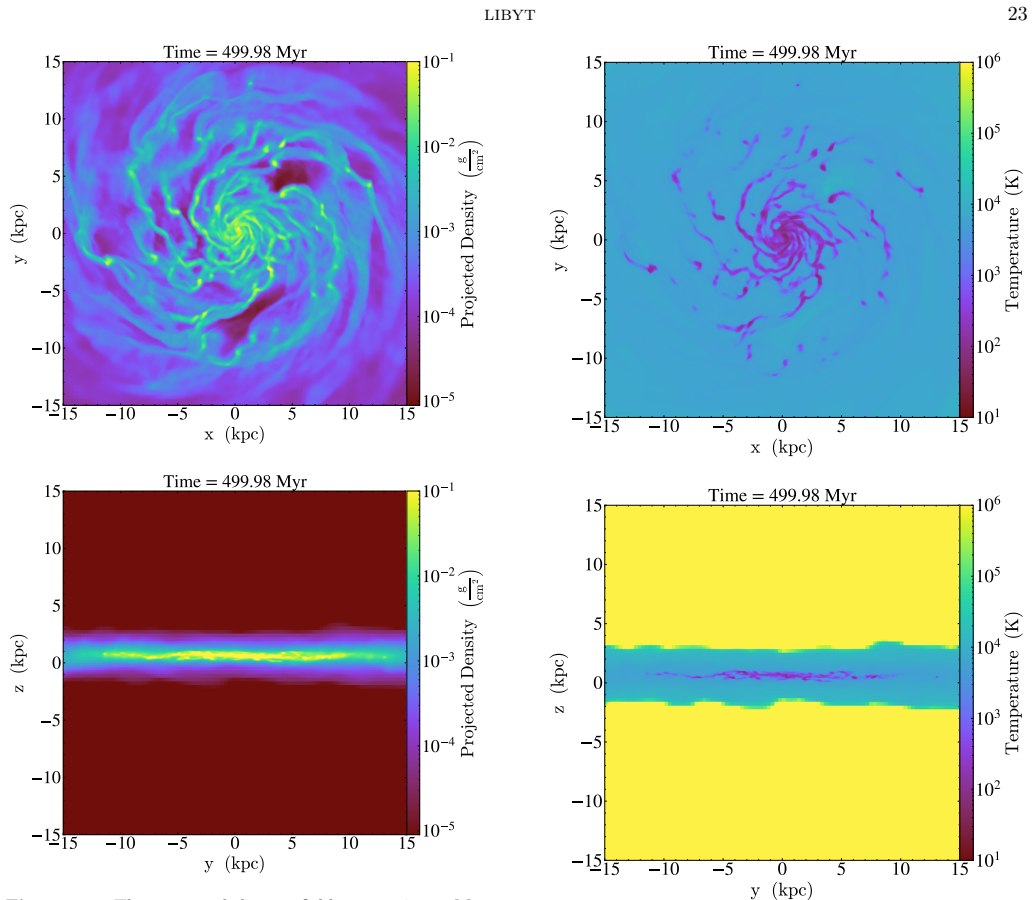
In the exascale computing era, handling and analyzing massive datasets have become extremely challenging. In situ analysis, which processes data during simulation runtime and bypasses costly intermediate disk input and output steps, offers a promising solution. We present libyt (https://github.com/yt-project/libyt), an open-source C library that enables astrophysical simulations to analyze and visualize data in parallel computation with yt or other Python packages. libyt can invoke Python routines automatically or provide interactive entry points via a Python prompt or a Jupyter Notebook. It requires minimal intervention in researchers' workflow, allowing users to reuse job submission scripts and Python routines. We describe libyt's architecture for parallel computing in high-performance computing environments, including its bidirectional connection between simulation codes and Python, and its integration into the Jupyter ecosystem. We detail its methods for reading patch-based adaptive mesh refinement (AMR) simulations and handling in-memory data with minimal overhead, and procedures for yielding data when requested by Python. We describe how libyt maps simulation data to yt frontends, allowing post-processing scripts to be converted into in situ analysis with just two lines of change. We document libyt's API and demonstrate its integration into two astrophysical simulation codes, GAMER and Enzo, using examples including core-collapse supernovae, isolated dwarf galaxies, fuzzy dark matter, the Sod shock tube test, Kelvin-Helmholtz instability, and the AGORA galaxy simulation. Finally, we discuss libyt's performance, limitations related to data redistribution, extensibility, architecture, and comparisons with traditional post-processing approaches.
Editorial analysis
A structured set of objections, weighed in public.
Referee Report
Summary. The manuscript presents libyt, an open-source C library that provides an in-situ interface between parallel astrophysical simulations (GAMER, Enzo) and yt/Python/Jupyter workflows. It claims that simulation data can be mapped to yt frontends so that existing post-processing scripts can be converted to in-situ analysis with only two lines of code change, while supporting AMR patch handling, bidirectional C-Python connections, automatic or interactive Python invocation, and minimal workflow disruption.
Significance. If the overhead remains acceptable, libyt offers a practical bridge between high-performance simulation codes and the flexible yt analysis ecosystem. The demonstrations across core-collapse supernovae, dwarf galaxies, fuzzy dark matter, standard hydro tests, and AGORA galaxy runs, together with the open-source release and Jupyter integration, provide a concrete tool that could reduce disk I/O bottlenecks in exascale astrophysics workflows.
major comments (1)
- [performance and limitations discussion] Performance and limitations discussion: the text notes data redistribution costs as a limitation but supplies no wall-clock timings, scaling curves, or overhead fractions measured on production-scale runs (thousands of ranks) for GAMER or Enzo. Without these numbers the claim that Python invocation and redistribution remain acceptable for exascale in-situ analysis rests on an untested assumption.
minor comments (2)
- [yt frontend mapping description] The exact two-line modification that converts a post-processing script to in-situ use is stated but not shown with a side-by-side code example; adding one would make the central usability claim immediately verifiable.
- [API documentation] The API documentation section would benefit from a concise table listing the principal C functions, their arguments, and return values rather than only prose descriptions.
Simulated Author's Rebuttal
We thank the referee for the positive summary, recognition of libyt's practical value for exascale workflows, and recommendation of minor revision. We address the single major comment below and will revise the manuscript accordingly.
read point-by-point responses
-
Referee: [performance and limitations discussion] Performance and limitations discussion: the text notes data redistribution costs as a limitation but supplies no wall-clock timings, scaling curves, or overhead fractions measured on production-scale runs (thousands of ranks) for GAMER or Enzo. Without these numbers the claim that Python invocation and redistribution remain acceptable for exascale in-situ analysis rests on an untested assumption.
Authors: We agree that quantitative performance data strengthens the manuscript. The current text discusses data redistribution as the primary cost and notes that overhead remains acceptable for the demonstrated cases, but we acknowledge the absence of explicit wall-clock timings, scaling curves, and overhead fractions at production scales. In the revised version we will add a dedicated performance subsection that reports: (1) wall-clock timings and Python invocation overhead for the GAMER core-collapse supernova and Enzo AGORA runs on up to 512 ranks, (2) scaling curves for the in-situ data-yield and redistribution steps, and (3) fractional overhead relative to the underlying hydro step. We will also state explicitly that full exascale (thousands of ranks) benchmarks lie beyond the present test suite and will be pursued in follow-up work. These additions will be placed in the performance and limitations section and will be accompanied by the raw timing tables in the supplementary material. revision: partial
Circularity Check
No circularity; direct description of software implementation
full rationale
The paper is a software engineering description of libyt's architecture, API, AMR data handling, C-Python bidirectional connection, yt frontend mapping, and integrations with GAMER/Enzo. No mathematical derivations, fitted parameters, predictions of new quantities, or load-bearing self-citations appear. The central claim (two-line script conversion via frontend mapping) follows directly from the implemented data-yielding procedures rather than reducing to a self-referential fit or imported uniqueness theorem. Performance discussion notes redistribution costs without claiming untested predictions. The work is self-contained against external benchmarks and code examples.
Axiom & Free-Parameter Ledger
Reference graph
Works this paper leans on
-
[1]
2005, Visualization Handbook, ed
Ahrens, J., Geveci, B., & Law, C. 2005, Visualization Handbook, ed. C. D. Hansen & C. R. Johnson (Burlington, MA: Elsevier Butterworth –Heinemann), 717
work page 2005
-
[2]
Ayachit, U., Bauer, A., Geveci, B., et al. 2015, in Proceedings of the First Workshop on In Situ Infrastructures for Enabling Extreme-Scale Analysis and Visualization (ISAV 2015), 25–29, doi: 10.1145/2828612.2828624
-
[3]
Bryan, G. L., Norman, M. L., O’Shea, B. W., et al. 2014, The Astrophysical Journal Supplement Series, 211, 19, doi: 10.1088/0067-0049/211/2/19
-
[4]
Childs, H., Brugger, E., Whitlock, B., et al. 2012, in High Performance Visualization–Enabling Extreme-Scale Scientific Insight, 357–372, doi: 10.1201/b12985
-
[5]
Dalcin, L., & Fang, Y.-L. L. 2021, Computing in Science & Engineering, 23, 47, doi: 10.1109/MCSE.2021.3083216
-
[6]
Gabriel, E., Fagg, G. E., Bosilca, G., et al. 2004, in Proceedings, 11th European PVM/MPI Users’ Group
work page 2004
-
[7]
Harris, C. R., Millman, K. J., van der Walt, S. J., et al. 2020, Nature, 585, 357, doi: 10.1038/s41586-020-2649-2
-
[8]
Hunter, J. D. 2007, Computing in Science & Engineering, 9, 90, doi: 10.1109/MCSE.2007.55
-
[9]
2017, pybind11 – Seamless operability between C++11 and Python
Jakob, W., Rhinelander, J., & Moldovan, D. 2017, pybind11 – Seamless operability between C++11 and Python
work page 2017
-
[10]
2016, ApJ, 833, 202, doi: 10.3847/1538-4357/833/2/202
Kim, J.-h., Agertz, O., Teyssier, R., et al. 2016, ApJ, 833, 202, doi: 10.3847/1538-4357/833/2/202
-
[11]
2016, in Positioning and Power in Academic Publishing: Players, Agents and Agendas, ed
Kluyver, T., Ragan-Kelley, B., Prez, F., et al. 2016, in Positioning and Power in Academic Publishing: Players, Agents and Agendas, ed. F. Loizides & B. Scmidt (IOS Press), 87–90. https://eprints.soton.ac.uk/403913/
work page 2016
-
[12]
Liao, P.-Y. 2025, ApJS, 279, 39, doi: 10.3847/1538-4365/addc59
-
[13]
Larsen, M., Brugger, E., Childs, H., & Harrison, C. 2022, in In Situ Visualization For Computational Science (Cham, Switzerland: Mathematics and Visualization book series from Springer Publishing), 255 – 279
work page 2022
-
[14]
Lattimer, J. M., & Swesty, D. F. 1991, NuPhA, 535, 331, doi: 10.1016/0375-9474(91)90452-C
-
[15]
Levkov, D. G., Panin, A. G., & Tkachev, I. I. 2018, PhRvL, 121, 151301, doi: 10.1103/PhysRevLett.121.151301 Liebend¨ orfer, M. 2005, ApJ, 633, 1042, doi: 10.1086/466517
-
[16]
Lin, S.-C., Schive, H.-Y., Wong, S.-K., & Chiueh, T. 2018, PhRvD, 97, 103523, doi: 10.1103/PhysRevD.97.103523
-
[17]
Loring, B., Myers, A., Camp, D., & Bethel, E. W. 2018, in Proceedings of the Workshop on In Situ Infrastructures for Enabling Extreme-Scale Analysis and Visualization, ISAV ’18 (New York, NY, USA: Association for Computing Machinery), 19–24, doi: 10.1145/3281464.3281465
-
[18]
2006, A&A, 445, 273, doi: 10.1051/0004-6361:20052840
Buras, R. 2006, A&A, 445, 273, doi: 10.1051/0004-6361:20052840 34 Tsai et al. Message Passing Interface Forum. 2023, MPI: A Message-Passing Interface Standard Version 4.1. https: //www.mpi-forum.org/docs/mpi-4.1/mpi41-report.pdf
-
[19]
2005, Journal of Computational Physics, 208, 315 , doi: https://doi.org/10.1016/j.jcp.2005.02.017
Miyoshi, T., & Kusano, K. 2005, Journal of Computational Physics, 208, 315 , doi: https://doi.org/10.1016/j.jcp.2005.02.017
-
[20]
Nethercote, N., & Seward, J. 2007, in Proceedings of the 28th ACM SIGPLAN Conference on Programming Language Design and Implementation, PLDI ’07 (New
work page 2007
-
[21]
York, NY, USA: Association for Computing Machinery), 89–100, doi: 10.1145/1250734.1250746
-
[22]
Niethammer, C., & Rabenseifner, R. 2019, in Proceedings of the 26th European MPI Users’ Group Meeting, EuroMPI ’19 (New York, NY, USA: Association for Computing Machinery), doi: 10.1145/3343211.3343217 O’Connor, E., & Ott, C. D. 2010, Classical and Quantum Gravity, 27, 114103, doi: 10.1088/0264-9381/27/11/114103 P´ erez, F., & Granger, B. E. 2007, Computi...
-
[23]
Pontzen, A., Roˇ skar, R., Stinson, G., & Woods, R. 2013, pynbody: N-Body/SPH analysis for python, Astrophysics Source Code Library, record ascl:1305.002. http://ascl.net/1305.002
work page 2013
-
[24]
2018, The Astrophysical Journal Supplement Series, 237, 23, doi: 10.3847/1538-4365/aac832
Pontzen, A., & Tremmel, M. 2018, The Astrophysical Journal Supplement Series, 237, 23, doi: 10.3847/1538-4365/aac832
-
[25]
2011, Computing in Science & Engineering, 13, 40
Ramachandran, P., & Varoquaux, G. 2011, Computing in Science & Engineering, 13, 40
work page 2011
-
[26]
Schive, H.-Y., ZuHone, J. A., Goldbaum, N. J., et al. 2018, Monthly Notices of the Royal Astronomical Society, 481, 4815, doi: 10.1093/mnras/sty2586
-
[27]
Smith, B. D., Bryan, G. L., Glover, S. C. O., et al. 2017, MNRAS, 466, 2217, doi: 10.1093/mnras/stw3291
-
[28]
Sod, G. A. 1978, Journal of Computational Physics, 27, 1, doi: https://doi.org/10.1016/0021-9991(78)90023-2
-
[29]
Springel, V., Di Matteo, T., & Hernquist, L. 2005, MNRAS, 361, 776, doi: 10.1111/j.1365-2966.2005.09238.x
-
[30]
Steiner, A. W., Hempel, M., & Fischer, T. 2013, ApJ, 774, 17, doi: 10.1088/0004-637X/774/1/17
-
[31]
Simon, J. B. 2008, ApJS, 178, 137, doi: 10.1086/588755
-
[32]
Toro, E. F. 2009, Riemann solvers and numerical methods for fluid dynamics. A practical introduction, 3rd edn. (Berlin: Springer)
work page 2009
-
[33]
Tsai, S.-R., Schive, H.-Y., & Turk, M. 2023, in Proceedings of the 22nd Python in Science Conference, SciPy (SciPy), doi: 10.25080/gerudo-f2bc6f59-011
-
[34]
2024, in Proceedings of the Platform for Advanced Scientific Computing
Tsai, S.-R., Schive, H.-Y., & Turk, M. 2024, in Proceedings of the Platform for Advanced Scientific Computing
work page 2024
-
[35]
Conference, PASC ’24 (New York, NY, USA: Association for Computing Machinery), doi: 10.1145/3659914.3659939
-
[36]
Turk, M. J., Smith, B. D., Oishi, J. S., et al. 2011, The Astrophysical Journal Supplement Series, 192, 9, doi: 10.1088/0067-0049/192/1/9 Van Rossum, G., & Drake, F. L. 2009, Python 3 Reference Manual (Scotts Valley, CA: CreateSpace)
-
[37]
1984, Journal of Computational Physics, 54, 115, doi: 10.1016/0021-9991(84)90142-6
Woodward, P., & Colella, P. 1984, Journal of Computational Physics, 54, 115, doi: 10.1016/0021-9991(84)90142-6
-
[38]
2007, Physics Reports, 442, 269, doi: 10.1016/j.physrep.2007.02.009
Woosley, S. E., & Heger, A. 2007, PhR, 442, 269, doi: 10.1016/j.physrep.2007.02.009
discussion (0)
Sign in with ORCID, Apple, or X to comment. Anyone can read and Pith papers without signing in.