REVIEW 4 major objections 5 minor 2 cited by
A qCMOS camera with sub-electron read noise can outperform classical CCDs for fast time-domain imaging on 1-meter telescopes.
Reviewed by Pith at T0; open to challenge. T0 means a machine referee read the full paper against a public rubric. the ladder, T0–T4 →
T0 review · deepseek-v4-flash
2026-08-03 16:11 UTC pith:SBO7E6RW
load-bearing objection A competent, honest commissioning report with new on-sky qCMOS data; the broad 'outperforms CCDs' claim is plausible but is calibrated against a slow, high-read-noise CCD and needs a fairer benchmark before it generalizes. the 4 major comments →
The ORCA-TWIN qCMOS Experiment I. Science case and commissioning at Calar Alto Observatory
The pith
A machine-rendered reading of the paper's core claim, the machinery that carries it, and where it could break.
Core claim
The central claim is that qCMOS technology, exploiting a floating diffusion node with tiny capacitance and on-chip correlated double sampling, reaches sub-electron read noise (0.3 e−) while reading out a full frame in 0.039 s; classical CCDs used for comparison need 1.6 s and carry 11.7 e− read noise at 3 MHz. Because nine qCMOS pixels fit in one CCD pixel's area, the binned qCMOS read noise adds in quadrature to 0.9 e− — still 13 times below the CCD's 11.7 e−. In time-series simulations of a 19th-magnitude star, the qCMOS reaches SNR=10 at a 0.8 s cadence, while the CCD needs about 10 s; the CCD is readout-noise limited throughout. The paper reports first-light and high-cadence observations
What carries the argument
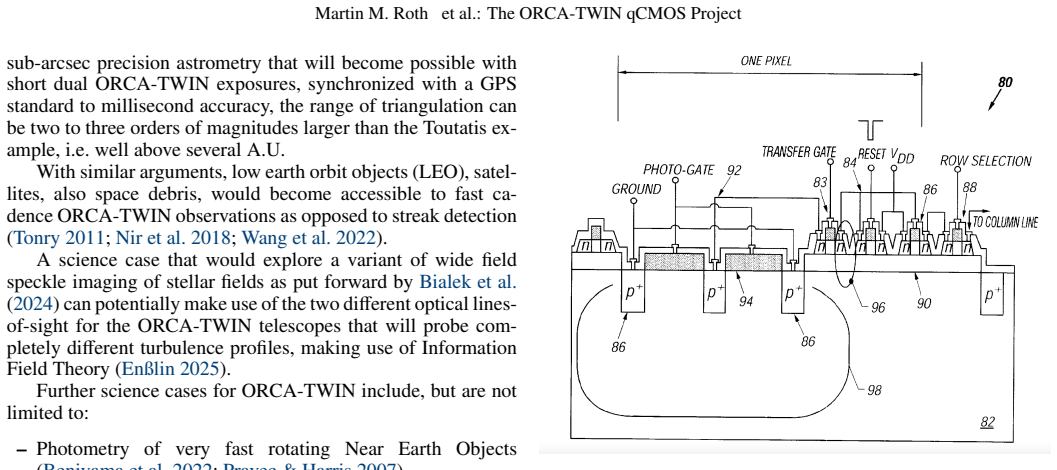
The enabling mechanism is the qCMOS pixel architecture: a floating diffusion node with very small capacitance converts individual photoelectrons into a high voltage, and on-chip correlated double sampling plus column-level low-pass filters suppress read noise to 0.3 e−. The argument's arithmetic engine is the comparison of binned read noise: for N=9 small pixels covering the same sky area as one CCD pixel, the combined noise is sqrt(N)×0.3 ≈ 0.9 e−, against 11.7 e− for the CCD, a factor-13 gain that shrinks but remains positive even against the CCD's slow-scan 2.9 e− mode.
Load-bearing premise
The paper's advantage rests on the assumption that the 11.7 e− read noise of the comparison CCD fairly represents what a classical CCD delivers at high cadence, and that the datasheet noise figures — not unmodeled effects like flat-field residuals or tracking jitter — govern real on-sky performance.
What would settle it
Point the same qCMOS and a modern frame-transfer CCD at the same 19th-magnitude star with 0.8 s exposures on the same telescope: if the qCMOS does not reach SNR≈10 where the CCD reaches SNR≈3 (or if the CCD reaches SNR=10 at a cadence well below 10 s), the central performance claim fails. A simpler check: a V=17 star at 0.1 s exposure should yield SNR≈4 on the qCMOS; if it does not, the simulation's prediction is not borne out.
If this is right
- High-cadence photometry at 0.1–2 s cadence becomes practical on 1-m telescopes, with SNR=10 reachable at 0.8 s for a 19th-magnitude star under good conditions.
- Time-series efficiency improves because the 0.039 s readout time is negligible, unlike the 1.6 s CCD readout that truncates cadence below that value.
- Two synchronized qCMOS cameras on an 1800 km baseline can extend asteroid parallax triangulation from the Moon-distance regime to several AU, and can probe different turbulence profiles for speckle imaging.
- Even under non-photometric, full-Moon conditions, differential photometry at 2 s cadence reproduces known light curves, showing the camera's robustness.
- The negligible penalty of post-readout binning opens scene-dependent data processing for direct imaging and potentially spectroscopy.
Where Pith is reading between the lines
- If the benchmark were a modern frame-transfer CCD with 2–3 e− read noise rather than the 11.7 e− used here, the factor-13 read-noise gain would shrink to roughly 3–4; the central 'generally outperforms' claim then depends on the CCD's slower readout time more than on its noise floor.
- The simulations omit flat-field residual noise, clock-induced charge, and tracking errors that may matter at 0.096 arcsec pixels; a realistic end-to-end test on bright stars with high cadence would quantify how much of the predicted SNR advantage survives on sky.
- The same noise arithmetic could apply to spectroscopy: if post-readout binning is nearly free, a qCMOS could replace a CCD for fast, low-resolution spectroscopy of variable targets on small telescopes.
- The two-site synchronized concept suggests a general method: any transient or Solar System object can be localized in 3D by differential timing between two fast cameras, not limited to the specific Toutatis-style triangulation.
Editorial analysis
A structured set of objections, weighed in public.
Referee Report
Summary. The paper reports the commissioning of a Hamamatsu ORCA-Quest 2 qCMOS camera at the Calar Alto 1.23 m telescope as the first element of the two-site ORCA-TWIN project. It presents the scientific motivation (high-cadence time-domain photometry, asteroid triangulation, occultations, speckle imaging), a numerical comparison of qCMOS versus a classical CCD based on a Poisson+Gaussian noise model and DAOPHOT aperture photometry, and commissioning results obtained under very unfavorable conditions (full Moon, Calima, clouds). The main claim, stated in the Abstract and Section 7, is that qCMOS technology generally outperforms classical CCDs for high-cadence imaging on 1 m-class telescopes. The simulation parameters are fully tabulated in Table A.1, and light curves of ZTF J2130+4420 and NN Ser are shown to demonstrate feasibility.
Significance. If the central comparative claim is correct, the result is valuable: it would show that small telescopes equipped with qCMOS cameras can reach cadences of ~0.1–2 s with SNR previously requiring much slower or noisier readouts. The paper has clear strengths: the simulation is transparent, all input parameters are tabulated, the noise model is standard, and the authors explicitly list their simplifications (Gaussian PSF, no flatfield residuals). The commissioning data are honest about the adverse conditions and still deliver scientifically usable light curves. However, the headline claim is broader than the evidence: the comparison uses only one specific full-frame CCD at a fast-readout setting, and no on-sky CCD comparison is presented. The central assertion therefore needs either a fairer benchmark or a more limited formulation.
major comments (4)
- [Abstract, §4, Table A.1] The claim that 'qCMOS technology generally outperforms classical CCDs for high-cadence imaging' rests on a simulation that compares ORCA-Quest 2 against a single CCD: the Andor iKon-L at 3 MHz with RON=11.7 e− and full-frame ROT=1.6 s. The paper itself states that the same CCD at 50 kHz has RON=2.9 e−, but no simulation is shown at that setting. For the published V=18/10 s example, a modern frame-transfer CCD with RON≈3 e− would reduce the SNR advantage from the quoted factor ~1.4 to roughly 1.1 (near unity). The generalization is therefore a parameterization of a favorable comparator, not an established general result. I recommend benchmarking against a representative frame-transfer/windowed CCD or replacing 'generally outperforms' with a qualified claim about full-frame CCDs of the iKon-L type.
- [§4, Fig. 6] The cadence-floor comparison is unfair. The CCD curve is truncated at 1.6 s because that is the full-frame readout time of the iKon-L at 3 MHz, but many classical CCDs used for high-cadence work (frame-transfer devices, windowed readout) can read a small science region in well under 0.1 s. Therefore the 0.1–2 s regime is not exclusive to qCMOS, and the conclusion that the CCD 'has already reached the detection limit at this short exposure time' should be demonstrated against a windowed/frame-transfer CCD scenario. Without this, the cadence advantage attributed to qCMOS alone is overstated.
- [§4, Table A.1] The simulation uses a Gaussian PSF and neglects flatfield residuals; these simplifications are acknowledged, but no sensitivity analysis is provided. The overall SNR advantage claimed for the qCMOS is only about a factor 1.4 in the headline case, and the qCMOS pixel scale is 0.096 arcsec, far finer than the seeing disk. Unmodeled Moffat wings, pixel-response nonuniformity, or tracking jitter at that sampling could plausibly change the DAOPHOT noise estimate by a non-negligible fraction of this margin. Please add robustness tests (e.g., Moffat PSF, 0.5% flatfield residuals) or state quantitatively why these effects are negligible for the 1.4× conclusion.
- [§7] Section 7 states that the feasibility of high-cadence photometry was demonstrated 'in agreement with the predictions from numerical simulations,' but no quantitative comparison between the measured light-curve scatter and the simulated SNR is given. Figure 10 shows a light curve obtained under non-photometric conditions, and the reduction is expressly preliminary. As written, the statement is too strong; either provide a quantitative SNR comparison from the commissioning data or soften the claim to 'consistent with the expected performance in a qualitative sense.'
minor comments (5)
- [Abstract vs. §2] The Abstract gives the ORCA-TWIN baseline as 1635 km, while §2 and Fig. 2 state 1800 km. Please unify.
- [§2] Typo: 'hot subdwards' should be 'hot subdwarfs'.
- [§4, Fig. 6] The axes of the scatter plot are not labeled in the available version of the figure. The reader should not have to infer which axis is cadence, which is detected photons, and which is SNR from the caption alone.
- [Table 1] Focal ratio is printed as '1/8'; this should be 'f/8' for consistency.
- [§4, p. 4] The text says 'a marginal SNR=4 detection' for the 0.1 s qCMOS exposure, and the printed value is 17±4 photons; the significance statement is clear, but defining SNR for these aperture-photometry numbers in one sentence would help.
Circularity Check
No significant circularity: the comparison is a parameterized simulation from external datasheet values, not a fitted input renamed as a prediction.
full rationale
The central claim (qCMOS generally outperforms classical CCDs for high-cadence imaging on 1-m telescopes) is supported by the §4 numerical simulation, whose inputs are manufacturer datasheet parameters: qCMOS RON 0.3 e−, readout time 0.039 s; Andor iKon-L RON 11.7 e−, readout time 1.6 s, plus QE, dark current, sky brightness, and telescope throughput (Table A.1). No parameter is fitted to the target claim. The quoted 'factor 13' readout-noise gain is an explicit quadrature calculation (√N × RON_qCMOS = 3 × 0.3 e− = 0.9 e− versus 11.7 e−), and the headline SNR advantage (~1.4) is a computed output that includes photon shot noise, sky, dark current, and DAOPHOT aperture photometry. That the result depends on the choice of CCD benchmark is a modeling limitation or correctness risk, not circularity: the paper even notes the slow-scan CCD mode with RON 2.9 e− yields a smaller gain of 3, but does not hide this dependency. The commissioning light curves are compared against external published light curves (Kupfer et al. 2020b; Özdönmez et al. 2023) and are not fed back into the simulation. Self-citations (Roth 2023; Enßlin 2025; Teckenburg et al. 2025) are not load-bearing for the derivation; external characterizations by Lucas et al. and Krynski et al. provide independent support. No self-definitional reduction, fitted-input prediction, or self-citation uniqueness argument is present.
Axiom & Free-Parameter Ledger
free parameters (3)
- Readout noise ORCA-Quest 2 (RON) =
0.3 e-
- Readout noise Andor iKon-L (RON) =
11.7 e- at 3 MHz (2.9 e- at 50 kHz)
- DAOPHOT aperture and sky annulus radii =
aperture radius 1.5 arcsec; sky annulus 2.0-3.0 arcsec
axioms (5)
- domain assumption Gaussian PSF adequately represents the stellar profile for SNR-comparison purposes
- domain assumption Pixel noise is fully described by Poisson (star, sky, dark) plus Gaussian (readout) statistics
- domain assumption Manufacturer datasheet parameters (QE, dark current, RON, ROT) describe real on-sky performance
- domain assumption The ORCA-Quest 2 vs Andor iKon-L at 3 MHz is a fair representative comparison for 'classical CCDs' on 1m telescopes
- standard math Poisson and Gaussian noise statistics and quadrature addition of independent noises
read the original abstract
We describe a pilot study to explore a new generation of fast and low noise CMOS image sensors for time domain astronomy, using two remote telescopes with a baseline of 1635 km. The experiment involves direct imaging with novel qCMOS image sensor technology that combines fast readout with sub-electron readout noise. Moreover, synchronized observations from two remote telescope sites will be used to explore new approaches for measuring Solar System bodies, precision stellar photometry, and speckle imaging. A fast-track installation of an ORCA-Quest2 camera at the Calar Alto Observatory 1.23m telescope has demonstrated the potential of the qCMOS technology for time domain astronomy. Numerical simulations suggest that owing to sub-electron readout noise, qCMOS sensors outperform classical CCDs for high-cadence imaging on 1m-class telescopes. The small penalty for post-readout binning, that is almost insignificant in comparison to higher readout noise detectors, opens interesting applications for scene-dependent data processing in direct imaging, and potentially even for spectroscopy.
Figures




Forward citations
Cited by 2 Pith papers
-
Optimal mitigation of random telegraph noise for improved photometry at high frame rates
A new algorithm correcting random telegraph noise jumps in CMOS sensors improves SNR of faint stellar light curves by over 5% on average and outperforms masking when the PSF is undersampled or noise sources are comparable.
-
proto-Lightspeed: a high-speed, ultra-low read noise imager on the Magellan Clay Telescope
The paper reports the design, commissioning on two runs, and measured performance of proto-Lightspeed, a seeing-limited high-speed imager delivering sub-electron read noise on the Magellan Clay Telescope.
Reference graph
Works this paper leans on
-
[1]
, " * write output.state after.block = add.period write newline
ENTRY address archiveprefix author booktitle chapter edition editor howpublished institution eprint journal key month note number organization pages publisher school series title type volume year label extra.label sort.label short.list INTEGERS output.state before.all mid.sentence after.sentence after.block FUNCTION init.state.consts #0 'before.all := #1 ...
-
[2]
write newline
" write newline "" before.all 'output.state := FUNCTION n.dashify 't := "" t empty not t #1 #1 substring "-" = t #1 #2 substring "--" = not "--" * t #2 global.max substring 't := t #1 #1 substring "-" = "-" * t #2 global.max substring 't := while if t #1 #1 substring * t #2 global.max substring 't := if while FUNCTION word.in bbl.in " " * FUNCTION format....
-
[3]
M., & Beletic , J
Amico , P., Madhav , K., Hernandez , E., Roth , M. M., & Beletic , J. W. 2023, Astronomische Nachrichten, 344, e20230138
2023
-
[4]
U., Lesser , M
Ay , S. U., Lesser , M. P., & Fossum , E. R. 2002, in Society of Photo-Optical Instrumentation Engineers (SPIE) Conference Series, Vol. 4836, Survey and Other Telescope Technologies and Discoveries, ed. J. A. Tyson & S. Wolff , 271--278
2002
-
[5]
2022, , 74, 877
Beniyama , J., Sako , S., Ohsawa , R., et al. 2022, , 74, 877
2022
-
[6]
Bessell , M. S. 1979, , 91, 589
1979
-
[7]
2024, , 531, 403
Bialek , S., Bertin , E., Fabbro , S., et al. 2024, , 531, 403
2024
-
[8]
2005, Experimental Astronomy, 19, 69
Burke , B., Jorden , P., & Vu , P. 2005, Experimental Astronomy, 19, 69
2005
-
[9]
H., & Lebofsky , M
Campins , H., Rieke , G. H., & Lebofsky , M. J. 1985, , 90, 896
1985
-
[10]
2024, , 110, 063029
Cuadrat-Grzybowski , M., Clesse , S., Defraigne , P., Van Camp , M., & Bertrand , B. 2024, , 110, 063029
2024
-
[11]
2024, , 686, A25
Dawson , H., Geier , S., Heber , U., et al. 2024, , 686, A25
2024
-
[12]
B., et al
Dorsman , B., Raaijmakers , G., Cenko , S. B., et al. 2023, , 944, 126
2023
-
[13]
2025, arXiv e-prints, arXiv:2508.17269
En lin , T. 2025, arXiv e-prints, arXiv:2508.17269
Pith/arXiv arXiv 2025
-
[14]
En lin , T. A. 2019, Annalen der Physik, 531, 1800127
2019
-
[15]
2022, , 661, A113
Geier , S., Dorsch , M., Pelisoli , I., et al. 2022, , 661, A113
2022
-
[16]
2015, Science, 347, 1126
Geier , S., F \"u rst , F., Ziegerer , E., et al. 2015, Science, 347, 1126
2015
-
[17]
1989, , 213, L15
Haefner , R. 1989, , 213, L15
1989
-
[18]
Hanbury Brown , R., Davis , J., Lake , R. J. W., & Thompson , R. J. 1974, , 167, 475
1974
-
[19]
Hodapp , K. W. & Hall , D. N. B. 2006, in IAU Symposium, Vol. 232, The Scientific Requirements for Extremely Large Telescopes, ed. P. Whitelock , M. Dennefeld , & B. Leibundgut , 40--51
2006
-
[20]
2025, Scientific Reports, 15, 41088
Hu , G., Mi , L., Xiao , K., et al. 2025, Scientific Reports, 15, 41088
2025
-
[21]
2007, in Society of Photo-Optical Instrumentation Engineers (SPIE) Conference Series, Vol
Janesick , J., Andrews , J., Tower , J., et al. 2007, in Society of Photo-Optical Instrumentation Engineers (SPIE) Conference Series, Vol. 6690, Focal Plane Arrays for Space Telescopes III, ed. T. J. Grycewicz , C. J. Marshall , & P. G. Warren , 669003
2007
-
[22]
T., & Elliott, T
Janesick, J., Andrews, J. T., & Elliott, T. 2006, in High Energy, Optical, and Infrared Detectors for Astronomy II, ed. D. A. Dorn & A. D. Holland, Vol. 6276, International Society for Optics and Photonics (SPIE), 62760M
2006
-
[23]
2002, Experimental Astronomy, 14, 33
Janesick , J., Gunawan , F., Dosluoglu , T., Tower , J., & McCaffrey , N. 2002, Experimental Astronomy, 14, 33
2002
-
[24]
2009, in Society of Photo-Optical Instrumentation Engineers (SPIE) Conference Series, Vol
Janesick , J., Pinter , J., Potter , R., et al. 2009, in Society of Photo-Optical Instrumentation Engineers (SPIE) Conference Series, Vol. 7439, Astronomical and Space Optical Systems, ed. P. G. Warren , C. J. Marshall , R. K. Tyson , M. Lloyd-Hart , J. B. Heaney , & E. T. Kvamme , 743907
2009
-
[25]
2010, in Society of Photo-Optical Instrumentation Engineers (SPIE) Conference Series, Vol
Janesick , J., Pinter , J., Potter , R., et al. 2010, in Society of Photo-Optical Instrumentation Engineers (SPIE) Conference Series, Vol. 7742, High Energy, Optical, and Infrared Detectors for Astronomy IV, ed. A. D. Holland & D. A. Dorn , 77420B
2010
-
[26]
Janesick , J. R. 2001, Scientific charge-coupled devices (SPIE Press Monograph)
2001
-
[27]
J., Bell , R., et al
Jerram , P., Pool , P. J., Bell , R., et al. 2001, in Society of Photo-Optical Instrumentation Engineers (SPIE) Conference Series, Vol. 4306, Sensors and Camera Systems for Scientific, Industrial, and Digital Photography Applications II, ed. M. M. Blouke , J. Canosa , & N. Sampat , 178--186
2001
-
[28]
& Stefanov , K
Jerram , P. & Stefanov , K. 2020, in High Performance Silicon Imaging (Second Edition): Fundamentals and Applications of CMOS and CCD Sensors, ed. D. Durini , Woodhead Publishing, 255--287
2020
-
[29]
L., Desmars , J., et al
Kretlow , M., Ortiz , J. L., Desmars , J., et al. 2024, , 691, A31
2024
-
[30]
2025 a , in Society of Photo-Optical Instrumentation Engineers (SPIE) Conference Series, Vol
Krynski , J., Bernard , V., Lalucaa , V., et al. 2025 a , in Society of Photo-Optical Instrumentation Engineers (SPIE) Conference Series, Vol. 13448, Advanced Photon Counting Techniques XIX, ed. M. A. Itzler , J. C. Bienfang , & K. A. McIntosh , 134480K
2025
-
[31]
2025 b , , 134, 037001
Krynski , J., McGrath , D., Le Roch , A., et al. 2025 b , , 134, 037001
2025
-
[32]
B., Burdge , K
Kupfer , T., Bauer , E. B., Burdge , K. B., et al. 2020 a , , 898, L25
2020
-
[33]
B., Marsh , T
Kupfer , T., Bauer , E. B., Marsh , T. R., et al. 2020 b , , 891, 45
2020
-
[34]
B., van Roestel , J., et al
Kupfer , T., Bauer , E. B., van Roestel , J., et al. 2022, , 925, L12
2022
-
[35]
2015, , 576, A44
Kupfer , T., Geier , S., Heber , U., et al. 2015, , 576, A44
2015
-
[36]
2024, , 967, 81
Leichty , M., Garnavich , P., Littlefield , C., et al. 2024, , 967, 81
2024
-
[37]
2024, , 136, 114504
Lucas , M., Norris , B., Guyon , O., et al. 2024, , 136, 114504
2024
-
[38]
A., & Masoodian , S
Ma , J., Zhang , D., Elgendy , O. A., & Masoodian , S. 2021, IEEE Electron Device Letters, 42, 891
2021
-
[39]
2004, in Society of Photo-Optical Instrumentation Engineers (SPIE) Conference Series, Vol
Mackay , C., Basden , A., & Bridgeland , M. 2004, in Society of Photo-Optical Instrumentation Engineers (SPIE) Conference Series, Vol. 5499, Optical and Infrared Detectors for Astronomy, ed. J. D. Garnett & J. W. Beletic , 203--209
2004
-
[40]
E., Sicardy , B., Braga-Ribas , F., et al
Morgado , B. E., Sicardy , B., Braga-Ribas , F., et al. 2023, , 614, 239
2023
-
[41]
T., Hindsley , R
Mozurkewich , D., Armstrong , J. T., Hindsley , R. B., et al. 2003, , 126, 2502
2003
-
[42]
Nir , G., Zackay , B., & Ofek , E. O. 2018, , 156, 229
2018
-
[43]
2013, , 767, 124
Nissanke , S., Kasliwal , M., & Georgieva , A. 2013, , 767, 124
2013
-
[44]
L., Santos-Sanz , P., Sicardy , B., et al
Ortiz , J. L., Santos-Sanz , P., Sicardy , B., et al. 2017, , 550, 219
2017
-
[45]
2023, , 526, 4725
\"O zd \"o nmez , A., Er , H., & Nasiroglu , I. 2023, , 526, 4725
2023
-
[46]
2024, in Society of Photo-Optical Instrumentation Engineers (SPIE) Conference Series, Vol
Pedichini , F., Piazzesi , R., Li Causi , G., et al. 2024, in Society of Photo-Optical Instrumentation Engineers (SPIE) Conference Series, Vol. 13097, Adaptive Optics Systems IX, ed. K. J. Jackson , D. Schmidt , & E. Vernet , 130970A
2024
-
[47]
2020, , 582, 497
Plavchan , P., Barclay , T., Gagn \'e , J., et al. 2020, , 582, 497
2020
-
[48]
& Harris , A
Pravec , P. & Harris , A. W. 2007, , 190, 250
2007
-
[49]
Roth , M. M. 2023, Astronomische Nachrichten, 344, e20230066
2023
-
[50]
P., Gunn , J
Schneider , D. P., Gunn , J. E., & Hoessel , J. G. 1983, , 264, 337
1983
-
[51]
D., Mackebrandt , F., Thinius , B
Schwope , A. D., Mackebrandt , F., Thinius , B. D., et al. 2015, Astronomische Nachrichten, 336, 115
2015
-
[52]
2004, in Society of Photo-Optical Instrumentation Engineers (SPIE) Conference Series, Vol
Smith , N., Coates , C., Giltinan , A., et al. 2004, in Society of Photo-Optical Instrumentation Engineers (SPIE) Conference Series, Vol. 5499, Optical and Infrared Detectors for Astronomy, ed. J. D. Garnett & J. W. Beletic , 162--172
2004
-
[53]
Stetson , P. B. 1987, , 99, 191
1987
-
[54]
J., Stassun , K
Stevens , D. J., Stassun , K. G., & Gaudi , B. S. 2017, , 154, 259
2017
-
[55]
2024, in Society of Photo-Optical Instrumentation Engineers (SPIE) Conference Series, Vol
Strakhov , I., Safonov , B., & Cheryasov , D. 2024, in Society of Photo-Optical Instrumentation Engineers (SPIE) Conference Series, Vol. 13095, Optical and Infrared Interferometry and Imaging IX, ed. J. Kammerer , S. Sallum , & J. Sanchez-Bermudez , 130952Q
2024
-
[56]
Teckenburg , P., Kupfer , T., Brown , A. J., et al. 2025, arXiv e-prints, arXiv:2510.25653
Pith/arXiv arXiv 2025
-
[57]
& Burkert , A
Thoss , V. & Burkert , A. 2025, , 980, 238
2025
-
[58]
Tonry , J. L. 2011, , 123, 58
2011
-
[59]
Tovar Mendoza , G., Davenport , J. R. A., Agol , E., Jackman , J. A. G., & Hawley , S. L. 2022, , 164, 17
2022
-
[60]
X., Geller , S
Tran , T. X., Geller , S. R., Lehmann , B. V., & Kaiser , D. I. 2024, , 110, 063533
2024
-
[61]
2024, , 684, A118
Uzundag , M., Krzesinski , J., Pelisoli , I., et al. 2024, , 684, A118
2024
-
[62]
S., van Belle , G
von Braun , K., Boyajian , T. S., van Belle , G. T., et al. 2014, , 438, 2413
2014
-
[63]
2012, in Society of Photo-Optical Instrumentation Engineers (SPIE) Conference Series, Vol
Vu , P., Fowler , B., Liu , C., et al. 2012, in Society of Photo-Optical Instrumentation Engineers (SPIE) Conference Series, Vol. 8453, High Energy, Optical, and Infrared Detectors for Astronomy V, ed. A. D. Holland & J. W. Beletic , 84530D
2012
-
[64]
2022, , 516, 5785
Wang , F., Ge , J., & Willis , K. 2022, , 516, 5785
2022
discussion (0)
Sign in with ORCID, Apple, or X to comment. Anyone can read and Pith papers without signing in.