Exciton radiative lifetimes in hexagonal diamond Ge and Si_xGe_(1-x) alloys
Pith reviewed 2026-05-16 21:48 UTC · model grok-4.3
The pith
Ideal hexagonal diamond germanium shows radiative lifetimes too long to explain the strong photoluminescence seen in experiments, even after full excitonic calculations.
A machine-rendered reading of the paper's core claim, the machinery that carries it, and where it could break.
Core claim
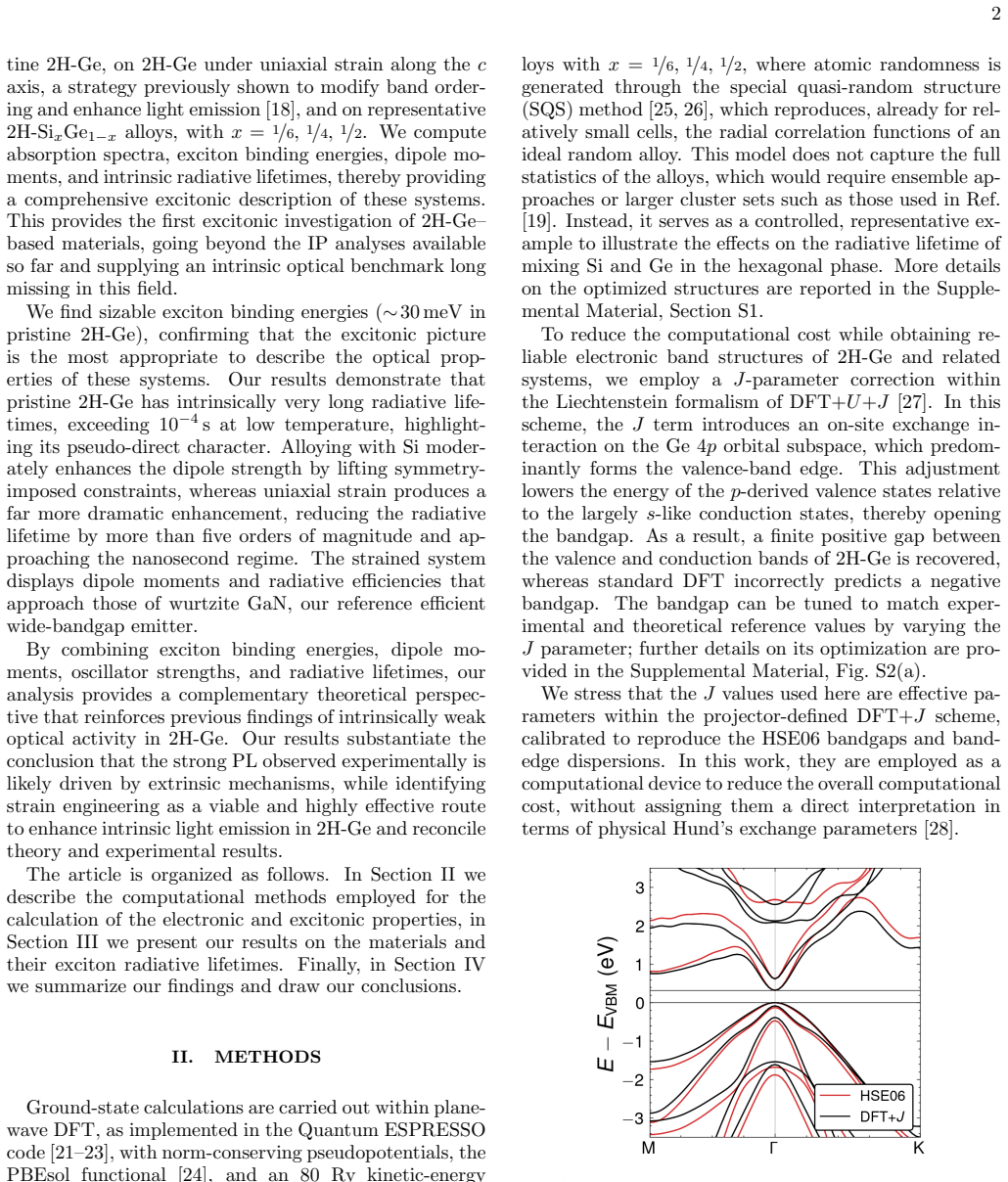
Pristine 2H-Ge features sizable exciton binding energies (~30 meV) but extremely small dipole moments, yielding radiative lifetimes above 10^{-4} s. Alloying with Si reduces the lifetime by nearly two orders of magnitude, whereas a 2% uniaxial strain along the c axis induces a band crossover that strongly enhances the in-plane dipole moment of the lowest-energy exciton and drives the lifetime down to the nanosecond scale. Although strained 2H-Ge approaches the radiative efficiency of GaN, its much lower exciton energy prevents a full match. These results demonstrate that, even when excitonic effects are fully accounted for, the strong photoluminescence reported experimentally cannot be from
What carries the argument
Bethe-Salpeter equation solutions that compute exciton binding energies, transition dipole moments, and radiative lifetimes for pristine, alloyed, and strained 2H-Ge structures.
If this is right
- Alloying 2H-Ge with 17-50% silicon shortens radiative lifetimes by up to two orders of magnitude.
- A 2% uniaxial strain along the c axis switches the lowest exciton to a bright in-plane dipole and yields nanosecond lifetimes.
- Strained 2H-Ge can reach radiative efficiencies comparable to wurtzite GaN, although at lower transition energies.
- Any observed strong room-temperature photoluminescence in 2H-Ge must involve non-ideal crystal features such as local strain or defects.
Where Pith is reading between the lines
- Experimental 2H-Ge samples are probably dominated by locally strained or defective regions that supply the observed brightness.
- Intentional strain engineering in epitaxial 2H-Ge layers could be tested as a route to efficient light emitters without changing composition.
- The same lifetime trends should appear in other hexagonal group-IV semiconductors, offering a design rule for their optical performance.
Load-bearing premise
The Bethe-Salpeter method correctly gives the exciton dipole moments that set the radiative lifetimes, and the measured photoluminescence comes from regions close to the ideal crystal rather than from defects or interfaces.
What would settle it
Time-resolved photoluminescence on high-purity, unstrained 2H-Ge single crystals should reveal lifetimes longer than 100 microseconds if the calculated values hold, directly contradicting claims of strong emission from ideal material.
Figures


read the original abstract
Recent reports of strong room-temperature photoluminescence in hexagonal diamond (2H) germanium stand in marked contrast to theoretical predictions of very weak band-edge optical transitions. Here we address radiative emission in 2H-Ge and related materials through a comprehensive investigation of their excitonic properties and radiative lifetimes, performing Bethe-Salpeter calculations on pristine and uniaxially strained 2H-Ge, 2H-Si$_x$Ge$_{1-x}$ alloys with $x=\frac{1}{6},\,\frac{1}{4},\,\frac{1}{2}$, and wurtzite GaN as a reference. Pristine 2H-Ge features sizable exciton binding energies ($\sim\!30$ meV) but extremely small dipole moments, yielding radiative lifetimes above $10^{-4}$ s. Alloying with Si reduces the lifetime by nearly two orders of magnitude, whereas a 2% uniaxial strain along the $c$ axis induces a band crossover that strongly enhances the in-plane dipole moment of the lowest-energy exciton and drives the lifetime down to the nanosecond scale. Although strained 2H-Ge approaches the radiative efficiency of GaN, its much lower exciton energy prevents a full match. These results provide the missing excitonic description of 2H-Ge and 2H-Si$_x$Ge$_{1-x}$, demonstrating that, even when excitonic effects are fully accounted for, the strong photoluminescence reported experimentally cannot originate from the ideal crystal.
Editorial analysis
A structured set of objections, weighed in public.
Referee Report
Summary. The manuscript uses Bethe-Salpeter equation (BSE) calculations to determine exciton binding energies, dipole moments, and radiative lifetimes for pristine 2H-Ge, uniaxially strained 2H-Ge, and 2H-Si_xGe_{1-x} alloys at x=1/6, 1/4, 1/2, with wurtzite GaN as reference. It reports ~30 meV binding energies but extremely small dipole moments in pristine 2H-Ge, yielding radiative lifetimes >10^{-4} s. Alloying shortens lifetimes by nearly two orders of magnitude; 2% c-axis strain induces a band crossover that enhances the in-plane dipole moment and reduces the lifetime to the nanosecond range. The central claim is that, even with excitonic effects fully included, the strong room-temperature photoluminescence observed experimentally cannot originate from the ideal crystal.
Significance. If the BSE dipole moments are robust, the work supplies the first detailed excitonic description of 2H-Ge and its alloys, clarifying why ideal crystals are optically weak and identifying strain and alloying as routes to improve radiative efficiency. The direct comparison to GaN provides a useful benchmark. The numerical results from standard many-body methods are reproducible in principle and offer falsifiable predictions for strained/alloyed samples.
major comments (2)
- [Pristine 2H-Ge results] Pristine 2H-Ge results (abstract and corresponding results section): the claim of radiative lifetimes above 10^{-4} s rests on extremely small BSE-computed exciton dipole moments. No k-grid density, band convergence, or truncation tests are reported for these weak transitions. Because lifetime scales as 1/|μ|^2 (plus the ω^3 factor), modest underestimation of |μ| from finite sampling would shorten the lifetime by 1-2 orders of magnitude, directly affecting the conclusion that the ideal crystal cannot explain the observed PL.
- [Strained 2H-Ge results] Strain-induced band crossover (results for strained 2H-Ge): the enhancement of the in-plane dipole moment and drop to nanosecond lifetimes is load-bearing for the claim that strain can approach GaN efficiency. The manuscript should demonstrate that this crossover is stable against small changes in strain value or k-point sampling, as the transition is described as occurring at ~2%.
minor comments (2)
- [Abstract] The abstract states that calculations were performed but does not mention the k-point mesh, number of bands, or convergence criteria used in the BSE step; adding one sentence would improve transparency.
- [Figures] Figures showing dipole moments or lifetimes should indicate numerical precision or include a note on the convergence level achieved for the smallest values.
Simulated Author's Rebuttal
We thank the referee for the detailed and constructive comments on our manuscript. We address each of the major comments below and will incorporate revisions to strengthen the presentation of our results.
read point-by-point responses
-
Referee: [Pristine 2H-Ge results] Pristine 2H-Ge results (abstract and corresponding results section): the claim of radiative lifetimes above 10^{-4} s rests on extremely small BSE-computed exciton dipole moments. No k-grid density, band convergence, or truncation tests are reported for these weak transitions. Because lifetime scales as 1/|μ|^2 (plus the ω^3 factor), modest underestimation of |μ| from finite sampling would shorten the lifetime by 1-2 orders of magnitude, directly affecting the conclusion that the ideal crystal cannot explain the observed PL.
Authors: We agree that explicit convergence tests for the k-grid, bands, and truncation were not reported for the pristine 2H-Ge calculations, which is a valid point given the sensitivity of the lifetime to the dipole moment. The extremely small dipole moments in pristine 2H-Ge are a consequence of the indirect nature and symmetry selection rules for the band-edge transitions in the ideal hexagonal structure. In the revised manuscript, we will add a dedicated subsection or appendix detailing convergence tests with denser k-grids (e.g., up to 12x12x12) and higher energy cutoffs, showing that the dipole moments remain below 0.01 a.u., confirming lifetimes well above 10^{-4} s. This will bolster the conclusion that the ideal crystal cannot account for the observed strong PL. revision: yes
-
Referee: [Strained 2H-Ge results] Strain-induced band crossover (results for strained 2H-Ge): the enhancement of the in-plane dipole moment and drop to nanosecond lifetimes is load-bearing for the claim that strain can approach GaN efficiency. The manuscript should demonstrate that this crossover is stable against small changes in strain value or k-point sampling, as the transition is described as occurring at ~2%.
Authors: We appreciate this suggestion to verify the robustness of the strain-induced band crossover. The crossover at approximately 2% uniaxial strain along the c-axis is driven by the relative shift of the conduction band minima, leading to a direct gap and enhanced dipole moment. To address the concern, we will include additional calculations in the revised manuscript for strain values of 1.8%, 2.0%, and 2.2%, as well as with increased k-point sampling. These will demonstrate that the crossover occurs consistently around 2% and results in radiative lifetimes in the nanosecond range, supporting the potential for strain to improve optical efficiency. revision: yes
Circularity Check
No circularity: lifetimes derived from independent BSE computations
full rationale
The paper computes exciton binding energies, dipole moments, and radiative lifetimes directly from Bethe-Salpeter equation solutions on top of DFT band structures for pristine 2H-Ge, strained 2H-Ge, and SiGe alloys. These quantities are obtained from first-principles matrix elements without fitting to experimental PL intensities, without self-citations that define the target result, and without any ansatz or uniqueness theorem imported from prior author work. The central claim (long lifetimes in ideal crystal) follows from the computed small dipole moments and is falsifiable against external benchmarks; no step reduces to a tautology or to the input data by construction.
Axiom & Free-Parameter Ledger
free parameters (2)
- Si alloy concentrations
- uniaxial strain
axioms (1)
- domain assumption Bethe-Salpeter equation with standard approximations accurately describes excitonic dipole moments and lifetimes in 2H-Ge and alloys.
Lean theorems connected to this paper
-
IndisputableMonolith/Cost/FunctionalEquation.leanwashburn_uniqueness_aczel unclear?
unclearRelation between the paper passage and the cited Recognition theorem.
The dipole moment also provides the dimensionless oscillator strength... τ_S(T) = ... (Eq. 3) ... thermal average ⟨τ⟩(T) (Eq. 4)
-
IndisputableMonolith/Foundation/AbsoluteFloorClosure.leanreality_from_one_distinction unclear?
unclearRelation between the paper passage and the cited Recognition theorem.
Pristine 2H-Ge features sizable exciton binding energies (~30 meV) but extremely small dipole moments, yielding radiative lifetimes above 10^{-4} s
What do these tags mean?
- matches
- The paper's claim is directly supported by a theorem in the formal canon.
- supports
- The theorem supports part of the paper's argument, but the paper may add assumptions or extra steps.
- extends
- The paper goes beyond the formal theorem; the theorem is a base layer rather than the whole result.
- uses
- The paper appears to rely on the theorem as machinery.
- contradicts
- The paper's claim conflicts with a theorem or certificate in the canon.
- unclear
- Pith found a possible connection, but the passage is too broad, indirect, or ambiguous to say the theorem truly supports the claim.
Reference graph
Works this paper leans on
-
[1]
L. S. Ramsdell, Studies on silicon car- bide, American Mineralogist32, 64 (1947), https://pubs.geoscienceworld.org/msa/ammin/article- pdf/32/1-2/64/4243735/am-1947-64.pdf
work page 1947
-
[2]
H. I. T. Hauge, S. Conesa-Boj, M. A. Verheijen, S. Koelling, and E. P. A. M. Bakkers, Single-crystalline hexagonal silicon–germanium, Nano Letters17, 85 (2017)
work page 2017
-
[3]
L. Vincent, G. Patriarche, G. Hallais, C. Renard, C. Gard` es, D. Troadec, and D. Bouchier, Novel het- erostructured ge nanowires based on polytype transfor- mation, Nano Letters14, 4828 (2014)
work page 2014
-
[4]
E. M. T. Fadaly, A. Dijkstra, J. R. Suckert, D. Ziss, M. A. J. van Tilburg, C. Mao, Y. Ren, V. T. van Lange, K. Korzun, S. K¨ olling, M. A. Verheijen, D. Busse, C. R¨ odl, J. Furthm¨ uller, F. Bechstedt, J. Stangl, J. J. Finley, S. Botti, J. E. M. Haverkort, and E. P. A. M. Bakkers, Direct-bandgap emission from hexagonal ge and sige alloys, Nature580, 205 (2020)
work page 2020
-
[5]
A. Li, H. I. T. Hauge, M. A. Verheijen, E. P. A. M. Bakkers, R. T. Tucker, L. Vincent, and C. Renard, Hexagonal silicon-germanium nanowire branches with tunable composition, Nanotechnology34, 015601 (2022)
work page 2022
-
[6]
L. H. G. Tizei, M. R. Fiorentin, T. Dursap, T. M. van den Berg, M. T´ unica, M. Palummo, M. Kociak, L. Vin- cent, and M. Amato, Optical absorption in hexagonal- diamond si and ge nanowires: Insights from stem-eels experiments and ab initio theory, Nano Letters25, 8604 (2025), pMID: 40326737
work page 2025
- [7]
-
[8]
W. H. J. Peeters, V. T. van Lange, A. Belabbes, M. C. van Hemert, M. M. Jansen, R. Farina, M. A. J. van Tilburg, M. A. Verheijen, S. Botti, F. Bechstedt, J. E. M. Haverkort, and E. P. A. M. Bakkers, Direct bandgap quantum wells in hexagonal silicon germanium, Nature Communications15, 5252 (2024)
work page 2024
-
[9]
W. H. J. Peeters, M. M. Jansen, M. F. Schouten, V. T. van Lange, M. Vettori, M. A. Verheijen, J. E. M. Haverkort, and E. P. A. M. Bakkers, Growth rate of hexagonal sige multi-quantum wells, Phys. Rev. B111, L241302 (2025)
work page 2025
-
[10]
R. Soref, The past, present, and future of silicon photon- ics, IEEE Journal of Selected Topics in Quantum Elec- tronics12, 1678 (2006)
work page 2006
-
[11]
Soref, Mid-infrared photonics in silicon and germa- nium, Nature Photonics4, 495 (2010)
R. Soref, Mid-infrared photonics in silicon and germa- nium, Nature Photonics4, 495 (2010)
work page 2010
- [12]
-
[13]
D. Thomson, A. Zilkie, J. E. Bowers, T. Komljenovic, G. T. Reed, L. Vivien, D. Marris-Morini, E. Cassan, L. Virot, J.-M. F´ ed´ eli, J.-M. Hartmann, J. H. Schmid, D.-X. Xu, F. Boeuf, P. O’Brien, G. Z. Mashanovich, and M. Nedeljkovic, Roadmap on silicon photonics, Journal of Optics18, 073003 (2016)
work page 2016
-
[14]
M. A. J. van Tilburg, W. H. J. Peeters, M. Vet- tori, V. T. van Lange, E. P. A. M. Bakkers, and J. E. M. Haverkort, Polarized emission from hexagonal- silicon–germanium nanowires, Journal of Applied Physics 9 133, 065702 (2023)
work page 2023
-
[15]
V. T. van Lange, A. Dijkstra, E. M. T. Fadaly, W. H. J. Peeters, M. A. J. van Tilburg, E. P. A. M. Bakkers, F. Bechstedt, J. J. Finley, and J. E. M. Haverkort, Nanosecond carrier lifetime of hexagonal ge, ACS Pho- tonics11, 4258 (2024)
work page 2024
- [16]
- [17]
-
[18]
J. R. Suckert, C. R¨ odl, J. Furthm¨ uller, F. Bechstedt, and S. Botti, Efficient strain-induced light emission in lons- daleite germanium, Phys. Rev. Mater.5, 024602 (2021)
work page 2021
-
[19]
P. Borlido, F. Bechstedt, S. Botti, and C. R¨ odl, Ensemble averages of ab initio optical, transport, and thermoelec- tric properties of hexagonal si xge1−x alloys, Phys. Rev. Mater.7, 014602 (2023)
work page 2023
-
[20]
Madelung, Semiconductors: data handbook (Springer Science & Business Media, 2004)
O. Madelung, Semiconductors: data handbook (Springer Science & Business Media, 2004)
work page 2004
-
[21]
P. Giannozzi, S. Baroni, N. Bonini, M. Calandra, R. Car, C. Cavazzoni, D. Ceresoli, G. L. Chiarotti, M. Cococ- cioni, I. Dabo, A. Dal Corso, S. de Gironcoli, S. Fabris, G. Fratesi, R. Gebauer, U. Gerstmann, C. Gougoussis, A. Kokalj, M. Lazzeri, L. Martin-Samos, N. Marzari, F. Mauri, R. Mazzarello, S. Paolini, A. Pasquarello, L. Paulatto, C. Sbraccia, S. S...
work page 2009
-
[22]
P. Giannozzi, O. Andreussi, T. Brumme, O. Bunau, M. B. Nardelli, M. Calandra, R. Car, C. Cavazzoni, D. Ceresoli, M. Cococcioni, N. Colonna, I. Carnimeo, A. D. Corso, S. de Gironcoli, P. Delugas, R. A. D. Jr, A. Ferretti, A. Floris, G. Fratesi, G. Fugallo, R. Gebauer, U. Gerstmann, F. Giustino, T. Gorni, J. Jia, M. Kawa- mura, H.-Y. Ko, A. Kokalj, E. K¨ u¸...
work page 2017
-
[23]
P. Giannozzi, O. Baseggio, P. Bonf` a, D. Brunato, R. Car, I. Carnimeo, C. Cavazzoni, S. de Gironcoli, P. Delugas, F. Ferrari Ruffino, A. Ferretti, N. Marzari, I. Timrov, A. Urru, and S. Baroni, Quantum espresso toward the exascale, The Journal of Chemical Physics152, 154105 (2020), https://doi.org/10.1063/5.0005082
-
[24]
J. P. Perdew, A. Ruzsinszky, G. I. Csonka, O. A. Vydrov, G. E. Scuseria, L. A. Constantin, X. Zhou, and K. Burke, Restoring the density-gradient expansion for exchange in solids and surfaces, Phys. Rev. Lett.100, 136406 (2008)
work page 2008
-
[25]
A. Zunger, S.-H. Wei, L. G. Ferreira, and J. E. Bernard, Special quasirandom structures, Phys. Rev. Lett.65, 353 (1990)
work page 1990
-
[26]
A. van de Walle, P. Tiwary, M. de Jong, D. Olmsted, M. Asta, A. Dick, D. Shin, Y. Wang, L.-Q. Chen, and Z.- K. Liu, Efficient stochastic generation of special quasir- andom structures, Calphad42, 13 (2013)
work page 2013
-
[27]
A. I. Liechtenstein, V. I. Anisimov, and J. Zaanen, Density-functional theory and strong interactions: Or- bital ordering in mott-hubbard insulators, Phys. Rev. B 52, R5467 (1995)
work page 1995
-
[28]
A. Georges, L. d. Medici, and J. Mravlje, Strong correla- tions from hund’s coupling, Annual Review of Condensed Matter Physics4, 137 (2013)
work page 2013
-
[29]
J. Heyd, G. E. Scuseria, and M. Ernzerhof, Hybrid func- tionals based on a screened coulomb potential, The Jour- nal of Chemical Physics118, 8207 (2003)
work page 2003
- [30]
-
[31]
T. Kaewmaraya, L. Vincent, and M. Amato, Accurate es- timation of band offsets in group iv polytype junctions: A first-principles study, The Journal of Physical Chemistry C121, 5820 (2017)
work page 2017
- [32]
-
[33]
D. Sangalli, A. Ferretti, H. Miranda, C. Attaccalite, I. Marri, E. Cannuccia, P. Melo, M. Marsili, F. Paleari, A. Marrazzo, G. Prandini, P. Bonf` a, M. O. Atambo, F. Affinito, M. Palummo, A. Molina-S´ anchez, C. Hogan, M. Gr¨ uning, D. Varsano, and A. Marini, Many-body perturbation theory calculations using the yambo code, Journal of Physics: Condensed Ma...
work page 2019
-
[34]
D. Sangalli, C. Attaccalite, M. Gr¨ uning, R. Reho, F. Paleari, M. D’Alessandro, M. Nalabothua, A. Molina Sanchez, E. Cannuccia, A. Ro- mani, P. Milev, and T. Geirsson, Lumen Code, https://www.lumen-code.org(2025), [Online; accessed 17-Dec-2025]
work page 2025
-
[35]
H.-Y. Chen, V. A. Jhalani, M. Palummo, and M. Bernardi, Ab initio calculations of exciton radiative lifetimes in bulk crystals, nanostructures, and molecules, Phys. Rev. B100, 075135 (2019)
work page 2019
-
[36]
V. A. Jhalani, H.-Y. Chen, M. Palummo, and M. Bernardi, Precise radiative lifetimes in bulk crystals from first principles: the case of wurtzite gallium nitride, Journal of Physics: Condensed Matter32, 084001 (2019)
work page 2019
-
[37]
M. Palummo, M. Bernardi, and J. C. Grossman, Exciton radiative lifetimes in two-dimensional transition metal dichalcogenides, Nano Letters15, 2794 (2015)
work page 2015
-
[38]
C. Delerue, G. Allan, and M. Lannoo, Theoretical aspects of the luminescence of porous silicon, Phys. Rev. B48, 11024 (1993)
work page 1993
-
[39]
Z. Wang, Z. Zhang, S. Liu, J. Robertson, and Y. Guo, Electronic properties and tunability of the hexagonal sige alloys, Applied Physics Letters118, 172101 (2021)
work page 2021
- [40]
-
[41]
W. C. Dunlap and R. L. Watters, Direct measurement of the dielectric constants of silicon and germanium, Phys. Rev.92, 1396 (1953)
work page 1953
-
[42]
R. Laskowski, N. E. Christensen, G. Santi, and C. Ambrosch-Draxl, Ab initio calculations of excitons in gan, Phys. Rev. B72, 035204 (2005)
work page 2005
-
[43]
J. S. Im, A. Moritz, F. Steuber, V. H¨ arle, F. Scholz, and A. Hangleiter, Radiative carrier lifetime, momentum 10 matrix element, and hole effective mass in gan, Applied Physics Letters70, 631 (1997)
work page 1997
discussion (0)
Sign in with ORCID, Apple, or X to comment. Anyone can read and Pith papers without signing in.