REVIEW 4 major objections 4 minor 2 cited by
A variational circuit's loss can be turned into an explicit trigonometric function of its parameters, so the circuit can be pre-trained classically with exponentially decaying truncation error.
Reviewed by Pith at T0; open to challenge. T0 means a machine referee read the full paper against a public rubric. the ladder, T0–T4 →
Truncated symbolic Pauli propagation yields a classical, differentiable proxy for quantum circuit observables, enabling classical pre-training demonstrated on an 18-qubit VQE spin-model task.
T0 review reviewed 2026-08-03 challenge →
load-bearing objection The pre-training method and 18-qubit VQE demo are credible, but the central exponential error bound is not just unproven — Assumption 1 is incompatible with the definition of c_j, so Eq. (7) does not follow. the 4 major comments →
Symbolic Pauli Propagation for Gradient-Enabled Pre-Training of Quantum Circuits
The pith
A machine-rendered reading of the paper's core claim, the machinery that carries it, and where it could break.
The reading
Core claim
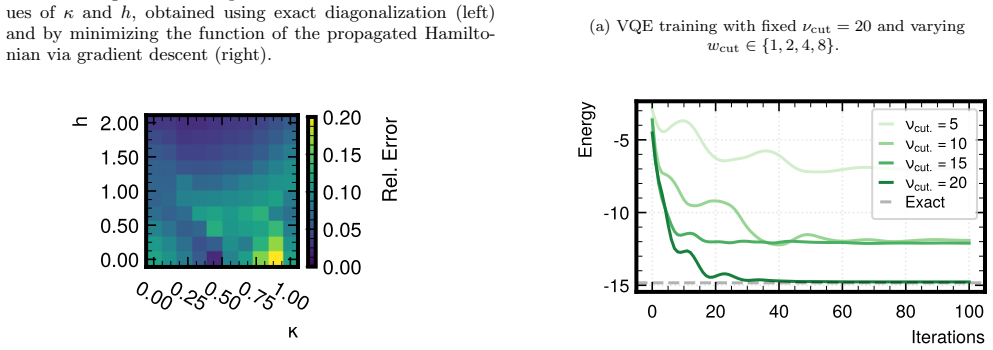
Under an exponential weight-frequency decay assumption on the propagated coefficients, the double-truncated observable approximates the exact loss with a worst-case error sup_θ |L(θ)−L_{w_cut,ν_cut}(θ)| ≤ C0 (A^{w_cut+1} + B^{ν_cut+1}) / ((1−A)(1−B)), where A=3nα and B=2Pβ. Provided A<1 and B<1, the surrogate converges uniformly to the true loss and its gradient as the cutoffs grow. On a 12-qubit local entangler ansatz the bound closely tracks the sampled mean absolute error; on an 18-qubit ANNNI VQE, gradient descent on the truncated symbolic objective yields energies matching exact diagonalization, with the largest deviations in the antiphase region where correlations become non-local.
What carries the argument
The load-bearing object is symbolic Pauli propagation: evolving an observable O → U†OU through the circuit while leaving all angles θ unassigned, so each surviving Pauli word carries a coefficient that is a product of sines and cosines of the parameters. Two truncation filters are applied during propagation: a Pauli-weight cutoff w_cut discards words acting on more than w_cut qubits, and a frequency cutoff ν_cut discards words whose coefficient contains more than ν_cut trigonometric factors. The joint error bound of Eq. (7) combines a combinatorial count of words at each weight and frequency with Assumption 1 (exponential coefficient decay), showing that both truncation tails are geometric w
Load-bearing premise
The whole accuracy guarantee rests on Assumption 1: every coefficient in the propagated Pauli expansion decays exponentially in both its Pauli weight and its frequency, uniformly over all parameter values—a property the paper motivates with locality and scrambling heuristics but does not prove for any infinite family of circuits.
What would settle it
Propagate a local observable through a fixed-depth locally scrambling ansatz on 10–20 qubits and check whether the supremum over θ of the coefficient magnitudes decays exponentially in weight and frequency (e.g., by detecting a heavy tail of high-weight or high-frequency terms). If any single ansatz and observable violate Assumption 1, the bound of Eq. (7) fails and the classical pre-training accuracy is no longer guaranteed.
If this is right
- If the bound holds, VQE circuits can be pre-trained entirely classically to near-exact energies, with the resulting parameters serving as a high-quality initialization for quantum-device fine-tuning.
- The method turns a once-per-ansatz propagation into a reusable resource: propagating only the three components of the ANNNI Hamiltonian covers the whole phase diagram for any (κ,h) and any parameter vector θ.
- Gradient errors on the truncated surrogate are themselves controlled by geometric tails (Eq. 8), so parameter-shift gradients computed classically agree with the exact gradient up to a tunable cutoff.
- Because the prefactor depends on the system only through n and P in A and B, the approach can scale beyond exact statevector simulation whenever the ansatz is locally scrambling and the decay dominates combinatorial growth.
Where Pith is reading between the lines
- The exponential-decay assumption is likely to fail precisely where the method is most needed—deep or highly entangling circuits that build up long-range correlations; the antiphase hotspot in the 18-qubit ANNNI results is a natural first place to test this.
- Appendix B justifies frequency truncation probabilistically (variance decay), but Assumption 1 upgrades this to a uniform worst-case statement; a natural extension is a high-probability or average-case error bound for a random parameter ensemble.
- The framework extends to any loss expressible as a sum of observable expectation values, but the cost scales with the number of observables; a practical criterion would be to compare propagated against exact gradients on small instances to certify when classical pre-training is trustworthy.
Editorial analysis
A structured set of objections, weighed in public.
Referee Report
Summary. The paper proposes a classical pre-training method for parametrized quantum circuits based on symbolic Pauli propagation. Observables are propagated backwards through the circuit symbolically, producing a trigonometric-polynomial representation whose terms are truncated by Pauli weight and frequency. The paper claims a uniform exponential error bound for this double truncation (Eq. 7), a similar gradient bound (Eq. 8), and demonstrates the approach for VQE on an 18-qubit ANNNI model, reporting good agreement with exact diagonalization. An abstract statement mentions 32 qubits, but the body reports 18 qubits.
Significance. If the claims were sound, the method would be a useful tool for classical pre-training of VQE and other QML models, with potential scalability beyond exact simulation. The code is publicly available, and the 18-qubit VQE comparison with exact diagonalization is a concrete, reproducible empirical result. However, the central theoretical guarantee (Eq. 7) rests on an assumption that is incompatible with the explicit form of the propagated coefficients, and the gradient bound is not derived. The practical heuristic may be valuable, but the paper's formal contribution is not currently valid.
major comments (4)
- [App. B, Eq. (B4); Eq. (7)] Assumption 1 is false for the circuit family considered. Each c_j(θ) in Eq. (B2) is a product of sine/cosine factors over distinct, independent parameters. Since each factor can be set to ±1 by choosing the corresponding parameter, sup_θ |c_j(θ)| = 1 for every term with ν_j ≥ 1 (and also for ν_j=0 if the coefficient is constant). No constants C0>0 and 0<β<1 can satisfy sup_θ |c_j| ≤ C0 α^{w_j} β^{ν_j} for all ν_j. Therefore the exponential bound in Eq. (7) does not follow; as a uniform statement it is incorrect. The combinatorial summation after Eq. (B8) is formally correct only conditional on the assumption, but the assumption itself is untenable for the local entangler ansatz used throughout the paper.
- [Sec. II E / App. B1, Eq. (B22)] The gradient bound (Eq. 8 / Eq. B22) is not established. It invokes 'locality-induced decay of Fourier coefficients,' but Assumption 1 is a statement about the Pauli-expansion coefficients c_j, not about the Fourier coefficients a_{P,k} of L(θ). Moreover, the truncation in Eq. (B19) is imposed on ∥k∥_1, whereas the surrogate L̃ is defined by truncating the Pauli expansion with cutoffs w_cut and ν_cut; the equivalence between these two truncations is never shown. Thus the claimed uniform convergence of parameter-shift gradients is unsupported.
- [Sec. II E, Fig. 3] The numerical validation of Eq. (7) uses the mean absolute error over 10,000 uniformly sampled parameter sets. This cannot confirm a sup-norm bound. Additionally, the constants C0, α, and β are not reported; if they are fitted to the observed errors, the 'agreement' is circular. A valid empirical check would either derive these constants from the ansatz or compute the empirical supremum over a dense grid and verify the inequality with pre-specified constants.
- [Abstract vs. Sec. III A] The abstract states that the VQE demonstration is performed on 32 qubits, but Sec. III A explicitly reports an 18-qubit simulation chosen to allow exact diagonalization comparison. This is a substantive inconsistency: the 32-qubit claim is not supported by the results in the paper. The authors should correct the abstract or provide a 32-qubit experiment.
minor comments (4)
- [Sec. II A] Typo: 'tiplically' should be 'typically'.
- [App. B] Typo: 'coefficiens' should be 'coefficients'.
- [Sec. II B / App. B] The definition of 'frequency' as the number of sine/cosine factors should be reconciled with the Fourier-space truncation using ∥k∥_1 in App. B1. These are not obviously identical, and the relationship should be stated explicitly.
- [Eq. (B2)] It would help to state explicitly that each parameter appears at most once in a given product, since the gate sequence imposes this for the local entangler ansatz. This is relevant to the sup-norm discussion above.
Circularity Check
No construction-level circularity; the main risk is an unproven assumption, not a circular derivation.
full rationale
The derivation of the central bound Eq. (7)/B16 is a conditional theorem: it starts from the explicitly stated Assumption 1 (App. B, Eq. B4), counts the discarded Pauli-word/trigonometric-monomial combinations (B9–B11), and sums geometric tails. The resulting bound is a direct consequence of the assumed coefficient decay; it does not secretly identify the truncated loss with the exact loss, and it is presented as conditional ('we assume', 'Provided A<1 and B<1'). The 18-qubit VQE benchmark is an independent external check: the truncated propagated Hamiltonian is optimized and compared against exact diagonalization, with deviations concentrated in the antiphase region. Self-citations are not load-bearing; the weight-decay heuristic is attributed to the external reference [6]. The only passage that could raise a circularity concern is the Figure 3 validation: the 'theoretical bound obtained from Assumption 1' requires values of C0, α, β that the paper does not report, and the plotted quantity is a mean absolute error while Eq. (7) is a sup-norm bound. If those constants were chosen to match the observed curve, then the 'agreement confirms the soundness of the underlying assumptions' would be close to circular. However, the manuscript does not state that any fitting was performed, and under the hard rule against speculative claims of circularity I do not classify this as circular. A separate, non-circularity concern is that Assumption 1 may be internally inconsistent with Eq. (B2): because each sine/cosine factor satisfies |f|≤1, sup_θ |c_j(θ)| can be as large as 1, so exponential decay in ν_j with fixed C0 is not automatic and must be justified; this is a correctness/validation risk rather than a by-construction circularity.
Axiom & Free-Parameter Ledger
free parameters (5)
- C0 (decay prefactor) =
unspecified
- α (weight decay constant) =
unspecified
- β (frequency decay constant) =
unspecified
- w_cut =
8
- ν_cut =
20
axioms (4)
- ad hoc to paper Assumption 1 (App. B): sup_θ |c_j(θ)| ≤ C0 α^{w_j} β^{ν_j} for all terms j
- ad hoc to paper Decay dominates combinatorial growth: A = 3nα < 1 and B = 2Pβ < 1
- domain assumption Random parameters θ_i ~ U[0,2π] with zero mean and E[f_i^2] = 1/2 in App. B
- standard math Standard combinatorics: number of Pauli words of weight w ≤ (3n)^w and number of trig monomials of frequency ν ≤ (2P)^ν
Cite this review
Pith. "Pith review of Symbolic Pauli Propagation for Gradient-Enabled Pre-Training of Quantum Circuits." pith.science (2026). https://pith.science/paper/AP7OVH4T
@misc{pith2026251216674,
  author       = {Pith},
  title        = {Pith review of: Symbolic Pauli Propagation for Gradient-Enabled Pre-Training of Quantum Circuits},
  year         = {2026},
  howpublished = {\url{https://pith.science/paper/AP7OVH4T}},
  note         = {Machine review of arXiv:2512.16674}
}
read the original abstract
Quantum Machine Learning models typically require expensive on-chip training procedures and often lack efficient gradient estimation methods. By employing Pauli propagation, it is possible to derive a symbolic representation of observables as analytic functions of a circuit's parameters. Although the number of terms in such functional representations grows rapidly with circuit depth, suitable choices of ansatz and controlled truncations on Pauli weights and frequency components yield accurate yet tractable estimators of the target observables. With the right ansatz design, this approach can be extended to system sizes beyond the reach of classical statevector simulation, enabling scalable training for larger quantum systems. This also enables a form of classical pre-training through gradient-based optimization prior to deployment on quantum hardware. The proposed approach is demonstrated on the Variational Quantum Eigensolver for obtaining the ground state of the ANNNI spin model on 32 qubits, showing that accurate results can be achieved with a scalable and computationally efficient procedure.
Figures



Forward citations
Cited by 2 Pith papers
-
Backpropagating Pauli Propagation
A backward-propagation algorithm computes gradients for sparse Pauli dynamics in O(1) passes and O(N_P) memory, with gradient accuracy empirically comparable to the simulation's own energy accuracy.
-
Time Evolution on Hybrid Tensor Networks -- A Novel and Parallelizable Algorithm
Introduces a parallelizable hybrid tensor network algorithm for time-evolving matrix product states that combines classical BUG integration with quantum methods without synchronization barriers.
Reference graph
Works this paper leans on
-
[1]
K. Mitarai, M. Negoro, M. Kitagawa, and K. Fu- jii, Quantum circuit learning, Physical Review A98, 10.1103/physreva.98.032309 (2018)
-
[2]
Deng, The mnist database of handwritten digit images for machine learning research, IEEE Signal Processing Magazine29, 141 (2012)
L. Deng, The mnist database of handwritten digit images for machine learning research, IEEE Signal Processing Magazine29, 141 (2012)
2012
-
[3]
E. Recio-Armengol, S. Ahmed, and J. Bowles, Train on classical, deploy on quantum: scaling generative quantum machine learning to a thousand qubits (2025), arXiv:2503.02934 [quant-ph]
arXiv 2025
-
[4]
J. C. Spall, An overview of the simultaneous perturba- tion method for efficient optimization, Johns Hopkins apl technical digest19, 482 (1998)
1998
-
[5]
M. J. Powell, A direct search optimization method that models the objective and constraint functions by linear interpolation, inAdvances in optimization and numerical analysis(Springer, 1994) pp. 51–67
1994
-
[6]
A. Angrisani, A. Schmidhuber, M. S. Rudolph, M. Cerezo, Z. Holmes, and H.-Y. Huang, Classically esti- mating observables of noiseless quantum circuits (2025), arXiv:2409.01706 [quant-ph]
arXiv 2025
-
[7]
Bowles, D
J. Bowles, D. Wierichs, and C.-Y. Park, Backpropagation scaling in parameterised quantum circuits, Quantum9, 1873 (2025)
2025
-
[8]
M. S. Rudolph, S. Lerch, S. Thanasilp, O. Kiss, O. Shaya, S. Vallecorsa, M. Grossi, and Z. Holmes, Trainability barriers and opportunities in quantum generative model- ing, npj Quantum Information10, 10.1038/s41534-024- 00902-0 (2024)
-
[9]
Selke, The annni model—theoretical analysis and ex- perimental application, Physics Reports170, 213 (1988)
W. Selke, The annni model—theoretical analysis and ex- perimental application, Physics Reports170, 213 (1988)
1988
-
[10]
D. Gottesman, The heisenberg representation of quan- tum computers (1998), arXiv:quant-ph/9807006 [quant- ph]
Pith/arXiv arXiv 1998
-
[11]
S. Bravyi and A. Kitaev, Universal quantum computa- tion with ideal clifford gates and noisy ancillas, Physical Review A71, 10.1103/physreva.71.022316 (2005)
-
[12]
Z.-L. Li and S.-X. Zhang, The dual role of low-weight pauli propagation: A flawed simulator but a power- ful initializer for variational quantum algorithms (2025), arXiv:2508.06358 [quant-ph]
arXiv 2025
-
[13]
Tilly, H
J. Tilly, H. Chen, S. Cao, D. Picozzi, K. Setia, Y. Li, E. Grant, L. Wossnig, I. Rungger, G. H. Booth,et al., The variational quantum eigensolver: a review of meth- ods and best practices, Physics Reports986, 1 (2022)
2022
-
[14]
S. Monaco, O. Kiss, A. Mandarino, S. Vallecorsa, and M. Grossi, Quantum phase detection generalization from marginal quantum neural network models, Physical Re- view B107, 10.1103/physrevb.107.l081105 (2023)
-
[15]
K. Kottmann, F. Metz, J. Fraxanet, and N. Baldelli, Variational quantum anomaly detection: Unsupervised mapping of phase diagrams on a physical quantum com- puter, Physical Review Research3, 10.1103/physrevre- search.3.043184 (2021)
-
[16]
D. P. Kingma and J. Ba, Adam: A method for stochastic optimization (2017), arXiv:1412.6980 [cs.LG]
Pith/arXiv arXiv 2017
-
[17]
Monaco, J
S. Monaco, J. Slim, D. Kr¨ ucker, and K. Borras, desyqml/pauli-propagator: Initial public release (2025)
2025
-
[18]
V. Bergholm, J. Izaac, M. Schuld, C. Gogolin, S. Ahmed, V. Ajith, M. S. Alam, G. Alonso-Linaje, B. Akash- Narayanan, A. Asadi, J. M. Arrazola, U. Azad, S. Ban- ning, C. Blank, T. R. Bromley, B. A. Cordier, J. Ceroni, A. Delgado, O. D. Matteo, A. Dusko, T. Garg, D. Guala, A. Hayes, R. Hill, A. Ijaz, T. Isacsson, D. Ittah, S. Ja- hangiri, P. Jain, E. Jiang,...
Pith/arXiv arXiv 2022
-
[19]
For any gate set admitting a valid parameter-shift rule
Gradients under Pauli-weight and frequency truncation The parameter-shift rule, when applied to the symbol- ically propagated observable, yields the same gradient of the truncated surrogate ˜Lwcut,νcut (θ). For any gate set admitting a valid parameter-shift rule. In general, how- ever, ∇θ ˜Lwcut,νcut (θ)̸=∇ θL(θ),(B17) because the latter still contains co...
This paper was first reviewed by deepseek-v4-flash on August 3, 2026.
discussion (0)
Sign in with ORCID, Apple, or X to comment. Anyone can read and Pith papers without signing in.