Quantum quenches across continuous and first-order quantum transitions in one-dimensional quantum Ising models
Pith reviewed 2026-05-16 21:06 UTC · model grok-4.3
The pith
Quantum quenches in the Ising chain produce qualitatively different dynamics when crossing a continuous transition versus a first-order transition.
A machine-rendered reading of the paper's core claim, the machinery that carries it, and where it could break.
Core claim
We investigate the quantum dynamics generated by quenches of the Hamiltonian parameters in the quantum Ising chain with transverse field g and longitudinal field h. We focus on protocols that change h from a negative value h_i < 0 to a positive value h_f > 0, crossing the line of quantum transitions at h=0. For g > g_c the chain remains in the disordered phase; at g = g_c the quench crosses the continuous quantum transition; for g < g_c it crosses the first-order quantum transition line. In the integrable limit h=0 the model maps to free fermions, but any nonzero h_f breaks integrability and places the post-quench spectrum in the chaotic regime where thermalization may occur at long times.We
What carries the argument
The one-dimensional Ising chain with transverse field g and longitudinal field h, subjected to a sudden quench in h across zero at fixed g, analyzed in the chaotic regime of the post-quench Hamiltonian.
If this is right
- Dynamics in the disordered phase g > g_c remain qualitatively separate from any quench that crosses a transition.
- Quenches exactly at g = g_c cross the continuous quantum transition and produce a distinct relaxation pattern.
- Quenches for g < g_c cross the first-order transition line and yield yet another long-time behavior.
- Because the post-quench spectrum is chaotic, thermalization is expected to appear at late times in all three regimes, but with different transient signatures.
Where Pith is reading between the lines
- The distinction between continuous and first-order crossings may survive in the thermodynamic limit and produce different steady-state properties.
- Similar quench protocols could be applied to other non-integrable spin chains to test whether the type of transition crossed universally controls relaxation.
- The results suggest that integrability breaking alone is insufficient to erase memory of the underlying quantum transition in the approach to equilibrium.
Load-bearing premise
The spectrum of the post-quench Hamiltonian lies in the chaotic regime so that thermalization can emerge at asymptotically long times.
What would settle it
Numerical or experimental observation that the long-time dynamics become indistinguishable for g > g_c, g = g_c and g < g_c, or that no thermalization occurs despite the assumed chaotic spectrum.
Figures




read the original abstract
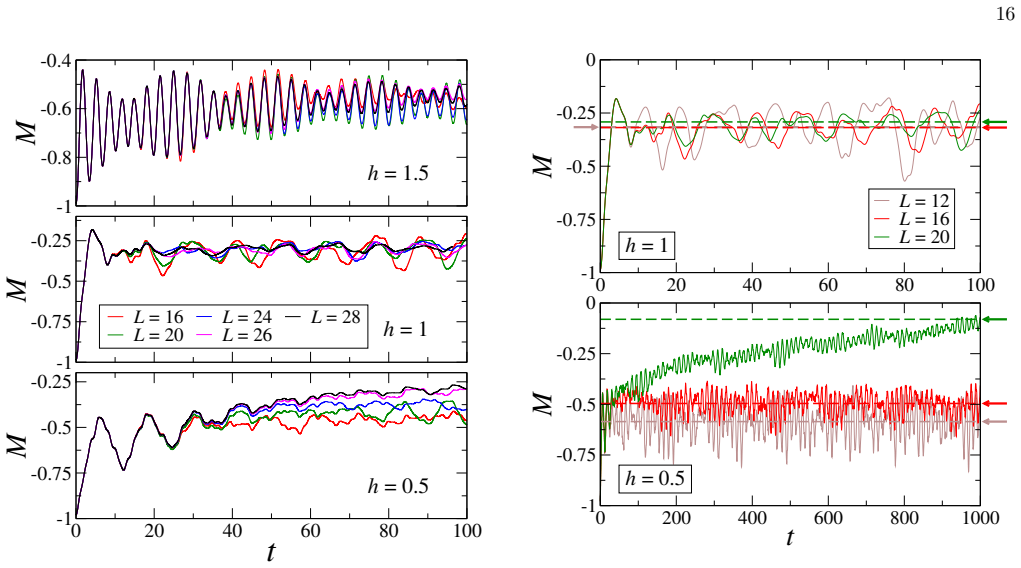
We investigate the quantum dynamics generated by quantum quenches (QQs) of the Hamiltonian parameters in many-body systems, focusing on protocols that cross first-order and continuous quantum transitions, both in finite-size systems and in the thermodynamic limit. As a paradigmatic example, we consider the quantum Ising chain in the presence of homogeneous transverse ($g$) and longitudinal ($h$) magnetic fields. This model exhibits a continuous quantum transition (CQT) at $g=g_c$ and $h=0$, and first-order quantum transitions (FOQTs) driven by $h$ along the line $h=0$ ($g<g_c$). In the integrable limit $h=0$, the system can be mapped onto a quadratic fermionic theory; however, any nonvanishing longitudinal field breaks integrability and the spectrum of the resulting Hamiltonian is generally expected to enter a chaotic regime. We analyze QQs in which the longitudinal field is suddenly changed from a negative value $h_i < 0$ to a positive value $h_f>0$. We focus on values of $h_f$ such that the spectrum of the post-QQ Hamiltonian $H(g,h_f)$ lies in the chaotic regime, where thermalization may emerge at asymptotically long times. We study the out-of-equilibrium dynamics for different values of $g$, finding qualitatively distinct behaviors for $g > g_c$ (where the chain is in the disordered phase), for $g = g_c$ (QQ across the CQT), and for $g<g_c$ (QQ across the FOQT line).
Editorial analysis
A structured set of objections, weighed in public.
Referee Report
Summary. The manuscript investigates quantum quenches in the one-dimensional quantum Ising chain with transverse field g and longitudinal field h. It considers protocols that suddenly change h from a negative initial value to a positive final value h_f, crossing either the continuous quantum transition at g = g_c (h=0) or first-order transitions along h=0 for g < g_c. The authors report qualitatively distinct out-of-equilibrium dynamics in three regimes: g > g_c (disordered phase), g = g_c (across the CQT), and g < g_c (across the FOQT line), attributing the distinctions to the post-quench Hamiltonian H(g, h_f) entering a chaotic regime where thermalization can occur at long times. The analysis builds on the exact mapping to free fermions when h=0 and numerical or approximate methods otherwise.
Significance. If the central claims hold after verification, the work would advance understanding of how the type of quantum transition crossed during a quench influences relaxation and thermalization in many-body systems. A strength is the systematic comparison across integrable and non-integrable cases using the model's exact solvability at h=0. The results could inform studies of non-equilibrium dynamics near quantum critical points, provided the chaotic regime is explicitly confirmed.
major comments (1)
- [Abstract and model Hamiltonian section] Abstract and the section introducing the post-quench Hamiltonian: The assertion that the spectrum of H(g, h_f) lies in the chaotic regime for the selected finite h_f (allowing thermalization at long times) is not supported by any reported diagnostics such as level-spacing ratio distributions, spectral form factors, or participation ratios. This assumption underpins the interpretation of qualitatively distinct behaviors across the three g regimes, yet near g = g_c or the FOQT line the integrability-breaking effect of h_f may be weak, potentially leading to intermediate statistics rather than full GOE chaos. Without such evidence, the central claim of regime-dependent dynamics risks being under-supported.
minor comments (1)
- Figure captions should explicitly list all parameter values (system size L, specific g, h_i, h_f) and the observable plotted to improve reproducibility and clarity.
Simulated Author's Rebuttal
We thank the referee for the careful reading and constructive comments on our manuscript. We address the major comment below.
read point-by-point responses
-
Referee: The assertion that the spectrum of H(g, h_f) lies in the chaotic regime for the selected finite h_f (allowing thermalization at long times) is not supported by any reported diagnostics such as level-spacing ratio distributions, spectral form factors, or participation ratios. This assumption underpins the interpretation of qualitatively distinct behaviors across the three g regimes, yet near g = g_c or the FOQT line the integrability-breaking effect of h_f may be weak, potentially leading to intermediate statistics rather than full GOE chaos. Without such evidence, the central claim of regime-dependent dynamics risks being under-supported.
Authors: We agree that the original manuscript did not include explicit diagnostics confirming the chaotic character of the post-quench spectra. The statement in the abstract and model section relies on the general expectation that a finite longitudinal field h_f breaks integrability in the Ising chain, leading to chaotic behavior for the chosen parameters (as supported by prior studies of this model). However, we acknowledge the referee's valid point that this may need verification near g = g_c or along the FOQT line. In the revised manuscript we will add level-spacing ratio distributions (and, where feasible, spectral form factors) computed for representative post-quench Hamiltonians H(g, h_f) in each of the three regimes. These diagnostics will be used to confirm the approach to GOE statistics and thereby strengthen the interpretation of the observed dynamical distinctions. revision: yes
Circularity Check
No significant circularity in the derivation chain
full rationale
The paper's analysis proceeds from the standard Jordan-Wigner mapping of the h=0 Ising chain to free fermions, followed by direct numerical or perturbative study of the time evolution after a quench to h_f>0. The statement that non-zero h_f breaks integrability and places the spectrum in a chaotic regime is presented as a general expectation rather than a fitted or self-derived input; the distinct dynamical behaviors for g>gc, g=gc, and g<gc are then extracted from the resulting equations of motion or spectra without reducing any central prediction to a tautological re-expression of the inputs. No load-bearing self-citations, ansatze smuggled via prior work, or renaming of known results appear in the derivation. The chain remains self-contained against the model's Hamiltonian and established many-body techniques.
Axiom & Free-Parameter Ledger
axioms (2)
- standard math The quantum Ising chain with h=0 is integrable and mappable to quadratic fermionic theory.
- domain assumption Nonzero longitudinal field h breaks integrability and places the spectrum in a chaotic regime.
Forward citations
Cited by 2 Pith papers
-
Spinodal-like scaling behavior after a temperature quench across the first-order phase transition in three-dimensional $q$-state Potts models
After a temperature quench across the first-order transition in 3D q-state Potts models, the energy density scales as a function of ρ = (ln t)^{3/2} δ with a discontinuity at ρ_s > 0, producing exponentially diverging...
-
Spinodal-like scaling behavior after a temperature quench across the first-order phase transition in three-dimensional $q$-state Potts models
In 3D q-state Potts models quenched across first-order transitions, energy density scales as a function of ρ = (ln t)^{3/2} δ with a discontinuity at ρ_s > 0, implying a characteristic time τ where ln τ ≈ (ρ_s/δ)^{2/3...
Reference graph
Works this paper leans on
-
[1]
M. E. Fisher, The renormalization group in the theory of critical behavior, Rev. Mod. Phys.46, 597 (1974); Erratum: Rev. Mod. Phys.47, 543 (1975)
work page 1974
-
[2]
K. G. Wilson, The renormalization group and critical phenomena, Rev. Mod. Phys.55, 483 (1983)
work page 1983
-
[3]
Binder, Theory of first-order phase transitions, Rep
K. Binder, Theory of first-order phase transitions, Rep. 21 Prog. Phys.50, 783 (1987)
work page 1987
-
[4]
Ma,Modern theory of critical phenomena, (Rout- ledge, New York, 2001)
S.-k. Ma,Modern theory of critical phenomena, (Rout- ledge, New York, 2001)
work page 2001
-
[5]
A. Pelissetto and E. Vicari, Critical phenomena and renormalization group theory, Phys. Rep.368, 549 (2002)
work page 2002
-
[6]
S. L. Sondhi, S. M. Girvin, J. P. Carini, and D. Sha- har, Continuous quantum phase transitions, Rev. Mod. Phys.69, 315 (1997)
work page 1997
-
[7]
Sachdev,Quantum Phase Transitions, 2nd ed
S. Sachdev,Quantum Phase Transitions, 2nd ed. (Cam- bridge University Press, Cambridge, 2011)
work page 2011
-
[8]
Pfleiderer, Why first order quantum phase transi- tions are interesting, J
C. Pfleiderer, Why first order quantum phase transi- tions are interesting, J. Phys. Condens. Matter17, S987 (2005)
work page 2005
-
[9]
D. Rossini and E. Vicari, Coherent and dissipative dy- namics at quantum phase transitions, Phys. Rep.936, 1 (2021)
work page 2021
-
[10]
A. Pelissetto and E. Vicari, Scaling behaviors at quan- tum and classical first-order transitions, in50 years of the renormalization group, chapter 27, dedicated to the memory of Michael E. Fisher, edited by A. Aharony, O. Entin-Wohlman, D. Huse, and L. Radzihovsky, World Scientific (2024) [arXiv:2302.08238]
-
[11]
T. W. B. Kibble, Some implications of a cosmological phase transition, Phys. Rep.67, 183 (1980)
work page 1980
-
[12]
W. H. Zurek, Cosmological experiments in condensed matter systems, Phys. Rep.276, 177 (1996)
work page 1996
-
[13]
A. J. Bray, Theory of phase-ordering kinetics, Adv. Phys.43, 357 (1994)
work page 1994
-
[14]
B. K. Chakrabarti and M. Acharyya, Dynamic transi- tions and hysteresis, Rev. Mod. Phys.71, 847 (1999)
work page 1999
-
[15]
P. Calabrese and A. Gambassi, Ageing Properties of Critical Systems, J. Phys. A38, R133 (2005)
work page 2005
-
[16]
A. Polkovnikov, K. Sengupta, A. Silva, and M. Ven- galattore, Colloquium: Nonequilibrium dynamics of closed interacting quantum systems, Rev. Mod. Phys. 83, 863 (2011)
work page 2011
-
[17]
G. Biroli, Slow Relaxations and Non-Equilibrium Dy- namics in Classical and Quantum Systems, inStrongly interacting quantum systems out of equilibrium: Lecture notes of the Les Houches Summer School, Aug. 2012, ed. T. Giamarchi and A. J. Millis and O. Parcollet and H. Saleur and L. F. Cugliandolo, vol. 99, chapter. 3, page 208 (Oxford University Press, 20...
work page internal anchor Pith review Pith/arXiv arXiv 2012
-
[18]
M. Campostrini, A. Pelissetto, and E. Vicari, Finite- size scaling at quantum transitions, Phys. Rev. B89, 094516 (2014)
work page 2014
-
[19]
T. Guhr, A. M¨ uller, Groeling, and H. A. Weidenm¨ uller, Random Matrix Theories in Quantum Physics: Com- mon Concepts, Phys. Rep.299, 189 (1998)
work page 1998
-
[20]
Alhassid, The statistical theory of quantum dots, Rev
Y. Alhassid, The statistical theory of quantum dots, Rev. Mod. Phys.72, 895 (2000)
work page 2000
-
[21]
M. L. Mehta,Random Matrices(Amsterdam: Else- vier/Academic Press, 2004)
work page 2004
-
[22]
L. D’Alessio, Y. Kafri, A. Polkovnikov, and M. Rigol, From Quantum Chaos and Eigenstate Thermalization to Statistical Mechanics and Thermodynamics, Adv. Phys.65, 239 (2016)
work page 2016
-
[23]
F. M. Izrailev, Simple models of quantum chaos: Spec- trum and eigenfunctions, Phys. Rep.196, 299 (1990)
work page 1990
-
[24]
V. Zelevinsky, B. A. Brown, N. Frazier, and M. Horoi, Phys. Rep.276, 85 (1996)
work page 1996
-
[25]
M. V. Berry and M. Tabor, Level clustering in the reg- ular spectrum, Proc. Roy. Soc. A356, 375 (1977)
work page 1977
-
[26]
B. Dietz and F. Haake, Taylor and Pad´ e analysis of the level spacing distributions of random-matrix ensembles, Z. Phys. B80, 153 (1990)
work page 1990
-
[27]
V. Oganesyan and D. A. Huse, Localization of inter- acting fermions at high temperature, Phys. Rev. B75, 155111 (2007)
work page 2007
- [28]
-
[29]
L. F. Santos and M. Rigol, Onset of quantum chaos in one-dimensional bosonic and fermionic systems and its relation to thermalization, Phys. Rev. E81, 036206 (2010)
work page 2010
-
[30]
M. C. Ba˜ nuls, J. I. Cirac, and M. B. Hastings, Strong and Weak Thermalization of Infinite Noninte- grable Quantum Systems, Phys. Rev. Lett.106, 050405 (2011)
work page 2011
-
[31]
L. F. Santos, A. Polkovnikov, and M. Rigol, Entropy of Isolated Quantum Systems after a Quench, Phys. Rev. Lett.107, 040601 (2011)
work page 2011
-
[32]
M. Rigol and M. Srednicki, Alternatives to Eigenstate Thermalization, Phys. Rev. Lett.108, 110601 (2012)
work page 2012
-
[33]
L. F. Santos, F. Borgonovi, and F. M. Izrailev, Chaos and Statistical Relaxation in Quantum Systems of Inter- acting Particles, Phys. Rev. Lett.108, 094102 (2012)
work page 2012
-
[34]
L. F. Santos, F. Borgonovi, and F. M. Izrailev, Onset of chaos and relaxation of isolated systems of interacting spins: Energy shell approach, Phys. Rev. E85, 036209 (2012)
work page 2012
-
[35]
Y. Y. Atas, E. Bogomolny, O. Giraud, and G. Roux, Distribution of the Ratio of Consecutive Level Spacings in Random Matrix Ensembles, Phys. Rev. Lett.110, 084101 (2013)
work page 2013
- [36]
-
[37]
H. Kim, T. N. Ikeda, and D. A. Huse, Testing whether all eigenstates obey the eigenstate thermalization hy- pothesis, Phys. Rev. E90, 052105 (2014)
work page 2014
-
[38]
T. Mori, T. N. Ikeda, E. Kaminishi, and N. Ueda, Ther- malization and prethermalization in isolated quantum systems: a theoretical overview, J. Phys. B51, 112001 (2018)
work page 2018
- [39]
-
[40]
C. Peng and X. Cui, Bridging quantum many-body scars and quantum integrability in Ising chains with transverse and longitudinal fields, Phys. Rev. B106, 214311 (2022)
work page 2022
-
[41]
M. Greiner, O. Mandel, T. Esslinger, T. W. H¨ ansch, and I. Bloch, Quantum phase transition from a superfluid to a Mott insulator in a gas of ultracold atoms, Nature 415, 39 (2002)
work page 2002
-
[42]
T. Kinoshita, T. Wenger, and D. S. Weiss, A quantum Newton’s cradle, Nature440, 900 (2006)
work page 2006
-
[43]
S. Hofferberth, I. Lesanovsky, B. Fischer, T. Schumm, and J. Schmiedmayer, Non-equilibrium coherence dy- namics in one-dimensional Bose gases, Nature449, 324 (2007)
work page 2007
-
[44]
S. Trotzky, Y.-A. Chen, A. Flesch, I. P. McCulloch, U. Schollw¨ ock, J. Eisert, and I. Bloch, Probing the relax- ation towards equilibrium in an isolated strongly cor- 22 related one-dimensional Bose gas, Nat. Phys.8, 325 (2012)
work page 2012
-
[45]
M. Cheneau, P. Barmettler, D. Poletti, M. Endres, P. Scbauß, T. Fukuhara, C. Gross, I. Bloch, C. Kollath, and S. Kuhr, Light-cone-like spreading of correlations in a quantum many-body system, Nature481, 484 (2012)
work page 2012
- [46]
-
[47]
E. Guardado-Sanchez, P. T. Brown, D. Mitra, T. De- vakul, D. A. Huse, P. Schauss, and W. S. Bakr, Probing the quench dynamics of antiferromagnetic correlations in a 2D quantum Ising spin system, Phys. Rev. X8, 021069 (2018)
work page 2018
-
[48]
A. Ali, H. Xu, W. Bernoudy, A. Nocera, A. D. King, and A. Banerjee, Quantum quench dynamics of geomet- rically frustrated Ising models, Nat Commun15, 10756 (2024)
work page 2024
-
[49]
T. Niemeijer, Some exact calculations on a chain of spins 1/2, Physica36, 377 (1967); Some exact calculations on a chain of spins 1/2 II, Physica39, 313 (1968)
work page 1967
-
[50]
E. Barouch, B. McCoy, and M. Dresden, Statistical me- chanics of the XY model. I, Phys. Rev. A2, 1075 (1970)
work page 1970
-
[51]
G. De Chiara, S. Montangero, P. Calabrese, and R. Fazio, Entanglement entropy dynamics of Heisenberg chains, J. Stat. Mech. P03001 (2006)
work page 2006
- [52]
-
[53]
C. Kollath, A. M. L¨ auchli, and E. Altman, Quench Dy- namics and Nonequilibrium Phase Diagram of the Bose- Hubbard Model, Phys. Rev. Lett.98, 180601 (2007)
work page 2007
-
[54]
S. R. Manmana, S. Wessel, R. M. Noack, and A. Mura- matsu, Strongly Correlated Fermions after a Quantum Quench, Phys. Rev. Lett.98, 210405 (2007)
work page 2007
-
[55]
M. ˇZnidariˇ c, T. Prosen, and P. Prelovˇ sek, Many-body localization in the Heisenberg XXZ magnet in a random field, Phys. Rev. B77, 064426 (2008)
work page 2008
-
[56]
I. Bloch, Quantum coherence and entanglement with ultracold atoms in optical lattices, Nature453, 1016 (2008)
work page 2008
-
[57]
T. Prosen and M. ˇZnidariˇ c, Matrix product simulations of non-equilibrium steady states of quantum spin chains, J. Stat. Mech. (2009) P02035
work page 2009
-
[58]
G. Roux, Finite-size effects in global quantum quenches: Examples from free bosons in an harmonic trap and the one-dimensional Bose-Hubbard model, Phys. Rev. A81, 053604 (2010)
work page 2010
-
[59]
F. Igl´ oi and H. Rieger, Quantum Relaxation after a Quench in Systems with Boundaries, Phys. Rev. Lett. 106, 035701 (2011); H. Rieger and F. Igl´ oi, Semiclas- sical theory for quantum quenches in finite transverse Ising chains, Phys. Rev. B84, 165117 (2011)
work page 2011
-
[60]
P. Calabrese, F. H. Essler, and M. Fagotti, Quantum quench in the transverse field Ising chain: I. Time evo- lution of order parameter correlators, J. Stat. Mech. (2012) P07016
work page 2012
-
[61]
P. Calabrese, F. H. Essler, and M. Fagotti, Quantum quenches in the transverse field Ising chain: II. Station- ary state properties, J. Stat. Mech. (2012) P07022
work page 2012
-
[62]
J.-S. Caux and F. H. L. Essler, Time evolution of lo- cal observables after quenching to an integrable model, Phys. Rev. Lett.110, 257203 (2013)
work page 2013
-
[63]
M. Fagotti, M. Collura, F. H. L. Essler, and P. Cal- abrese, Relaxation after quantum quenches in the spin- 1/2 Heisenberg XXZ chain, Phys. Rev. B89, 125101 (2014)
work page 2014
-
[64]
R. Nandkishore and D. A. Huse, Many body localiza- tion and thermalization in quantum statistical mechan- ics, Annu. Rev. Condens. Matter Phys.6, 15 (2015)
work page 2015
-
[65]
A. Chiocchetta, M. Tavora, A. Gambassi, and A. Mitra, Short-time universal scaling and light-cone dynamics af- ter a quench in an isolated quantum system indspatial dimensions, Phys. Rev. B94, 134311 (2016)
work page 2016
-
[66]
S. Bhattacharyya, S. Dasgupta, and A. Das, Signa- ture of a continuous quantum phase transition in non- equilibrium energy absorption: Footprints of criticality on higher excited states, Sci. Rep.5, 16490 (2015)
work page 2015
-
[67]
P. Calabrese and J. Cardy, Quantum quenches in 1 + 1 dimensional conformal field theories, J. Stat. Mech. (2016) 064003
work page 2016
-
[68]
D. Bernard and B. Doyon, Conformal field theory out of equilibrium: a review, J. Stat. Mech. (2016) 064005
work page 2016
-
[69]
E. Ilievski, M. Medenjak, T. Prosen, and L. Zadnik, Quasilocal charges in integrable lattice systems, J. Stat. Mech. (2016) 064008
work page 2016
- [70]
-
[71]
R. Vasseur and J. E. Moore, Nonequilibrium quantum dynamics and transport: from integrability to many- body localization, J. Stat. Mech. (2016) 064010
work page 2016
-
[72]
F. H. L. Essler and M. Fagotti, Quench dynamics and relaxation in isolated integrable quantum spin chains, J. Stat. Mech. (2016) 064002
work page 2016
-
[73]
M. Collura, M. Kormos, and G. Tak´ acs, Dynamical manifestation of the Gibbs paradox after a quantum quench, Phys. Rev. A98, 053610 (2018)
work page 2018
- [74]
-
[75]
Heyl, Dynamical quantum phase transitions: a re- view, Rep
M. Heyl, Dynamical quantum phase transitions: a re- view, Rep. Prog. Phys.81, 054001 (2018)
work page 2018
-
[76]
S. Roy, R. Moessner, and A. Das, Locating topolog- ical phase transitions using nonequilibrium signatures in local bulk observables, Phys. Rev. B95, 041105(R) (2017)
work page 2017
- [77]
-
[78]
A. Pelissetto, D. Rossini, and E. Vicari, Dynamic finite- size scaling after a quench at quantum transitions, Phys. Rev. E97, 052148 (2018)
work page 2018
-
[79]
M. Heyl, F. Pollmann, and B. Dora, Detecting equilib- rium and dynamical quantum phase transitions in Ising chains via out-of-time-ordered correlators, Phys. Rev. Lett.121, 016801 (2018)
work page 2018
- [80]
discussion (0)
Sign in with ORCID, Apple, or X to comment. Anyone can read and Pith papers without signing in.