REVIEW 4 major objections 5 minor 14 cited by
A lightweight 'Canon layer' that mixes neighboring tokens can increase language-model reasoning depth 2–4× and revive architectures with no position embeddings.
Reviewed by Pith at T0; open to challenge. T0 means a machine referee read the full paper against a public rubric. the ladder, T0–T4 →
T0 review · deepseek-v4-flash
2026-08-03 15:18 UTC pith:7ISGGDM6
load-bearing objection The 'canon layer' story — residual conv1d helps learning speed and Mamba2's internal conv1d matters — is plausible and systematically argued, but the real-world transfer claim rests on noise-level evidence. the 4 major comments →
Physics of Language Models: Part 4.1, Architecture Design and the Magic of Canon Layers
The pith
A machine-rendered reading of the paper's core claim, the machinery that carries it, and where it could break.
Core claim
The central claim is that horizontal information flow within a layer — not attention, recurrence, or positional embeddings by themselves — is a load-bearing architectural ingredient. Canon layers compute h'_t = h_t + conv1d([h_t, h_{t-1}, h_{t-2}, h_{t-3}]), a kernel-size-4 causal convolution with a residual connection, and can be inserted at four points: before attention, inside attention, before the MLP, and inside the MLP. In the synthetic playground, adding these layers with less than 0.5% more trainable parameters lets a RoPE Transformer solve substantially deeper multi-hop reasoning than the same model without them, brings NoPE models up to or beyond RoPE performance, and makes GLA com
What carries the argument
The Canon layer: a residual causal convolution over a four-token window, h'_t = h_t + w1⊙h_{t-1} + w2⊙h_{t-2} + w3⊙h_{t-3}, which provides cheap local context at chosen sublayer positions (A: before attention, B: inside attention, C: before MLP, D: inside MLP). This mechanism carries the argument by giving every token a lightweight horizontal 'residual link' to its neighbors, so global attention and recurrent states can be used for targeted retrieval rather than for local copying; it is supported by the five-task synthetic pretraining setup that isolates each capability separately.
Load-bearing premise
The whole argument rests on the assumption that the five synthetic tasks isolate skills whose learning-speed rankings transfer to real-world pretraining at larger scale; if those rankings flip outside the synthetic playground, the architecture conclusions lose their real-world force.
What would settle it
Pretrain GLA+Canon and Mamba2/GDN at a scale where multi-hop reasoning actually emerges (e.g., 8B parameters on 1–2T tokens) and compare on real-world multi-hop benchmarks: if GLA+Canon falls clearly behind GDN/Mamba2, or NoPE+Canon falls clearly behind RoPE+Canon, the synthetic ranking would be falsified.
If this is right
- Adding Canon layers to a standard Transformer at negligible parameter cost increases reasoning depth by 2–4× in the synthetic tasks, letting smaller models master multi-hop problems they otherwise cannot solve.
- NoPE plus Canon layers matches or beats RoPE plus Canon layers, so heavy rotary positional encoding can be reduced or removed without a performance penalty, improving length generalization.
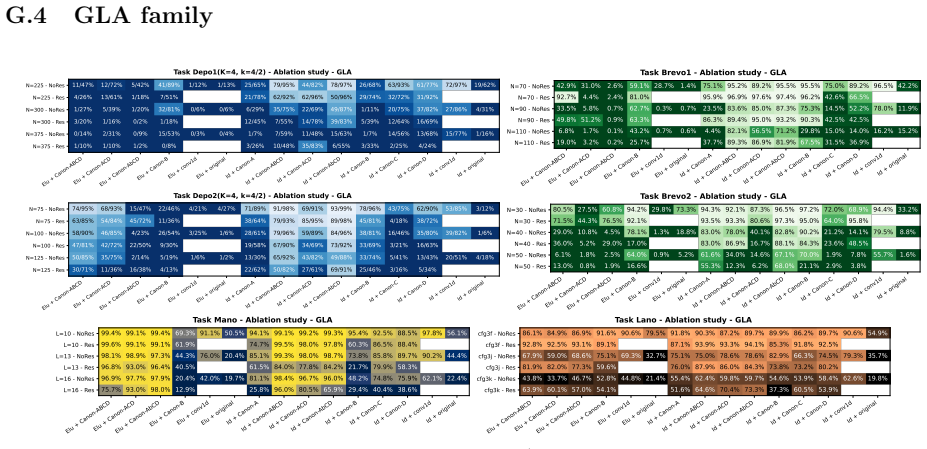
- A simple GLA plus Canon-AbCD setup rivals Mamba2 and GDN, suggesting that much of the benefit of recent linear-model refinements may come from internal convolution-style mixing rather than the state-space mechanism itself.
- Removing Mamba2's built-in conv1d drops its performance to GLA level, while replacing it with full Canon layers improves it further, identifying the conv1d as a key load-bearing component.
- Academic-scale real-world pretraining (1.3B parameters, 100B tokens) is too noisy to resolve fine architectural differences, yet the coarse patterns — Canon helping NoPE and GLA, linear models lagging on retrieval — mirror the synthetic results.
Where Pith is reading between the lines
- If the synthetic-to-real transfer holds, architecture search could be performed at tiny scale on controlled data, making systematic ablations feasible before expensive industrial-scale training.
- A testable consequence of the paper's view is that many familiar components — positional encodings, gating, delta rules — may partly work by providing local mixing; replacing each with an explicit Canon layer should recover most of their benefit.
- The paper's 'prediction of future architectures' claim implicitly extends beyond architecture to data curation and RL post-training, but that extension is not tested here and would need its own synthetic benchmarks.
- Varying Canon kernel width, layer placement, and dynamic input-dependent weights is a natural next experiment; the current paper uses only a fixed kernel size 4, so the claimed benefits are a lower bound on what this design family might achieve.
Editorial analysis
A structured set of objections, weighed in public.
Referee Report
Summary. The paper introduces 'Canon layers' — lightweight causal conv1d residual blocks (Eq. 4.1) inserted at various sub-layer positions — and argues, via a suite of five synthetic pretraining tasks (Depo, Brevo, Capo, Mano, Lano), that these layers substantially improve reasoning depth, breadth, knowledge capacity, and knowledge manipulation across Transformers, linear attention (GLA), and state-space models (Mamba2, GDN). It further claims that the synthetic rankings 'mirror' academic-scale real-world pretraining at 1.3B/100B tokens, and that the synthetic playground can predict future architecture behavior as training pipelines improve. Twelve key results are presented, leading to recommendations such as Canon-ABCD for Transformers and Canon-AbCD(res) for linear models.
Significance. If the claims hold, the paper would offer a practical architectural primitive — a few lines of code — that improves multiple capabilities across model families, and a low-cost synthetic evaluation methodology for architecture science. The empirical scope is unusually broad: 3×4 mini scaling laws per task, ablations over Canon positions, residualness, activations, and comparisons against recent baselines. The paper is also commendably explicit about the noise and limited resolution of academic-scale pretraining, and it ships or promises code and datasets. However, the headline quantitative claims and the synthetic-to-real transfer argument rest on evaluation protocols that need tightening: best-of-LR selection without a validation split, reduced difficulty for weaker models, and single-seed real-world validation. These issues are local enough to be addressed in revision, but they directly affect the stated multipliers and the 'mirror' claim.
major comments (4)
- [§3.1 and Appendix A.1/A.3] All synthetic results are reported as the best accuracy over 4 learning rates (Depo/Brevo: Appendix A.1/A.2; Mano: 4 LRs × 2 seeds, A.4; Capo: best of 2 LRs, A.3), with no held-out validation split for LR selection and no confidence intervals. Since the paper itself notes grokking-driven randomness in Mano and 2–4% seed swings in real-world data, selecting the maximum over LRs on the test distribution inflates apparent gains and makes the precise multipliers (2–4×, 30%, 10–15%) in Results 2–5 fragile. Please report a validation-based selection procedure or show the full LR × seed distribution for the headline comparisons.
- [§2.1, Figures 4, 7, 14] Weaker models are evaluated on Depo with K=4, while the reasoning-depth improvements in Result 2 are claimed from Depo1(K=8) and Depo2(K=16) where the original models score 0% or near-0%. Figure 14 further states that for linear models 'meaningful results only for Depo(K=4)'. Consequently, the '2–4× deeper reasoning' comparison is not made at matched difficulty across all architectures; the 4× figure is a ratio against a 0% baseline. Please provide matched-K comparisons for all models in the claim, or explicitly restrict the depth-ratio conclusion to the difficulty range where all compared models were evaluated.
- [§8, Result 12, Figure 16] The real-world transfer evidence consists of single-seed runs (seed 20) for almost every architecture, with best-of-LR selection, while only Llama(RoPE)-original has seeds 20–27. The paper documents 2–4% seed noise and states that 'academic-scale pretraining cannot reliably distinguish finer architectural differences', yet the abstract claims Canon layers are 'validated through ... real-world academic-scale pretraining' and Result 12 asserts that trends 'mirror' synthetic results. The claimed equalities (NoPE+Canon≈RoPE, GLA+Canon≈GDN) fall within the paper's own noise band. The future-work sentence about 1–8B/1–2T pretrains provides no data or protocol. Please provide multi-seed statistics with confidence intervals for the key real-world comparisons, or downgrade the transfer claim to tentative.
- [§3.1 vs. Abstract/Result 2] Section 3.1 explicitly reframes all synthetic results as 'differences in the speed of skill acquisition, not absolute capability,' yet the abstract and Result 2 state absolute-sounding multipliers ('reasoning depth increases by 2–4×', 'knowledge capacity by 10–15%', 'knowledge manipulation length by 30%') measured after a fixed budget with best-of-LR reporting. These are speed-of-learning statements on specific synthetic tasks. Please carry the speed/absolute distinction through every quantitative claim, e.g., 'within our fixed training budget and under best-of-LR reporting, Canon reaches the same depth with fewer steps' rather than 'increases depth by 4×'.
minor comments (5)
- [Eq. (4.1)] The formal definition uses h'_t = h_t + conv1d([h_t, ..., h_{t-3}]), but the earlier general form writes h'_t = w_0⊙h_t + w_1⊙h_{t-1} + ... . Clarify that Eq. (4.1) is the residual parameterization with learned kernel weights and no bias.
- [§2.1] Task name typo: 'Breo' is introduced in the text but the task is called 'Brevo' throughout the rest of the paper and in Figure 3. Harmonize.
- [Figure 16] The table is extremely dense and difficult to read, with 30+ models × 32 metrics. Consider splitting into panels or moving the full table to the appendix and showing only the key comparisons (NoPE±Canon, GLA±Canon, Mamba2±conv1d) in the main text.
- [§5.2] The notation RoPE(♩), representing reduced RoPE (1/4 of dimensions), is used before it is formally introduced. Define it when first used and keep a consistent symbol list.
- [§4, Related Work] The aside about an ICML reviewer comment ('too surprising to be true') is out of place in a formal paper; remove it or move it to acknowledgments.
Circularity Check
No significant circularity: the paper is an empirical architecture study whose claims are measured against independently defined synthetic and real-world tasks; limitations and self-citations do not reduce the results to their inputs.
full rationale
The paper does not derive its predictions from its inputs by construction. Canon layers are defined independently in Eq. (4.1) as h'_t = h_t + conv1d([h_t, h_{t-1}, h_{t-2}, h_{t-3}]), and the five synthetic tasks (Depo, Brevo, Capo, Mano, Lano) are specified by graph, CFG, and arithmetic generators that do not mention Canon layers, so the reported accuracy differences are measured rather than definitionally forced. The recommended Canon configurations (Canon-ABCD, Canon-AbCD(res)) are selected via ablations on the synthetic playground and then carried into the real-world section; this is a model-selection and potential overfitting risk, but Section 8 evaluates on held-out natural-language benchmarks, so the real-world comparison is not statistically forced by the synthetic fits. Section 3.1 explicitly reframes all synthetic results as 'differences in the speed of skill acquisition, not absolute capability,' and Result 12 concedes that 'Academic-scale pretraining cannot reliably distinguish finer architectural differences' — these are honest limitations, not evidence that a prediction equals its input. The paper's self-citations (e.g., [3,4] for hierarchical-learning theory, [8] for Capo, [75] for the Brevo preprocessing observation) supply background and are acknowledged as prior work; they are not used to forbid alternatives or to define the central Canon claim. The paper also transparently credits causal conv1d to H3/Mamba/GLA and Primer, saying those 'roughly correspond to Canon-B(no-res),' so the Canon idea is presented as a generalization rather than a hidden renaming. The unsupported sentence that 'Preliminary results from larger pretrains (1-8B models on 1-2T tokens) closely align' is a missing-evidence issue for the transfer claim, not a circular derivation. No equation reduces to another equation, and no fitted parameter is relabeled as a prediction. Verdict: no significant circularity.
Axiom & Free-Parameter Ledger
free parameters (6)
- Canon kernel size =
4
- Canon placement and residual design =
Canon-ABCD / Canon-AbCD(res)
- Best-of-LR reporting protocol =
best of {3e-4, 5e-4, 1e-3, 2e-3}, sometimes 8 runs
- n-sampling distribution for Depo/Brevo =
p(n) ∝ 1/sqrt(N+n)
- Reduced difficulty for weak models =
K=4 instead of K=8/16
- Real-world training budget =
1.3B params, 100B tokens, context 4096
axioms (5)
- domain assumption Synthetic tasks isolate atomic capabilities and learning-speed differences on them rank real-world architectures.
- domain assumption Faster skill acquisition is an interpretable architectural advantage.
- domain assumption Mamba2/GDN public implementations are faithful baselines and removing conv1d cleanly isolates the SSM behavior.
- domain assumption Academic-scale pretraining on FineWeb-Edu/SlimPajama is a valid (if noisy) real-world test of the synthetic predictions.
- ad hoc to paper Random fixed-weight Canon layers are already effective.
invented entities (1)
-
Canon layer
independent evidence
read the original abstract
Understanding architectural differences in language models is challenging, especially at academic-scale pretraining (e.g., 1.3B parameters, 100B tokens), where results are often dominated by noise and randomness. To overcome this, we introduce controlled synthetic pretraining tasks that isolate and evaluate core model capabilities. Within this framework, we discover CANON LAYERS: lightweight architectural components -- named after the musical term "canon" -- that promote horizontal information flow across neighboring tokens. Canon layers compute weighted sums of nearby token representations and integrate seamlessly into Transformers, linear attention, state-space models, or any sequence architecture. We present 12 key results. This includes how Canon layers enhance reasoning depth (e.g., by $2\times$), reasoning breadth, knowledge manipulation, etc. They lift weak architectures like NoPE to match RoPE, and linear attention to rival SOTA linear models like Mamba2/GDN -- validated both through synthetic tasks and real-world academic-scale pretraining. This synthetic playground offers an economical, principled path to isolate core model capabilities often obscured at academic scales. Equipped with infinite high-quality data, it may even PREDICT how future architectures will behave as training pipelines improve -- e.g., through better data curation or RL-based post-training -- unlocking deeper reasoning and hierarchical inference.
Figures




Forward citations
Cited by 14 Pith papers
-
Smooth Scaling Laws Hide Stepwise Token Learning
Power-law LLM scaling laws are largely the aggregate of stepwise token learning events whose heavy-tailed learning-time spectrum reconstructs loss derivatives along step, data, and model axes.
-
Smooth Scaling Laws Hide Stepwise Token Learning
Token loss trajectories follow localized sigmoids whose learning-time spectrum quantitatively reconstructs scaling-law derivatives on T, D, and M axes and enables faster training via distribution reshaping.
-
The Key to Going Linear: Analysis-Driven Transformer Linearization
Delta-rule linear attention faithfully approximates softmax attention through key-dependent rank-1 projections, enabling efficient post-hoc linearization of LLMs up to 32B parameters.
-
Adaptive Depth in Looped Transformers: Diagnosing Learned Halting Gates and Trajectory Readouts
In looped transformers, halting-gate failures come mainly from how gate training reshapes the trajectory; fixed-prior depth supervision plus simple confidence readouts yields better accuracy per unit of compute.
-
Dynamic Short Convolutions Improve Transformers
Dynamic short convolutions applied to key/query/value projections and linear layers in Transformers yield consistent performance gains and 1.33-1.60x compute advantages over standard models on language modeling from 1...
-
Beyond Similarity: Temporal Operator Attention for Time Series Analysis
TOA augments attention with learnable sequence-space operators and stochastic regularization to enable signed temporal mixing, yielding gains on forecasting and related benchmarks when added to PatchTST and iTransformer.
-
Convergent Evolution: How Different Language Models Learn Similar Number Representations
Diverse language models converge on similar periodic number features with a two-tier hierarchy of Fourier sparsity and geometric separability, acquired via language co-occurrences or multi-token arithmetic.
-
The Topological Trouble With Transformers
Feedforward transformers push each state update into deeper layers, exhausting the model's depth, so the authors argue step-wise recurrence is required and propose a taxonomy of recurrent transformer designs.
-
ATMA: Length-Invariant Language Modeling via Polar Attention and Gated-Delta Compression Memory
ATMA combines three-channel polar attention with gated-delta recurrent memory to achieve monotonic perplexity reduction and over 90% needle-in-haystack accuracy at 32x training context length.
-
ATMA: Length-Invariant Language Modeling via Polar Attention and Gated-Delta Compression Memory
ATMA combines polar attention (direction + bounded-magnitude channels) with gated-delta recurrent compression to achieve length-invariant perplexity and >90% needle retrieval at 64K tokens after 2K training.
-
Beyond Similarity: Temporal Operator Attention for Time Series Analysis
Temporal Operator Attention augments softmax attention with learnable sequence-space operators for signed temporal mixing and uses stochastic regularization to enable practical training, yielding consistent gains on t...
-
The Topological Trouble With Transformers
Transformers face a topological limitation in dynamic state tracking because their feedforward architecture pushes evolving state representations deeper into layers until depth is exhausted, requiring a shift to recur...
-
Lifelong In-Context Learning with Transformers Requires Parametric Forms of Attention
Argues that parametric attention forms are necessary for lifelong in-context learning in transformers to maintain constant memory footprint over arbitrary sequence lengths.
-
The Topological Trouble With Transformers
An intermediate-fusion model concatenating ResNet-18 image embeddings with MLP-derived clinical embeddings reports improved mitosis-class AUC, but the image and tabular datasets are unpaired, undermining the fusion claim.
Reference graph
Works this paper leans on
-
[1]
Phi-4 technical report.arXiv preprint arXiv:2412.08905, 2024
Marah Abdin, Jyoti Aneja, Harkirat Behl, S´ ebastien Bubeck, Ronen Eldan, Suriya Gunasekar, Michael Harrison, Russell J Hewett, Mojan Javaheripi, Piero Kauffmann, et al. Phi-4 technical report.arXiv preprint arXiv:2412.08905, 2024
Pith/arXiv arXiv 2024
-
[2]
Physics of Language Models: Part 4.2, Canon Layers at Scale where Synthetic Pretraining Resonates in Reality, 2025
Zeyuan Allen-Zhu. Physics of Language Models: Part 4.2, Canon Layers at Scale where Synthetic Pretraining Resonates in Reality, 2025. URLhttps://physics.allen-zhu. com/part-4-architecture-design/part-4-2. Code released athttps://github.com/ facebookresearch/PhysicsLM4
2025
-
[3]
Can SGD Learn Recurrent Neural Networks with Provable Gener- alization? InNeurIPS, 2019
Zeyuan Allen-Zhu and Yuanzhi Li. Can SGD Learn Recurrent Neural Networks with Provable Gener- alization? InNeurIPS, 2019. Full version available athttp://arxiv.org/abs/1902.01028
Pith/arXiv arXiv 2019
-
[4]
Backward Feature Correction: How Deep Learning Performs Deep (Hierarchical) Learning
Zeyuan Allen-Zhu and Yuanzhi Li. Backward Feature Correction: How Deep Learning Performs Deep (Hierarchical) Learning. InConference on Learning Theory, COLT ’23, 2023. Full version available at http://arxiv.org/abs/2001.04413
Pith/arXiv arXiv 2023
-
[5]
Physics of Language Models: Part 3.1, Knowledge Storage and Extraction
Zeyuan Allen-Zhu and Yuanzhi Li. Physics of Language Models: Part 3.1, Knowledge Storage and Extraction. InProceedings of the 41st International Conference on Machine Learning, ICML 2024,
2024
-
[6]
Zeyuan Allen-Zhu and Yuanzhi Li. Physics of Language Models: Part 1, Learning Hierarchical Language Structures.Transactions on Machine Learning Research, 2025. Full version available athttp://arxiv. org/abs/2305.13673
Pith/arXiv arXiv 2025
-
[7]
Physics of Language Models: Part 3.2, Knowledge Manipulation
Zeyuan Allen-Zhu and Yuanzhi Li. Physics of Language Models: Part 3.2, Knowledge Manipulation. In Proceedings of the 13th International Conference on Learning Representations, ICLR 2025, 2025. Full version available athttp://arxiv.org/abs/2309.14402
Pith/arXiv arXiv 2025
-
[8]
Physics of Language Models: Part 3.3, Knowledge Capacity Scaling Laws
Zeyuan Allen-Zhu and Yuanzhi Li. Physics of Language Models: Part 3.3, Knowledge Capacity Scaling Laws. InProceedings of the 13th International Conference on Learning Representations, ICLR 2025,
2025
-
[9]
Simran Arora, Aman Timalsina, Aaryan Singhal, Benjamin Spector, Sabri Eyuboglu, Xinyi Zhao, Ashish Rao, Atri Rudra, and Christopher R´ e. Just read twice: closing the recall gap for recurrent language models.arXiv preprint arXiv:2407.05483, 2024
Pith/arXiv arXiv 2024
-
[10]
Titans: Learning to memorize at test time.arXiv preprint arXiv:2501.00663, 2024
Ali Behrouz, Peilin Zhong, and Vahab Mirrokni. Titans: Learning to memorize at test time.arXiv preprint arXiv:2501.00663, 2024
Pith/arXiv arXiv 2024
-
[11]
Curriculum learning
Yoshua Bengio, J´ erˆ ome Louradour, Ronan Collobert, and Jason Weston. Curriculum learning. In Proceedings of the 26th annual international conference on machine learning, pages 41–48, 2009
2009
-
[12]
PIQA: Reasoning about physical common- sense in natural language
Yonatan Bisk, Rowan Zellers, Jianfeng Gao, Yejin Choi, et al. PIQA: Reasoning about physical common- sense in natural language. InProceedings of the AAAI conference on artificial intelligence, volume 34, pages 7432–7439, 2020
2020
-
[13]
GPT-NeoX-20B: An open-source autoregressive language model
Sid Black, Stella Biderman, Eric Hallahan, Quentin Anthony, Leo Gao, Laurence Golding, Horace He, Connor Leahy, Kyle McDonell, Jason Phang, Michael Pieler, USVSN Sai Prashanth, Shivanshu Purohit, Laria Reynolds, Jonathan Tow, Ben Wang, and Samuel Weinbach. GPT-NeoX-20B: An open-source autoregressive language model. InProceedings of the ACL Workshop on Cha...
Pith/arXiv arXiv 2022
-
[14]
Language models are few-shot learners.Advances in neural information processing systems, 33:1877–1901, 2020
Tom Brown, Benjamin Mann, Nick Ryder, Melanie Subbiah, Jared D Kaplan, Prafulla Dhariwal, Arvind Neelakantan, Pranav Shyam, Girish Sastry, Amanda Askell, et al. Language models are few-shot learners.Advances in neural information processing systems, 33:1877–1901, 2020
1901
-
[15]
Rethinking attention with performers.arXiv preprint arXiv:2009.14794, 2020
Krzysztof Choromanski, Valerii Likhosherstov, David Dohan, Xingyou Song, Andreea Gane, Tamas Sarlos, Peter Hawkins, Jared Davis, Afroz Mohiuddin, Lukasz Kaiser, et al. Rethinking attention with performers.arXiv preprint arXiv:2009.14794, 2020
Pith/arXiv arXiv 2009
-
[16]
Palm: Scaling language modeling with pathways.Journal of Machine Learning Research, 24(240):1–113, 2023
Aakanksha Chowdhery, Sharan Narang, Jacob Devlin, Maarten Bosma, Gaurav Mishra, Adam Roberts, Paul Barham, Hyung Won Chung, Charles Sutton, Sebastian Gehrmann, et al. Palm: Scaling language modeling with pathways.Journal of Machine Learning Research, 24(240):1–113, 2023
2023
-
[17]
BoolQ: Exploring the surprising difficulty of natural yes/no questions
Christopher Clark, Kenton Lee, Ming-Wei Chang, Tom Kwiatkowski, Michael Collins, and Kristina Toutanova. BoolQ: Exploring the surprising difficulty of natural yes/no questions. InProceedings of the 2019 Conference of the North American Chapter of the Association for Computational Linguistics: Human Language Technologies, pages 2924–2936, 2019. doi: 10.186...
-
[18]
Think you have solved question answering? try ARC, the AI2 reasoning challenge
Peter Clark, Isaac Cowhey, Oren Etzioni, Tushar Khot, Ashish Sabharwal, Carissa Schoenick, and Oyvind Tafjord. Think you have solved question answering? try ARC, the AI2 reasoning challenge. arXiv preprint arXiv:1803.05457, 2018
Pith/arXiv arXiv 2018
-
[19]
Tri Dao and Albert Gu. Transformers are ssms: Generalized models and efficient algorithms through structured state space duality.arXiv preprint arXiv:2405.21060, 2024. URLhttps://arxiv.org/abs/ 2405.21060
Pith/arXiv arXiv 2024
-
[20]
Soham De, Samuel L Smith, Anushan Fernando, Aleksandar Botev, George Cristian-Muraru, Albert Gu, Ruba Haroun, Leonard Berrada, Yutian Chen, Srivatsan Srinivasan, et al. Griffin: Mixing gated linear recurrences with local attention for efficient language models.arXiv preprint arXiv:2402.19427, 2024
Pith/arXiv arXiv 2024
-
[21]
Drop: A reading comprehension benchmark requiring discrete reasoning over paragraphs
Dheeru Dua, Yizhong Wang, Pradeep Dasigi, Gabriel Stanovsky, Sameer Singh, and Matt Gardner. Drop: A reading comprehension benchmark requiring discrete reasoning over paragraphs. InProceedings of the 2019 Conference of the North American Chapter of the Association for Computational Linguistics: Human Language Technologies, Volume 1 (Long and Short Papers)...
-
[22]
Switch transformers: Scaling to trillion parameter models with simple and efficient sparsity.The Journal of Machine Learning Research, 23(1):5232–5270, 2022
William Fedus, Barret Zoph, and Noam Shazeer. Switch transformers: Scaling to trillion parameter models with simple and efficient sparsity.The Journal of Machine Learning Research, 23(1):5232–5270, 2022
2022
-
[24]
A framework for few-shot language model evaluation, 07 2024
Leo Gao, Jonathan Tow, Baber Abbasi, Stella Biderman, Sid Black, Anthony DiPofi, Charles Foster, Laurence Golding, Jeffrey Hsu, Alain Le Noac’h, Haonan Li, Kyle McDonell, Niklas Muennighoff, Chris Ociepa, Jason Phang, Laria Reynolds, Hailey Schoelkopf, Aviya Skowron, Lintang Sutawika, Eric Tang, Anish Thite, Ben Wang, Kevin Wang, and Andy Zou. A framework...
arXiv 2024
-
[25]
Multi-token attention.arXiv preprint arXiv:2504.00927, 2025
Olga Golovneva, Tianlu Wang, Jason Weston, and Sainbayar Sukhbaatar. Multi-token attention.arXiv preprint arXiv:2504.00927, 2025
Pith/arXiv arXiv 2025
-
[26]
Albert Gu and Tri Dao. Mamba: Linear-time sequence modeling with selective state spaces.arXiv preprint arXiv:2312.00752, 2023. URLhttps://arxiv.org/abs/2312.00752
Pith/arXiv arXiv 2023
-
[27]
Anmol Gulati, James Qin, Chung-Cheng Chiu, Niki Parmar, Yu Zhang, Jiahui Yu, Wei Han, Shibo Wang, Zhengdong Zhang, Yonghui Wu, et al. Conformer: Convolution-augmented transformer for speech recognition.arXiv preprint arXiv:2005.08100, 2020
Pith/arXiv arXiv 2005
-
[28]
Deberta: Decoding-enhanced bert with disentangled attention.arXiv preprint arXiv:2006.03654, 2020
Pengcheng He, Xiaodong Liu, Jianfeng Gao, and Weizhu Chen. Deberta: Decoding-enhanced bert with disentangled attention.arXiv preprint arXiv:2006.03654, 2020
Pith/arXiv arXiv 2006
-
[29]
Cheng-Ping Hsieh, Simeng Sun, Samuel Kriman, Shantanu Acharya, Dima Rekesh, Fei Jia, Yang Zhang, and Boris Ginsburg. Ruler: What’s the real context size of your long-context language models?arXiv preprint arXiv:2404.06654, 2024
Pith/arXiv arXiv 2024
-
[30]
Tutel: Adaptive mixture-of-experts at scale.CoRR, abs/2206.03382, June 2022
Changho Hwang, Wei Cui, Yifan Xiong, Ziyue Yang, Ze Liu, Han Hu, Zilong Wang, Rafael Salas, Jithin Jose, Prabhat Ram, Joe Chau, Peng Cheng, Fan Yang, Mao Yang, and Yongqiang Xiong. Tutel: Adaptive mixture-of-experts at scale.CoRR, abs/2206.03382, June 2022. URLhttps://arxiv.org/ pdf/2206.03382.pdf
Pith/arXiv arXiv 2022
-
[31]
Samy Jelassi, David Brandfonbrener, Sham M Kakade, and Eran Malach. Repeat after me: Transformers are better than state space models at copying.arXiv preprint arXiv:2402.01032, 2024
Pith/arXiv arXiv 2024
-
[32]
Survey of hallucination in natural language generation.ACM Computing Surveys, 55(12):1–38, 2023
Ziwei Ji, Nayeon Lee, Rita Frieske, Tiezheng Yu, Dan Su, Yan Xu, Etsuko Ishii, Ye Jin Bang, Andrea Madotto, and Pascale Fung. Survey of hallucination in natural language generation.ACM Computing Surveys, 55(12):1–38, 2023. doi: 10.1145/3571730. URLhttps://doi.org/10.1145/3571730
doi:10.1145/3571730 2023
-
[33]
Albert Q Jiang, Alexandre Sablayrolles, Arthur Mensch, Chris Bamford, Devendra Singh Chaplot, Diego de las Casas, Florian Bressand, Gianna Lengyel, Guillaume Lample, Lucile Saulnier, et al. Mistral 7b. arXiv preprint arXiv:2310.06825, 2023
Pith/arXiv arXiv 2023
-
[34]
Triviaqa: A large scale distantly supervised challenge dataset for reading comprehension
Mandar Joshi, Eunsol Choi, Daniel Weld, and Luke Zettlemoyer. Triviaqa: A large scale distantly supervised challenge dataset for reading comprehension. InProceedings of the 55th Annual Meeting of the Association for Computational Linguistics (Volume 1: Long Papers), pages 1601–1611, 2017
2017
-
[35]
Transformers are RNNs: Fast autoregressive transformers with linear attention
Angelos Katharopoulos, Apoorv Vyas, Nikolaos Pappas, and Fran¸ cois Fleuret. Transformers are RNNs: Fast autoregressive transformers with linear attention. InInternational conference on machine learning, pages 5156–5165. PMLR, 2020
2020
-
[36]
Bert: Pre-training of deep bidi- rectional transformers for language understanding
Jacob Devlin Ming-Wei Chang Kenton and Lee Kristina Toutanova. Bert: Pre-training of deep bidi- rectional transformers for language understanding. InProceedings of NAACL-HLT, pages 4171–4186, 2019
2019
-
[37]
Babilong: Testing the limits of llms with long context reasoning-in-a-haystack.Ad- vances in Neural Information Processing Systems, 37:106519–106554, 2024
Yury Kuratov, Aydar Bulatov, Petr Anokhin, Ivan Rodkin, Dmitry Sorokin, Artyom Sorokin, and Mikhail Burtsev. Babilong: Testing the limits of llms with long context reasoning-in-a-haystack.Ad- vances in Neural Information Processing Systems, 37:106519–106554, 2024
2024
-
[38]
Dai, Jakob Uszkoreit, Quoc Le, and Slav Petrov
Tom Kwiatkowski, Jennimaria Palomaki, Olivia Redfield, Michael Collins, Ankur Parikh, Chris Alberti, Danielle Epstein, Illia Polosukhin, Jacob Devlin, Kenton Lee, Kristina Toutanova, Llion Jones, Matthew Kelcey, Ming-Wei Chang, Andrew M. Dai, Jakob Uszkoreit, Quoc Le, and Slav Petrov. Natural ques- tions: A benchmark for question answering research.Transa...
doi:10.1162/tacl 2019
-
[39]
Nayoung Lee, Ziyang Cai, Avi Schwarzschild, Kangwook Lee, and Dimitris Papailiopoulos. Self- improving transformers overcome easy-to-hard and length generalization challenges.arXiv preprint arXiv:2502.01612, 2025. URLhttps://arxiv.org/abs/2502.01612
Pith/arXiv arXiv 2025
-
[40]
Gpt-4 technical report, 2023
OpenAI. Gpt-4 technical report, 2023. 56
2023
-
[41]
The LAMBADA dataset: Word prediction requiring a broad discourse context
Denis Paperno, Germ´ an Kruszewski, Angeliki Lazaridou, Ngoc Quan Pham, Raffaella Bernardi, Sandro Pezzelle, Marco Baroni, Gemma Boleda, and Raquel Fern´ andez. The LAMBADA dataset: Word prediction requiring a broad discourse context. InProceedings of the 54th Annual Meeting of the Association for Computational Linguistics (Volume 1: Long Papers), pages 1...
-
[42]
The fineweb datasets: Decanting the web for the finest text data at scale
Guilherme Penedo, Hynek Kydl ´ ıˇ cek, Loubna Ben allal, Anton Lozhkov, Margaret Mitchell, Colin Raffel, Leandro Von Werra, and Thomas Wolf. The fineweb datasets: Decanting the web for the finest text data at scale. InThe Thirty-eight Conference on Neural Information Processing Systems Datasets and Benchmarks Track, 2024. URLhttps://arxiv.org/abs/2406.17557
Pith/arXiv arXiv 2024
-
[43]
Rwkv: Reinventing rnns for the transformer era
Bo Peng, Eric Alcaide, Quentin Anthony, Alon Albalak, Samuel Arcadinho, Stella Biderman, Huanqi Cao, Xin Cheng, Michael Chung, Matteo Grella, et al. Rwkv: Reinventing rnns for the transformer era. arXiv preprint arXiv:2305.13048, 2023
Pith/arXiv arXiv 2023
-
[44]
Alethea Power, Yuri Burda, Harri Edwards, Igor Babuschkin, and Vedant Misra. Grokking: General- ization beyond overfitting on small algorithmic datasets.arXiv preprint arXiv:2201.02177, 2022. URL https://arxiv.org/abs/2201.02177
Pith/arXiv arXiv 2022
-
[45]
Ofir Press, Noah A Smith, and Mike Lewis. Train short, test long: Attention with linear biases enables input length extrapolation.arXiv preprint arXiv:2108.12409, 2021
Pith/arXiv arXiv 2021
-
[46]
Hierarchically gated recurrent neural network for sequence modeling.Advances in Neural Information Processing Systems, 36:33202–33221, 2023
Zhen Qin, Songlin Yang, and Yiran Zhong. Hierarchically gated recurrent neural network for sequence modeling.Advances in Neural Information Processing Systems, 36:33202–33221, 2023
2023
-
[47]
Qwen3-Next: Towards Ultimate Training & Inference Efficiency, Sep 2025
QwenTeam. Qwen3-Next: Towards Ultimate Training & Inference Efficiency, Sep 2025. URL https://qwen.ai/blog?id=4074cca80393150c248e508aa62983f9cb7d27cd&from=research. latest-advancements-list
2025
-
[48]
Language models are unsupervised multitask learners.OpenAI blog, 1(8):9, 2019
Alec Radford, Jeffrey Wu, Rewon Child, David Luan, Dario Amodei, Ilya Sutskever, et al. Language models are unsupervised multitask learners.OpenAI blog, 1(8):9, 2019
2019
-
[49]
Know what you don’t know: Unanswerable questions for SQuAD
Pranav Rajpurkar, Robin Jia, and Percy Liang. Know what you don’t know: Unanswerable questions for SQuAD. InProceedings of the 56th Annual Meeting of the Association for Computational Linguistics (Volume 2: Short Papers), pages 784–789, Melbourne, Australia, 2018. Association for Computational Linguistics. doi: 10.18653/v1/P18-2124. URLhttps://aclantholog...
-
[50]
Liliang Ren, Yang Liu, Yadong Lu, Yelong Shen, Chen Liang, and Weizhu Chen. Samba: Simple hybrid state space models for efficient unlimited context language modeling.arXiv preprint arXiv:2406.07522, 2024
Pith/arXiv arXiv 2024
-
[51]
WinoGrande: An adversarial winograd schema challenge at scale.arXiv preprint arXiv:1907.10641, 2019
Keisuke Sakaguchi, Ronan Le Bras, Chandra Bhagavatula, and Yejin Choi. WinoGrande: An adversarial winograd schema challenge at scale.arXiv preprint arXiv:1907.10641, 2019
Pith/arXiv arXiv 1907
-
[52]
Socialiqa: Commonsense reasoning about social interactions
Maarten Sap, Hannah Rashkin, Derek Chen, Ronan Le Bras, and Yejin Choi. Socialiqa: Commonsense reasoning about social interactions. InProceedings of the 2019 Conference on Empirical Methods in Nat- ural Language Processing and the 9th International Joint Conference on Natural Language Processing (EMNLP-IJCNLP), pages 4463–4473, 2019. doi: 10.18653/v1/D19-1454
-
[53]
Teaching transformers modular arithmetic at scale.arXiv preprint arXiv:2410.03569, 2024
Eshika Saxena, Alberto Alfarano, Emily Wenger, and Kristin Lauter. Teaching transformers modular arithmetic at scale.arXiv preprint arXiv:2410.03569, 2024. URLhttps://arxiv.org/abs/2410. 03569
Pith/arXiv arXiv 2024
-
[54]
Proximal policy optimization algorithms.arXiv preprint arXiv:1707.06347, 2017
John Schulman, Filip Wolski, Prafulla Dhariwal, Alec Radford, and Oleg Klimov. Proximal policy optimization algorithms.arXiv preprint arXiv:1707.06347, 2017
Pith/arXiv arXiv 2017
-
[55]
Zhihong Shao, Peiyi Wang, Qihao Zhu, Runxin Xu, Junxiao Song, Xiao Bi, Haowei Zhang, Mingchuan Zhang, YK Li, Y Wu, et al. Deepseekmath: Pushing the limits of mathematical reasoning in open language models.arXiv preprint arXiv:2402.03300, 2024
Pith/arXiv arXiv 2024
-
[56]
Glu variants improve transformer.arXiv preprint arXiv:2002.05202, 2020
Noam Shazeer. Glu variants improve transformer.arXiv preprint arXiv:2002.05202, 2020
Pith/arXiv arXiv 2002
-
[57]
Outrageously large neural networks: The sparsely-gated mixture-of-experts layer
Noam Shazeer, Azalia Mirhoseini, Krzysztof Maziarz, Andy Davis, Quoc Le, Geoffrey Hinton, and Jeff Dean. Outrageously large neural networks: The sparsely-gated mixture-of-experts layer. InInternational Conference on Learning Representations, 2016
2016
-
[58]
Simplified state space layers for 57 sequence modeling.arXiv preprint arXiv:2208.04933, 2022
Jimmy TH Smith, Andrew Warrington, and Scott W Linderman. Simplified state space layers for 57 sequence modeling.arXiv preprint arXiv:2208.04933, 2022
Pith/arXiv arXiv 2022
-
[59]
Primer: Searching for efficient transformers for language modeling
DR So, W Manke, H Liu, Z Dai, N Shazeer, and QV Le. Primer: Searching for efficient transformers for language modeling. arxiv 2021.arXiv preprint arXiv:2109.08668, 2021
Pith/arXiv arXiv 2021
-
[60]
SlimPajama: A 627B token cleaned and deduplicated version of RedPajama.https://www.cerebras
Daria Soboleva, Faisal Al-Khateeb, Robert Myers, Jacob R Steeves, Joel Hestness, and Nolan Dey. SlimPajama: A 627B token cleaned and deduplicated version of RedPajama.https://www.cerebras. net/blog/slimpajama-a-627b-token-cleaned-and-deduplicated-version-of-redpajama, June
-
[61]
Roformer: Enhanced transformer with rotary position embedding, 2021
Jianlin Su, Yu Lu, Shengfeng Pan, Bo Wen, and Yunfeng Liu. Roformer: Enhanced transformer with rotary position embedding, 2021
2021
-
[62]
Yutao Sun, Li Dong, Shaohan Huang, Shuming Ma, Yuqing Xia, Jilong Xue, Jianyong Wang, and Furu Wei. Retentive network: A successor to transformer for large language models.arXiv preprint arXiv:2307.08621, 2023
Pith/arXiv arXiv 2023
-
[63]
Falcon-h1: A family of hybrid-head language models redefining efficiency and performance, May 2025
Falcon-LLM Team. Falcon-h1: A family of hybrid-head language models redefining efficiency and performance, May 2025. URLhttps://falcon-lm.github.io/blog/falcon-h1
2025
-
[64]
Llama: Open and efficient foundation language models.arXiv preprint arXiv:2302.13971, 2023
Hugo Touvron, Thibaut Lavril, Gautier Izacard, Xavier Martinet, Marie-Anne Lachaux, Timoth´ ee Lacroix, Baptiste Rozi` ere, Naman Goyal, Eric Hambro, Faisal Azhar, et al. Llama: Open and efficient foundation language models.arXiv preprint arXiv:2302.13971, 2023
Pith/arXiv arXiv 2023
-
[65]
Llama 2: Open foundation and fine-tuned chat models.arXiv preprint arXiv:2307.09288, 2023
Hugo Touvron, Louis Martin, Kevin Stone, Peter Albert, Amjad Almahairi, Yasmine Babaei, Nikolay Bashlykov, Soumya Batra, Prajjwal Bhargava, Shruti Bhosale, et al. Llama 2: Open foundation and fine-tuned chat models.arXiv preprint arXiv:2307.09288, 2023
Pith/arXiv arXiv 2023
-
[66]
Asher Trockman, Hrayr Harutyunyan, J Zico Kolter, Sanjiv Kumar, and Srinadh Bhojanapalli. Mimetic initialization helps state space models learn to recall.arXiv preprint arXiv:2410.11135, 2024
Pith/arXiv arXiv 2024
-
[67]
Attention is all you need.Advances in neural information processing systems, 30, 2017
Ashish Vaswani, Noam Shazeer, Niki Parmar, Jakob Uszkoreit, Llion Jones, Aidan N Gomez, Lukasz Kaiser, and Illia Polosukhin. Attention is all you need.Advances in neural information processing systems, 30, 2017
2017
-
[68]
Linformer: Self-attention with linear complexity.arXiv preprint arXiv:2006.04768, 2020
Sinong Wang, Belinda Z Li, Madian Khabsa, Han Fang, and Hao Ma. Linformer: Self-attention with linear complexity.arXiv preprint arXiv:2006.04768, 2020
Pith/arXiv arXiv 2006
-
[69]
Towards ai-complete question answering: A set of prerequisite toy tasks
Jason Weston, Antoine Bordes, Sumit Chopra, Alexander M Rush, Bart Van Merri¨ enboer, Armand Joulin, and Tomas Mikolov. Towards ai-complete question answering: A set of prerequisite toy tasks. arXiv preprint arXiv:1502.05698, 2015
Pith/arXiv arXiv 2015
-
[70]
Cvt: Intro- ducing convolutions to vision transformers
Haiping Wu, Bin Xiao, Noel Codella, Mengchen Liu, Xiyang Dai, Lu Yuan, and Lei Zhang. Cvt: Intro- ducing convolutions to vision transformers. InProceedings of the IEEE/CVF international conference on computer vision, pages 22–31, 2021
2021
-
[71]
Fla: A triton-based library for hardware-efficient implementations of linear attention mechanism, January 2024
Songlin Yang and Yu Zhang. Fla: A triton-based library for hardware-efficient implementations of linear attention mechanism, January 2024. URLhttps://github.com/fla-org/flash-linear-attention
2024
-
[72]
Songlin Yang, Bailin Wang, Yikang Shen, Rameswar Panda, and Yoon Kim. Gated linear attention transformers with hardware-efficient training.arXiv preprint arXiv:2312.06635, 2023
Pith/arXiv arXiv 2023
-
[73]
Gated delta networks: Improving mamba2 with delta rule.arXiv preprint arXiv:2412.06464, 2024
Songlin Yang, Jan Kautz, and Ali Hatamizadeh. Gated delta networks: Improving mamba2 with delta rule.arXiv preprint arXiv:2412.06464, 2024
Pith/arXiv arXiv 2024
-
[74]
Songlin Yang, Bailin Wang, Yu Zhang, Yikang Shen, and Yoon Kim. Parallelizing linear transformers with the delta rule over sequence length.arXiv preprint arXiv:2406.06484, 2024
Pith/arXiv arXiv 2024
-
[75]
Physics of Language Models: Part 2.1, Grade- School Math and the Hidden Reasoning Process
Tian Ye, Zicheng Xu, Yuanzhi Li, and Zeyuan Allen-Zhu. Physics of Language Models: Part 2.1, Grade- School Math and the Hidden Reasoning Process. InProceedings of the 13th International Conference on Learning Representations, ICLR 2025, 2025. Full version available athttps://arxiv.org/abs/2407. 20311
2025
-
[76]
Physics of Language Models: Part 2.2, How to Learn From Mistakes on Grade-School Math Problems
Tian Ye, Zicheng Xu, Yuanzhi Li, and Zeyuan Allen-Zhu. Physics of Language Models: Part 2.2, How to Learn From Mistakes on Grade-School Math Problems. InProceedings of the 13th International Conference on Learning Representations, ICLR 2025, 2025. Full version available athttp://arxiv. org/abs/2408.16293. 58
Pith/arXiv arXiv 2025
-
[77]
Distilling system 2 into system 1.arXiv preprint arXiv:2407.06023, 2024
Ping Yu, Jing Xu, Jason Weston, and Ilia Kulikov. Distilling system 2 into system 1.arXiv preprint arXiv:2407.06023, 2024
Pith/arXiv arXiv 2024
-
[78]
Jingyang Yuan, Huazuo Gao, Damai Dai, Junyu Luo, Liang Zhao, Zhengyan Zhang, Zhenda Xie, YX Wei, Lean Wang, Zhiping Xiao, et al. Native sparse attention: Hardware-aligned and natively trainable sparse attention.arXiv preprint arXiv:2502.11089, 2025
Pith/arXiv arXiv 2025
-
[79]
Rowan Zellers, Ari Holtzman, Yonatan Bisk, Ali Farhadi, and Yejin Choi. HellaSwag: Can a ma- chine really finish your sentence? InProceedings of the 57th Annual Meeting of the Association for Computational Linguistics, pages 4791–4800, 2019. doi: 10.18653/v1/P19-1472
-
[80]
Gated slot attention for efficient linear-time sequence modeling.Advances in Neural Information Processing Systems, 37:116870–116898, 2024
Yu Zhang, Songlin Yang, Rui-Jie Zhu, Yue Zhang, Leyang Cui, Yiqiao Wang, Bolun Wang, Freda Shi, Bailin Wang, Wei Bi, et al. Gated slot attention for efficient linear-time sequence modeling.Advances in Neural Information Processing Systems, 37:116870–116898, 2024
2024
-
[81]
Zhengyan Zhang, Yixin Song, Guanghui Yu, Xu Han, Yankai Lin, Chaojun Xiao, Chenyang Song, Zhiyuan Liu, Zeyu Mi, and Maosong Sun. Relu 2 wins: Discovering efficient activation functions for sparse llms.arXiv preprint arXiv:2402.03804, 2024
Pith/arXiv arXiv 2024
discussion (0)
Sign in with ORCID, Apple, or X to comment. Anyone can read and Pith papers without signing in.