REVIEW 3 major objections 5 minor 5 cited by
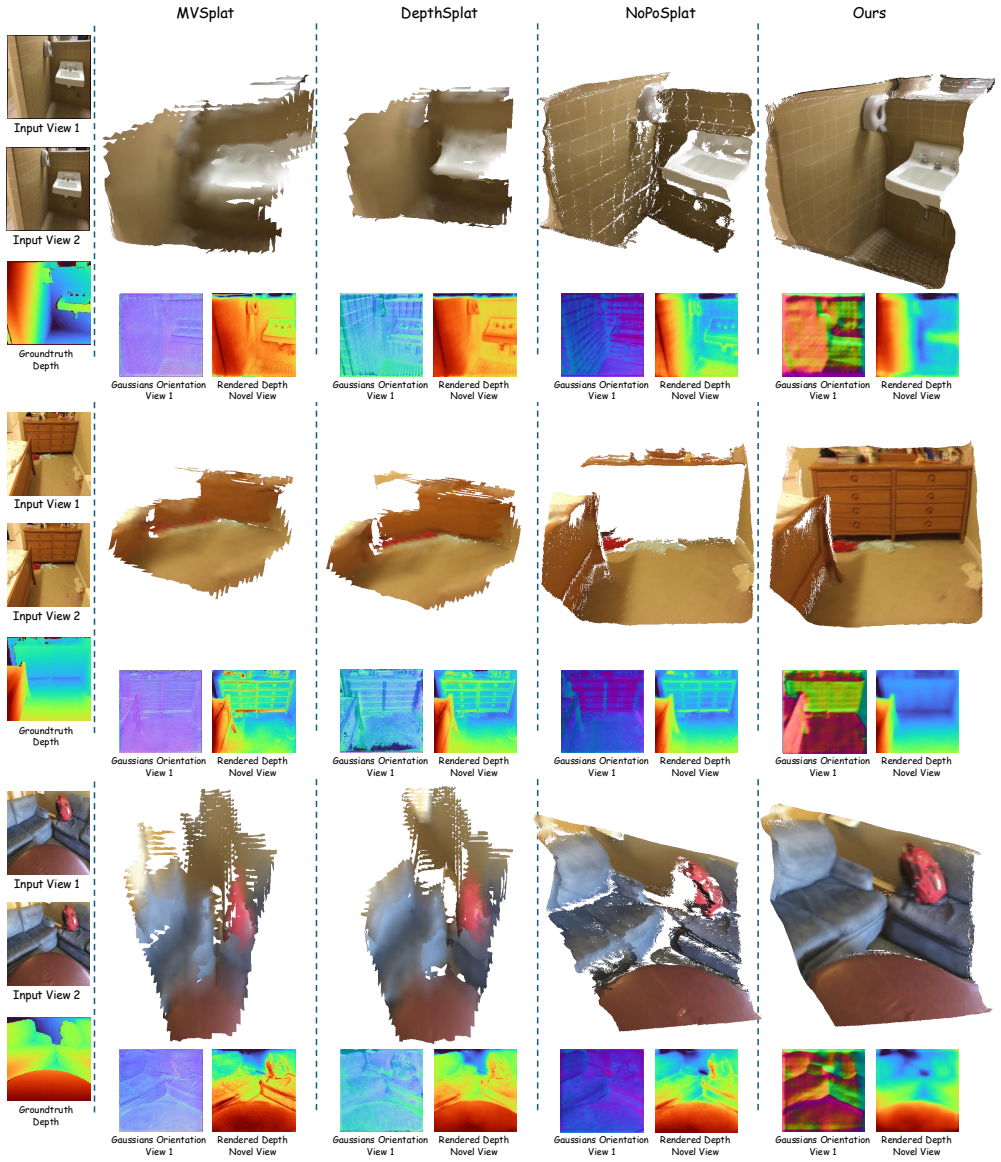
View-synthesis loss alone cannot teach Gaussian splats geometry; G3Splat's two differentiable priors (ray alignment, surface-normal alignment) make feed-forward splatting well-posed, yielding pose, depth, and mesh from two unposed images.
Reviewed by Pith at T0; open to challenge. T0 means a machine referee read the full paper against a public rubric. the ladder, T0–T4 →
T0 review · deepseek-v4-flash
2026-08-03 15:13 UTC pith:KGLBDZPI
load-bearing objection Useful priors, real geometric gains, but the 3DGS ablation for the orientation loss is confounded with the scale-flattening term, so the causal story is stronger than the evidence. the 3 major comments →
G3Splat: Geometrically Consistent Generalizable Gaussian Splatting
The pith
A machine-rendered reading of the paper's core claim, the machinery that carries it, and where it could break.
Core claim
On its own terms, the paper diagnoses a degeneracy: when a splat predictor is trained with only photometric losses, the Gaussian means (which come from a strong depth/point backbone) remain roughly sensible, but orientations, scales, and opacities are free to absorb appearance rather than geometry. The authors then show that a pixel-alignment loss (Lalign) and an edge-aware orientation loss (Lorient) — the latter using the cross product of central-difference neighbor means as a pseudo surface normal — eliminate the degeneracy. With these, predicted Gaussians align with real surface structure, which makes it possible to render novel-view depth maps reliably, fuse them into meshes via TSDF, an
What carries the argument
The central object is the per-pixel 3D Gaussian splat — mean, quaternion orientation, three scale parameters, opacity, color — predicted in a canonical coordinate frame. The argument turns on two differentiable regularizers: Lalign, a re-projection loss that demands each Gaussian center reproject exactly to its pixel (so splats cannot drift off their viewing rays), and Lorient, which computes a local surface normal from the cross product of central-difference vectors between neighboring Gaussian means (Δy × Δx), weights it by an edge-aware confidence term, and penalizes angular disagreement with the Gaussian's smallest-eigenvalue direction. The orientation loss provides the missing structura
Load-bearing premise
The orientation prior assumes the cross product of neighboring predicted Gaussian centers is the true local surface normal, which holds only where means are accurate and the surface is smooth; at depth discontinuities, occlusions, or with mean errors, these pseudo-labels are wrong, and edge-weighting merely downweights rather than corrects them.
What would settle it
Train a generalizable splatting model with the same two priors on a dataset dominated by thin structures, vegetation, or heavy texture (where central-difference normals are unreliable) and compare against the view-synthesis-only baseline: if relative pose and depth gains vanish or reverse, the assumption that local finite-difference normals provide a trustworthy supervisory signal in new domains would be refuted. A more direct test is to inspect predicted Gaussian normals along a rendered depth discontinuity: correct geometry should show normals flipping exactly at the edge, whereas the prior'
If this is right
- Any feed-forward geometry backbone (depth-based or point-map-based) can be turned into a geometrically meaningful splat predictor by adding Lalign and Lorient, so future architectures inherit the well-posedness without new supervision.
- A single RE10K-trained model can serve as a general structure-and-pose estimator, producing relative pose, depth, and meshes from two unposed images — matching or beating task-specific matching methods on zero-shot indoor scenes.
- Geometric evaluation of splatting methods becomes possible: rendered depth from virtual views and TSDF-fused meshes can be used as standard benchmarks, replacing input-view-only depth metrics.
- Test-time photometric pose refinement using the same losses further improves pose and depth, indicating the priors are stable enough to guide gradient-based optimization at inference.
- The edge-aware normal prior and flatness penalty push full-rank 3DGS splats toward a surfel-like behavior, narrowing the gap between 3DGS and 2DGS representations in the generalizable setting.
Where Pith is reading between the lines
- The paper's diagnosis generalizes: any representation with more degrees of freedom than needed to explain pixels (radiance fields, warped surfaces) may exhibit the same photometric degeneracy; the alignment-plus-orientation recipe could transfer to other overparameterized self-supervised learners.
- One testable extension is to replace the central-difference normal estimator with a robust plane fit or learned normal predictor; if that reduces the need for the edge-aware weighting, the orientation prior could become stronger in geometrically complex scenes.
- Since the priors only supervise orientation through the predicted means, any systematic bias in the mean predictor (e.g., scale drift) would propagate to normals; coupling Lorient to a scale-invariant normal loss could decouple mean accuracy from orientation accuracy.
- If the priors truly make the problem well-posed, they may also stabilize few-shot per-scene Gaussian optimization, offering a replacement for depth-regularization heuristics currently used in sparse-view 3DGS.
Editorial analysis
A structured set of objections, weighed in public.
Referee Report
Summary. The paper proposes G3Splat, a framework for generalizable Gaussian splatting that augments the standard view-synthesis loss with two geometric priors: a pixel-alignment loss Lalign and an orientation-alignment loss Lorient, plus a minimum-scale penalty Lflat for 3DGS. The method is instantiated on DUSt3R- and VGGT-based backbones with both 3DGS and 2DGS representations, trained on RealEstate10K, and evaluated on RE10K, ACID, and ScanNet for relative pose, depth, mesh, and novel-view synthesis. The central claim is that view-synthesis supervision alone is under-constrained, and the proposed priors make predicted Gaussian orientations and scales geometrically meaningful.
Significance. If the central claim holds, the paper addresses a genuine degeneracy in generalizable Gaussian splatting and provides a simple, architecture-agnostic remedy. Strengths include extensive evaluation with retrained NoPoSplat baselines, consistent ablations across two backbones and two scene representations, a well-motivated expected-depth renderer, and released code and models. The main concern is that the ablation evidence for the orientation prior is confounded with Lflat for the primary 3DGS variant, and the mesh evaluation omits external baselines despite SOTA claims; both weaken the paper's central attribution as currently presented.
major comments (3)
- [§3.1, Eq. (12); Tables 2, 4, 9, 10] For the 3DGS variant, Lflat is applied 'whenever Lorient is enabled' and all ablation rows labeled 'Orient' therefore include both Lorient and Lflat. No row isolates Lflat alone or Lorient alone. Because Lflat directly penalizes the minimum Gaussian scale, it could by itself reduce geometric degeneracy and improve pose/depth, so the reported gains of 'Orient' over 'Align' cannot be attributed to orientation alignment. This is load-bearing: the paper's headline conceptual finding—that aligning orientations with surface normals is crucial—is argued primarily from the 3DGS results. The 2DGS results, where Lflat is disabled, do not cleanly support it either: '2DGS+Orient' alone is unstable (e.g., Table 2, RE10K Trans. 34.414 vs. 29.693 no-prior). Please add ablations that separate Lflat and Lorient (e.g., Align+Lflat, Align+Orient without Lflat) before claiming orientation alignment is the d
- [§4.2, Table 5] The mesh reconstruction table compares only internal variants (No Prior/With Priors for DUSt3R and VGGT). The abstract and Section 4.2 claim state-of-the-art mesh reconstruction, but no external prior-art method (e.g., MVSplat, NoPoSplat, DepthSplat) is included in the mesh comparison, despite such baselines appearing in other tables. Either include external methods under the same TSDF-Fusion protocol, or revise the claims to state that the comparison is an internal ablation. This is necessary to support the 'state-of-the-art mesh reconstruction' assertion.
- [§4.2, Tables 3 and 4] Depth evaluation uses ground-truth relative poses for rendering virtual views, which the text notes places pose-free methods at a disadvantage. While this is a defensible protocol, the reported margin over NoPoSplat (AbsRel 0.090 vs 0.131) is large and central to the geometry claim. However, because the 3DGS ablation columns again combine Lorient with Lflat, the depth gains in Table 4 inherit the same confound as the pose ablations. If Lflat is responsible for most of the improvement, the depth and mesh conclusions would need to be reframed accordingly.
minor comments (5)
- [General] No error bars, confidence intervals, or multiple-seed runs are reported. Several headline differences are small (e.g., Table 7 average PSNR 23.417 vs. 23.244 for NoPoSplat; Table 1 ScanNet AUC@5 0.124 vs. 0.109 for NoPoSplat w/ refinement). Reporting variance across seeds would strengthen the quantitative claims.
- [§4.3] The sentence 'We noted that the proposed method outperforms prior work...' appears without a reference to the underlying table; please cite Table 7 (and Table 8) explicitly.
- [Eq. (9)] The notation with trailing asterisk for normalization is nonstandard; define it where first used or use a named operator.
- [§3.1, Eq. (11)] The definition of Ω says it excludes a one-pixel boundary, but |Ω|=T(H−2)(W−2) assumes all interior pixels are valid; in practice invalid depths/out-of-bounds means may further reduce the set. Clarify whether Eq. (11) normalizes by the count of valid pixels or by the full interior size.
- [Introduction / Related Work] The statement that 'all existing generalizable splatting methods struggle to learn geometrically faithful orientations and scales' is strong; consider softening or citing the specific evidence for each cited method.
Circularity Check
No significant circularity: the claimed geometric gains are measured against external ground truth, and the priors are self-consistency regularizers rather than fitted inputs renamed as predictions.
full rationale
The paper's derivation chain is self-contained with respect to circularity. The orientation prior Lorient (Eqs. 8-11) supervises predicted Gaussian normals using normals computed by finite differences of predicted Gaussian means; this is self-consistency between two predicted outputs, not a fitted quantity masquerading as an external prediction. The pixel-alignment loss Lalign (Eqs. 13-14) uses training-time ground-truth intrinsics and extrinsics as a regularizer, but test-time pose/depth/mesh evaluations are performed against held-out COLMAP poses, ScanNet RGB-D ground truth, and TSDF meshes, none of which appear as training targets in the priors. The scale regularizer Lflat (Eq. 12) is a genuine ablation confound for the 3DGS variant: the paper states it is applied 'whenever Lorient is enabled' (Sec. 3.1), so the 'Orient' rows in Tables 2, 4, 9, and 10 do not isolate orientation alignment from flattening. This is a correctness/attribution concern, not a circularity: the reported metrics are not constructed from the losses, and the 2DGS experiments, where Lflat is disabled, provide partially supporting evidence for the orientation prior. Self-citations appear only in related-work and implementation contexts and are not load-bearing for the central claim. No step reduces by construction to its own inputs.
Axiom & Free-Parameter Ledger
free parameters (7)
- lambda_a (alignment weight) =
0.1
- lambda_o (orientation weight) =
0.05
- lambda_flat (minimum-scale penalty weight) =
1000
- w0 (edge-aware weight constant) =
10
- kappa (edge decay) =
4
- q (quantile for normalization) =
0.95
- delta (Huber threshold) =
0.1
axioms (5)
- standard math Cross product of central-difference vectors (Δy × Δx) gives the local surface normal.
- domain assumption Gaussian centers predicted for neighboring pixels in each input frame are spatially adjacent on the underlying surface.
- domain assumption COLMAP or ground-truth poses used by Lalign during training are accurate enough to define pixel-alignment targets.
- domain assumption A Gaussian's smallest-eigenvalue eigenvector is the geometric normal of the underlying surface.
- domain assumption Pretrained geometry backbones (MASt3R/VGGT) provide a sufficient starting point for fine-tuning with view-synthesis and the proposed priors.
Cite this review
Pith. "Pith review of G3Splat: Geometrically Consistent Generalizable Gaussian Splatting." pith.science (2026). https://pith.science/paper/KGLBDZPI
@misc{pith2026251217547,
  author       = {Pith},
  title        = {Pith review of: G3Splat: Geometrically Consistent Generalizable Gaussian Splatting},
  year         = {2026},
  howpublished = {\url{https://pith.science/paper/KGLBDZPI}},
  note         = {Machine review of arXiv:2512.17547}
}
read the original abstract
3D Gaussians have become a powerful scene representation for real-time splatting and high-quality novel-view synthesis. This has motivated generalizable splatting -- methods that adapt feed-forward geometry prediction networks to produce per-pixel Gaussians from a set of images. However, most generalizable splatting pipelines are supervised primarily through a view-synthesis loss to predict Gaussian orientation, anisotropic scale, opacity, and appearance in addition to their locations. We show that this learning objective is under-constrained. Models trained with view synthesis alone produce splats whose orientations and scales have no geometric connotation. The result is that, while producing decent view-synthesis performance, nearly all generalizable splatting methods produce geometrically inaccurate and misaligned Gaussians. We introduce G3Splat, a geometry-consistent generalizable splatting framework that addresses these degeneracies through differentiable geometric priors on the predicted 3D Gaussians, making the learning problem well-posed. These priors encourage the per-pixel splats to remain on their viewing rays and to orient themselves in accordance with local surfaces. Our priors are architecture-agnostic and can be incorporated into any previously studied geometric backbone for generalizable splatting, as well as different scene representations. We test G3Splat with both DUSt3R-style and VGGT-style backbones to predict pixel-aligned full-rank 3DGS as well as surfel-like 2DGS. Trained on RE10K, G3Splat produces Gaussian splats with significantly higher geometric fidelity than baselines, providing state-of-the-art novel-view depth, mesh reconstruction, and relative pose estimation performance while preserving novel-view synthesis quality, as evaluated on datasets such as ACID and ScanNet. Code and pretrained models are released on our project page.
Figures



Forward citations
Cited by 5 Pith papers
-
DF3DV-1K: A Large-Scale Dataset and Benchmark for Distractor-Free Novel View Synthesis
DF3DV-1K supplies 1,048 scenes with clean and cluttered image pairs plus a challenging 41-scene subset to benchmark and improve distractor-free radiance field methods.
-
G$^2$SR: Geometric Methods for Fast and Memory-Efficient Gaussian-based Surface Reconstruction
A lightweight neural frontend plus analytic triangulation recovers metric-scale 3D Gaussian surfaces from 2–3 posed images faster and in less memory than end-to-end splat regressors.
-
DF3DV-1K: A Large-Scale Dataset and Benchmark for Distractor-Free Novel View Synthesis
DF3DV-1K supplies 1,048 real scenes with clean/cluttered image pairs and a 41-scene hard subset to benchmark and improve distractor-free radiance-field methods.
-
RMGS-SLAM: Real-time Multi-sensor Gaussian Splatting SLAM
RMGS-SLAM delivers real-time multi-sensor 3D Gaussian splatting SLAM with cascaded initialization, Gaussian-based loop closure, and claimed state-of-the-art efficiency, accuracy, and rendering quality on large-scale l...
-
FlowObject: Flow Steering for Bridging Generative Priors and Reconstruction Fidelity
FlowObject reformulates sparse-view 3D reconstruction as a training-free guided inverse problem in flow-matching models, augmented by 3DGS refinement to improve geometric completeness and fidelity.
Reference graph
Works this paper leans on
-
[1]
Auto-rectify network for un- supervised indoor depth estimation.IEEE transactions on pattern analysis and machine intelligence, 44(12):9802–9813,
Jia-Wang Bian, Huangying Zhan, Naiyan Wang, Tat-Jun Chin, Chunhua Shen, and Ian Reid. Auto-rectify network for un- supervised indoor depth estimation.IEEE transactions on pattern analysis and machine intelligence, 44(12):9802–9813,
-
[2]
Pyramid stereo match- ing network
Jia-Ren Chang and Yong-Sheng Chen. Pyramid stereo match- ing network. InCVPR, 2018. 3
2018
-
[3]
pixelsplat: 3d gaussian splats from image pairs for scalable generalizable 3d reconstruction
David Charatan, Sizhe Lester Li, Andrea Tagliasacchi, and Vincent Sitzmann. pixelsplat: 3d gaussian splats from image pairs for scalable generalizable 3d reconstruction. InCVPR,
-
[4]
Pgsr: Planar-based gaussian splatting for efficient and high-fidelity surface reconstruction.TVCG,
Danpeng Chen, Hai Li, Weicai Ye, Yifan Wang, Weijian Xie, Shangjin Zhai, Nan Wang, Haomin Liu, Hujun Bao, and Guofeng Zhang. Pgsr: Planar-based gaussian splatting for efficient and high-fidelity surface reconstruction.TVCG,
-
[5]
Mvsplat: Efficient 3d gaussian splatting from sparse multi-view images
Yuedong Chen, Haofei Xu, Chuanxia Zheng, Bohan Zhuang, Marc Pollefeys, Andreas Geiger, Tat-Jen Cham, and Jianfei Cai. Mvsplat: Efficient 3d gaussian splatting from sparse multi-view images. InECCV, 2024. 1, 2, 3, 4, 6, 8, 5
2024
-
[6]
Invertible neural warp for nerf
Shin-Fang Chng, Ravi Garg, Hemanth Saratchandran, and Simon Lucey. Invertible neural warp for nerf. InECCV, 2024. 3
2024
-
[7]
Depth- regularized optimization for 3d gaussian splatting in few-shot images
Jaeyoung Chung, Jeongtaek Oh, and Kyoung Mu Lee. Depth- regularized optimization for 3d gaussian splatting in few-shot images. InCVPR, 2024. 2, 3
2024
-
[8]
A volumetric method for building complex models from range images
Brian Curless and Marc Levoy. A volumetric method for building complex models from range images. InProceedings of the 23rd annual conference on Computer graphics and interactive techniques, pages 303–312, 1996. 9, 5, 12, 13
1996
-
[9]
Scannet: Richly- annotated 3d reconstructions of indoor scenes
Angela Dai, Angel X Chang, Manolis Savva, Maciej Halber, Thomas Funkhouser, and Matthias Nießner. Scannet: Richly- annotated 3d reconstructions of indoor scenes. InCVPR,
-
[10]
Learning to render novel views from wide-baseline stereo pairs
Yilun Du, Cameron Smith, Ayush Tewari, and Vincent Sitz- mann. Learning to render novel views from wide-baseline stereo pairs. InCVPR, 2023. 5
2023
-
[11]
Roma: Robust dense feature matching
Johan Edstedt, Qiyu Sun, Georg Bökman, Mårten Wadenbäck, and Michael Felsberg. Roma: Robust dense feature matching. InCVPR, 2024. 2, 6, 7
2024
-
[12]
Predicting depth, surface nor- mals and semantic labels with a common multi-scale convolu- tional architecture
David Eigen and Rob Fergus. Predicting depth, surface nor- mals and semantic labels with a common multi-scale convolu- tional architecture. InProceedings of the IEEE international conference on computer vision, pages 2650–2658, 2015. 5
2015
-
[13]
Depth map prediction from a single image using a multi-scale deep network
David Eigen, Christian Puhrsch, and Rob Fergus. Depth map prediction from a single image using a multi-scale deep network. InNeurIPS, 2014. 3
2014
-
[14]
Deep ordinal regression network for monocular depth estimation
Huan Fu, Mingming Gong, Chaohui Wang, Kayhan Bat- manghelich, and Dacheng Tao. Deep ordinal regression network for monocular depth estimation. InCVPR, 2018. 3
2018
-
[15]
Colmap-free 3d gaussian splatting
Yang Fu, Sifei Liu, Amey Kulkarni, Jan Kautz, Alexei A Efros, and Xiaolong Wang. Colmap-free 3d gaussian splatting. InCVPR, 2024. 4
2024
-
[16]
Unsupervised cnn for single view depth estimation: Geometry to the rescue
Ravi Garg, Vijay Kumar Bg, Gustavo Carneiro, and Ian Reid. Unsupervised cnn for single view depth estimation: Geometry to the rescue. InECCV, 2016. 4
2016
-
[17]
Direct align- ment for robust nerf learning
Ravi Garg, Shin-Fang Chng, and Simon Lucey. Direct align- ment for robust nerf learning. InACCV, 2024. 3
2024
-
[18]
Unsupervised monocular depth estimation with left-right con- sistency
Clément Godard, Oisin Mac Aodha, and Gabriel J Brostow. Unsupervised monocular depth estimation with left-right con- sistency. InCVPR, 2017. 4
2017
-
[19]
Clement Godard, Oisin Mac Aodha, Michael Firman, and Gabriel J. Brostow. Digging into self-supervised monocular depth estimation. InICCV, 2019. 4
2019
-
[20]
Digging into self-supervised monocular depth estimation
Clément Godard, Oisin Mac Aodha, Michael Firman, and Gabriel J Brostow. Digging into self-supervised monocular depth estimation. InProceedings of the IEEE/CVF inter- national conference on computer vision, pages 3828–3838,
-
[21]
Cascade cost volume for high-resolution multi-view stereo and stereo matching
Xiaodong Gu, Zhiwen Fan, Siyu Zhu, Zuozhuo Dai, Feitong Tan, and Ping Tan. Cascade cost volume for high-resolution multi-view stereo and stereo matching. InCVPR, 2020. 3
2020
-
[22]
Sugar: Surface-aligned gaussian splatting for efficient 3d mesh reconstruction and high-quality mesh rendering.CVPR, 2024
Antoine Guédon and Vincent Lepetit. Sugar: Surface-aligned gaussian splatting for efficient 3d mesh reconstruction and high-quality mesh rendering.CVPR, 2024. 3
2024
-
[23]
Neural 3d scene reconstruction with the manhattan-world assumption
Haoyu Guo, Sida Peng, Haotong Lin, Qianqian Wang, Guofeng Zhang, Hujun Bao, and Xiaowei Zhou. Neural 3d scene reconstruction with the manhattan-world assumption. InProceedings of the IEEE/CVF conference on computer vision and pattern recognition, pages 5511–5520, 2022. 9, 14
2022
-
[24]
Binocular-guided 3d gaussian splatting with view consistency for sparse view synthesis.NeurIPS, 2024
Liang Han, Junsheng Zhou, Yu-Shen Liu, and Zhizhong Han. Binocular-guided 3d gaussian splatting with view consistency for sparse view synthesis.NeurIPS, 2024. 3
2024
-
[25]
Unifying corre- spondence pose and nerf for generalized pose-free novel view synthesis
Sunghwan Hong, Jaewoo Jung, Heeseong Shin, Jiaolong Yang, Seungryong Kim, and Chong Luo. Unifying corre- spondence pose and nerf for generalized pose-free novel view synthesis. InCVPR, 2024. 6, 7, 5
2024
-
[26]
2d gaussian splatting for geometrically accu- rate radiance fields
Binbin Huang, Zehao Yu, Anpei Chen, Andreas Geiger, and Shenghua Gao. 2d gaussian splatting for geometrically accu- rate radiance fields. InACM SIGGRAPH 2024, 2024. 2, 3, 4, 5, 10, 11, 13
2024
-
[27]
Deepmvs: Learning multi-view stereopsis
Jia-Bin Huang, Iain Matthews, and Wolf Kienzle. Deepmvs: Learning multi-view stereopsis. InCVPR, 2018. 3
2018
-
[28]
Lihan Jiang, Yucheng Mao, Linning Xu, Tao Lu, Kerui Ren, Yichen Jin, Xudong Xu, Mulin Yu, Jiangmiao Pang, Feng Zhao, et al. Anysplat: Feed-forward 3d gaussian splatting from unconstrained views.arXiv preprint arXiv:2505.23716,
-
[29]
Self- splat: Pose-free and 3d-prior-free generalizable 3d gaussian splatting.CVPR, 2025
Seunghyun Kang, Hyunwoo Lee, and Hyeongju Chae. Self- splat: Pose-free and 3d-prior-free generalizable 3d gaussian splatting.CVPR, 2025. 1, 4, 7, 8, 5
2025
-
[30]
Splatam: Splat, track & map 3d gaussians for dense rgb-d slam
Nikhil Keetha, Jay Karhade, Krishna Murthy Jatavallabhula, Gengshan Yang, Sebastian Scherer, Deva Ramanan, and Jonathon Luiten. Splatam: Splat, track & map 3d gaussians for dense rgb-d slam. InCVPR, 2024. 3
2024
-
[31]
3d gaussian splatting for real-time radiance field rendering.ACM TOG, 2023
Bernhard Kerbl, Georgios Kopanas, Thomas Leimkühler, and George Drettakis. 3d gaussian splatting for real-time radiance field rendering.ACM TOG, 2023. 1, 2, 3, 10
2023
-
[32]
Tanks and temples: Benchmarking large-scale scene reconstruction.ACM TOG, 2017
Arno Knapitsch, Jaesik Park, Qian-Yi Zhou, and Vladlen Koltun. Tanks and temples: Benchmarking large-scale scene reconstruction.ACM TOG, 2017. 4 15
2017
-
[33]
Deeper depth prediction with fully convolutional residual networks
Iro Laina, Christian Rupprecht, Vasileios Belagiannis, Fed- erico Tombari, and Nassir Navab. Deeper depth prediction with fully convolutional residual networks. In3DV, 2016. 3
2016
-
[34]
Bts: Depth estimation via local planar guidance.arXiv preprint arXiv:1907.10326, 2019
Jin Han Lee, Youngbok Bae, and In So Kweon Han. Bts: Depth estimation via local planar guidance.arXiv preprint arXiv:1907.10326, 2019. 3
Pith/arXiv arXiv 1907
-
[35]
Ground- ing image matching in 3d with mast3r.arXiv preprint arXiv:2406.09756, 2024
Vincent Leroy, Yohann Cabon, and Jérôme Revaud. Ground- ing image matching in 3d with mast3r.arXiv preprint arXiv:2406.09756, 2024. 1, 2, 3, 4, 6, 7, 10
Pith/arXiv arXiv 2024
-
[36]
Dngaussian: Optimizing sparse-view 3d gaussian radiance fields with global-local depth normalization
Jiahe Li, Jiawei Zhang, Xiao Bai, Jin Zheng, Xin Ning, Jun Zhou, and Lin Gu. Dngaussian: Optimizing sparse-view 3d gaussian radiance fields with global-local depth normalization. InCVPR, 2024. 3
2024
-
[37]
Sgs-slam: Se- mantic gaussian splatting for neural dense slam
Mingrui Li, Shuhong Liu, Heng Zhou, Guohao Zhu, Na Cheng, Tianchen Deng, and Hongyu Wang. Sgs-slam: Se- mantic gaussian splatting for neural dense slam. InECCV,
-
[38]
Megadepth: Learning single- view depth prediction from internet photos
Zhengqi Li and Noah Snavely. Megadepth: Learning single- view depth prediction from internet photos. InCVPR, 2018. 6
2018
-
[39]
Spacetime gaus- sian feature splatting for real-time dynamic view synthesis
Zhan Li, Zhang Chen, Zhong Li, and Yi Xu. Spacetime gaus- sian feature splatting for real-time dynamic view synthesis. InCVPR, 2024. 3
2024
-
[40]
Infinite nature: Perpetual view generation of natural scenes from a single image
Andrew Liu, Richard Tucker, Varun Jampani, Ameesh Maka- dia, Noah Snavely, and Angjoo Kanazawa. Infinite nature: Perpetual view generation of natural scenes from a single image. InICCV, 2021. 6, 7, 4, 5, 11, 13
2021
-
[41]
Gaussian splatting slam
Hidenobu Matsuki, Riku Murai, Paul HJ Kelly, and Andrew J Davison. Gaussian splatting slam. InCVPR, 2024. 3, 6
2024
-
[42]
Occupancy networks: Learning 3d reconstruction in function space
Lars Mescheder, Michael Oechsle, Michael Niemeyer, Se- bastian Nowozin, and Andreas Geiger. Occupancy networks: Learning 3d reconstruction in function space. InProceedings of the IEEE/CVF conference on computer vision and pattern recognition, pages 4460–4470, 2019. 14
2019
-
[43]
Epipolar-free 3d gaussian splatting for generalizable novel view synthesis.NeurIPS, 2024
Zhiyuan Min, Yawei Luo, Jianwen Sun, and Yi Yang. Epipolar-free 3d gaussian splatting for generalizable novel view synthesis.NeurIPS, 2024. 4
2024
-
[44]
Creating video from text, 2024
OpenAI. Creating video from text, 2024. 1
2024
-
[45]
Vi- sion transformers for dense prediction
René Ranftl, Alexey Bochkovskiy, and Vladlen Koltun. Vi- sion transformers for dense prediction. InICCV, 2021. 3
2021
-
[46]
Structure- from-motion revisited
Johannes L Schonberger and Jan-Michael Frahm. Structure- from-motion revisited. InCVPR, 2016. 6
2016
-
[47]
Indoor segmentation and support inference from rgbd images
Nathan Silberman, Derek Hoiem, Pushmeet Kohli, and Rob Fergus. Indoor segmentation and support inference from rgbd images. InComputer Vision–ECCV 2012: 12th European Conference on Computer Vision, Florence, Italy, October 7- 13, 2012, Proceedings, Part V 12, pages 746–760. Springer,
2012
-
[48]
Brandon Smart, Chuanxia Zheng, Iro Laina, and Vic- tor Adrian Prisacariu. Splatt3r: Zero-shot gaussian splatting from uncalibrated image pairs.arXiv preprint arXiv:2408.13912, 2024. 1, 4, 7, 8, 3, 5
Pith/arXiv arXiv 2024
-
[49]
Sc-depthv3: Robust self-supervised monocular depth estimation for dynamic scenes.IEEE trans- actions on pattern analysis and machine intelligence, 46(1): 497–508, 2023
Libo Sun, Jia-Wang Bian, Huangying Zhan, Wei Yin, Ian Reid, and Chunhua Shen. Sc-depthv3: Robust self-supervised monocular depth estimation for dynamic scenes.IEEE trans- actions on pattern analysis and machine intelligence, 46(1): 497–508, 2023. 2, 4
2023
-
[50]
Scalability in perception for autonomous driving: Waymo open dataset
Pei Sun, Henrik Kretzschmar, Xerxes Dotiwalla, Aurelien Chouard, Vijaysai Patnaik, Paul Tsui, James Guo, Yin Zhou, Yuning Chai, Benjamin Caine, et al. Scalability in perception for autonomous driving: Waymo open dataset. InCVPR,
-
[51]
Flash3d: Feed-forward generalisable 3d scene reconstruction from a single image
Stanislaw Szymanowicz, Eldar Insafutdinov, Chuanxia Zheng, Dylan Campbell, Joao F Henriques, Christian Rupprecht, and Andrea Vedaldi. Flash3d: Feed-forward generalisable 3d scene reconstruction from a single image. In2025 Interna- tional Conference on 3D Vision (3DV), pages 670–681. IEEE,
-
[52]
Hisplat: Hierarchical 3d gaus- sian splatting for generalizable sparse-view reconstruction
Shengji Tang, Weicai Ye, Peng Ye, Weihao Lin, Yang Zhou, Tao Chen, and Wanli Ouyang. Hisplat: Hierarchical 3d gaus- sian splatting for generalizable sparse-view reconstruction. ICLR, 2025. 4
2025
-
[53]
Demon: Depth and motion network for learning monocular stereo
Benjamin Ummenhofer, Hao Zhou, Jonas Uhrig, Nikolaus Mayer, Eddy Ilg, Alexey Dosovitskiy, and Thomas Brox. Demon: Depth and motion network for learning monocular stereo. InCVPR, 2017. 3
2017
-
[54]
S2gaussian: Sparse-view super-resolution 3d gaussian splatting
Ziyu Wan, Hao Gao, Rui Xiong, and Fang Du. S2gaussian: Sparse-view super-resolution 3d gaussian splatting. InCVPR,
-
[55]
Patchmatchnet: Learned multi- view patchmatch stereo
Fangjinhua Wang, Silvano Galliani, Christoph V ogel, Pablo Speciale, and Marc Pollefeys. Patchmatchnet: Learned multi- view patchmatch stereo. InCVPR, 2021. 3
2021
-
[56]
Vggt: Visual geometry grounded transformer
Jianyuan Wang, Minghao Chen, Nikita Karaev, Andrea Vedaldi, Christian Rupprecht, and David Novotny. Vggt: Visual geometry grounded transformer. InProceedings of the IEEE/CVF Conference on Computer Vision and Pattern Recognition, 2025. 1, 2, 3, 8, 9, 5, 10
2025
-
[57]
Efros, and Angjoo Kanazawa
Qianqian Wang, Yifei Zhang, Aleksander Holynski, Alexei A. Efros, and Angjoo Kanazawa. Continuous 3d perception model with persistent state. InCVPR, 2025. 3
2025
-
[58]
Dust3r: Geometric 3d vision made easy
Shuzhe Wang, Vincent Leroy, Yohann Cabon, Boris Chidlovskii, and Jerome Revaud. Dust3r: Geometric 3d vision made easy. InCVPR, 2024. 1, 2, 3, 6, 7, 8, 9, 4, 5
2024
-
[59]
Freesplat: Generalizable 3d gaussian splatting towards free view synthesis of indoor scenes.NeurIPS, 2024
Yunsong Wang, Tianxin Huang, Hanlin Chen, and Gim Hee Lee. Freesplat: Generalizable 3d gaussian splatting towards free view synthesis of indoor scenes.NeurIPS, 2024. 1, 4, 8, 5, 10
2024
-
[60]
4d gaussian splatting for real-time dynamic scene rendering
Guanjun Wu, Taoran Yi, Jiemin Fang, Lingxi Xie, Xiaopeng Zhang, Wei Wei, Wenyu Liu, Qi Tian, and Xinggang Wang. 4d gaussian splatting for real-time dynamic scene rendering. InCVPR, 2024. 3
2024
-
[61]
Sparsegs: Real- time 360° sparse view synthesis using gaussian splatting
Haolin Xiong, Sairisheek Muttukuru, Rishi Upadhyay, Pradyumna Chari, and Achuta Kadambi. Sparsegs: Real- time 360° sparse view synthesis using gaussian splatting. In 3DV, 2025. 3
2025
-
[62]
Unifying flow, stereo and depth estimation.IEEE Transactions on Pat- tern Analysis and Machine Intelligence, 45(11):13941–13958,
Haofei Xu, Jing Zhang, Jianfei Cai, Hamid Rezatofighi, Fisher Yu, Dacheng Tao, and Andreas Geiger. Unifying flow, stereo and depth estimation.IEEE Transactions on Pat- tern Analysis and Machine Intelligence, 45(11):13941–13958,
-
[63]
Depth- splat: Connecting gaussian splatting and depth
Haofei Xu, Songyou Peng, Fangjinhua Wang, Hermann Blum, Daniel Barath, Andreas Geiger, and Marc Pollefeys. Depth- splat: Connecting gaussian splatting and depth. InCVPR,
-
[64]
Depth anything v2.arXiv:2406.09414, 2024
Lihe Yang, Bingyi Kang, Zilong Huang, Zhen Zhao, Xiao- gang Xu, Jiashi Feng, and Hengshuang Zhao. Depth anything v2.arXiv:2406.09414, 2024. 2
Pith/arXiv arXiv 2024
-
[65]
Deformable 3d gaussians for high- fidelity monocular dynamic scene reconstruction
Ziyi Yang, Xinyu Gao, Wen Zhou, Shaohui Jiao, Yuqing Zhang, and Xiaogang Jin. Deformable 3d gaussians for high- fidelity monocular dynamic scene reconstruction. InCVPR,
-
[66]
Real-time photorealistic dynamic scene representation and rendering with 4d gaussian splatting
Zeyu Yang, Hongye Yang, Zijie Pan, and Li Zhang. Real-time photorealistic dynamic scene representation and rendering with 4d gaussian splatting. InICLR, 2024. 3
2024
-
[67]
Mvsnet: Depth inference for unstructured multi-view stereo
Yao Yao, Zixin Luo, Shiwei Li, Tian Fang, and Long Quan. Mvsnet: Depth inference for unstructured multi-view stereo. InECCV, 2018. 3
2018
-
[68]
No pose, no problem: Surprisingly simple 3d gaussian splats from sparse unposed images
Botao Ye, Sifei Liu, Haofei Xu, Li Xueting, Marc Pollefeys, Ming-Hsuan Yang, and Peng Songyou. No pose, no problem: Surprisingly simple 3d gaussian splats from sparse unposed images. InICLR, 2025. 1, 2, 3, 4, 6, 7, 8, 5, 10, 12
2025
-
[69]
Scannet++: A high-fidelity dataset of 3d indoor scenes
Chandan Yeshwanth, Yueh-Cheng Liu, Matthias Nießner, and Angela Dai. Scannet++: A high-fidelity dataset of 3d indoor scenes. InICCV, 2023. 6
2023
-
[70]
pixelnerf: Neural radiance fields from one or few images
Alex Yu, Vickie Ye, Matthew Tancik, and Angjoo Kanazawa. pixelnerf: Neural radiance fields from one or few images. In CVPR, 2021. 5
2021
-
[71]
Unsupervised learning of monocular depth estimation and visual odometry with deep feature reconstruction
Huangying Zhan, Ravi Garg, Chamara Saroj Weerasekera, Kejie Li, Harsh Agarwal, and Ian Reid. Unsupervised learning of monocular depth estimation and visual odometry with deep feature reconstruction. InCVPR, 2018. 4
2018
-
[72]
Gps-gaussian: Generalizable pixel-wise 3d gaussian splatting for real-time human novel view synthesis
Shunyuan Zheng, Boyao Zhou, Ruizhi Shao, Boning Liu, Shengping Zhang, Liqiang Nie, and Yebin Liu. Gps-gaussian: Generalizable pixel-wise 3d gaussian splatting for real-time human novel view synthesis. InCVPR, 2024. 1, 4
2024
-
[73]
Open3d: A modern library for 3d data processing.arXiv preprint arXiv:1801.09847, 2018
Qian-Yi Zhou, Jaesik Park, and Vladlen Koltun. Open3d: A modern library for 3d data processing.arXiv preprint arXiv:1801.09847, 2018. 2
Pith/arXiv arXiv 2018
-
[74]
Unsupervised learning of depth and ego-motion from video
Tinghui Zhou, Matthew Brown, Noah Snavely, and David G Lowe. Unsupervised learning of depth and ego-motion from video. InCVPR, 2017. 4
2017
-
[75]
Stereo magnification: learning view syn- thesis using multiplane images.ACM TOG, 2018
Tinghui Zhou, Richard Tucker, John Flynn, Graham Fyffe, and Noah Snavely. Stereo magnification: learning view syn- thesis using multiplane images.ACM TOG, 2018. 1, 6, 7, 3, 4, 5, 8, 10, 11, 13
2018
-
[76]
Nice-slam: Neural implicit scalable encoding for slam
Zihan Zhu, Songyou Peng, Viktor Larsson, Weiwei Xu, Hujun Bao, Zhaopeng Cui, Martin R Oswald, and Marc Pollefeys. Nice-slam: Neural implicit scalable encoding for slam. In CVPR, 2022. 4, 9
2022
-
[77]
Fsgs: Real-time few-shot view synthesis using gaussian splat- ting
Zehao Zhu, Zhiwen Fan, Yifan Jiang, and Zhangyang Wang. Fsgs: Real-time few-shot view synthesis using gaussian splat- ting. InECCV, 2024. 2, 3
2024
-
[78]
Nicer- slam: Neural implicit scene encoding for rgb slam
Zihan Zhu, Songyou Peng, Viktor Larsson, Zhaopeng Cui, Martin R Oswald, Andreas Geiger, and Marc Pollefeys. Nicer- slam: Neural implicit scene encoding for rgb slam. In3DV,
-
[2017]
2, 6, 7, 8, 9, 1, 4, 5, 10, 11, 13
discussion (0)
Sign in with ORCID, Apple, or X to comment. Anyone can read and Pith papers without signing in.