REVIEW 2 major objections 4 minor 6 cited by
This paper claims that placing a conventional spin-singlet s-wave superconductor in contact with a p-wave unconventional magnet—a magnet with a noncollinear spin texture and zero net magnetization—effectively produces spin-triplet p-wave su
Reviewed by Pith at T0; open to challenge. T0 means a machine referee read the full paper against a public rubric. the ladder, T0–T4 →
T0 review · deepseek-v4-flash
2026-08-03 14:59 UTC pith:XSXMRQWE
load-bearing objection Solid extension of known PUM-superconductor flat-band physics to Josephson transport; the first-harmonic survival claim is plausible but not fully shielded against inter-sublattice pairing. the 2 major comments →
p-wave superconductivity and Josephson current in p-wave unconventional magnet/s-wave superconductor hybrid systems
The pith
A machine-rendered reading of the paper's core claim, the machinery that carries it, and where it could break.
Core claim
The central claim is that in a PUM/s-wave hybrid, a purely spin-singlet s-wave pair potential, combined with the p-wave unconventional magnetic order, behaves as an effective spin-triplet p-wave superconducting gap. The noncollinear spin structure along the relevant direction gives the quasiparticle dispersion the p_x-wave or p_y-wave form, and for J > Δ zero-energy flat bands appear at the [100] edge. Analyzing the pair amplitude, the paper finds that odd-frequency spin-triplet even-parity pairing is strongly induced in the presence of these flat bands, while even-frequency spin-singlet even-parity pairing remains. That remaining singlet component is what couples to the s-wave side of a Jos
What carries the argument
The load-bearing object is the effective two-dimensional tight-binding model of a p-wave unconventional magnet: H(k) = ε(k) + (t_x sin k_x + t_y sin k_y)s₃ + J s₁ in spin-sublattice space, whose noncollinear spin configuration gives p-wave-like band splitting. Coupling this to intra-sublattice spin-singlet s-wave pairing Δ produces a Bogoliubov-de Gennes Hamiltonian that separates into two sublattice sectors. Within each sector the effective gap has an odd-parity p-wave structure; analytically, the even-frequency spin-triplet odd-parity pair amplitude is proportional to ΔJ t_x sin k_x, and the odd-frequency spin-triplet even-parity amplitude to ΔJ ω_n. This identity—spin-singlet pairing plus
Load-bearing premise
The central assumption is that the superconducting order is a purely intra-sublattice spin-singlet s-wave pairing, so the Bogoliubov-de Gennes Hamiltonian separates into two independent sublattice sectors; if a realistic interface induces inter-sublattice or spin-triplet pairing, or if J is not larger than Δ, the effective p-wave gap and flat bands would be altered or absent.
What would settle it
Measure the surface density of states at the [100] edge of a PUM/s-wave hybrid while tuning the magnetic exchange J relative to the pair potential Δ: the paper predicts zero-energy flat bands (a zero-bias peak) only for J > Δ and no peak for J < Δ. Alternatively, in a low-transparency PUM-s-wave/s-wave Josephson junction the first harmonic I₁ should remain finite; observing I₁ → 0 would refute the singlet-coupling mechanism.
If this is right
- At the [100] edge of a PUM/s-wave hybrid, zero-energy flat bands appear when J > Δ, showing up as a zero-bias peak in the surface density of states.
- Odd-frequency spin-triplet even-parity pairing is strongly enhanced exactly where flat bands exist, linking edge topology to odd-frequency correlations.
- In PUM/s-wave–s-wave Josephson junctions, the first harmonic I₁ remains nonzero because the singlet even-parity pair amplitude on the PUM side couples to the s-wave side; a pure p-wave/s-wave junction would lose I₁.
- The temperature dependence of the maximum Josephson current can be tuned by the chemical potential, because the chemical potential controls whether flat bands exist and how much they resonate across the junction.
- PUM/PUM junctions show skewness or φ-junction behavior depending on the p_x/p_y orientation and on the presence of flat bands, modified by the residual singlet coupling.
Where Pith is reading between the lines
- If the effective p-wave gap is topologically protected by winding numbers, as the paper suggests, these hybrids are a plausible platform for Majorana zero modes built from a spin-singlet superconductor and an unconventional magnet, though the paper does not propose braiding or qubit operations.
- A clean experimental test would be a tunneling-spectroscopy scan at the [100] edge as the ratio J/Δ is varied: the paper predicts a zero-bias conductance peak only for J > Δ, vanishing for J < Δ.
- Because the singlet pairing survives, the Josephson current is not a clean probe of pure p-wave order; a more discriminating experiment would compare the first-harmonic amplitude across chemical potentials that switch the flat bands on and off.
- The model assumes purely intra-sublattice singlet pairing; a real interface with inter-sublattice or self-consistently inhomogeneous pairing could gap the flat bands, so engineering the interface to preserve the sublattice structure may be essential for the predicted signatures.
Editorial analysis
A structured set of objections, weighed in public.
Referee Report
Summary. The manuscript studies a two-dimensional tight-binding model of a p-wave unconventional magnet (PUM) in proximity to a conventional spin-singlet s-wave superconductor. Starting from the Brekke et al. PUM Hamiltonian (Eq. (1)) and assuming intra-sublattice spin-singlet pairing (Eq. (5)), the authors show in Appendix A that the BdG Hamiltonian separates into two sublattice sectors; for J>Δ this yields nodal quasiparticle spectra and zero-energy flat bands at the [100] edge that mimic p_x/p_y-wave superconductivity. They compute surface DOS by recursive Green's functions, classify edge pair amplitudes into ESE/ETO/OSO/OTE, and present analytical bulk formulas (Appendix B). They then calculate Josephson currents in PUM/s-wave and PUM/PUM junctions in both high- and low-transparency regimes. The central claim is that the residual spin-singlet even-parity component at the edge couples to the s-wave side, so I1 survives in PUM/s-wave junctions even though the bulk behaves as an effective p-wave superconductor, and the μ-dependent flat bands control the low-temperature enhancement of Ic in PUM/PUM junctions.
Significance. If the central assumptions hold, the paper offers a concrete path to effective p-wave superconductivity and zero-energy flat bands from a conventional s-wave superconductor and an unconventional magnet, with analytical bulk pair amplitudes and standard recursive-Green's-function numerics. Strengths include the explicit derivation of the η-sector spectrum in Appendix A, the analytical bulk anomalous Green's functions in Appendix B, and the absence of parameter fitting: all transport curves follow from the stated Hamiltonian. The paper also connects the edge pair-amplitude classification (OTE enhancement) to the Josephson harmonics in a useful way. The main weakness is that the sublattice-diagonal form of the pairing is assumed rather than justified at a real interface, and the temperature-dependent Josephson results rely on a non-self-consistent BCS gap ansatz.
major comments (2)
- [Sec. II and Appendix A (Eqs. (5), (A1))] The block-diagonal structure that separates the BdG Hamiltonian into η=± sublattice sectors, and hence the zero-energy flat bands in Figs. 2(b)-(c), relies on the spin-singlet pairing Δ[s0⊗σ0]i s2 commuting with σ3. At a physical PUM/s-wave interface, the proximity-induced pair potential need not be sublattice-diagonal: a term Δ12[s0⊗σ1]i s2 (or σ2) couples the two η sectors. Since the η=± spectra in Eq. (A2) have nodal/zero-energy features at different k, such a term generically opens a gap and would destroy the flat bands, the OTE enhancement in Sec. IV, and the I1/I2 ratios presented in Secs. V-VI. The topological-protection argument cited from Ref. [111] does not cover a model with σ1/σ2 pairing. Please either provide a symmetry argument that inter-sublattice pairing is exactly forbidden at the interface, or include Δ12≠0 and demonstrate that the flat bands, edge pair amplitudes, and
- [Sec. VI, Eq. (20)] The temperature-dependent Josephson current is computed with a fixed BCS order parameter Δ(T)=Δ0 tanh(1.74 sqrt((Tc-T)/T)), Δ0=1.76Tc, on both sides rather than a self-consistent BdG solution. For J=t and Δ=0.01t the exchange energy is two orders of magnitude larger than the gap, and the bulk spectrum is gapless for J>Δ (Appendix A, Fig. 14). The magnitude and T-dependence of the induced order parameter in the PUM layer are not guaranteed to follow the bulk s-wave BCS ansatz. Since Sec. VI's central claim—that Ic can be tuned by μ through the generation of zero-energy flat bands—depends on Δ(T), please test self-consistency at least for representative parameters (μ, J/t, tint) or explicitly state this as a limitation of the transport predictions.
minor comments (4)
- [Sec. III] Several figure callouts appear swapped: the p_x-wave results are cited as Fig. 3(b)/(c) instead of Fig. 2(b)/(c), and conversely. Please check all cross-references between Figs. 2 and 3, and also in the captions of Figs. 6-8 where panel letters do not match the text.
- [Sec. IV] Figure labels such as |F^{↑↑,↓↓}_{OTE}| are hard to parse; please define this notation explicitly in the caption (equal-spin components) and use a consistent typesetting for all pair-amplitude components.
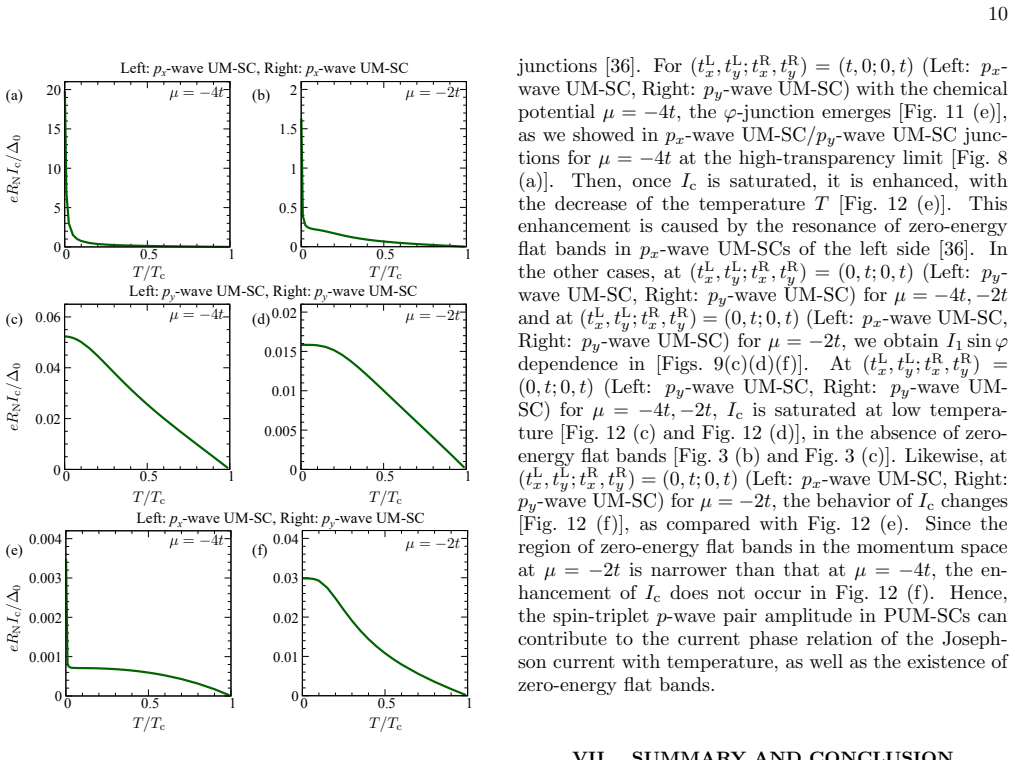
- [Sec. VII] The statement that zero-energy flat bands are realized 'independent of the chemical potential μ' is overstated: Figs. 2(b) and 2(c) show that the momentum-space extent of the flat bands changes strongly with μ, and Sec. VI itself relies on this difference. Rephrase as 'robust to changes in μ within the studied range' or similar.
- [Sec. V-VI] The high-transparency and low-transparency regimes are studied with tint=1.0 and tint=0.1 respectively, but no convergence checks (e.g., in the number of Matsubara frequencies or in the k_y grid) are reported. Adding a brief convergence statement would strengthen the numerical claims.
Circularity Check
No significant circularity: the flat-band, odd-frequency, and Josephson results are direct outputs of a stated BdG Hamiltonian, with no fitted parameters; the only self-citations are methodological or contextual.
full rationale
The paper's central predictions are obtained by solving an explicit BdG Hamiltonian, Eqs. (4)-(5), built from the externally published PUM model of Ref. [51]. The bulk pair amplitudes, Eqs. (17)-(18) and (B2)-(B10), are analytic outputs rather than imposed symmetries, and the edge SDOS and Josephson current are computed from recursive Green's functions using the standard current formula Eq. (21). No parameter is fitted to the reported flat bands, OTE enhancement, or current harmonics, and the 'effective p-wave' statement is supported by explicit spectral and Green's-function algebra (Appendix A and Appendix B) rather than by definition. The main caveats are conditional assumptions, not circularity: the effective p-wave nodal structure requires J > Δ (Appendix A, Fig. 14), and the pairing is assumed to be purely intra-sublattice spin-singlet s-wave, Eq. (5). Inter-sublattice proximity pairing is not modeled, but that absence is a stated model limitation, not a circular step. Same-author citations such as Ref. [75] for the Josephson-current method are methodological and not load-bearing; the topological interpretation of the flat bands is assigned to external Refs. [111,113]. Therefore no prediction reduces by construction to a fitted input or to a self-citation chain.
Axiom & Free-Parameter Ledger
free parameters (8)
- J =
t
- tx, ty =
t or 0
- μ =
-4t, -2t
- Δ0 =
1.76 Tc
- Tc =
0.01 t
- t_int =
1.0 (high), 0.1 (low)
- δ =
0.01 Δ
- μN, μs =
-3.5t, -1.5t
axioms (5)
- domain assumption The effective PUM Hamiltonian Eq. (1) from Ref [51] captures the essential noncollinear spin structure of p-wave unconventional magnets.
- domain assumption The proximity-induced pair potential in PUM-SC is a constant intra-sublattice spin-singlet s-wave pairing, Eq. (5), with no inter-sublattice or self-consistent correction.
- domain assumption Quasiparticle energies and Josephson currents are computed in mean-field Bogoliubov-de Gennes theory with Δ(T) given by the BCS formula Eq. (20).
- standard math The recursive Green's function method of Refs [128,129] is a valid tool for semi-infinite lattice Green's functions and Josephson currents.
- domain assumption The interface is described by the local tunneling matrices in Appendix C, with no disorder, spin-flip scattering, or Fermi-surface reconstruction at the interface.
read the original abstract
We study the surface density of states in $p$-wave unconventional magnet-spin-singlet $s$-wave superconductor hybrid systems ($p$-wave unconventional magnetic superconductors). Owing to the noncollinear spin structure in $p$-wave unconventional magnets, the spin-singlet $s$-wave pair potential behaves as the spin-triplet $p$-wave superconductivity. As a result, zero-energy flat bands can emerge at the edge. Analyzing the pair amplitude at the edge, odd-frequency spin-triplet even-parity pairing is induced in the presence of zero-energy flat bands, while even-frequency spin-singlet even-parity remains. We also demonstrate the Josephson current in superconducting junctions with $p$-wave unconventional magnet-spin-singlet $s$-wave superconductor hybrid systems. By the cooperation of spin-singlet $s$-wave pair potential and the $p$-wave unconventional magnetic order, the coupling of the spin-singlet even-parity pairings in junctions generates the first harmonics of the Josephson current. In addition, the temperature dependence of the maximum Josephson current can be tuned by the chemical potential, which determines the generation of zero-energy flat bands. Our results indicate that $s+p$-wave-like superconducting state is generated in $p$-wave unconventional magnet-$s$-wave superconductor hybrid systems.
Figures




Forward citations
Cited by 6 Pith papers
-
Floquet Majorana flat bands and emergent Cooper pair symmetries in $p-$wave magnet$-$superconductor heterostructure
A p-wave magnet-s-wave superconductor heterostructure hosts seven nodal topological phases with Majorana flat bands; Floquet driving generates additional zero/pi Majorana bands, higher-winding nodes, and a distinct od...
-
Nonrelativistic Spin-Orbit-Coupling Effects in Odd-Parity Coplanar Magnets
Bilayer odd-parity coplanar magnets constructed from altermagnets realize tunable nonrelativistic SOC spin textures equivalent to relativistic counterparts.
-
Finite temperature pair density wave superconductivity in $d$-wave altermagnets
D-wave altermagnets host a robust finite-temperature pair-density-wave superconducting phase driven by momentum-dependent spin splitting.
-
Dynamical Polarization from Hidden Spin and Orbital Textures in p-Wave Magnets
Optically driven p-wave magnets develop a resonantly enhanced ac spin polarization at the 2J_sd exchange gap and a rectified, polarization-controlled dc orbital polarization invisible to period-averaged treatments.
-
$P$-wave Orbital Magnetism
P-wave orbital magnetism protected by combined translation and time-reversal symmetry is proposed to originate from loop-current-induced orbital textures in a 2D Dirac lattice model, measurable via orbital Hall conductivity.
-
Competition and coexistence of superconducting symmetries in $p$-wave magnets
Self-consistent BdG calculations on a p-wave magnet model show magnetic coupling drives transitions from dominant s-wave to mixed p_x-wave and then to equal-spin p_y-wave superconductivity with coexistence and competi...
Reference graph
Works this paper leans on
-
[1]
Qi and S.-C
X.-L. Qi and S.-C. Zhang, Topological insulators and superconductors, Rev. Mod. Phys.83, 1057 (2011)
2011
-
[2]
B. A. Bernevig,Topological insulators and topological superconductors(Princeton university press, 2013)
2013
-
[3]
A. P. Schnyder and P. M. Brydon, Topological surface states in nodal superconductors, J. Phys.: Condens. Matter27, 243201 (2015)
2015
-
[4]
Sato and S
M. Sato and S. Fujimoto, Majorana fermions and topol- ogy in superconductors, J. Phys. Soc. Jpn.85, 072001 (2016)
2016
-
[5]
Sato and Y
M. Sato and Y. Ando, Topological superconductors: a review, Reports on Progress in Physics80, 076501 (2017)
2017
-
[6]
S. M. Frolov, M. J. Manfra, and J. D. Sau, Topological superconductivity in hybrid devices, Nat. Phys.16, 718 (2020)
2020
-
[7]
Tanaka, M
Y. Tanaka, M. Sato, and N. Nagaosa, Symmetry and topology in superconductors–odd-frequency pairing and edge states–, J. Phys. Soc. Jpn.81, 011013 (2012)
2012
-
[8]
M. Sato, Y. Takahashi, and S. Fujimoto, Non-abelian topological orders and Majorana fermions in spin-singlet superconductors, Phys. Rev. B82, 134521 (2010)
2010
-
[9]
S. D. Sarma, M. Freedman, and C. Nayak, Majorana zero modes and topological quantum computation, npj Quantum Inf.1, 15001 (2015)
2015
-
[10]
Aguado and L
R. Aguado and L. P. Kouwenhoven, Majorana qubits for topological quantum computing, Physics Today73, 44 (2020)
2020
-
[11]
Marra, Majorana nanowires for topological quantum computation, Journal of Applied Physics132, 231101 (2022)
P. Marra, Majorana nanowires for topological quantum computation, Journal of Applied Physics132, 231101 (2022)
2022
-
[12]
Hu, Midgap surface states as a novel signature ford 2 xa -x 2 b -wave superconductivity, Phys
C.-R. Hu, Midgap surface states as a novel signature ford 2 xa -x 2 b -wave superconductivity, Phys. Rev. Lett.72, 1526 (1994)
1994
-
[13]
Kashiwaya and Y
S. Kashiwaya and Y. Tanaka, Tunnelling effects on sur- face bound states in unconventional superconductors, Rep. Prog. Phys.63, 1641 (2000)
2000
-
[14]
K. Yada, M. Sato, Y. Tanaka, and T. Yokoyama, Surface density of states and topological edge states in noncen- trosymmetric superconductors, Phys. Rev. B83, 064505 (2011)
2011
-
[15]
M. Sato, Y. Tanaka, K. Yada, and T. Yokoyama, Topol- ogy of Andreev bound states with flat dispersion, Phys. Rev. B83, 224511 (2011)
2011
-
[16]
P. M. R. Brydon, A. P. Schnyder, and C. Timm, Topo- logically protected flat zero-energy surface bands in noncentrosymmetric superconductors, Phys. Rev. B84, 020501 (2011)
2011
-
[17]
Tanaka, S
Y. Tanaka, S. Tamura, and J. Cayao, Theory of Ma- jorana zero modes in unconventional superconductors, Prog. Theor. Exp. Phys.2024, 08C105 (2024)
2024
-
[18]
A. Y. Kitaev, Unpaired Majorana fermions in quantum wires, Phys.-Usp.44, 131 (2001)
2001
-
[19]
R. M. Lutchyn, J. D. Sau, and S. Das Sarma, Ma- jorana fermions and a topological phase transition in semiconductor-superconductor heterostructures, Phys. 15 Rev. Lett.105, 077001 (2010)
2010
-
[20]
Leijnse and K
M. Leijnse and K. Flensberg, Introduction to topological superconductivity and majorana fermions, Semiconduc- tor Science and Technology27, 124003 (2012)
2012
-
[21]
R. M. Lutchyn, T. D. Stanescu, and S. Das Sarma, Search for majorana fermions in multiband semicon- ducting nanowires, Phys. Rev. Lett.106, 127001 (2011)
2011
-
[22]
Klinovaja, P
J. Klinovaja, P. Stano, A. Yazdani, and D. Loss, Topo- logical superconductivity and majorana fermions in rkky systems, Phys. Rev. Lett.111, 186805 (2013)
2013
-
[23]
San-Jose, J
P. San-Jose, J. Cayao, E. Prada, and R. Aguado, Multi- ple Andreev reflection and critical current in topological superconducting nanowire junctions, New J. Phys.15, 075019 (2013)
2013
-
[24]
Nakosai, Y
S. Nakosai, Y. Tanaka, and N. Nagaosa, Topological superconductivity in bilayer rashba system, Phys. Rev. Lett.108, 147003 (2012)
2012
-
[25]
Ebisu, K
H. Ebisu, K. Yada, H. Kasai, and Y. Tanaka, Odd- frequency pairing in topological superconductivity in a one-dimensional magnetic chain, Phys. Rev. B91, 054518 (2015)
2015
-
[26]
Ikegaya, Y
S. Ikegaya, Y. Asano, and Y. Tanaka, Anomalous prox- imity effect and theoretical design for its realization, Phys. Rev. B91, 174511 (2015)
2015
-
[27]
Ikegaya and Y
S. Ikegaya and Y. Asano, Degeneracy of majorana bound states and fractional josephson effect in a dirty sns junction, J. of Phys.: Condens. Matter28, 375702 (2016)
2016
-
[28]
Ikegaya and Y
S. Ikegaya and Y. Asano, Stability of flat zero-energy states at the dirty surface of a nodal superconductor, Phys. Rev. B95, 214503 (2017)
2017
-
[29]
Ikegaya, S
S. Ikegaya, S. Kobayashi, and Y. Asano, Symmetry con- ditions of a nodal superconductor for generating ro- bust flat-band andreev bound states at its dirty surface, Phys. Rev. B97, 174501 (2018)
2018
-
[30]
Ikegaya, S
S. Ikegaya, S. Tamura, D. Manske, and Y. Tanaka, Anomalous proximity effect of planar topological josephson junctions, Phys. Rev. B102, 140505 (2020)
2020
-
[32]
Nagae, A
Y. Nagae, A. P. Schnyder, Y. Tanaka, Y. Asano, and S. Ikegaya, Multilocational majorana zero modes, Phys. Rev. B110, L041110 (2024)
2024
-
[33]
Z. Zhu, R. Huang, X. Chen, X. Duan, J. Zhang, I. Zutic, and T. Zhou, Altermagnetic proximity effect, arXiv , 2509.06790 (2025)
arXiv 2025
-
[34]
Tanaka and S
Y. Tanaka and S. Kashiwaya, Theory of tunneling spec- troscopy ofd-wave superconductors, Phys. Rev. Lett. 74, 3451 (1995)
1995
-
[35]
Tanaka and S
Y. Tanaka and S. Kashiwaya, Theory of the Joseph- son effect ind-wave superconductors, Phys. Rev. B53, R11957 (1996)
1996
-
[36]
Tanaka and S
Y. Tanaka and S. Kashiwaya, Theory of Josephson ef- fects in anisotropic superconductors, Phys. Rev. B56, 892 (1997)
1997
-
[37]
Tanaka and S
Y. Tanaka and S. Kashiwaya, Anomalous charge trans- port in triplet superconductor junctions, Phys. Rev. B 70, 012507 (2004)
2004
-
[38]
Kokkeler, A
T. Kokkeler, A. Golubov, F. S. Bergeret, and Y. Tanaka, Full counting statistics for unconventional superconduc- tor junctions, Phys. Rev. B112, 024507 (2025)
2025
-
[39]
Ambegaokar and A
V. Ambegaokar and A. Baratoff, Tunneling between su- perconductors, Phys. Rev. Lett.10, 486 (1963)
1963
-
[40]
J. A. Pals, W. van Haeringen, and M. H. van Maaren, Josephson effect between superconductors in possibly different spin-pairing states, Phys. Rev. B15, 2592 (1977)
1977
-
[41]
Fenton, Proximity and josephson effects for heavy- fermion superconductors, Solid state commun.54, 709 (1985)
E. Fenton, Proximity and josephson effects for heavy- fermion superconductors, Solid state commun.54, 709 (1985)
1985
-
[42]
Fenton, The josephson effect in superconductors with heavy fermions, Solid state commun.60, 347 (1986)
E. Fenton, The josephson effect in superconductors with heavy fermions, Solid state commun.60, 347 (1986)
1986
-
[43]
V. B. Geshkenbein and A. I. Larkin, Pis’ma Zh. Eksp. Teor. Fiz. [JETP Lett.]43, 306 (1986)
1986
-
[44]
Millis, D
A. Millis, D. Rainer, and J. A. Sauls, Quasiclassical the- ory of superconductivity near magnetically active inter- faces, Phys. Rev. B38, 4504 (1988)
1988
-
[45]
Yip, Weak link between conventional and unconven- tional superconductors, J
S. Yip, Weak link between conventional and unconven- tional superconductors, J. Low Temp. Phys.91, 203 (1993)
1993
-
[46]
Yamashiro, Y
M. Yamashiro, Y. Tanaka, and S. Kashiwaya, Theory of the dc josephson effect in s-wave/p-wave/s-wave super- conductor junction, J. Phys. Soc. Jpn.67, 3364 (1998)
1998
-
[47]
Asano, Y
Y. Asano, Y. Tanaka, M. Sigrist, and S. Kashiwaya, Josephson current in s-wave-superconductor/sr 2ruo4 junctions, Phys. Rev. B67, 184505 (2003)
2003
-
[48]
Tanaka, T
Y. Tanaka, T. Hirai, K. Kusakabe, and S. Kashiwaya, Theory of the josephson effect in a superconductor/one- dimensional electron gas/superconductor junction, Phys. Rev. B60, 6308 (1999)
1999
-
[49]
H.-J. Kwon, K. Sengupta, and V. M. Yakovenko, Frac- tional ac josephson effect in p-and d-wave superconduc- tors, The European Physical Journal B-Condensed Mat- ter and Complex Systems37, 349 (2004)
2004
-
[50]
Asano, Y
Y. Asano, Y. Tanaka, and S. Kashiwaya, Anomalous josephson effect inp-wave dirty junctions, Phys. Rev. Lett.96, 097007 (2006)
2006
-
[51]
Brekke, P
B. Brekke, P. Sukhachov, H. G. Giil, A. Brataas, and J. Linder, Minimal models and transport properties of unconventionalp-wave magnets, Phys. Rev. Lett.133, 236703 (2024)
2024
-
[52]
Y. Noda, K. Ohno, and S. Nakamura, Momentum- dependent band spin splitting in semiconducting mno 2: a density functional calculation, Physical Chemistry Chemical Physics18, 13294 (2016)
2016
-
[53]
M. Naka, S. Hayami, H. Kusunose, Y. Yanagi, Y. Mo- tome, and H. Seo, Spin current generation in organic antiferromagnets, Nat. Commun.10, 4305 (2019)
2019
-
[54]
Hayami, Y
S. Hayami, Y. Yanagi, and H. Kusunose, Momentum- dependent spin splitting by collinear antiferromagnetic ordering, J. Phys. Soc. Jpn.88, 123702 (2019)
2019
-
[55]
K.-H. Ahn, A. Hariki, K.-W. Lee, and J. Kuneˇ s, Antifer- romagnetism in ruo2 asd-wave pomeranchuk instability, Phys. Rev. B99, 184432 (2019)
2019
-
[56]
M. Naka, S. Hayami, H. Kusunose, Y. Yanagi, Y. Mo- tome, and H. Seo, Anomalous Hall effect inκ-type organic antiferromagnets, Phys. Rev. B102, 075112 (2020)
2020
-
[57]
L.-D. Yuan, Z. Wang, J.-W. Luo, E. I. Rashba, and A. Zunger, Giant momentum-dependent spin splitting in centrosymmetric low-zantiferromagnets, Phys. Rev. B102, 014422 (2020)
2020
-
[58]
ˇSmejkal, R
L. ˇSmejkal, R. Gonz´ alez-Hern´ andez, T. Jungwirth, and J. Sinova, Crystal time-reversal symmetry breaking and spontaneous Hall effect in collinear antiferromagnets, Sci. Adv.6, eaaz8809 (2020)
2020
-
[59]
ˇSmejkal, J
L. ˇSmejkal, J. Sinova, and T. Jungwirth, Emerging re- 16 search landscape of altermagnetism, Phys. Rev. X12, 040501 (2022)
2022
-
[60]
ˇSmejkal, J
L. ˇSmejkal, J. Sinova, and T. Jungwirth, Beyond con- ventional ferromagnetism and antiferromagnetism: A phase with nonrelativistic spin and crystal rotation sym- metry, Phys. Rev. X12, 031042 (2022)
2022
-
[61]
Mazin, Editorial: Altermagnetism—a new punch line of fundamental magnetism, Phys
I. Mazin, Editorial: Altermagnetism—a new punch line of fundamental magnetism, Phys. Rev. X12, 040002 (2022)
2022
-
[62]
L. Bai, W. Feng, S. Liu, L. ˇSmejkal, Y. Mokrousov, and Y. Yao, Altermagnetism: Exploring new frontiers in magnetism and spintronics, Adv. Funct. Mater.34, 2409327 (2024)
2024
-
[63]
C. Song, H. Bai, Z. Zhou, L. Han, H. Reichlova, J. H. Dil, J. Liu, X. Chen, and F. Pan, Altermagnets as a new class of functional materials, Nat. Rev. Mater.10, 473 (2025)
2025
-
[64]
I. I. Mazin, Notes on altermagnetism and superconduc- tivity, AAPPS Bull.35, 18 (2025)
2025
-
[65]
Fukaya, B
Y. Fukaya, B. Lu, K. Yada, Y. Tanaka, and J. Cayao, Superconducting phenomena in systems with unconven- tional magnets, J. Phys.: Condens. Matter37, 313003 (2025)
2025
-
[66]
Z. Liu, H. Hu, and X.-J. Liu, Altermagnetism and superconductivity: A short historical review, arXiv , 2510.09170 (2025)
Pith/arXiv arXiv 2025
-
[67]
A. B. Hellenes, T. Jungwirth, R. Jaeschke-Ubiergo, A. Chakraborty, J. Sinova, and L.ˇSmejkal, P-wave mag- nets, arXiv:2309.01607 (2024)
Pith/arXiv arXiv 2024
-
[68]
C. Sun, A. Brataas, and J. Linder, Andreev reflection in altermagnets, Phys. Rev. B108, 054511 (2023)
2023
-
[69]
Papaj, Andreev reflection at the altermagnet- superconductor interface, Phys
M. Papaj, Andreev reflection at the altermagnet- superconductor interface, Phys. Rev. B108, L060508 (2023)
2023
-
[70]
Z. P. Niu and Z. Yang, Orientation- dependent Andreev reflection in an altermag- net/altermagnet/superconductor junction, J. Phys. D: Appl. Phys.57, 395301 (2024)
2024
-
[71]
Nagae, A
Y. Nagae, A. P. Schnyder, and S. Ikegaya, Spin- polarized specular Andreev reflections in altermagnets, Phys. Rev. B111, L100507 (2025)
2025
-
[72]
J. A. Ouassou, A. Brataas, and J. Linder, dc Joseph- son effect in altermagnets, Phys. Rev. Lett.131, 076003 (2023)
2023
-
[73]
C. W. J. Beenakker and T. Vakhtel, Phase-shifted An- dreev levels in an altermagnet Josephson junction, Phys. Rev. B108, 075425 (2023)
2023
-
[74]
B. Lu, K. Maeda, H. Ito, K. Yada, and Y. Tanaka,φ Josephson junction induced by altermagnetism, Phys. Rev. Lett.133, 226002 (2024)
2024
-
[75]
Fukaya, K
Y. Fukaya, K. Maeda, K. Yada, J. Cayao, Y. Tanaka, and B. Lu, Josephson effect and odd-frequency pairing in superconducting junctions with unconventional mag- nets, Phys. Rev. B111, 064502 (2025)
2025
-
[76]
Sun, S.-B
H.-P. Sun, S.-B. Zhang, C.-A. Li, and B. Trauzettel, Tunable second harmonic in altermagnetic Josephson junctions, Phys. Rev. B111, 165406 (2025)
2025
-
[77]
Cheng and Q.-F
Q. Cheng and Q.-F. Sun, Orientation- dependent Josephson effect in spin-singlet superconductor/altermagnet/spin-triplet supercon- ductor junctions, Phys. Rev. B109, 024517 (2024)
2024
-
[78]
W. Zhao, Y. Fukaya, P. Burset, J. Cayao, Y. Tanaka, and B. Lu, Orientation-dependent transport in junc- tions formed byd-wave altermagnets andd-wave su- perconductors, Phys. Rev. B111, 184515 (2025)
2025
-
[79]
Sun, S.-B
H.-P. Sun, S.-B. Zhang, C.-A. Li, and B. Trauzettel, Tunable second harmonic in altermagnetic josephson junctions, Phys. Rev. B111, 165406 (2025)
2025
-
[80]
Li, J.-X
C. Li, J.-X. Hou, F.-C. Zhang, S.-B. Zhang, and L.-H. Hu, Spin-polarized josephson supercurrent in nodeless altermagnets (2025)
2025
-
[81]
A. Pal, D. Mondal, T. Nag, and A. Saha, Josephson current signature of floquet majorana and topological accidental zero modes in altermagnet heterostructures, Phys. Rev. B112, L201408 (2025)
2025
discussion (0)
Sign in with ORCID, Apple, or X to comment. Anyone can read and Pith papers without signing in.