REVIEW 3 major objections 5 minor 1 cited by
A neural-network impact study of the proposed Chinese electron-ion collider finds that its projected DVCS measurements would reduce the uncertainties of all four leading-twist Compton form factors, particularly in the proton's sea-quark reg
Reviewed by Pith at T0; open to challenge. T0 means a machine referee read the full paper against a public rubric. the ladder, T0–T4 →
T0 review · deepseek-v4-flash
2026-08-03 14:47 UTC pith:YEOKGKA3
load-bearing objection A genuine step beyond the earlier EicC impact study, but the sea-quark uncertainty reduction is partly inherited from the GK model used to generate pseudo-data, so the quantitative claim is model-dependent. the 3 major comments →
Assessing the impact of the electron ion collider in China on Deeply Virtual Compton Scattering
The pith
A machine-rendered reading of the paper's core claim, the machinery that carries it, and where it could break.
Core claim
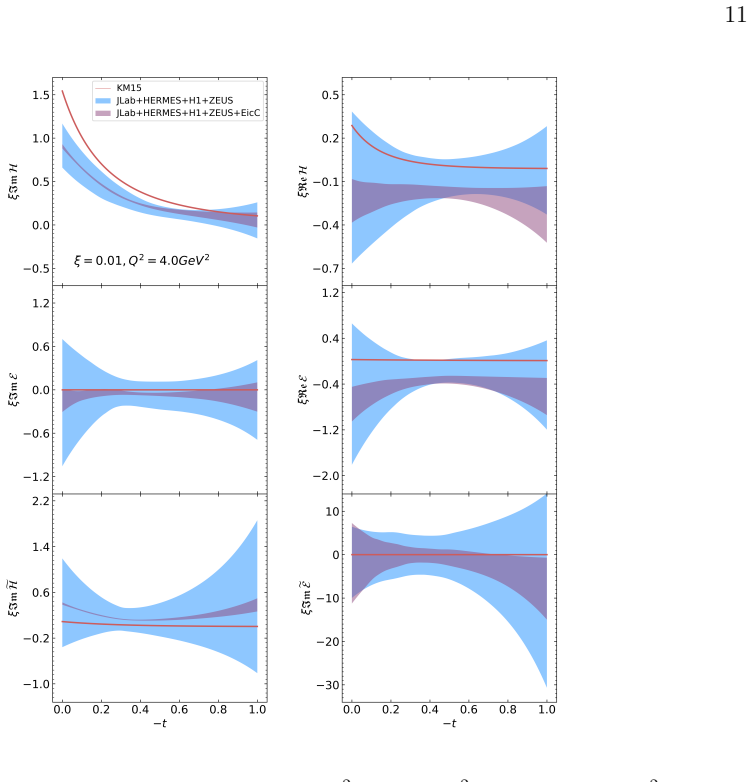
The paper's central claim is that a year of DVCS asymmetry measurements at the proposed Chinese collider, combined with the existing world dataset, would shrink the error bands of all four leading-twist chiral-even Compton form factors—in some kinematic regions by a large factor, and most dramatically at small x_B down to ξ ≈ 10⁻⁴, where today's data provide almost no constraint. The resulting t-dependence of the sea-quark-dominated form factors would be measured well enough up to |t| = 1 GeV² to support a first spatial tomography of the sea quarks; the Q²-dependence would extend to about 20 GeV², which the authors argue opens the possibility of GPD deconvolution through QCD scale evolution.
What carries the argument
The analysis is carried by a modular neural network that represents each Compton form factor as an independent function of (ξ, t, Q²), with separate sub-networks for the real and imaginary parts (architecture 3→90→90→90→90→1), trained with an uncertainty-weighted Huber loss and propagated through Monte Carlo replicas for error bands. On the experimental side, the input is the standard dictionary between azimuthal modulations of electron and proton spin asymmetries and particular CFF combinations: the sin φ modulation of the electron-spin asymmetry projects Im H, the corresponding proton-spin modulation projects Im H-tilde, transverse-spin asymmetries give access to E and E-tilde, and the dou
Load-bearing premise
The simulated measurements are centered on a single assumed model of the proton's sea-quark distribution; if that model is not close to nature, the claimed reduction in uncertainties is biased by the model choice.
What would settle it
Generate the same projected dataset from two or three independent GPD models and rerun the fit: if the inferred central values or error bands shift by more than the quoted uncertainties depending on which model generated the pseudo-data, the impact forecast is not robust. The definitive test would be a first real spin-asymmetry measurement at the proposed collider landing outside the predicted band by more than the statistical uncertainty.
If this is right
- Sea-quark tomography becomes realistic: the t-dependence of the constrained CFFs at small ξ would support Fourier-transform imaging of the sea-quark spatial distribution.
- A wide Q² lever arm (roughly 2 to 20 GeV² in the sea region) would let future data test QCD scale evolution of CFFs, a prerequisite for turning DVCS measurements into GPDs.
- The valence-region results remain compatible with earlier extractions, so the main effect of the new machine would be to add precision where current data are weakest rather than shift established central values.
- The closure test suggests the neural-network fitting strategy can be used reliably for impact forecasts, not just for retrospective fits of existing data.
- Tighter CFFs feed directly into the proton's mechanical properties (pressure and shear distributions) via the connection to gravitational form factors.
Where Pith is reading between the lines
- The forecast's strength is tied to the model used to generate the fake measurements; averaging over several independent GPD models would give a more honest estimate of the achievable precision.
- A comparable exercise for the US electron-ion collider or the proposed LHeC, using the same neural-network machinery, would directly show which machine is best suited to shrink which form factor in which kinematic corner.
- The assumption that the real parts of H-tilde and E-tilde vanish means the quoted improvements for those two quantities are effectively bounds on their imaginary parts; if unpolarized cross-section measurements at the new collider turn out to be precise, this assumption would have to be relaxed.
- Because the biggest gains are claimed in the low-x region, the projection is sensitive to the machine's luminosity and to the small-angle acceptance of the Roman pots; any shortfall would erode exactly the advertised sea-quark precision.
Editorial analysis
A structured set of objections, weighed in public.
Referee Report
Summary. The paper presents a projection study of DVCS measurements at the proposed Electron-Ion Collider in China (EicC). A neural-network parametrization of the leading-twist chiral-even Compton Form Factors (CFFs), trained within the Gepard framework on existing world data, is extended with pseudo-data for single- and double-spin asymmetries generated under EicC detector assumptions from the EicC Conceptual Design Report. The authors report that including these pseudo-data substantially reduces the uncertainty bands of all CFFs, especially in the previously unconstrained sea-quark region (0.01 < xB < 0.1), and interpret the resulting t-dependence as enabling spatial tomography of sea quarks. The paper also presents a closure test of the NN methodology and discusses deviations in ReH and ReE that exceed 1σ after the pseudo-data are included.
Significance. If the projection is quantitatively reliable, the result would be an important input for the EicC physics case and for planning CFF extraction strategies. The study has several strengths: it uses a state-of-the-art global fit framework (Gepard), a flexible NN parametrization with replica-method uncertainties, realistic detector acceptance and efficiency from the EicC CDR, and it includes multiple asymmetry observables rather than a single channel. The qualitative conclusion that EicC data will sharpen CFF constraints in the sea-quark region is defensible. However, the quantitative uncertainty reductions are conditional on the GK GPD model used to generate the pseudo-data and on the assumption that the real parts of eH and eE vanish; the paper does not quantify how the projection changes under model variation. The reported numbers should therefore be read as a model-dependent forecast, not a robust, data-driven bound.
major comments (3)
- [Sec. II, Fig. 2 caption and pseudo-data generation] The central values of the EicC pseudo-data are generated with the GK GPD model and smeared only by statistical uncertainties. In the sea-quark region (0.01 < xB < 0.1) the existing world data provide essentially no constraint, as the paper itself states (CFFs are 'consistent with zero within large uncertainties'). The post-fit red bands in Figs. 4–6 are therefore largely a measure of how well the NN can reproduce one specific model, GK, rather than a model-independent estimate of EicC's constraining power. The >1σ deviations in ReH and ReE noted in Sec. II show a tension between GK-generated pseudo-data and the world-data fit. To make the headline claim robust, please regenerate the pseudo-data with at least one independent GPD model and show whether the uncertainty reductions persist; alternatively, present a model-variation envelope.
- [Sec. II, paragraph on Re(eH)=Re(eE)=0] The analysis assumes the real parts of eH and eE vanish because current world data provide no constraint on them. Yet the abstract and conclusion claim uncertainty reductions for 'all CFFs'. These two real parts are not extracted; they are fixed by assumption, so they cannot exhibit an uncertainty reduction from EicC pseudo-data. Moreover, the zero values are adopted from Ref. [36] and enter the observables in Eqs. (2), (8), and (10); a non-zero real part would bias the central values of the extracted CFFs. Please clarify which CFF components are actually fitted and quantify the sensitivity to this assumption, e.g., by allowing Re(eH) and Re(eE) to be fitted or by varying them within plausible ranges.
- [Sec. II, Eq. (11) and Table I] The pseudo-data include only statistical uncertainties, and Table I reports the χ²/datum for existing world-data sets but not for the EicC pseudo-data. Without the χ² per point of the pseudo-data, the reader cannot assess whether the generated pseudo-data are consistent with the final fit; a large χ² would indicate that the GK-based pseudo-data are in tension with the extracted CFFs, while a very small χ² would indicate overfitting. Please report the χ²/datum for the EicC pseudo-data separately and discuss the impact of realistic systematic uncertainties on the width of the final error bands.
minor comments (5)
- [Fig. 2 caption] Typo: 'statistic uncertainties' should be 'statistical uncertainties'.
- [References] References [94] and [103] are the same ZEUS paper, and [96] and [102] are the same H1 paper; please consolidate.
- [Eq. (5)] The numerator has an unmatched square bracket: '[dσ(ϕ)→⇒ + dσ(ϕ)←⇐] − [(dσ(ϕ)←⇒ + dσ(ϕ)→⇐]' is missing a closing bracket.
- [Figs. 4–6 captions and text] The text writes 'ξ=0.01 GeV²' in the captions of Figs. 5 and 6; ξ is dimensionless, so the units should be removed.
- [Sec. II, text near Fig. 4] Minor language issues: 'assymmetries' should be 'asymmetries', 'noticable' should be 'noticeable', and the sentence 'the presented global analysis clearly demonstrates...' is stronger than the evidence supports, given the model dependence noted above.
Circularity Check
No significant circularity: pseudo-data model dependence is a stated input and limitation, not a recycled conclusion.
full rationale
The paper's derivation chain is a standard pseudo-data impact study: existing world DVCS data are fit with a neural-network CFF parametrization, synthetic EicC measurements are generated from the GK GPD model with detector-related statistical uncertainties, and the two are combined to estimate the resulting uncertainty reduction. The GK-generated pseudo-data are explicitly disclosed in the Fig. 2 caption ('The central values of pseudo-data are generated using the GK GPD model [62,64,65] and smeared by the statistic uncertainties'), so there is no hidden fitted parameter renamed as a prediction. The extraction inverts the nontrivial relations of Eqs. (7)-(10), and the headline claim concerns uncertainty reduction rather than model-independent central values. The paper itself flags the main caveats: it notes deviations exceeding 1 sigma in ReH and ReE, states that realistic systematics would enlarge the final error bands, and attributes the relatively small uncertainties partly to the vanishing-real-part assumption for eE and eH. That assumption is adopted from Ref. [36], which includes a coauthor, but the paper also justifies it by the independent statement that current world data provide essentially no constraint on those CFFs. This is a transparent modeling choice, not a self-citation chain used to force the conclusion. Model-dependence of pseudo-data is a real limitation of any impact study, but it is not circularity: the conclusion does not reduce by construction to the inputs, and no uniqueness theorem or ansatz is smuggled in via citation.
Axiom & Free-Parameter Ledger
free parameters (3)
- NN hyperparameters =
3->90->90->90->90->1; exponential activation; Huber loss; early stopping
- EicC beam and polarization inputs =
P_e=80%, P_p=70%; L=4e33 and 1.1e33 cm^-2 s^-1; Roman-pot thresholds 10 and 5 mrad
- Luminosity time split and dilution factor f_d =
3/4 high-luminosity, 1/4 small-angle mode; f_d from background assumptions
axioms (5)
- standard math Leading-twist DVCS factorization and the CFF relations in Eqs. (2) and (7)-(10)
- ad hoc to paper Pseudo-data generated with the GK GPD model are representative of future EicC measurements
- ad hoc to paper Re(eH)=Re(eE)=0
- domain assumption Systematic uncertainties will be comparable to or smaller than statistical uncertainties
- domain assumption Detector acceptance, efficiency, and luminosity from the EicC CDR (Ref. [69], 'to appear')
read the original abstract
We assess the impact of future measurements of deeply virtual Compton scattering (DVCS) off protons using the planned detector at the Electron-Ion Collider in China (EicC), proposed as an upgrade to the High Intensity heavy-ion Accelerator Facility (HIAF). We develop a neural-network architecture to flexibly parameterize the Compton Form Factors (CFFs), extrapolate reliably into unmeasured kinematic regions, and provide robust uncertainty estimates through the replica method. The framework is fitted to the available worldwide DVCS data using the Gepard software. We find a significant reduction in the uncertainties of all CFFs after incorporating pseudo-data from single and double polarization asymmetries at the EicC, with particularly strong improvements in the sea-quark region.
Figures



Forward citations
Cited by 1 Pith paper
-
Constraining DVCS Compton Form Factors Using Lattice QCD informed Neural Network
A neural network framework informed by lattice QCD uses all-order dispersion relations to significantly constrain both real and imaginary parts of Compton Form Factors extracted from DVCS proton data.
Reference graph
Works this paper leans on
- [1]
-
[2]
A. V. Belitsky and A. V. Radyushkin, Phys. Rept.418, 1 (2005), hep-ph/0504030
Pith/arXiv arXiv 2005
-
[3]
M. Guidal, H. Moutarde, and M. Vanderhaeghen, Rept. Prog. Phys.76, 066202 (2013), 1303.6600
Pith/arXiv arXiv 2013
-
[4]
Diehl, Prog
S. Diehl, Prog. Part. Nucl. Phys.133, 104069 (2023)
2023
-
[5]
D. M¨ uller, D. Robaschik, B. Geyer, F. M. Dittes, and J. Hoˇ rejˇ si, Fortsch. Phys.42, 101 (1994), hep-ph/9812448
Pith/arXiv arXiv 1994
- [6]
- [7]
-
[8]
A. V. Radyushkin, Phys. Rev. D56, 5524 (1997), hep-ph/9704207
Pith/arXiv arXiv 1997
-
[9]
M. Diehl and S. Sapeta, Eur. Phys. J. C41, 515 (2005), hep-ph/0503023
Pith/arXiv arXiv 2005
-
[10]
A. Accardi et al., Eur. Phys. J. A52, 268 (2016), 1212.1701
Pith/arXiv arXiv 2016
-
[11]
R. Abdul Khalek et al., Nucl. Phys. A1026, 122447 (2022), 2103.05419
Pith/arXiv arXiv 2022
-
[12]
A. Accardi et al., Eur. Phys. J. A60, 173 (2024), 2306.09360
Pith/arXiv arXiv 2024
-
[13]
X. Cao, L. Chang, N. Chang, et al., Nuclear Techniques43, 020001 (2020)
2020
-
[14]
X. Cao, X. Chen, C. Gong, et al., SCIENTIA SINICA Physica, Mechanica, Astronomica50, 112005 (2020)
2020
-
[15]
D. P. Anderle et al., Front. Phys. (Beijing)16, 64701 (2021), 2102.09222
Pith/arXiv arXiv 2021
-
[16]
J. L. Abelleira Fernandez et al. (LHeC Study Group), J. Phys. G39, 075001 (2012), 1206.2913
Pith/arXiv arXiv 2012
-
[17]
P. Agostini et al. (LHeC, FCC-he Study Group), J. Phys. G48, 110501 (2021), 2007.14491
arXiv 2021
-
[18]
J. P. Ralston and B. Pire, Phys. Rev. D66, 111501 (2002), hep-ph/0110075
Pith/arXiv arXiv 2002
-
[19]
M. Diehl, Eur. Phys. J. C25, 223 (2002), [Erratum: Eur.Phys.J.C 31, 277–278 (2003)], hep-ph/0205208
Pith/arXiv arXiv 2002
-
[20]
M. Burkardt, Phys. Rev. D62, 071503 (2000), [Erratum: Phys.Rev.D 66, 119903 (2002)], hep-ph/0005108
Pith/arXiv arXiv 2000
- [21]
-
[22]
M. V. Polyakov, Phys. Lett. B555, 57 (2003), hep-ph/0210165
Pith/arXiv arXiv 2003
-
[23]
V. Bertone, H. Dutrieux, C. Mezrag, H. Moutarde, and P. Sznajder, Phys. Rev. D103, 114019 (2021), 2104.03836
Pith/arXiv arXiv 2021
-
[24]
E. Moffat, A. Freese, I. Clo¨ et, T. Donohoe, L. Gamberg, W. Melnitchouk, A. Metz, A. Prokudin, and N. Sato, Phys. Rev. D108, 036027 (2023), 2303.12006
Pith/arXiv arXiv 2023
- [25]
- [26]
-
[27]
K. Kumeriˇ cki, D. M¨ uller, and M. Murray, Phys. Part. Nucl.45, 723 (2014), 1301.1230
Pith/arXiv arXiv 2014
-
[28]
S. Forte, L. Garrido, J. I. Latorre, and A. Piccione, JHEP05, 062 (2002), hep-ph/0204232
Pith/arXiv arXiv 2002
-
[29]
X. Wang, X. Cao, Y. Lu, and W. Xiong (2025), 2509.14549
arXiv 2025
-
[30]
Z. Ye, J. Arrington, R. J. Hill, and G. Lee, Phys. Lett. B777, 8 (2018), 1707.09063
Pith/arXiv arXiv 2018
-
[31]
L. Kotz, A. Courtoy, P. Nadolsky, F. Olness, and M. Ponce-Chavez, Phys. Rev. D109, 16 074027 (2024), 2311.08447
Pith/arXiv arXiv 2024
-
[32]
K. Kumericki, D. Mueller, and A. Schafer, JHEP07, 073 (2011), 1106.2808
Pith/arXiv arXiv 2011
-
[33]
H. Moutarde, P. Sznajder, and J. Wagner, Eur. Phys. J. C79, 614 (2019), 1905.02089
Pith/arXiv arXiv 2019
-
[34]
L. Calero Diaz and D. Keller, Phys. Rev. D112, 096001 (2025), 2509.18331
arXiv 2025
-
[35]
Kumeriˇ cki, Nature570, E1 (2019)
K. Kumeriˇ cki, Nature570, E1 (2019)
2019
-
[36]
M. ˇCui´ c, K. Kumeriˇ cki, and A. Sch¨ afer, Phys. Rev. Lett.125, 232005 (2020), 2007.00029
Pith/arXiv arXiv 2020
-
[37]
A. Hobart et al. (CLAS), Phys. Rev. Lett.133, 211903 (2024), 2406.15539
Pith/arXiv arXiv 2024
-
[38]
I. V. Musatov and A. V. Radyushkin, Phys. Rev. D61, 074027 (2000), hep-ph/9905376
Pith/arXiv arXiv 2000
-
[39]
D. Mueller and A. Schafer, Nucl. Phys. B739, 1 (2006), hep-ph/0509204
Pith/arXiv arXiv 2006
-
[40]
K. A. Mamo and I. Zahed, Phys. Rev. Lett.133, 241901 (2024), 2411.04162
Pith/arXiv arXiv 2024
-
[41]
S. Xu, C. Mondal, J. Lan, X. Zhao, Y. Li, and J. P. Vary (BLFQ), Phys. Rev. D104, 094036 (2021), 2108.03909
Pith/arXiv arXiv 2021
-
[42]
H. Dutrieux, H. Dutrieux, O. Grocholski, O. Grocholski, H. Moutarde, H. Moutarde, P. Sz- najder, and P. Sznajder, Eur. Phys. J. C82, 252 (2022), [Erratum: Eur.Phys.J.C 82, 389 (2022)], 2112.10528
Pith/arXiv arXiv 2022
- [43]
-
[44]
K. Kumericki, D. Mueller, and K. Passek-Kumericki, Nucl. Phys. B794, 244 (2008), hep- ph/0703179
arXiv 2008
-
[45]
K. Kumeriˇ cki and D. Mueller, Nucl. Phys. B841, 1 (2010), 0904.0458
Pith/arXiv arXiv 2010
-
[46]
H. Moutarde, P. Sznajder, and J. Wagner, Eur. Phys. J. C78, 890 (2018), 1807.07620
Pith/arXiv arXiv 2018
-
[47]
M. ˇCui´ c, G. Duplanˇ ci´ c, K. Kumeriˇ cki, and K. Passek-K., JHEP12, 192 (2023), [Erratum: JHEP 02, 225 (2024)], 2310.13837
Pith/arXiv arXiv 2023
-
[48]
Y. Guo, X. Ji, M. G. Santiago, K. Shiells, and J. Yang, JHEP05, 150 (2023), 2302.07279
Pith/arXiv arXiv 2023
-
[49]
Y. Guo, F. P. Aslan, X. Ji, and M. G. Santiago (2025), 2509.08037
Pith/arXiv arXiv 2025
-
[50]
M. Constantinou et al., Prog. Part. Nucl. Phys.121, 103908 (2021), 2006.08636
Pith/arXiv arXiv 2021
- [51]
-
[52]
J. Holligan and H.-W. Lin, Phys. Rev. D110, 034503 (2024), 2312.10829
Pith/arXiv arXiv 2024
-
[53]
S. Bhattacharya, K. Cichy, M. Constantinou, A. Metz, N. Nurminen, and F. Steffens, Phys. Rev. D110, 054502 (2024), 2405.04414
Pith/arXiv arXiv 2024
-
[54]
M. J. Riberdy, H. Dutrieux, C. Mezrag, and P. Sznajder, Eur. Phys. J. C84, 201 (2024), 2306.01647. 17
Pith/arXiv arXiv 2024
- [55]
-
[56]
X. Ji, Sci. China Phys. Mech. Astron.57, 1407 (2014), 1404.6680
Pith/arXiv arXiv 2014
-
[57]
A. V. Radyushkin, Phys. Rev. D96, 034025 (2017), 1705.01488
Pith/arXiv arXiv 2017
- [58]
-
[59]
A. Bacchetta, U. D’Alesio, M. Diehl, and C. A. Miller, Phys. Rev. D70, 117504 (2004), hep-ph/0410050
Pith/arXiv arXiv 2004
-
[60]
A. V. Belitsky, D. Mueller, and A. Kirchner, Nucl. Phys. B629, 323 (2002), hep-ph/0112108
Pith/arXiv arXiv 2002
-
[61]
A. V. Belitsky and D. Mueller, Phys. Rev. D82, 074010 (2010), 1005.5209
Pith/arXiv arXiv 2010
-
[62]
P. Kroll, H. Moutarde, and F. Sabatie, Eur. Phys. J. C73, 2278 (2013), 1210.6975
Pith/arXiv arXiv 2013
-
[63]
d’Hose, S
N. d’Hose, S. Niccolai, and A. Rostomyan, Eur. Phys. J. A52, 151 (2016)
2016
-
[64]
S. V. Goloskokov and P. Kroll, Eur. Phys. J. C65, 137 (2010), 0906.0460
Pith/arXiv arXiv 2010
-
[65]
S. V. Goloskokov and P. Kroll, Eur. Phys. J. A47, 112 (2011), 1106.4897
Pith/arXiv arXiv 2011
- [66]
-
[67]
E.-C. Aschenauer, S. Fazio, K. Kumericki, and D. Mueller, JHEP09, 093 (2013), 1304.0077
Pith/arXiv arXiv 2013
-
[68]
E. C. Aschenauer, S. Fazio, J. H. Lee, H. Mantysaari, B. S. Page, B. Schenke, T. Ullrich, R. Venugopalan, and P. Zurita, Rept. Prog. Phys.82, 024301 (2019), 1708.01527
Pith/arXiv arXiv 2019
-
[69]
C. B. e. a. Luis Albino, Daniele P. Anderle (2025), EicC Conceptual Design Report Volume II - Physics & Detector, to appear
2025
-
[70]
X. Wang, X. Cao, A. Guo, L. Gong, X.-S. Kang, Y.-T. Liang, J.-J. Wu, and Y.-P. Xie, Eur. Phys. J. C84, 684 (2024), 2311.07008
Pith/arXiv arXiv 2024
-
[71]
X. Cao, F.-K. Guo, Y.-T. Liang, J.-J. Wu, J.-J. Xie, Y.-P. Xie, Z. Yang, and B.-S. Zou, Phys. Rev. D101, 074010 (2020), 1912.12054
Pith/arXiv arXiv 2020
- [72]
-
[73]
X. Cao, J.-P. Dai, and Z. Yang, Eur. Phys. J. C81, 184 (2021), 2011.09244
Pith/arXiv arXiv 2021
-
[74]
Z. Yang, X. Cao, Y.-T. Liang, and J.-J. Wu, Chin. Phys. C44, 084102 (2020), 2003.06774
Pith/arXiv arXiv 2020
- [75]
-
[76]
Z. Lu, Z. Yu, T. Lin, Y.-T. Liang, R. Wang, W. Chang, and W. Xiong (2025), 2512.01720
Pith/arXiv arXiv 2025
-
[77]
C. Zeng, T. Liu, P. Sun, and Y. Zhao, Phys. Rev. D106, 094039 (2022), 2208.14620
Pith/arXiv arXiv 2022
-
[78]
He et al., Nucl
R. He et al., Nucl. Sci. Tech.34, 205 (2023)
2023
-
[79]
D. P. Kingma and J. Ba (2014), 1412.6980
Pith/arXiv arXiv 2014
-
[80]
J. Grigsby, B. Kriesten, J. Hoskins, S. Liuti, P. Alonzi, and M. Burkardt, Phys. Rev. D104, 18 016001 (2021), 2012.04801
Pith/arXiv arXiv 2021
discussion (0)
Sign in with ORCID, Apple, or X to comment. Anyone can read and Pith papers without signing in.