Recognition: 2 theorem links
· Lean TheoremIrreducible Constraints on Hadronically Interacting Sub-GeV Dark Matter
Pith reviewed 2026-05-16 19:52 UTC · model grok-4.3
The pith
Sub-GeV dark matter with hadronic couplings is ruled out above 10^{-36} cm² nucleon scattering by induced electromagnetic effects
A machine-rendered reading of the paper's core claim, the machinery that carries it, and where it could break.
Core claim
Dark matter that interacts only hadronically at leading order in the chiral effective theory inevitably produces electromagnetic interactions at next-to-leading order. These electromagnetic couplings drive strong constraints from big bang nucleosynthesis and dark-matter overproduction via freeze-in at low temperatures, while the leading-order hadronic couplings face direct limits from meson decays. Taken together the limits rule out dark-matter-nucleon scattering cross sections of 10^{-36} cm² or larger for masses in the keV to 100 MeV window, without dependence on the details of the ultraviolet theory.
What carries the argument
Next-to-leading-order electromagnetic operators that are necessarily generated by leading-order hadronic dark-matter couplings inside chiral effective field theory
If this is right
- Both spin-independent and spin-dependent dark-matter-nucleon cross sections are excluded above 10^{-36} cm² across the full keV-100 MeV range
- Future low-mass direct detection experiments must reach sensitivities well below 10^{-36} cm² to retain discovery potential
- The bounds hold independently of any specific high-energy completion of the dark-matter model
- Cosmological and meson-decay limits dominate over prior astrophysical constraints by several orders of magnitude
Where Pith is reading between the lines
- Models of light dark matter that rely on hadronic couplings to explain other anomalies would need additional suppression mechanisms to survive these limits
- The effective-theory linking of hadronic and electromagnetic sectors at successive orders could be applied to other light-particle scenarios beyond dark matter
- If a signal appears above the bound, it would require either breakdown of the chiral effective theory or a different leading interaction structure
Load-bearing premise
Dark matter interacts only hadronically at leading order in the chiral effective theory, with electromagnetic interactions appearing only at next-to-leading order, and the effective theory remains valid down to the momentum scales set by sub-GeV masses
What would settle it
A confirmed direct-detection signal of sub-GeV dark matter with nucleon scattering cross section above 10^{-36} cm², or a measurement of primordial light-element abundances that contradicts the predicted big-bang-nucleosynthesis effects from the induced electromagnetic couplings
Figures


read the original abstract
We derive conservative upper limits on the dark-matter--nucleon scattering cross-section for sub-GeV mass dark matter. Working exclusively within the low-energy chiral effective theory, we derive bounds that are independent of the details of the dark matter interactions in the UV. Dark matter that interacts only hadronically at leading order also inevitably interacts with photons or electrons at next-to-leading-order. We show that these electromagnetic interactions lead to strong constraints from big bang nucleosynthesis and over-production of dark matter via freeze-in at low temperatures, while the leading-order hadronic couplings face stringent constraints from meson decays. Combining these constraints, we rule out both spin-independent and spin-dependent dark-matter--nucleon scattering cross-sections $\gtrsim 10^{-36}\,{\rm cm}^2$ for dark matter masses in the keV - 100 MeV range. These bounds are several orders of magnitude stronger than the existing constraints from astrophysics and cosmology and have significant implications for future low-mass direct detection experiments.
Editorial analysis
A structured set of objections, weighed in public.
Referee Report
Summary. The paper derives UV-independent upper limits on sub-GeV dark-matter–nucleon scattering cross sections by working in chiral effective theory. Dark matter is assumed to couple hadronically at leading order (LO), which generates electromagnetic couplings at next-to-leading order (NLO). LO hadronic operators are constrained by meson decays, while NLO electromagnetic operators are constrained by BBN and low-temperature freeze-in. Combining these yields the claim that both spin-independent and spin-dependent DM-nucleon cross sections ≳ 10^{-36} cm² are excluded for DM masses in the keV–100 MeV range.
Significance. If the central result holds, the work supplies conservative, model-independent bounds on light hadronic dark matter that are several orders of magnitude stronger than existing astrophysical and cosmological limits. The approach relies on standard chiral EFT power counting, BBN calculations, and freeze-in production, and the bounds would have direct implications for the sensitivity targets of future low-mass direct-detection experiments.
major comments (2)
- [§2] §2 (chiral Lagrangian): The central claim requires that NLO electromagnetic operators (DM-photon or DM-electron) cannot be parametrically suppressed relative to the LO hadronic couplings (DM-nucleon or DM-pion) while preserving the EFT validity. The manuscript states that electromagnetic interactions appear “only at next-to-leading order,” but does not demonstrate whether the NLO Wilson coefficients are fixed by the LO ones via matching or remain independent counterterms that can be tuned small. If independent tuning is allowed, the combined bound on the low-energy DM-nucleon cross section can be evaded. An explicit power-counting argument or matching calculation showing a lower bound on the NLO coefficients is needed.
- [§4–5] §4–5 (BBN and freeze-in): The quantitative translation from NLO electromagnetic couplings to the 10^{-36} cm² exclusion relies on specific freeze-in rates and BBN abundance limits. Without the explicit expressions for the NLO-induced DM production cross sections or the error propagation from the chiral scale, it is not possible to verify that the bound remains robust when the NLO coefficients are varied within the EFT uncertainty band.
minor comments (2)
- [Table 1] Table 1: the quoted meson-decay limits should include the precise branching-ratio inputs and the assumed form-factor parametrization used to convert them into bounds on the LO couplings.
- [Eq. (X)] Eq. (X) (cross-section formula): the relation between the low-energy DM-nucleon cross section and the chiral coefficients should be written explicitly, including the kinematic factors for both SI and SD cases.
Simulated Author's Rebuttal
We thank the referee for the careful reading of our manuscript and the constructive comments. We address each major point below and will incorporate clarifications to strengthen the presentation.
read point-by-point responses
-
Referee: [§2] §2 (chiral Lagrangian): The central claim requires that NLO electromagnetic operators (DM-photon or DM-electron) cannot be parametrically suppressed relative to the LO hadronic couplings (DM-nucleon or DM-pion) while preserving the EFT validity. The manuscript states that electromagnetic interactions appear “only at next-to-leading order,” but does not demonstrate whether the NLO Wilson coefficients are fixed by the LO ones via matching or remain independent counterterms that can be tuned small. If independent tuning is allowed, the combined bound on the low-energy DM-nucleon cross section can be evaded. An explicit power-counting argument or matching calculation showing a lower bound on the NLO coefficients is needed.
Authors: In the chiral EFT we employ, standard power counting ensures that LO hadronic operators (DM-pion and DM-nucleon) generate NLO electromagnetic operators through tree-level matching to the electromagnetic current and one-loop pion exchange, with the NLO Wilson coefficients fixed in terms of the LO couplings up to O(1) factors set by the chiral scale Λ_χ. Independent suppression of the NLO coefficients would require additional fine-tuning or new light degrees of freedom that lie outside the EFT validity range, which is inconsistent with our UV-independent approach. We will revise §2 to include an explicit schematic matching calculation and power-counting argument demonstrating the lower bound on the NLO coefficients. revision: yes
-
Referee: [§4–5] §4–5 (BBN and freeze-in): The quantitative translation from NLO electromagnetic couplings to the 10^{-36} cm² exclusion relies on specific freeze-in rates and BBN abundance limits. Without the explicit expressions for the NLO-induced DM production cross sections or the error propagation from the chiral scale, it is not possible to verify that the bound remains robust when the NLO coefficients are varied within the EFT uncertainty band.
Authors: We agree that explicit expressions improve verifiability. In the revised manuscript we will add the full analytic expressions for the NLO-induced DM production cross sections (both DM-photon and DM-electron channels) in §4, together with the freeze-in rate integrals. In §5 we will include a dedicated error-propagation analysis showing that O(1) variations in the NLO coefficients around the chiral-scale expectation leave the 10^{-36} cm² bound intact as a conservative order-of-magnitude limit. The BBN constraints are obtained from standard public codes with the induced electromagnetic interactions; we will reference the relevant input files and parameter ranges. revision: yes
Circularity Check
No significant circularity in derivation chain
full rationale
The paper's central bounds combine standard BBN and freeze-in limits on NLO electromagnetic operators with meson-decay limits on LO hadronic operators, all within chiral EFT. No equations reduce the final cross-section limit to a parameter fitted from the same data or to a self-citation chain. The claim that NLO EM interactions arise inevitably is presented as a derivation from the EFT structure rather than an assumption that loops back to the target result. The derivation remains self-contained against external benchmarks (BBN, meson lifetimes) without self-definitional or fitted-input reductions.
Axiom & Free-Parameter Ledger
axioms (1)
- domain assumption Chiral effective theory accurately captures low-energy hadronic interactions independent of UV completion
Lean theorems connected to this paper
-
IndisputableMonolith/Cost/FunctionalEquation.leanwashburn_uniqueness_aczel unclear?
unclearRelation between the paper passage and the cited Recognition theorem.
Working exclusively within the low-energy chiral effective theory... DM that interacts only hadronically at leading order also inevitably interacts with photons or electrons at next-to-leading-order.
-
IndisputableMonolith/Foundation/AbsoluteFloorClosure.leanabsolute_floor_iff_bare_distinguishability unclear?
unclearRelation between the paper passage and the cited Recognition theorem.
The leading order DM-meson interactions are given by the CV-dependent terms... at O(p4) via L10 + 2H1 and WZW
What do these tags mean?
- matches
- The paper's claim is directly supported by a theorem in the formal canon.
- supports
- The theorem supports part of the paper's argument, but the paper may add assumptions or extra steps.
- extends
- The paper goes beyond the formal theorem; the theorem is a base layer rather than the whole result.
- uses
- The paper appears to rely on the theorem as machinery.
- contradicts
- The paper's claim conflicts with a theorem or certificate in the canon.
- unclear
- Pith found a possible connection, but the passage is too broad, indirect, or ambiguous to say the theorem truly supports the claim.
Reference graph
Works this paper leans on
-
[1]
DM interacts only hadronically at leading order. 1
-
[2]
The mediator(s) between the DM and SM have mass greater than 2 O(100) MeV
-
[3]
(Motivated by aU(1) orZ 2 stabilising symmetry.)
DM interacts with the SM via an operator that is bilinear in the DM fieldχ. (Motivated by aU(1) orZ 2 stabilising symmetry.)
-
[4]
The DM fieldχis a singlet underSU(3) c ×U(1) Q. Schematically, we consider DM interactions of the form L ⊃ cαβ Λn Oα SMOβ χ ,(1) whereO α SM are local, gauge-singlet operators consisting of quark and/or gluon fields and the operatorsO β χ are bi- linear inχand can be non-local. Thec αβ are dimension- less coefficients and Λ parametrises the scale of the U...
-
[5]
Big Bang Nucleosynthesis The success of SM BBN tightly constraints the abun- dances of any additional relativistic degrees of freedom during neutrino decoupling and nucleosynthesis. In fact, sub-MeV mass states that were in equilibrium at any time after the QCD phase transition but before the end of BBN are essentially excluded. More specifically, an elec...
-
[6]
Irreducible DM abundance We do not require thatχsaturates the DM relic abun- dance (except when showing existing bounds from direct detection). Once again, this allows us to remain insen- sitive to the early cosmological history and the specifics of the DM production mechanism. We do, however, re- quire that any DM produced at low temperatures (below 10 M...
-
[7]
Meson decays Meson decays can provide strong constraints on the hadronic interactions of DM. In particular, the decay rates ofπ,K, andBmesons to final states with miss- ing energy are all tightly constrained. This is espe- cially true for the FCNC decaysK→π+ invisible, B→K+ invisible, andB→π+ invisible. In this work, we do not consider bounds from invisib...
-
[8]
Other constraints There are many other observables that can be used to constrain the DM parameter space, but which we do not consider here. First, there are those observables 5 that require the specification of a Lagrangian valid at higher energies, beyond a few hundred MeV. These in- clude searches for missing energy at the Large Hadron Collider, direct ...
-
[9]
Vector operator For the vector operator, DM interacts with the SM plasma atT≲10 MeV via the processese +e− →χ¯χand/or γγ→γχ¯χ. The former process generally dominates, since the latter is suppressed by an additional factor ofαand the three-body phase space. However,γγ→γχ¯χbecomes the dominant process for the case of universal couplings, C V =1. In the foll...
work page 2025
-
[10]
Axial-vector operator For the axial-vector operator, the DM interacts with the SM plasma viaγγ→χ¯χ, which proceeds through the Feynman diagram shown in the left panel of fig. 4. The amplitude for this process is readily obtained from the DM-meson Lagrangian in eq. (14) and is given as follows: iMγγ→χ¯χ= iα πΛ2 ϵµναβ k1µk2νϵα(k1)ϵβ(k2) s−m 2 π0 +im π0Γπ0 P...
work page 2025
-
[11]
This process proceeds via the Feynman diagram shown in the left panel of fig
Pseudoscalar operator For DM interactions with the quark pseudoscalar operator,γγ→χ¯χis the leading process for DM thermalisation and freeze-in production atT≲10 MeV. This process proceeds via the Feynman diagram shown in the left panel of fig. 4 and its amplitude can be readily obtained from the leading order Chiral Lagrangian in eq. (19): iMγγ→χ¯χ= iα π...
-
[12]
Vector operator For the vector operator, the relevant flavour physics constraints come from the upper-limits on the branching ratios ofK + →π +ν¯ν[28] andπ 0 →γν¯ν[32]. We provide the decay rates for the corresponding decays to DM,K + →π +χ¯χ andπ 0 →γχ¯χ, in the following subsections. a.K + →π +χ¯χ Under the assumption of flavour-diagonal Wilson coeffici...
-
[13]
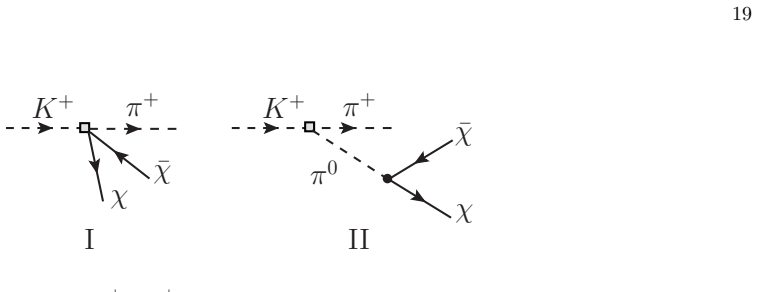
Axial-vector operator For the axial-vector operator, the relevant flavour physics constraints come from the measurements of, or upper- limits on, the branching ratios ofK + →π +ν¯ν[28],π 0 →ν¯ν[33] andη→ν¯ν[34]. In the following subsections we derive the decay rates for the corresponding decays to DM. 19 γ γ π0 π0, η ¯χ χ K + π+ χ ¯χ ¯χ χ ¯χ χ K + π+ π0 I...
-
[14]
There are also constraints from the decayK + →π +χ¯χ
Pseudoscalar operator Similar to the axial-vector operator, for the pseudoscalar operator, the leading order Chiral Lagrangian (19) leads to the decaysπ 0 →χ¯χandη→χ¯χ. There are also constraints from the decayK + →π +χ¯χ. a.K + →π +χ¯χ The relevant terms in the ∆S= 1 Lagrangian (7) for the pseudoscalar operator are LLO ∆S=1 =− √ 2GF VudV ∗ usf2g8 (∂µK+)(...
-
[15]
Essiget al., inSnowmass 2021(2022) arXiv:2203.08297 [hep-ph]
R. Essiget al., inSnowmass 2021(2022) arXiv:2203.08297 [hep-ph]
- [16]
- [17]
-
[18]
K. Maamari, V. Gluscevic, K. K. Boddy, E. O. Nadler, and R. H. Wechsler, Astrophys. J. Lett.907, L46 (2021), arXiv:2010.02936 [astro-ph.CO]
- [19]
-
[20]
Constraining Dark Matter-Baryon Scattering with Linear Cosmology
C. Dvorkin, K. Blum, and M. Kamionkowski, Phys. Rev. D89, 023519 (2014), arXiv:1311.2937 [astro-ph.CO]
work page internal anchor Pith review Pith/arXiv arXiv 2014
-
[21]
W. L. Xu, C. Dvorkin, and A. Chael, Phys. Rev. D97, 103530 (2018), arXiv:1802.06788 [astro-ph.CO]
work page internal anchor Pith review Pith/arXiv arXiv 2018
- [22]
-
[23]
X.-l. Chen, S. Hannestad, and R. J. Scherrer, Phys. Rev. D65, 123515 (2002), arXiv:astro-ph/0202496
work page internal anchor Pith review Pith/arXiv arXiv 2002
-
[24]
Constraints on scattering of keV--TeV dark matter with protons in the early Universe
V. Gluscevic and K. K. Boddy, Phys. Rev. Lett.121, 081301 (2018), arXiv:1712.07133 [astro-ph.CO]
work page internal anchor Pith review Pith/arXiv arXiv 2018
-
[25]
T. R. Slatyer and C.-L. Wu, Phys. Rev. D98, 023013 (2018), arXiv:1803.09734 [astro-ph.CO]
work page internal anchor Pith review Pith/arXiv arXiv 2018
- [26]
- [27]
-
[28]
M. J. Dolan, F. Kahlhoefer, C. McCabe, and K. Schmidt- Hoberg, JHEP03(2015), 171, [Erratum: JHEP 07, 103 (2015)], arXiv:1412.5174 [hep-ph]
work page internal anchor Pith review Pith/arXiv arXiv 2015
-
[29]
Probing Light Thermal Dark-Matter With a Higgs Portal Mediator
G. Krnjaic, Phys. Rev. D94, 073009 (2016), arXiv:1512.04119 [hep-ph]
work page internal anchor Pith review Pith/arXiv arXiv 2016
-
[30]
Light Dark Matter: Models and Constraints
S. Knapen, T. Lin, and K. M. Zurek, Phys. Rev. D96, 115021 (2017), arXiv:1709.07882 [hep-ph]
work page internal anchor Pith review Pith/arXiv arXiv 2017
- [31]
- [32]
- [33]
-
[34]
Chiral Effective Theory of Dark Matter Direct Detection
F. Bishara, J. Brod, B. Grinstein, and J. Zupan, JCAP 02(2017), 009, arXiv:1611.00368 [hep-ph]
work page internal anchor Pith review Pith/arXiv arXiv 2017
-
[35]
Matrix element analyses of dark matter scattering and annihilation
J. Kumar and D. Marfatia, Phys. Rev. D88, 014035 (2013), arXiv:1305.1611 [hep-ph]
work page internal anchor Pith review Pith/arXiv arXiv 2013
-
[36]
A Lower Bound on the Mass of Cold Thermal Dark Matter from Planck
C. Boehm, M. J. Dolan, and C. McCabe, JCAP08 (2013), 041, arXiv:1303.6270 [hep-ph]
work page internal anchor Pith review Pith/arXiv arXiv 2013
-
[37]
P. F. Depta, M. Hufnagel, K. Schmidt-Hoberg, and S. Wild, JCAP04, 029, arXiv:1901.06944 [hep-ph]
work page internal anchor Pith review Pith/arXiv arXiv 1901
- [38]
- [39]
-
[40]
What is the lowest possible reheating temperature?
S. Hannestad, Phys. Rev. D70, 043506 (2004), arXiv:astro-ph/0403291
work page internal anchor Pith review Pith/arXiv arXiv 2004
-
[41]
N. Barbieri, T. Brinckmann, S. Gariazzo, M. Lattanzi, S. Pastor, and O. Pisanti, Phys. Rev. Lett.135, 181003 (2025), arXiv:2501.01369 [astro-ph.CO]
-
[42]
Cortina Gilet al.(NA62), JHEP02(2025), 191, arXiv:2412.12015 [hep-ex]
E. Cortina Gilet al.(NA62), JHEP02(2025), 191, arXiv:2412.12015 [hep-ex]
- [43]
-
[44]
A. Pich and A. Rodr´ ıguez-S´ anchez, JHEP06(2021), 005, arXiv:2102.09308 [hep-ph]
-
[45]
Kaon Decays in the Standard Model
V. Cirigliano, G. Ecker, H. Neufeld, A. Pich, and J. Por- toles, Rev. Mod. Phys.84, 399 (2012), arXiv:1107.6001 [hep-ph]
work page internal anchor Pith review Pith/arXiv arXiv 2012
-
[46]
Search for production of an invisible dark photon in $\pi^0$ decays
E. Cortina Gilet al.(NA62), JHEP05(2019), 182, arXiv:1903.08767 [hep-ex]
work page internal anchor Pith review Pith/arXiv arXiv 2019
-
[47]
Search forπ 0 decays to invisible particles,
E. Cortina Gilet al.(NA62), JHEP02(2021), 201, arXiv:2010.07644 [hep-ex]
- [48]
-
[49]
G. Ballesteros, M. A. G. Garcia, and M. Pierre, JCAP 03(2021), 101, arXiv:2011.13458 [hep-ph]
-
[50]
Stellar cooling bounds on new light particles: plasma mixing effects
E. Hardy and R. Lasenby, JHEP02, 033, arXiv:1611.05852 [hep-ph]
work page internal anchor Pith review Pith/arXiv arXiv
- [51]
-
[52]
S. Bottaro, A. Caputo, G. Raffelt, and E. Vitagliano, JCAP07, 071, arXiv:2303.00778 [hep-ph]
- [53]
- [54]
-
[55]
J. Bijnens and G. Ecker, Ann. Rev. Nucl. Part. Sci.64, 149 (2014), arXiv:1405.6488 [hep-ph]
work page internal anchor Pith review Pith/arXiv arXiv 2014
-
[56]
Tools for model-independent bounds in direct dark matter searches
M. Cirelli, E. Del Nobile, and P. Panci, JCAP10(2013), 019, arXiv:1307.5955 [hep-ph]
work page internal anchor Pith review Pith/arXiv arXiv 2013
-
[57]
T. R. Slatyer, Phys. Rev. D93, 023527 (2016), arXiv:1506.03811 [hep-ph]
work page internal anchor Pith review Pith/arXiv arXiv 2016
-
[58]
K. Aggarwalet al.(DAMIC-M), Phys. Rev. Lett.135, 071002 (2025), arXiv:2503.14617 [hep-ex]
-
[59]
P. Adariet al.(SENSEI), Phys. Rev. Lett.134, 011804 (2025), arXiv:2312.13342 [astro-ph.CO]
-
[60]
D. Huanget al.(PandaX), Phys. Rev. Lett.131, 191002 (2023), arXiv:2308.01540 [hep-ex]
-
[61]
Revisiting Scalar and Pseudoscalar Couplings with Nucleons
H.-Y. Cheng and C.-W. Chiang, JHEP07(2012), 009, arXiv:1202.1292 [hep-ph]
work page internal anchor Pith review Pith/arXiv arXiv 2012
-
[62]
W. Wang, K.-Y. Wu, L. Wu, and B. Zhu, Nucl. Phys. B 983, 115907 (2022), arXiv:2112.06492 [hep-ph]
-
[63]
L. Di Luzio, G. Levati, P. Paradisi, and X. Ponce D´ ıaz, JHEP12(2023), 016, arXiv:2308.05215 [hep-ph]
-
[64]
Y. Kahn, G. Krnjaic, S. Mishra-Sharma, and T. M. P. Tait, JHEP05(2017), 002, arXiv:1609.09072 [hep-ph]
work page internal anchor Pith review Pith/arXiv arXiv 2017
-
[65]
Axial Vector $Z'$ and Anomaly Cancellation
A. Ismail, W.-Y. Keung, K.-H. Tsao, and J. Unwin, Nucl. Phys. B918, 220 (2017), arXiv:1609.02188 [hep-ph]
work page internal anchor Pith review Pith/arXiv arXiv 2017
-
[66]
S. Ipek, D. McKeen, and A. E. Nelson, Phys. Rev. D90, 055021 (2014), arXiv:1404.3716 [hep-ph]
work page internal anchor Pith review Pith/arXiv arXiv 2014
-
[67]
Pseudoscalar Portal Dark Matter
A. Berlin, S. Gori, T. Lin, and L.-T. Wang, Phys. Rev. D92, 015005 (2015), arXiv:1502.06000 [hep-ph]
work page internal anchor Pith review Pith/arXiv arXiv 2015
-
[68]
H. Sch´ erer and K. Schutz, JHEP11(2024), 139, arXiv:2405.18466 [hep-ph]
-
[69]
Making dark matter out of light: freeze-in from plasma effects
C. Dvorkin, T. Lin, and K. Schutz, Phys. Rev. D 99, 115009 (2019), [Erratum: Phys.Rev.D 105, 119901 (2022)], arXiv:1902.08623 [hep-ph]
work page internal anchor Pith review Pith/arXiv arXiv 2019
- [70]
discussion (0)
Sign in with ORCID, Apple, or X to comment. Anyone can read and Pith papers without signing in.