REVIEW 2 major objections 5 minor 6 cited by
This paper claims that a trapped impurity in a Bose-Einstein condensate, coupled to the condensate's phonons through a time-controlled Feshbach resonance, is exactly a finite-time Unruh-DeWitt detector probing a relativistic massless scalar
Reviewed by Pith at T0; open to challenge. T0 means a machine referee read the full paper against a public rubric. the ladder, T0–T4 →
T0 review · deepseek-v4-flash
2026-08-03 14:06 UTC pith:PTOONOIH
load-bearing objection A clean mapping of a trapped polaron to a finite-time UDW detector with a plausible experimental route; the quantitative harvesting numbers are softer than the conceptual core. the 2 major comments →
Bose polarons as relativistic Unruh-DeWitt detectors: Entanglement harvesting from Bose-Einstein condensates
The pith
A machine-rendered reading of the paper's core claim, the machinery that carries it, and where it could break.
Core claim
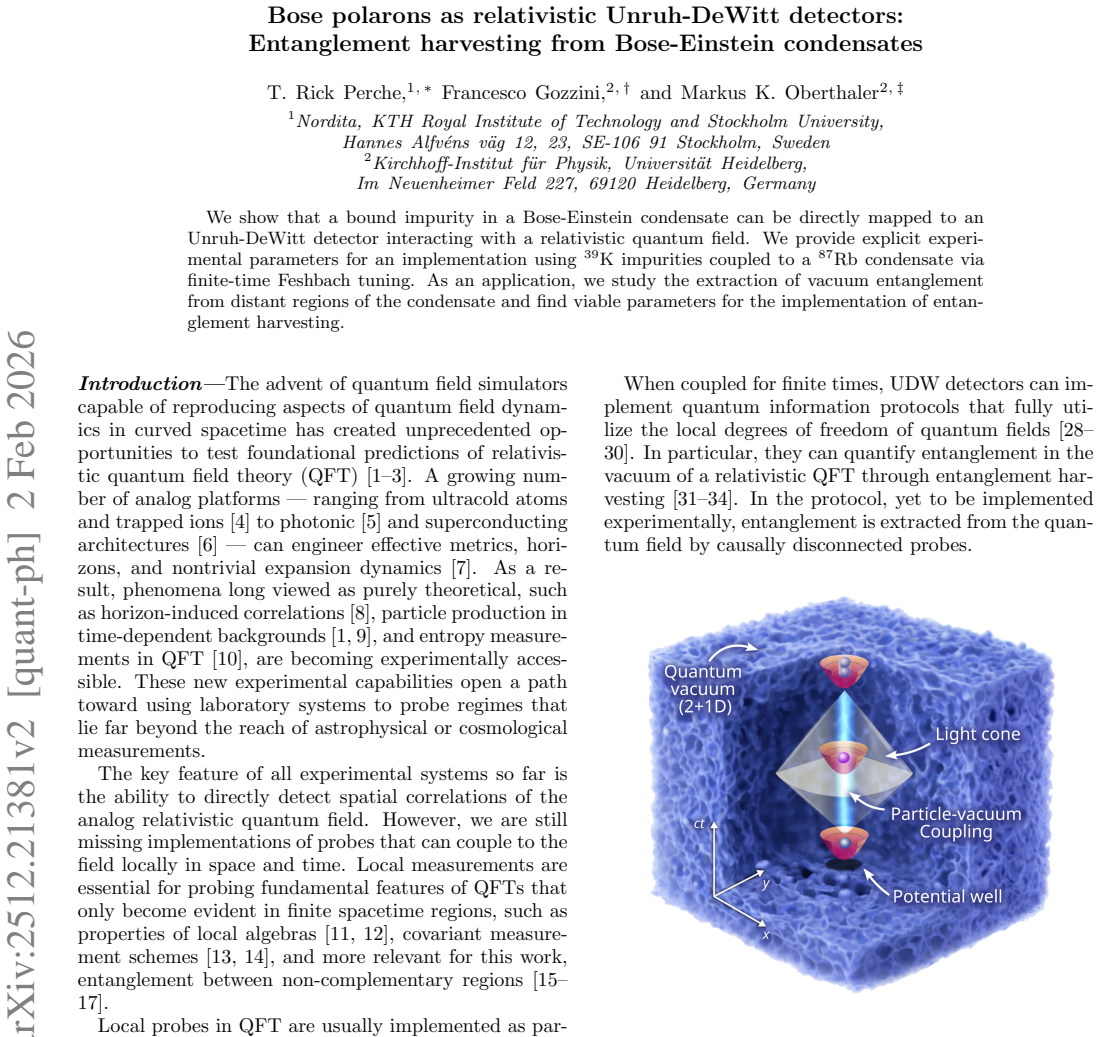
The central claim is an exact mapping: after writing the interspecies scattering length as g_ab(t) = gbar_ab χ(t), the impurity–phonon interaction Hamiltonian takes the same form as a momentum-coupled Unruh-DeWitt detector, with the dictionary π(x) ↦ sqrt(c_s/c) sqrt(g_bb) δρ(x) and λ ↦ sqrt(c/c_s) gbar_ab/sqrt(g_bb), along with the rescalings Ω ↦ (c/c_s)Ω and T ↦ (c_s/c)T. This means the condensate's density fluctuation operator δρ(x) is the relativistic field momentum, the harmonic-trap wavefunction product ψ_g^* ψ_e is the spatial smearing, and the Feshbach pulse χ(t) is the temporal switching function. The paper then uses closed-form expressions for derivative-coupled detectors to comput
What carries the argument
The key machinery is the dictionary between the polaron model and the derivative-coupled Unruh-DeWitt detector. Explicitly, the condensate density fluctuation δρ(x), expanded in Bogoliubov phonons with relativistic dispersion ω_k = c_s|k|, is identified with the conjugate momentum π(x) of a massless scalar field up to a rescaling; the coupling constant gbar_ab is rescaled to the UDW coupling λ; the product f(x) = (ψ_g^* ψ_e)(x) serves as the spatial smearing; and the time-dependent Feshbach tuning g_ab(t) = gbar_ab χ(t) provides the switching function. This dictionary transfers all standard UDW detector results—excitation probabilities, nonlocal terms, and negativity—directly to the cold-ato
Load-bearing premise
The mapping is only exact if the phonon dispersion is strictly linear, ω_k = c_s|k|, for every momentum that contributes to the detector response; non-relativistic Bogoliubov corrections or finite-temperature phonons entering that momentum window could change the predicted negativity.
What would settle it
Measure the excitation probability L of a single 39K impurity in a trapped state as a function of trap frequency and compare it to the closed-form relativistic prediction for the proposed Gaussian switching; a systematic deviation at frequencies where the integrand samples momenta above the healing length (|k| > ξ^-1 = 120 nm) would falsify the mapping. Alternatively, repeat the entanglement-harvesting measurement at elevated BEC temperatures and check whether the negativity vanishes with a temperature dependence inconsistent with the relativistic vacuum model.
If this is right
- Entanglement harvesting becomes experimentally accessible: two potassium impurities separated by a few microns in a rubidium BEC are predicted to show negativity ~10^-4 with current technology.
- The excitation probability L and the nonlocal harvesting term M are measurable (L via excited-state occupancy, M via a local unitary rotation before detection), yielding a concrete witness of phonon vacuum entanglement.
- The same setup can implement other relativistic QFT protocols requiring finite-time local coupling, such as quantum energy teleportation and quantum collect calling, as named in the paper.
- Because the mapping is derived at the level of the Hamiltonian, a large body of existing UDW detector calculations transfers to BEC impurity experiments, turning theoretical predictions into falsifiable laboratory tests.
Where Pith is reading between the lines
- If the mapping is taken further, any discrepancy between the relativistic predictions and experiments at higher momenta would directly expose Bogoliubov dispersion corrections, turning the same platform into a probe of Lorentz-violating field theories.
- A natural extension the paper does not consider is accelerating or rotating the trap to move the impurity along a non-inertial trajectory, which the dictionary suggests would realize an experimental Unruh effect test.
- Heating the condensate in a controlled way would replace the vacuum two-point function with a thermal one, allowing a test of how detector response and harvested negativity depend on field temperature, effectively simulating a thermal relativistic field.
- The predicted need for ~10^5 experimental repetitions is well within the reach of modern BEC setups, suggesting a near-term, concrete experimental pathway to verify the harvesting numbers.
Editorial analysis
A structured set of objections, weighed in public.
Referee Report
Summary. The paper claims that a trapped impurity in a uniform BEC, with the interspecies coupling switched by a Feshbach pulse, realizes a derivative-coupled Unruh-DeWitt detector for the phonon field. The authors derive a microscopic dictionary, Eq. (10), between the polaron model and the momentum-coupled UDW Hamiltonian, and then use it to compute the two-impurity negativity for a 39K-in-87Rb setup, finding values of order 10^-4 and arguing that these parameters make entanglement harvesting experimentally accessible. The central analytical steps are the reduction of the impurity to two levels, the low-energy phonon description with linear dispersion, and closed-form evaluations of the local and nonlocal correlation integrals in Appendix C.
Significance. If the quantitative predictions survive scrutiny, this would be a valuable bridge between analogue gravity / BEC experiments and relativistic quantum information, providing a concrete microscopic realization of finite-time UDW detectors and a plausible entanglement-harvesting platform. The paper’s strengths are the clean microscopic derivation of the detector dictionary, the closed-form analytic integrals, the explicit experimental parameters taken from prior measurements, and the signaling analysis in Appendix D. The results are falsifiable in the sense that L and M are measurable and the negativity is predicted without free fitting parameters once the experimental inputs are fixed. However, the quantitative claims rest on two approximations (linear phonon dispersion and a Gaussian spatial profile) whose validity is not yet established at the precision needed for the negativity prediction.
major comments (2)
- [Appendix D / Eqs. (C8), (C20), Fig. 3] The quantitative negativity values in Fig. 3 are obtained using the relativistic dispersion ω_k = c_s|k| in Eqs. (C8)–(C20). The check in Appendix D only plots where the integrands L(|k|), M_+(|k|), M_-(|k|) peak for one parameter set; it does not recompute L and M with the full Bogoliubov dispersion ω_k = sqrt(c_s^2 k^2 + (ℏ k^2/2m_b)^2). This is load-bearing because for the proposed parameters σ ≈ 0.2 μm and ξ ≈ 0.12 μm, modes with k ∼ 1/σ ≈ 5×10^6 m^-1 already have a Bogoliubov correction of about 8%, and 7% of the M_- integrand lies beyond ξ^-1. Since N = max(|M| − L, 0) is a difference of two comparable O(g^2) quantities, a few-percent change in L or M can produce a large relative change in N, and potentially change its sign. Please compute L, M, and N with the full Bogoliubov dispersion, or provide a rigorous bound on the induced error.
- [Experimental implementation / Eq. (C10)] The spatial profile f(x) = (ψ_g^* ψ_e)(x) is approximated by a Gaussian in Eq. (C10), but for a harmonic-oscillator trap the actual ground–first-excited overlap is proportional to x exp(−|x|^2/σ^2) (or a vector-like function in 3D), which has a node and anisotropic angular dependence. Its Fourier transform is proportional to k exp(−σ^2 k^2/2), not the Gaussian used in the analytic results. Thus the L and M integrals behind Fig. 3 correspond to a different detector profile than the physical impurity. The nodal profile shifts the integrands to larger |k|, which also aggravates the relativistic-dispersion issue raised in the previous comment. Please recompute the negativity with the actual overlap profile, or justify on experimental grounds why a Gaussian envelope is an adequate replacement, and show that the harvesting conclusion is unchanged.
minor comments (5)
- [Appendix D] The statement that the tails of M_- extend up to 6 (nm)^-1 is inconsistent with the exponential suppression e^{-σ^2 k^2} and with the claim that only 7% lies above ξ^-1; this is likely a typo for 6 μm^-1 or 6ξ^-1. Please correct.
- [Fig. 5 caption] The notation 'Ω = 35 2πkHz' is ambiguous and differs from the text's 'Ω = 35 krad/s' and Fig. 2's 'Ω = 36 krad/s'. Use a single convention consistently.
- [Introduction, paragraph after Eq. (9)] The phrase 'which discusses a related implementation' is a dangling fragment; rephrase to identify the reference and its relation to the present work.
- [Experimental implementation] The sentence 'temperatures of the order of nK ensure that the zero temperature approximation is valid' would be more compelling with a quantitative thermal-occupation estimate, e.g., e^{-ℏΩ/k_B T} for the proposed Ω and T values.
- [Entanglement harvesting from a BEC] The statistics paragraph says 'requires at least N≈100 detection events' and then 'this translates to more than 10^5 experimental realizations.' Clarify the distinction between detection events and experimental repetitions so the counting argument is unambiguous.
Circularity Check
No significant circularity: polaron-to-UDW mapping is an algebraic identification from the microscopic Hamiltonian; negativity prediction follows from the stated model with parameters taken from literature, not fitted.
full rationale
The derivation is self-contained. Eq. (9) is obtained from the microscopic density–density Hamiltonian (6) by two-level truncation and g_ab(t)=gbar_ab χ(t); comparison with Eq. (1) gives the dictionary (10). This is an algebraic identification of Hamiltonian forms, not a prediction obtained from a fitted parameter. The entanglement-harvesting quantifiers L and M are then computed from the stated phonon two-point function (C1) under the explicitly stated low-energy dispersion assumption (Eq. (4), Appendix A), and the negativity (14) follows. No parameter is fitted to the predicted negativity; the experimental inputs (a_bb, ρ0, c_s, etc.) are taken from prior literature, while T, σ, Ω, and L are selected/scan parameters. The self-citation [95] supplies a parameter-free closed-form integral identity used to evaluate M_-; this is independent mathematical support, not a load-bearing self-citation of a physical premise. The Appendix D check of the relativistic regime is an approximation-validity check; whether it is quantitatively sufficient is a correctness/robustness concern, not circularity. No circular step is exhibited.
Axiom & Free-Parameter Ledger
free parameters (4)
- Coupling strength gbar_ab (via a_ab) =
a_ab up to 1000 a0; gbar_ab implicit
- Detector gap Ω (trap frequency) =
~36 krad/s (from Fig. 2 text), peaks near 35 krad/s in Fig. 3
- Switching time T =
0.065 ms to ~0.4 ms
- Detector separation L =
L = 5.25 c_s T
axioms (6)
- domain assumption Phonon dispersion is relativistic ω_k ≈ c_s |k| for all relevant momenta
- domain assumption The impurity is weakly coupled, so first-order perturbation theory is valid (O(g^2) terms in L and M)
- domain assumption Zero-temperature approximation: the BEC is in its ground state, no thermal phonons
- ad hoc to paper The impurity is well-described by a two-level system (only ground and first excited motional states)
- ad hoc to paper The spatial profile f(x) is Gaussian with σ = sqrt(ℏ/(m_a Ω))
- ad hoc to paper The Feshbach switching χ(t) is Gaussian
read the original abstract
We show that a bound impurity in a Bose-Einstein condensate can be directly mapped to an Unruh-DeWitt detector interacting with a relativistic quantum field. We provide explicit experimental parameters for an implementation using ${}^{41}\text{K}$ impurities coupled to a ${}^{87}\text{Rb}$ condensate via finite-time Feshbach tuning. As an application, we study the extraction of vacuum entanglement from distant regions of the condensate and find viable parameters for the implementation of entanglement harvesting.
Figures


Forward citations
Cited by 6 Pith papers
-
Ultraviolet structure of entanglement harvesting from energy density and other quadratic couplings
Energy-density-coupled entanglement harvesting is UV finite when detector switchings do not overlap in time, and for Gaussian-smeared detectors it is automatically finite in 1+1 and 2+1 dimensions.
-
Optimization of entanglement harvesting with arbitrary temporal profiles: the limit of second order perturbation theory
A Hermite-expansion method optimizes the temporal switching profiles of Unruh-DeWitt detectors and claims order-of-magnitude improvements in vacuum entanglement harvesting, with the largest gains occurring outside the...
-
Optimization of entanglement harvesting with arbitrary temporal profiles: the limit of second order perturbation theory
Hermite expansions enable closed-form computation and optimization of entanglement harvesting negativity for arbitrary temporal profiles, increasing harvested entanglement by orders of magnitude beyond second-order pe...
-
Asymmetric quantum steering harvested near a Lorentz-violating BTZ black hole
In Lorentz-violating BTZ spacetime, quantum steering between detectors at unequal radial positions shows an inversion where the detector with higher effective temperature exhibits stronger steerability, with Lorentz v...
-
Asymmetric quantum steering harvested near a Lorentz-violating BTZ black hole
Unruh-DeWitt detectors near a Lorentz-violating BTZ black hole harvest asymmetric quantum steering, with a thermal-intuition inversion and Lorentz violation suppressing maximal correlations.
-
Bipartite entanglement harvesting with multiple detectors
Multiple Unruh-DeWitt detectors harvest more vacuum entanglement when arranged in specific configurations, with harvested negativity scaling linearly in linear chains.
Reference graph
Works this paper leans on
-
[1]
Viermann, M
C. Viermann, M. Sparn, N. Liebster, M. Hans, E. Kath, A. Parra-Lopez, M. Tolosa-Simeon, N. Sanchez-Kuntz, T. Haas, H. Strobel, S. Floerchinger, and M. K. Oberthaler, Quantum field simulator for dynamics in curved spacetime, Nature611, 260 (2022)
2022
-
[2]
Tajik, M
M. Tajik, M. Gluza, N. Sebe, P. Sch¨ uttelkopf, F. Catal- dini, J. Sabino, F. Møller, S.-C. Ji, S. Erne, G. Guarnieri, S. Sotiriadis, J. Eisert, and J. Schmiedmayer, Experimen- tal observation of curved light-cones in a quantum field simulator, Proceedings of the National Academy of Sci- ences120, e2301287120 (2023). 6
2023
-
[3]
Sch¨ utzhold, Ultra-cold atoms as quantum simulators for relativistic phenomena, Progress in Particle and Nu- clear Physics145, 104198 (2025)
R. Sch¨ utzhold, Ultra-cold atoms as quantum simulators for relativistic phenomena, Progress in Particle and Nu- clear Physics145, 104198 (2025)
2025
-
[4]
C. F. Roos, R. Gerritsma, G. Kirchmair, F. Z¨ ahringer, E. Solano, and R. Blatt, Quantum simulation of rela- tivistic quantum physics with trapped ions, Journal of Physics: Conference Series264, 012020 (2011)
2011
-
[5]
Longhi, Classical simulation of relativistic quantum mechanics in periodic optical structures, Applied Physics B104, 453 (2011)
S. Longhi, Classical simulation of relativistic quantum mechanics in periodic optical structures, Applied Physics B104, 453 (2011)
2011
-
[6]
J. S. Pedernales, R. Di Candia, D. Ballester, and E. Solano, Quantum simulations of relativistic quantum physics in circuit qed, New Journal of Physics15, 055008 (2013)
2013
-
[7]
Barcel´ o, S
C. Barcel´ o, S. Liberati, and M. Visser, Analogue gravity, Living Reviews in Relativity14, 3 (2011)
2011
-
[8]
Y. H. Shi, R. Q. Yang, Z. Xiang,et al., Quantum sim- ulation of hawking radiation and curved spacetime with a superconducting on-chip black hole, Nature Communi- cations14, 3263 (2023)
2023
-
[9]
J. Steinhauer, M. Abuzarli, T. Aladjidi, T. Bienaim´ e, C. Piekarski, W. Liu, E. Giacobino, A. Bramati, and Q. Glorieux, Analogue cosmological particle creation in an ultracold quantum fluid of light, Nature Commun.13, 2890 (2022), arXiv:2102.08279 [cond-mat.quant-gas]
Pith/arXiv arXiv 2022
-
[10]
Deller, M
Y. Deller, M. G¨ arttner, T. Haas, M. K. Oberthaler, M. Reh, and H. Strobel, Area laws and thermalization from classical entropies in a bose-einstein condensate, Phys. Rev. A112, L011303 (2025)
2025
-
[11]
Chandrasekaran, R
V. Chandrasekaran, R. Longo, G. Penington, and E. Wit- ten, An algebra of observables for de sitter space, J. High Energy Phys.2023(2), 82
2023
-
[12]
C. J. Fewster, D. W. Janssen, L. D. Loveridge, K. Re- jzner, and J. Waldron, Quantum reference frames, mea- surement schemes and the type of local algebras in quan- tum field theory, Comm. in Math. Phys.406, 19 (2024)
2024
-
[13]
C. J. Fewster and R. Verch, Quantum Fields and Local Measurements, Commun. Math. Phys.378, 851 (2020)
2020
-
[14]
C. J. Fewster and R. Verch, Measurement in quantum field theory (2023), arXiv:2304.13356 [math-ph]
Pith/arXiv arXiv 2023
-
[15]
Witten, Aps medal for exceptional achievement in research: Invited article on entanglement properties of quantum field theory, Rev
E. Witten, Aps medal for exceptional achievement in research: Invited article on entanglement properties of quantum field theory, Rev. Mod. Phys.90, 045003 (2018)
2018
-
[16]
N. Klco, D. H. Beck, and M. J. Savage, Entanglement structures in quantum field theories: Negativity cores and bound entanglement in the vacuum, Phys. Rev. A 107, 012415 (2023)
2023
-
[17]
Klco and D
N. Klco and D. H. Beck, Entanglement structures in quantum field theories. ii. distortions of vacuum corre- lations through the lens of local observers, Phys. Rev. A 108, 012429 (2023)
2023
-
[18]
W. G. Unruh, Notes on black-hole evaporation, Phys. Rev. D14, 870 (1976)
1976
-
[19]
W. G. Unruh and R. M. Wald, What happens when an accelerating observer detects a Rindler particle, Phys. Rev. D29, 1047 (1984)
1984
-
[20]
DeWitt,General Relativity; an Einstein Centenary Survey(Cambridge University Press, Cambridge, UK, 1980)
B. DeWitt,General Relativity; an Einstein Centenary Survey(Cambridge University Press, Cambridge, UK, 1980)
1980
-
[21]
T. R. Perche, Localized nonrelativistic quantum systems in curved spacetimes: A general characterization of par- ticle detector models, Phys. Rev. D106, 025018 (2022)
2022
-
[22]
T. R. Perche, J. Polo-G´ omez, B. de S. L. Torres, and E. Mart ´ ın-Mart ´ ınez, Particle Detectors from Local- ized Quantum Field Theories (2023), arXiv:2308.11698 [quant-ph]
Pith/arXiv arXiv 2023
-
[23]
S. Onoe, T. L. M. Guedes, A. S. Moskalenko, A. Leit- enstorfer, G. Burkard, and T. C. Ralph, Realizing a rapidly switched unruh-dewitt detector through electro- optic sampling of the electromagnetic vacuum, Physical Review D105, 056023 (2022), arXiv:2103.14360 [quant- ph]
Pith/arXiv arXiv 2022
-
[24]
F. F. Settembrini, F. Lindel, A. M. Herter, S. Y. Buh- mann, and J. Faist, Detection of quantum-vacuum field correlations outside the light cone, Nature Communica- tions13, 3383 (2022)
2022
-
[25]
A. Teixid´ o-Bonfill, X. Dai, A. Lupascu, and E. Mart ´ ın- Mart ´ ınez, Towards an experimental implementation of entanglement harvesting in superconducting circuits: ef- fect of detector gap variation on entanglement harvesting (2025), arXiv:2505.01516 [quant-ph]
Pith/arXiv arXiv 2025
-
[26]
C. Gooding, S. Biermann, S. Erne, J. Louko, W. G. Un- ruh, J. Schmiedmayer, and S. Weinfurtner, Interferomet- ric unruh detectors for bose-einstein condensates, Physi- cal Review Letters125, 213603 (2020), arXiv:2007.07160 [gr-qc]
Pith/arXiv arXiv 2020
-
[27]
Gooding, A
C. Gooding, A. Sachs, R. B. Mann, and S. Weinfurt- ner, Vacuum entanglement probes for ultra-cold atom systems, New Journal of Physics26, 105001 (2024)
2024
-
[28]
Hotta, Quantum measurement information as a key to energy extraction from local vacuums, Phys
M. Hotta, Quantum measurement information as a key to energy extraction from local vacuums, Phys. Rev. D 78, 045006 (2008)
2008
-
[29]
Hotta, Quantum Energy Teleportation: An Introduc- tory Review (2011), arXiv:1101.3954 [quant-ph]
M. Hotta, Quantum Energy Teleportation: An Introduc- tory Review (2011), arXiv:1101.3954 [quant-ph]
Pith/arXiv arXiv 2011
-
[30]
R. H. Jonsson, E. Mart ´ ın-Mart ´ ınez, and A. Kempf, In- formation transmission without energy exchange, Phys. Rev. Lett.114, 110505 (2015)
2015
-
[31]
Valentini, Non-local correlations in quantum electro- dynamics, Phys
A. Valentini, Non-local correlations in quantum electro- dynamics, Phys. Lett. A153, 321 (1991)
1991
-
[32]
Reznik, Entanglement from the vacuum, Foundations of Physics33, 167 (2003)
B. Reznik, Entanglement from the vacuum, Foundations of Physics33, 167 (2003)
2003
-
[33]
Reznik, A
B. Reznik, A. Retzker, and J. Silman, Violating Bell’s inequalities in vacuum, Phys. Rev. A71, 042104 (2005)
2005
-
[34]
Pozas-Kerstjens and E
A. Pozas-Kerstjens and E. Mart ´ ın-Mart ´ ınez, Harvesting correlations from the quantum vacuum, Phys. Rev. D92, 064042 (2015)
2015
-
[35]
Grusdt, N
F. Grusdt, N. Mostaan, E. Demler, and L. A. Pe˜ na Ardila, Impurities and polarons in bosonic quantum gases: a review on recent progress, Reports on Progress in Physics88, 066401 (2025)
2025
-
[36]
P. Massignan, R. Schmidt, G. E. Astrakharchik, A. ˙Imamo˘ glu, M. Zwierlein, J. J. Arlt, and G. M. Bruun, Polarons in atomic gases and two-dimensional semicon- ductors (2025), arXiv:2501.09618 [cond-mat.quant-gas]
Pith/arXiv arXiv 2025
-
[37]
Retzker, J
A. Retzker, J. I. Cirac, M. B. Plenio, and B. Reznik, Methods for detecting acceleration radiation in a bose- einstein condensate, Phys. Rev. Lett.101, 110402 (2008)
2008
-
[38]
Marino, A
J. Marino, A. Recati, and I. Carusotto, Casimir forces and quantum friction from ginzburg radiation in atomic bose-einstein condensates, Phys. Rev. Lett.118, 045301 (2017)
2017
-
[39]
P. O. Fedichev and U. R. Fischer, Gibbons-hawking ef- fect in the sonic de sitter space-time of an expanding bose-einstein-condensed gas, Phys. Rev. Lett.91, 240407 (2003). 7
2003
-
[40]
P. O. Fedichev and U. R. Fischer, Observer dependence for the phonon content of the sound field living on the effective curved space-time background of a bose-einstein condensate, Phys. Rev. D69, 064021 (2004)
2004
-
[41]
Haag,Local Quantum Physics: Fields, Particles, Al- gebras(Springer-Verlag Berlin Heidelberg, 1992)
R. Haag,Local Quantum Physics: Fields, Particles, Al- gebras(Springer-Verlag Berlin Heidelberg, 1992)
1992
-
[42]
Fredenhagen, An Introduction to Algebraic Quantum Field Theory, inAdvances in algebraic quantum field the- ory, edited by R
K. Fredenhagen, An Introduction to Algebraic Quantum Field Theory, inAdvances in algebraic quantum field the- ory, edited by R. Brunetti, C. Dappiaggi, K. Freden- hagen, and J. Yngvason (2015) pp. 1–30
2015
-
[43]
Fewster and K
C. Fewster and K. Rejzner, Algebraic quantum field the- ory: An introduction, inProgress and Visions in Quan- tum Theory in View of Gravity, edited by F. Finster, D. Giulini, J. Kleiner, and J. Tolksdorf (Birkhauser, 2020)
2020
-
[44]
T. R. Perche and E. Mart ´ ın-Mart ´ ınez, Role of quantum degrees of freedom of relativistic fields in quantum infor- mation protocols, Phys. Rev. A107, 042612 (2023)
2023
-
[45]
B. A. Ju´ arez-Aubry and J. Louko, Onset and decay of the 1 + 1 Hawking–Unruh effect: what the derivative- coupling detector saw, Class. Quantum Gravity31, 245007 (2014)
2014
-
[46]
T. R. Perche and M. H. Zambianco, Duality between am- plitude and derivative coupled particle detectors in the limit of large energy gaps, Phys. Rev. D108, 045017 (2023)
2023
-
[47]
Teixid´ o-Bonfill and E
A. Teixid´ o-Bonfill and E. Mart ´ ın-Mart ´ ınez, Derivative coupling enables genuine entanglement harvesting in causal communication, Phys. Rev. D110, 105016 (2024)
2024
-
[48]
Mart ´ ın-Mart ´ ınez, T
E. Mart ´ ın-Mart ´ ınez, T. R. Perche, and B. de S. L. Torres, General relativistic quantum optics: Finite-size particle detector models in curved spacetimes, Phys. Rev. D101, 045017 (2020)
2020
-
[49]
S. W. Hawking, Particle creation by black holes, Comm. Math. Phys.43, 199 (1975)
1975
-
[50]
Hodgkinson, J
L. Hodgkinson, J. Louko, and A. C. Ottewill, Static detectors and circular-geodesic detectors on the Schwarzschild black hole, Phys. Rev. D89, 104002 (2014)
2014
-
[51]
Louko and D
J. Louko and D. Marolf, Inextendible Schwarzschild black hole with a single exterior: How thermal is the Hawking radiation?, Phys. Rev. D58, 024007 (1998)
1998
-
[52]
Takagi, Vacuum Noise and Stress Induced by Uniform Acceleration: Hawking-Unruh Effect in Rindler Manifold of Arbitrary Dimension, Prog
S. Takagi, Vacuum Noise and Stress Induced by Uniform Acceleration: Hawking-Unruh Effect in Rindler Manifold of Arbitrary Dimension, Prog. Theor. Phys. Supp.88, 1 (1986)
1986
-
[53]
L. C. B. Crispino, A. Higuchi, and G. E. A. Matsas, The Unruh effect and its applications, Rev. Mod. Phys.80, 787 (2008)
2008
-
[54]
Earman, The unruh effect for philosophers, STUD HIST PHILOS M P42, 81 (2011)
J. Earman, The unruh effect for philosophers, STUD HIST PHILOS M P42, 81 (2011)
2011
-
[55]
T. R. Perche, General features of the thermalization of particle detectors and the Unruh effect, Phys. Rev. D 104, 065001 (2021)
2021
-
[56]
Pozas-Kerstjens and E
A. Pozas-Kerstjens and E. Mart ´ ın-Mart ´ ınez, Entangle- ment harvesting from the electromagnetic vacuum with hydrogenlike atoms, Phys. Rev. D94, 064074 (2016)
2016
-
[57]
Funai, J
N. Funai, J. Louko, and E. Mart ´ ın-Mart ´ ınez,ˆp· ˆAvs ˆx· ˆE: Gauge invariance in quantum optics and quantum field theory, Phys. Rev. D99, 065014 (2019)
2019
-
[58]
Lopp and E
R. Lopp and E. Mart ´ ın-Mart ´ ınez, Quantum delocaliza- tion, gauge, and quantum optics: Light-matter interac- tion in relativistic quantum information, Phys. Rev. A 103, 013703 (2021)
2021
-
[59]
Faure, T
R. Faure, T. R. Perche, and B. d. S. L. Torres, Particle detectors as witnesses for quantum gravity, Phys. Rev. D 101, 125018 (2020)
2020
-
[60]
J. P. M. Pitelli and T. R. Perche, Angular momen- tum based graviton detector, Phys. Rev. D104, 065016 (2021)
2021
-
[61]
T. R. Perche, B. Ragula, and E. Mart ´ ın-Mart ´ ınez, Har- vesting entanglement from the gravitational vacuum, Phys. Rev. D108, 085025 (2023)
2023
-
[62]
W. G. Unruh, Experimental Black-Hole Evaporation?, Phys. Rev. Lett.46, 1351
-
[63]
L. J. Garay, J. R. Anglin, J. I. Cirac, and P. Zoller, Sonic analog of gravitational black holes in bose-einstein con- densates, Physical Review Letters85, 4643 (2000)
2000
-
[64]
C. Barcelo, S. Liberati, and M. Visser, Analogue Gravity, Living Rev. Relativ.8, 12, gr-qc/0505065
-
[65]
L. P. Pitaevskii and S. Stringari,Bose–Einstein Conden- sation and Superfluidity, International Series of Mono- graphs on Physics, Vol. 164 (Oxford University Press, Oxford, 2018) reprint
2018
-
[66]
M. Tolosa-Sime´ on, ´A. Parra-L´ opez, N. S´ anchez-Kuntz, T. Haas, C. Viermann, M. Sparn, N. Liebster, M. Hans, E. Kath, H. Strobel, M. K. Oberthaler, and S. Flo- erchinger, Curved and expanding spacetime geometries in Bose–Einstein condensates, Physical Review A106, 033313 (2022), arXiv:2202.10441 [cond-mat.quant-gas]
Pith/arXiv arXiv 2022
-
[67]
R. Scelle, T. Rentrop, A. Trautmann, T. Schuster, and M. K. Oberthaler, Motional coherence of fermions im- mersed in a bose gas, Physical Review Letters111, 070401 (2013), arXiv:1306.3308 [cond-mat.quant-gas]
Pith/arXiv arXiv 2013
-
[68]
Rentrop, A
T. Rentrop, A. Trautmann, F. A. Olivares, F. Jendrze- jewski, A. Komnik, and M. K. Oberthaler, Observation of the phononic lamb shift with a synthetic vacuum, Phys. Rev. X6, 041041 (2016)
2016
-
[69]
Fr¨ ohlich, Electrons in lattice fields, Advances in Physics3, 325 (1954)
H. Fr¨ ohlich, Electrons in lattice fields, Advances in Physics3, 325 (1954)
1954
-
[70]
F. M. Cucchietti and E. Timmermans, Strong-Coupling Polarons in Dilute Gas Bose-Einstein Condensates, Phys. Rev. Lett.96, 210401
-
[71]
Tempere, W
J. Tempere, W. Casteels, M. K. Oberthaler, S. Knoop, E. Timmermans, and J. T. Devreese, Feynman path- integral treatment of the BEC-impurity polaron, Phys. Rev. B80, 184504
-
[72]
C. Chin, R. Grimm, P. Julienne, and E. Tiesinga, Fesh- bach resonances in ultracold gases, Rev. Mod. Phys.82, 1225 (2010)
2010
-
[73]
M.-G. Hu, M. J. Van de Graaff, D. Kedar, J. P. Corson, E. A. Cornell, and D. S. Jin, Bose polarons in the strongly interacting regime, Phys. Rev. Lett.117, 055301 (2016)
2016
-
[74]
Schmidt, D
F. Schmidt, D. Mayer, M. Hohmann, T. Lausch, F. Kin- dermann, and A. Widera, Precision measurement of the 87Rb tune-out wavelength in the hyperfine ground state f= 1 at 790 nm, Phys. Rev. A93, 022507 (2016)
2016
-
[75]
J. L. Ville, R. Saint-Jalm, ´E. Le Cerf, M. Aidelsburger, S. Nascimb` ene, J. Dalibard, and J. Beugnon, Sound prop- agation in a uniform superfluid two-dimensional Bose gas, Phys. Rev. Lett.121, 145301 (2018)
2018
-
[76]
E. W. Streed, S. Schabel, J. Mun, M. Boyd, G. K. Camp- bell, W. Ketterle, and D. E. Pritchard, Large atom num- ber bose-einstein condensate machines, Review of Scien- tific Instruments77, 023106 (2006). 8
2006
-
[77]
Ferlaino, C
F. Ferlaino, C. D’Errico, G. Roati, M. Zaccanti, M. In- guscio, G. Modugno, and A. Simoni, Feshbach spec- troscopy of a K−Rb atomic mixture, Phys. Rev. A73, 040702 (2006)
2006
-
[78]
Thalhammer, G
G. Thalhammer, G. Barontini, L. De Sarlo, J. Catani, F. Minardi, and M. Inguscio, Double species bose-einstein condensate with tunable interspecies interactions, Phys. Rev. Lett.100, 210402 (2008)
2008
-
[79]
Wacker, N
L. Wacker, N. B. Jørgensen, D. Birkmose, R. Horchani, W. Ertmer, C. Klempt, N. Winter, J. Sherson, and J. J. Arlt, Tunable dual-species bose-einstein condensates of 39K and 87Rb, Phys. Rev. A92, 053602 (2015)
2015
-
[80]
L. J. Wacker, N. B. Jørgensen, D. Birkmose, N. Win- ter, M. Mikkelsen, J. Sherson, N. Zinner, and J. J. Arlt, Universal three-body physics in ultracold krb mixtures, Phys. Rev. Lett.117, 163201 (2016)
2016
discussion (0)
Sign in with ORCID, Apple, or X to comment. Anyone can read and Pith papers without signing in.