REVIEW 4 major objections 6 minor 78 references
A resummation of large Pomeron loops shows that produced gluons obey KNO scaling and that their entropy equals the logarithm of the gluon structure function.
Reviewed by Pith at T0; open to challenge. T0 means a machine referee read the full paper against a public rubric. the ladder, T0–T4 →
T0 review · deepseek-v4-flash
2026-08-03 14:03 UTC pith:UVOQAQ47
load-bearing objection An honest, technically clear extension of Levin's Pomeron-loop program that delivers new KNO functions and the expected exp(-z'^2/16) amplitude, but the exact entropy equality S_E = ln(xG) rests on a hand-picked continuation of C_n and is not fully established. the 4 major comments →
Dipole-dipole scattering: summing large Pomeron loops in non-linear evolution with leading twist kernel
The pith
A machine-rendered reading of the paper's core claim, the machinery that carries it, and where it could break.
Core claim
The paper's central claim is that the dipole densities in the saturation region can be written as products of single-Pomeron Green's functions with coefficients C_n, and that this representation allows the full dipole-dipole S-matrix to be obtained by summing large Pomeron loops. For the leading-twist BFKL kernel, the coefficients at large n behave as C_n approximately (1/n) exp(1/2 n^2 - 2n), and the divergent multi-Pomeron series can be summed via a Borel-type integral. The resulting amplitude leads, through the AGK cutting rules, to KNO-scaled multiplicity distributions: P_n = (1/<n>) Psi(n/<n>), with the same mean multiplicity <n> = G_IP(z) for both the BK and dipole-dipole cases. Since
What carries the argument
The multi-Pomeron expansion of the scattering amplitude, built from the BFKL Pomeron Green's function G_IP(z) and the coefficients C_n determined from the BK equation. The t-channel unitarity relation writes the amplitude as a sum over dipole densities rho_n; for the leading-twist kernel these densities factorize as C_n times the product of G_IP(z_i). The asymptotic behavior of C_n, combined with Borel summation of the resulting badly divergent series, yields the S-matrix; the AGK cutting rules then convert powers of Im G_IP into multi-gluon cross sections, producing the KNO scaling function expressed through the Lambert W function.
Load-bearing premise
The load-bearing premise is that the coefficients C_n, which are solved only for large n, can be continued to all n with the particular choice alpha = beta = 1; if another valid continuation exists, the predicted KNO functions and entropy constants change, although the leading ln-term S_E = ln(xG) remains.
What would settle it
Solve the recurrence for C_n numerically at all n (without the large-n-only ansatz), insert into the t-channel unitarity series, and compute the dipole-dipole multiplicity distribution; if the resulting KNO function equals Psi_BK(sqrt(xi)) rather than sqrt(Psi_BK(xi)), the paper's analytic continuation is falsified.
If this is right
- The entropy of produced gluons in deep inelastic scattering and dipole-dipole collisions is both S_E = ln(xG), making the final-state entropy a direct probe of the gluon structure function in the saturation region.
- The multiplicity distributions in the two processes have different KNO functions (Psi_dd = sqrt(Psi_BK)), unlike one-dimensional model predictions; measuring them can discriminate between evolution pictures.
- The mean multiplicity of produced gluons equals the single-Pomeron amplitude G_IP, so the gluon density determines the average final-state multiplicity.
- The Borel-type resummation of the divergent multi-Pomeron series provides an explicit mechanism to compute higher-order loop corrections from the BK equation.
Where Pith is reading between the lines
- Because the leading logarithmic term in the entropy does not depend on the undetermined continuation of C_n, the relation S_E = ln(xG) is likely robust even if the full multiplicity distribution changes; future work with the full BK kernel should test whether the additive constant shifts.
- The different KNO functions for BK and dipole-dipole scattering suggest a way to use experimental multiplicity distributions in e+p and p+A collisions to constrain the coefficients C_n at small n.
- The same machinery might be extended beyond the leading-twist kernel once the smooth function C(z) in the general BK solution is known; the paper's result then gives the entropy relation as a general consequence.
- The entropy relation implies that the number of independent gluon emitters is effectively xG, which could connect to entanglement-based interpretations of final-state entropy in QCD.
Editorial analysis
A structured set of objections, weighed in public.
Referee Report
Summary. The paper proposes a method to sum large Pomeron loops in dipole-dipole scattering within a simplified 'leading twist' BFKL kernel. The author solves the QCD evolution equations for dipole densities in terms of fan diagrams, fixes the coefficients C_n of the multi-Pomeron expansion by matching the known BK dipole-nucleus amplitude, and then uses t-channel unitarity and AGK cutting rules to compute the dipole-dipole amplitude, the KNO multiplicity distributions, and the entropy of produced gluons. The central claim is that, for both BK and dipole-dipole scattering, the KNO scaling of the multiplicity distribution yields S_E = ln(xG(x,Q^2)), in agreement with Kharzeev and Levin. The paper explicitly acknowledges several limitations: the solution is for the leading-twist kernel only, the recurrence for C_n is solved only at large n, and the second term in the dipole-density evolution equation is not controlled.
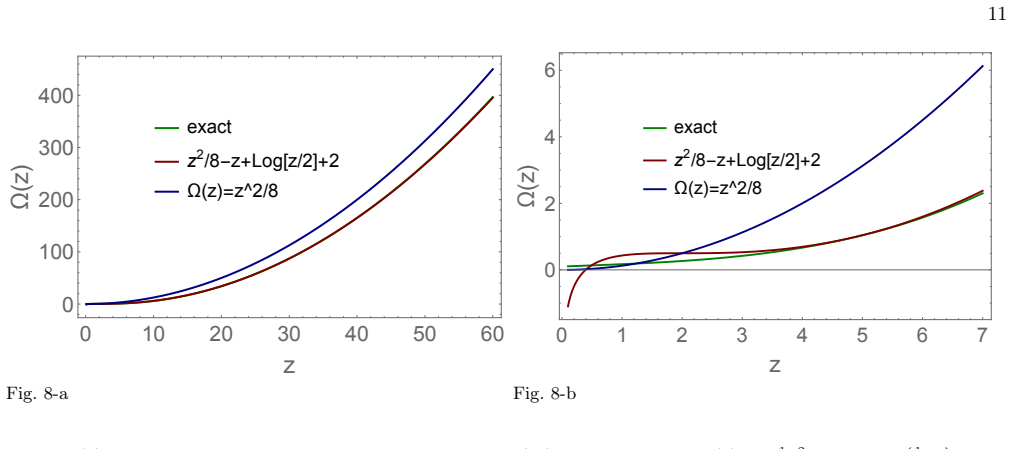
Significance. If the derivation were fully controlled, the paper would provide a concrete QCD-based realization of large-Pomeron-loop summation and would connect the saturated scattering amplitude to KNO scaling and final-state entropy. The analytic method is transparent: the large-z saddle-point calculations are explicit, and the comparison with the numerical BK solution (Figs. 3 and 8) supports the asymptotic form of the amplitude. The author is also honest about the uncontrolled elements, which is a strength. However, the exact equality S_E = ln(xG) is a much stronger statement than what the derivation shows: the arbitrary continuation parameters in C_n and the dropped O(1) constant in the entropy formula mean that the result is at present only a leading-logarithmic statement with an undetermined additive constant. The paper's main value is therefore as a plausible and explicit scheme for the leading asymptotic behavior, not as a proof of the exact Kharzeev-Levin relation.
major comments (4)
- [§IV, Eq. (50)] The coefficients C_n are not determined by QCD. The recurrence (38)-(39) is solved only for large n, and Eq. (50) contains two arbitrary parameters α and β. The text states that the initial condition C_1=1 cannot fix all coefficients and that α=β=1 is only a 'preferable choice.' Every subsequent result that matters — the BK phase (48)-(49), the dipole-dipole amplitude (68), the KNO functions (62) and (78), and the entropy constant in Sec. VIII — depends on this continuation. A different valid continuation, e.g. matching the known small-n values C_2=2/3, C_3=3/8 to the large-n form, would shift the saddle points and change Ψ(ξ) and the O(1) entropy. The leading logarithmic term in S_E is robust, but the exact claim S_E=ln G_IP is not established. This must be stated explicitly, or α and β must be fixed by an additional principle.
- [§VIII, Eq. (80)] The derivation gives S_E = ln \bar n + Const, with Const = -Σ P_n ln(Ψ(n/\bar n)) (up to normalization). For the two computed Ψ functions the paper itself finds Const = -1.706 (BK) and -0.217 (dipole-dipole). Eq. (80) drops this constant and writes S_E = ln N(z_A) = ln G_IP(z_A). Unless the normalization of \bar n and the constant Const cancel exactly — which is not shown — the relation is only S_E = ln(xG) + O(1), not an exact equality. This is load-bearing for the abstract and conclusions. Note also that N(z_A) in Eq. (80) is not the scattering amplitude of Eq. (48), which tends to 1 at large z; it is the single-Pomeron factor defined in Eq. (55d). The notation is overloaded and the identification with xG is an input, not a consequence of the KNO calculation.
- [§III.B, Eq. (27)] The neglect of the second term in the dipole-density evolution equation is asserted, not controlled. The text says that only the first term contributes to t-channel unitarity for large Pomeron loops and that the second term 'leads to the corrections which we cannot control.' Since Eq. (27) is the exact evolution equation and the omitted term is formally of the same order in \bar α_s, the factorized ansatz (34) is not proven to solve the full equation. The diagrammatic argument around Fig. 6 identifies some contributions as Y0-suppressed, but it does not provide a systematic estimate of the neglected sector. The paper should either supply such an estimate or explicitly frame the result as a truncated leading-loop calculation, rather than as the natural solution of the exact QCD equations.
- [§II, Eq. (14)] The entire construction uses the leading-twist kernel χ(γ)=1/(1−γ) for z>0 and 1/γ for z<0, with κ=4. The paper states that a solution for the full BFKL kernel is not available at this stage. Yet the final identification S_E=ln(xG) and the use of the BFKL Pomeron Green's function in Eq. (80) refer to QCD with the full BFKL kernel. The abstract's unqualified 'leads to the entropy S_E=ln(xG)' is therefore stronger than what is proven. The conclusion does mention 'proven for the leading twist kernel', but the abstract and several intermediate statements should be brought in line with this limitation.
minor comments (6)
- [§VIII, Eq. (80)] The symbol N is used both for the scattering amplitude (Eqs. (37),(48)) and for the single-Pomeron factor (Eq. (55d)). Please use distinct notation, e.g. \bar N or G_IP, to avoid the impression that S_E equals the log of the scattering amplitude, which tends to 1 at large z.
- [§V, after Eq. (55e)] The discussion of the 1/n factor is confusing: the text says the factor 1/n is 'not valid in this region' and should be taken off, but then σ_in is computed with it. Clarify whether the reported KNO function is normalized with or without this factor.
- [§VI] The text says 'we reduce Eq. (66)' but the equation being reduced is Eq. (65). Please correct the cross-reference.
- [§VIII] The text contains 'Fig.??' instead of a figure number for the comparison of Ψ functions. Either insert the figure or remove the reference.
- [Various] Typos and grammar: 'satursation' in Sec. II, 'this equations' in Sec. III, and several awkward phrasings in Secs. V and VII. A careful proofread is needed.
- [Eq. (52)] The expression 'k 1/2 z' is ambiguous; write k × \bar n or k z/2 explicitly.
Circularity Check
No significant circularity: the C_n continuation is underdetermined but not an input–output identification; KNO and entropy are derived, not fitted.
full rationale
I find no circular step. The coefficients C_n are not fitted to the dipole–dipole quantity they are later used to predict: in Eq. (37)–(48) they are fixed by requiring that the multi-Pomeron series reproduce the known dipole–nucleus BK amplitude, and the same universal coefficients are then inserted into the t-channel unitarity expression (65)–(66) to obtain a different object, the dipole–dipole S-matrix. The paper explicitly acknowledges the main limitation at Eq. (50): 'we cannot use the initial condition C1=1 to determine all coefficients... α=β=1 is our preferable choice.' That is an underdetermination/robustness caveat affecting the O(1) constants in S_E, not a case where the predicted quantity is identical by construction to the fitted input. The KNO functions in Eqs. (62) and (78) are obtained by saddle-point evaluation of the AGK-cut sums rather than assumed. Finally, Eq. (80) is a generic KNO identity S_E = ln \bar n + O(1); substituting the standard identification xG = G_IP makes the advertised result a consequence of the derived KNO scaling, not a restatement of an input. Ref. [70] is a self-citation of an earlier Kharzeev–Levin prediction, but it is cited for agreement after the derivation, not used as load-bearing evidence for it.
Axiom & Free-Parameter Ledger
free parameters (2)
- alpha =
1
- beta =
1
axioms (7)
- domain assumption The BK equation Eq. (10) is the correct QCD evolution of the dipole S-matrix.
- ad hoc to paper The leading-twist BFKL kernel χ(γ)=1/(1−γ) for z>0 and 1/γ for z<0, with κ=4 (Eq. 14), captures the relevant high-energy dynamics.
- domain assumption t-channel unitarity representation Eq. (2) sums large Pomeron loops.
- ad hoc to paper Only the first term of the ρ_n evolution equation (27) contributes to large-loop summation; the second term is negligible/uncontrolled.
- domain assumption AGK cutting rules with a Poisson distribution of mean z/2 per cut Pomeron give the produced-gluon multiplicity.
- domain assumption The gluon structure function xG equals the single BFKL Pomeron exchange G_IP.
- standard math Borel-type resummation and analytic continuation of the asymptotic series in n (Eqs. 46-47) is legitimate.
read the original abstract
It is shown in this paper that the QCD equations for dipole density have the natural solution: the 'fan' diagrams of the Pomeron calculus. We found the dipole densities comparing the analytic solution to the Balitsky-Kovchegov (BK) equation for the simplified leading twist kernel with the $t$ channel unitarity. Using these densities we calculate the contributions of large Pomeron loops to dipole-dipole scattering at high energies. Applying the Abramovsky,Gribov and Kancheli cutting rules we found that the produced gluons are distributed accordingly the KNO (Koba, Nielsen and Olesen) law which leads to the entropy $S_E = \ln(x G(x,Q^2))$ in an agreement with Kharzeev - Levin predictions.
Figures




Reference graph
Works this paper leans on
-
[1]
E. Levin, Phys. Rev. D107(2023) no.5, 054012 [arXiv:2209.07095 [hep-ph]]
Pith/arXiv arXiv 2023
-
[2]
d2(r′ 1 +r ′ 2) (r′ 1 +r ′ 2)2 GI P Y ′, ξr′ 1+r′ 2,R + YZ 0 dY ′ Z GI P Y−Y ′, ξr1,r′ 1 ∂ GI P Y−Y ′, ξr2,r′ 2 ∂ Y d2r′ 1 K(r ′ 1,r ′ 2|r′ 1 +r ′
-
[3]
d2(r′ 1 +r ′ 2) (r′ 1 +r ′ 2)2 GI P Y ′, ξr′ 1+r′ 2,R + Z GI P 0, ξr1,r′ 1 GI P 0, ξr2,r′ 2 d2r′ 1K(r ′ 1,r ′ 2|r′ 1 +r ′
-
[4]
(27) forρ2 sinceG I P(Y−Y ′, ξ1 −ξ ′ 1)as well asG I P(Y−Y ′, ξ2 −ξ ′ 2)satisfy the BFKL equations
d2(r′ 1 +r ′ 2) (r′ 1 +r ′ 2)2 GI P Y, ξr′ 1+r′ 2,R The first two terms of this equations reproduce the first two terms of Eq. (27) forρ2 sinceG I P(Y−Y ′, ξ1 −ξ ′ 1)as well asG I P(Y−Y ′, ξ2 −ξ ′ 2)satisfy the BFKL equations. Using the initial conditions of Eq. (5b) forρ1 (Y= 0, r1, b1) =G I P(0, ξ1 −ξ ′ 1)(ρ 1 (Y= 0, r2, b2) =G I P(0, ξ2 −ξ ′ 2) ) one c...
-
[5]
d2(r′ 1 +r ′ 2) (r′ 1 +r ′ 2)2 GI P 0, ξr′ 1+r′ 2,R − 1 2 Z GI P 0, ξr1,r′ 1 GI P 0, ξr2,r′ 2 d2r′ 1K(r ′ 1,r ′ 2|r′ 1 +r ′
-
[6]
d2(r′ 1 +r ′ 2) (r′ 1 +r ′ 2)2 GI P Y, ξr′ 1+r′ 2,R Using the initial conditions of Eq. (5b) one obtain: ¯ρ2 (Y;r 1,b 1,r 2,b 2) = 1 2 ξ1Z 0 dξ′GI P(Y, ξ1 −ξ ′)G I P(Y, ξ2 −ξ(R))− 1 2 Z ξ(r ′ 1+r2) dξ′GI P(Y, ξ′) =G I P(Y, ξ1 −ξ(R))G I P(Y, ξ2 −ξ(R))−G I P(Y, ξr1+r2,R)(32) The contribution ofρ2 to the t-channel unitarity from Eq. (2) has the form: A2 (Y, ...
-
[7]
E. Levin, Phys. Rev. D110(2024) no.11, 116021 [arXiv:2409.00761 [hep-ph]]
Pith/arXiv arXiv 2024
-
[8]
E. Levin, Phys. Rev. D111(2025) no.9, 096004 [arXiv:2502.01712 [hep-ph]]
Pith/arXiv arXiv 2025
-
[9]
E. Levin, Phys. Rev. D112(2025) no.5, 054033 [arXiv:2506.07569 [hep-ph]]
Pith/arXiv arXiv 2025
-
[10]
V. S. Fadin, E. A. Kuraev and L. N. Lipatov, Phys. Lett.B60, 50 (1975); E. A. Kuraev, L. N. Lipatov and V. S. Fadin, Sov. Phys. JETP45, 199 (1977), [Zh. Eksp. Teor. Fiz.72,377(1977)]; I. I. Balitsky and L. N. Lipatov, Sov. J. Nucl. Phys. 28, 822 (1978), [Yad. Fiz.28,1597(1978)]
1975
-
[11]
I. Balitsky, Phys. Rev.D60, 014020 (1999); [arXiv:hep-ph/9812311]
Pith/arXiv arXiv 1999
-
[12]
Y. V. Kovchegov, Phys. Rev.D60, 034008 (1999). [arXiv:hep-ph/9901281]
Pith/arXiv arXiv 1999
-
[13]
E.LevinandK.Tuchin,Nucl.Phys.B573,833(2000)[hep-ph/9908317]; Nucl.Phys.A691,779(2001)[hep-ph/0012167]; 693, 787 (2001) [hep-ph/0101275]
Pith/arXiv arXiv 2000
-
[14]
Quantum Chromodynamics at High Energies
Yuri V. Kovchegov and Eugene Levin,“ Quantum Chromodynamics at High Energies", Cambridge Monographs on Particle Physics, Nuclear Physics and Cosmology, Cambridge University Press, 2012
2012
-
[15]
A. Kovner, E. Levin and M. Lublinsky, JHEP10(2024), 127, [arXiv:2406.12691 [hep-ph]]
Pith/arXiv arXiv 2024
-
[16]
A. H. Mueller and G. P. Salam, Nucl. Phys. B475, 293 (1996), [hep-ph/9605302]; G. P. Salam, Nucl. Phys. B461, 512 (1996), [hep-ph/9509353]
Pith/arXiv arXiv 1996
-
[17]
E. Levin and M. Lublinsky, Phys. Lett. B607(2005) 131, [hep-ph/0411121]; Nucl. Phys. A763(2005) 172, [hep- ph/0501173]
Pith/arXiv arXiv 2005
-
[18]
L. N. Lipatov, Sov. Phys. JETP63, 904 (1986) [Zh. Eksp. Teor. Fiz.90, 1536 (1986)]
1986
-
[19]
Y. V. Kovchegov, Phys. Rev. D72(2005), 094009, [arXiv:hep-ph/0508276 [hep-ph]]
Pith/arXiv arXiv 2005
-
[20]
E. Levin, Nucl. Phys. A763(2005), 140-171, [arXiv:hep-ph/0502243 [hep-ph]]. 19
Pith/arXiv arXiv 2005
-
[21]
P. Rembiesa and A. M. Stasto, Nucl. Phys. B725(2005) 251, [hep-ph/0503223]
Pith/arXiv arXiv 2005
-
[23]
A. I. Shoshi and B. W. Xiao, Phys. Rev. D73(2006) 094014, [hep-ph/0512206]
Pith/arXiv arXiv 2006
-
[24]
M. Kozlov and E. Levin, Nucl. Phys. A779(2006) 142, [hep-ph/0604039]
Pith/arXiv arXiv 2006
-
[25]
N. Armesto, S. Bondarenko, J. G. Milhano and P. Quiroga, JHEP 0805 (2008) 103, arXiv:0803.0820 [hep-ph]
Pith/arXiv arXiv 2008
-
[26]
E. Levin and A. Prygarin, Eur. Phys. J. C53(2008) 385, [hep-ph/0701178]
Pith/arXiv arXiv 2008
-
[27]
A. D. Le, A. H. Mueller and S. Munier, Phys. Rev. D104, 034026 (2021), [arXiv:2103.10088 [hep-ph]]
Pith/arXiv arXiv 2021
-
[28]
E. Levin, Phys. Rev. D104, no.5, 056025 (2021), [arXiv:2106.06967 [hep-ph]]
Pith/arXiv arXiv 2021
-
[29]
E. Iancu and A. Mueller, Nucl. Phys. A730(2004), 494-513 [arXiv:hep-ph/0309276 [hep-ph]]
Pith/arXiv arXiv 2004
-
[30]
E. Iancu and A. Mueller Nucl. Phys. A730(2004), 460-493 [arXiv:hep-ph/0308315 [hep-ph]]
Pith/arXiv arXiv 2004
-
[31]
A. H. Mueller and D. N. Triantafyllopoulos, Nucl. Phys. B640(2002) 331 [hep-ph/0205167]
Pith/arXiv arXiv 2002
-
[32]
E. Iancu, K. Itakura and L. McLerran, Nucl. Phys. A708(2002) 327 [hep-ph/0203137]
Pith/arXiv arXiv 2002
-
[33]
L. N. Lipatov, Phys. Rept.286(1997) 131, [hep-ph/9610276]
Pith/arXiv arXiv 1997
-
[34]
L. N. Lipatov, Nucl. Phys. B365, 614 (1991), Nucl. Phys. B452, 369 (1995), [arXiv:hep-ph/9502308]; R. Kirschner, L. N. Lipatov and L. Szymanowski, Nucl. Phys. B425, 579 (1994), [arXiv:hep-th/9402010]. Phys. Rev. D 51, 838 (1995), [arXiv:hep-th/9403082]
Pith/arXiv arXiv 1991
-
[35]
L. V. Gribov, E. M. Levin and M. G. Ryskin, Phys. Rept.100, 1 (1983)
1983
-
[36]
E. M. Levin and M. G. Ryskin, Phys. Rept.189, 267 (1990)
1990
-
[37]
A. H. Mueller and J. Qiu, Nucl. Phys.B268(1986) 427
1986
-
[38]
A. H. Mueller, Nucl. Phys. B415(1994) 373; Nucl. Phys. B437(1995) 107; A. H. Mueller and B. Patel, Nucl. Phys. B 425, 471, 1994
1994
-
[39]
G. P. Salam, Nucl. Phys. B461, 512 (1996); [hep-ph/9509353]
Pith/arXiv arXiv 1996
-
[40]
H. Navelet and R. B. Peschanski, Nucl. Phys. B507(1997), 353-366 [arXiv:hep-ph/9703238 [hep-ph]]
Pith/arXiv arXiv 1997
-
[41]
J. Bartels, Z. Phys. C60(1993), 471-488 ; J. Bartels and M. Wusthoff, Z. Phys. C66(1995), 157-1801; J. Bartels and C. Ewerz, JHEP09(1999), 026 [arXiv:hep-ph/9908454 [hep-ph]]; C. Ewerz, JHEP0104(2001) 031
Pith/arXiv arXiv 1993
-
[42]
Bartels, Nucl
J. Bartels, Nucl. Phys.B175, 365 (1980); J. Kwiecinski and M. Praszalowicz, Phys. Lett.B94, 413 (1980)
1980
-
[43]
McLerran and R
L. McLerran and R. Venugopalan, Phys. Rev.D49(1994) 2233, Phys. Rev.D49(1994), 3352;D50(1994) 2225;D59 (1999) 09400
1994
-
[44]
Y. V. Kovchegov and E. Levin, Nucl. Phys. B577(2000) 221, [hep-ph/9911523]
Pith/arXiv arXiv 2000
-
[45]
M. A. Braun, Eur. Phys. J.C16(2000) 337, [arXiv:hep-ph/0001268]; M. A. Braun and G. P. Vacca, Eur. Phys. J.C6(1999) 147,[arXiv:hep-ph/9711486]; J. Bartels, M. Braun and G. P. Vacca, Eur. Phys. J. C40, 419 (2005), [arXiv:hep-ph/0412218]. J. Bartels, L. N. Lipatov and G. P. Vacca, Nucl. Phys. B706, 391 (2005)
Pith/arXiv arXiv 2000
-
[46]
M. A. Braun, Phys. Lett. B483, 115 (2000), [hep-ph/0003004];Eur. Phys. J. C33, 113 (2004), [hep-ph/0309293];Phys. Lett. B632, 297 (2006)
Pith/arXiv arXiv 2000
-
[47]
A. Kovner and M. Lublinsky, JHEP02(2007), 058 [arXiv:hep-ph/0512316 [hep-ph]]
Pith/arXiv arXiv 2007
-
[48]
J. Jalilian-Marian, A. Kovner, A. Leonidov, and H. Weigert,,Nucl. Phys.B504(1997) 415–431, [ arXiv:hep-ph/9701284]
Pith/arXiv arXiv 1997
-
[49]
J. Jalilian-Marian, A. Kovner, A. Leonidov, and H. Weigert,,Phys.Rev.D59(1998) 014014, [arXiv:hep-ph/9706377 [hep-ph]]
Pith/arXiv arXiv 1998
-
[50]
A. Kovner, J. G. Milhano, and H. Weigert,,Phys. Rev.D62(2000) 114005, [ arXiv:hep-ph/0004014]
Pith/arXiv arXiv 2000
-
[51]
E. Iancu, A. Leonidov, and L. D. McLerran,,Nucl. Phys.A692(2001) 583–645, [ arXiv:hep-ph/0011241]
Pith/arXiv arXiv 2001
-
[52]
E. Iancu, A. Leonidov, and L. D. McLerran, Phys. Lett.B510(2001) 133–144,[ arXiv:hep-ph/0102009]
Pith/arXiv arXiv 2001
-
[53]
E. Ferreiro, E. Iancu, A. Leonidov, and L. McLerran,,Nucl. Phys.A703(2002) 489–538, [ arXiv:hep-ph/0109115]
Pith/arXiv arXiv 2002
-
[54]
H. Weigert, Nucl. Phys. A703(2002), 823-860 [arXiv:hep-ph/0004044 [hep-ph]]
Pith/arXiv arXiv 2002
-
[55]
A. Kovner and J. G. Milhano, Phys. Rev. D61(2000), 014012 [arXiv:hep-ph/9904420 [hep-ph]]
Pith/arXiv arXiv 2000
-
[56]
T. Altinoluk, A. Kovner, E. Levin and M. Lublinsky, JHEP04(2014), 075 [arXiv:1401.7431 [hep-ph]]
Pith/arXiv arXiv 2014
-
[57]
A. Kovner and M. Lublinsky, Phys. Rev. D71(2005), 085004 [arXiv:hep-ph/0501198 [hep-ph]]
Pith/arXiv arXiv 2005
-
[58]
A. Kovner and M. Lublinsky, Phys. Rev. Lett.94, 181603 (2005), [hep-ph/0502119]
Pith/arXiv arXiv 2005
-
[59]
I. Balitsky, Phys. Rev. D72, 074027 (2005), arXiv:hep-ph/0507237
Pith/arXiv arXiv 2005
- [60]
-
[61]
A. Kovner, M. Lublinsky and U. Wiedemann, JHEP06(2007), 075 [arXiv:0705.1713 [hep-ph]]; T. Altinoluk, A. Kovner, M. Lublinsky and J. Peressutti, JHEP0903, 109 (2009), [arXiv:0901.2559 [hep-ph]]
Pith/arXiv arXiv 2007
-
[62]
A. Kovner, E. Levin, M. Li and M. Lublinsky, JHEP09(2020), 199 [arXiv:2006.15126 [hep-ph]]
Pith/arXiv arXiv 2020
-
[63]
A. Kovner, E. Levin, M. Li and M. Lublinsky, JHEP10(2020), 185 [arXiv:2007.12132 [hep-ph]]
Pith/arXiv arXiv 2020
-
[64]
A. Kovner and M. Lublinsky Nucl. Phys. A767, 171-188 (2006),[arXiv:hep-ph/0510047 [hep-ph]]
Pith/arXiv arXiv 2006
-
[65]
A. Kormilitzin, E. Levin and A. Prygarin, Nucl. Phys. A813(2008), 1-13 [arXiv:0807.3413 [hep-ph]]; E. Levin and A. Prygarin, Eur. Phys. J. C53(2008), 385-399 [arXiv:hep-ph/0701178 [hep-ph]]
Pith/arXiv arXiv 2008
-
[66]
C. Contreras, E. Levin, R. Meneses and M. Sanhueza, Eur. Phys. J. C80(2020) no.11, 1029, [arXiv:2007.06214 [hep-ph]]
Pith/arXiv arXiv 2020
-
[67]
J. Bartels, E. Levin, Nucl. Phys.B387(1992) 617-637; A. M. Stasto, K. J. Golec-Biernat, J. Kwiecinski, Phys. Rev. Lett. 86(2001) 596-599, [hep-ph/0007192]; L. McLerran, M. Praszalowicz, Acta Phys. Polon.B42(2011) 99, [arXiv:1011.3403 [hep-ph]]B41(2010) 1917-1926, [arXiv:1006.4293 [hep-ph]]
Pith/arXiv arXiv 1992
-
[68]
Levin, ‘Scattering amplitude in QCD: summing large Pomeron loops,” [arXiv:2403.10364 [hep-ph]]
E. Levin, ‘Scattering amplitude in QCD: summing large Pomeron loops,” [arXiv:2403.10364 [hep-ph]]. 20
-
[69]
Borel’s Method of Summability, Theory and Application
Bruce Shawyer and Bruce Watson,“Borel’s Method of Summability, Theory and Application”, Clarendon Press, Ox- ford,1994; Ovidiu Costin,“Asymptotocs and Borel Summability”, Chapman & HALL/CRC Monographs and Surveys in Pure and Applied Mathematics, CRC Press, Taylor & Frencis Group,2009; http://www1.phys.vt.edu/ ersharpe/spec−f n/app−d.pd f
1994
-
[70]
Handbook of nonlinear partial differential equations
A.D. Polyanin and V.F. Zaitsev“Handbook of nonlinear partial differential equations", Chapman and Hall/CRC Press, 2004, Raca Baton, New York, London, Tokyo
2004
-
[71]
V. A. Abramovsky, V. N. Gribov and O. V. Kancheli, Yad. Fiz.18(1973), 595, (Sov.J. Nucl.Phys. 18 (1974),308)
1973
-
[72]
S. Munier and R. B. Peschanski, Phys. Rev. D69, 034008 (2004) [hep-ph/0310357]; Phys. Rev. Lett.91, 232001 (2003) [hep-ph/0309177]
Pith/arXiv arXiv 2004
-
[73]
A. H. Mueller and S. Munier, Phys. Rev. D98(2018) no.3, 034021, [arXiv:1805.02847 [hep-ph]]
Pith/arXiv arXiv 2018
-
[74]
Gradstein and I
I. Gradstein and I. Ryzhik,Table of Integrals, Series, and Products, Fifth Edition, Academic Press, London, 1994
1994
-
[75]
D. E. Kharzeev and E. M. Levin, Phys. Rev. D95(2017) no.11, 114008 [arXiv:1702.03489 [hep-ph]]
Pith/arXiv arXiv 2017
-
[76]
Polyakov, Zh
A.M. Polyakov, Zh. Eksp. Teor. Fiz.59, 542 (1970); Z. Koba, H.B. Nielsen and P. Olesen, Nucl. Phys.B40, 317 (1972); Z. Koba, in Proc. of the 1973 CERN School of Physics, p. 171, CERN Yellow Report CERN-73-12 (1973)
1970
-
[77]
Handbook of Mathematical Functions with Formulas, Graphs, and Mathematical Tables
M. Abramowitz and I. Stegun,“Handbook of Mathematical Functions with Formulas, Graphs, and Mathematical Tables”, United States Department of Commerce, National Bureau of Standards,1964
1964
-
[78]
E. Levin, Eur. Phys. J. C84(2024) no.7, 662 [arXiv:2306.12055 [hep-ph]]
Pith/arXiv arXiv 2024
-
[79]
E. Levin, Phys. Rev. D111(2025) no.1, 016019, [arXiv:2412.02504 [hep-ph]]
Pith/arXiv arXiv 2025
discussion (0)
Sign in with ORCID, Apple, or X to comment. Anyone can read and Pith papers without signing in.