REVIEW 3 major objections 5 minor 3 cited by
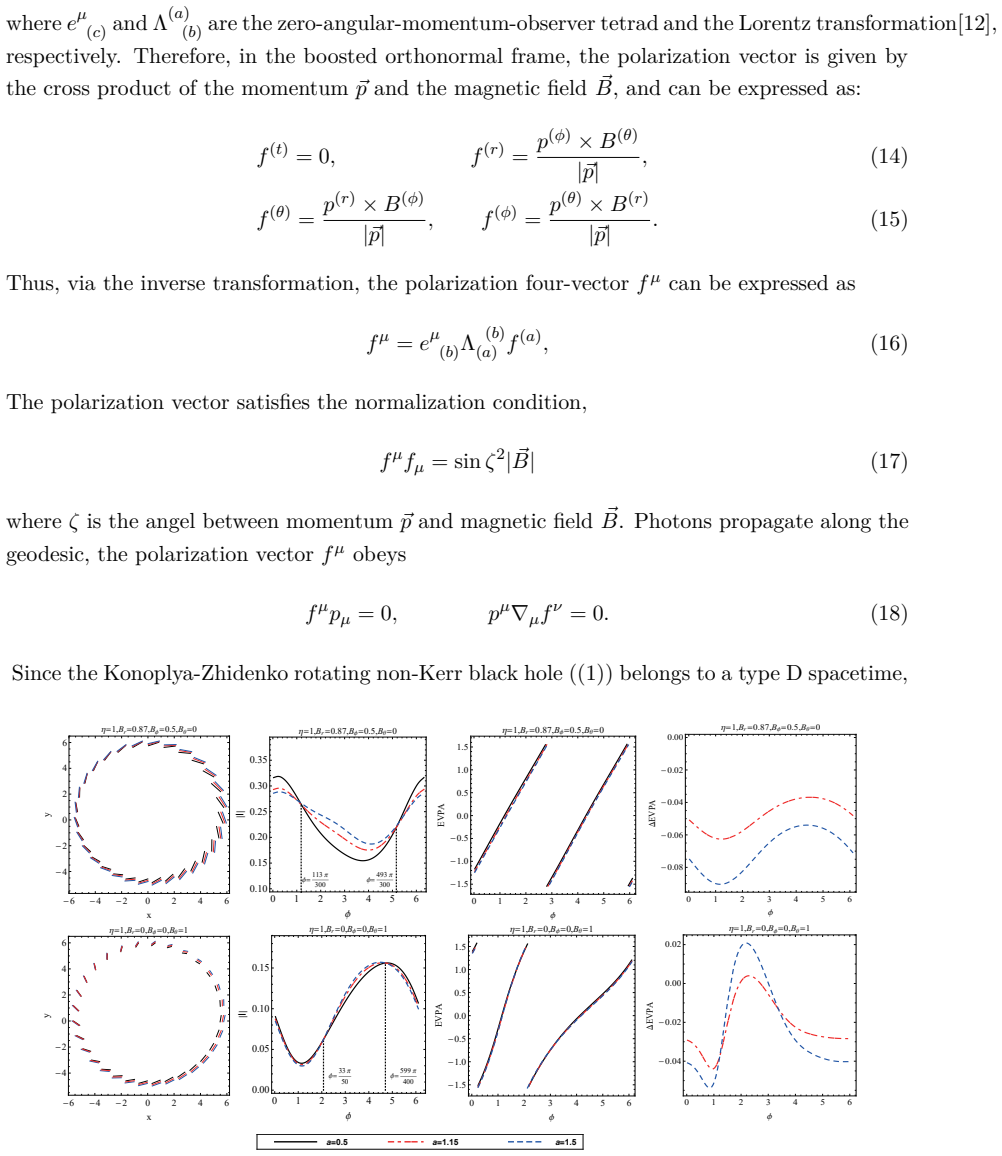
The deformation parameter η in a Konoplya-Zhidenko rotating non-Kerr black hole leaves systematic imprints on the polarized image of an equatorial emitting ring, providing a potential observational probe of deviations from Kerr geometry.
Reviewed by Pith at T0; open to challenge. T0 means a machine referee read the full paper against a public rubric. the ladder, T0–T4 →
T0 review · deepseek-v4-flash
2026-08-03 13:48 UTC pith:Q2TROC46
load-bearing objection Useful forward-modeling extension to the Konoplya–Zhidenko metric, but the polarization transport rests on an unproven type-D claim and the η overload needs fixing before the central results can be trusted. the 3 major comments →
Polarized image of an equatorial emitting ring around a Konoplya-Zhidenko rotating non-Kerr black hole
The pith
A machine-rendered reading of the paper's core claim, the machinery that carries it, and where it could break.
Core claim
For the Konoplya-Zhidenko metric, which adds a deformation parameter η to Kerr and allows the spin to exceed the Kerr bound, the paper computes the polarized image of an equatorial emitting ring using the conserved Walker-Penrose constant for parallel transport. It finds that the resulting polarization maps depend on η as well as on spin, magnetic field geometry, fluid velocity, and inclination. Specifically, for magnetic fields in the equatorial plane the polarized intensity decreases monotonically with η, while for vertical fields it varies non-monotonically; the EVPA can increase or decrease depending on field configuration and azimuth; and the Q-U loop shrinks for equatorial fields but s
What carries the argument
The central object is the Walker-Penrose constant κ, a complex conserved quantity carried along photon geodesics in type D spacetimes. It lets the paper transport the polarization vector from the emitting ring to the observer's screen, converting the source's local magnetic field and velocity into observed Stokes Q and U without running a full radiative-transfer simulation. The paper pairs it with the simplified equatorial ring model and ray tracing through the KZ spacetime's radial and angular potentials.
Load-bearing premise
The calculation assumes the Konoplya-Zhidenko metric is Petrov type D, which guarantees a conserved Walker-Penrose constant; the paper states this without proof or citation, and if the metric is not type D the polarization transport equations do not follow.
What would settle it
Compute the Newman-Penrose Weyl scalars of metric (1) in a suitable null tetrad: type D requires Ψ0, Ψ1, Ψ3, and Ψ4 to vanish identically (with Ψ2 nonzero). If that is not shown, the conserved quantity in Eq. (19) is not established. Observationally, a future high-resolution polarimetric map of a black hole ring that matches the predicted η dependence in intensity and EVPA trend would confirm it; a clear mismatch would falsify the model.
If this is right
- Polarized images of black hole rings can encode the deformation parameter η, meaning future high-resolution polarimetric observations could test the Kerr hypothesis without needing full accretion-disk simulations.
- The predicted monotonic decrease of polarized intensity with η for equatorial fields gives a simple, falsifiable trend to search for.
- Q-U loop shape changes with η provide an observable complementary to total intensity, potentially breaking degeneracies with spin or magnetic-field orientation.
- The azimuthal separation features, once resolvable, could distinguish η from spin and field orientation; current non-detection is a resolution limit, not a disproof.
- The same ring-model approach extends naturally to other parametric non-Kerr metrics, enabling model comparison with polarization data.
Where Pith is reading between the lines
- If the type D claim is verified, the same Walker-Penrose machinery could be applied to other parametric non-Kerr metrics, turning the polarized-ring test into a model-comparison tool.
- The monotonic intensity decline with η could be degenerate with spin, inclination, or field geometry; the azimuthal separation feature is the only one currently predicted to break that degeneracy, which is why its observability matters.
- A direct algebraic check of the Petrov classification would decisively test the foundation; until then the polarized-image predictions should be treated as conditional on that property.
Editorial analysis
A structured set of objections, weighed in public.
Referee Report
Summary. The paper studies polarized images of a synchrotron-emitting equatorial ring in the Konoplya-Zhidenko (KZ) rotating non-Kerr spacetime, which adds a deformation parameter η to the Kerr metric. Using the photonic geodesic equations and Walker-Penrose transport, the authors compute map-plane polarization intensity, EVPA, and Stokes Q–U loops for a range of η, spin a, magnetic-field configurations, fluid direction angles, and observer inclinations. They report that increasing η tends to decrease the polarization intensity for equatorial fields, produces complex EVPA variations, and alters the Q–U loop structure, concluding that polarized images carry potentially distinguishable signatures of deviation from Kerr and may serve as probes of GR, pending ngEHT-class resolution.
Significance. If the underlying spacetime and transport assumptions are correct, the paper is a competent extension of the now-standard Narayan/Gelles equatorial-ring polarization framework to a family of deformed Kerr metrics. Its strengths are a systematic parameter survey, transparent equations for geodesics and polarization, and a clear statement of the observational limits (features are not resolvable with current EHT but might be with ngEHT). The paper does not claim a fit or an inverse measurement, so there is no circularity issue. However, the central calculation rests on the assertion that the KZ metric is Petrov type D, and that assertion is neither proved nor referenced; this makes the main quantitative results fragile. The manuscript also plots parameter combinations that violate its own event-horizon existence condition. With those issues addressed, the paper would be a useful addition to the strong-field polarization literature.
major comments (3)
- [Sec. 2, near Eq. (19)] The statement "Since the Konoplya-Zhidenko rotating non-Kerr black hole (1) belongs to a type D spacetime" is load-bearing but unsupported. The Walker-Penrose constant, Eq. (19), and hence the entire polarization transport, Eqs. (19)–(22), exist generically only in type D spacetimes; the separability of the photon geodesic equations in Eqs. (7)–(8) also relies on the same special algebraic structure. Only Ψ2 is supplied in Eq. (21). To establish type D one must exhibit a null tetrad in which Ψ0=Ψ1=Ψ3=Ψ4=0, or cite a proof for this particular Δ(r)=r^2-2Mr+a^2-η/r family. As written, the central claim that η leaves distinguishable polarized-image imprints has no demonstrated foundation.
- [Eq. (6) and Figs. 2, 3, 6] The horizon-existence condition in Eq. (6) states that for a>M one must have η>0. However, Figs. 2, 3, and 6 plot η=-0.8 for a=1.15 and a=1.5. Those spacetimes are naked singularities, not black holes, despite the text saying the analysis is restricted to black-hole geometries. Either remove those panels, recompute them for allowed η>0, or explicitly treat and label the naked-singularity cases as a separate class. As it stands, some conclusions about 'black-hole deformation' are supported by non-black-hole configurations.
- [Eqs. (2), (8), and (10)] The symbol η denotes both the metric deformation parameter in Eq. (2) and the Carter separation constant in Eq. (8) and subsequent screen-coordinate equations. These are physically distinct quantities; a photon's Carter constant is not equal to the spacetime deformation parameter. This ambiguity makes the equations formally inconsistent and the numerical implementation irreproducible. Please rename one of them (e.g., use Q or C for the Carter constant) and re-derive the displayed formulas consistently.
minor comments (5)
- [Eq. (17)] Typo: "angel" should be "angle."
- [Eq. (10)] The quantities u±, F_o, K, and sign(y) are not defined in the text. Since the numerical image construction relies on this formula, please define these symbols or explicitly refer to the defining equations in the cited Gralla-Lupsasca/ Himwich et al. works.
- [Fig. 9 and Fig. 10 captions] The captions say "Effects of b" but the varied parameter is η. The label appears to be a leftover from another manuscript.
- [Eq. (23)] The text reads "lp = p(t)_s / p(z)_s His the geodesic path length"—"His" should be "is," and the definition of lp as a ratio of momentum components deserves an explicit explanation.
- [Abstract and Sec. 4] The abstract's final sentence calls the imprint a "high-precision observational probe." Given the highly simplified ring model and the paper's own statement that the features are difficult to resolve with current facilities, a more cautious phrase such as "potentially distinguishable with future high-resolution observations" would be more proportionate.
Circularity Check
No significant circularity: the paper is a self-contained forward-modeling parameter scan; the main caveat is an unproven Petrov type-D assertion, which is a validity gap rather than a circular reduction.
full rationale
This is a forward-modeling calculation, not an inversion or fit. The KZ metric with deformation parameter eta is an input (Eq. (1)); the plotted polarization intensity, EVPA, and Q-U loops (Figs. 1-10) are outputs obtained by solving null geodesics (Eqs. (7)-(11)), transporting an initially specified polarization vector via the Walker-Penrose constant (Eqs. (19)-(22)), and applying the synchrotron intensity formula (Eqs. (23)-(26)). No parameter is fitted to the observable, no image is inverted, and no conclusion is assumed in the form in which it is then recovered. The cited method papers ([11], [12], [30]-[33]) are independent prior work; self-citations ([13], [15], [25]-[28]) are contextual applications of the same method to other spacetimes and are not load-bearing. The central fragility is the unproven assertion, 'Since the Konoplya-Zhidenko rotating non-Kerr black hole ((1)) belongs to a type D spacetime, the conserved Penrose-Walker constant kappa can be written as...' (Sec. 2, Eq. (19)); if the metric is not Petrov type D, the Walker-Penrose transport equations are unsupported. That is a correctness gap, not circularity, because the type-D property is not equivalent to the claimed eta-imprint trends. Likewise, the use of eta = -0.8 with a = 1.15/1.5 in Figs. 2-3/6 conflicts with the paper's own horizon condition (6), but this is an internal-consistency issue rather than a circular derivation. No step reduces to its inputs by construction.
Axiom & Free-Parameter Ledger
free parameters (8)
- deformation parameter η =
-0.8, 0.0001, 0.5, 1, 1.5, 2
- spin parameter a =
0.5, 1.15, 1.5
- ring radius r_s =
4.5 (6 for Q-U plots)
- fluid speed β_ν =
0.3
- fluid direction angle χ =
-90° (also -120°, -150°, -180°)
- observer inclination θ_o =
20° (also 50°, 80°)
- magnetic field components (B_r,B_φ,B_θ) =
(1,0,0), (0,1,0), (0,0,1), (0.87,0.5,0)
- spectral index α_ν =
1
axioms (5)
- domain assumption The Konoplya-Zhidenko metric (1) accurately describes a rotating non-Kerr black hole spacetime with a deformation parameter η.
- ad hoc to paper The KZ metric is Petrov type D, so the Walker-Penrose constant exists.
- domain assumption Null geodesics and parallel-transported polarization vectors in this spacetime obey the separable equations (7)-(8) with a Carter constant (denoted η).
- domain assumption The emission is an equatorial synchrotron ring with the simplified intensity law of Narayan et al. (Eq. 23), and each image point receives one dominant geodesic.
- domain assumption The source velocity lies in the equatorial plane with speed β_ν in direction χ in the ZAMO frame.
read the original abstract
We investigate the polarized images of an equatorial emitting ring around a Konoplya-Zhidenko rotating non-Kerr black hole, which introduces an additional deformation parameter. The deformation parameter $\eta$ allows the spin parameter to extend beyond the bounds imposed by the standard Kerr black hole. The results indicate that the polarized images depend not only on the magnetic field configuration, fluid velocity, and observer inclination angle, but also on the deformation parameter and the spin parameter. As the deformation parameter increases, the polarization intensity decreases monotonically. However, the magnitude of the Electric Vector Position Angle (EVPA) increases with $\eta$. Furthermore, we note that the parameter $\eta$ may induce subtle yet discernible azimuthal separation features, which could potentially distinguish it from the spin parameter and the magnetic field orientation angle. Nevertheless, these features are difficult to resolve under current observational conditions and await verification by future high-resolution facilities such as the next-generation Event Horizon Telescope (ngEHT).
Figures


Forward citations
Cited by 3 Pith papers
-
Polarized Equatorial Emission around Kerr Black Holes with Synchronized Scalar Hair. I. Direct images
Polarization maps of direct images from scalar-hairy Kerr black holes exhibit dephasing in the polarization-vector twist (larger for weakly scalarized cases) and a reversal for vertical magnetic fields at high inclinations.
-
Circular polarization images of Sgr A* for different magnetic field geometries
RIAF polarized-transfer models of six poloidal field geometries show Faraday-conversion-dominated, polarity-invariant CP for radial/parabolic fields and emission-dominated, polarity-sensitive CP for dipole/vertical fi...
-
Circular polarization images of Sgr A* for different magnetic field geometries
Modeling of Sgr A* shows Faraday conversion dominates circular polarization in radial, parabolic, quadrupole and combined magnetic fields while intrinsic emission dominates in dipole and vertical fields, allowing excl...
Reference graph
Works this paper leans on
-
[1]
First m87 event horizon telescope results
Event Horizon Telescope Collaboration. First m87 event horizon telescope results. i. the shadow of the supermassive black hole.Astrophys. J. Lett., 875:L1, 2019
2019
-
[2]
First m87 event horizon telescope results
Event Horizon Telescope Collaboration. First m87 event horizon telescope results. ii. array and instrumentation.Astrophys. J. Lett., 875:L2, 2019. 13
2019
-
[3]
First m87 event horizon telescope results
Event Horizon Telescope Collaboration. First m87 event horizon telescope results. iii. data processing and calibration.Astrophys. J. Lett., 875:L3, 2019
2019
-
[4]
First m87 event horizon telescope results
Event Horizon Telescope Collaboration. First m87 event horizon telescope results. iv. imaging the central supermassive black hole.Astrophys. J. Lett., 875:L4, 2019
2019
-
[5]
First m87 event horizon telescope results
Event Horizon Telescope Collaboration. First m87 event horizon telescope results. v. phys- ical origin of the asymmetric ring.Astrophys. J. Lett., 875:L5, 2019
2019
-
[6]
First m87 event horizon telescope results
Event Horizon Telescope Collaboration. First m87 event horizon telescope results. vi. the shadow and mass of the central black hole.Astrophys. J. Lett., 875:L6, 2019
2019
-
[7]
First sagittarius a* event horizon telescope results
Event Horizon Telescope Collaboration. First sagittarius a* event horizon telescope results. i. the shadow of the supermassive black hole in the center of the milky way.Astrophys. J. Lett., 930:L12, 2022
2022
-
[8]
First m87 event horizon telescope results
Event Horizon Telescope Collaboration. First m87 event horizon telescope results. vii. polarization of the ring.Astrophys. J. Lett., 875:L7, 2019
2019
-
[9]
First m87 event horizon telescope results
Event Horizon Telescope Collaboration. First m87 event horizon telescope results. viii. magnetic field structure near the event horizon.Astrophys. J. Lett., 875:L8, 2019
2019
-
[10]
First m87 event horizon telescope results
Event Horizon Telescope Collaboration. First m87 event horizon telescope results. ix. testing the kerr metric.Astrophys. J. Lett., 875:L9, 2019
2019
-
[11]
Narayan, D
R. Narayan, D. C. M. Palumbo, M. D. Johnson, Z. Gelles, E. Himwich, D. O. Chang, A. Ricarte, J. Dexter, C. F. Gammie, A. A. Chael, and The Event Horizon Telescope Collaboration. The polarized image of a synchrotron-emitting ring of gas orbiting a black hole.Astrophys. J., 912(1):35, 2021
2021
-
[12]
Polarizedimageofequatorial emission in the kerr geometry.Physical Review D, 104(4):044060, 2021
Z.Gelles, E.Himwich, D.C.M.Palumbo, andM.D.Johnson. Polarizedimageofequatorial emission in the kerr geometry.Physical Review D, 104(4):044060, 2021
2021
-
[13]
X. Qin, S. Chen, and J. Jing. Polarized image of an equatorial emitting ring around a 4d gauss-bonnet black hole.Eur. Phys. J. C, 82:784, 2022
2022
-
[14]
Z. Hu, Y. Hou, H. Yan, M. Guo, and B. Chen. Polarized images of synchrotron radiations in curved spacetime.Eur. Phys. J. C, 82:1166, 2022
2022
-
[15]
X. Qin, S. Chen, Z. Zhang, and J. Jing. Polarized image of a rotating black hole surrounded by a cold dark matter halo.Eur. Phys. J. C, 83:159, 2023
2023
-
[16]
H. Zhu and M. Guo. Polarized image of synchrotron radiations of hotspots in schwarzschild- melvin black hole spacetime.arxiv, page 2205.04777, 2023
Pith/arXiv arXiv 2023
-
[17]
Deliyski, G
V. Deliyski, G. Gulychev, P. Nedkova, and S. Yazadjiev. Polarized image of equatorial emission in horizonless spacetimes: Naked singularities.Phys. Rev. D, 108:104049, 2023
2023
-
[18]
S. Gu, Y. Huang, K. Liu, E. Liang, and K. Lin. Influence of quantum correction on the schwarzschild black hole polarized image.Eur. Phys. J. C, 84:601, 2024. 14
2024
-
[19]
Shi and T
H. Shi and T. Zhu. Polarized image of a synchrotron emitting ring around a static hairy black hole in horndeski theory.Eur. Phys. J. C, 84:814, 2024
2024
-
[20]
Y. Chen, L. Cheng, P. Wang, and H. Yang. Polarized image of a synchrotron-emitting ring in einstein-maxwell-scalar theory.arxiv, page 2409.05304, 2024
Pith/arXiv arXiv 2024
-
[21]
Johannsen and D
T. Johannsen and D. Psaltis. A metric for rapidly spinning black holes suitable for strong- field tests of the no-hair theorem.Phys. Rev. D, 83:124015, 2011
2011
-
[22]
Konoplya and A
R. Konoplya and A. Zhidenko. Detection of gravitational waves from black holes: Is there a window for alternative theories?Phys. Lett. B, 756:350, 2016
2016
-
[23]
Bambi and S
C. Bambi and S. Nampalliwar. Quasi-periodic oscillations as a tool for testing the kerr metric: A comparison with gravitational waves and iron line.Europhys. Lett., 130:10006, 2020
2020
-
[24]
Y. Ni, J. Jiang, and C. Bambi. Testing the kerr metric with the iron line and the kq2 parametrization.J. Cosmol. Astropart. P., 09:014, 2016
2016
-
[25]
S. Wang, S. Chen, and J. Jing. Strong gravitational lensing by a konoplya-zhidenko rotating non-kerr compact object.J. Cosmol. Astropart. P., 11:020, 2016
2016
-
[26]
M. Wang, S. Chen, and J. Jing. Shadow casted by a konoplya-zhidenko rotating non-kerr black hole.J. Cosmol. Astropart. P., 01:051, 2017
2017
-
[27]
F. Long, S. Chen, S. Wang, and J. Jing. Energy extraction from a konoplya-zhidenko rotating non-kerr black hole.Nucl. Phys. B, 926:1, 2018
2018
-
[28]
F. Long, S. Wang, S. Chen, and J. Jing. Magnetic reconnection and energy extraction from a konoplya-zhidenko rotating non-kerr black hole.Eur. Phys. J. C, 85:26, 2025
2025
-
[29]
K. He, C. Yang, and X. Zeng. Optical appearance of the konoplya-zhidenko rotating non- kerr black hole surrounded by a thin accretion disk.arxiv, page 2501.06778, 2025
Pith/arXiv arXiv 2025
-
[30]
S. E. Gralla and A. Lupsasca. Lensing by kerr black holes.Phys. Rev. D, 101:044031, 2020
2020
-
[31]
Himwich, M
E. Himwich, M. D. Johnson, A. Lupsasca, and A. Strominger. Universal polarimetric signatures of the black hole photon ring.Phys. Rev. D, 101(2):084020, 2020
2020
-
[32]
Walker and R
M. Walker and R. Penrose. On quadratic first integrals of the geodesic equations for type s(22) spacetimes.Commun. Math. Phys., 118:265, 2001
2001
-
[33]
Chandrasekhar.The Mathematical Theory of Black Holes
S. Chandrasekhar.The Mathematical Theory of Black Holes. Oxford University Press, 1985. 15
1985
discussion (0)
Sign in with ORCID, Apple, or X to comment. Anyone can read and Pith papers without signing in.