Recognition: no theorem link
Bell nonlocality and entanglement in chi_{cJ} decays into baryon pair
Pith reviewed 2026-05-16 19:44 UTC · model grok-4.3
The pith
χ_c0 decays to baryon pairs produce maximal Bell inequality violation and full entanglement, while χ_c2 pairs are separable with no violation.
A machine-rendered reading of the paper's core claim, the machinery that carries it, and where it could break.
Core claim
From the baryon-antibaryon spin density matrix in χ_cJ decays, the analysis shows that χ_c0 exhibits maximal Bell nonlocality and entanglement, χ_c1 violates Bell inequalities for θ1 in (0, π) with angle-dependent strength, and χ_c2 produces a separable state with no indication of Bell inequality violation. Complete analytical formulas are derived for J=0 and J=1; for J=2 the paper supplies numerical estimates that incorporate experimental inputs.
What carries the argument
The spin density matrix of the baryon-antibaryon pair, from which measurable Bell observables and concurrence are constructed.
If this is right
- Bell observables constructed from the density matrix reach their theoretical maximum in χ_c0 decays.
- χ_c1 decays allow angle-dependent tests of Bell violation that can be mapped directly onto observable angular distributions.
- χ_c2 decays produce baryon pairs whose state is separable, so no Bell violation is expected from the density matrix.
- The derived analytical expressions for J=0 and J=1 can be compared with existing or future BESIII data without additional model assumptions.
Where Pith is reading between the lines
- The angular-momentum dependence of the charmonium state appears to control how much quantum correlation survives into the baryon pair.
- These decays could serve as a laboratory for studying whether relativistic particle production preserves or degrades entanglement in ways not captured by the spin density matrix alone.
- If the hierarchy holds, similar radiative transitions in other heavy-quark systems might be scanned for comparable patterns of nonlocality.
Load-bearing premise
The spin density matrix of the baryon-antibaryon pair fully captures the quantum state produced in the radiative transition without additional decoherence or unaccounted effects.
What would settle it
An experimental measurement at BESIII of the Bell parameter in χ_c0 decays falling below its quantum maximum, or of nonzero concurrence in χ_c2 decays, would falsify the reported hierarchy.
Figures


read the original abstract
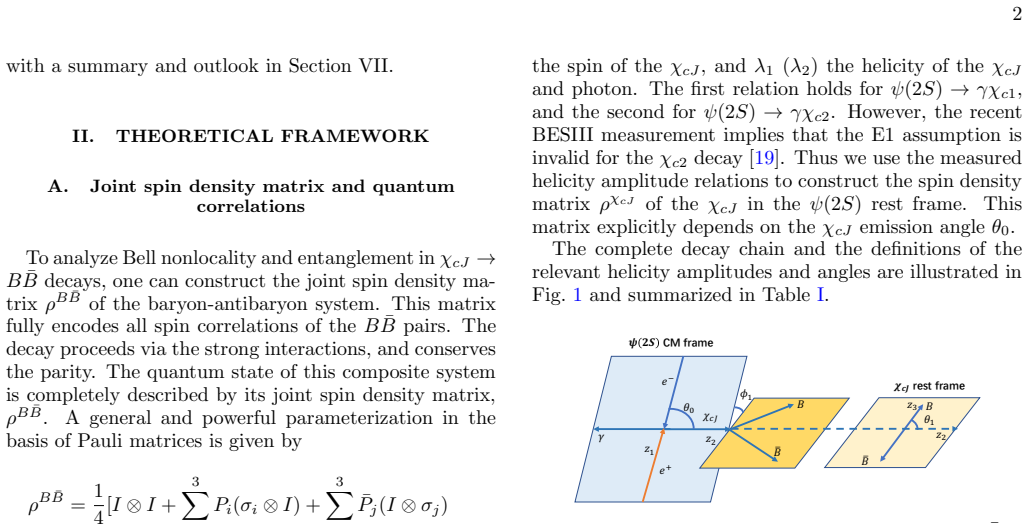
We present a systematic analysis of Bell nonlocality and entanglement in $\chi_{cJ}$($J=0,1,2$) decays into baryon pair($B\bar{B}$), with particular emphasis on their production via the process $e^+e^- \to \psi(2S) \to \gamma \chi_{cJ}$ at BESIII. From the baryon-antibaryon spin density matrix, we construct measurable Bell observables and concurrence, revealing a striking hierarchy of quantum correlations: $\chi_{c0}$ decays exhibit maximal violation and entanglement; $\chi_{c1}$ decays violate Bell inequalities for $\theta_1 \in (0, \pi)$ with angle-modulated strength; we find that the $B\bar{B}$ pair in $\chi_{c2}$ decays is in a separable state, and no indication of Bell inequality violation is observed. We provide complete analytical results for $J=0,1$ and quantitative, uncertainty-aware estimations for $J=2$ based on experimental inputs from BESIII. These results establish the $\chi_{cJ}$ system produced via this radiative transition as a novel and promising platform for testing quantum entanglement and Bell nonlocality in high-energy collisions.
Editorial analysis
A structured set of objections, weighed in public.
Referee Report
Summary. The paper analyzes Bell nonlocality and entanglement in χ_cJ (J=0,1,2) decays to baryon-antibaryon pairs produced via e⁺e⁻ → ψ(2S) → γ χ_cJ at BESIII. From the spin density matrix of the B B-bar pair, it constructs measurable Bell observables and concurrence, claiming a hierarchy: maximal violation and entanglement for χ_c0, angle-dependent Bell violation for χ_c1 (θ1 ∈ (0,π)), and a separable state with no violation for χ_c2. Complete analytical results are given for J=0,1; quantitative, uncertainty-aware estimates for J=2 use BESIII experimental inputs for helicity amplitudes.
Significance. If the hierarchy holds, the work identifies the χ_cJ radiative decays as a new high-energy platform for quantum information tests, with analytical control for J=0,1 enabling clean predictions and J=2 estimates providing a concrete benchmark for BESIII data. This could motivate dedicated entanglement measurements in charmonium decays.
major comments (1)
- [Quantitative estimation for J=2] The separability conclusion for χ_c2 (no Bell violation) rests on quantitative estimates using BESIII-measured helicity-amplitude ratios to construct the 4×4 density matrix and evaluate concurrence and the CHSH correlator. The manuscript must propagate the finite experimental uncertainties explicitly through these quantities to demonstrate that the eigenvalues of the partial transpose remain non-negative and the Bell parameter stays ≤2 within errors; without this, small shifts could allow violations and weaken the hierarchy claim.
minor comments (2)
- [Analytical results for J=1] Clarify the precise definition of the angle θ1 in the χ_c1 case and provide the explicit functional form of the Bell parameter as a function of θ1 to make the angle-modulated strength fully reproducible from the density matrix.
- Add a brief discussion of possible decoherence or higher-order effects that might modify the spin density matrix assumption in the radiative transition, even if they are argued to be negligible.
Simulated Author's Rebuttal
We thank the referee for the careful reading of our manuscript and the constructive comment regarding the quantitative analysis for χ_c2. We address the major comment below.
read point-by-point responses
-
Referee: [Quantitative estimation for J=2] The separability conclusion for χ_c2 (no Bell violation) rests on quantitative estimates using BESIII-measured helicity-amplitude ratios to construct the 4×4 density matrix and evaluate concurrence and the CHSH correlator. The manuscript must propagate the finite experimental uncertainties explicitly through these quantities to demonstrate that the eigenvalues of the partial transpose remain non-negative and the Bell parameter stays ≤2 within errors; without this, small shifts could allow violations and weaken the hierarchy claim.
Authors: We agree that explicit propagation of the experimental uncertainties is essential to robustly confirm the separability conclusion and the absence of Bell violation for χ_c2. In the revised manuscript, we will add a dedicated subsection detailing the error propagation through the density matrix elements (using the reported BESIII uncertainties on the helicity amplitude ratios), followed by explicit calculations of the concurrence eigenvalues and the CHSH parameter with uncertainties. This will demonstrate that the partial transpose eigenvalues remain non-negative and the Bell parameter stays ≤2 within errors, thereby strengthening the hierarchy claim without altering the central conclusions. revision: yes
Circularity Check
No significant circularity; derivation applies standard quantum-information tools to external density-matrix inputs
full rationale
The paper begins from the standard spin density matrix of the produced B B-bar pair (constructed via the radiative transition e+e- → ψ(2S) → γ χ_cJ) and applies the usual definitions of concurrence and Bell correlators (CHSH-type) to it. For J=0,1 the results are fully analytical; for J=2 the 4×4 matrix is populated with measured helicity-amplitude ratios taken from BESIII data. None of the seven circularity patterns appear: there is no self-definition of observables in terms of themselves, no fitted parameter relabeled as a prediction, and no load-bearing self-citation chain. The central claims therefore remain independent of the paper’s own outputs.
Axiom & Free-Parameter Ledger
free parameters (1)
- BESIII experimental inputs for J=2
axioms (2)
- domain assumption The baryon-antibaryon system is described by a two-particle spin density matrix that encodes all relevant quantum correlations.
- domain assumption Standard quantum mechanics applies without additional relativistic or environmental decoherence effects in the decay process.
Reference graph
Works this paper leans on
-
[1]
Either from Eq. (10) orρ B ¯B =|ψ +⟩⟨ψ+|, the joint spin density matrix ofB ¯Bis calculated in the helicity basis (| ↑↑⟩,| ↑↓ ⟩,| ↓↑⟩ | ↓↓⟩,) as ρB ¯B = 1 2 1 0 0 1 0 0 0 0 0 0 0 0 1 0 0 1 .(12)
-
[2]
Comparing with the general parameterization in Eq
This corresponds to that in the spin basis|ψ +⟩s = 1√ 2 (| ↑↓⟩+| ↓↑ ⟩). Comparing with the general parameterization in Eq. (1), we obtain the calculated polarization vectors and spin correlations are Pi = ¯Pi = 0 (i=x, y, z),(13) and C= 1 0 0 0−1 0 0 0 1 .(14) The vanishing polarizations for bothBand ¯Bare man- dated by parity conservation in the ...
-
[3]
sin2 θ1 2+3r2 1+(r2 1 −2) cos 2θ1 0 0 (2−r2
-
[4]
(15) Here the parameterr 1 comes from theρ χc1
sin2 θ1 2+3r2 1+(r2 1 −2) cos 2θ1 1 2 0 0 0 0 0 . (15) Here the parameterr 1 comes from theρ χc1. In the E1 transition assumption, one hasr 1 = 1. The baryon and antibaryon polarization can be calculated withP i= Tr(ρB ¯Bσi ⊗I) and ¯Pi= Tr(ρB ¯BI⊗σ i), respectively, and we find: Pi = ¯Pi = 0 (i=x, y, z),(16) 5 and the correlation parameters can be ...
-
[5]
sin2 θ1 2+3r2 1+(r2 1 −2) cos 2θ1 0 0 0 2(2−r2
-
[6]
sin2 θ1 2+3r2 1+(r2 1 −2) cos 2θ1 0 0 0−1 . (17) The structure of the spin density matrixρ B ¯B clearly shows how C-parity conservation restricts helicity choices inχ c1 →B ¯Bdecay. Non-zero spin density matrix ele- ments appear only for the helicity basis states| ↑⟩| ↓⟩ and| ↓⟩| ↑⟩. The elements for| ↑⟩| ↑⟩and| ↓⟩| ↓⟩are all zero. The off-diagonal e...
-
[7]
For spin cor- relation,C zz =−1
This is different from the spin 0 case. For spin cor- relation,C zz =−1. This means Alice and Bob measure opposite helicities for the particles. It is a direct result of the helicity selection rule. One key point to emphasize is this: In the decay ofχ c1, the helicity selection rule forces the final-state baryon spins into a Bell-state singlet form. Howev...
-
[9]
sin2 θ1 )2,forχ c1,(24) m12 = Max(m1 +m 2, m1 +m 3, m2 +m 3),forχ c2, Forχ c2, the eigenvaluesm i (withi= 1,2,3) of M=C ⊤Care functions ofF 1–F4 defined in Eqs. (18) and (19). Their explicit forms are m1 = (F3 − F4)2 F2 1 , m2 = 1 2F2 1 (F2 1 +F 2 2 +F 2 3 −4F 1F4 + 2F3F4 + 5F2 4 +F 2 2 cos 2∆Φ − q (F1 +F 3 − F4)2((−F1 +F 3 + 3F4)2 + 2F2 2 cos(2∆Φ) + 2F2 ...
-
[10]
sin2 θ1 2r2 1 + (2−r 2
-
[11]
sin2 θ1 |,forχ c1 (26) Forχ c2, the concurrence depends onθ 1,x, and ∆Φ and will be analyzed numerically in Sec. VI. The results indicate that theχ c0 state is maximally entangled, while the entanglement ofχ c1 is modulated, and no clear evidence of entanglement is observed inχ c2 decays. VI. NUMERICAL ANALYSIS AND PHENOMENOLOGICAL DISCUSSION A. Input par...
-
[12]
R. Horodecki, P. Horodecki, M. Horodecki and K. Horodecki, Rev. Mod. Phys.81, 865-942 (2009) [arXiv:quant-ph/0702225 [quant-ph]]
work page internal anchor Pith review Pith/arXiv arXiv 2009
-
[13]
J. S. Bell, Physics Physique Fizika1, 195-200 (1964)
work page 1964
-
[14]
J. F. Clauser, M. A. Horne, A. Shimony and R. A. Holt, Phys. Rev. Lett.23, 880-884 (1969)
work page 1969
-
[15]
N. Brunner, D. Cavalcanti, S. Pironio, V. Scarani and S. Wehner, Rev. Mod. Phys.86, 419 (2014) 9 [arXiv:1303.2849 [quant-ph]]
work page internal anchor Pith review Pith/arXiv arXiv 2014
-
[16]
S. J. Freedman and J. F. Clauser, Phys. Rev. Lett.28, 938-941 (1972)
work page 1972
- [17]
- [18]
- [19]
-
[20]
M. Fabbrichesi, R. Floreanini and G. Panizzo, Phys. Rev. Lett.127, no.16, 16 (2021) [arXiv:2102.11883 [hep-ph]]
- [21]
-
[22]
Aadet al.[ATLAS], Nature633, no.8030, 542-547 (2024) [arXiv:2311.07288 [hep-ex]]
G. Aadet al.[ATLAS], Nature633, no.8030, 542-547 (2024) [arXiv:2311.07288 [hep-ex]]
-
[23]
K. Ehat¨ aht, M. Fabbrichesi, L. Marzola and C. Veelken, Phys. Rev. D109, no.3, 032005 (2024) [arXiv:2311.17555 [hep-ph]]
-
[24]
Polarization and Entanglement in Baryon-Antibaryon Pair Production in Electron-Positron Annihilation
M. Ablikimet al.[BESIII], Nature Phys.15, 631-634 (2019) [arXiv:1808.08917 [hep-ex]]
work page internal anchor Pith review Pith/arXiv arXiv 2019
-
[25]
Ablikimet al.[BESIII], Nature Commun.16, 4948 (2025) [arXiv:2505.14988 [hep-ex]]
M. Ablikimet al.[BESIII], Nature Commun.16, 4948 (2025) [arXiv:2505.14988 [hep-ex]]
-
[26]
S. U. Chung, CERN Yellow Reports: Monographs
- [27]
-
[28]
M. Fabbrichesi, R. Floreanini, E. Gabrielli and L. Marzola, Phys. Rev. D110, no.5, 053008 (2024) [arXiv:2406.17772 [hep-ph]]
-
[29]
G. Karl, S. Meshkov and J. L. Rosner, Phys. Rev. D13, 1203 (1976)
work page 1976
-
[30]
Ablikimet al.[BESIII], [arXiv:2509.00289 [hep-ex]]
M. Ablikimet al.[BESIII], [arXiv:2509.00289 [hep-ex]]
-
[31]
Phys. Rev. C{31}, 1857 (1985)
work page 1985
-
[32]
R. Horodecki, P. Horodecki and M. Horodecki, Phys. Lett. A200, no.5, 340-344 (1995)
work page 1995
-
[33]
W. K. Wootters, Phys. Rev. Lett.80, 2245-2248 (1998) [arXiv:quant-ph/9709029 [quant-ph]]
work page internal anchor Pith review Pith/arXiv arXiv 1998
-
[34]
M. Ablikimet al.[BESIII], Phys. Rev. D88, no.11, 112001 (2013) [arXiv:1310.6099 [hep-ex]]
work page internal anchor Pith review Pith/arXiv arXiv 2013
-
[35]
Ablikimet al.[BESIII], JHEP06, 74 (2022) [arXiv:2202.08058 [hep-ex]]
M. Ablikimet al.[BESIII], JHEP06, 74 (2022) [arXiv:2202.08058 [hep-ex]]
-
[36]
G. Vidal and R. F. Werner, Computable measure of en- tanglement, Phys. Rev. A 65, 032314 (2002)
work page 2002
discussion (0)
Sign in with ORCID, Apple, or X to comment. Anyone can read and Pith papers without signing in.