REVIEW 3 major objections 4 minor 76 references
Zero-shot 3D grounding can find objects no Object Lookup Table lists, so long as a chain of contextual cues leads to them.
Reviewed by Pith at T0; open to challenge. T0 means a machine referee read the full paper against a public rubric. the ladder, T0–T4 →
T0 review · deepseek-v4-flash
2026-08-03 13:42 UTC pith:7Z4BZZSH
load-bearing objection Useful step for zero-shot 3DVG, but the OpenTarget benchmark is built the way the method reasons, so the headline open-world gap should be read with caution. the 3 major comments →
OpenGround: Planning-based Online Perception for Open-World 3D Visual Grounding
The pith
A machine-rendered reading of the paper's core claim, the machinery that carries it, and where it could break.
Core claim
The paper's central claim is that the hard part of open-world 3D grounding is not the final VLM call but the cognitive preparation before it. The Active Cognition-based Reasoning (ACR) module decomposes a query into an ordered task chain of context-to-target sub-goals; then, for each sub-goal whose object is absent from the OLT, the Active Cognition Enhancement (ACE) module selects viewpoints around objects already grounded, segments the novel object with an open-vocabulary 2D segmenter, lifts the masks to 3D, merges spatially overlapping masks, and appends new entries to a continuously updated OLT. Single-Step Grounding then reasons over annotated views that mark both previously grounded ob
What carries the argument
The load-bearing mechanism is the object lookup table (OLT) turned dynamic. In prior zero-shot work the OLT is a fixed dictionary of IDs, labels, and boxes that the VLM can reason over; OpenGround's ACE module rewrites the table mid-query. A Cognitive Task Chain Construction module prompts the VLM to parse the query into target plus relevant objects, retrieves candidate IDs by text similarity, and orders them into a sequence (validated against human-constructed chains by weighted edit distance). ACE then greedily selects up to V views that maximize coverage of previously grounded objects, runs an open-vocabulary 2D segmenter (GroundedSAM) on those views, lifts masks into 3D, merges them by I
Load-bearing premise
ACE only looks for new objects around objects already grounded, so if the next object named in the query is far from the current chain, it will never be observed and can never enter the object table.
What would settle it
Take the OpenTarget queries and split them by the distance between the first grounded context object and the target's decisive reference. If accuracy on the far-far subset (e.g., reference farther than 3 m from any earlier object) does not collapse toward random while near queries stay high, the spatial-proximity assumption is not the active constraint. A direct experiment would annotate each query with the minimal distance from the target to the nearest previously grounded object and plot accuracy against it.
If this is right
- Open-world 3D grounding is feasible without an exhaustive object dictionary: the ACR+ACE pipeline grounds objects never listed, as long as they are spatially reachable from already grounded context.
- The approach is a plug-in: replacing the single-step grounding backbone with prior methods (SeeGround, SeqVLM) still confers open-world ability, so the cognitive-chain idea transfers as a module.
- Reasoning structure, not VLM scale, drives performance: a 32B VLM in the framework still beats zero-shot baselines given the ground-truth OLT, per the ablations.
- Long, multi-step queries benefit the most: accuracy stays high for chain lengths 8–10 while flat baselines drop, suggesting decomposition pays off precisely where single-shot reasoning is weakest.
- Without any initial OLT the method still outperforms baselines that are given ground-truth boxes, indicating the online perception loop is doing the grounding work rather than the initial detector.
Where Pith is reading between the lines
- The spatial-proximity premise means the method is a 'local' reasoner: if a query's decisive reference is far from the current chain, the ACE cameras never point there; a natural extension is a global BEV-guided region selection before local ACE, which the authors themselves outline as future work.
- Task-chain ordering could be bootstrapped from repeated grounding attempts rather than a learned model: the weighted edit-distance agreement with humans suggests an active-learning loop that adapts chain construction to the VLM's failure modes.
- The IoU-based mask merging and the dependence on an open-vocabulary segmenter make the ceiling set by 2D open-world segmentation; swapping in stronger segmenters (or open-vocabulary 3D segmentation, which the authors test) is a direct lever for accuracy.
- Compatibility results imply the ACE module can be retrofitted to any OLT-based zero-shot 3DVG pipeline, which would let the field upgrade existing systems without changing their reasoning core.
Editorial analysis
A structured set of objections, weighed in public.
Referee Report
Summary. The paper proposes OpenGround, a zero-shot framework for 3D visual grounding that does not require the target object to appear in a predefined object lookup table (OLT). It introduces an Active Cognition-based Reasoning (ACR) module that (i) decomposes a query into a cognitive task chain of context-to-target sub-goals, (ii) actively extends the OLT by perceiving novel objects around previously grounded objects, and (iii) performs single-step VLM grounding with contextual annotations. The paper also introduces OpenTarget, a benchmark derived from ScanNet++ and Articulate3D with 7,724 VLM-generated and partially manually filtered query-object pairs, designed to test grounding of fine-grained/open-world objects. Experiments report 46.2%/34.2% Acc@0.25/0.50 on OpenTarget (a 17.6% improvement over baselines given ground-truth OLT), 61.8%/53.1% on ScanRefer (best among zero-shot methods in the comparison), and 61.7% on Nr3D.
Significance. If the claims hold, the contribution is meaningful: OpenGround offers a principled way to escape the fixed-OLT bottleneck of existing VLM-based zero-shot 3D grounding, and the OpenTarget benchmark addresses a real evaluation gap. The paper has several strengths: the task-chain decomposition is well motivated and compared against human-constructed orderings; the ACE module is evaluated in isolation and in combination with other single-step grounding methods (Fig. 8b), showing a degree of generality; the ablations cover OLT initialization, task-chain strategies, annotation design, VLM choice, perspective selection, and segmentation backbones. The central idea of progressive, context-driven perception is useful and likely to stimulate follow-up work. However, the main open-world evidence rests on a dataset whose construction closely mirrors the method's own assumptions, and the quantitative comparisons are single-run point estimates without error bars or significance tests. These issues affect the strength of the central claim but are addressable with additional evaluation and analysis.
major comments (3)
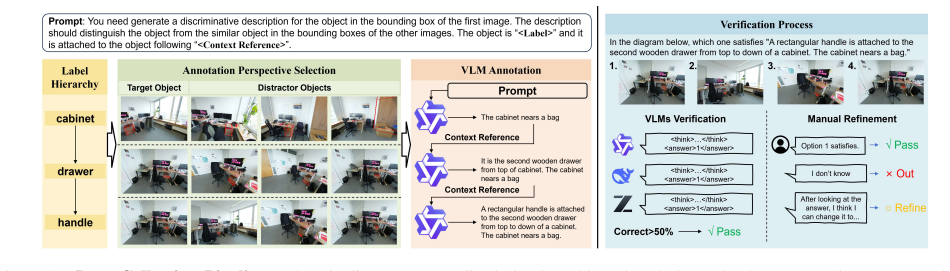
- [Sec. 3, Fig. 2, Table 3, Appendix Tab. 9] The OpenTarget benchmark appears to encode the same hierarchical, spatially proximal structure that OpenGround's ACR/ACE modules are explicitly designed to exploit. The annotation prompt in Tab. 9 supplies the label hierarchy (e.g., cabinet→drawer→handle) and the parent object's annotation as context reference, so the resulting descriptions naturally name the parent object and often locate it near the target. ACR constructs its task chain precisely to ground such parent/context objects first, and ACE restricts perception to their spatial neighborhood. The strong OpenTarget margin (46.2/34.2 vs. 28.6/20.4 for VLM-Grounder+GT) may therefore reflect compatibility with the benchmark-generation pipeline rather than a general open-world capability. The paper's Limitation admits the spatial-proximity assumption, but the dataset construction likely guarantees it for most queries. I request an ad
- [Sec. 5.2, Tables 1-4, Fig. 8] All quantitative results are single-run point estimates. No error bars, confidence intervals, or significance tests are reported. This is particularly important for the ablation claims, where several differences are small: Full vs. Relevance task chains differ by 1.6 points at Acc@0.50 (Tab. 4, rows 1 and 4), V=3 vs. V=4 differ by 0.52 points (Fig. 8a), and the claimed 17.6% improvement on OpenTarget could also be affected by sampling or VLM nondeterminism. At minimum, the authors should provide repeated runs (or bootstrap over queries) for the main OpenTarget result and for the key ablations, and state the variance.
- [Table 3 and Table 6] VLM-Grounder, the strongest OpenTarget baseline, is evaluated only on a randomly selected 300-sample subset, with no confidence interval or representativeness check. The main table reports VLM-Grounder+GT at 28.6/20.4, yet this number comes from 300 samples rather than the full 7,724, making the comparison to OpenGround's full-benchmark numbers difficult to interpret. Please evaluate VLM-Grounder on the full benchmark (with the same efficiency optimizations used elsewhere) or, if that is infeasible, provide stratified bootstrap intervals and show that the 300-sample subset has the same query-type distribution as the full set.
minor comments (4)
- [Sec. 6] In the Conclusion, 'SceneRefer' should be 'ScanRefer'.
- [Algorithm 2, line 26] Line 26 updates the candidate's observed region using P_Oi (previously grounded object) instead of P_cj (the candidate). This makes the pseudocode inconsistent with the text in Sec. 8.4.
- [Sec. 3 and Sec. 7.1] The text says 'manual filtering' ensures quality, while Sec. 7.1 describes a VLM-voting stage followed by human review. The number of human annotators, the inter-annotator agreement, and the fraction of queries rejected at each stage are not reported; this information is important for a new benchmark.
- [General] The paper does not state whether code, the OpenTarget benchmark, or the evaluation scripts will be released. For a benchmark paper and for reproducibility of the reported results, this should be clarified.
Circularity Check
No significant circularity: the central zero-shot grounding pipeline is a VLM-driven process evaluated on external benchmarks, and the OpenTarget alignment concern is benchmark design rather than an equivalence-by-construction.
full rationale
OpenGround's derivation is a zero-shot inference pipeline built from independent modules: task-chain construction is a VLM call (Eq. 4), ACE extends the OLT via 2D segmentation, lifting, and merging (Eqs. 5–8), and single-step grounding follows an existing paradigm with contextual annotations. None of these equations define the target in terms of the output, and no parameter is fitted to the evaluation set before prediction. The ScanRefer and Nr3D results are external benchmarks, so the state-of-the-art claims there rest on independent evidence. The OpenTarget benchmark is author-constructed and its annotation prompt supplies the label hierarchy and parent-object context reference (Table 9), which does align with the hierarchical task-chain structure ACR consumes; that is a legitimate benchmark-design concern about favorability, but it is not a circular derivation because the method's outputs are not restatements of the dataset construction and the baselines receive GT OLT without the task chain. The paper explicitly acknowledges its spatial-proximity assumption as a Limitation, and the supplementary discusses extensions, which is a scope caveat rather than a circular step. No self-citation is load-bearing: the only author-overlapping reference, 3D-R1 [15], appears in related work as a supervised baseline, not as justification for the open-world claim. Overall, the claimed predictions do not reduce to their inputs by construction.
Axiom & Free-Parameter Ledger
free parameters (6)
- tau_cand (candidate retrieval threshold) =
0.9
- tau_iou (mask merging threshold) =
0.5
- V (max ACE views) =
3
- alpha (soft margin in single-step view selection) =
not reported
- GroundedSAM text/box thresholds =
0.4
- tau (fallback coverage threshold) =
not reported
axioms (5)
- domain assumption Spatial proximity of relevant objects
- domain assumption VLM reliability for parsing, ordering, and reasoning
- domain assumption Open-vocabulary segmentation adequacy
- ad hoc to paper OpenTarget queries are valid open-world queries
- domain assumption Mask3D OLT excludes the OpenTarget targets
read the original abstract
3D visual grounding aims to locate objects based on natural language descriptions in 3D scenes. Existing supervised methods are limited by generalization and recent zero-shot methods typically rely on a predefined Object Lookup Table (OLT) to query Visual Language Models (VLMs) for reasoning about object locations via a single step grounding, which limits the applications in scenarios with undefined targets and complex queries. To address these problems, we present OpenGround, a novel zero-shot framework for open-world 3D visual grounding that remains compatible with recent zero-shot methods. OpenGround integrates Task-Chain Planning to decompose a query into a plan of context-to-target sub-goals for progressive grounding, and Context-Guided Perception to perceive novel objects online under context guidance from the task chain. We also propose a new dataset named OpenTarget, which contains over 7000 object-description pairs to mimic open-world evaluation. Extensive experiments demonstrate that OpenGround achieves competitive performance on Nr3D, state-of-the-art on ScanRefer, and delivers a substantial 17.6\% improvement on OpenTarget. Project Page at https://why-102.github.io/openground.io/.
Figures



Reference graph
Works this paper leans on
-
[1]
Referit3d: Neural listeners for fine-grained 3d object identification in real-world scenes
Panos Achlioptas, Ahmed Abdelreheem, Fei Xia, Mohamed Elhoseiny, and Leonidas Guibas. Referit3d: Neural listeners for fine-grained 3d object identification in real-world scenes. In European conference on computer vision, pages 422–440. Springer, 2020. 1, 2, 3, 5, 6, 7
2020
-
[2]
Jinze Bai, Shuai Bai, Shusheng Yang, Shijie Wang, Sinan Tan, Peng Wang, Junyang Lin, Chang Zhou, and Jingren Zhou. Qwen-vl: A versatile vision-language model for un- derstanding, localization, text reading, and beyond. arXiv preprint arXiv:2308.12966, 2023. 2
Pith/arXiv arXiv 2023
-
[3]
Shuai Bai, Keqin Chen, Xuejing Liu, Jialin Wang, Wenbin Ge, Sibo Song, Kai Dang, Peng Wang, Shijie Wang, Jun Tang, Humen Zhong, Yuanzhi Zhu, Mingkun Yang, Zhao- hai Li, Jianqiang Wan, Pengfei Wang, Wei Ding, Zheren Fu, Yiheng Xu, Jiabo Ye, Xi Zhang, Tianbao Xie, Zesen Cheng, Hang Zhang, Zhibo Yang, Haiyang Xu, and Jun- yang Lin. Qwen2.5-vl technical repor...
Pith/arXiv arXiv 2025
-
[4]
Arkitscenes: A diverse real-world dataset for 3d indoor scene understanding using mobile rgb-d data
Gilad Baruch, Zhuoyuan Chen, Afshin Dehghan, Tal Dimry, Yuri Feigin, Peter Fu, Thomas Gebauer, Brandon Joffe, Daniel Kurz, Arik Schwartz, et al. Arkitscenes: A diverse real-world dataset for 3d indoor scene understanding using mobile rgb-d data. arXiv preprint arXiv:2111.08897, 2021. 1
Pith/arXiv arXiv 2021
-
[5]
V olcengine, 2025
ByteDance. V olcengine, 2025. Accessed: 2025-02-18. 7
2025
-
[6]
Scanrefer: 3d object localization in rgb-d scans using natural language
Dave Zhenyu Chen, Angel X Chang, and Matthias Nießner. Scanrefer: 3d object localization in rgb-d scans using natural language. In European conference on computer vision, pages 202–221. Springer, 2020. 1, 2, 3, 6, 7
2020
-
[7]
Clip2scene: Towards label-efficient 3d scene understanding by clip
Runnan Chen, Youquan Liu, Lingdong Kong, Xinge Zhu, Yuexin Ma, Yikang Li, Yuenan Hou, Yu Qiao, and Wen- ping Wang. Clip2scene: Towards label-efficient 3d scene understanding by clip. In Proceedings of the IEEE/CVF Conference on Computer Vision and Pattern Recognition, pages 7020–7030, 2023. 1
2023
-
[8]
Internvl: Scaling up vision founda- tion models and aligning for generic visual-linguistic tasks
Zhe Chen, Jiannan Wu, Wenhai Wang, Weijie Su, Guo Chen, Sen Xing, Muyan Zhong, Qinglong Zhang, Xizhou Zhu, Lewei Lu, et al. Internvl: Scaling up vision founda- tion models and aligning for generic visual-linguistic tasks. In Proceedings of the IEEE/CVF Conference on Computer Vision and Pattern Recognition, pages 24185–24198, 2024. 2
2024
-
[9]
Scannet: Richly-annotated 3d reconstructions of indoor scenes
Angela Dai, Angel X Chang, Manolis Savva, Maciej Hal- ber, Thomas Funkhouser, and Matthias Nießner. Scannet: Richly-annotated 3d reconstructions of indoor scenes. In Proceedings of the IEEE conference on computer vision and pattern recognition, pages 5828–5839, 2017. 1, 6
2017
-
[10]
Text-guided sparse voxel prun- ing for efficient 3d visual grounding
Wenxuan Guo, Xiuwei Xu, Ziwei Wang, Jianjiang Feng, Jie Zhou, and Jiwen Lu. Text-guided sparse voxel prun- ing for efficient 3d visual grounding. In Proceedings of the Computer Vision and Pattern Recognition Conference, pages 3666–3675, 2025. 1, 2, 7
2025
-
[11]
Holistic understanding of 3d scenes as universal scene description
Anna-Maria Halacheva, Yang Miao, Jan-Nico Zaech, Xi Wang, Luc Van Gool, and Danda Pani Paudel. Holistic understanding of 3d scenes as universal scene description. arXiv preprint arXiv:2412.01398, 2024. 2, 3
Pith/arXiv arXiv 2024
-
[12]
Visual language maps for robot navigation
Chenguang Huang, Oier Mees, Andy Zeng, and Wolfram Burgard. Visual language maps for robot navigation. arXiv preprint arXiv:2210.05714, 2022. 1
Pith/arXiv arXiv 2022
-
[13]
Viewsrd: 3d vi- sual grounding via structured multi-view decomposition
Ronggang Huang, Haoxin Yang, Yan Cai, Xuemiao Xu, Huaidong Zhang, and Shengfeng He. Viewsrd: 3d vi- sual grounding via structured multi-view decomposition. In Proceedings of the IEEE/CVF International Conference on Computer Vision, pages 9726–9736, 2025. 1, 2, 6, 7
2025
-
[14]
Real-time object detection meets dinov3
Shihua Huang, Yongjie Hou, Longfei Liu, Xuanlong Yu, and Xi Shen. Real-time object detection meets dinov3. arXiv,
-
[15]
3d-r1: Enhancing reasoning in 3d vlms for unified scene understanding
Ting Huang, Zeyu Zhang, and Hao Tang. 3d-r1: Enhancing reasoning in 3d vlms for unified scene understanding. arXiv preprint arXiv:2507.23478, 2025. 1, 2, 7
Pith/arXiv arXiv 2025
-
[16]
Assister: As- sistive navigation via conditional instruction generation
Zanming Huang, Zhongkai Shangguan, Jimuyang Zhang, Gilad Bar, Matthew Boyd, and Eshed Ohn-Bar. Assister: As- sistive navigation via conditional instruction generation. In European Conference on Computer Vision, pages 271–289. Springer, 2022. 1
2022
-
[17]
Bottom up top down detection transform- ers for language grounding in images and point clouds
Ayush Jain, Nikolaos Gkanatsios, Ishita Mediratta, and Kate- rina Fragkiadaki. Bottom up top down detection transform- ers for language grounding in images and point clouds. In European Conference on Computer Vision, pages 417–433. Springer, 2022. 2
2022
-
[18]
Pointgroup: Dual-set point grouping for 3d instance segmentation
Li Jiang, Hengshuang Zhao, Shaoshuai Shi, Shu Liu, Chi- Wing Fu, and Jiaya Jia. Pointgroup: Dual-set point grouping for 3d instance segmentation. In Proceedings of the IEEE/CVF conference on computer vision and Pattern recognition, pages 4867–4876, 2020. 2, 3
2020
-
[19]
Spazer: Spatial- semantic progressive reasoning agent for zero-shot 3d visual grounding, 2025
Zhao Jin, Rong-Cheng Tu, Jingyi Liao, Wenhao Sun, Xiao Luo, Shunyu Liu, and Dacheng Tao. Spazer: Spatial- semantic progressive reasoning agent for zero-shot 3d visual grounding, 2025. 2, 6, 7, 5
2025
-
[20]
Berg, Wan-Yen Lo, Piotr Doll ´ar, and Ross Girshick
Alexander Kirillov, Eric Mintun, Nikhila Ravi, Hanzi Mao, Chloe Rolland, Laura Gustafson, Tete Xiao, Spencer White- head, Alexander C. Berg, Wan-Yen Lo, Piotr Doll ´ar, and Ross Girshick. Segment anything. arXiv:2304.02643, 2023. 3
Pith/arXiv arXiv 2023
-
[21]
Robo3d: Towards robust and reliable 3d perception against corruptions
Lingdong Kong, Youquan Liu, Xin Li, Runnan Chen, Wen- wei Zhang, Jiawei Ren, Liang Pan, Kai Chen, and Ziwei Liu. Robo3d: Towards robust and reliable 3d perception against corruptions. In Proceedings of the IEEE/CVF International Conference on Computer Vision, pages 19994–20006, 2023. 1
2023
-
[22]
Binary coors capable or ‘correcting dele- tions, insertions, and reversals
VI Lcvenshtcin. Binary coors capable or ‘correcting dele- tions, insertions, and reversals. In Soviet physics-doklady,
-
[23]
Cityanchor: City-scale 3d visual grounding with multi-modality llms
Jinpeng Li, Haiping Wang, Yuan Liu, Zhiyang Dou, Yuexin Ma, Sibei Yang, Yuan Li, Wenping Wang, Zhen Dong, Bisheng Yang, et al. Cityanchor: City-scale 3d visual grounding with multi-modality llms. In The Thirteenth International Conference on Learning Representations. 1, 2
-
[24]
Seeground: See and ground for zero-shot open-vocabulary 3d visual grounding
Rong Li, Shijie Li, Lingdong Kong, Xulei Yang, and Jun- wei Liang. Seeground: See and ground for zero-shot open-vocabulary 3d visual grounding. In Proceedings of the IEEE/CVF Conference on Computer Vision and Pattern Recognition (CVPR), 2025. 2, 6, 7, 9, 4, 5
2025
-
[25]
Seqvlm: Proposal- guided multi-view sequences reasoning via vlm for zero- shot 3d visual grounding
Jiawen Lin, Shiran Bian, Yihang Zhu, Wenbin Tan, Yachao Zhang, Yuan Xie, and Yanyun Qu. Seqvlm: Proposal- guided multi-view sequences reasoning via vlm for zero- shot 3d visual grounding. In Proceedings of the 33rd ACM International Conference on Multimedia, page 3094–3103, New York, NY , USA, 2025. Association for Computing Ma- chinery. 2, 6, 7, 9, 4, 5
2025
-
[26]
Groundflow: A plug-in module for temporal reasoning on 3d point cloud sequential grounding
Zijun Lin, Shuting He, Cheston Tan, and Bihan Wen. Groundflow: A plug-in module for temporal reasoning on 3d point cloud sequential grounding. arXiv preprint arXiv:2506.21188, 2025. 1, 2
arXiv 2025
-
[27]
Improved baselines with visual instruction tuning, 2023
Haotian Liu, Chunyuan Li, Yuheng Li, and Yong Jae Lee. Improved baselines with visual instruction tuning, 2023. 2
2023
-
[28]
Visual instruction tuning, 2023
Haotian Liu, Chunyuan Li, Qingyang Wu, and Yong Jae Lee. Visual instruction tuning, 2023
2023
-
[29]
Llava-next: Im- proved reasoning, ocr, and world knowledge, 2024
Haotian Liu, Chunyuan Li, Yuheng Li, Bo Li, Yuanhan Zhang, Sheng Shen, and Yong Jae Lee. Llava-next: Im- proved reasoning, ocr, and world knowledge, 2024. 2
2024
-
[30]
Grounding dino: Marrying dino with grounded pre-training for open-set object detection
Shilong Liu, Zhaoyang Zeng, Tianhe Ren, Feng Li, Hao Zhang, Jie Yang, Chunyuan Li, Jianwei Yang, Hang Su, Jun Zhu, et al. Grounding dino: Marrying dino with grounded pre-training for open-set object detection. arXiv preprint arXiv:2303.05499, 2023. 3, 4
Pith/arXiv arXiv 2023
-
[31]
Aligning cyber space with physical world: A comprehensive survey on embodied ai
Yang Liu, Weixing Chen, Yongjie Bai, Xiaodan Liang, Guanbin Li, Wen Gao, and Liang Lin. Aligning cyber space with physical world: A comprehensive survey on embodied ai. IEEE/ASME Transactions on Mechatronics, 2025. 1
2025
-
[32]
Group-free 3d object detection via transformers
Ze Liu, Zheng Zhang, Yue Cao, Han Hu, and Xin Tong. Group-free 3d object detection via transformers. In Proceedings of the IEEE/CVF international conference on computer vision, pages 2949–2958, 2021. 2
2021
-
[33]
Rea- songrounder: Lvlm-guided hierarchical feature splatting for open-vocabulary 3d visual grounding and reasoning
Zhenyang Liu, Yikai Wang, Sixiao Zheng, Tongying Pan, Longfei Liang, Yanwei Fu, and Xiangyang Xue. Rea- songrounder: Lvlm-guided hierarchical feature splatting for open-vocabulary 3d visual grounding and reasoning. In CVPR, pages 3718–3727. Computer Vision Foundation / IEEE, 2025. 2
2025
-
[34]
An examination of the compositionality of large generative vision-language mod- els
Teli Ma, Rong Li, and Junwei Liang. An examination of the compositionality of large generative vision-language mod- els. arXiv preprint arXiv:2308.10509, 2023. 1
Pith/arXiv arXiv 2023
-
[35]
A guided tour to approximate string matching
Gonzalo Navarro. A guided tour to approximate string matching. ACM Comput. Surv., 33(1):31–88, 2001. 5
2001
-
[36]
Open3dis: Open-vocabulary 3d instance segmentation with 2d mask guidance
Phuc Nguyen, Tuan Duc Ngo, Evangelos Kalogerakis, Chuang Gan, Anh Tran, Cuong Pham, and Khoi Nguyen. Open3dis: Open-vocabulary 3d instance segmentation with 2d mask guidance. In Proceedings of the IEEE/CVF conference on computer vision and pattern recognition, pages 4018–4028, 2024. 5, 6
2024
-
[37]
Gpt-4 technical report, 2024
OpenAI. Gpt-4 technical report, 2024. 2, 6, 7
2024
-
[38]
Gpt4scene: Understand 3d scenes from videos with vision-language models
Zhangyang Qi, Zhixiong Zhang, Ye Fang, Jiaqi Wang, and Hengshuang Zhao. Gpt4scene: Understand 3d scenes from videos with vision-language models. arXiv preprint arXiv:2501.01428, 2025. 1, 2, 6, 7, 4
Pith/arXiv arXiv 2025
-
[39]
Multi-branch collabora- tive learning network for 3d visual grounding
Zhipeng Qian, Yiwei Ma, Zhekai Lin, Jiayi Ji, Xiawu Zheng, Xiaoshuai Sun, and Rongrong Ji. Multi-branch collabora- tive learning network for 3d visual grounding. In European Conference on Computer Vision, pages 381–398. Springer,
-
[40]
Learning transferable visual models from natural language supervision, 2021
Alec Radford, Jong Wook Kim, Chris Hallacy, Aditya Ramesh, Gabriel Goh, Sandhini Agarwal, Girish Sastry, Amanda Askell, Pamela Mishkin, Jack Clark, Gretchen Krueger, and Ilya Sutskever. Learning transferable visual models from natural language supervision, 2021. 6
2021
-
[41]
Sam 2: Segment anything in images and videos
Nikhila Ravi, Valentin Gabeur, Yuan-Ting Hu, Ronghang Hu, Chaitanya Ryali, Tengyu Ma, Haitham Khedr, Roman R¨adle, Chloe Rolland, Laura Gustafson, Eric Mintun, Junt- ing Pan, Kalyan Vasudev Alwala, Nicolas Carion, Chao- Yuan Wu, Ross Girshick, Piotr Doll´ar, and Christoph Feicht- enhofer. Sam 2: Segment anything in images and videos. arXiv preprint arXiv:...
Pith/arXiv arXiv 2024
-
[42]
Grounding dino 1.5: Ad- vance the ”edge” of open-set object detection, 2024
Tianhe Ren, Qing Jiang, Shilong Liu, Zhaoyang Zeng, Wen- long Liu, Han Gao, Hongjie Huang, Zhengyu Ma, Xiaoke Jiang, Yihao Chen, Yuda Xiong, Hao Zhang, Feng Li, Peijun Tang, Kent Yu, and Lei Zhang. Grounding dino 1.5: Ad- vance the ”edge” of open-set object detection, 2024. 4
2024
-
[43]
Grounded sam: Assembling open-world models for diverse visual tasks,
Tianhe Ren, Shilong Liu, Ailing Zeng, Jing Lin, Kun- chang Li, He Cao, Jiayu Chen, Xinyu Huang, Yukang Chen, Feng Yan, Zhaoyang Zeng, Hao Zhang, Feng Li, Jie Yang, Hongyang Li, Qing Jiang, and Lei Zhang. Grounded sam: Assembling open-world models for diverse visual tasks,
-
[44]
Jonas Schult, Francis Engelmann, Alexander Hermans, Or Litany, Siyu Tang, and Bastian Leibe. Mask3d: Mask trans- former for 3d semantic instance segmentation.arXiv preprint arXiv:2210.03105, 2022. 2, 3, 6, 7, 8, 4
Pith/arXiv arXiv 2022
-
[45]
Zhihong Shao, Peiyi Wang, Qihao Zhu, Runxin Xu, Junx- iao Song, Mingchuan Zhang, Y .K. Li, Y . Wu, and Daya Guo. Deepseekmath: Pushing the limits of mathematical reason- ing in open language models, 2024. 2
2024
-
[46]
Chain of semantics programming in 3d gaussian splatting representation for 3d vision grounding
Jiaxin Shi, Mingyue Xiang, Hao Sun, Yixuan Huang, and Zhi Weng. Chain of semantics programming in 3d gaussian splatting representation for 3d vision grounding. In CVPR, pages 24560–24569. Computer Vision Foundation / IEEE,
-
[47]
Scanverse: An extended reality authoring platform for in- dustrial digital twins
Serkan Solmaz, Lode Jorissen, and Vasilios Zogopoulos. Scanverse: An extended reality authoring platform for in- dustrial digital twins. Procedia CIRP, 136:624–629, 2025. 1
2025
-
[48]
Toronto-3D: A large-scale mobile lidar dataset for semantic segmenta- tion of urban roadways
Weikai Tan, Nannan Qin, Lingfei Ma, Ying Li, Jing Du, Guorong Cai, Ke Yang, and Jonathan Li. Toronto-3D: A large-scale mobile lidar dataset for semantic segmenta- tion of urban roadways. In Proceedings of the IEEE/CVF Conference on Computer Vision and Pattern Recognition Workshops, pages 202–203, 2020. 8
2020
-
[49]
Qwen3 technical report, 2025
Qwen Team. Qwen3 technical report, 2025. 2, 3, 8, 1
2025
-
[50]
Step-3 is large yet affordable: Model-system co-design for cost-effective decoding, 2025
StepFun Team. Step-3 is large yet affordable: Model-system co-design for cost-effective decoding, 2025. 8, 1
2025
-
[51]
Glm-4.5v and glm-4.1v-thinking: Towards versatile multi- modal reasoning with scalable reinforcement learning, 2025
V Team, Wenyi Hong, Wenmeng Yu, Xiaotao Gu, Guo Wang, Guobing Gan, Haomiao Tang, Jiale Cheng, Ji Qi, Junhui Ji, Lihang Pan, Shuaiqi Duan, Weihan Wang, Yan Wang, Yean Cheng, Zehai He, Zhe Su, Zhen Yang, Ziyang Pan, Aohan Zeng, Baoxu Wang, Bin Chen, Boyan Shi, Changyu Pang, Chenhui Zhang, Da Yin, Fan Yang, Guoqing Chen, Jiazheng Xu, Jiale Zhu, Jiali Chen, J...
2025
-
[52]
Four ways to improve verbo-visual fusion for dense 3d visual grounding
Ozan Unal, Christos Sakaridis, Suman Saha, and Luc Van Gool. Four ways to improve verbo-visual fusion for dense 3d visual grounding. In European Conference on Computer Vision, pages 196–213. Springer, 2024. 2
2024
-
[53]
Four ways to improve verbo-visual fusion for dense 3d visual grounding
Ozan Unal, Christos Sakaridis, Suman Saha, and Luc Van Gool. Four ways to improve verbo-visual fusion for dense 3d visual grounding. In European Conference on Computer Vision (ECCV), 2024. 1
2024
-
[54]
Softgroup for 3d instance segmentation on point clouds
Thang Vu, Kookhoi Kim, Tung M Luu, Thanh Nguyen, and Chang D Yoo. Softgroup for 3d instance segmentation on point clouds. In Proceedings of the IEEE/CVF conference on computer vision and pattern recognition, pages 2708–2717,
-
[55]
Qwen2-vl: Enhancing vision-language model’s perception of the world at any resolution
Peng Wang, Shuai Bai, Sinan Tan, Shijie Wang, Zhihao Fan, Jinze Bai, Keqin Chen, Xuejing Liu, Jialin Wang, Wenbin Ge, Yang Fan, Kai Dang, Mengfei Du, Xuancheng Ren, Rui Men, Dayiheng Liu, Chang Zhou, Jingren Zhou, and Jun- yang Lin. Qwen2-vl: Enhancing vision-language model’s perception of the world at any resolution. arXiv preprint arXiv:2409.12191, 2024. 2, 7
Pith/arXiv arXiv 2024
-
[56]
Internvl3.5: Advancing open-source multimodal models in versatility, reasoning, and efficiency
Weiyun Wang, Zhangwei Gao, Lixin Gu, Hengjun Pu, Long Cui, Xingguang Wei, Zhaoyang Liu, Linglin Jing, Sheng- long Ye, Jie Shao, et al. Internvl3.5: Advancing open-source multimodal models in versatility, reasoning, and efficiency. arXiv preprint arXiv:2508.18265, 2025. 2, 3
Pith/arXiv arXiv 2025
-
[57]
Gˆ 3-lq: Marry- ing hyperbolic alignment with explicit semantic-geometric modeling for 3d visual grounding
Yuan Wang, Yali Li, and Shengjin Wang. Gˆ 3-lq: Marry- ing hyperbolic alignment with explicit semantic-geometric modeling for 3d visual grounding. In Proceedings of the IEEE/CVF Conference on Computer Vision and Pattern Recognition, pages 13917–13926, 2024. 2
2024
-
[58]
Deepseek-vl2: Mixture-of-experts vision-language models for advanced multimodal understanding, 2024
Zhiyu Wu, Xiaokang Chen, Zizheng Pan, Xingchao Liu, Wen Liu, Damai Dai, Huazuo Gao, Yiyang Ma, Chengyue Wu, Bingxuan Wang, Zhenda Xie, Yu Wu, Kai Hu, Jiawei Wang, Yaofeng Sun, Yukun Li, Yishi Piao, Kang Guan, Aixin Liu, Xin Xie, Yuxiang You, Kai Dong, Xingkai Yu, Haowei Zhang, Liang Zhao, Yisong Wang, and Chong Ruan. Deepseek-vl2: Mixture-of-experts visio...
2024
-
[59]
Vlm-grounder: A vlm agent for zero-shot 3d visual grounding
Runsen Xu, Zhiwei Huang, Tai Wang, Yilun Chen, Jiang- miao Pang, and Dahua Lin. Vlm-grounder: A vlm agent for zero-shot 3d visual grounding. In CoRL, 2024. 2, 6, 7, 8, 4, 5
2024
-
[60]
Pointllm: Empowering large language models to understand point clouds
Runsen Xu, Xiaolong Wang, Tai Wang, Yilun Chen, Jiang- miao Pang, and Dahua Lin. Pointllm: Empowering large language models to understand point clouds. In European Conference on Computer Vision, pages 131–147. Springer,
-
[61]
Llm- grounder: Open-vocabulary 3d visual grounding with large language model as an agent
Jianing Yang, Xuweiyi Chen, Shengyi Qian, Nikhil Madaan, Madhavan Iyengar, David F Fouhey, and Joyce Chai. Llm- grounder: Open-vocabulary 3d visual grounding with large language model as an agent. In 2024 IEEE International Conference on Robotics and Automation (ICRA), pages 7694–7701. IEEE, 2024. 2
2024
-
[62]
Gupta, Rilyn Han, Li Fei-Fei, and Saining Xie
Jihan Yang, Shusheng Yang, Anjali W. Gupta, Rilyn Han, Li Fei-Fei, and Saining Xie. Thinking in Space: How Multi- modal Large Language Models See, Remember and Recall Spaces. arXiv preprint arXiv:2412.14171, 2024. 2
Pith/arXiv arXiv 2024
-
[63]
Scannet++: A high-fidelity dataset of 3d in- door scenes
Chandan Yeshwanth, Yueh-Cheng Liu, Matthias Nießner, and Angela Dai. Scannet++: A high-fidelity dataset of 3d in- door scenes. In Proceedings of the International Conference on Computer Vision (ICCV), 2023. 2, 3, 8
2023
-
[64]
Visual programming for zero-shot open-vocabulary 3d visual grounding
Zhihao Yuan, Jinke Ren, Chun-Mei Feng, Hengshuang Zhao, Shuguang Cui, and Zhen Li. Visual programming for zero-shot open-vocabulary 3d visual grounding. In Proceedings of the IEEE/CVF Conference on Computer Vision and Pattern Recognition, pages 20623–20633, 2024. 2, 6, 7
2024
-
[65]
Nader Zantout, Haochen Zhang, Pujith Kachana, Jinkai Qiu, Ji Zhang, and Wenshan Wang. Sort3d: Spatial object-centric reasoning toolbox for zero-shot 3d grounding using large language models. CoRR, abs/2504.18684, 2025. 2
Pith/arXiv arXiv 2025
-
[66]
Freeq-graph: Free-form querying with semantic con- sistent scene graph for 3d scene understanding, 2025
Chenlu Zhan, Yufei Zhang, Gaoang Wang, and Hongwei Wang. Freeq-graph: Free-form querying with semantic con- sistent scene graph for 3d scene understanding, 2025. 2
2025
-
[67]
Multi3drefer: Grounding text description to multiple 3d objects
Yiming Zhang, ZeMing Gong, and Angel X Chang. Multi3drefer: Grounding text description to multiple 3d objects. In Proceedings of the IEEE/CVF International Conference on Computer Vision, pages 15225–15236, 2023. 1, 2
2023
-
[68]
Prototype correlation matching and class- relation reasoning for few-shot medical image seg- mentation
Yumin Zhang, Hongliu Li, Yajun Gao, Haoran Duan, Yawen Huang, and Yefeng Zheng. Prototype correlation matching and class- relation reasoning for few-shot medical image seg- mentation. IEEE Transactions on Medical Imaging, 43(11): 4041–4054, 2024. 1
2024
-
[69]
Vision-and-language navigation today and tomorrow: A survey in the era of foundation models
Yue Zhang, Ziqiao Ma, Jialu Li, Yanyuan Qiao, Zun Wang, Joyce Chai, Qi Wu, Mohit Bansal, and Parisa Kordjamshidi. Vision-and-language navigation today and tomorrow: A survey in the era of foundation models. arXiv preprint arXiv:2407.07035, 2024. 1
Pith/arXiv arXiv 2024
-
[70]
3dvg- transformer: Relation modeling for visual grounding on point clouds
Lichen Zhao, Daigang Cai, Lu Sheng, and Dong Xu. 3dvg- transformer: Relation modeling for visual grounding on point clouds. In Proceedings of the IEEE/CVF International Conference on Computer Vision, pages 2928–2937, 2021. 2
2021
-
[71]
Densegrounding: Improving dense language-vision seman- tics for ego-centric 3d visual grounding
Henry Zheng, Hao Shi, Qihang Peng, Yong Xien Chng, Rui Huang, Yepeng Weng, Zhongchao Shi, and Gao Huang. Densegrounding: Improving dense language-vision seman- tics for ego-centric 3d visual grounding. arXiv preprint arXiv:2505.04965, 2025. 1, 2
Pith/arXiv arXiv 2025
-
[72]
Point-SAM: Promptable 3d segmentation model for point clouds
Yuchen Zhou, Jiayuan Gu, Tung Yen Chiang, Fanbo Xiang, and Hao Su. Point-SAM: Promptable 3d segmentation model for point clouds. In The Thirteenth International Conference on Learning Representations, 2025. 3
2025
-
[73]
Llava-3d: A simple yet effective pathway to empowering lmms with 3d-awareness
Chenming Zhu, Tai Wang, Wenwei Zhang, Jiangmiao Pang, and Xihui Liu. Llava-3d: A simple yet effective pathway to empowering lmms with 3d-awareness. arXiv preprint arXiv:2409.18125, 2024. 2
Pith/arXiv arXiv 2024
-
[74]
Struct2d: A perception-guided framework for spatial reasoning in large multimodal models
Fangrui Zhu, Hanhui Wang, Yiming Xie, Jing Gu, Tianye Ding, Jianwei Yang, and Huaizu Jiang. Struct2d: A perception-guided framework for spatial reasoning in large multimodal models. CoRR, abs/2506.04220, 2025. 2
arXiv 2025
-
[75]
3d-vista: Pre-trained transformer for 3d vision and text alignment
Ziyu Zhu, Xiaojian Ma, Yixin Chen, Zhidong Deng, Siyuan Huang, and Qing Li. 3d-vista: Pre-trained transformer for 3d vision and text alignment. In Proceedings of the IEEE/CVF International Conference on Computer Vision, pages 2911– 2921, 2023. 2
2023
-
[76]
Move to understand a 3d scene: Bridg- ing visual grounding and exploration for efficient and versa- tile embodied navigation
Ziyu Zhu, Xilin Wang, Yixuan Li, Zhuofan Zhang, Xiaojian Ma, Yixin Chen, Baoxiong Jia, Wei Liang, Qian Yu, Zhi- dong Deng, et al. Move to understand a 3d scene: Bridg- ing visual grounding and exploration for efficient and versa- tile embodied navigation. In Proceedings of the IEEE/CVF International Conference on Computer Vision, pages 8120– 8132, 2025. 1
2025
discussion (0)
Sign in with ORCID, Apple, or X to comment. Anyone can read and Pith papers without signing in.