REVIEW 4 major objections 5 minor 51 references
Oscillatory strain can dynamically modulate Berry curvature and generate a pseudo-electric field, producing Hall voltages at mixed frequencies without an external electric field.
Reviewed by Pith at T0; open to challenge. T0 means a machine referee read the full paper against a public rubric. the ladder, T0–T4 →
Oscillatory strain modulates the Berry curvature dipole and produces a pseudo-electric field in bilayer graphene stacks, detected as Hall voltages at mixed strain and current frequencies.
T0 review reviewed 2026-08-03 challenge →
load-bearing objection Genuinely new experiment with a load-bearing theory gap: the mixed-frequency Hall signals look real, but the omega_m scaling in Eq. (3) is put in by hand and needs a proper derivation or calibration before the 'dynamic BCD' claim is taken at face value. the 4 major comments →
Modulation of quantum geometry and its coupling to pseudo-electric field by dynamic strain
The pith
A machine-rendered reading of the paper's core claim, the machinery that carries it, and where it could break.
The reading
Core claim
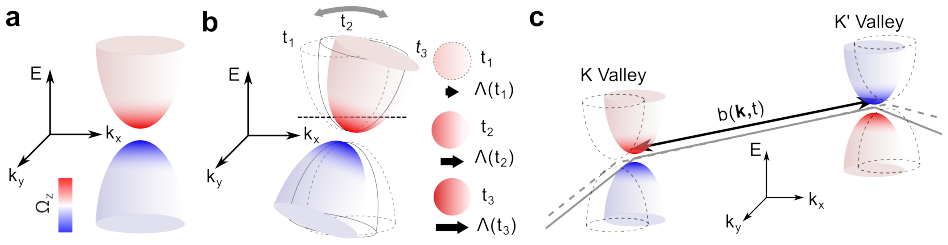
The central discovery is that time-dependent strain acts as a dynamic handle on quantum geometry. As the strain oscillates at omega_m, the Berry curvature distribution over the Fermi surface tilts and the separation between valleys changes, so the Berry curvature dipole acquires a component oscillating at omega_m. This produces nonlinear Hall signals at omega_m and omega_m ± 2 omega_c whose amplitude scales linearly with strain amplitude and with the effective time-derivative of the dipole. In addition, the time-varying lattice produces a valley-dependent (chirality-dependent) pseudo-electric field E_m(t). That pseudo-electric field couples to the static Berry curvature to give an anomalous
What carries the argument
The Berry curvature dipole (BCD), the first moment of the Berry curvature over occupied states, is the object being modulated; its strain-induced oscillation is encoded in the factor delta_Lambda_m ~ (∂Λ/∂u)(∂u/∂V) V_m omega_m δt. The pseudo-electric field is generated by the time derivative of the strain-induced gauge potential, E^{ωm} = -χ ∂_t A, with valley chirality χ = ±1. The paper's transport framework combines these two pieces with a Boltzmann-equation analysis of a driven electron distribution, producing explicit predictions for the Hall voltages at the mixed frequencies.
Load-bearing premise
The measured linear scaling of the Hall voltages with strain-modulation frequency is attributed to the physical time-derivative of the Berry curvature dipole; if that scaling instead comes from the strain transducer delivering larger displacement at higher frequencies, the 'rate of change' interpretation and the extracted dipole-modulation values are not valid.
What would settle it
Measure the strain displacement actually delivered to the sample as a function of frequency, e.g., by interferometry on the membrane, and check whether it is flat over the 200-400 Hz range. If the displacement is frequency-independent yet the Hall signals still scale linearly with omega_m, the dynamic-modulation claim is supported; if displacement grows with frequency, the scaling is a transducer artifact.
If this is right
- If correct, the technique provides real-time, reversible control of the Berry curvature dipole and Berry curvature in 2D materials, replacing static strain or electric-field gating.
- The zero-current Hall voltage at the strain frequency is a direct, field-free readout of the pseudo-electric field's coupling to static Berry curvature, which could be used to probe topological properties in time-reversal-symmetric systems.
- The linear-in-omega_m scaling of the sideband Hall signals implies these measurements are sensitive to the rate of change of the quantum geometry, not just its instantaneous value.
- The same mechanism should work in any material with finite Berry curvature, including Dirac, Weyl, and excitonic systems, providing a generic probe of quantum geometry.
- The mixed-frequency pattern (omega_m, omega_m ± omega_c, omega_m ± 2 omega_c) offers a way to separate quantum-geometric contributions from other nonlinear transport effects.
Where Pith is reading between the lines
- Inference (beyond the paper): if the pseudo-electric field really couples to Berry curvature as stated, then a measurement of the omega_m Hall voltage as a function of strain gradient direction could be used to map the momentum-space Berry curvature distribution directly, not just its first moment.
- Inference: the same experimental protocol could be applied to moiré systems near band crossings to detect whether topological transitions are accompanied by a non-analytic change in the BCD's strain susceptibility.
- Inference: a crucial test would be to compare the extracted delta_Lambda_m with first-principles tight-binding calculations of ∂Λ/∂u for the same devices; agreement would validate the quantitative link between strain voltage and BCD change.
- Inference: if the omega_m ± omega_c signal scales linearly with both strain and current amplitudes while the omega_m signal has a current-independent offset, the ratio between them imposes a consistency check on the pseudo-field magnitude that could rule out alternative mechanisms such as thermal or magnetostriction effects.
Editorial analysis
A structured set of objections, weighed in public.
Referee Report
Summary. The manuscript reports transport measurements on twisted double bilayer graphene and Bernal bilayer graphene placed on silicon nitride membranes, subjected simultaneously to oscillatory strain at frequency ωm and an in-plane AC current at frequency ωc. Hall voltages are detected at mixed frequencies ωm, ωm ± ωc, and ωm ± 2ωc. The authors interpret the ωm ± 2ωc and part of the ωm signals as arising from time-dependent modulation of the Berry curvature dipole (BCD), with the sideband amplitude written in Eq. (3) as δΛm = (∂Λ/∂u)(∂u/∂V)V0Vmωmδt. The zero-current component of Vxy^{ωm} and the ωm ± ωc signals are attributed to a strain-induced pseudo-electric field that couples to static Berry curvature and to band velocity, respectively. The data show clean scalings in piezo voltage, current, and frequency, and the D-field reversal of the BCD-related signals is consistent with a Berry-curvature origin. The central interpretive claim is, however, tied to a specific frequency-scaling mechanism that is not derived from the stated Boltzmann transport formalism.
Significance. If the interpretation were established, this would be a notable advance: real-time modulation of quantum geometry and a transport signature of a pseudo-electric field coupled to Berry curvature, applicable beyond the specific graphene systems studied. The experiments are technically impressive in combining a membrane strain platform with phase-sensitive multi-frequency Hall measurements and in reproducing the main trends in two different materials. The D-field antisymmetry of the BCD-related channels, the quadratic-in-current scaling, the linear-in-piezo-voltage scaling, and the internal −1/2 overlay between Vxy^{ωm+2ωc} and ΔVxy^{ωm} are genuine strengths. However, the load-bearing derivation of the linear-in-ωm frequency scaling is not provided, and an uncalibrated frequency-dependent strain transfer could explain the same data. A zero-current Hall signal measured at the piezo drive frequency also requires controls against capacitive pickup. The significance is therefore conditional on resolving these issues.
major comments (4)
- [Main text, 'Berry Curvature Dipole Modulation', Eq. (3)] Equation (3) introduces the factor ωmδt with δt never defined and V0 never defined. This factor is the sole basis for the claim that the signals are proportional to the rate of change of BCD. If the strain modulates the BCD quasi-statically, as Eq. (2) assumes via Λ(t) = Λ0 + δΛm cos(ωm t), the correct sideband amplitude would be δΛm = (∂Λ/∂u)(∂u/∂V)Vm, with no ωm factor. No relaxation mechanism or microscopic derivation is given that would convert a quasi-static BCD modulation into a derivative response. Consequently, the linear frequency scaling in Figs. 3e-f and Extended Figs. 4-5 is not a prediction of the stated theory; Eq. (3) is circular with respect to the central claim. The authors must either derive the ωmδt factor from a Boltzmann/adiabatic calculation with a defined time interval, or remove it and reassess the interpretation of the frequency dependence.
- [Experimental Results, frequency dependence; Figs. 3e-f, Extended Fig. 3] The linear scaling of Vxy^{ωm+2ωc}, Vxy^{ωm}, and Vxy^{ωm+ωc} with ωm is presented as evidence for the dynamic mechanisms in Eqs. (3) and (4). But the actual strain amplitude delivered to the sample as a function of frequency in the 170-400 Hz range is never calibrated. A linear mechanical or electrical transfer function of the piezoelectric strain cell and membrane assembly would produce exactly the observed linear scaling and would explain the frequency dependence without any quantum-geometric time-derivative effect. The manuscript controls only the piezo voltage, not the strain at the device. Quantitative calibration of the frequency-dependent strain transfer (e.g., via a strain gauge, interferometric displacement measurement, or a reference transduction measurement) is required before the frequency scaling can be attributed to the purported BCD derivative or pseudo-electric field.
- [Coupling of Pseudo-Electric Field with Static Berry Curvature; Extended Fig. 2] The finite Vxy^{ωm} at zero current is the decisive new phenomenology and is attributed to a pseudo-electric field coupling to static Berry curvature. The measurement is performed at the same frequency as a 10 V peak-to-peak piezo drive, so stray capacitive coupling from the piezo lines to the Hall contacts, cable microphonics, or a ground loop could easily produce a zero-current offset at ωm. The manuscript does not report the necessary controls: for example, measuring Vxy^{ωm} at zero current with the strain modulation on but at a gate/density where Berry curvature vanishes, with a dummy load replacing the sample, or with the piezo drive disconnected but an equivalent electrical signal injected into the sample environment. The D-reversal antisymmetry of the current-carrying BCD channels does not by itself protect the I=0 channel. Until these controls are supplied, the pseudo-electric-f
- [Main text, Fig. 3i and Eq. (2)] The overlay in Fig. 3i is presented as independent confirmation that the BCD modulation and the pseudo-electric-field contributions are correctly separated. However, ΔVxy^{ωm} is defined as Vxy^{ωm} − Vxy^{ωm}(I=0), and Vxy^{ωm}(I=0) is precisely the quantity whose physical origin is under test. Thus the −1/2 overlay tests only the internal consistency of the BCD-modulated component, assuming the offset is a current-independent pseudo-electric-field contribution. This is useful but not an independent validation of the pseudo-electric-field mechanism. An independent estimate of the expected offset from Eq. (4), using measured or bounded values of β, dU/dV, and the Berry curvature, is needed to make the claim quantitative.
minor comments (5)
- [Fig. 3 caption and text] The text says 'Figure 3c and 3e illustrate the scaling ... at ωm+2ωc and ωm'; the caption indicates that panels c-d show piezo-voltage scaling and panels e-f show frequency scaling. Please correct the cross-reference to 'c-d' and 'e-f'.
- [Eq. (3)] V0 is not defined. If it is the DC piezo bias voltage, state so explicitly and explain why the product V0Vm, rather than Vm alone, controls δΛm. If it is a nominal voltage scale, that should be stated as well.
- [Eq. (2) and phase convention] The text writes δu_m(t) ∝ sin(ωm t) but Eq. (2) uses δΛm cos(ωm t), and later says the signals are 90° out of phase with the applied current. A single phase convention should be defined at the start of the theory section, including the relative phase of the strain, the current, and the lock-in reference.
- [Abstract and Discussion] The abstract and Discussion use 'conclusive experimental demonstration' and 'direct experimental and theoretical evidence.' Given the issues with Eq. (3) and the calibration controls, the wording should be toned down until the theoretical derivation and experimental controls are complete.
- [Supplementary references] The main text repeatedly refers to Supplementary Information sections for derivations, but the reader cannot verify the central derivation of Eq. (3) from the main text. If the derivation is indeed in the Supplementary Information, it should be summarized or at least stated explicitly in the main text; if it is not, it must be added.
Circularity Check
Eq. (3) inserts the ωm·δt factor by hand; the linear-in-ωm scaling quoted as confirmation is built into the definition of δΛm.
specific steps
-
self definitional
[Berry Curvature Dipole Modulation, Eqs. (2)-(3); Fig. 3e-f; Extended Figs. 3-5]
"Here, δΛm = (∂Λ/∂u)_{u0} (∂u/∂V) V0 Vm ωm δt (3) is the change of BCD due to strain over a small time interval δt, and Λ0 = Λ(u0) is the static BCD. ... Figure 3e and 3f illustrate the linear dependence for both V^{ωm+2ωc}_xy and V^{ωm}_xy on ωm. These results are in agreement with equation (2) and (3), and offer compelling experimental evidence for the dynamic modulation of the BCD under strain."
The sideband amplitudes in Eq. (2) are proportional to δΛm. A quasi-static expansion Λ(u0+δu_m)=Λ0+δΛm cos(ωm t) determines δΛm=(∂Λ/∂u)(∂u/∂V)Vm, with no ωm factor. Eq. (3) instead defines δΛm ∝ ωm δt, with δt and V0 left unspecified in the main text. The measured linear-in-ωm scaling of V^{ωm+2ωc}_xy and V^{ωm}_xy is therefore not a prediction of the BCD-modulation mechanism; it is inserted into the definition of δΛm and then presented as agreement. Without an independent derivation of δt or of a dΛ/dt coupling in the Boltzmann transport equations, the frequency scaling cannot be used as evidence that the signal measures the rate of change of BCD.
full rationale
The paper's central dynamic-BCD claim is partially circular. Eq. (2) correctly produces mixed-frequency nonlinear Hall sidebands from a time-modulated BCD, but the amplitude of those sidebands should be ωm-independent under the stated quasi-static strain modulation u(t)=u0+δu cos(ωm t). The paper obtains the observed linear-in-ωm scaling only by defining δΛm with an un-derived ωm δt factor in Eq. (3), then cites that scaling as 'compelling experimental evidence.' That is a prediction-by-construction for the frequency dependence, and it weakens the 'rate of change of BCD' interpretation. The pseudo-electric-field channel is not circular in the same way: E^ωm = -χ∂A/∂t naturally contains a factor of ωm, so the linear frequency dependence of V^{ωm±ωc} follows from a standard derivative. The internal consistency tests (D-reversal antisymmetry, I^2 scaling, and the -1/2 overlay of ΔV^{ωm}_xy with V^{ωm+2ωc}_xy) are genuine and support a BCD-related origin, but they do not validate the specific ωm dependence. Self-citations such as [28] and [48] are present but not the main load-bearing mechanism; the dominant circularity is the ωm factor in Eq. (3). Overall score 6: one central 'prediction' reduces to an inserted definition, while substantial independent content remains.
Axiom & Free-Parameter Ledger
free parameters (3)
- delta_t (Eq. 3 time interval) =
unspecified
- du/dV (piezo strain transfer coefficient) =
unknown, not calibrated
- relaxation time tau in Boltzmann transport =
assumed constant
axioms (5)
- domain assumption Adiabatic strain modulation (omega_m << electronic relaxation rate)
- domain assumption Semiclassical Boltzmann transport with constant tau and instantaneous Berry curvature
- standard math Strain couples to electrons as a pseudo-gauge vector potential A with beta/a prefactor
- domain assumption The measured TDBG twist angle is 1.1 degrees and band-structure calculations with that angle approximate the device
- domain assumption No other nonlinear transport mechanisms (disorder, flexoelectric, thermal) contribute at the measured frequencies
Cite this review
Pith. "Pith review of Modulation of quantum geometry and its coupling to pseudo-electric field by dynamic strain." pith.science (2026). https://pith.science/paper/CZ225CB2
@misc{pith2026251224681,
  author       = {Pith},
  title        = {Pith review of: Modulation of quantum geometry and its coupling to pseudo-electric field by dynamic strain},
  year         = {2026},
  howpublished = {\url{https://pith.science/paper/CZ225CB2}},
  note         = {Machine review of arXiv:2512.24681}
}
read the original abstract
Two-dimensional materials are a fertile ground for exploring quantum geometric phenomena, with Berry curvature and its first moment, the Berry curvature dipole, playing a central role in their electronic response. These geometric properties influence electronic transport and result in the anomalous and nonlinear Hall effects, and are typically controlled using static electric fields or strain. However, the possibility of modulating quantum geometric quantities in real-time remains unexplored. Here, we demonstrate the dynamic modulation of Berry curvature and its moments, as well as the generation of a pseudo-electric field using time-dependent strain. By placing heterostructures on a membrane, we introduce oscillatory strain together with an in-plane AC electric field and measure Hall signals that are modulated at linear combinations of the frequencies of strain and electric field. Our measurements reveal modulation of Berry curvature and its first moment. Notably, we provide direct experimental evidence of pseudo-electric field that results in an unusual dynamic strain-induced Hall response. This approach opens up a new pathway for controlling quantum geometry on demand, moving beyond conventional static perturbations. The pseudo-electric field provides a framework for external electric field-free anomalous Hall response and opens new avenues for probing the topological properties.
Figures


Reference graph
Works this paper leans on
-
[1]
Ohta, T., Bostwick, A., Seyller, T., Horn, K. & Rotenberg, E. Controlling the Electronic Structure of Bilayer Graphene.Science313, 951–954 (2006). URLhttps://www.science. 17 org/doi/10.1126/science.1130681. Publisher: American Association for the Advancement of Science
-
[2]
URLhttps://doi.org/10.1038/nature08105
Zhang, Y.et al.Direct observation of a widely tunable bandgap in bilayer graphene.Nature 459, 820–823 (2009). URLhttps://doi.org/10.1038/nature08105
-
[3]
URLhttps://www.nature.com/articles/ s41567-024-02560-7
Arp, T.et al.Intervalley coherence and intrinsic spin–orbit coupling in rhombohedral trilayer graphene.Nature Physics20, 1413–1420 (2024). URLhttps://www.nature.com/articles/ s41567-024-02560-7. Publisher: Nature Publishing Group
2024
-
[4]
Li, S.-Y., Su, Y., Ren, Y.-N. & He, L. Valley Polarization and Inversion in Strained Graphene via Pseudo-Landau Levels, Valley Splitting of Real Landau Levels, and Confined States. Physical Review Letters124, 106802 (2020). URLhttps://link.aps.org/doi/10.1103/ PhysRevLett.124.106802. Publisher: American Physical Society
2020
-
[5]
& Zeng, H
Qi, Y., Yao, C., Zhao, J. & Zeng, H. Strain-induced tunable valley polarization and topological phasetransitioninSVSiN2monolayer.Journal of Materials Chemistry C12, 4417–4425(2024). URLhttps://pubs.rsc.org/en/content/articlelanding/2024/tc/d3tc04759h. Publisher: The Royal Society of Chemistry
2024
-
[6]
URLhttps://www.nature.com/articles/ s41565-021-01052-6
Cenker, J.et al.Reversible strain-induced magnetic phase transition in a van der Waals mag- net.Nature Nanotechnology17, 256–261 (2022). URLhttps://www.nature.com/articles/ s41565-021-01052-6. Publisher: Nature Publishing Group
2022
-
[7]
W.et al.Uniaxial strain-induced phase transition in the 2D topological semimetal IrTe2.Communications Materials2, 1–8 (2021)
Nicholson, C. W.et al.Uniaxial strain-induced phase transition in the 2D topological semimetal IrTe2.Communications Materials2, 1–8 (2021). URLhttps://www.nature.com/articles/ s43246-021-00130-5. Publisher: Nature Publishing Group
2021
-
[8]
RevealingQuantumGeometryinNonlinearQuantumMaterials (2025)
Jiang, Y., Holder, T.&Yan, B. RevealingQuantumGeometryinNonlinearQuantumMaterials (2025). URLhttp://arxiv.org/abs/2503.04943. ArXiv:2503.04943 [cond-mat]
Pith/arXiv arXiv 2025
-
[9]
Kruchkov, A. Quantum geometry, flat Chern bands, and Wannier orbital quantization.Physical Review B105, L241102 (2022). URLhttps://link.aps.org/doi/10.1103/PhysRevB.105. L241102. 18
-
[10]
Liu, T., Qiang, X.-B., Lu, H.-Z. & Xie, X. C. Quantum geometry in condensed matter.National Science Reviewnwae334 (2024). URLhttp://arxiv.org/abs/2409.13408. ArXiv:2409.13408 [cond-mat]
Pith/arXiv arXiv 2024
-
[11]
C., Sinha, S., Agarwal, A
Adak, P. C., Sinha, S., Agarwal, A. & Deshmukh, M. M. Tunable moiré materials for probing Berry physics and topology.Nature Reviews Materials9, 481–498 (2024). URLhttps://www. nature.com/articles/s41578-024-00671-4. Publisher: Nature Publishing Group
2024
-
[12]
Xiao, D., Yao, W. & Niu, Q. Valley-Contrasting Physics in Graphene: Magnetic Moment and Topological Transport.Physical Review Letters99, 236809 (2007). URLhttps://link.aps. org/doi/10.1103/PhysRevLett.99.236809. Publisher: American Physical Society
-
[13]
Nagaosa, N., Sinova, J., Onoda, S., MacDonald, A. H. & Ong, N. P. Anomalous Hall effect. Reviews of Modern Physics82, 1539–1592(2010). URLhttps://link.aps.org/doi/10.1103/ RevModPhys.82.1539
2010
-
[14]
F., McGill, K
Mak, K. F., McGill, K. L., Park, J. & McEuen, P. L. The valley Hall effect in MoS2 transistors.Science344, 1489–1492 (2014). URLhttps://www.science.org/doi/10.1126/ science.1250140. Publisher: American Association for the Advancement of Science
2014
-
[15]
URLhttps: //www.nature.com/articles/nphys3551
Shimazaki, Y.et al.Generation and detection of pure valley current by electrically induced Berry curvature in bilayer graphene.Nature Physics11, 1032–1036 (2015). URLhttps: //www.nature.com/articles/nphys3551. Number: 12 Publisher: Nature Publishing Group
2015
-
[16]
URLhttps://www.nature.com/articles/nphys3485
Sui, M.et al.Gate-tunable topological valley transport in bilayer graphene.Nature Physics 11, 1027–1031 (2015). URLhttps://www.nature.com/articles/nphys3485. Number: 12 Publisher: Nature Publishing Group
2015
-
[17]
& Law, K
Hu, J.-X., Zhang, C.-P., Xie, Y.-M. & Law, K. T. Nonlinear Hall effects in strained twisted bilayer WSe2.Communications Physics5, 1–6 (2022). URLhttps://www.nature.com/ articles/s42005-022-01034-7. Publisher: Nature Publishing Group
2022
-
[18]
W.et al.Enhanced valley polarization at valence/conduction band in transition- metal-doped WTe2 under strain force.Applied Surface Science504, 144367 (2020)
Zhao, X. W.et al.Enhanced valley polarization at valence/conduction band in transition- metal-doped WTe2 under strain force.Applied Surface Science504, 144367 (2020). URL https://www.sciencedirect.com/science/article/pii/S0169433219331836. 19
2020
-
[19]
Strain engineering of electronic properties and anomalous valley hall conduc- tivity of transition metal dichalcogenide nanoribbons.Scientific Reports12, 11285 (2022)
Shayeganfar, F. Strain engineering of electronic properties and anomalous valley hall conduc- tivity of transition metal dichalcogenide nanoribbons.Scientific Reports12, 11285 (2022). URLhttps://www.nature.com/articles/s41598-022-13398-5. Publisher: Nature Publish- ing Group
2022
-
[20]
Son, J., Kim, K.-H., Ahn, Y., Lee, H.-W. & Lee, J. Strain Engineering of the Berry Curvature Dipole and Valley Magnetization in Monolayer ${\mathrm{MoS}}_{2}$.Physical Review Letters123, 036806 (2019). URLhttps://link.aps.org/doi/10.1103/PhysRevLett.123. 036806. Publisher: American Physical Society
-
[21]
Zhang, C.-P.et al.Giant nonlinear hall effect in strained twisted bilayer graphene.Phys. Rev. B106, L041111 (2022). URLhttps://link.aps.org/doi/10.1103/PhysRevB.106.L041111
-
[22]
Bi, Z., Yuan, N. F. Q. & Fu, L. Designing flat bands by strain.Physical Review B100, 035448 (2019). URLhttps://link.aps.org/doi/10.1103/PhysRevB.100.035448. Publisher: American Physical Society
-
[24]
Nature565, 337–342 (2019)
Ma, Q.et al.Observation of the nonlinear Hall effect under time-reversal-symmetric conditions. Nature565, 337–342 (2019). URLhttps://www.nature.com/articles/s41586-018-0807-6
2019
-
[25]
& Mak, K
Kang, K., Li, T., Sohn, E., Shan, J. & Mak, K. F. Nonlinear anomalous Hall effect in few-layer WTe2.Nature Materials18, 324–328 (2019). URLhttps://doi.org/10.1038/ s41563-019-0294-7
2019
-
[26]
URLhttps://www.nature.com/articles/ s41567-022-01606-y
Sinha, S.et al.Berry curvature dipole senses topological transition in a moiré super- lattice.Nature Physics18, 765–770 (2022). URLhttps://www.nature.com/articles/ s41567-022-01606-y. Publisher: Nature Publishing Group
2022
-
[27]
URLhttps://dx.doi.org/ 10.1088/2053-1583/ac8b93
Chakraborty, A.et al.Nonlinear anomalous Hall effects probe topological phase-transitions in twisted double bilayer graphene.2D Materials9, 045020 (2022). URLhttps://dx.doi.org/ 10.1088/2053-1583/ac8b93. 20
-
[28]
Bhuvaneswari, R., Deshmukh, M. M. & Waghmare, U. V. Sensing vibrations using quantum geometry of electrons.Physical Review B110, 014305 (2024). URLhttps://link.aps.org/ doi/10.1103/PhysRevB.110.014305. Publisher: American Physical Society
-
[29]
& Yao, W
Chen, C., Zhai, D., Xiao, C. & Yao, W. Crossed nonlinear dynamical Hall effect in twisted bilayers.Physical Review Research6, L012059 (2024). URLhttps://link.aps.org/doi/10. 1103/PhysRevResearch.6.L012059. Publisher: American Physical Society
2024
-
[30]
Vozmediano, M. A. H., Katsnelson, M. I. & Guinea, F. Gauge fields in graphene.Physics Re- ports496, 109–148 (2010). URLhttps://www.sciencedirect.com/science/article/pii/ S0370157310001729
2010
-
[31]
& Peeters, F
Ramezani Masir, M., Moldovan, D. & Peeters, F. M. Pseudo magnetic field in strained graphene: Revisited.Solid State Communications175-176, 76–82 (2013). URLhttps: //www.sciencedirect.com/science/article/pii/S0038109813001555
2013
-
[32]
Ilan, R., Grushin, A. G. & Pikulin, D. I. Pseudo-electromagnetic fields in 3D topologi- cal semimetals.Nature Reviews Physics2, 29–41 (2020). URLhttps://www.nature.com/ articles/s42254-019-0121-8. Publisher: Nature Publishing Group
2020
-
[33]
URLhttps://link.aps.org/doi/10.1103/PhysRevLett.128
Zhao, P.et al.AcousticallyInducedGiantSyntheticHallVoltagesinGraphene.Physical Review Letters128, 256601 (2022). URLhttps://link.aps.org/doi/10.1103/PhysRevLett.128. 256601. Publisher: American Physical Society
-
[35]
Sela, E., Bloch, Y., Von Oppen, F. & Shalom, M. B. Quantum Hall Response to Time- Dependent Strain Gradients in Graphene.Physical Review Letters124(2020). URLhttps: //link.aps.org/doi/10.1103/PhysRevLett.124.026602. Publisher: American Physical So- ciety (APS)
-
[36]
Bistritzer, R. & MacDonald, A. H. Moiré bands in twisted double-layer graphene.Proceedings 21 of the National Academy of Sciences108, 12233–12237 (2011). URLhttps://www.pnas.org/ doi/10.1073/pnas.1108174108. Publisher: Proceedings of the National Academy of Sciences
-
[37]
Band structure and topological properties of twisted double bilayer graphene
Koshino, M. Band structure and topological properties of twisted double bilayer graphene. Physical Review B99, 235406 (2019). URLhttps://link.aps.org/doi/10.1103/PhysRevB. 99.235406. Publisher: American Physical Society
doi:10.1103/physrevb 2019
-
[38]
Adak, P. C.et al.Tunable bandwidths and gaps in twisted double bilayer graphene on the verge of correlations.Physical Review B101, 125428 (2020). URLhttps://link.aps.org/ doi/10.1103/PhysRevB.101.125428. Publisher: American Physical Society
-
[39]
Haddadi, F., Wu, Q., Kruchkov, A. J. & Yazyev, O. V. moiré Flat Bands in Twisted Double Bilayer Graphene.Nano Letters(2020). URLhttps://doi.org/10.1021/acs.nanolett. 9b05117
-
[40]
URLhttps://doi.org/10.1038/ s41467-020-19284-w
Sinha, S.et al.Bulk valley transport and Berry curvature spreading at the edge of flat bands.Nature Communications11, 5548 (2020). URLhttps://doi.org/10.1038/ s41467-020-19284-w
2020
-
[41]
W., Barber, M
Hicks, C. W., Barber, M. E., Edkins, S. D., Brodsky, D. O. & Mackenzie, A. P. Piezoelectric-based apparatus for strain tuning.Review of Scientific Instru- ments85, 065003 (2014). URLhttps://pubs.aip.org/rsi/article/85/6/065003/356043/ Piezoelectric-based-apparatus-for-strain-tuning
2014
-
[42]
Liu, Z.et al.Continuously tunable uniaxial strain control of van der Waals heterostructure devices.Journal of Applied Physics135, 204306 (2024). URLhttps://doi.org/10.1063/5. 0211557
doi:10.1063/5 2024
-
[43]
Pereira, V. M., Castro Neto, A. H. & Peres, N. M. R. Tight-binding approach to uniaxial strain in graphene.Physical Review B80, 045401 (2009). URLhttps://link.aps.org/doi/ 10.1103/PhysRevB.80.045401. Publisher: American Physical Society
-
[44]
URLhttps://www.nature.com/articles/s41567-020-0825-9
Shen, C.et al.Correlated states in twisted double bilayer graphene.Nature Physics16, 520–525 (2020). URLhttps://www.nature.com/articles/s41567-020-0825-9. Publisher: Nature Publishing Group. 22
2020
-
[45]
M.et al.Strain-Enhanced Mobility of Monolayer MoS2.Nano Letters22, 8052– 8059 (2022)
Datye, I. M.et al.Strain-Enhanced Mobility of Monolayer MoS2.Nano Letters22, 8052– 8059 (2022). URLhttps://doi.org/10.1021/acs.nanolett.2c01707. Publisher: American Chemical Society
-
[46]
Smalln/a, 2311185 (2024)
Hou, Y.et al.Strain Engineering of Twisted Bilayer Graphene: The Rise of Strain-Twistronics. Smalln/a, 2311185 (2024). URLhttps://onlinelibrary.wiley.com/doi/abs/10.1002/ smll.202311185
2024
-
[47]
arXiv:2010.08333 [cond-mat](2020)
Zhang, C.-P.et al.Giant nonlinear Hall effect in strained twisted bilayer graphene. arXiv:2010.08333 [cond-mat](2020)
Pith/arXiv arXiv 2010
-
[48]
URLhttps://advanced.onlinelibrary.wiley.com/doi/abs/ 10.1002/adma.202417682
Layek, S.et al.Quantum geometric moment encodes stacking order of moiré matter.Advanced Materials37, 2417682 (2025). URLhttps://advanced.onlinelibrary.wiley.com/doi/abs/ 10.1002/adma.202417682
-
[49]
URLhttps://www.science.org/doi/abs/10
Levy, N.et al.Strain-induced pseudo–magnetic fields greater than 300 tesla in graphene nanobubbles.Science329, 544–547 (2010). URLhttps://www.science.org/doi/abs/10. 1126/science.1191700.https://www.science.org/doi/pdf/10.1126/science.1191700
-
[50]
V.et al.Observation of giant nonlinear Hall conductivity in Bernal bilayer graphene (2024)
Chichinadze, D. V.et al.Observation of giant nonlinear Hall conductivity in Bernal bilayer graphene (2024). URLhttp://arxiv.org/abs/2411.11156. ArXiv:2411.11156
Pith/arXiv arXiv 2024
-
[51]
P., Mele, E
Armitage, N. P., Mele, E. J. & Vishwanath, A. Weyl and dirac semimetals in three-dimensional solids.Rev. Mod. Phys.90, 015001 (2018). URLhttps://link.aps.org/doi/10.1103/ RevModPhys.90.015001
2018
-
[52]
Srivastava, A. & Imamoğlu, A. m. c. Signatures of bloch-band geometry on excitons: Non- hydrogenic spectra in transition-metal dichalcogenides.Phys. Rev. Lett.115, 166802 (2015). URLhttps://link.aps.org/doi/10.1103/PhysRevLett.115.166802
-
[53]
& Xiao, D
Zhou, J., Shan, W.-Y., Yao, W. & Xiao, D. Berry phase modification to the energy spectrum of excitons.Phys. Rev. Lett.115, 166803 (2015). URLhttps://link.aps.org/doi/10.1103/ PhysRevLett.115.166803. 23 ωm-2ωc Frequency Modulation of BCD Modulation of BCD and coupling of Berry curvature with pseudo electric field Modulation of BCD Coupling of pseudo electr...
2015
This paper was first reviewed by deepseek-v4-flash on August 3, 2026.
discussion (0)
Sign in with ORCID, Apple, or X to comment. Anyone can read and Pith papers without signing in.