REVIEW 3 major objections 5 minor 3 cited by
A sparse mixture-of-experts transformer pre-trained on unlabeled network flows can match or beat dense pre-trained baselines on traffic security tasks while roughly doubling throughput and halving latency, establishing that model capacity a
Reviewed by Pith at T0; open to challenge. T0 means a machine referee read the full paper against a public rubric. the ladder, T0–T4 →
Traffic-MoE is a mixture-of-experts traffic transformer that claims up to 12.38% better detection Macro-F1 than dense pre-trained baselines while roughly doubling throughput and cutting latency by roughly half.
T0 review reviewed 2026-08-03 challenge →
load-bearing objection Traffic-MoE is a credible, well-evaluated first application of sparse MoE to traffic transformers, but the headline efficiency numbers rest on an underspecified dense comparison and no variance reporting; worth refereeing, not worth citing yet. the 3 major comments →
Traffic-MoE: A Sparse Foundation Model for Network Traffic Security Analysis
The pith
A machine-rendered reading of the paper's core claim, the machinery that carries it, and where it could break.
The reading
Core claim
Traffic-MoE establishes that a sparsely activated transformer can be both a larger-capacity and a more deployable network-traffic classifier than a dense one. After pre-training by next-token prediction on a corpus of over two million unlabeled flows spanning malware, intrusion, IoT, and VPN/Tor traffic, the model is fine-tuned on four downstream datasets via temporal slicing, mean pooling, and layer-wise learning-rate decay. In the paper's evaluation it reaches 0.89 Macro-F1 on Tor traffic, 0.8332 on mixed VPN traffic, 0.8839 on IoMT attacks, and 0.7824 on IoT attacks, numbers above the compared baselines; at batch size 64 it reports 186.25 samples/sec throughput versus 131.56 for its dense
What carries the argument
The central object is the top-2 sparse mixture-of-experts layer: a bank of N SwiGLU-based experts plus one always-on shared expert, with a gating network that selects the two most relevant experts per token. Because only k experts plus the shared expert are activated, the model's parameter count grows with N while its inference cost stays tied to k, so capacity and latency are decoupled. A load-balancing auxiliary loss keeps the router from collapsing onto a few experts, and the shared expert absorbs protocol-universal patterns so that specialized experts can specialize in distinct traffic behaviors. The supporting tokenizer, Traffic2Token, maps each packet's metadata bytes and a sampled pay
Load-bearing premise
The load-bearing premise is that the dense comparison model really is the same size as Traffic-MoE, and that the pre-training corpus does not silently overlap with the labels or distributions used in the downstream tasks.
What would settle it
Recompute the headline comparison with a dense network of exactly the same layer count, hidden width, and total parameters as Traffic-MoE, and check whether the throughput, latency, and memory advantages shrink; then remove every pre-training flow that also appears in the fine-tuning test sets and see whether the few-shot and distribution-shift margins survive.
If this is right
- If the efficiency figures hold at deployment scale, a foundation-model-level traffic classifier can run on the same hardware that currently runs smaller dense models, removing a stated obstacle to encrypted-traffic detection at network gateways.
- The reported few-shot results imply that a sparse router pre-trained on unlabeled flows can match the full-supervision accuracy of dense baselines with 10-20% of the labels, which matters for zero-day and long-tail attack classes.
- The robustness results under time, proportion, and composition shifts indicate the model relies on protocol grammar rather than dataset-specific statistics, so it may degrade more gracefully when traffic patterns drift.
- The Tor-specific gains suggest that routing, not just additional parameters, is what recovers signal from traffic shaping: dense baselines trained identically on the same corpus do not show the same resilience.
Where Pith is reading between the lines
- If expert specialization is the true cause of the Tor/VPN gains, then routing visualizations such as Figure 8 could be turned into a diagnostic: clusters of flows that consistently activate the same experts should correspond to semantically related applications, and adversarial flows should be detectable by anomalous routing patterns.
- The paper leaves open whether the shared expert alone, rather than the mix of shared plus specialized experts, could carry the whole accuracy gain; an ablation that replaces specialized experts with a single large shared expert would isolate the contribution of routing.
- A natural stress test is to pre-train on flows deliberately disjoint from the downstream evaluation sets; if the few-shot and OOD gains shrink, the benefits are partly dataset overlap rather than general traffic understanding.
- The efficiency comparison would generalize more convincingly if repeated on CPU and edge hardware, since real gateways often lack A100-class GPUs; the reported GPU numbers may not transfer directly.
Editorial analysis
A structured set of objections, weighed in public.
Referee Report
Summary. The paper proposes Traffic-MoE, a sparse Mixture-of-Experts transformer for network traffic security analysis. Input flows are serialized into byte-level token sequences by a new module called Traffic2Token, then processed by a causal transformer in which dense feed-forward layers are replaced by a shared expert plus top-2 routed specialized experts. The model is pre-trained with a next-token prediction objective plus a load-balancing auxiliary loss on a corpus of roughly two million flows drawn from five public datasets, and fine-tuned on six downstream tasks spanning Tor/NonTor service classification, VPN/NonVPN service classification, and IoT/IoMT attack detection. The paper reports state-of-the-art or competitive Macro-F1 on those tasks, substantial inference-efficiency gains over dense baselines and prior pre-trained models, superior few-shot behavior, and robustness to three types of distribution shift.
Significance. If the reported results are correct, the paper makes a useful contribution: it demonstrates that sparse expert activation can be carried over to network traffic analysis and that a large-capacity model can remain efficient enough for throughput-sensitive deployment. The evaluation is broad — six tasks, four public datasets, six baselines, ablations for MoE-vs-dense, pre-training, load-balancing loss, input representations, top-k, payload length, packet count, few-shot curves, and three OOD shift types — and it compares against independently published methods on public benchmarks. The central claim, however, rests on two controls that are not documented: the claimed parameter-matched dense twin, and the avoidance of train/test leakage when pre-training and fine-tuning draw from the same datasets. Both are load-bearing for the headline efficiency and few-shot/OOD conclusions.
major comments (3)
- [§5.2.2, Table 4, §5.7, Appendix E.3.1] The 'MoE→Dense' ablation is called parameter-matched, but no model-size information is reported anywhere: the number of layers L, hidden dimension d, expert count N, expert intermediate dimension d'/k, total parameter count, active parameter count, or FLOPs are absent. Without these numbers the efficiency claims in §5.7 — 41.57% throughput gain, 29.36% latency reduction, and roughly 40% computation bypass versus the dense variant — are not interpretable. The accuracy comparison in Table 4 is also fragile: the dense variant wins on CICIoMT2024 (0.8946 vs 0.8839) and CICIoT2023 (0.7894 vs 0.7824), ties on NonTor (0.8904 vs 0.8900), and the remaining gains are 0.8–3.0 M-F1 points with no error bars or seed variance. Please report the full architecture table and repeat the dense/MoE comparison over at least three seeds.
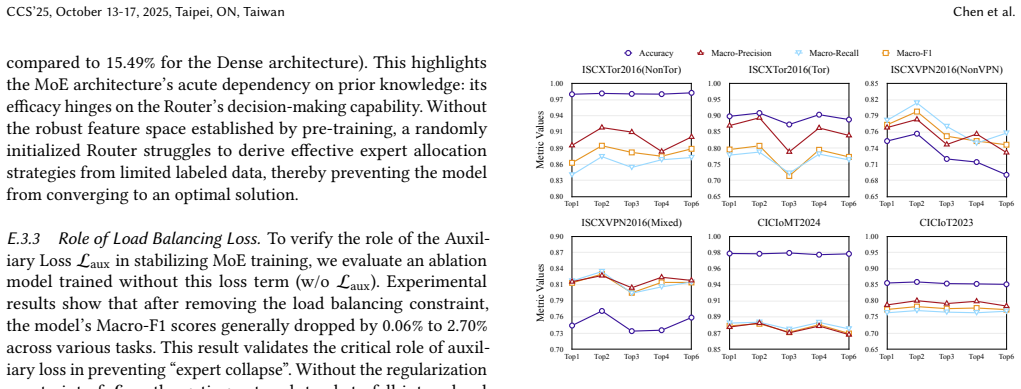
- [§5.1.1, Table 1, §5.1.2] The pre-training corpus includes CICIoT2023, CICIoMT2024, and ISCXVPN2016(NonVPN), and the same three datasets are later used for fine-tuning. The paper says the pre-training flows are unlabeled, but unlabeled flows from the same source still carry distributional information about the downstream test sets, especially after the 8:1:1 split is applied within each dataset. This threatens the few-shot and OOD robustness conclusions: the model may be evaluated on flows whose source distribution was already seen during pre-training. Please either (a) exclude the downstream datasets from pre-training and re-run the key experiments, or (b) demonstrate that the pre-training and fine-tuning session splits are disjoint and quantify the performance change when the overlap is removed.
- [Abstract vs. §5.7] The efficiency numbers are inconsistent across versions of the paper. The supplied abstract reports a 70.42% throughput increase and 41.39% latency reduction; the full-text abstract and the contributions list report 91.62% throughput and 47.81% latency; §5.7 reports 41.57% throughput and 29.36% latency against the dense variant and 91.62% throughput with a 38.72% memory saving against NetGPT. These are not the same comparisons, and the abstract's numbers are not derivable from the body. The detection improvement claim of 'up to 12.38%' is also not tied to a specific row of Table 2. Please harmonize the abstract, contributions, and Section 5.7, and state precisely which baseline each efficiency percentage refers to.
minor comments (5)
- [Table 2] The ET-BERT row for CICIoMT2024 appears to contain an anomalous 0.9769 in the accuracy column before recycling into the M-PR/M-RC/M-F1 columns. Please verify the table formatting.
- [§5.9 / Table 6] The definitions of Time-shift, Proportion-shift, and Compose-shift are deferred to Appendix E.6. Since robustness under distribution shift is a central claim, at least a one-sentence definition of each shift should appear in the main text, and the appendix must be included in the submission.
- [§5.6.1] The phrase 'parameter-matched dense baseline' is used twice without any supporting parameter count. If the authors intend a fixed total-parameter match, this should be stated explicitly in the text and not only in the appendix.
- [§5.4.2 / Appendix E.2] The explanation of Audio/Email degradation under Tor is reasonable, but it is post-hoc and not tested. A short experiment restricting the input window or ablating padding could make the claim more than an interpretation.
- [Conclusion] The conclusion repeats the 91.62% / 47.81% / 38.72% numbers without specifying the comparison baseline; it should match the clarified Section 5.7 figures.
Circularity Check
No significant circularity: Traffic-MoE's core claims rest on external benchmarks, measured efficiency numbers, and author-trained ablation controls; the flagged issues are reporting/leakage concerns, not equivalence-by-construction.
full rationale
The paper's derivation chain is self-contained in the sense required by the circularity test. Traffic2Token produces token sequences from packet metadata/payload bytes; pre-training is next-token prediction (Eqs. 10-12) plus a load-balancing auxiliary loss, neither of which consumes downstream labels; fine-tuning is standard cross-entropy over public benchmark labels (Eqs. 13-15). Downstream performance is compared against independently published baselines (ET-BERT, NetGPT, TrafficFormer, etc.) on public datasets, and the MoE-vs-dense and pre-training ablations are author-trained controls rather than fitted values renamed as predictions. The efficiency claims are empirical throughput/latency/memory measurements (Sec. 5.7, Fig. 7), not theorem-level consequences of the architecture alone; the sparse-activation speedup follows from top-2 routing by design, but the reported percentages are measured. The main concerns raised in the paper — the under-specified 'parameter-matched dense baseline' (Table 4, Sec. 5.6.1) with no layer count, expert count, hidden dim, or parameter totals, and the overlap between pre-training corpora and fine-tuning datasets (Table 1) — are correctness, reproducibility, and potential leakage issues, not circular reasoning: no equation in the paper reduces a predicted quantity to its own input, and no load-bearing argument is supported by a self-citation chain. The self-citations (e.g., refs. [42], [58]) appear only in related-work/motivation and are not used to justify the central result. Accordingly, the circularity score is 0.
Axiom & Free-Parameter Ledger
free parameters (5)
- k (number of active experts) =
2
- Auxiliary loss weight lambda_aux =
0.02
- Number of experts N and layer count L =
N/A
- J (payload length) and K (packet count) =
J=40, K=10
- LLRD decay factor xi and base LR eta0 =
xi=0.9, eta0=5e-5
axioms (4)
- domain assumption MoE top-2 routing plus load-balancing loss confers domain specialization that improves generalization on obfuscated traffic
- domain assumption Pre-training on the five listed public datasets plus fine-tuning on overlapping dataset families does not leak label-distribution information into downstream evaluation
- domain assumption The first K=10 packets of a flow carry enough behavioral signal to classify the whole flow
- domain assumption Byte bigram + packet metadata tokenization is a sufficient representation for security-relevant semantics
invented entities (2)
-
Traffic2Token byte-level token vocabulary with [PD]/[PY]/[PAD]/[END]/[UNK] markers
no independent evidence
-
Specialized experts as interpretable 'domain experts' that decouple obfuscation artifacts
no independent evidence
Cite this review
Pith. "Pith review of Traffic-MoE: A Sparse Foundation Model for Network Traffic Security Analysis." pith.science (2026). https://pith.science/paper/UFTE4ER2
@misc{pith2026260100357,
  author       = {Pith},
  title        = {Pith review of: Traffic-MoE: A Sparse Foundation Model for Network Traffic Security Analysis},
  year         = {2026},
  howpublished = {\url{https://pith.science/paper/UFTE4ER2}},
  note         = {Machine review of arXiv:2601.00357}
}
read the original abstract
As adversaries increasingly weaponize encryption and protocol obfuscation to evade traffic detection, traditional methods are rendered obsolete, necessitating deep learning to unmask sophisticated threats. However, the prohibitive computational costs of existing large models create a critical defense gap, hindering their deployment in real-time and throughput-sensitive environments. To close this vulnerability, we introduce Traffic-MoE, a sparse foundation model tailored for traffic security analysis. By dynamically routing traffic tokens to a small subset of specialized experts, Traffic-MoE effectively decouples model capacity from computational overhead. Extensive evaluations across four security-oriented tasks demonstrate that Traffic-MoE achieves state-of-the-art or highly competitive performance compared to leading competitors. Crucially, it delivers a 70.42% increase in throughput, reduces inference latency by 41.39% while significantly optimizing GPU memory consumption. Beyond efficiency, Traffic-MoE exhibits superior robustness against adversarial traffic shaping and maintains strong detection capabilities in few-shot scenarios, establishing a scalable and resilient paradigm for modern network traffic security analysis.
Figures


Forward citations
Cited by 3 Pith papers
-
NetVAD: Foundation-Model Representation Learning for Identifier-Free Unsupervised Intrusion Detection
NetVAD is a strictly identifier-free VAE that projects frozen foundation-model network representations into a latent space trained solely on benign traffic, reporting 98% micro F1 and 96% macro F1 on ToN-IoT.
-
NetVAD: Foundation-Model Representation Learning for Identifier-Free Unsupervised Intrusion Detection
NetVAD uses a strictly identifier-free VAE on frozen foundation model embeddings, trained solely on benign traffic, to achieve 98% micro F1 and 96% macro F1 on ToN-IoT for unsupervised intrusion detection.
-
Towards Intrusion Detection Systems for RPL-based IoT Networks using Foundation Models
Fine-tuning the MOMENT foundation model on simulated RPL statistics enables multi-class attack identification with performance comparable to state-of-the-art methods.
Reference graph
Works this paper leans on
-
[1]
Mohammed Ali Al-Garadi, Amr Mohamed, Abdulla Khalid Al-Ali, Xiaojiang Du, Ihsan Ali, and Mohsen Guizani. 2020. A survey of machine and deep learning methods for internet of things (IoT) security.IEEE communications surveys & tutorials22, 3 (2020), 1646–1685
2020
-
[2]
Blake Anderson and David McGrew. 2016. Identifying encrypted malware traffic with contextual flow data. InProceedings of the 2016 ACM workshop on artificial intelligence and security. 35–46
2016
-
[3]
Blake Anderson, Subharthi Paul, and David McGrew. 2018. Deciphering mal- ware’s use of TLS (without decryption).Journal of Computer Virology and Hacking Techniques14, 3 (2018), 195–211
2018
-
[4]
Manos Antonakakis, Tim April, Michael Bailey, Matt Bernhard, Elie Bursztein, Jaime Cochran, Zakir Durumeric, J Alex Halderman, Luca Invernizzi, Michalis Kallitsis, et al. 2017. Understanding the mirai botnet. In26th USENIX security symposium (USENIX Security 17). 1093–1110
2017
-
[5]
Ahmad Azab, Mahmoud Khasawneh, Saed Alrabaee, Kim-Kwang Raymond Choo, and Maysa Sarsour. 2024. Network traffic classification: Techniques, datasets, and challenges.Digital Communications and Networks10, 3 (2024), 676–692
2024
-
[6]
Alireza Bahramali, Ardavan Bozorgi, and Amir Houmansadr. 2023. Realistic website fingerprinting by augmenting network traces. InProceedings of the 2023 ACM SIGSAC Conference on Computer and Communications Security. 1035–1049
2023
-
[7]
Juan Camilo Correa Chica, Jenny Cuatindioy Imbachi, and Juan Felipe Botero Vega. 2020. Security in SDN: A comprehensive survey.Journal of Network and Computer Applications159 (2020), 102595
2020
-
[8]
Sajjad Dadkhah, Euclides Carlos Pinto Neto, Raphael Ferreira, Reginald Chuk- wuka Molokwu, Somayeh Sadeghi, and Ali A Ghorbani. 2024. CICIoMT2024: A benchmark dataset for multi-protocol security assessment in IoMT.Internet of Things28 (2024), 101351
2024
-
[9]
Roger Dingledine, Nick Mathewson, and Paul Syverson. 2004. Tor: The second- generation onion router. (2004)
2004
-
[10]
William Fedus, Barret Zoph, and Noam Shazeer. 2022. Switch transformers: Scaling to trillion parameter models with simple and efficient sparsity.Journal of Machine Learning Research23, 120 (2022), 1–39
2022
-
[11]
Igor Fosić, Drago Žagar, Krešimir Grgić, and Višnja Križanović. 2023. Anom- aly detection in NetFlow network traffic using supervised machine learning algorithms.Journal of industrial information integration33 (2023), 100466
2023
-
[12]
Chuanpu Fu, Qi Li, Meng Shen, and Ke Xu. 2024. Detecting tunneled flooding traffic via deep semantic analysis of packet length patterns. InProceedings of the 2024 on ACM SIGSAC Conference on Computer and Communications Security. 3659–3673
2024
-
[13]
Gerard Drapper Gil, Arash Habibi Lashkari, Mohammad Mamun, and Ali A Ghorbani. 2016. Characterization of encrypted and VPN traffic using time-related features. InProceedings of the 2nd international conference on information systems security and privacy (ICISSP 2016). SciTePress Setúbal, Portugal, 407–414
2016
-
[14]
Jie Gui, Tuo Chen, Jing Zhang, Qiong Cao, Zhenan Sun, Hao Luo, and Dacheng Tao. 2024. A survey on self-supervised learning: Algorithms, applications, and future trends.IEEE Transactions on Pattern Analysis and Machine Intelligence46, 12 (2024), 9052–9071
2024
-
[15]
Chaoqun Guo, Nan Wang, Yuanlin Sun, and Dalin Zhang. 2023. DTC: Addressing the long-tailed problem in intrusion detection through the divide-then-conquer paradigm. In2023 IEEE 29th International Conference on Parallel and Distributed Systems (ICPADS). IEEE, 1319–1326
2023
-
[16]
Hong Ye He, Zhi Guo Yang, and Xiang Ning Chen. 2020. PERT: Payload encoding representation from transformer for encrypted traffic classification. In2020 ITU Kaleidoscope: Industry-Driven Digital Transformation (ITU K). IEEE, 1–8
2020
-
[17]
Jordan Holland, Paul Schmitt, Nick Feamster, and Prateek Mittal. 2021. New directions in automated traffic analysis. InProceedings of the 2021 ACM SIGSAC conference on computer and communications security. 3366–3383
2021
-
[18]
Amir Houmansadr, Chad Brubaker, and Vitaly Shmatikov. 2013. The parrot is dead: Observing unobservable network communications. In2013 IEEE Symposium on Security and Privacy. IEEE, 65–79
2013
-
[19]
Hongxin Hu, Wonkyu Han, Gail-Joon Ahn, and Ziming Zhao. 2014. FLOW- GUARD: Building robust firewalls for software-defined networks. InProceedings of the third workshop on Hot topics in software defined networking. 97–102
2014
-
[20]
Albert Q Jiang, Alexandre Sablayrolles, Antoine Roux, Arthur Mensch, Blanche Savary, Chris Bamford, Devendra Singh Chaplot, Diego de las Casas, Emma Bou Hanna, Florian Bressand, et al . 2024. Mixtral of experts.arXiv preprint arXiv:2401.04088(2024)
Pith/arXiv arXiv 2024
-
[21]
Adam Langley, Alistair Riddoch, Alyssa Wilk, Antonio Vicente, Charles Krasic, Dan Zhang, Fan Yang, Fedor Kouranov, Ian Swett, Janardhan Iyengar, et al. 2017. The quic transport protocol: Design and internet-scale deployment. InProceedings of the conference of the ACM special interest group on data communication. 183– 196
2017
-
[22]
Arash Habibi Lashkari, Gerard Draper Gil, Mohammad Saiful Islam Mamun, and Ali A Ghorbani. 2017. Characterization of tor traffic using time based features. InInternational conference on information systems security and privacy, Vol. 2. SciTePress, 253–262
2017
-
[23]
Hyunwoo Lee, Doowon Kim, and Yonghwi Kwon. 2021. TLS 1.3 in practice: How TLS 1.3 contributes to the internet. InProceedings of the Web Conference 2021. 70–79
2021
-
[24]
Dmitry Lepikhin, HyoukJoong Lee, Yuanzhong Xu, Dehao Chen, Orhan Firat, Yanping Huang, Maxim Krikun, Noam Shazeer, and Zhifeng Chen. 2020. Gshard: Scaling giant models with conditional computation and automatic sharding.arXiv preprint arXiv:2006.16668(2020)
Pith/arXiv arXiv 2020
-
[25]
Peiyang Li, Ye Wang, Qi Li, Zhuotao Liu, Ke Xu, Ju Ren, Zhiying Liu, and Ruilin Lin. 2023. Learning from limited heterogeneous training data: Meta-learning for unsupervised zero-day web attack detection across web domains. InProceedings of the 2023 ACM SIGSAC Conference on Computer and Communications Security. 1020–1034
2023
-
[26]
Xinjie Lin, Gang Xiong, Gaopeng Gou, Zhen Li, Junzheng Shi, and Jing Yu
-
[27]
Chang Liu, Longtao He, Gang Xiong, Zigang Cao, and Zhen Li. 2019. FS-Net: A flow sequence network for encrypted traffic classification. InIEEE INFOCOM 2019-IEEE Conference On Computer Communications. IEEE, 1171–1179
2019
-
[28]
Ya Liu, Xiao Wang, Bo Qu, and Fengyu Zhao. 2024. ATVITSC: A Novel Encrypted Traffic Classification Method Based on Deep Learning.IEEE Transactions on Information Forensics and Security19 (2024), 9374–9389
2024
-
[29]
Mohammad Lotfollahi, Mahdi Jafari Siavoshani, Ramin Shirali Hossein Zade, and Mohammdsadegh Saberian. 2020. Deep packet: A novel approach for encrypted traffic classification using deep learning.Soft Computing24, 3 (2020), 1999–2012
2020
-
[30]
Xuying Meng, Chungang Lin, Yequan Wang, and Yujun Zhang. 2023. Net- GPT: Generative pretrained transformer for network traffic.arXiv preprint arXiv:2304.09513(2023)
Pith/arXiv arXiv 2023
-
[31]
Andrew W Moore and Konstantina Papagiannaki. 2005. Toward the accurate identification of network applications. InInternational workshop on passive and active network measurement. Springer, 41–54
2005
-
[32]
Nour Moustafa and Jill Slay. 2015. UNSW-NB15: a comprehensive data set for network intrusion detection systems (UNSW-NB15 network data set). In2015 military communications and information systems conference (MilCIS). IEEE, 1–6
2015
-
[33]
Euclides Carlos Pinto Neto, Sajjad Dadkhah, Raphael Ferreira, Alireza Zohourian, Rongxing Lu, and Ali A Ghorbani. 2023. CICIoT2023: A real-time dataset and benchmark for large-scale attacks in IoT environment.Sensors23, 13 (2023), 5941
2023
-
[34]
Eva Papadogiannaki and Sotiris Ioannidis. 2021. A survey on encrypted network traffic analysis applications, techniques, and countermeasures.ACM Computing Surveys (CSUR)54, 6 (2021), 1–35
2021
-
[35]
Nicolas Papernot, Patrick McDaniel, Arunesh Sinha, and Michael P Wellman
-
[36]
2018.The transport layer security (TLS) protocol version 1.3
Eric Rescorla. 2018.The transport layer security (TLS) protocol version 1.3. Techni- cal Report
2018
-
[37]
Martin Roesch et al. 1999. Snort: Lightweight intrusion detection for networks.. InLisa, Vol. 99. 229–238. CCS’25, October 13-17, 2025, Taipei, ON, Taiwan Chen et al
1999
-
[38]
Matthew Roughan, Subhabrata Sen, Oliver Spatscheck, and Nick Duffield. 2004. Class-of-service mapping for QoS: a statistical signature-based approach to IP traffic classification. InProceedings of the 4th ACM SIGCOMM conference on Internet measurement. 135–148
2004
-
[39]
Abid Saber, Belkacem Fergani, and Moncef Abbas. 2018. Encrypted traffic classifi- cation: Combining over-and under-sampling through a pca-svm. InInternational conference on pattern analysis and intelligent systems (PAIS). IEEE, 1–5
2018
-
[40]
Yam Sharon, David Berend, Yang Liu, Asaf Shabtai, and Yuval Elovici. 2022. Tantra: Timing-based adversarial network traffic reshaping attack.IEEE Transactions on Information Forensics and Security17 (2022), 3225–3237
2022
-
[41]
Noam Shazeer, Azalia Mirhoseini, Krzysztof Maziarz, Andy Davis, Quoc Le, Geoffrey Hinton, and Jeff Dean. 2017. Outrageously Large Neural Networks: The Sparsely-Gated Mixture-of-Experts Layer. InInternational Conference on Learning Representations. 1–19
2017
-
[42]
Meng Shen, Jinhe Wu, Ke Ye, Ke Xu, Gang Xiong, and Liehuang Zhu. 2025. Robust Detection of Malicious Encrypted Traffic via Contrastive Learning.IEEE Transactions on Information Forensics and Security(2025)
2025
-
[43]
Meng Shen, Ke Ye, Xingtong Liu, Liehuang Zhu, Jiawen Kang, Shui Yu, Qi Li, and Ke Xu. 2022. Machine learning-powered encrypted network traffic analysis: A comprehensive survey.IEEE Communications Surveys & Tutorials25, 1 (2022), 791–824
2022
-
[44]
Robin Sommer and Vern Paxson. 2010. Outside the closed world: On using machine learning for network intrusion detection. In2010 IEEE symposium on security and privacy. IEEE, 305–316
2010
-
[45]
Jianlin Su, Murtadha Ahmed, Yu Lu, Shengfeng Pan, Wen Bo, and Yunfeng Liu. 2024. Roformer: Enhanced transformer with rotary position embedding. Neurocomputing568 (2024), 127063
2024
-
[46]
Vincent F Taylor, Riccardo Spolaor, Mauro Conti, and Ivan Martinovic. 2017. Robust smartphone app identification via encrypted network traffic analysis. IEEE Transactions on Information Forensics and Security13, 1 (2017), 63–78
2017
-
[47]
Thijs Van Ede, Riccardo Bortolameotti, Andrea Continella, Jingjing Ren, Daniel J Dubois, Martina Lindorfer, David Choffnes, Maarten Van Steen, and Andreas Peter. 2020. Flowprint: Semi-supervised mobile-app fingerprinting on encrypted network traffic. InNetwork and distributed system security symposium (NDSS), Vol. 27. 1–18
2020
-
[48]
Wei Wang, Ming Zhu, Xuewen Zeng, Xiaozhou Ye, and Yiqiang Sheng. 2017. Malware traffic classification using convolutional neural network for representa- tion learning. In2017 International conference on information networking (ICOIN). IEEE, 712–717
2017
-
[49]
Guanglu Wei and Zhonghua Wang. 2021. Adoption and realization of deep learning in network traffic anomaly detection device design.Soft Computing-A Fusion of Foundations, Methodologies & Applications25, 2 (2021), 1147–1158
2021
-
[50]
Yonghui Wu. 2016. Google’s neural machine translation system: Bridging the gap between human and machine translation.arXiv preprint arXiv:1609.08144 (2016)
Pith/arXiv arXiv 2016
-
[51]
Diwen Xue, Reethika Ramesh, Arham Jain, Michaelis Kallitsis, J Alex Halder- man, Jedidiah R Crandall, and Roya Ensafi. 2025. OpenVPN is open to VPN fingerprinting.Commun. ACM68, 1 (2025), 79–87
2025
-
[52]
2019.𝐷𝑒𝑒𝑝−𝐹𝑢𝑙𝑙−𝑅𝑎𝑛𝑔𝑒 : a deep learning based network encrypted traffic classification and intrusion detection framework.IEEE Access7 (2019), 45182–45190
Yi Zeng, Huaxi Gu, Wenting Wei, and Yantao Guo. 2019.𝐷𝑒𝑒𝑝−𝐹𝑢𝑙𝑙−𝑅𝑎𝑛𝑔𝑒 : a deep learning based network encrypted traffic classification and intrusion detection framework.IEEE Access7 (2019), 45182–45190
2019
-
[53]
Biao Zhang and Rico Sennrich. 2019. Root mean square layer normalization. Advances in neural information processing systems32 (2019)
2019
-
[54]
Haozhen Zhang, Le Yu, Xi Xiao, Qing Li, Francesco Mercaldo, Xiapu Luo, and Qixu Liu. 2023. TFE-GNN: A temporal fusion encoder using graph neural networks for fine-grained encrypted traffic classification. InProceedings of the ACM web conference. 2066–2075
2023
-
[55]
Menghao Zhang, Guanyu Li, Shicheng Wang, Chang Liu, Ang Chen, Hongxin Hu, Guofei Gu, Qianqian Li, Mingwei Xu, and Jianping Wu. 2020. Poseidon: Mitigating volumetric ddos attacks with programmable switches. Inthe 27th Network and Distributed System Security Symposium (NDSS 2020)
2020
-
[56]
Ruijie Zhao, Mingwei Zhan, Xianwen Deng, Yanhao Wang, Yijun Wang, Guan Gui, and Zhi Xue. 2023. Yet another traffic classifier: A masked autoencoder based traffic transformer with multi-level flow representation. InProceedings of the AAAI Conference on Artificial Intelligence, Vol. 37. 5420–5427
2023
-
[57]
Guangmeng Zhou, Xiongwen Guo, Zhuotao Liu, Tong Li, Qi Li, and Ke Xu
-
[58]
Jiajun Zhou, Wentao Fu, Hao Song, Shanqing Yu, and Qi Xuan. 2025. Multiview Correlation-Aware Network Traffic Detection on Flow Hypergraph.IEEE Internet of Things Journal12, 24 (2025), 55922–55935
2025
-
[59]
Shitong Zhu, Shasha Li, Zhongjie Wang, Xun Chen, Zhiyun Qian, Srikanth V Krishnamurthy, Kevin S Chan, and Ananthram Swami. 2020. You do (not) be- long here: detecting DPI evasion attacks with context learning. InProceedings of the 16th International Conference on emerging Networking EXperiments and Technologies. 183–197. Traffic-MoE: A Sparse Foundation M...
2020
-
[63]
The task covers 33 distinct attack behaviors categorized into 7 major classes, including DDoS, Brute Force, Web attacks, and Mirai botnets
IoT Attack Detection.Based on theCICIoT2023[ 33] dataset, this scenario simulates a complex network environment consisting of 105 real IoT devices. The task covers 33 distinct attack behaviors categorized into 7 major classes, including DDoS, Brute Force, Web attacks, and Mirai botnets. This task evaluates the model’s capability for fine-grained classific...
-
[64]
IoMT Attack Detection.Based on theCICIoMT2024[ 8] dataset, the data originates from a testbed containing 40 real/sim- ulated medical devices, covering 18 targeted attacks across vari- ous protocols such as Wi-Fi and MQTT. Given the high sensitiv- ity of healthcare environments, this task focuses on examining the model’s detection performance in specialize...
-
[65]
NonVPNService Classification
VPN/NonVPN Service Classification.Based on theIS- CXVPN2016[ 13] dataset. This task is highly challenging as VPN technologies introduce multi-layer encryption and tunnel encapsu- lation, significantly altering traffic statistical characteristics. We con- struct two sub-tasks: “NonVPNService Classification” and “Mixed Traffic (VPNandNonVPN) Service Classif...
-
[66]
Tor Traffic
Tor/NonTor Anonymous Service Classification.Based on theISCXTor2016[ 22] dataset. The Onion Router (Tor) achieves high anonymity through multi-layer encryption and node hopping. We divide the dataset into two subsets, “Tor Traffic” and “NonTor Traffic”, and classify 8 distinct application services within each. This task tests the model’s efficacy in captu...
2025
-
[67]
Tor enforces fixed- size cell padding (512 bytes) and multi-hop randomized delays (jitter)
Erosion of Statistical Fingerprints.Traditional identifica- tion of streaming media (Audio) and short-burst messaging (Email) Table 5: Mapping between fine-grained categories and merged classes in the CICIoMT2024 and CICIoT2023 datasets.CICIoMT2024 Merged Categories Fine-grained Categories Benign BenignTraffic DDoS MQTT-DDoS-Connect_Flood, MQTT-DDoS-Publi...
-
[68]
Protocol Gram- mar
Low Information Density in Input Window.Our model utilizes the first𝐾= 10packets of a flow. For complex interactive protocols (VoIP/P2P), this window captures rich “Protocol Gram- mar”, such as authentication handshakes and signaling exchanges. However, Audio and Email protocols often exhibit low interaction density during the setup phase. In the first 10...
-
[69]
A “Many-to-One” Mapping Problem.From an information- theoretic perspective, Tor’s obfuscation creates a “Many-to-One” mapping where distinct application-layer behaviors (continuous streaming vs. bulk downloading vs. message sending) are mapped to an identical physical-layer representation (a sequence of fixed-size encrypted blocks with randomized timing)....
arXiv 2025
-
[70]
divide-and-conquer
Mitigation of Intra-class Distribution Shift (Proportion- shift):Traffic-MoEcontinues to outperform all competitors, sug- gesting that the MoE architecture effectively mitigates thegradient starvationof minority classes typically encountered in dense net- works. The “divide-and-conquer” dynamic routing allows long-tail minor components to be handled by sp...
-
[71]
flooding
Adaptation to Unseen Variants (Compose-shift):Traffic- MoEranks first in core metrics on both datasets. Notably, while FS- Net achieved higher Macro-Precision inCICIoMT2024,Traffic-MoE surpasses it by a significant margin of14.19%in Macro-Recall. High recall on unseen sub-classes indicates thatTraffic-MoEhas moved beyond simplesignature memorizationto ach...
-
[2018]
In2018 IEEE European symposium on security and privacy (EuroS&P)
Sok: Security and privacy in machine learning. In2018 IEEE European symposium on security and privacy (EuroS&P). IEEE, 399–414
-
[2022]
InProceedings of the ACM Web Conference
ET-BERT: A contextualized datagram representation with pre-training transformers for encrypted traffic classification. InProceedings of the ACM Web Conference. 633–642
-
[2025]
In2025 IEEE Symposium on Security and Privacy (SP)
Trafficformer: an efficient pre-trained model for traffic data. In2025 IEEE Symposium on Security and Privacy (SP). IEEE, 1844–1860
This paper was first reviewed by deepseek-v4-flash on August 3, 2026.
discussion (0)
Sign in with ORCID, Apple, or X to comment. Anyone can read and Pith papers without signing in.