REVIEW 4 major objections 5 minor 12 references
A retrieval memory of past optimal expert assignments can improve Mixture-of-Experts routing at inference, matching supervised fine-tuning without parameter updates.
Reviewed by Pith at T0; open to challenge. T0 means a machine referee read the full paper against a public rubric. the ladder, T0–T4 →
T0 review · deepseek-v4-flash
2026-08-03 12:35 UTC pith:CSFO6H47
load-bearing objection A clean, honest paper on retrieval-augmented MoE routing; the gains are modest and single-run, but the method is clearly described and the comparison to SFT is fair. the 4 major comments →
Routing by Analogy: kNN-Augmented Expert Assignment for Mixture-of-Experts
The pith
A machine-rendered reading of the paper's core claim, the machinery that carries it, and where it could break.
Core claim
The central claim is that expert assignment can be treated as a retrievable entity: rather than learning a fixed routing policy, store the actual assignments that would have maximized next-token likelihood for past tokens, and reuse them for similar future tokens. The memory is built by taking one gradient step (or a few) on per-token routing logits to maximize the likelihood of the reference token, holding all other model parameters frozen. At test time, the aggregate similarity of retrieved neighbors provides a principled mixing weight between the memory proposal and the frozen router, so the method degrades gracefully to the original router when retrieval is uncertain. The paper reports c
What carries the argument
The key object is a key-value memory per MoE layer, where keys are router input hidden states and values are per-token 'optimal' expert assignments obtained by gradient-based likelihood maximization on reference tokens. The second key mechanism is confidence-aware adaptive mixing: the average RBF similarity of the retrieved neighbors (with K=1 found best) acts as a scalar mixing coefficient that linearly interpolates the parametric router output and the memory proposal, allowing automatic fallback to the frozen router when no similar past case exists.
Load-bearing premise
The method assumes that if two router inputs are close in Euclidean (RBF) distance, then the expert assignment that would have maximized likelihood for one is beneficial for the other, and that the labeled reference set is representative of the test distribution; if similar router inputs do not share optimal experts, the memory proposal adds noise that the mixing coefficient cannot fully suppress.
What would settle it
Build the memory from a reference set in one domain and evaluate on a test set from a different domain; if kNN-MoE accuracy drops below the zero-shot baseline, the core distribution-match assumption fails. More directly, for a sample of router inputs, compute the expert assignment that truly maximizes target-token likelihood and check whether the nearest neighbor in router-input space has significantly higher assignment overlap than a random neighbor; if overlap is not significantly higher, the retrieval signal is absent.
If this is right
- If correct, any frozen MoE model can be adapted to a new domain by constructing a memory from a few hundred labeled examples, without retraining or modifying weights.
- The method is especially beneficial for high-perplexity (hard, out-of-distribution) inputs, where the router is unreliable; low-perplexity inputs see little change or slight degradation.
- The offline memory construction is substantially faster than LoRA-based supervised fine-tuning (about one-third the time in the reported setting), with moderate per-token latency overhead at inference.
- The finding that K=1 beats larger K indicates that in routing, a single most similar past case carries the signal; aggregating more neighbors dilutes it.
- In data-scarce settings where supervised fine-tuning overfits and degrades below zero-shot, kNN-MoE still improves over zero-shot, suggesting a robustness advantage.
Where Pith is reading between the lines
- Editorial extension: The success of K=1 over K>1 hints that the router-input space may be locally structured such that one exemplar is enough; if so, memory pruning or quantization could cut storage and latency with little loss, which the paper leaves as future work.
- Editorial extension: The mixing coefficient is an uncalibrated average similarity; a testable extension is to calibrate it or learn a threshold on a small validation set, which might reduce the slight degradation observed on low-perplexity inputs.
- Editorial extension: The 'optimal' assignments are derived from a single gradient step and are not guaranteed to be globally optimal; a direct test would check whether the stored assignment actually improves likelihood over the router on the reference token, and whether this improvement correlates with downstream gains.
- Editorial extension: The method depends on labeled, distribution-matched reference data; the paper's proposed unlabeled extension (using pseudo-labels from a judge model) could be tested directly and would determine whether the mechanism works without ground-truth answers.
Editorial analysis
A structured set of objections, weighed in public.
Referee Report
Summary. The paper proposes kNN-MoE, an inference-time routing refinement for Mixture-of-Experts language models. For each MoE layer, a memory is built offline from a labeled reference set: router inputs are stored as keys, and values are expert assignments obtained by taking one or more gradient steps on token-level negative log-likelihood with respect to the routing logits. At test time, for each router input the method retrieves the K nearest keys, aggregates their stored assignments with an RBF similarity kernel, and interpolates this memory-based proposal with the frozen router's output using the average similarity as a confidence coefficient. Experiments on OLMoE, GPT-OSS, and Qwen3 across GPQA, MMLU, SuperGPQA, USMLE, and MedMCQA compare against zero-shot, 5-shot, SFT, and router-only SFT. The paper reports that kNN-MoE improves over zero-shot in all 15 model-benchmark cells and is competitive with SFT while requiring much less preparation time.
Significance. The idea is timely and pragmatic: augmenting frozen MoE routers with a retrievable store of locally optimized assignments offers a parameter-free (in the sense of no gradient updates to the model) alternative to supervised fine-tuning. The paper is careful in several respects: it uses disjoint reference/test splits, honestly frames the comparison with SFT as competitive rather than uniformly superior, and includes ablations over reference size, neighbor count, gradient steps, similarity function, and perplexity buckets. The limitations section explicitly acknowledges the reliance on a labeled, distribution-matched reference set. If the empirical claims are confirmed with appropriate statistical controls and a clearly specified optimization procedure, this would be a useful contribution to inference-time adaptation of MoE models. The main weaknesses are statistical (single runs, test-set-tuned hyperparameters) and a lack of verification of the central mechanism—the 'optimality' of stored assignments and the router-input-to-assignment mapping.
major comments (4)
- [§5.2, Table 2] All reported accuracies are single-run point estimates without confidence intervals or significance tests. Several key improvements over zero-shot are very small, e.g., GPT-OSS MMLU +0.08, Qwen3 MMLU +0.27, OLMoE SuperGPQA +0.25. Since the abstract and §5.2 claim consistent gains across all models and benchmarks, the reader cannot assess whether these differences are meaningful. Please provide multiple seeds or bootstrap confidence intervals, and state significance for the aggregate comparisons.
- [§5.1, §6.3, §6.4] The default hyperparameters K=1 and S=1 are selected using accuracy on MedMCQA, which is one of the test benchmarks reported in Table 2 (see Tables 6 and 7). This is test-set tuning for exactly the dataset where gains are largest (e.g., OLMoE MedMCQA +1.44). This compromises the validity of the MedMCQA result and makes it difficult to know how K and S generalize. Use a separate validation split disjoint from both D_ref and D_test, or report results across all K/S values without selecting the best on the test set.
- [§4.1, Eq. (2)] The optimization in Eq. (2) minimizes L_t(r) where the dependence on r goes through π(r)=TopK(Softmax(r)). TopK is a non-differentiable selection operator, so the gradient ∇_r L_t does not exist in the usual sense; with S=1, the update r^(1)=r^(0)-η∇L would leave r unchanged if the exact TopK derivative (zero a.e.) is used. The paper does not specify whether a straight-through estimator, a softmax relaxation, or a gradient through the softmax probabilities is used. This is central: if the stored values v_t equal the original router assignments, the method reduces to the zero-shot baseline. Please specify the surrogate gradient and report reference-set likelihoods of v_t vs a(x_t) to show that the 'optimal' assignments are actually better than the frozen router's.
- [§4.1–4.2, §6.1] Memory values v_t are optimized against reference target tokens y_t, but retrieval keys are router inputs only. The method therefore assumes that, for a given router input x, the beneficial expert assignment is approximately independent of the target token. This assumption is not directly tested. The PPL-bucket analysis in §6.1 shows that gains concentrate in high-perplexity inputs, which is consistent with the mechanism, but does not rule out the alternative that the gain comes from a generic bias introduced by mixing with a reference-derived assignment. Please include a diagnostic, e.g., compare kNN-MoE against a random-memory baseline or measure the within-neighborhood variance of stored optimal assignments for nearby router inputs.
minor comments (5)
- [§4.1] Typo: 'We equip each MoE' is rendered as 'We equipeachMoE'.
- [Table 1] The header 'Ref. Source' is ambiguous; clarify that the column specifies the origin of the reference split.
- [§6.1] Please specify how perplexity is computed: per-token, per-sequence, or over answer tokens only.
- [§5.1] The RBF kernel width γ is 'set heuristically based on the average nearest neighbor distance in the memory.' Give the exact formula and state whether it is computed per layer or globally.
- [§6.5] The claim that Qwen3 router inputs are more uniform in magnitude is speculative; if kept, support it with statistics of router input norms.
Circularity Check
No significant circularity: memory is built on a reference split and evaluated on disjoint test splits; no load-bearing self-citation or by-construction reduction found.
full rationale
The derivation chain is self-contained in the sense relevant to circularity. The memory values v_t = a*(x_t) in Section 4.1 are produced by optimizing token-wise routing logits to maximize likelihood on D_ref (Eq. 2), using only reference tokens and frozen model parameters. Test-time retrieval (Section 4.2) uses only router inputs as keys and mixes the retrieved assignments with the frozen router; the evaluation in Section 5 uses disjoint D_test for accuracy. No equation defining the method consumes test labels or test results, so the reported gains are not forced by construction. The method's dependence on a labeled, distribution-matched reference set is explicitly acknowledged in the Limitations section; that is an external assumption and a likely deployment limitation, not a circular step. There are no load-bearing self-citations: the authors' prior work is not used to justify the central mechanism. The stated premise that similar router inputs share beneficial expert assignments is an untested empirical assumption and is a correctness risk (as the skeptic notes), but it is not a circularity: the method could fail without the claim reducing to its inputs. Mild hyperparameter selection on MedMCQA (K in §6.3) is an evaluation-selection concern, not a circular derivation. Overall score 0.
Axiom & Free-Parameter Ledger
free parameters (4)
- K (number of neighbors) =
1
- gamma (RBF kernel bandwidth) =
not disclosed
- eta (gradient step size for memory construction) =
2e-2
- S (gradient descent steps per token) =
1
axioms (4)
- domain assumption Router-input Euclidean/RBF similarity is predictive of beneficial expert assignment.
- domain assumption Reference set Dref is representative of the test distribution.
- ad hoc to paper A single gradient step on routing logits through TopK-softmax produces assignments that improve next-token likelihood.
- domain assumption Interpolating frozen-router and memory assignments keeps expert outputs valid.
read the original abstract
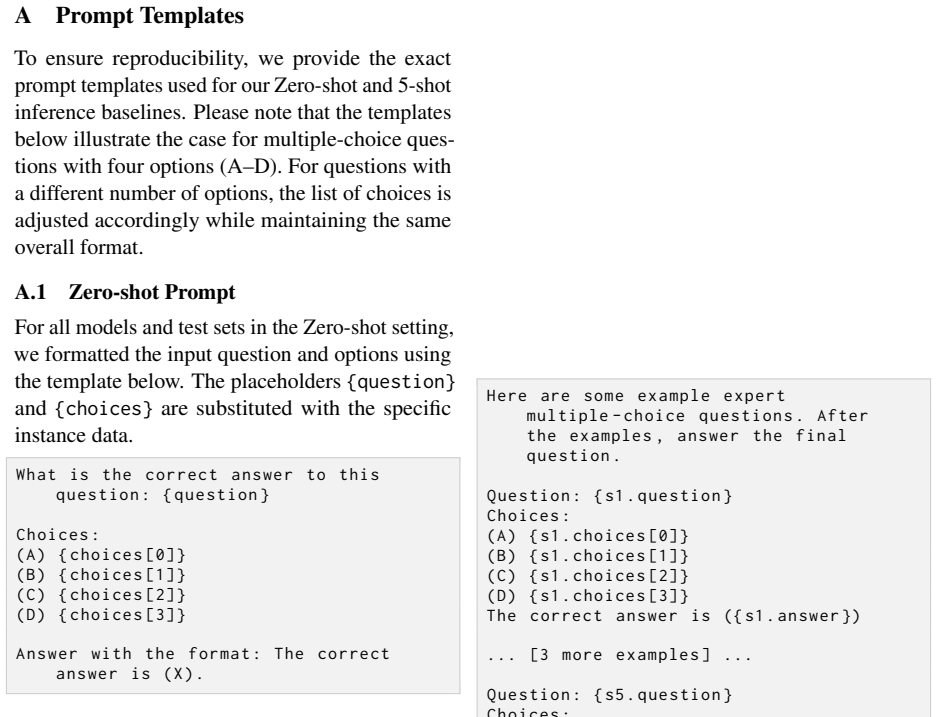
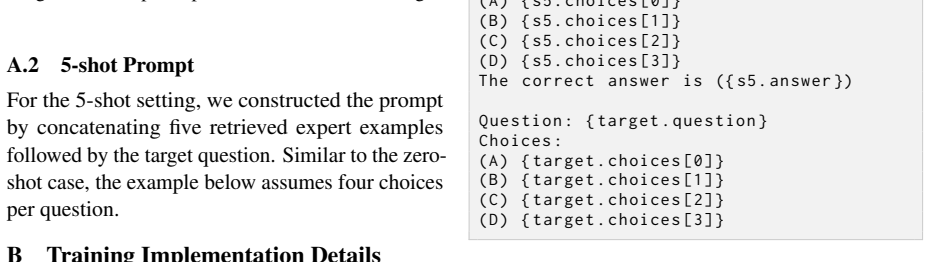
Mixture-of-Experts (MoE) architectures scale large language models efficiently by employing a parametric ``router'' to dispatch tokens to a sparse subset of experts. Typically, this router is trained once and then frozen, rendering routing decisions brittle under distribution shifts. We address this limitation by introducing kNN-MoE, a retrieval-augmented routing framework that reuses locally optimal expert assignments from a memory of similar past cases. This memory is constructed offline by directly optimizing token-wise routing logits to maximize the likelihood on a reference set. Crucially, we use the average similarity of retrieved neighbors as a confidence-driven mixing coefficient, thus allowing the method to fall back to the frozen router when no relevant cases are found. Experiments show that kNN-MoE outperforms the zero-shot baseline and is competitive with computationally intensive supervised fine-tuning.
Figures

Reference graph
Works this paper leans on
-
[4]
arXiv preprint arXiv:2009.13081
What dis- ease does this patient have? a large-scale open do- main question answering dataset from medical exams. arXiv preprint arXiv:2009.13081. Jeff Johnson, Matthijs Douze, and Hervé Jégou
Pith/arXiv arXiv 2009
-
[5]
Retrieval-augmented generation for knowledge- intensive nlp tasks. InProceedings of the 34th Inter- national Conference on Neural Information Process- ing Systems, NIPS ’20, Red Hook, NY , USA. Curran Associates Inc. Zhongyang Li, Ziyue Li, and Tianyi Zhou. 2025a. C3PO: Critical-layer, core-expert, collaborative path- way optimization for test-time expert...
-
[6]
Olmoe: Open mixture-of-experts language models.Preprint, arXiv:2409.02060. OpenAI
-
[7]
gpt-oss-120b & gpt-oss-20b model card. Preprint, arXiv:2508.10925. Ankit Pal, Logesh Kumar Umapathi, and Malaikannan Sankarasubbu
-
[9]
Rewiring experts on the fly:continuous rerouting for better online adaptation in mixture-of-expert models.Preprint, arXiv:2510.14853. M-A-P Team, Xinrun Du, Yifan Yao, Kaijing Ma, Bingli Wang, Tianyu Zheng, Kang Zhu, Minghao Liu, Yim- ing Liang, Xiaolong Jin, Zhenlin Wei, Chujie Zheng, Kaixin Deng, Shian Jia, Sichao Jiang, Yiyan Liao, Rui Li, Qinrui Li, S...
-
[10]
Su- pergpqa: Scaling llm evaluation across 285 graduate disciplines.Preprint, arXiv:2502.14739. Qwen Team
-
[11]
Qwen3 technical report.Preprint, arXiv:2505.09388. Ashish Vaswani, Noam Shazeer, Niki Parmar, Jakob Uszkoreit, Llion Jones, Aidan N Gomez, Ł ukasz Kaiser, and Illia Polosukhin
-
[12]
arXiv preprint arXiv:2506.05176
Qwen3 embedding: Advancing text embedding and reranking through foundation models. arXiv preprint arXiv:2506.05176. Lianmin Zheng, Wei-Lin Chiang, Ying Sheng, Siyuan Zhuang, Zhanghao Wu, Yonghao Zhuang, Zi Lin, Zhuohan Li, Dacheng Li, Eric P. Xing, Hao Zhang, Joseph E. Gonzalez, and Ion Stoica
-
[2017]
Guinan Su, Yanwu Yang, Li Shen, Lu Yin, Shiwei Liu, and Jonas Geiping
Outrageously large neural networks: The sparsely-gated mixture-of-experts layer.arXiv preprint arXiv:1701.06538. Guinan Su, Yanwu Yang, Li Shen, Lu Yin, Shiwei Liu, and Jonas Geiping
-
[2020]
InProceedings of the 34th International Conference on Neural Information Processing Systems, NIPS ’20, Red Hook, NY , USA
Language models are few-shot learners. InProceedings of the 34th International Conference on Neural Information Processing Systems, NIPS ’20, Red Hook, NY , USA. Curran Associates Inc. B.V . Dasarathy. 1991.Nearest Neighbor (NN) Norms: Nn Pattern Classification Techniques. IEEE Com- puter Society Press tutorial. IEEE Computer Society Press. Hiroyuki Deguc...
1991
-
[2024]
Mixtral of experts. Preprint, arXiv:2401.04088. Di Jin, Eileen Pan, Nassim Oufattole, Wei-Hung Weng, Hanyi Fang, and Peter Szolovits
-
[2025]
InProceedings of the 2025 Conference on Empirical Methods in Natural Language Processing, pages 33679–33694, Suzhou, China
Case- based decision-theoretic decoding with quality mem- ories. InProceedings of the 2025 Conference on Empirical Methods in Natural Language Processing, pages 33679–33694, Suzhou, China. Association for Computational Linguistics. William Fedus, Barret Zoph, and Noam Shazeer
2025
discussion (0)
Sign in with ORCID, Apple, or X to comment. Anyone can read and Pith papers without signing in.