REVIEW 4 major objections 5 minor 2 cited by
Asymptotic freedom, lost: Complex conformal field theory in the two-dimensional $O(N>2)$ nonlinear sigma model and its realization in Heisenberg spin chains
T0 review · 4 major / 5 minor · reviewed 2026-08-03 · deepseek-v4-flash
Pith's one-line read The two-dimensional O(N) nonlinear sigma model acquires a pair of complex-conjugate fixed points when the coupling is allowed to be complex, described by a complex conformal field theory.
desk verdict Serious numerical evidence for a complex O(3) CFT in non-Hermitian spin chains, but the NLSM port rests on a marginally irrelevant operator and two headline exponents are fit targets, not predictions. read the letter →
The pith
A machine-rendered reading of the paper's core claim, the machinery that carries it, and where it could break.
The reading
What carries the argument
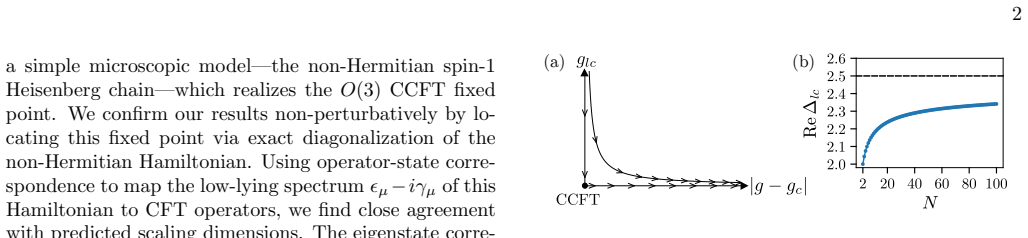
The carrying object is the O(N) loop model's Coulomb-gas data, analytically continued to N>2: the fixed-point branches g̃± = 1 ± e(N) with e(N) = (1/π)cos⁻¹(N/2) give closed-form central charge and scaling dimensions that are real for N≤2 and move into a complex-conjugate pair for N>2. The link to the NLSM is provided by the loop-crossing operator, the singlet component of the ℓ=4 watermelon operator, which the paper computes to be irrelevant for all N>2 (Re Δ_{ℓ=4} rises from about 2.04 at N=3 to 2.5 as N→∞). That irrelevance is what makes the loop-model CCFT the generic critical behavior of the non-Hermitian NLSM rather than an artifact of the loop-model truncation.
What would settle it
Measure the finite-size scaling of the loop-crossing coupling in the non-Hermitian spin-1 chain: if Re Δ_{ℓ=4} ≤ 2, the near-marginal operator will grow with system size and the spectrum will drift away from the predicted CCFT; alternatively, a high-precision transfer-matrix calculation of the ℓ=4 watermelon scaling dimension at N=3 would settle whether the loop-model fixed point carries over to the NLSM.
Extended reading notes
Core claim
The central claim is that the 2D O(N) nonlinear sigma model, for N>2, possesses a pair of complex-conjugate fixed points at complex values of the coupling g, obtained by analytic continuation of two branches of real fixed points that annihilate at N=2. At these points the theory becomes a CCFT with central charge c±(N) = 1 − 6(1−g̃±)²/g̃±, where g̃± = 1 ± (1/π)cos⁻¹(N/2); for N=3 this gives c ≈ 1.51 ± 0.158i. The fixed point is generic: it has a single relevant singlet operator, the energy operator, so it requires tuning only one complex parameter. The port from the loop model to the NLSM rests on the irrelevance of loop crossings, identified with the singlet component of the ℓ=4 watermelon
Load-bearing premise
The argument stands on the claim that loop crossings—the singlet component of the ℓ=4 watermelon operator—are irrelevant for N>2; at N=3 the computed exponent Re Δ_{ℓ=4} ≈ 2.04 is barely above the marginal value of 2, so if this near-marginal operator is actually relevant or exactly marginal, the NLSM would flow elsewhere and the CCFT would not be the generic fixed point.
Editorial extensions
If this is right
- Asymptotic freedom is lost in the complex coupling plane: a wide region of initial couplings flows to the CCFT rather than to the trivial g=0 fixed point.
- The CCFT is the generic critical point of any non-Hermitian O(N>2)-symmetric model, requiring only a single complex tuning parameter.
- Numerical agreement at N=3 in spin-1 chains and a spin-1/2 ladder supports the analytic continuation of the N≤2 real fixed points to complex N>2.
- Because the CCFT vacuum is the longest-lived state, no-click dissipative dynamics of the proposed Lindbladian relaxes into a CFT state, providing a route to preparing long-range entangled states through engineered dissipation.
- Perturbative beta functions at any fixed loop order should generically have zeros away from the positive real axis; whether these align with the CCFT points is a testable consistency check on perturbation theory.
Reading between the lines
- Editorial inference: If the complex fixed point exists beyond the one-loop approximation, the NLSM on the real axis may pass near the complex fixed point and exhibit slow 'walking' RG flow or weakly first-order behavior, analogous to other complex-fixed-point phenomena.
- Editorial inference: The near-marginal loop-crossing exponent at N=3 (Re Δ=2.04) makes the universality claim delicate; a high-precision transfer-matrix or Monte Carlo calculation of the ℓ=4 watermelon dimension would directly sharpen or refute the port from loop models to the NLSM.
- Editorial inference: The ladder model with exact non-invertible symmetry may be a cleaner experimental and numerical platform for observing the CCFT, since it eliminates the slow finite-size convergence caused by loop crossings.
- Editorial inference: The dissipative preparation protocol relies on postselecting no-click trajectories; a natural extension, noted as open by the authors, is whether the CCFT can appear as the steady state of the full Lindbladian without postselection.
Editorial analysis
A structured set of objections, weighed in public.
Referee Report
Summary. The paper claims that the two-dimensional O(N>2) nonlinear sigma model (NLSM), when the coupling g is allowed to be complex, possesses a pair of complex-conjugate fixed points described by a complex CFT (CCFT) with complex central charge c(N). This is obtained by analytically continuing the known O(N) loop-model fixed points from N≤2 to N>2 and by arguing that loop crossings—the singlet component of the ℓ=4 watermelon operator—are irrelevant for N>2. The authors then locate the N=3 CCFT numerically in non-Hermitian spin-1 Heisenberg chains, in a K1-K2 chain, and in a spin-1/2 ladder with an exact non-invertible symmetry, comparing the complex spectrum and the biorthogonal entanglement entropy with Coulomb-gas predictions. They further propose a Lindbladian whose no-click trajectories realize the non-Hermitian Hamiltonian, so that dissipative evolution can prepare the CCFT vacuum.
Significance. If the central claim holds, it is conceptually significant: it would show that asymptotic freedom is lost in the complex coupling plane, that a generic non-Hermitian O(N>2) model can flow to a CCFT with a single complex relevant coupling, and that dissipative no-click dynamics can prepare a long-range entangled critical state. The numerical work is extensive: several distinct microscopic models are studied, and the non-fitted quantities—central charge, current, stress tensor, and several watermelon multiplets—show reasonable agreement. The Lindblad construction is explicit and physically motivated. However, the NLSM-to-loop-model port rests on the marginal irrelevance of loop crossings, and the main numerical confirmation uses the predicted ϵ and ℓ=1 dimensions as fitting targets. These issues are load-bearing and require additional evidence before the strong claims can be accepted.
major comments (4)
- [Predictions for the O(N) NLSM, Eq. (4), Fig. 2(b)] The crossover from the O(N) loop model to the NLSM rests entirely on the loop-crossing operator (singlet component of the ℓ=4 watermelon) being irrelevant at the CCFT. At N=3, Eq. (4) predicts Re∆_lc ≈ 2.04, only 0.04 above marginal. The numerical spectrum in Fig. 3(d) gives Re∆ for D0 as 1.94, actually below 2. Because the critical point was located by fitting the predicted ℓ=1 and ϵ dimensions, this near-marginal/relevant value is not an independent check. Please provide a direct finite-size determination of the loop-crossing RG eigenvalue, e.g. the L-dependence of the D0 gap at fixed (J2,K), and state whether Re∆_lc > 2 in the thermodynamic limit. If it is ≤2, the NLSM does not flow to the CCFT and the central claim fails.
- [Supplemental Material Sec. II, Eq. (S3)] The finite-size critical point (J2,K) is found by minimizing the cost function with R1 and R2 set to zero against the predicted ∆ϵ and ∆ℓ=1. Reporting these two operators in the main text as 'good agreement' is circular. The independent confirmation consists of the central charge, J, T, and the ℓ=2,3,4 watermelon operators (with the caveat in Comment 1). Please label ϵ and A as fitting targets, remove them from the confirmation table, and quantify the agreement using only the non-fitted data. This is essential for the non-perturbative claim.
- [Microscopic model and numerical results, Eq. (6)] The genericity claim—single relevant singlet and single complex tuning parameter—is in tension with the actual numerical procedure, which tunes two complex parameters (J2,K) or (K1,K2) and uses an optimization weight w in Eq. (S3). The explanation is that loop crossings are weakly irrelevant, but this means the identified point is not shown to lie on the one-complex-parameter critical manifold. Please demonstrate either that a one-complex-parameter family through (J2,K)+ remains critical in the thermodynamic limit, or provide a quantitative estimate of the residual loop-crossing coupling at L=14 and its RG flow. Without this, the 'generic' statement is not supported by the numerics.
- [End Matter, Ladder model with exact non-invertible symmetry] The spin-1/2 ladder is an exact realization of the dilute Temperley-Lieb/loop model and therefore excludes loop crossings by construction. It strengthens the loop-model side but cannot test the NLSM port. Please state this limitation explicitly where the ladder is presented as confirmation of the NLSM CCFT, and avoid presenting it as independent evidence for the NLSM-to-CCFT claim.
minor comments (5)
- [Fig. 3(d)] The table of identified CCFT states appears to be duplicated in panels (a) and (b)/(c) of Fig. 3; please remove the duplicate and ensure the table is a single panel.
- [Eq. (S3)] Define clearly that R2 is complex and that the cost function uses |R2| after the feature-scaling weight w; the notation f(J2,K)=|R1|+w|R2| is only presented in the text and could be made explicit.
- [Discussion] The phrase 'unnecessary transition' is used without a precise definition. Please define what is meant in terms of the RG flow or the phase diagram.
- [Monitored dynamics, Eq. (8)-(9)] The claim that the system 'naturally relaxes' to the CCFT should be qualified: no-click postselection has a success probability that decays exponentially in time and system size. This is not a fatal issue, but it should be stated to calibrate the proposed state-preparation protocol.
- [General] For a numerics-heavy Letter, please include a data/code availability statement, especially since exact diagonalization and DMRG details are only partially described in the Supplemental Material.
Circularity Check
The spin-1 chain 'confirmation' of the ϵ and ℓ=1 scaling dimensions is fitted: SM Eq. S3 uses these predicted values as the optimization target, and Fig. 3(d) then lists the same numbers as predicted-vs-calculated. Central charge and other operators remain independent, so the paper is partially but not fully circular.
-
fitted input called prediction
[Supplemental Material Sec. II, Eqs. (S2)-(S3); main text around Eq. (6) and Fig. 3(d) table]
"We do so by matching the thermal and ℓ= 1 watermelon scaling dimensions in the spin chain spectrum with their predicted values. ... R1 = ∆ℓ=1/∆ϵ − ∆calcℓ=1/∆calcϵ, R2 = ∆ϵ/∆calcϵ −1. ... Energy ϵ 0 0 1.66 − 1.12i 1.67 − 1.1i ... ℓ= 1 WM A 1 π 0.168 + 0.0251i 0.168 + 0.0252i"
The gradient-descent cost function f(J2,K)=|R1|+w|R2| is minimized by construction when the calculated ϵ and ℓ=1 dimensions equal the Coulomb-gas predictions: R2=0 forces ∆calcϵ=∆ϵ, and R1=0 then forces the ratio, hence ∆calcℓ=1=∆ℓ=1. The resulting finite-size point (J2,K) is then used in Fig. 3(d), where the same two operators are listed as 'Predicted' vs 'Calculated' and reported as confirmed. This is a fitted input presented as a prediction. The same optimization is reused for the K1-K2 model ('A similar optimization scheme as the one used in the main text'), so its low-energy ϵ and ℓ=1 agreement is likewise not independent. Other quantities — central charge, ℓ=2,3,4 operators, current, stress tensor — were not in the cost function and remain independent evidence.
full rationale
The paper's central field-theoretic claim — that the O(N>2) NLSM in the complex coupling plane flows to the loop-model CCFT — is not itself circular: it rests on Coulomb-gas formulas that are standard and cited to multiple independent sources (Refs. [22,70-76]), and on the porting argument that loop crossings are irrelevant (Eq. (4), Ref. [80]). The numerical confirmation, however, contains a genuinely circular element for two headline numbers. The SM explicitly states that the optimization searches for the finite-size critical point 'by matching the thermal and ℓ=1 watermelon scaling dimensions in the spin chain spectrum with their predicted values,' via cost functions R1,R2 (Eq. S3). Minimizing these residuals forces the calculated ϵ and ℓ=1 dimensions to coincide with the predicted ones, so the Fig. 3(d) entries for those operators are fitted inputs, not independent predictions. The same procedure is used for the K1-K2 model. By contrast, the central charge (c=1.529−0.161i vs 1.51−0.158i), the ℓ=2,3,4 watermelon multiplets, the current, and the stress tensor are not used in the cost function and are compared with predictions after the fact; they provide genuine, non-circular support. The spin-1/2 ladder analysis also uses a scale-invariance residual (Eq. 13) rather than a predicted-dimension target, so it is independent. The near-marginal loop-crossing exponent Re∆ℓ=4≈2.04 is a fragility of the porting argument, not a circularity. Overall, the central claim has substantial independent content, but at least two of the paper's headline 'confirmed' scaling dimensions are fitted rather than predicted, giving a partial-circularity score of 6.
Assumptions & free parameters
free parameters (6)
- (J2,K) critical point in spin-1 chain =
(0.0660+0.338i, 0.176+0.335i)
- (K1,K2) critical point in K1-K2 chain =
(0.385+0.243i, −0.414−1.77i)
- complex velocity v =
0.796−1.03i (spin-1); 0.578−0.72i (K1-K2); 0.767+0.235i (ladder)
- central charge c =
1.529−0.161i (spin-1); 1.565−0.2i (K1-K2); 1.54−0.214i (ladder)
- optimization weight w =
0.2
- bulk energy density e∞ =
not quoted
assumptions (6)
- domain assumption Coulomb gas formulas for O(N) loop model central charge and scaling dimensions (Eqs. 2-4) from Refs [22,70-76].
- domain assumption Loop crossings correspond to the singlet component of the ℓ=4 watermelon operator and are irrelevant for N>2.
- ad hoc to paper Complexifying J2 and K in the spin-1 Heisenberg chain yields an O(3) NLSM with complex coupling g(J2,K).
- standard math Biorthogonal entanglement entropy for non-Hermitian critical systems obeys S=(c/3)log[(L/π)sin(πl/L)]+s0 with complex c.
- standard math No-click Lindblad dynamics are governed by H_eff = H0 − (i/2)Σ_a L_a†L_a.
- domain assumption The dilute Temperley-Lieb algebra and Yang-Baxter point analytically continued to N>2 describe the O(3) loop model and the spin-1/2 ladder.
Cite this review
Pith. "Pith review of Asymptotic freedom, lost: Complex conformal field theory in the two-dimensional $O(N>2)$ nonlinear sigma model and its realization in Heisenberg spin chains." pith.science (2026). https://pith.science/paper/QBRXGIQF
@misc{pith2026260102459,
  author       = {Pith},
  title        = {Pith review of: Asymptotic freedom, lost: Complex conformal field theory in the two-dimensional $O(N>2)$ nonlinear sigma model and its realization in Heisenberg spin chains},
  year         = {2026},
  howpublished = {\url{https://pith.science/paper/QBRXGIQF}},
  note         = {Machine review of arXiv:2601.02459}
}
abstract
The two-dimensional $O(N)$ nonlinear sigma model (NLSM) is asymptotically free for $N>2$: it exhibits neither a nontrivial fixed point nor spontaneous symmetry-breaking. Here we show that a nontrivial fixed point generically does exist in the complex coupling plane and is described by a complex conformal field theory (CCFT). This CCFT fixed point is generic in the sense that it has a single relevant singlet operator, and is thus expected to arise in any non-Hermitian model with $O(N)$ symmetry upon tuning a single complex parameter. We confirm this prediction numerically by locating the CCFT at $N = 3$ in two non-Hermitian spin-1 antiferromagnetic Heisenberg chains, and in a non-Hermitian spin-$1/2$ ladder, finding good agreement between the complex central charge and scaling dimensions and those obtained by analytic continuation of real fixed points from $N\leq 2$. We further construct a realistic Lindbladian for a spin-1 chain whose no-click dynamics are governed by the non-Hermitian Hamiltonian realizing the CCFT. Since the CCFT vacuum is the eigenstate with the smallest decay rate, the system naturally relaxes under dissipative dynamics toward a CFT state, thus providing a route to preparing long-range entangled states through engineered dissipation.
Figures


Figures from the paper (4 more)


Forward citations
Cited by 2 Pith papers
-
Complex Conformal Manifolds
Complexified exactly-marginal couplings produce solvable complex CFTs, with the Ising defect verified numerically in non-Hermitian chains.
-
Spiral renormalization group flow and universal entanglement spectrum of the non-Hermitian 5-state Potts model
Tensor network simulations of the non-Hermitian 5-state Potts model reveal the predicted spiral RG flow and a boundary spectrum matching complex conformal field theory.
Reference graph
Works this paper leans on
-
[22]
Benini, C
F. Benini, C. Iossa, and M. Serone, Phys. Rev. Lett. 6 124, 051602 (2020)
2020
-
[1]
J. M. Kosterlitz and D. J. Thouless, Journal of Physics C: Solid State Physics6, 1181 (1973)
1973
-
[2]
nonlinearσ-model (NLSM) with a complex coupling pa- rameterg. On the real axis, the flow goes to strong coupling. The CCFTs (red dots) appear at complex-conjugate positions in the complex-gplane, around which the flow forms an out- ward spiral which eventually also flows to strong coupling. explanation for the conformality loss and the “walking behavior” ...
arXiv 2026
-
[3]
loop crossings
NLSM. The parameter|g−g c|is the distance from the critical pointg c in the complex plane of the coupling con- stantg, and thus corresponds to the energy operatorϵ, which is relevant. The parameterg lc controls the strength of the “loop crossings” and corresponds to the 4-leg watermelon op- erator, with scaling dimension ∆lc ≡∆ l=4, which is irrelevant at...
-
[4]
Polyakov, Physics Letters B59, 79 (1975)
A. Polyakov, Physics Letters B59, 79 (1975)
1975
-
[5]
Br´ ezin and J
E. Br´ ezin and J. Zinn-Justin, Phys. Rev. Lett.36, 691 (1976)
1976
-
[6]
W. A. Bardeen, B. W. Lee, and R. E. Shrock, Phys. Rev. D14, 985 (1976)
1976
-
[7]
Br´ ezin and J
E. Br´ ezin and J. Zinn-Justin, Phys. Rev. B14, 3110 (1976)
1976
Show all 121 references
-
[8]
Witten, Nuclear Physics B223, 422 (1983)
E. Witten, Nuclear Physics B223, 422 (1983)
1983
-
[9]
Gasser and H
J. Gasser and H. Leutwyler, Annals of Physics158, 142 (1984)
1984
-
[10]
D. H. Friedan, Annals of Physics163, 318 (1985)
1985
-
[11]
Gawedzki and A
K. Gawedzki and A. Kupiainen, Communications in Mathematical Physics106, 533 (1986)
1986
-
[12]
P. K. Mitter and T. R. Ramadas, Communications in Mathematical Physics122, 575–596 (1989)
1989
-
[13]
Haldane, Physics Letters A93, 464 (1983)
F. Haldane, Physics Letters A93, 464 (1983)
1983
-
[14]
F. D. M. Haldane, Phys. Rev. Lett.61, 1029 (1988)
1988
-
[15]
Chepiga, I
N. Chepiga, I. Affleck, and F. Mila, Phys. Rev. B93, 241108 (2016)
2016
-
[16]
Fradkin,Field Theories of Condensed Matter Physics (Cambridge University Press, 2013)
E. Fradkin,Field Theories of Condensed Matter Physics (Cambridge University Press, 2013)
2013
-
[17]
J. H. Pixley, A. Shashi, and A. H. Nevidomskyy, Phys. Rev. B90, 214426 (2014)
2014
-
[18]
N. D. Mermin and H. Wagner, Phys. Rev. Lett.17, 1133 (1966)
1966
-
[19]
Gorbenko, S
V. Gorbenko, S. Rychkov, and B. Zan, Journal of High Energy Physics2018(2018), 10.1007/jhep10(2018)108
2018 doi
-
[20]
Gorbenko, S
V. Gorbenko, S. Rychkov, and B. Zan, SciPost Phys. 5, 050 (2018)
2018
-
[21]
A. F. Faedo, C. Hoyos, D. Mateos, and J. G. Subils, Phys. Rev. Lett.124, 161601 (2020)
2020
-
[23]
A. F. Faedo, C. Hoyos, D. Mateos, and J. G. Subils, Journal of High Energy Physics2021(2021), 10.1007/jhep10(2021)246
2021 doi
-
[25]
J. L. Jacobsen and K. J. Wiese, Phys. Rev. Lett.133, 077101 (2024)
2024
-
[26]
Itakura, Journal of the Physical Society of Japan72, 74 (2003), https://doi.org/10.1143/JPSJ.72.74
M. Itakura, Journal of the Physical Society of Japan72, 74 (2003), https://doi.org/10.1143/JPSJ.72.74
2003 doi
-
[27]
D. B. Kaplan, J.-W. Lee, D. T. Son, and M. A. Stephanov, Phys. Rev. D80, 125005 (2009)
2009
-
[28]
Nahum, J
A. Nahum, J. T. Chalker, P. Serna, M. Ortu˜ no, and A. M. Somoza, Phys. Rev. X5, 041048 (2015)
2015
-
[29]
C. Wang, A. Nahum, M. A. Metlitski, C. Xu, and T. Senthil, Phys. Rev. X7, 031051 (2017)
2017
-
[30]
S. Iino, S. Morita, N. Kawashima, and A. W. Sandvik, Journal of the Physical Society of Japan88, 034006 (2019), https://doi.org/10.7566/JPSJ.88.034006
2019 doi
-
[31]
Serna and A
P. Serna and A. Nahum, Phys. Rev. B99, 195110 (2019)
2019
-
[32]
Ma and Y.-C
H. Ma and Y.-C. He, Phys. Rev. B99, 195130 (2019)
2019
-
[33]
Ma and C
R. Ma and C. Wang, Phys. Rev. B102, 020407 (2020)
2020
-
[34]
D’Emidio, A
J. D’Emidio, A. A. Eberharter, and A. M. L¨ auchli, SciPost Phys.15, 061 (2023)
2023
-
[35]
Z. Zhou, L. Hu, W. Zhu, and Y.-C. He, Phys. Rev. X 14, 021044 (2024)
2024
-
[36]
Y. Tang, H. Ma, Q. Tang, Y.-C. He, and W. Zhu, Phys. Rev. Lett.133, 076504 (2024)
2024
-
[37]
Spiral renormalization group flow and universal entanglement spectrum of the non-hermitian 5-state potts model,
V. V. Linden, B. De Vos, K. Vervoort, F. Verstraete, and A. Ueda, “Spiral renormalization group flow and universal entanglement spectrum of the non-hermitian 5-state potts model,” (2025)
2025
-
[38]
Nauenberg and D
M. Nauenberg and D. J. Scalapino, Phys. Rev. Lett.44, 837 (1980)
1980
-
[39]
J. L. Cardy, M. Nauenberg, and D. J. Scalapino, Phys. Rev. B22, 2560 (1980)
1980
-
[40]
Fukugita and M
M. Fukugita and M. Okawa, Phys. Rev. Lett.63, 13 (1989)
1989
-
[41]
Shimizu and K
H. Shimizu and K. Kawabata, Phys. Rev. B112, 085112 (2025)
2025
-
[42]
Unraveling deconfined quantum criticality in non-hermitian easy- planej-qmodel,
X. Zou, S. Yin, Z.-X. Li, and H. Yao, “Unraveling deconfined quantum criticality in non-hermitian easy- planej-qmodel,” (2025)
2025
-
[43]
Pseudocritical- ity in antiferromagnetic spin chains,
S. Kumar, S. Pujari, and J. D’Emidio, “Pseudocritical- ity in antiferromagnetic spin chains,” (2025)
2025
-
[44]
Gopalakrishnan and M
S. Gopalakrishnan and M. J. Gullans, Phys. Rev. Lett. 126, 170503 (2021)
2021
-
[45]
E. G. Dalla Torre, E. Demler, T. Giamarchi, and E. Alt- man, Phys. Rev. B85, 184302 (2012)
2012
-
[46]
L. M. Sieberer, S. D. Huber, E. Altman, and S. Diehl, Phys. Rev. Lett.110, 195301 (2013)
2013
-
[47]
L. M. Sieberer, M. Buchhold, and S. Diehl, Reports on Progress in Physics79, 096001 (2016)
2016
-
[48]
B´ acsi, C
A. B´ acsi, C. u. u. u. u. P. m. c. Moca, G. Zar´ and, and B. D´ ora, Phys. Rev. Lett.125, 266803 (2020)
2020
-
[49]
Yamamoto, M
K. Yamamoto, M. Nakagawa, M. Tezuka, M. Ueda, and N. Kawakami, Phys. Rev. B105, 205125 (2022)
2022
-
[50]
S. J. Garratt, Z. Weinstein, and E. Altman, Phys. Rev. X13, 021026 (2023)
2023
-
[51]
S. Han, D. J. Schultz, and Y. B. Kim, Phys. Rev. B 107, 235153 (2023)
2023
-
[52]
A. I. Lotkov, D. V. Kurlov, A. K. Fedorov, N. A. Nemkov, and V. Gritsev, Phys. Rev. B108, 064312 (2023)
2023
-
[53]
Murciano, P
S. Murciano, P. Sala, Y. Liu, R. S. K. Mong, and J. Al- icea, Phys. Rev. X13, 041042 (2023)
2023
-
[54]
O. A. Castro-Alvaredo and A. Fring, Journal of Physics A: Mathematical and Theoretical42, 465211 (2009)
2009
-
[55]
Couvreur, J
R. Couvreur, J. L. Jacobsen, and H. Saleur, Phys. Rev. Lett.119, 040601 (2017)
2017
-
[56]
X. Chen, Y. Li, M. P. A. Fisher, and A. Lucas, Phys. Rev. Res.2, 033017 (2020)
2020
-
[57]
Tu, Y.-C
Y.-T. Tu, Y.-C. Tzeng, and P.-Y. Chang, SciPost Phys. 12, 194 (2022)
2022
-
[58]
Dengis, R
J. Dengis, R. K¨ onig, and F. Pastawski, New Journal of Physics16, 013023 (2014)
2014
-
[59]
Universal non-hermitian flow in one-dimensional pt-symmetric quantum criticalities,
X.-C. Zhou and K. Wang, “Universal non-hermitian flow in one-dimensional pt-symmetric quantum criticalities,” (2024), arXiv:2405.01640 [cond-mat.stat-mech]
2024 arXiv
-
[60]
Lapierre, P
B. Lapierre, P. Pelliconi, S. Ryu, and J. Sonner, Phys. Rev. B112, 104322 (2025)
2025
-
[61]
Biella and M
A. Biella and M. Schir´ o, Quantum5, 528 (2021)
2021
-
[62]
Kraus, H
B. Kraus, H. P. B¨ uchler, S. Diehl, A. Kantian, A. Micheli, and P. Zoller, Phys. Rev. A78, 042307 (2008)
2008
-
[63]
Weimer, M
H. Weimer, M. M¨ uller, I. Lesanovsky, P. Zoller, and H. P. B¨ uchler, Nature Physics6, 382–388 (2010)
2010
-
[64]
L. M. Sieberer, M. Buchhold, J. Marino, and S. Diehl, Rev. Mod. Phys.97, 025004 (2025)
2025
-
[65]
D’Abbruzzo, V
A. D’Abbruzzo, V. Alba, and D. Rossini, Phys. Rev. B 106, 235149 (2022)
2022
-
[66]
Turkeshi, A
X. Turkeshi, A. Biella, R. Fazio, M. Dalmonte, and M. Schir´ o, Phys. Rev. B103, 224210 (2021)
2021
-
[67]
Szyniszewski, O
M. Szyniszewski, O. Lunt, and A. Pal, Phys. Rev. B 108, 165126 (2023)
2023
-
[68]
Alberton, M
O. Alberton, M. Buchhold, and S. Diehl, Phys. Rev. Lett.126, 170602 (2021)
2021
-
[69]
R. D. Soares, Y. Le Gal, and M. Schir` o, Phys. Rev. B 111, 064313 (2025)
2025
-
[70]
Botzung, S
T. Botzung, S. Diehl, and M. M¨ uller, Phys. Rev. B 104, 184422 (2021)
2021
-
[71]
Nienhuis, Phys
B. Nienhuis, Phys. Rev. Lett.49, 1062 (1982)
1982
-
[72]
R. J. Baxter, Journal of Physics A: Mathematical and General19, 2821 (1986)
1986
-
[73]
di Francesco, H
P. di Francesco, H. Saleur, and J. B. Zuber, Journal of Statistical Physics49, 57–79 (1987)
1987
-
[74]
M. T. Batchelor and H. W. J. Bl¨ ote, Phys. Rev. Lett. 61, 138 (1988)
1988
-
[75]
H. W. J. Blote and B. Nienhuis, Journal of Physics A: Mathematical and General22, 1415 (1989)
1989
-
[76]
Conformal field theory applied to loop models,
J. L. Jacobsen, “Conformal field theory applied to loop models,” inPolygons, Polyominoes and Polycubes, edited by A. J. Guttman (Springer Netherlands, Dor- drecht, 2009) pp. 347–424
2009
-
[77]
Grans-Samuelsson, R
L. Grans-Samuelsson, R. Nivesvivat, J. L. Jacobsen, S. Ribault, and H. Saleur, SciPost Phys.12, 147 (2022)
2022
-
[78]
J. L. Jacobsen, R. Nivesvivat, and H. Saleur, SciPost Phys.16, 111 (2024)
2024
-
[80]
J. L. Jacobsen, S. Ribault, and H. Saleur, SciPost Phys. 14, 092 (2023)
2023
-
[82]
J. L. Jacobsen, N. Read, and H. Saleur, Phys. Rev. Lett.90, 090601 (2003)
2003
-
[83]
W. J. L. Buyers, R. M. Morra, R. L. Armstrong, M. J. 7 Hogan, P. Gerlach, and K. Hirakawa, Phys. Rev. Lett. 56, 371 (1986)
1986
-
[84]
J. P. Renard, M. Verdaguer, L. P. Regnault, W. A. C. Erkelens, J. Rossat-Mignod, and W. G. Stirling, Euro- physics Letters3, 945 (1987)
1987
-
[85]
Sompet, S
P. Sompet, S. Hirthe, D. Bourgund, T. Chalopin, J. Bibo, J. Koepsell, P. Bojovi´ c, R. Verresen, F. Poll- mann, G. Salomon, C. Gross, T. A. Hilker, and I. Bloch, Nature606, 484 (2022)
2022
-
[86]
Edmunds, E
C. Edmunds, E. Rico, I. Arrazola, G. Brennen, M. Meth, R. Blatt, and M. Ringbauer, PRX Quantum 6, 020349 (2025)
2025
-
[87]
We use integer spinS= 1 so that theθ= 2πStopolog- ical term does not change the physics in the bulk
-
[88]
Affleck, inFields, Strings and Critical Phenomena, Les Houches Summer School of Theoretical Physics, Vol
I. Affleck, inFields, Strings and Critical Phenomena, Les Houches Summer School of Theoretical Physics, Vol. Session XLIX, edited by E. Br´ ezin and J. Zinn-Justin (North-Holland, Amsterdam, 1990) pp. 563–640
1990
-
[89]
J. L. Cardy, Journal of Physics A: Mathematical and General17, L385 (1984)
1984
-
[90]
Strictly speaking, depending on the value of Arg[v] an- other primary could have been the state with the lowest real part of the energy, but this does not happen for the value ofvwe found
-
[91]
[77, 78, 90, 99–103]
See Supplemental Material at [url] for details of derivations and numerical calculations, which includes Refs. [77, 78, 90, 99–103]
-
[93]
Belletˆ ete, A
J. Belletˆ ete, A. M. Gainutdinov, J. L. Jacobsen, H. Saleur, and T. S. Tavares, Communications in Math- ematical Physics400, 1203–1254 (2023)
2023
-
[94]
Minganti, D
F. Minganti, D. Huybrechts, C. Elouard, F. Nori, and I. I. Arkhipov, Phys. Rev. A106, 042210 (2022)
2022
-
[95]
Ashida, Z
Y. Ashida, Z. Gong, and M. Ueda, Advances in Physics69, 249 (2020), https://doi.org/10.1080/00018732.2021.1876991
2020
-
[96]
Roccati, G
F. Roccati, G. M. Palma, F. Ciccarello, and F. Bagarello, Open Systems & In- formation Dynamics29, 2250004 (2022), https://doi.org/10.1142/S1230161222500044
2022 doi
-
[97]
Bernreuther and F
W. Bernreuther and F. J. Wegner, Phys. Rev. Lett.57, 1383 (1986)
1986
-
[98]
Complex nonlin- ear sigma model,
K. Yamamoto and K. Kawabata, “Complex nonlin- ear sigma model,” (2026), arXiv:2601.20166 [cond- mat.stat-mech]
2026 arXiv
-
[99]
Burgelman, L
L. Burgelman, L. Devos, B. Vanhecke, F. Verstraete, and L. Vanderstraeten, Phys. Rev. E107, 014117 (2023)
2023
-
[100]
M. Fava, L. Piroli, T. Swann, D. Bernard, and A. Nahum, Phys. Rev. X13, 041045 (2023)
2023
-
[104]
Conformal field theory and statistical me- chanics,
J. Cardy, “Conformal field theory and statistical me- chanics,” (2008)
2008
-
[106]
Chang, J.-S
P.-Y. Chang, J.-S. You, X. Wen, and S. Ryu, Phys. Rev. Res.2, 033069 (2020)
2020
-
[107]
C. H. Lee, Phys. Rev. Lett.128, 010402 (2022)
2022
-
[108]
Guo, Y.-C
Y.-B. Guo, Y.-C. Yu, R.-Z. Huang, L.-P. Yang, R.-Z. Chi, H.-J. Liao, and T. Xiang, Journal of Physics: Con- densed Matter33, 475502 (2021)
2021
-
[109]
Topologically protected non- hermitian super-volume-law entanglement,
W.-T. Xue and C. H. Lee, “Topologically protected non- hermitian super-volume-law entanglement,” (2024)
2024
-
[110]
Ryu and J
S. Ryu and J. Yoon, Phys. Rev. Lett.130, 241602 (2023)
2023
-
[111]
Hsieh and P.-Y
C.-T. Hsieh and P.-Y. Chang, SciPost Phys. Core6, 062 (2023)
2023
-
[112]
Fossati, F
M. Fossati, F. Ares, and P. Calabrese, Phys. Rev. B 107, 205153 (2023)
2023
-
[113]
Calabrese and J
P. Calabrese and J. Cardy, Journal of Statistical Me- chanics: Theory and Experiment2004, P06002 (2004)
2004
-
[114]
Holzhey, F
C. Holzhey, F. Larsen, and F. Wilczek, Nuclear Physics B424, 443 (1994)
1994
-
[115]
Vidal, J
G. Vidal, J. I. Latorre, E. Rico, and A. Kitaev, Phys. Rev. Lett.90, 227902 (2003)
2003
-
[116]
Calabrese, M
P. Calabrese, M. Campostrini, F. Essler, and B. Nien- huis, Phys. Rev. Lett.104, 095701 (2010)
2010
-
[117]
S. R. White, Phys. Rev. Lett.69, 2863 (1992)
1992
-
[118]
Fishman, S
M. Fishman, S. R. White, and E. M. Stoudenmire, SciPost Phys. Codebases , 4 (2022)
2022
-
[119]
triplet gap
T. Hikihara and O. A. Starykh, Physical Review B81, 064432 (2010). 8 End Matter Entanglement entropy and central charge.—We pro- vide further evidence of the CCFT by calculating the central charge via the entanglement entropy. For non- Hermitian Hamiltonians, the generalized e...
2010
-
[120]
J. L. Jacobsen, S. Ribault, and H. Saleur, SciPost Phys. 14, 092 (2023). 6
2023
-
[121]
Cvitanovic,Group Theory: Birdtracks, Lie’s, and Ex- ceptional Groups(Princeton University Press, 2008)
P. Cvitanovic,Group Theory: Birdtracks, Lie’s, and Ex- ceptional Groups(Princeton University Press, 2008)
2008
-
[122]
Gorbenko and B
V. Gorbenko and B. Zan, Journal of High Energy Physics 2020(2020), 10.1007/jhep10(2020)099
2020 doi
-
[123]
H. W. J. Bl¨ ote, J. L. Cardy, and M. P. Nightingale, Phys. Rev. Lett.56, 742 (1986)
1986
-
[124]
Di Francesco, P
P. Di Francesco, P. Mathieu, and D. S´ en´ echal,Confor- mal Field Theory(Springer New York, 1997)
1997
-
[125]
Conformal field theory and statistical mechan- ics,
J. Cardy, “Conformal field theory and statistical mechan- ics,” (2008)
2008
- [126]
-
[127]
J. L. Jacobsen and H. Saleur, Journal of High Energy Physics2023(2023), 10.1007/jhep12(2023)090
2023 doi
-
[128]
Haldar, O
A. Haldar, O. Tavakol, H. Ma, and T. Scaffidi, Phys. Rev. Lett.131, 131601 (2023)
2023
-
[129]
Hijii and K
K. Hijii and K. Nomura, Phys. Rev. B80, 014426 (2009)
2009
Reviewed August 3, 2026 · model on record in the stance chip above.
Discussion (0). Continue with ORCID to comment.