Recognition: 2 theorem links
· Lean TheoremTensor renormalization group approach to critical phenomena via symmetry-twisted partition functions
Pith reviewed 2026-05-16 17:32 UTC · model grok-4.3
The pith
Symmetry-twisted partition functions computed via tensor renormalization group locate critical points and extract exponents in classical spin models.
A machine-rendered reading of the paper's core claim, the machinery that carries it, and where it could break.
Core claim
The tensor renormalization group offers an efficient framework to compute the symmetry-twisted partition functions, which enables detection of the symmetry-breaking transition and study of associated critical phenomena. Critical points are identified solely from the twisted partition function, and finite-size scaling extracts the critical temperature Tc = 2.2017(2) with exponent nu = 0.663(33) for the 3D O(2) model together with the BKT temperature TBKT = 0.8928(2) for the 2D O(2) model.
What carries the argument
Symmetry-twisted partition function, which encodes the response of the system to twisted boundary conditions and serves as an order parameter for spontaneous symmetry breaking through its low-energy scaling.
If this is right
- Critical temperatures and exponents can be determined solely from the scaling of twisted partition functions without reference to conventional order parameters.
- The helicity modulus for BKT transitions becomes directly accessible from the same twisted sectors.
- The approach applies uniformly to both discrete-symmetry models such as the Ising model and continuous-symmetry models such as O(2).
- Finite-size scaling analysis on TRG data yields quantitative estimates for Tc and nu that match known benchmarks within reported errors.
Where Pith is reading between the lines
- The same TRG construction could be applied to quantum lattice models by replacing the classical tensor network with a quantum one while retaining the twisted-boundary construction.
- Because twisted sectors are sensitive to long-distance symmetry realizations, the method may help classify phases protected by higher-form or subsystem symmetries.
- Numerical cost scales with bond dimension rather than volume, so the technique could reach system sizes where conventional Monte Carlo sampling of twisted boundaries becomes impractical.
Load-bearing premise
The bond-dimension truncation in the tensor renormalization group is large enough to capture the long-distance physics of the symmetry-twisted sectors with accuracy sufficient for reliable finite-size scaling.
What would settle it
A systematic discrepancy between the critical temperature and exponent extracted from the twisted partition functions and the values obtained from conventional Monte Carlo simulations on the same models would falsify the claim that the TRG twisted sectors are sufficient.
Figures
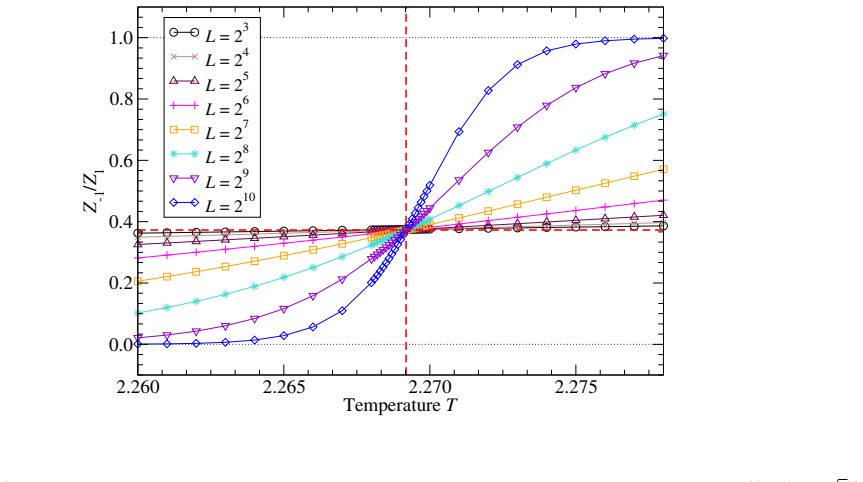


read the original abstract
The locality of field theories strongly constrains the possible behaviors of symmetry-twisted partition functions, and thus they serve as order parameters to detect low-energy realizations of global symmetries, such as spontaneous symmetry breaking (SSB). We demonstrate that the tensor renormalization group (TRG) offers an efficient framework to compute the symmetry-twisted partition functions, which enables us to detect the symmetry-breaking transition and also to study associated critical phenomena. As concrete examples of SSB, we investigate the two-dimensional (2D) classical Ising model and the three-dimensional (3D) classical $O(2)$ nonlinear sigma model, and we identify their critical points solely from the twisted partition function. By employing the finite-size scaling argument, we find the critical temperature $T_c=2.2017(2)$ with the critical exponent $\nu = 0.663(33)$ for the 3D $O(2)$ model. In addition, we also study the Berezinskii-Kosterlitz-Thouless (BKT) criticality of the 2D classical $O(2)$ model by extracting the helicity modulus from the twisted partition functions, and we obtain the BKT transition temperature, $T_{\mathrm{BKT}}=0.8928(2)$.
Editorial analysis
A structured set of objections, weighed in public.
Referee Report
Summary. The manuscript introduces a TRG-based method to compute symmetry-twisted partition functions, which serve as order parameters for spontaneous symmetry breaking due to locality constraints in field theories. It applies this to the 2D Ising model, extracts Tc=2.2017(2) and ν=0.663(33) for the 3D O(2) nonlinear sigma model via finite-size scaling of the twisted partition function, and determines TBKT=0.8928(2) for the 2D O(2) model from the helicity modulus extracted from twisted sectors.
Significance. If the numerical extractions prove robust against truncation artifacts, the approach provides an efficient tensor-network route to critical parameters that relies only on twisted partition functions rather than direct order-parameter measurements, with potential extension to other models exhibiting SSB or topological transitions.
major comments (1)
- Results for the 3D O(2) model: The quoted Tc=2.2017(2) and ν=0.663(33) are obtained from finite-size scaling fits to the twisted partition function, yet no data or plots are provided showing stability of these quantities (or of the underlying twisted free energies) under successive increases in TRG bond dimension D. Because the truncation directly affects the entanglement spectrum in the twisted sectors, this omission leaves open a possible D-dependent systematic bias in the extracted critical parameters.
minor comments (1)
- The abstract states that critical points are identified 'solely from the twisted partition function,' but the implementation section should explicitly describe how the phase factors or boundary conditions for the twisted sectors are incorporated into the TRG coarse-graining steps.
Simulated Author's Rebuttal
We thank the referee for the careful reading of our manuscript and the constructive comment. We address the major point below and will revise the manuscript to incorporate additional checks as suggested.
read point-by-point responses
-
Referee: Results for the 3D O(2) model: The quoted Tc=2.2017(2) and ν=0.663(33) are obtained from finite-size scaling fits to the twisted partition function, yet no data or plots are provided showing stability of these quantities (or of the underlying twisted free energies) under successive increases in TRG bond dimension D. Because the truncation directly affects the entanglement spectrum in the twisted sectors, this omission leaves open a possible D-dependent systematic bias in the extracted critical parameters.
Authors: We agree that explicit demonstration of stability under increasing bond dimension D is important for establishing the reliability of the results, particularly given the truncation effects on the entanglement spectrum in twisted sectors. The manuscript presents results obtained at bond dimensions where our internal convergence checks indicated stability within the reported statistical errors, but we did not include the supporting D-dependence data or plots. In the revised version we will add a new figure (or table) showing the twisted free energies and the fitted values of Tc and ν for successive D (e.g., D = 16, 32, 64), confirming that the quoted central values remain stable within the stated uncertainties. revision: yes
Circularity Check
No circularity: critical parameters extracted numerically via TRG and finite-size scaling
full rationale
The derivation computes symmetry-twisted partition functions using the standard TRG coarse-graining algorithm applied to the lattice models. Critical temperatures and exponents are then obtained by fitting finite-size scaling forms to the numerically generated data for the twisted free energies and helicity modulus. These steps are independent of the target values; the reported Tc=2.2017(2), ν=0.663(33), and TBKT=0.8928(2) emerge from the scaling analysis rather than being inserted by definition or reduced to prior fitted parameters. No self-definitional relations, fitted-input predictions, or load-bearing self-citations that collapse the central claim are present. The TRG bond-dimension truncation is an approximation whose convergence is external to the logical chain and does not create equivalence by construction.
Axiom & Free-Parameter Ledger
free parameters (1)
- TRG bond dimension
axioms (1)
- domain assumption Locality of field theories strongly constrains the possible behaviors of symmetry-twisted partition functions
Lean theorems connected to this paper
-
IndisputableMonolith/Foundation/AbsoluteFloorClosure.lean; Cost/FunctionalEquation.leanreality_from_one_distinction; washburn_uniqueness_aczel unclear?
unclearRelation between the paper passage and the cited Recognition theorem.
we identify their critical points solely from the twisted partition function... Tc=2.2017(2) with ν=0.663(33) for the 3D O(2) model... TBKT=0.8928(2)
-
IndisputableMonolith/Foundation/AlexanderDuality.leanalexander_duality_circle_linking unclear?
unclearRelation between the paper passage and the cited Recognition theorem.
TRG algorithms... symmetry blocking... Zα/Z0 ratios and finite-size scaling
What do these tags mean?
- matches
- The paper's claim is directly supported by a theorem in the formal canon.
- supports
- The theorem supports part of the paper's argument, but the paper may add assumptions or extra steps.
- extends
- The paper goes beyond the formal theorem; the theorem is a base layer rather than the whole result.
- uses
- The paper appears to rely on the theorem as machinery.
- contradicts
- The paper's claim conflicts with a theorem or certificate in the canon.
- unclear
- Pith found a possible connection, but the passage is too broad, indirect, or ambiguous to say the theorem truly supports the claim.
Reference graph
Works this paper leans on
-
[1]
Density matrix formulation for quantum renormalization groups,
S. R. White, “Density matrix formulation for quantum renormalization groups,”Phys. Rev. Lett.69(1992) 2863–2866
work page 1992
-
[2]
The density-matrix renormalization group in the age of matrix product states,
U. Schollw¨ ock, “The density-matrix renormalization group in the age of matrix product states,”Annals of Physics326 no. 1, (Jan., 2011) 96–192
work page 2011
-
[3]
Corner transfer matrix renormalization group method,
T. Nishino and K. Okunishi, “Corner transfer matrix renormalization group method,”Journal of the Physical Society of Japan65no. 4, (Apr., 1996) 891–894
work page 1996
-
[4]
Corner transfer matrix algorithm for classical renormalization group,
T. Nishino and K. Okunishi, “Corner transfer matrix algorithm for classical renormalization group,”Journal of the Physical Society of Japan66no. 10, (Oct., 1997) 3040–3047
work page 1997
-
[5]
Dimers on a Rectangular Lattice,
R. J. Baxter, “Dimers on a Rectangular Lattice,”J. Math. Phys.9no. 4, (1968) 650
work page 1968
-
[6]
Variational approximations for square lattice models in statistical mechanics,
R. J. Baxter, “Variational approximations for square lattice models in statistical mechanics,”Journal of Statistical Physics19no. 5, (1978) 461–478
work page 1978
-
[7]
Tensor renormalization group approach to two-dimensional classical lattice models,
M. Levin and C. P. Nave, “Tensor renormalization group approach to two-dimensional classical lattice models,”Phys. Rev. Lett.99no. 12, (2007) 120601
work page 2007
-
[8]
Calculation of higher-order moments by higher-order tensor renormalization group,
S. Morita and N. Kawashima, “Calculation of higher-order moments by higher-order tensor renormalization group,” Computer Physics Communications236(2019) 65 – 71
work page 2019
-
[9]
Differentiable programming tensor networks,
H.-J. Liao, J.-G. Liu, L. Wang, and T. Xiang, “Differentiable programming tensor networks,”Phys. Rev. X9(Sep, 2019) 19 031041
work page 2019
-
[10]
Tensor-entanglement-filtering renormalization approach and symmetry-protected topological order,
Z.-C. Gu and X.-G. Wen, “Tensor-entanglement-filtering renormalization approach and symmetry-protected topological order,”Phys. Rev. B80(Oct, 2009) 155131
work page 2009
-
[11]
Tensor network renormalization,
G. Evenbly and G. Vidal, “Tensor network renormalization,”Phys. Rev. Lett.115(Oct, 2015) 180405
work page 2015
-
[12]
Loop optimization for tensor network renormalization,
S. Yang, Z.-C. Gu, and X.-G. Wen, “Loop optimization for tensor network renormalization,”Phys. Rev. Lett.118(Mar,
-
[13]
S. Iino, S. Morita, and N. Kawashima, “Boundary conformal spectrum and surface critical behavior of classical spin systems: A tensor network renormalization study,”Phys. Rev. B101no. 15, (2020) 155418
work page 2020
-
[14]
Nuclear norm regularized loop optimization for tensor network,
K. Homma, T. Okubo, and N. Kawashima, “Nuclear norm regularized loop optimization for tensor network,”Physical Review Research6no. 4, (Nov., 2024)
work page 2024
-
[15]
A. Ueda, S. D. Meyer, A. Naravane, V. Vanthilt, and F. Verstraete, “Global tensor network renormalization for 2d quantum systems: A new window to probe universal data from thermal transitions,”arXiv:2508.05406 [cond-mat.str-el]
work page internal anchor Pith review Pith/arXiv arXiv
-
[16]
Phase transitions of ferromagnetic potts models on the simple cubic lattice,
S. Wang, Z.-Y. Xie, J. Chen, B. Normand, and T. Xiang, “Phase transitions of ferromagnetic potts models on the simple cubic lattice,”Chinese Physics Letters31no. 7, (Jul, 2014) 070503
work page 2014
-
[17]
Phase transition of the q-state clock model: duality and tensor renormalization,
J. Chen, H.-J. Liao, H.-D. Xie, X.-J. Han, R.-Z. Huang, S. Cheng, Z.-C. Wei, Z.-Y. Xie, and T. Xiang, “Phase transition of the q-state clock model: duality and tensor renormalization,”Chin. Phys. Lett.34(2017) 050503
work page 2017
-
[18]
Phase transition of four-dimensional Ising model with higher-order tensor renormalization group,
S. Akiyama, Y. Kuramashi, T. Yamashita, and Y. Yoshimura, “Phase transition of four-dimensional Ising model with higher-order tensor renormalization group,”Phys. Rev.D100no. 5, (2019) 054510,arXiv:1906.06060 [hep-lat]
-
[19]
Tensor-network renormalization approach to theq-state clock model,
G. Li, K. H. Pai, and Z.-C. Gu, “Tensor-network renormalization approach to theq-state clock model,”Phys. Rev. Res.4 (May, 2022) 023159
work page 2022
-
[20]
S. Akiyama and Y. Kuramashi, “Tensor renormalization group study of (1 + 1)-dimensional U(1) gauge-Higgs model atθ =πwith L¨ uscher’s admissibility condition,”JHEP09(2024) 086,arXiv:2407.10409 [hep-lat]
-
[21]
H. Kanno, S. Akiyama, K. Murakami, and S. Takeda, “Grassmann tensor renormalization group for the massive Schwinger model with aθterm using staggered fermions,”JHEP11(2025) 036,arXiv:2412.08959 [hep-lat]
-
[22]
Three-dimensional finite temperature Z 2 gauge theory with tensor network scheme,
Y. Kuramashi and Y. Yoshimura, “Three-dimensional finite temperature Z 2 gauge theory with tensor network scheme,” JHEP08(2019) 023,arXiv:1808.08025 [hep-lat]
-
[23]
Multi-impurity method for the bond-weighted tensor renormalization group,
S. Morita and N. Kawashima, “Multi-impurity method for the bond-weighted tensor renormalization group,”Phys. Rev. B111no. 5, (2025) 054433,arXiv:2411.13998 [cond-mat.stat-mech]
-
[24]
H. Aizawa, S. Takeda, and Y. Yoshimura, “Phase structure analysis of 2d lattice CP(1) model withθterm using tensor renormalization group method,”arXiv:2510.06624 [hep-lat]
-
[25]
Tensor renormalization group calculations of partition-function ratios,
S. Morita and N. Kawashima, “Tensor renormalization group calculations of partition-function ratios,” arXiv:2512.03395 [cond-mat.stat-mech]
-
[26]
SU(2) principal chiral model with tensor renormalization group on a cubic lattice,
S. Akiyama, R. G. Jha, and J. Unmuth-Yockey, “SU(2) principal chiral model with tensor renormalization group on a cubic lattice,”Phys. Rev. D110no. 3, (2024) 034519,arXiv:2406.10081 [hep-lat]
-
[27]
Twisted partition functions as order parameters,
J. Maeda and Y. Tanizaki, “Twisted partition functions as order parameters,”JHEP08(2025) 128,arXiv:2505.16546 [hep-th]
-
[28]
Aharonov-Bohm effect and nucleon-nucleon phase shifts on the lattice
P. F. Bedaque, “Aharonov-Bohm effect and nucleon nucleon phase shifts on the lattice,”Phys. Lett. B593(2004) 82–88, arXiv:nucl-th/0402051
work page internal anchor Pith review Pith/arXiv arXiv 2004
-
[29]
Twisted Boundary Conditions in Lattice Simulations
C. T. Sachrajda and G. Villadoro, “Twisted boundary conditions in lattice simulations,”Phys. Lett. B609(2005) 73–85, arXiv:hep-lat/0411033
work page internal anchor Pith review Pith/arXiv arXiv 2005
-
[30]
Monte carlo simulation with fluctuating boundary conditions,
M. Hasenbusch, “Monte carlo simulation with fluctuating boundary conditions,”Physica A: Statistical Mechanics and its Applications197no. 3, (1993) 423–435
work page 1993
-
[31]
Domain-wall free energy of spin-glass models: Numerical method and boundary conditions,
K. Hukushima, “Domain-wall free energy of spin-glass models: Numerical method and boundary conditions,”Physical Review E60no. 4, (Oct., 1999) 3606–3613
work page 1999
-
[32]
Critical behavior of the three-dimensional xy universality class,
M. Campostrini, M. Hasenbusch, A. Pelissetto, P. Rossi, and E. Vicari, “Critical behavior of the three-dimensional xy universality class,”Phys. Rev. B63(2001) 214503
work page 2001
-
[33]
A study of the 't Hooft loop in SU(2) Yang-Mills theory
P. de Forcrand, M. D’Elia, and M. Pepe, “A Study of the ’t Hooft loop in SU(2) Yang-Mills theory,”Phys. Rev. Lett.86 (2001) 1438,arXiv:hep-lat/0007034
work page internal anchor Pith review Pith/arXiv arXiv 2001
-
[34]
Structure of phenomenological Lagrangians. 1.,
S. R. Coleman, J. Wess, and B. Zumino, “Structure of phenomenological Lagrangians. 1.,”Phys. Rev.177(1969) 2239–2247
work page 1969
-
[35]
Structure of phenomenological Lagrangians. 2.,
C. G. Callan, Jr., S. R. Coleman, J. Wess, and B. Zumino, “Structure of phenomenological Lagrangians. 2.,”Phys. Rev. 177(1969) 2247–2250
work page 1969
-
[36]
N. D. Mermin and H. Wagner, “Absence of ferromagnetism or antiferromagnetism in one-dimensional or two-dimensional isotropic Heisenberg models,”Phys. Rev. Lett.17(1966) 1133–1136
work page 1966
-
[37]
There are no Goldstone bosons in two-dimensions,
S. R. Coleman, “There are no Goldstone bosons in two-dimensions,”Commun. Math. Phys.31(1973) 259–264
work page 1973
-
[38]
V. . L. Berezinskii, “Destruction of Long-range Order in One-dimensional and Two-dimensional Systems Possessing a Continuous Symmetry Group. II. Quantum Systems,”Sov. Phys. JETP34no. 3, (1972) 610–616. 20
work page 1972
-
[39]
Ordering, metastability and phase transitions in two-dimensional systems,
J. M. Kosterlitz and D. J. Thouless, “Ordering, metastability and phase transitions in two-dimensional systems,”J. Phys. C6(1973) 1181–1203
work page 1973
-
[40]
A. Pelissetto and E. Vicari, “Renormalization-group flow and asymptotic behaviors at the Berezinskii-Kosterlitz-Thouless transitions,”Phys. Rev. E87no. 3, (2013) 032105,arXiv:1212.2322 [cond-mat.stat-mech]
work page internal anchor Pith review Pith/arXiv arXiv 2013
-
[41]
On the Phase Transition Towards Permanent Quark Confinement,
G. ’t Hooft, “On the Phase Transition Towards Permanent Quark Confinement,”Nucl. Phys. B138(1978) 1–25
work page 1978
-
[42]
A Property of Electric and Magnetic Flux in Nonabelian Gauge Theories,
G. ’t Hooft, “A Property of Electric and Magnetic Flux in Nonabelian Gauge Theories,”Nucl. Phys. B153(1979) 141–160
work page 1979
-
[43]
Hidden symmetry breaking and the Haldane phase inS= 1 quantum spin chains,
T. Kennedy and H. Tasaki, “Hidden symmetry breaking and the Haldane phase inS= 1 quantum spin chains,” Commun. Math. Phys.147no. 3, (1992) 431–484
work page 1992
-
[44]
Hidden Z2×Z2 symmetry breaking in Haldane-gap antiferromagnets,
T. Kennedy and H. Tasaki, “Hidden Z2×Z2 symmetry breaking in Haldane-gap antiferromagnets,”Phys. Rev. B45 no. 1, (1992) 304
work page 1992
-
[45]
Hidden Z2×Z2 symmetry in quantum spin chains with arbitrary integer spin,
M. Oshikawa, “Hidden Z2×Z2 symmetry in quantum spin chains with arbitrary integer spin,”Journal of Physics: Condensed Matter4no. 36, (Sep, 1992) 7469
work page 1992
-
[46]
L. Li, M. Oshikawa, and Y. Zheng, “Noninvertible duality transformation between symmetry-protected topological and spontaneous symmetry breaking phases,”Phys. Rev. B108no. 21, (2023) 214429,arXiv:2301.07899 [cond-mat.str-el]
-
[47]
Study of gapped phases of 4d gauge theories using temporal gauging of theZ N 1-form symmetry,
M. Nguyen, Y. Tanizaki, and M. ¨Unsal, “Study of gapped phases of 4d gauge theories using temporal gauging of theZ N 1-form symmetry,”JHEP08(2023) 013,arXiv:2306.02485 [hep-th]
-
[48]
Exact blocking formulas for spin and gauge models
Y. Liu, Y. Meurice, M. P. Qin, J. Unmuth-Yockey, T. Xiang, Z. Y. Xie, J. F. Yu, and H. Zou, “Exact Blocking Formulas for Spin and Gauge Models,”Phys. Rev.D88(2013) 056005,arXiv:1307.6543 [hep-lat]
work page internal anchor Pith review Pith/arXiv arXiv 2013
-
[49]
More about the Grassmann tensor renormalization group,
S. Akiyama and D. Kadoh, “More about the Grassmann tensor renormalization group,”JHEP10(2021) 188, arXiv:2005.07570 [hep-lat]
-
[50]
Examples of symmetry-preserving truncations in tensor field theory
Y. Meurice, “Examples of symmetry-preserving truncations in tensor field theory,”Phys. Rev.D100no. 1, (2019) 014506,arXiv:1903.01918 [hep-lat]
work page internal anchor Pith review Pith/arXiv arXiv 2019
-
[51]
Discrete aspects of continuous symmetries in the tensorial formulation of Abelian gauge theories,
Y. Meurice, “Discrete aspects of continuous symmetries in the tensorial formulation of Abelian gauge theories,”Phys. Rev. D102no. 1, (2020) 014506,arXiv:2003.10986 [hep-lat]
-
[52]
Tensor lattice field theory for renormalization and quantum computing,
Y. Meurice, R. Sakai, and J. Unmuth-Yockey, “Tensor lattice field theory for renormalization and quantum computing,” Rev. Mod. Phys.94no. 2, (2022) 025005,arXiv:2010.06539 [hep-lat]
-
[53]
Tensor renormalization group for fermions,
S. Akiyama, Y. Meurice, and R. Sakai, “Tensor renormalization group for fermions,”J. Phys. Condens. Matter36no. 34, (2024) 343002,arXiv:2401.08542 [hep-lat]
-
[54]
The fine structure of the entanglement entropy in the classical XY model
L.-P. Yang, Y. Liu, H. Zou, Z. Xie, and Y. Meurice, “Fine structure of the entanglement entropy in the O(2) model,” Phys. Rev. E93no. 1, (2016) 012138,arXiv:1507.01471 [cond-mat.stat-mech]
work page internal anchor Pith review Pith/arXiv arXiv 2016
-
[55]
Bond-weighted tensor renormalization group,
D. Adachi, T. Okubo, and S. Todo, “Bond-weighted tensor renormalization group,”Phys. Rev. B105(Feb, 2022) L060402,arXiv:2011.01679 [cond-mat.stat-mech]
-
[56]
Anisotropic Tensor Renormalization Group,
D. Adachi, T. Okubo, and S. Todo, “Anisotropic Tensor Renormalization Group,”Phys. Rev. B102no. 5, (2020) 054432,arXiv:1906.02007 [cond-mat.stat-mech]
-
[57]
Helicity modulus, superfluidity, and scaling in isotropic systems,
M. E. Fisher, M. N. Barber, and D. Jasnow, “Helicity modulus, superfluidity, and scaling in isotropic systems,”Physical Review A8no. 2, (Aug., 1973) 1111–1124
work page 1973
-
[58]
Finite size scaling analysis of Ising model block distribution functions,
K. Binder, “Finite size scaling analysis of Ising model block distribution functions,”Z. Phys. B43(1981) 119–140
work page 1981
-
[59]
Applied Conformal Field Theory
P. H. Ginsparg, “APPLIED CONFORMAL FIELD THEORY,” inLes Houches Summer School in Theoretical Physics: Fields, Strings, Critical Phenomena. 9, 1988.arXiv:hep-th/9108028
work page internal anchor Pith review Pith/arXiv arXiv 1988
-
[60]
Y. Komura and Y. Okabe, “Cuda programs for the gpu computing of the swendsen–wang multi-cluster spin flip algorithm: 2d and 3d ising, potts, and xy models,”Computer Physics Communications185no. 3, (Mar., 2014) 1038–1043
work page 2014
-
[61]
High-precision Monte Carlo study of several models in the three-dimensional U(1) universality class,
W. Xu, Y. Sun, J.-P. Lv, and Y. Deng, “High-precision Monte Carlo study of several models in the three-dimensional U(1) universality class,”Phys. Rev. B100no. 6, (2019) 064525,arXiv:1908.10990 [cond-mat.stat-mech]
-
[62]
Precision Islands in the Ising and $O(N)$ Models
F. Kos, D. Poland, D. Simmons-Duffin, and A. Vichi, “Precision Islands in the Ising andO(N) Models,”JHEP08(2016) 036,arXiv:1603.04436 [hep-th]
work page internal anchor Pith review Pith/arXiv arXiv 2016
-
[63]
Carving out OPE space and preciseO(2) model critical exponents,
S. M. Chester, W. Landry, J. Liu, D. Poland, D. Simmons-Duffin, N. Su, and A. Vichi, “Carving out OPE space and preciseO(2) model critical exponents,”JHEP06(2020) 142,arXiv:1912.03324 [hep-th]
-
[64]
Tensor renormalization group study of the three-dimensional O(2) model,
J. Bloch, R. G. Jha, R. Lohmayer, and M. Meister, “Tensor renormalization group study of the three-dimensional O(2) model,”Phys. Rev. D104no. 9, (2021) 094517,arXiv:2105.08066 [hep-lat]
-
[65]
A. P. Gottlob and M. Hasenbusch, “The xy model and the three-state antiferromagnetic potts model in three dimensions: Critical properties from fluctuating boundary conditions,”Journal of Statistical Physics77no. 3–4, (Nov., 1994) 919–930
work page 1994
-
[66]
Finite-size and finite bond dimension effects of tensor network renormalization,
A. Ueda and M. Oshikawa, “Finite-size and finite bond dimension effects of tensor network renormalization,”Phys. Rev. B108(Jul, 2023) 024413
work page 2023
-
[67]
Critical behavior of the three-dimensional±j model in a magnetic field,
N. Kawashima and N. Ito, “Critical behavior of the three-dimensional±j model in a magnetic field,”Journal of the Physical Society of Japan62no. 2, (1993) 435–438. 21
work page 1993
-
[68]
Three-dimensional real-space renormalization group with well-controlled approximations,
X. Lyu and N. Kawashima, “Three-dimensional real-space renormalization group with well-controlled approximations,” Phys. Rev. E111no. 5, (2025) 054140,arXiv:2412.13758 [cond-mat.stat-mech]
-
[69]
GPU-Acceleration of Tensor Renormalization with PyTorch using CUDA,
R. G. Jha and A. Samlodia, “GPU-Acceleration of Tensor Renormalization with PyTorch using CUDA,”Comput. Phys. Commun.108941(6, 2023) 2023,arXiv:2306.00358 [hep-lat]
-
[70]
Universal Jump in the Superfluid Density of Two-Dimensional Superfluids,
D. R. Nelson and J. M. Kosterlitz, “Universal Jump in the Superfluid Density of Two-Dimensional Superfluids,”Phys. Rev. Lett.39(1977) 1201–1205
work page 1977
-
[71]
Two definitions of superfluid density,
N. V. Prokof’ev and B. V. Svistunov, “Two definitions of superfluid density,”Phys. Rev. B61(May, 2000) 11282–11284
work page 2000
-
[72]
Aspect-ratio dependence of the spin stiffness of a two-dimensional XY model,
R. G. Melko, A. W. Sandvik, and D. J. Scalapino, “Aspect-ratio dependence of the spin stiffness of a two-dimensional XY model,”Phys. Rev. B69(Jan, 2004) 014509
work page 2004
-
[73]
Helicity modulus and chiral symmetry breaking for boundary conditions with finite twist,
G. Khairnar and T. Vojta, “Helicity modulus and chiral symmetry breaking for boundary conditions with finite twist,” Physical Review E111no. 2, (Feb., 2025)
work page 2025
-
[74]
Loop optimization for tensor network renormalization
S. Yang, Z.-C. Gu, and X.-G. Wen, “Loop Optimization for Tensor Network Renormalization,”Phys. Rev. Lett.118 no. 11, (2017) 110504,arXiv:1512.04938 [cond-mat.str-el]
work page internal anchor Pith review Pith/arXiv arXiv 2017
-
[75]
Computational Studies of Quantum Spin Systems
A. W. Sandvik, “Computational Studies of Quantum Spin Systems,”AIP Conf. Proc.1297no. 1, (2010) 135, arXiv:1101.3281 [cond-mat.str-el]
work page internal anchor Pith review Pith/arXiv arXiv 2010
-
[76]
Finite-size scaling method for the berezinskii–kosterlitz–thouless transition,
Y.-D. Hsieh, Y.-J. Kao, and A. W. Sandvik, “Finite-size scaling method for the berezinskii–kosterlitz–thouless transition,”Journal of Statistical Mechanics: Theory and Experiment2013no. 09, (Sept., 2013) P09001
work page 2013
-
[77]
The two dimensional XY model at the transition temperature: A high precision Monte Carlo study
M. Hasenbusch, “The Two dimensional XY model at the transition temperature: A High precision Monte Carlo study,” J. Phys. A38(2005) 5869–5884,arXiv:cond-mat/0502556
work page internal anchor Pith review Pith/arXiv arXiv 2005
-
[78]
Approaching the Kosterlitz-Thouless transition for the classical XY model with tensor networks,
L. Vanderstraeten, B. Vanhecke, A. M. L¨ auchli, and F. Verstraete, “Approaching the Kosterlitz-Thouless transition for the classical XY model with tensor networks,”Phys. Rev. E100no. 6, (2019) 062136,arXiv:1907.04576 [cond-mat.stat-mech]
-
[79]
Critical analysis of two-dimensional classical XY model,
R. G. Jha, “Critical analysis of two-dimensional classical XY model,”J. Stat. Mech.2008(2020) 083203, arXiv:2004.06314 [hep-lat]
-
[80]
A. Ueda and M. Oshikawa, “Resolving the berezinskii-kosterlitz-thouless transition in the two-dimensional xy model with tensor-network-based level spectroscopy,”Phys. Rev. B104(Oct, 2021) 165132
work page 2021
discussion (0)
Sign in with ORCID, Apple, or X to comment. Anyone can read and Pith papers without signing in.