REVIEW 4 major objections 4 minor 19 references
CuMA: Aligning LLMs with Sparse Cultural Values via Demographic-Aware Mixture of Adapters
T0 review · 4 major / 4 minor · reviewed 2026-08-03 · deepseek-v4-flash
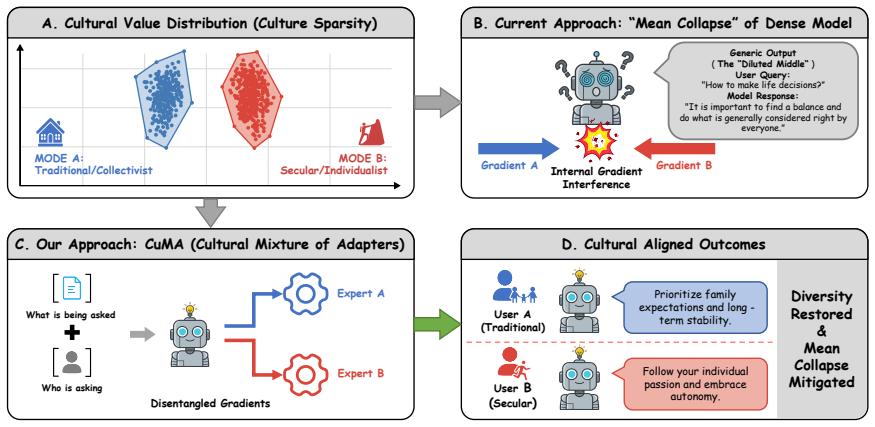
Pith's one-line read Dense models collapse conflicting cultural values into a bland average; the paper argues the remedy is demographic-conditioned expert routing.
desk verdict A solid, parameter-efficient recipe for pluralistic alignment — the benchmark gains look real — but the central theorem only proves that a constant Gaussian fits the marginal mean, not that dense LLMs inevitably collapse. read the letter →
The pith
A machine-rendered reading of the paper's core claim, the machinery that carries it, and where it could break.
The reading
What carries the argument
The load-bearing mechanism is the demographic-aware router acting as a topology learner. Its routing logits are s = W_r · [h ⊕ e_d], where h is the layer's hidden state (what is being asked) and e_d is a frozen embedding of the linearized demographic profile (who is asking). Top-k sparsity then enforces conditional capacity separation: only two of eight LoRA experts are active per token, creating functionally orthogonal parameter subspaces. Theorem 2.1 supplies the negative result that motivates this design: a dense estimator minimizing forward KL must collapse to the mixture mean, with probability density at that mean decaying exponentially in the squared inter-mode distance. The load-balan
What would settle it
Permute or randomize the demographic embeddings across training samples while keeping the semantic routing branch intact; if accuracy and Earth Mover's Distance then match a semantic-only mixture-of-experts baseline, the 'who is asking' signal is doing no work and the method's advantage evaporates.
Extended reading notes
Core claim
On the paper's own terms: the central claim is that dense parameterization is structurally incapable of representing pluralistic cultural values. The paper defines Cultural Sparsity as the geometric condition where inter-group value differences dominate intra-group dispersion, and proves Theorem 2.1: a dense estimator constrained to a single-component exponential family and trained by minimizing forward KL divergence converges to the global mixture mean, placing its probability mass in a low-density 'diluted middle' that matches no real culture. CuMA's remedy is conditional capacity separation: a router computes logits from the concatenation of the token's hidden state and a frozen embedding
Load-bearing premise
The framework stands on the premise that a user's demographic profile is an observable proxy for their latent cultural values; the paper's own Limitations section concedes that such profiles may be incomplete, inaccurate, or unavailable, and if they do not carry the value signal the router is conditioning on noise and the expert separation collapses.
Editorial extensions
If this is right
- Dense alignment methods will keep producing 'diluted middle' responses on culturally contested questions regardless of training data, because a single parameter set must average across conflicting modes.
- Alignment quality depends on who is asking, not just what is asked; demographic context should be a conditioning input rather than something averaged away.
- Sparse Top-k routing is doing structural work, not just saving compute: the paper's own soft-routing ablation shows accuracy dropping and distributional divergence rising back toward dense-model levels.
- Culturally proximate groups can share expert capacity, so held-out demographics benefit from topological transfer with only a small accuracy drop.
- Distribution-level metrics such as Earth Mover's Distance reveal stereotyping that accuracy alone hides; matching the shape of a value distribution is the real alignment target.
Reading between the lines
- Editorial inference: the mean-collapse mechanism is not specific to culture; any pluralistic alignment problem with genuinely conflicting modes, such as political, moral, or aesthetic preferences, should exhibit the same averaging pathology, making conditional capacity separation a candidate treatment there too.
- Editorial inference: the route to handling missing or private demographics is to infer the demographic signal from language use or conversation history rather than relying on declared profiles; the framework would survive with a learned probabilistic estimate of d in place of the frozen embedding.
- Editorial inference: if the theoretical claim is correct, simply scaling up dense models will not fix pluralistic alignment, so alignment scaling laws should be expected to diverge from general capability scaling.
- Editorial inference: the router's emergent country-level clusters form a data-driven cultural map, which could serve as an instrument for testing or revising established cultural taxonomies.
Editorial analysis
A structured set of objections, weighed in public.
Referee Report
Summary. The paper proposes CuMA, a demographic-aware mixture-of-LoRA-adapter framework for pluralistic cultural alignment. It argues that dense models trained on conflicting cultural value distributions suffer from 'Mean Collapse'—converging to a generic average—and claims to formally prove that dense parameterization inevitably causes this failure. The method routes inputs using both the hidden state and a demographically encoded profile, activating a sparse subset of LoRA experts to separate conflicting gradients. Experiments on WorldValuesBench, Community Alignment, and PRISM report consistent improvements over dense fine-tuning and semantic-only MoE baselines across two 8B backbones, together with analyses of prediction entropy, generative diversity, routing topology, and zero-shot generalization.
Significance. The empirical core of the paper is valuable: cultural pluralism is an important and under-addressed alignment problem, and the idea of conditioning a sparse mixture of adapters on demographic signals is a natural and plausible design. If the reported gains are robust, CuMA would be a useful contribution to pluralistic alignment, and the paper provides a reasonable amount of experimental evidence for that claim. The paper also ships a code repository, which aids reproducibility and follow-up work. However, the central theoretical novelty—the claim that dense parameterization 'inevitably leads to Mean Collapse'—is not established by the proof as written, and the evaluation has a circularity risk because the same GPT-4o judge is used for both GRPO rewards and win-rate evaluation. These issues do not necessarily invalidate the empirical method, but they substantially weaken the paper's strongest claims.
major comments (4)
- [Theorem 2.1 / Appendix B.2, Eqs. (7)–(13)] The Mean Collapse theorem is derived for an unconditional estimator: P_data(y) is a marginal mixture of two Gaussians and P_θ(y) = N(y; μ_θ, Σ_θ), with objective J(μ_θ) = E_{P_data(y)}[-log P_θ(y)]. There is no x and no d in this derivation. For the paper's own conditional model P_θ(y|x,d), the same Gaussian computation gives μ_θ*(x,d) = E_{P_data(y|x,d)}[y]. Under cultural sparsity, P_data(y|x,d) is concentrated near one mode, so the conditional minimizer is not the global mixture mean. Thus Theorem 2.1 establishes only that an unconditioned constant Gaussian estimator matches the marginal mean; it does not show that dense parameterization of a conditional LLM inevitably leads to Mean Collapse. This is a load-bearing problem for Contribution (1), which claims a formal identification of dense-parameterization failure. Please either prove a conditional analogue with explicit capacity limi
- [Appendix D.2/D.5 and Table 1] The GRPO reward signal is computed by a GPT-4o judge prompted to compare model responses against a reference for a given demographic profile, and the same style of GPT-4o judge is used as the evaluation oracle for the CA and PRISM win-rates. Optimizing against this judge and then reporting win-rates from the same judge conflates reward optimization with cultural alignment: the DPO/GRPO columns may partially measure agreement with GPT-4o's preferences rather than with the human communities the datasets represent. Please validate the judge against held-out human judgments for the final models, use an independent judge model, or report the judge's agreement with human labels separately for training and evaluation.
- [Appendix E.2 and Table 2] The 'zero-shot cross-cultural generalization' protocol holds out demographic profiles—specific attribute combinations—within each cultural cluster, while the training set contains other profiles from the same countries and same clusters. This tests interpolation to unseen attribute combinations, not transfer to genuinely unseen cultural groups. The text in §5.3 speaks of generalization to 'unseen demographic profiles,' which is accurate, but the title 'Zero-Shot Cross-Cultural Generalization' and the surrounding discussion overstate the result. If the claim is about transfer across cultural clusters, the protocol should hold out whole clusters; otherwise the wording should be revised.
- [Section 2.2, Eq. (1)] Cultural Sparsity is introduced as a formal geometric condition, quantified by a Mahalanobis distance inequality, but the paper does not measure this quantity on WVB, CA, or PRISM in the representation space where the router operates. Since the entire motivation and the Mean Collapse theorem rest on this sparsity assumption, the paper should provide at least an empirical estimate of the separation δ relative to the ambient dimension m, or explicitly state that Eq. (1) is an idealized assumption not directly verified in the experiments. Without such evidence, the claimed 'formal identification' of cultural sparsity as the root cause remains unsupported.
minor comments (4)
- [Related Work, Section 6] Typo: 'contidtional capacity separation' should be 'conditional capacity separation.'
- [Table 3 and Appendix D] The description of the 'w/o Semantic Routing' ablation is confusing: the text says the demographic-specific prompt is replaced with a generic instruction, which seems to remove demographic information from the prompt rather than removing the semantic hidden-state branch from the router. Please clarify what exactly is ablated and how the router input differs in each row.
- [Section 4.3 / Table 1] No standard deviations or significance tests are reported. Given that several headline differences are small in absolute terms (e.g., ~2–4% accuracy gaps), additional runs or at least a statement about evaluation variance would strengthen confidence in the comparisons.
- [Appendix C, Eq. (22)] The GRPO objective is written without the explicit expectation over (x,d) and the group sampling procedure; adding this notation would make the equation self-contained.
Circularity Check
Theorem 2.1's Mean Collapse result is an artifact of the chosen estimator class (a constant, unconditioned single Gaussian), not a property of the conditional dense models the paper claims to analyze; the GRPO win-rates are also partly self-referential because the GPT-4o judge is both reward model and evaluation oracle.
-
self definitional
[Section 2.3 (Theorem 2.1); Appendix B.1–B.2 (Eqs. 7–13)]
"Theorem 2.1 (Mean Collapse). Under the assumption of cultural sparsity (Eq. 1), consider a dense estimator Pθ constrained to a single-component exponential family (e.g., a Gaussian) with mean parameter μθ. The solution minimizing the forward-KL divergence satisfies μ*θ = E_Pdata[y], converging strictly to the global mixture mean. Appendix B.1: 'A standard dense model Pθ(y|x, d) utilizes a monolithic parameter set θ for all groups... To analyze this structural tendency, we approximate the dense estimator as a single Gaussian N(y; μθ, Σθ).'"
The proof in Appendix B.2 minimizes J(μθ) = E_Pdata[-log N(y; μθ, Σθ)] with respect to a single vector μθ that depends on neither x nor d, and obtains μ*θ = π1μ1 + π2μ2. That conclusion is true by construction for a constant, unconditioned Gaussian estimator: a one-component Gaussian has only one mean, so it cannot represent a bimodal mixture. But Section 2.1 frames cultural alignment as learning Pθ(y|x,d). If the dense estimator were instead a conditional Gaussian with mean μθ(x,d), the same derivation gives μ*θ(x,d) = E_Pdata(y|x,d)[y], which under sparsity is the mode-conditional mean, not the global mixture mean. Thus Theorem 2.1 does not establish that dense parameterization 'inevitably leads to Mean Collapse' for the dense conditional models actually trained; it establishes only the
-
other
[Appendix D.2 (Reward Signal for GRPO); Appendix D.5 (GPT-4o Judge); Table 1 (CA/PRISM Win-Rates)]
"Following the protocol of Zhang et al. (2025a), we utilize a model-based reward signal derived from GPT-4o. For each generated response yi in the group, we compute a pairwise comparison against the base model's response yref... We assign a scalar reward ri ∈ {1.0,0.5,0.0} corresponding to a win, tie, or loss relative to the reference. Appendix D.5: We employ a GPT-4o judge for evaluating open-ended generation tasks... Validation against ground-truth labels confirms high reliability, with the judge achieving an accuracy of 83.3% on the Community Alignment (CA) dataset and 89.8% on PRISM."
The GRPO advantage Ai is computed by normalizing rewards ri assigned by the GPT-4o judge, so training explicitly optimizes the policy to maximize that judge's preferences. The reported Win-Rates vs Base in Table 1 for the GRPO rows are then computed with the same GPT-4o judge and the same prompt template described in Appendix D.5. The evaluation metric is therefore not independent of the training signal for the GRPO models: the headline win-rate is, to a significant degree, a measure of how well the model learned to satisfy the judge that also produced its rewards. This is partial rather than total circularity because the judge is separately validated against ground-truth labels (83.3% on CA, 89.8% on PRISM).
full rationale
The paper's main theoretical contribution—that dense parameterization inevitably collapses plural cultural values to a mean—is not established by the provided proof. Theorem 2.1 and Appendix B.2 minimize over a single unconditioned Gaussian mean, so μ*θ = E[Pdata(y)] is a property of the assumed estimator class, not a consequence of dense parameterization in the conditional model Pθ(y|x,d) that the paper itself defines. A conditional dense Gaussian would instead match the conditional mean, avoiding the global-mode averaging under sparsity. Thus the central 'inevitability' claim is self-definitional: the inability to represent multiple modes is put into the estimator class at the start and then read back out as a theorem. The empirical comparisons are largely independent, but the Win-Rate results for GRPO are partially self-referential because the GPT-4o judge used for rewards is also the evaluation oracle; the judge's agreement with human labels mitigates but does not remove this overlap. No load-bearing self-citation chain or imported uniqueness theorem was found; the paper's method and ablations are self-contained. Overall circularity score 6: the central theoretical claim reduces by construction, while the rest of the paper retains independent empirical content.
Assumptions & free parameters
free parameters (4)
- number of experts N =
8
- top-k routing =
2
- LoRA rank r =
64 (and 8 in a variant)
- load balancing coefficient λ_lb =
0.01
assumptions (5)
- domain assumption Demographic profile d is an observable proxy for latent cultural values (D set).
- domain assumption Cultural value distributions are culturally sparse (Eq. 1, Definition 2.1), i.e., inter-group Mahalanobis distance ≫ m.
- domain assumption Frozen text-embedding space preserves demographic/cultural topology for generalization to unseen profiles.
- ad hoc to paper A dense LLM's output distribution can be approximated by a single-component Gaussian/exponential family for the mean-collapse analysis.
- domain assumption GPT-4o judge is a reliable proxy for human cultural preferences.
invented entities (1)
-
Latent Cultural Topology
Cite this review
Pith. "Pith review of CuMA: Aligning LLMs with Sparse Cultural Values via Demographic-Aware Mixture of Adapters." pith.science (2026). https://pith.science/paper/GUMVECVR
@misc{pith2026260104885,
  author       = {Pith},
  title        = {Pith review of: CuMA: Aligning LLMs with Sparse Cultural Values via Demographic-Aware Mixture of Adapters},
  year         = {2026},
  howpublished = {\url{https://pith.science/paper/GUMVECVR}},
  note         = {Machine review of arXiv:2601.04885}
}
read the original abstract
As Large Language Models (LLMs) serve a global audience, alignment must transition from enforcing universal consensus to respecting cultural pluralism. We demonstrate that dense models, when forced to fit conflicting value distributions, suffer from \textbf{Mean Collapse}, converging to a generic average that fails to represent diverse groups. We attribute this to \textbf{Cultural Sparsity}, where gradient interference prevents dense parameters from spanning distinct cultural modes. To resolve this, we propose \textbf{\textsc{CuMA}} (\textbf{Cu}ltural \textbf{M}ixture of \textbf{A}dapters), a framework that frames alignment as a \textbf{conditional capacity separation} problem. By incorporating demographic-aware routing, \textsc{CuMA} internalizes a \textit{Latent Cultural Topology} to explicitly disentangle conflicting gradients into specialized expert subspaces. Extensive evaluations on WorldValuesBench, Community Alignment, and PRISM demonstrate that \textsc{CuMA} achieves state-of-the-art performance, significantly outperforming both dense baselines and semantic-only MoEs. Crucially, our analysis confirms that \textsc{CuMA} effectively mitigates mean collapse, preserving cultural diversity. Our code is available at https://github.com/Throll/CuMA.
Figures


Figures from the paper (1 more)

Reference graph
Works this paper leans on
-
[1]
safe middle
Probability Density Gap.Assume a symmet- ric conflict where π1 =π 2 = 0.5 and Σ =I . The optimal dense mean lies at µ∗ θ = (µ1 +µ 2)/2. The distance from this collapsed mean to a true mode is∥µ ∗ θ −µ 1∥=δ/2. The true probability density at the collapsed mean is: Pdata(µ∗ θ) = 1 2 N(µ ∗ θ;µ 1, I) +1 2 N(µ ∗ θ;µ 2, I) ∝exp − 1 2 δ 2 2! = exp − δ2 8 (14) In...
-
[2]
Variance Inflation.Mean collapse also im- plies a loss of precision. By the law of total vari- ance, the optimal covariance Σ∗ θ for the dense model decomposes into two terms: Σ∗ θ =Var Pdata[y] = X k πkΣk + X k πk(µk −µ ∗ θ)(µk −µ ∗ θ)⊤ (17) The second term scales quadratically with δ. This forces the dense model to expand its prob- ability mass to span ...
-
[3]
Large language models empowered agent- based modeling and simulation: a survey and per- spectives.Humanities and Social Sciences Commu- nications, 11(1):1259. Aaron Grattafiori, Abhimanyu Dubey, Abhinav Jauhri, Abhinav Pandey, Abhishek Kadian, Ahmad Al- Dahle, Aiesha Letman, Akhil Mathur, Alan Schel- ten, Alex Vaughan, Amy Yang, Angela Fan, Anirudh Goyal,...
arXiv 2024
-
[5]
Strong and weak alignment of large lan- guage models with human values.Scientific Reports, 14(1):19399. Hannah Rose Kirk, Alexander Whitefield, Paul Röttger, Andrew Bean, Katerina Margatina, Juan Ciro, Rafael Mosquera, Max Bartolo, Adina Williams, He He, Bertie Vidgen, and Scott A. Hale. 2024. The prism alignment dataset: What participatory, representa- t...
arXiv 2024
-
[7]
Shibani Santurkar, Esin Durmus, Faisal Ladhak, Cinoo Lee, Percy Liang, and Tatsunori Hashimoto
Direct preference optimization: Your lan- guage model is secretly a reward model.Preprint, arXiv:2305.18290. Shibani Santurkar, Esin Durmus, Faisal Ladhak, Cinoo Lee, Percy Liang, and Tatsunori Hashimoto. 2023. Whose opinions do language models reflect? InIn- ternational Conference on Machine Learning, pages 29971–30004. PMLR. Noam Shazeer, Azalia Mirhose...
arXiv 2023
-
[9]
Self-pluralising culture alignment for large language models.arxiv preprint arXiv:2410.12971. Wanqi Xue, Bo An, Shuicheng Yan, and Zhongwen Xu. 2024. Reinforcement learning from diverse hu- man preferences. InProceedings of the Thirty-Third International Joint Conference on Artificial Intel- ligence, IJCAI-24, pages 5298–5306. International Joint Conferen...
arXiv 2024
-
[10]
assess cultural knowledge and bias, while PRISM (Kirk et al., 2024) links fine-grained so- ciodemographics to interactive preferences. On the methodological front, approaches like Cul- tureLLM (Li et al., 2024a) utilize semantic data augmentation, and CultureSPA (Xu et al., 2024) employs contrastive learning to distinguish cultural norms. Others have expl...
2024
-
[14]
Conditional SFT.For standard instruction fol- lowing and knowledge injection, we minimize the negative log-likelihood conditioned on the demo- graphic profiled: LSFT(θ) =−E (x,y,d)∼DSFT [logP θ(y|x, d)] (20)
Show all 19 references
-
[15]
neutral" or
Conditional Preference Optimization.To sharpen the decision boundaries between cultural modes and explicitly penalize mean collapse, we align the model with human preferences. Depend- ing on the available data format, we employ one of the following objectives: Option A: Condit...
-
[16]
User Pro- file
Load Balancing Loss.To prevent router col- lapse, we incorporate an auxiliary load balancing loss Llb, defined as the scaled dot-product between expert selection frequency f and average routing probabilityP: Llb =N NX i=1 fi ·P i (23) This regularization ensures that the laten...
-
[17]
Exclusion:Within each cluster Ci, we ran- domly select a subset of specific demographic profiles (defined by unique combinations of at- tributes like age, gender, and education within a country) to hold out from the training set
-
[18]
Training:We train CUMA on the remaining dataset, ensuring that the model has seen the general cultural cluster but not the specific held-out demographic combinations
-
[19]
mean collapse
Evaluation:The model is evaluated exclu- sively on the held-out demographic profiles. This tests the model’s ability to generalize to unseen profiles by leveraging the learned topo- logical structure of the cultural cluster. F Impact of Routing Strategy To validate our hypothe...
-
[1028]
Cheng Li, Mengzhou Chen, Jindong Wang, Sunayana Sitaram, and Xing Xie
Worldwide trends in the development of edu- cation and academic research, Sofia, Bulgaria, 15-18 June, 2015. Cheng Li, Mengzhou Chen, Jindong Wang, Sunayana Sitaram, and Xing Xie. 2024a. Culturellm: Incorpo- rating cultural differences into large language models. InThirty-Eigh...
2015 arXiv
-
[2010]
Edward J Hu, Yelong Shen, Phillip Wallis, Zeyuan Allen-Zhu, Yuanzhi Li, Shean Wang, Lu Wang, and 9 Weizhu Chen
The weirdest people in the world?Behavioral and Brain Sciences, 33(2–3):61–83. Edward J Hu, Yelong Shen, Phillip Wallis, Zeyuan Allen-Zhu, Yuanzhi Li, Shean Wang, Lu Wang, and 9 Weizhu Chen. 2022. LoRA: Low-rank adaptation of large language models. InInternational Conference o...
2022
-
[2021]
Evaluating large language models trained on code. Paul F. Christiano, Jan Leike, Tom B. Brown, Miljan Martic, Shane Legg, and Dario Amodei. 2017. Deep reinforcement learning from human preferences. In Proceedings of the 31st International Conference on Neural Information Proce...
2017 arXiv
-
[2022]
provides a lightweight adaptation mecha- nism, while MoE scales capacity via conditional computation (Shazeer et al., 2017). Recent innovations like MixLoRA (Li et al., 2024b) and HydraLoRA (Tian et al., 2024) inte- grate these paradigms, composing multiple LoRA adapters to ha...
2017
-
[2024]
Llemma: An open language model for mathe- matics.Preprint, arXiv:2310.10631. Mark Chen, Jerry Tworek, Heewoo Jun, Qiming Yuan, Henrique Ponde de Oliveira Pinto, Jared Kaplan, Harri Edwards, Yuri Burda, Nicholas Joseph, Greg Brockman, Alex Ray, Raul Puri, Gretchen Krueger, Mich...
-
[2025]
Yan Tao, Olga Viberg, Ryan S Baker, and René F Kizil- cec
An evaluation of cultural value alignment in llm.Preprint, arXiv:2504.08863. Yan Tao, Olga Viberg, Ryan S Baker, and René F Kizil- cec. 2024. Cultural bias and cultural alignment of large language models.PNAS Nexus, 3(9):pgae346. _eprint: https://academic.oup.com/pnasnexus/art...
2024 arXiv
Reviewed August 3, 2026 · model on record in the stance chip above.
Discussion (0). Sign in to comment.