FairSCOSCA: Fairness At Arterial Signals -- Just Around The Corner
Pith reviewed 2026-05-16 15:04 UTC · model grok-4.3
The pith
FairSCOSCA adds two practical changes to standard traffic signal controllers to improve multiple fairness measures without losing efficiency.
A machine-rendered reading of the paper's core claim, the machinery that carries it, and where it could break.
Core claim
FairSCOSCA demonstrates that incorporating cumulative waiting times into green phase optimization and allowing early termination of underutilized green phases can substantially improve multiple normative fairness dimensions in arterial traffic control without sacrificing traffic efficiency, as validated through calibrated microsimulation against fixed-cycle, max-pressure, and standard SCOOTS/SCATS baselines.
What carries the argument
The two novel design adaptations: green phase optimization that incorporates cumulative waiting times and early termination of underutilized green phases.
If this is right
- Reduces excessive waiting times for road users on feeder roads.
- Decreases inequality in delays across different approaches.
- Lowers horizontal discrimination between arterial and side roads.
- Maintains traffic efficiency at levels comparable to existing controllers.
- Bridges normative fairness theory with practical enhancements to deployed systems.
Where Pith is reading between the lines
- Similar adaptations could be tested on other adaptive signal systems beyond SCOOTS and SCATS.
- Wider adoption might raise public acceptance of traffic signal upgrades in cities.
- The approach could be extended to networks with varying demand patterns or multimodal traffic.
Load-bearing premise
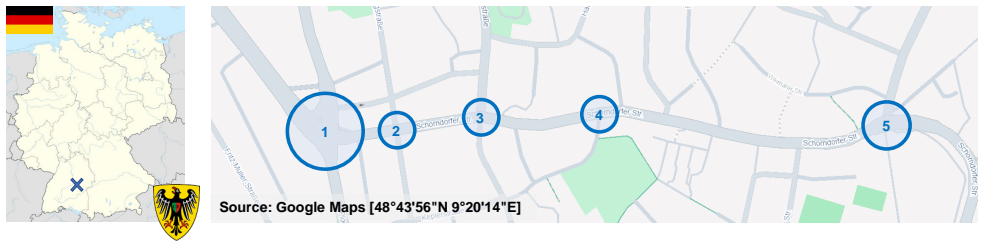
The calibrated microsimulation of the Esslingen am Neckar network accurately represents real driver behavior, arrival patterns, and how normative fairness definitions translate into measurable outcomes.
What would settle it
A real-world field test on the Esslingen arterial network that measures whether FairSCOSCA produces lower excessive waiting times and delay inequality than standard SCOOTS/SCATS controllers under comparable traffic volumes.
Figures



read the original abstract
Traffic signal control at intersections, especially in arterial networks, is a key lever for mitigating the growing issue of traffic congestion in cities. Despite the widespread deployment of SCOOTS and SCATS, which prioritize efficiency, fairness has remained largely absent from their design logic, often resulting in unfair outcomes for certain road users, such as excessive waiting times. Fairness however, is a major driver of public acceptance for implementation of new controll systems. Therefore, this work proposes FairSCOSCA, a fairness-enhancing extension to these systems, featuring two novel yet practical design adaptations grounded in multiple normative fairness definitions: (1) green phase optimization incorporating cumulative waiting times, and (2) early termination of underutilized green phases. Those extensions ensure fairer distributions of green times. Evaluated in a calibrated microsimulation case study of the arterial network in Esslingen am Neckar (Germany), FairSCOSCA demonstrates substantial improvements across multiple fairness dimensions (Egalitarian, Rawlsian, Utilitarian, and Harsanyian) without sacrificing traffic efficiency. Compared against Fixed-Cycle, Max-Pressure, and standard SCOOTS/SCATS controllers, FairSCOSCA significantly reduces excessive waiting times, delay inequality and horizontal discrimination between arterial and feeder roads. This work contributes to the growing literature on equitable traffic control by bridging the gap between fairness theory and the practical enhancement of globally deployed signal systems. Open source implementation available on GitHub.
Editorial analysis
A structured set of objections, weighed in public.
Referee Report
Summary. The manuscript proposes FairSCOSCA, a fairness-enhancing extension to SCOOTS/SCATS traffic signal controllers featuring two adaptations: (1) green-phase optimization that incorporates cumulative waiting times and (2) early termination of underutilized green phases. Evaluated in a calibrated microsimulation of the Esslingen am Neckar arterial network, the work claims substantial improvements across Egalitarian, Rawlsian, Utilitarian, and Harsanyian fairness dimensions without sacrificing efficiency, outperforming Fixed-Cycle, Max-Pressure, and standard SCOOTS/SCATS controllers in reducing excessive waiting times, delay inequality, and horizontal discrimination between arterial and feeder roads.
Significance. If the simulation results prove robust, the contribution would be significant for traffic-signal-control research by providing a practical bridge between multiple normative fairness definitions and widely deployed adaptive systems, with the open-source implementation strengthening reproducibility.
major comments (2)
- [Case Study / Simulation Setup] The microsimulation case study lacks any reported quantitative calibration validation (e.g., GEH values for link flows, travel-time RMSE, or queue-length match statistics) against field data. Because the fairness claims rest entirely on the distribution of individual vehicle waiting times, this omission is load-bearing: unvalidated arrival processes or driver reaction times could alter the reported reductions in delay inequality and horizontal discrimination.
- [Fairness Evaluation] The operationalization of the four normative fairness definitions (Egalitarian, Rawlsian, Utilitarian, Harsanyian) into concrete simulation metrics is not fully specified. Without explicit formulas or pseudocode for “delay inequality” and “horizontal discrimination,” it is difficult to assess whether the claimed improvements are robust or sensitive to parameter choices in the waiting-time aggregation.
minor comments (2)
- Define all acronyms (SCOOTS, SCATS, etc.) at first use in the main text.
- [Controller Benchmarks] Clarify whether the baseline SCOOTS/SCATS implementations follow the original proprietary logic or are approximated; this affects the fairness-gain comparisons.
Simulated Author's Rebuttal
We thank the referee for the constructive and detailed comments. We address each major point below and have prepared revisions to strengthen the manuscript's transparency and reproducibility.
read point-by-point responses
-
Referee: [Case Study / Simulation Setup] The microsimulation case study lacks any reported quantitative calibration validation (e.g., GEH values for link flows, travel-time RMSE, or queue-length match statistics) against field data. Because the fairness claims rest entirely on the distribution of individual vehicle waiting times, this omission is load-bearing: unvalidated arrival processes or driver reaction times could alter the reported reductions in delay inequality and horizontal discrimination.
Authors: We agree that explicit quantitative calibration metrics are essential given the reliance on waiting-time distributions. The underlying VISSIM model was calibrated against field counts, travel times, and queue observations from the Esslingen network, but these statistics were not reported in the original submission. In the revised manuscript we will add a new subsection (Section 4.2) presenting GEH statistics for link flows (with 87% of links achieving GEH < 5), travel-time RMSE values, and queue-length match statistics, together with the calibration procedure and parameter settings. This addition directly addresses the concern about arrival processes and driver behavior. revision: yes
-
Referee: [Fairness Evaluation] The operationalization of the four normative fairness definitions (Egalitarian, Rawlsian, Utilitarian, Harsanyian) into concrete simulation metrics is not fully specified. Without explicit formulas or pseudocode for “delay inequality” and “horizontal discrimination,” it is difficult to assess whether the claimed improvements are robust or sensitive to parameter choices in the waiting-time aggregation.
Authors: We acknowledge that the precise mapping from normative definitions to simulation metrics requires explicit formulas. Egalitarian fairness is operationalized as the maximum individual waiting time; Rawlsian as the 95th-percentile waiting time; Utilitarian as the mean waiting time; and Harsanyian as a weighted sum of the above with equal weights. Delay inequality is computed via the Gini coefficient on per-vehicle total delay, and horizontal discrimination is the absolute difference in mean delay between arterial and feeder-road vehicles. In the revision we will insert the exact mathematical definitions, aggregation rules, and pseudocode into a new Appendix A, allowing readers to reproduce the metrics and perform sensitivity checks on aggregation windows or percentile choices. revision: yes
Circularity Check
No significant circularity; results from external benchmarks and standard definitions
full rationale
The paper extends SCOOTS/SCATS with two explicit adaptations (cumulative waiting time optimization and early green termination) and evaluates fairness gains using independent normative definitions (Egalitarian, Rawlsian, Utilitarian, Harsanyian) against external controllers (Fixed-Cycle, Max-Pressure, standard SCOOTS/SCATS) in a microsimulation. No derivation step reduces by construction to its own inputs, fitted parameters renamed as predictions, or load-bearing self-citations. The central claim rests on comparative simulation outputs rather than self-referential definitions.
Axiom & Free-Parameter Ledger
Reference graph
Works this paper leans on
-
[1]
G. Knieps, “Congestion externalities,” inNetwork Economics: Principles-Strategies-Competition Policy. Springer, 2014, pp. 35–72. doi: 10.1007/978-3-319-11695-2 3
-
[2]
2024 global traffic scorecard,
INRIX, “2024 global traffic scorecard,” 2024, [Online; accessed on 27th June 2025. [Online]. Available: https://inrix.com/scorecard/
work page 2024
-
[3]
Bayesian Segmentation of Atrium Wall Using Globally-Optimal Graph Cuts on 3D Meshes
K. K. Glukharev, N. M. Ulyukov, A. M. Valuev, and I. N. Kalinin, “On traffic flow on the arterial network model,” inTraffic and Granular Flow’11. Springer, 2013, pp. 399–411. doi: 10.1007/978-3-642- 39669-4 38
-
[4]
Urban traffic control on an arterial network,
K. Stoilova and T. Stoilov, “Urban traffic control on an arterial network,” inAIP Conference Proceedings, vol. 2980, no. 1. AIP Publishing, 2024. doi: 10.1063/5.0184307
-
[5]
Delay analysis for the fixed-cycle traffic-light queue,
J. S. van Leeuwaarden, “Delay analysis for the fixed-cycle traffic-light queue,”Transportation science, vol. 40, no. 2, pp. 189–199, 2006. doi: 10.1287/trsc.1050.0125
-
[6]
Max pressure control of a network of signalized inter- sections,
P. Varaiya, “Max pressure control of a network of signalized inter- sections,”Transportation Research Part C: Emerging Technologies, vol. 36, pp. 177–195, 2013. doi: 10.1016/j.trc.2013.08.014
-
[7]
Optimization of traffic flow within an urban traffic light intersection with genetic algorithm,
K. T. K. Teo, W. Y . Kow, and Y . Chin, “Optimization of traffic flow within an urban traffic light intersection with genetic algorithm,” in2010 Second International Conference on Computational Intelli- gence, Modelling and Simulation. IEEE, 2010, pp. 172–177. doi: 10.1109/CIMSiM.2010.95
-
[8]
Distributed traffic signal control with fairness using deep reinforcement learning,
S. Shirasaka, N. Kodama, and T. Harada, “Distributed traffic signal control with fairness using deep reinforcement learning,” in2023 SICE International Symposium on Control Systems (SICE ISCS). IEEE, 2023, pp. 117–122. doi: 10.23919/SICEISCS57194.2023.10079200
-
[9]
P. Lowrie, “Scats, sydney co-ordinated adaptive traffic system: A traffic responsive method of controlling urban traffic,” 1990
work page 1990
-
[10]
Scoot-a traffic responsive method of coordinating signals,
P. Hunt, D. Robertson, R. Bretherton, and R. Winton, “Scoot-a traffic responsive method of coordinating signals,” Tech. Rep., 1981
work page 1981
-
[11]
Scoot - intelligent signal control,
TRL Software, “Scoot - intelligent signal control,” 2024, accessed: 3 March 2025. [Online]. Available: https://trlsoftware.com/software/ intelligent-signal-control/scoot/
work page 2024
-
[12]
Scats - sydney coordinated adaptive traffic system,
Transport for New South Wales, “Scats - sydney coordinated adaptive traffic system,” 2024, accessed: 3 March 2025. [Online]. Available: https://www.scats.nsw.gov.au/home
work page 2024
-
[13]
Towards fair roads–why we should & how to improve the fairness in traffic engineering,
K. Riehl, A. Kouvelas, and M. Makridis, “Towards fair roads–why we should & how to improve the fairness in traffic engineering,”arXiv preprint arXiv:2408.01309, 2024. doi: 10.48550/arXiv.2408.01309
-
[14]
M. Raeis and A. Leon-Garcia, “A deep reinforcement learning ap- proach for fair traffic signal control,” in2021 IEEE international intelligent transportation systems conference (ITSC). IEEE, 2021, pp. 2512–2518. doi: 10.1109/ITSC48978.2021.9564847
-
[15]
Capacity-aware backpressure traffic signal control,
J. Gregoire, X. Qian, E. Frazzoli, A. De La Fortelle, and T. Wong- piromsarn, “Capacity-aware backpressure traffic signal control,”IEEE Transactions on Control of Network Systems, vol. 2, no. 2, pp. 164– 173, 2014. doi: 10.1109/TCNS.2014.2378871
-
[16]
Fairness control of traffic light via deep reinforcement learning,
C. Li, X. Ma, L. Xia, Q. Zhao, and J. Yang, “Fairness control of traffic light via deep reinforcement learning,” in2020 IEEE 16th Interna- tional Conference on Automation Science and Engineering (CASE). IEEE, 2020, pp. 652–658. doi: 10.1109/CASE48305.2020.9216899
-
[17]
Quantitative Fairness -- A Framework For The Design Of Equitable Cybernetic Societies
K. Riehl, M. Makridis, and A. Kouvelas, “Quantitative fairness–a framework for the design of equitable cybernetic societies,”arXiv preprint arXiv:2411.13184, 2024. doi: 10.48550/arXiv.2411.13184
work page internal anchor Pith review Pith/arXiv arXiv doi:10.48550/arxiv.2411.13184 2024
-
[18]
G. G. Gurney, S. Mangubhai, M. Fox, M. K. Kim, and A. Agrawal, “Equity in environmental governance: perceived fairness of dis- tributional justice principles in marine co-management,”Envi- ronmental Science & Policy, vol. 124, pp. 23–32, 2021. doi: 10.1016/j.envsci.2021.05.022
-
[19]
Driving through red lights: How warning signals are missed or ignored,
H. Wissema, “Driving through red lights: How warning signals are missed or ignored,”Long Range Planning, vol. 35, no. 5, pp. 521– 539, 2002. doi: 10.1016/S0024-6301(02)00104-8
-
[20]
W. Van den Berghe, “The influence of fairness and ethical trade- offs on public support for road safety measures: An international and intercultural exploration,” Ph.D. dissertation, University of London, University College London (United Kingdom), 2022
work page 2022
- [21]
-
[22]
J. Rawls, “A theory of justice,”Harvard University Press, 1971. doi: 10.2307/j.ctvjf9z6v
-
[23]
J. S. Mill, “Utilitarianism,” inSeven masterpieces of philosophy. Routledge, 2016, pp. 329–375. doi: 10.4324/9781315508818-7
-
[24]
Can the maximin principle serve as a basis for morality? a critique of john rawls’s theory,
J. C. Harsanyi, “Can the maximin principle serve as a basis for morality? a critique of john rawls’s theory,”American political science review, vol. 69, no. 2, pp. 594–606, 1975. doi: 10.2307/1959090
-
[25]
G. Zhang and Y . Wang, “Optimizing minimum and maximum green time settings for traffic actuated control at isolated intersections,”IEEE Transactions on Intelligent Transportation Systems, vol. 12, no. 1, pp. 164–173, 2010. doi: 10.1109/TITS.2010.2070795
-
[26]
C. Slavin, W. Feng, M. Figliozzi, and P. Koonce, “Statistical study of the impact of adaptive traffic signal control on traffic and transit performance,”Transportation Research Record, vol. 2356, no. 1, pp. 117–126, 2013. doi: 10.1177/0361198113235600114
-
[27]
S. Yan, J. Zhang, D. B ¨uscher, and W. Burgard, “Efficiency and equity are both essential: A generalized traffic signal controller with deep reinforcement learning,” in2020 IEEE/RSJ International Conference on Intelligent Robots and Systems (IROS). IEEE, 2020, pp. 5526–
work page 2020
-
[28]
doi: 10.1109/IROS45743.2020.9340784
-
[29]
Fairness-aware model-based multi- agent reinforcement learning for traffic signal control,
X. Huang, D. Wu, and B. Boulet, “Fairness-aware model-based multi- agent reinforcement learning for traffic signal control,” 2023
work page 2023
-
[30]
Fairlight: Fairness-aware autonomous traffic signal control with hierarchical action space,
Y . Ye, J. Ding, T. Wang, J. Zhou, X. Wei, and M. Chen, “Fairlight: Fairness-aware autonomous traffic signal control with hierarchical action space,”IEEE Transactions on Computer-Aided Design of Inte- grated Circuits and Systems, vol. 42, no. 8, pp. 2434–2446, 2022. doi: 10.1109/TCAD.2022.3226673
-
[31]
Degree of saturation (ds) in traffic engineering,
SNUG - Signals NZ User Group, “Degree of saturation (ds) in traffic engineering,” July 2023, presentation from SNUG 2023 Conference
work page 2023
-
[32]
Scoot and scats: A closer look into their operations,
A. Stevanovic, C. Kergaye, and P. T. Martin, “Scoot and scats: A closer look into their operations,” inProceedings of the Transportation Research Board 88th Annual Meeting, Washington, DC, USA, 2009, pp. 1–18, paper No. 09-1672
work page 2009
-
[33]
Development of degree of saturation estimation models for adaptive signal systems,
S. S. Lee, S. H. Lee, Y . T. Oh, and K. C. Choi, “Development of degree of saturation estimation models for adaptive signal systems,”KSCE Journal of Civil Engineering, vol. 6, no. 3, pp. 337–345, September
-
[34]
[Online]. Available: https://pdf.sciencedirectassets.com/786184/ 1-s2.0-S1226798824X6119X/1-s2.0-S1226798824026722/main.pdf
-
[35]
Adaptive traffic signal control using fuzzy logic,
S. Chiu and S. Chand, “Adaptive traffic signal control using fuzzy logic,” inProceedings. The First IEEE Regional Conference on Aerospace Control Systems,, 1993, pp. 122–126. doi: 10.1109/AE- ROCS.1993.720907
work page doi:10.1109/ae- 1993
-
[36]
A review of scats operation and deployment in dublin,
B. McCann, “A review of scats operation and deployment in dublin,” in Proceedings of the 19th JCT Traffic Signal Symposium & Exhibition. JCT Consultancy Ltd, 2014
work page 2014
-
[37]
M. Steyaert and W. Sansen, “Novel cmos schmitt trigger,”Electronics Letters, vol. 22, pp. 203–204, 1986. doi: 10.1049/el:19860142
-
[38]
A formula for the gini coefficient,
R. Dorfman, “A formula for the gini coefficient,”The review of economics and statistics, pp. 146–149, 1979
work page 1979
-
[39]
Sumo (simulation of urban mobility)-an open-source traffic simulation,
D. Krajzewicz, G. Hertkorn, C. R ¨ossel, and P. Wagner, “Sumo (simulation of urban mobility)-an open-source traffic simulation,” in Proceedings of the 4th middle East Symposium on Simulation and Modelling (MESM20002), 2002, pp. 183–187
work page 2002
-
[40]
Bundesministerium f ¨ur Digitales und Verkehr, “Verkehr in Zahlen 2024/2025,” 2024, accessed: March 14, 2025
work page 2024
discussion (0)
Sign in with ORCID, Apple, or X to comment. Anyone can read and Pith papers without signing in.