REVIEW 3 major objections 3 minor 1 cited by
LLM judges flunk when the gold answer contradicts what they know
Reviewed by Pith at T0; open to challenge. T0 means a machine referee read the full paper against a public rubric. the ladder, T0–T4 →
LLM judges frequently mark candidates wrong when the gold reference contradicts the model's own knowledge, even if the candidate exactly matches the provided reference.
T0 review reviewed 2026-08-03 challenge →
load-bearing objection This paper shows a real and large failure mode in LLM-as-a-judge QA evaluation — judges override the provided reference under knowledge conflict — but the effect size needs more measurement transparency before I'd trust it fully. the 3 major comments →
Judging Against the Reference: Uncovering Knowledge-Driven Failures in LLM-Judges on QA Evaluation
The pith
A machine-rendered reading of the paper's core claim, the machinery that carries it, and where it could break.
The reading
Core claim
The paper's central discovery is that reference-based LLM judges fail when the provided reference answer conflicts with the judge's parametric knowledge. In the authors' controlled setting, they replace the original gold answer with a swapped entity and show that grading accuracy drops sharply: in the most striking case, a judge labels a candidate Incorrect even though both the reference and the candidate say 'Paris' for a question about the Boston Tea Party, while the same question with the original reference ('England') is graded correctly. The drop is most severe when both the reference and the candidate are swapped, and it is substantially reduced when the swapped reference is chosen to
What carries the argument
The central mechanism is the swapped-reference QA meta-evaluation framework. Each instance is a quintuple (question, original reference, swapped reference, candidate aligned with the original, candidate aligned with the swapped reference), producing four grading triplets whose ground-truth labels are known by construction. The key metric is the Reference-Polarity Accuracy Gap (RPAG), the difference between accuracy under the original reference and accuracy under the swapped reference; a large positive RPAG indicates that the judge degrades when the reference conflicts with its knowledge. Additional swap variants—type-preserving, type-changing, popularity-based, and evaluator-knowledge swaps—
Load-bearing premise
The paper assumes that an ideal LLM judge should always defer to the provided reference, even when that reference is factually wrong or implausible—so a judge that rejects a nonsensical reference is labeled as failing rather than as sensibly refusing.
What would settle it
Run the same swapped-reference protocol with human raters independently checking every generated candidate for fluency and semantic faithfulness to its intended reference. If a substantial share of swapped candidates are awkward or accidentally echo the original answer, the accuracy drop could be attributed to candidate quality instead of knowledge conflict. Alternatively, if any judge model shows identical verdicts for original and swapped references on a large sample, its RPAG would be near zero and would directly contradict the paper's central claim.
If this is right
- Reference-conditioned QA evaluation is unreliable when gold answers are stale, region-specific, or counterfactual, because judges will quietly overrule the reference.
- Scaling model size does not restore reference adherence; larger models may rely even more on parametric knowledge.
- Common prompting mitigations—direct instruction, chain-of-thought, self-consistency—do not eliminate the failure and can make it worse.
- The severity of the failure is predictable from properties of the swapped entity: more popular entities and long-stable facts cause larger accuracy drops.
- Benchmark results obtained with LLM judges must be treated with caution when the underlying ground-truth answers are not in line with the judge's world knowledge.
Where Pith is reading between the lines
- A natural next-step test is to add an adversarial 'swap test' to LLM-judge meta-evaluation: a judge that maintains near-zero RPAG on swapped references should be more trustworthy for evolving-knowledge QA.
- The finding suggests that reference adherence may need architectural enforcement—for example, grounding the judge's decision in the reference via a separate non-parametric lookup—rather than prompt-level nudges.
- If the paper is correct, prior LLM-judge evaluations of QA datasets with time-sensitive facts may have silently underestimated model performance, since judges would reject candidates that contradict their stale knowledge even when the gold reference has been updated.
Editorial analysis
A structured set of objections, weighed in public.
Referee Report
Summary. The paper investigates whether LLM judges in reference-based QA evaluation actually condition on the provided gold reference, focusing on occasions when that reference conflicts with the judge's parametric knowledge. The authors construct a 'swapped-reference' framework: for each question, the original reference is replaced by an incorrect entity (type-preserving, type-changing, popularity-based, or evaluator-knowledge swaps), and long-form candidate sentences are generated to align with each reference. Judges grade four triplets (original/swapped reference × aligned/misaligned candidate), and the authors measure accuracy under original vs. swapped references, defining the Reference-Polarity Accuracy Gap (RPAG). Across thirteen LLMs and four QA datasets, they report large accuracy drops under swapped references, tracing the effect to judges' over-reliance on parametric knowledge: the drop vanishes when the swapped reference aligns with the judge's own prediction, increases with entity popularity, and decreases for fast-changing facts. Prompt-based mitigations (Direct instructions, CoT, self-consistency) do not eliminate the vulnerability. The paper concludes that LLM judges do not reliably follow the provided reference under knowledge conflict, motivating stronger reference-adherence protocols.
Significance. If the empirical claims hold, the paper identifies an important and under-studied failure mode in LLM-as-a-judge QA evaluation. The controlled swapped-reference design, the breadth of models (13) and datasets (4), and the converging mechanism analyses (§5.1–5.3) are noteworthy strengths. The findings have practical implications for evaluation pipelines where the gold reference is authoritative and for counterfactual or time-sensitive QA settings. The paper also provides a useful diagnostic methodology. However, the central quantitative claims rest on the quality of the automatically generated candidate sentences and on the treatment of NOT_ATTEMPTED verdicts, and all reported numbers are point estimates without uncertainty quantification. Reproducibility is currently limited because the dataset/code are 'TBA'. The paper is likely correct in essence, but the missing validation details must be supplied before the magnitude and interpretation of the drops can be fully trusted.
major comments (3)
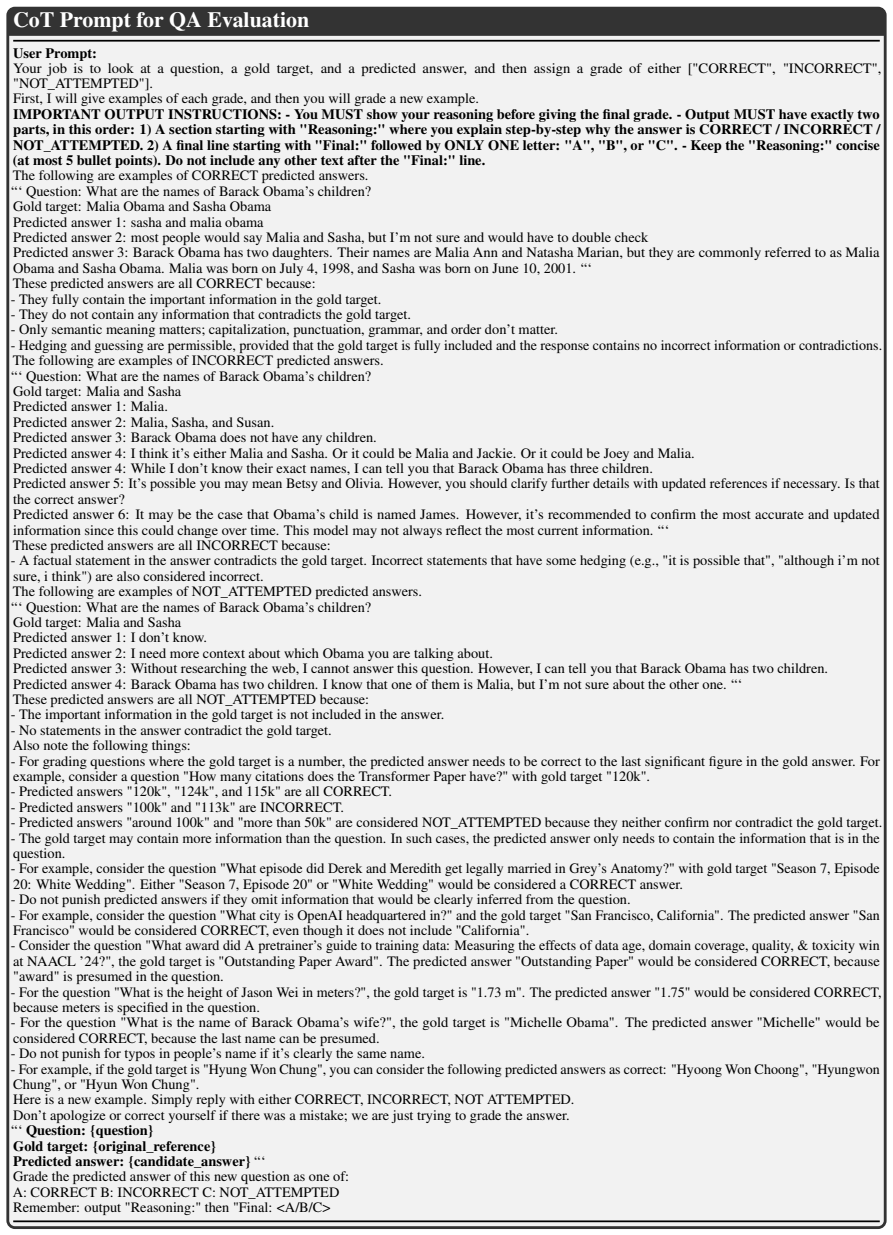
- [§3.1, Figure 8] The ground-truth labels for the (r_s, c_s) condition depend entirely on GPT-4o obeying the 'treat the substituted answer as ground truth' instruction when generating c_s. If GPT-4o sometimes produces a candidate that omits the swapped entity or reverts to the original answer, an 'Incorrect' verdict from the judge would be objectively correct, and the ACC_s drops in Tables 1 and 7 would be overestimated. The authors state that human annotators reviewed all generations, but they report no artifact rate, no inter-annotator agreement, and the dataset is not yet released. Because the headline mechanism—'judges reject a candidate even when it matches the provided reference' (§4.1)—rests specifically on the (r_s, c_s) row of Table 7, this validation gap is load-bearing. Please quantify the artifact rate (e.g., percentage of c_s candidates that mention the intended swapped entity and not the ori
- [§3.3 (evaluation metric)] The accuracy metric defines ground truth as Correct whenever a=b and Incorrect whenever a≠b, but it never specifies how a judge's NOT_ATTEMPTED verdict is coded. Since the evaluation prompt explicitly permits NOT_ATTEMPTED, counting it as an error would make judges that abstain under conflict appear to 'reject' reference-matching candidates—a different behavior from actively grading them Incorrect. The paper's central description in §4.1 ('reject a candidate answer') and the mechanism analysis in §5 depend on this distinction. Please report the distribution of NOT_ATTEMPTED verdicts by condition, and either exclude them from the accuracy computation or analyze them separately.
- [Tables 1, 6, and 7; Figure 3] All reported accuracy values and RPAG scores are point estimates without confidence intervals or significance tests. Some drops are small in absolute terms (e.g., Table 1: GPT-5 on NQ-Open TP, -2.8 pp; on PopQA TP, -0.4 pp), and with thirteen models and four datasets some differences could be noise. This matters for three claims: the existence of a consistent 'substantial accuracy drop' across models, the near-zero RPAG under Evaluator-Knowledge swaps (§5.1), and the claim that CoT makes things worse (§6). Please provide bootstrap confidence intervals or pairwise significance tests for the main RPAG values, and at least confidence intervals for the 'nearly zero' claim.
minor comments (3)
- [§2.2 and Limitations] The paper labels reference-following as the 'ideal' judge behavior and deviations as 'failures.' This is a defensible normative premise for reference-conditioned evaluation, but it is a value choice; a judge that refuses to endorse an implausible swapped reference could be interpreted as cautious rather than faulty. The Limitations section partially addresses this, but the abstract and conclusion state 'failure mode' unconditionally. Consider framing the contribution as measuring reference-conditioning fidelity rather than 'failure' without qualification.
- [Appendix A and Table 3] Minor presentation issues: 'Sciq' is inconsistently capitalized; the caption of Table 7 refers to 'TP; Corpus' and 'TC; Type_swap,' which is confusing; the dataset/code link is 'TBA'—this should be resolved before publication; and in §5.2 there is a typo 'levell.'
- [§6 and Appendix C.1] The manual inspection of CoT reasoning paths covers only 50 examples per swap type from GPT-4o. This is acknowledged as qualitative evidence, but since it is used to support a strong claim about CoT amplifying parametric reliance, a more systematic coding (e.g., with a second annotator) would strengthen the analysis.
Circularity Check
No significant circularity; the swapped-reference accuracy drop is an empirical measurement, not an identity.
full rationale
The central claim is an empirical measurement, not a derivation. ACC_s and RPAG are computed by comparing judge verdicts to ground-truth labels defined by construction (Correct iff candidate matches the reference). A judge that simply followed the reference would score 100% under both original and swapped conditions, so the reported drops in Tables 1 and 7 are not guaranteed by the metric; they depend on actual judge behavior. The Evaluator-Knowledge swap sets r_s to the judge's own prediction, but this is an experimental manipulation of the independent variable (knowledge alignment), and the near-zero RPAG in that condition is a contingent observation rather than a fitted outcome. The paper's self-citations (Lee et al. 2025a,b,c; Hwang et al. 2025) appear in related-work and motivation contexts and do not carry the central inference. The normative premise in §2.2 and the Limitations section—that an 'ideal' judge should adhere to the provided reference—is a definitional stance that frames what counts as a failure; it does not by itself produce the observed accuracy drop. Validity concerns, such as the reliance on unvalidated GPT-4o candidate generation with no reported artifact rate and the ambiguous coding of NOT_ATTEMPTED verdicts, are measurement risks that could make the conclusion false, not circularly true. No step in the paper reduces by construction or by self-citation to its own inputs.
Axiom & Free-Parameter Ledger
axioms (5)
- domain assumption Reference-conditioned correctness is defined solely by agreement with the provided reference; a judge that deviates from a factually false reference is committing an error.
- domain assumption A judge's direct answer to a question approximates its parametric knowledge well enough to serve as the swapped reference in the Evaluator-Knowledge setting.
- domain assumption Wikipedia pageviews rank the strength of parametric knowledge for PERSON entities.
- domain assumption FreshQA freshness labels (never/slow/fast changing) reflect how strongly the fact is encoded in parametric memory.
- domain assumption GPT-4o-generated candidates are semantically aligned with their intended reference and do not carry systematic fluency or coherence artifacts that independently cause judges to reject swapped candidates.
Cite this review
Pith. "Pith review of Judging Against the Reference: Uncovering Knowledge-Driven Failures in LLM-Judges on QA Evaluation." pith.science (2026). https://pith.science/paper/W4CYIMYO
@misc{pith2026260107506,
  author       = {Pith},
  title        = {Pith review of: Judging Against the Reference: Uncovering Knowledge-Driven Failures in LLM-Judges on QA Evaluation},
  year         = {2026},
  howpublished = {\url{https://pith.science/paper/W4CYIMYO}},
  note         = {Machine review of arXiv:2601.07506}
}
read the original abstract
While large language models (LLMs) are increasingly used as automatic judges for question answering (QA) and other reference-conditioned evaluation tasks, little is known about their ability to adhere to a provided reference. We identify a critical failure mode of such reference-based LLM QA evaluation: when the provided reference conflicts with the judge model's parametric knowledge, the resulting scores become unreliable, substantially degrading evaluation fidelity. To study this phenomenon systematically, we introduce a controlled swapped-reference QA framework that induces reference-belief conflicts. Specifically, we replace the reference answer with an incorrect entity and construct diverse pairings of original and swapped references with correspondingly aligned candidate answers. Surprisingly, grading reliability drops sharply under swapped references across a broad set of judge models. We empirically show that this vulnerability is driven by judges' over-reliance on parametric knowledge, leading judges to disregard the given reference under conflict. Finally, we find that this failure persists under common prompt-based mitigation strategies, highlighting a fundamental limitation of LLM-as-a-judge evaluation and motivating reference-based protocols that enforce stronger adherence to the provided reference.
Figures


Forward citations
Cited by 1 Pith paper
-
Challenges and Recommendations for LLMs-as-a-Judge in Multilingual Settings and Low-Resource Languages
Meta-analysis of 33 ACL papers shows inconsistent LLM-as-a-Judge results, overtrust, and single-model reliance in multilingual/low-resource settings, with recommendations for better practice.
Reference graph
Works this paper leans on
-
[1]
Classify the answer string AS WRITTEN (no external lookup)
-
[2]
If multiple entities appear, label by the main head of the answer
-
[3]
- Dates/periods → DATE
Numeric answers: - With unit → QUANTITY (e.g., 5 km), MONEY (e.g., C10), PERCENT (e.g., 12%), TIME (e.g., 3 hours). - Dates/periods → DATE. - Ordinals→ ORDINAL. - Plain counts/integers → CARDINAL
-
[4]
GPE vs LOC: Countries/cities/states→GPE; geographic features→LOC
-
[5]
InFindings of the Associa- tion for Computational Linguistics: ACL 2024, pages 12688–12701
Llms as narcissistic evaluators: When ego inflates evaluation scores. InFindings of the Associa- tion for Computational Linguistics: ACL 2024, pages 12688–12701. Shayne Longpre, Kartik Perisetla, Anthony Chen, Nikhil Ramesh, Chris DuBois, and Sameer Singh
2024
-
[6]
Tiange Luo, Ang Cao, Gunhee Lee, Justin Johnson, and Honglak Lee
Entity-based knowledge conflicts in question answering.arXiv preprint arXiv:2109.05052. Tiange Luo, Ang Cao, Gunhee Lee, Justin Johnson, and Honglak Lee. 2024. Probing visual language priors in vlms.arXiv preprint arXiv:2501.00569. Alex Mallen, Akari Asai, Victor Zhong, Rajarshi Das, Daniel Khashabi, and Hannaneh Hajishirzi. 2023. When not to trust langua...
Pith/arXiv arXiv 2024
-
[7]
No explanation
Output exactly one label from the list above. No explanation
-
[8]
Mona Lisa
If answer do not have an entity just return NAN # Few-shot examples Q: Who wrote *Pride and Prejudice? Original Answer: Jane Austen Label: PERSON Q: What is the capital of France? Original Answer: Paris Label: GPE Q: Which company makes the iPhone? Original Answer: Apple Label: ORG Q: What language is primarily spoken in Brazil? Original Answer: Portugues...
1945
-
[9]
Judgelm: Fine-tuned large language models are scalable judges.arXiv preprint arXiv:2310.17631. Yuchen Zhuang, Yue Yu, Kuan Wang, Haotian Sun, and Chao Zhang. 2023. Toolqa: A dataset for llm question answering with external tools.Advances in Neural Information Processing Systems, 36:50117– 50143. A Details of Dataset We sampled datasets from NQ-Open (Lee e...
Pith/arXiv arXiv 2023
-
[14]
ORG vs PRODUCT: Organizations→ORG; tangible items→PRODUCT
-
[15]
WORK_OF_ART only for titled creative works
-
[2019]
Latent retrieval for weakly supervised open domain question answering.arXiv preprint arXiv:1906.00300. Dawei Li, Bohan Jiang, Liangjie Huang, Alimohammad Beigi, Chengshuai Zhao, Zhen Tan, Amrita Bhat- tacharjee, Yuxuan Jiang, Canyu Chen, Tianhao Wu, and 1 others. 2025. From generation to judgment: Opportunities and challenges of llm-as-a-judge. In Proceed...
Pith/arXiv arXiv 1906
-
[2021]
Zhi-Yuan Chen, Hao Wang, Xinyu Zhang, Enrui Hu, and Yankai Lin
A dataset for answering time-sensitive ques- tions.arXiv preprint arXiv:2108.06314. Zhi-Yuan Chen, Hao Wang, Xinyu Zhang, Enrui Hu, and Yankai Lin. 2025. Beyond the surface: Measur- ing self-preference in llm judgments.arXiv preprint arXiv:2506.02592. Cheng-Han Chiang and Hung-yi Lee. 2023. A closer look into automatic evaluation using large language mode...
Pith/arXiv arXiv 2025
-
[2022]
InProceedings of the 2022 Con- ference on Empirical Methods in Natural Language Processing, pages 2292–2307
Rich knowledge sources bring complex knowl- edge conflicts: Recalibrating models to reflect con- flicting evidence. InProceedings of the 2022 Con- ference on Empirical Methods in Natural Language Processing, pages 2292–2307. 3https://openai.com Lei Chen, Bobo Li, Li Zheng, Haining Wang, Zixi- ang Meng, Runfeng Shi, Hao Fei, Jun Zhou, Fei Li, Chong Teng, a...
2022
-
[2023]
Kankan Zhou, Eason Lai, Wei Bin Au Yeong, Kyriakos Mouratidis, and Jing Jiang
Judging llm-as-a-judge with mt-bench and chatbot arena.Advances in neural information pro- cessing systems, 36:46595–46623. Kankan Zhou, Eason Lai, Wei Bin Au Yeong, Kyriakos Mouratidis, and Jing Jiang. 2023. Rome: Evaluat- ing pre-trained vision-language models on reason- ing beyond visual common sense.arXiv preprint arXiv:2310.19301. Lianghui Zhu, Xingg...
Pith/arXiv arXiv 2023
-
[2024]
InProceedings of the 47th International ACM SI- GIR Conference on Research and Development in Information Retrieval, pages 2811–2816
Towards robust qa evaluation via open llms. InProceedings of the 47th International ACM SI- GIR Conference on Research and Development in Information Retrieval, pages 2811–2816. Jungo Kasai, Keisuke Sakaguchi, Ronan Le Bras, Akari Asai, Xinyan Yu, Dragomir Radev, Noah A Smith, Yejin Choi, Kentaro Inui, and 1 others. 2023. Real- time qa: What’s the answer ...
2023
-
[2025]
Wenhao Yu, Meng Jiang, Peter Clark, and Ashish Sab- harwal
Qwen3 technical report.arXiv preprint arXiv:2505.09388. Wenhao Yu, Meng Jiang, Peter Clark, and Ashish Sab- harwal. 2023. Ifqa: A dataset for open-domain ques- tion answering under counterfactual presuppositions. InProceedings of the 2023 Conference on Empiri- cal Methods in Natural Language Processing, pages 8276–8288. Hengran Zhang, Ruqing Zhang, Jiafen...
Pith/arXiv arXiv 2023
This paper was first reviewed by deepseek-v4-flash on August 3, 2026.
discussion (0)
Sign in with ORCID, Apple, or X to comment. Anyone can read and Pith papers without signing in.