Geometric theory of constrained Schr\"odinger dynamics with application to time-dependent density-functional theory on a finite lattice
Pith reviewed 2026-05-16 15:09 UTC · model grok-4.3
The pith
Constrained Schrödinger dynamics on the quantum state manifold admits multiple geometric definitions, yielding both conventional TDDFT and a new alternative evolution.
A machine-rendered reading of the paper's core claim, the machinery that carries it, and where it could break.
Core claim
The manifold of states with prescribed expectation values supports several natural notions of constrained dynamics. The standard TDDFT evolution is recovered by imposing stationarity of the action, whereas a purely geometric projection onto the allowed tangent directions produces an inequivalent flow that can be realized by augmenting the Hamiltonian with an imaginary potential to keep the density fixed.
What carries the argument
The geometry of the finite-dimensional state manifold, which determines distinct projections that keep selected expectation values constant while evolving the state vector.
If this is right
- New Kohn-Sham schemes for lattice TDDFT in which the density constraint is enforced by an imaginary potential.
- The alternative geometric dynamics offers a route to TDDFT that may avoid certain mathematical difficulties of the conventional action-based formulation.
- The same geometric construction can be used to derive constrained schemes for other observables beyond the density.
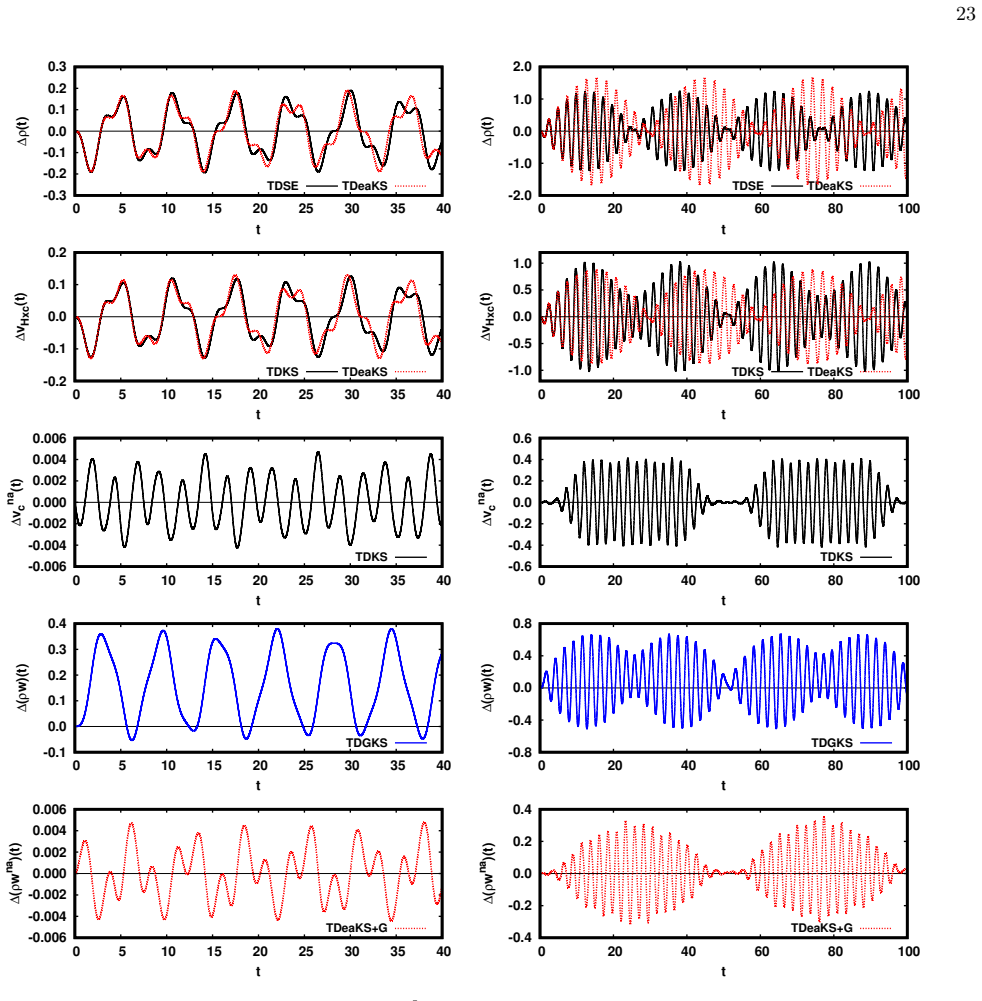
- Numerical illustrations on the Hubbard dimer already show how the new schemes differ from standard TDDFT in their time evolution.
Where Pith is reading between the lines
- The framework could be lifted from finite lattices to continuous or periodic systems to check whether the alternative dynamics remains stable or converges to known limits.
- It may connect to other geometric formulations of quantum dynamics that appear in open-system or non-Hermitian settings.
- Direct comparison of the two dynamics on small exact-solvable models could quantify which one better reproduces exact nonadiabatic transitions.
Load-bearing premise
The geometry of the state manifold itself supplies a physically preferred constrained dynamics that does not require the action principle.
What would settle it
Numerical integration of the alternative geometric dynamics on the Hubbard dimer for a chosen initial state and fixed density, followed by direct comparison of its time-dependent observables against the exact many-body Schrödinger evolution.
Figures




read the original abstract
Time-dependent density-functional theory (TDDFT) is a central tool for studying the dynamical electronic structure of molecules and solids, yet aspects of its mathematical foundations remain insufficiently understood. In this work, we revisit the foundations of TDDFT within a finite-dimensional setting by developing a general geometric framework for Schr\"odinger dynamics subject to prescribed expectation values of selected observables. We show that multiple natural definitions of such constrained dynamics arise from the underlying geometry of the state manifold. The conventional TDDFT formulation emerges from demanding stationarity of the action functional, while an alternative, purely geometric construction leads to a distinct form of constrained Schr\"odinger evolution that has not been previously explored. This alternative dynamics may provide a more mathematically robust route to TDDFT and may suggest new strategies for constructing nonadiabatic approximations. Applying the theory to interacting fermions on finite lattices, we derive novel Kohn--Sham schemes in which the density constraint is enforced via an imaginary potential or, equivalently, a nonlocal Hermitian operator. Numerical illustrations for the Hubbard dimer demonstrate the behavior of these new approaches.
Editorial analysis
A structured set of objections, weighed in public.
Referee Report
Summary. The paper develops a geometric framework for Schrödinger dynamics constrained to fixed expectation values of selected observables on finite-dimensional state manifolds (projective space with Fubini-Study metric). It argues that multiple natural definitions of such dynamics arise from the manifold geometry: the conventional TDDFT formulation is recovered by stationarity of the action functional, while an alternative, purely geometric construction (via a specific choice of horizontal distribution on the constraint subbundle) yields a distinct constrained evolution. This is applied to interacting fermions on finite lattices to derive novel Kohn-Sham schemes enforcing density constraints via an imaginary potential (or equivalent nonlocal Hermitian operator), with numerical illustrations on the Hubbard dimer.
Significance. If the alternative geometric dynamics is shown to be canonically distinct, robust, and independent of the action principle, the work could strengthen the mathematical foundations of TDDFT and suggest new nonadiabatic approximation strategies, especially for lattice models where standard variational approaches encounter difficulties. The provision of explicit Kohn-Sham schemes and Hubbard-dimer illustrations is a concrete strength.
major comments (2)
- [§3] §3: The alternative dynamics is obtained by selecting a particular orthogonal complement to the vertical directions generated by the constraint generators. This choice is equivalent to fixing a connection on the constraint subbundle whose curvature is not determined solely by the Kähler structure of the state manifold. Different choices of complement recover the standard variational TDDFT or other flows, so the construction is not unique without an additional selection rule whose physical motivation is not supplied by the manifold geometry alone.
- [§4] §4 (lattice application): The freedom to add any operator commuting with the density constraints is parametrized via the imaginary potential, but the manuscript does not demonstrate that this is the only (or the geometrically preferred) choice among the family of possible horizontal distributions. This directly affects whether the resulting Kohn-Sham scheme is uniquely determined by the geometric framework.
minor comments (1)
- [Abstract] The abstract and introduction should explicitly state the precise sense in which the geometric construction is claimed to be 'independent' of the action principle, given that both ultimately operate on the same constrained manifold.
Simulated Author's Rebuttal
We thank the referee for the careful reading and constructive comments on our manuscript. We appreciate the positive evaluation of the potential significance of the geometric framework and its application to lattice TDDFT. Below we respond point by point to the major comments.
read point-by-point responses
-
Referee: [§3] §3: The alternative dynamics is obtained by selecting a particular orthogonal complement to the vertical directions generated by the constraint generators. This choice is equivalent to fixing a connection on the constraint subbundle whose curvature is not determined solely by the Kähler structure of the state manifold. Different choices of complement recover the standard variational TDDFT or other flows, so the construction is not unique without an additional selection rule whose physical motivation is not supplied by the manifold geometry alone.
Authors: We agree that multiple horizontal distributions are mathematically possible on the constraint subbundle. Our construction selects the specific orthogonal complement with respect to the Fubini-Study metric that is compatible with the symplectic structure of the projective space while remaining independent of any action principle. This yields a canonical alternative to the variational dynamics whose curvature is fixed by the chosen orthogonality. We will revise §3 to state this selection rule explicitly, derive its curvature properties from the Kähler geometry, and clarify how it differs from other complements (including the variational one). revision: partial
-
Referee: [§4] §4 (lattice application): The freedom to add any operator commuting with the density constraints is parametrized via the imaginary potential, but the manuscript does not demonstrate that this is the only (or the geometrically preferred) choice among the family of possible horizontal distributions. This directly affects whether the resulting Kohn-Sham scheme is uniquely determined by the geometric framework.
Authors: In the lattice setting the imaginary potential (equivalently, the nonlocal Hermitian operator) is the operator that realizes the horizontal lift defined by the orthogonal complement of §3 while preserving the local character of the density constraint. We acknowledge that other commuting operators could be added in principle, but they would violate the orthogonality condition or introduce extraneous nonlocality. We will expand §4 to derive this preference explicitly from the geometric construction, compare it briefly to other possible lifts, and thereby establish that the resulting Kohn-Sham scheme is the one uniquely selected by the framework. revision: yes
Circularity Check
No circularity: derivation distinguishes action-based TDDFT from independent geometric flow on the constraint subbundle
full rationale
The paper explicitly states that multiple natural definitions of constrained dynamics arise from the state manifold geometry, with the conventional TDDFT recovered from stationarity of the action functional and the alternative construction presented as a distinct, purely geometric choice. No equation reduces a claimed prediction to a fitted input by construction, no load-bearing uniqueness theorem is imported via self-citation, and the lattice Kohn-Sham schemes follow directly from enforcing density constraints through the selected horizontal distribution without redefining the target quantities. The framework is self-contained against the Kähler structure and constraint generators, with the non-uniqueness of horizontal complements acknowledged rather than smuggled in as canonical.
Axiom & Free-Parameter Ledger
axioms (1)
- domain assumption The state manifold possesses a natural geometry that defines multiple distinct notions of constrained dynamics
Lean theorems connected to this paper
-
IndisputableMonolith/Foundation/AbsoluteFloorClosure.lean; IndisputableMonolith/Cost/FunctionalEquation.leanreality_from_one_distinction; washburn_uniqueness_aczel unclear?
unclearRelation between the paper passage and the cited Recognition theorem.
multiple natural definitions of such constrained dynamics arise from the underlying geometry of the state manifold. The conventional TDDFT formulation emerges from demanding stationarity of the action functional, while an alternative, purely geometric construction leads to a distinct form of constrained Schrödinger evolution
-
IndisputableMonolith/Foundation/AlexanderDuality.leanalexander_duality_circle_linking unclear?
unclearRelation between the paper passage and the cited Recognition theorem.
the geometric principle requires that ∂tψ(t) be the orthogonal projection of −iH(t)ψ(t) onto T_ψ(t) ... i∂tψ(t) = (H(t) + i Σ w_m(t) O_m) ψ(t)
What do these tags mean?
- matches
- The paper's claim is directly supported by a theorem in the formal canon.
- supports
- The theorem supports part of the paper's argument, but the paper may add assumptions or extra steps.
- extends
- The paper goes beyond the formal theorem; the theorem is a base layer rather than the whole result.
- uses
- The paper appears to rely on the theorem as machinery.
- contradicts
- The paper's claim conflicts with a theorem or certificate in the canon.
- unclear
- Pith found a possible connection, but the passage is too broad, indirect, or ambiguous to say the theorem truly supports the claim.
Forward citations
Cited by 1 Pith paper
-
Geometric Time-Dependent Density Functional Theory
Geometric TDDFT reformulates the theory on the manifold of fixed-density states, producing a hydrodynamics equation for orbital-free TDDFT and a non-local operator for the Kohn-Sham version.
Reference graph
Works this paper leans on
-
[1]
= Tr(γ1) = 2KX k=1 λk(γ) = 2KX k=1 λk(γ′). The first part is becauseγandγ ′ have the same density and the second is because they have the same spectrum. Next we use the variational characterization of the sum of the lowest eigenvalues, which is nothing but the Aufbau principle for fermions. We denote byP:=1(γ ′ ⩽λ 2K) the spectral projection corresponding...
-
[2]
Similarly, we callλ 2 andλ ′ 2 the lowest and largest eigenvalues ofγ 2, with eigenvec- torsφ 2 andφ ′
-
[3]
It is perfectly possible thatλ 1 =λ ′ 1 in case of degeneracy
We thus haveλ 1 < λ ′ 2 andλ ′ 1 < λ 2. It is perfectly possible thatλ 1 =λ ′ 1 in case of degeneracy. We can always assume thatφ 1 andφ ′ 1 are orthogonal, even whenK= 1, thanks to the spin. Similarly forφ 2 andφ ′
-
[4]
By doing so we insert non-zero terms outside of the blocks, as needed to make the matrix irreducible
Next we apply two rotations, replacing (φ1, φ′ 2)7→(cosθ 1φ1 + sinθ 1φ′ 2,−sinθ 1φ1 + cosθ 1φ′ 2) and (φ′ 1, φ2)7→(cosθ 2φ′ 1 + sinθ 2φ2,−sinθ 2φ′ 1 + cosθ 2φ2). By doing so we insert non-zero terms outside of the blocks, as needed to make the matrix irreducible. We obtain a new matrixγ ′′ whose diagonal blocks are γ′′ 1 =γ 1 + (λ′ 2 −λ 1) sin2 θ1 |φ1⟩⟨φ1...
-
[5]
To conclude this appendix, we extract a result dealing specifically with projections
Putting every- thing together, we have constructed the desired unitary matrix. To conclude this appendix, we extract a result dealing specifically with projections. Theorem 10(Perturbing non-irreducible projections). Letγbe a one-particle rank-Nprojection that does not act irreducibly. We assume that0< ρ γ <2everywhere. Then, for anyε >0we can find a unit...
-
[6]
P. Hohenberg and W. Kohn, Inhomogeneous electron gas, Phys. Rev.136, B864 (1964)
work page 1964
-
[7]
W. Kohn and L. J. Sham, Self-Consistent Equations In- cluding Exchange and Correlation Effects, Phys. Rev. 140, A1133 (1965)
work page 1965
-
[8]
E. Runge and E. K. U. Gross, Density-functional the- ory for time-dependent systems, Phys. Rev. Lett.52, 997 (1984)
work page 1984
-
[9]
van Leeuwen, Mapping from densities to potentials in time-dependent density-functional theory, Phys
R. van Leeuwen, Mapping from densities to potentials in time-dependent density-functional theory, Phys. Rev. Lett.82, 3863 (1999)
work page 1999
-
[10]
E. H. Lieb, Density functionals for Coulomb systems, Int. J. Quantum Chem.24, 243 (1983)
work page 1983
-
[11]
N. T. Maitra, T. N. Todorov, C. Woodward, and K. Burke, Density-potential mapping in time-dependent density-functional theory, Phys. Rev. A81, 042525 (2010)
work page 2010
-
[12]
Z.-h. Yang, N. T. Maitra, and K. Burke, Effect of cusps in time-dependent quantum mechanics, Phys. Rev. Lett. 108, 063003 (2012)
work page 2012
-
[13]
S. Fournais, J. Lampart, M. Lewin, and T. Østergaard Sørensen, Coulomb potentials and Taylor expansions in Time-Dependent Density Functional Theory, Phys. Rev. A93, 062510 (2016)
work page 2016
-
[14]
M. Farzanehpour and I. V. Tokatly, Time-dependent den- sity functional theory on a lattice, Phys. Rev. B86, 125130 (2012)
work page 2012
-
[15]
M. Ruggenthaler, M. Penz, and D. Bauer, On the ex- 34 istence of effective potentials in time-dependent density functional theory, J. Phys. A, Math. Gen.42, 425207 (2009)
work page 2009
-
[16]
M. Ruggenthaler and R. van Leeuwen, Global fixed-point proof of time-dependent density-functional theory, EPL (Europhysics Letters)95, 13001 (2011)
work page 2011
-
[17]
M. Penz and M. Ruggenthaler, Domains of time- dependent density-potential mappings, J. Phys. A, Math. Gen.44, 335208 (2011)
work page 2011
-
[18]
M. Ruggenthaler, K. J. H. Giesbertz, M. Penz, and R. van Leeuwen, Density-potential mappings in quantum dy- namics, Phys. Rev. A85, 052504 (2012)
work page 2012
-
[19]
M. Ruggenthaler, M. Penz, and R. van Leeuwen, Ex- istence, uniqueness, and construction of the density- potential mapping in time-dependent density-functional theory, J. Phys. Condens. Matter27, 203202 (2015)
work page 2015
-
[20]
L. Lacombe and N. T. Maitra, Non-adiabatic ap- proximations in time-dependent density functional the- ory: progress and prospects, npj Comput. Mater.9, 10.1038/s41524-023-01061-0 (2023)
-
[21]
Geometric Time-Dependent Density Functional Theory
´E. Canc` es, T. Duez, J. van Gog, A. B. Lauritsen, M. Lewin, and J. Toulouse, Geometric Time-Dependent Density Functional Theory, ArXiv e-prints (2026), arXiv:2601.07724
work page internal anchor Pith review Pith/arXiv arXiv 2026
-
[22]
K. Sch¨ onhammer, O. Gunnarsson, and R. M. Noack, Density-functional theory on a lattice: Comparison with exact numerical results for a model with strongly corre- lated electrons, Phys. Rev. B52, 2504 (1995)
work page 1995
-
[23]
L. Xu, J. Mao, X. Gao, and Z. Liu, Extensibility of hohen- berg–kohn theorem to general quantum systems, Adv. Quantum Technol.5, 10.1002/qute.202200041 (2022)
-
[24]
Song, Quantum geometry of expectation values, Phys
C. Song, Quantum geometry of expectation values, Phys. Rev. A107, 062207 (2023)
work page 2023
-
[25]
M. Penz and R. van Leeuwen, Constrained search in imaginary time, Phys. Rev. A119, 032815 (2025)
work page 2025
-
[26]
N. Boumal,An introduction to optimization on smooth manifolds(Cambridge University Press, Cambridge, 2023)
work page 2023
-
[27]
J. M. Lee,Introduction to Smooth Manifolds, 2nd ed., Graduate Texts in Mathematics (Springer New York, 2012)
work page 2012
-
[28]
M. Penz and R. van Leeuwen, Density-functional the- ory on graphs, J. Chem. Phys.155, 10.1063/5.0074249 (2021)
-
[29]
P. A. M. Dirac,The Principles of Quantum Mechanics (Oxford, at the Clarendon Press,, 1930) pp. xii+311, 3d ed (1947)
work page 1930
-
[30]
Frenkel,Wave Mechanics; Advanced General Theory (Oxford University Press, 1934)
J. Frenkel,Wave Mechanics; Advanced General Theory (Oxford University Press, 1934)
work page 1934
- [31]
-
[32]
J. Broeckhove, L. Lathouwers, E. Kesteloot, and P. Van Leuven, On the equivalence of time-dependent variational principles, Chem. Phys. Lett.149, 547 (1988)
work page 1988
-
[33]
Raab, On the Dirac–Frenkel/McLachlan variational principle, Chem
A. Raab, On the Dirac–Frenkel/McLachlan variational principle, Chem. Phys. Lett.319, 674 (2000)
work page 2000
-
[34]
L. Hackl, T. Guaita, T. Shi, J. Haegeman, E. Demler, and I. Cirac, Geometry of variational methods: dynamics of closed quantum systems, SciPost Phys.9, 10.21468/sci- postphys.9.4.048 (2020)
-
[35]
R. Martinazzo and I. Burghardt, Local-in-Time Error in Variational Quantum Dynamics, Phys. Rev. Lett.124, 150601 (2020)
work page 2020
-
[36]
C. Lasser and C. Su, Various variational approxi- mations of quantum dynamics, J. Math. Phys.63, 10.1063/5.0088265 (2022)
-
[37]
P. Kramer and M. Saraceno,Geometry of the Time- Dependent Variational Principle in Quantum Mechanics (Springer Berlin Heidelberg, 1981)
work page 1981
-
[38]
van Leeuwen, Causality and symmetry in time- dependent density-functional theory, Phys
R. van Leeuwen, Causality and symmetry in time- dependent density-functional theory, Phys. Rev. Lett.80, 1280 (1998)
work page 1998
-
[39]
G. Vignale, Real-time resolution of the causality paradox of time-dependent density-functional theory, Phys. Rev. A77, 062511 (2008)
work page 2008
-
[40]
D. J. Rowe, A. Ryman, and G. Rosensteel, Many-body quantum mechanics as a symplectic dynamical system, Phys. Rev. A22, 2362 (1980)
work page 1980
-
[41]
McLachlan, A variational solution of the time- dependent Schr¨ odinger equation, Mol
A. McLachlan, A variational solution of the time- dependent Schr¨ odinger equation, Mol. Phys.8, 39 (1964)
work page 1964
-
[42]
C. Lubich,From quantum to classical molecular dynam- ics: reduced models and numerical analysis, Zurich Lec- tures in Advanced Mathematics (European Mathemati- cal Society (EMS), Z¨ urich, 2008) pp. x+144
work page 2008
-
[43]
V. U. Nazarov, Time-dependent variational principle and self-consistent field equations, Math. Proc. Cambridge Philos. Soc.98, 373 (1985)
work page 1985
-
[44]
V. U. Nazarov and V. M. Silkin, Exchange kernelf h x (q, ω) of electron liquid from the variational principle of mclach- lan, Phys. Rev. B110, 104310 (2024)
work page 2024
-
[45]
P.-O. L¨ owdin and P. Mukherjee, Some comments on the time-dependent variation principle, Chem. Phys. Lett. 14, 1 (1972)
work page 1972
-
[46]
U. V. Riss and H. D. Meyer, Calculation of resonance en- ergies and widths using the complex absorbing potential method, J. Phys. B26, 4503 (1993)
work page 1993
-
[47]
R. Santra and L. S. Cederbaum, Non-hermitian electronic theory and applications to clusters, Phys. Rep.368, 1 (2002)
work page 2002
-
[48]
Ernzerhof, Density functional theory of complex tran- sition densities, J
M. Ernzerhof, Density functional theory of complex tran- sition densities, J. Chem. Phys.125, 10.1063/1.2348880 (2006)
-
[49]
Y. Zhou and M. Ernzerhof, Open-system Kohn-Sham density functional theory, J. Chem. Phys.136, 094105 (2012)
work page 2012
-
[50]
R. Gebauer and R. Car, Current in Open Quantum Sys- tems, Phys. Rev. Lett.93, 160404 (2004)
work page 2004
-
[51]
J. Yuen-Zhou, C. Rodr´ ıguez-Rosario, and A. Aspuru- Guzik, Time-dependent current-density functional the- ory for generalized open quantum systems, Phys. Chem. Chem. Phys.11, 4509 (2009)
work page 2009
-
[52]
R. D’Agosta and M. Di Ventra, Foundations of stochas- tic time-dependent current-density functional theory for open quantum systems: Potential pitfalls and rigorous results, Phys. Rev. B87, 155129 (2013)
work page 2013
-
[53]
Baer, On the mapping of time-dependent densities onto potentials in quantum mechanics, J
R. Baer, On the mapping of time-dependent densities onto potentials in quantum mechanics, J. Chem. Phys. 128, 10.1063/1.2822124 (2008)
-
[54]
Y. Li and C. A. Ullrich, Time-dependent V- representability on lattice systems, J. Chem. Phys. 129, 10.1063/1.2955733 (2008)
-
[55]
C. Verdozzi, Time-Dependent Density-Functional The- ory and Strongly Correlated Systems: Insight from Nu- merical Studies, Phys. Rev. Lett.101, 166401 (2008)
work page 2008
-
[56]
S. T. Epstein and C. M. Rosenthal, The Hohen- berg–Kohn theorem, J. Chem. Phys.64, 247 (1976). 35
work page 1976
-
[57]
H. Englisch and R. Englisch, V-representability in finite- dimensional spaces, J. Phys. A: Math. Gen.16, L693 (1983)
work page 1983
-
[58]
Kohn,v-representability and density functional the- ory, Phys
W. Kohn,v-representability and density functional the- ory, Phys. Rev. Lett.51, 1596 (1983)
work page 1983
-
[59]
H. Englisch and R. Englisch, Exact density functionals for ground-state energies. i. general results, Phys. Status Solidi B123, 711 (1984)
work page 1984
-
[60]
J. T. Chayes, L. Chayes, and M. B. Ruskai, Density functional approach to quantum lattice systems, J. Stat. Phys.38, 497 (1985)
work page 1985
-
[61]
C. A. Ullrich and W. Kohn, Degeneracy in Density Func- tional Theory: Topology in thevandnSpaces, Phys. Rev. Lett.89, 156401 (2002)
work page 2002
-
[62]
M. Penz and R. van Leeuwen, Geometrical perspective on spin–lattice density-functional theory, J. Chem. Phys. 161, 10.1063/5.0230494 (2024)
-
[63]
V. H. Bakkestuen, M. A. Csirik, A. Laestadius, and M. Penz, Density-Functional Theory for the Dicke Hamil- tonian, J. Statist. Phys.192, 10.1007/s10955-025-03442- 9 (2025)
-
[64]
Garrigue, Unique continuation for many-body Schr¨ odinger operators and the Hohenberg-Kohn theorem
L. Garrigue, Unique continuation for many-body Schr¨ odinger operators and the Hohenberg-Kohn theorem. II. The Pauli Hamiltonian, Doc. Math.25, 869 (2020)
work page 2020
- [65]
-
[66]
A. Schindlmayr and R. W. Godby, Density-functional theory and thev-representability problem for model strongly correlated electron systems, Phys. Rev. B51, 10427 (1995)
work page 1995
-
[67]
T. R¨ ossler, C. Verdozzi, and C.-O. Almbladh, Av 0- representability issue in lattice ensemble-DFT and its signature in lattice TDDFT, Eur. Phys. J. B91, 10.1140/epjb/e2018-90205-7 (2018)
-
[68]
E. K. U. Gross, J. F. Dobson, and M. Petersilka, Den- sity functional theory of time-dependent phenomena, in Density Functional Theory II(Springer-Verlag, 1996) pp. 81–172
work page 1996
-
[69]
M. A. Marques, C. A. Ullrich, F. Nogueira, A. Rubio, K. Burke, and E. K. U. Gross, eds.,Time-Dependent Density Functional Theory(Springer Berlin Heidelberg, 2006)
work page 2006
-
[70]
C. A. Ullrich,Time-Dependent Density-Functional The- ory, Concepts and Applications, Oxford Graduate Texts (Oxford University Press, 2011)
work page 2011
-
[71]
M. A. Marques, N. T. Maitra, F. M. Nogueira, E. Gross, and A. Rubio, eds.,Fundamentals of Time-Dependent Density Functional Theory(Springer Berlin Heidelberg, 2012)
work page 2012
-
[72]
N. A. Lima, M. F. Silva, L. N. Oliveira, and K. Capelle, Density functionals not based on the electron gas: Local- density approximation for a luttinger liquid, Phys. Rev. Lett.90, 146402 (2003)
work page 2003
-
[73]
F. Aryasetiawan and O. Gunnarsson, Exchange- correlation kernel in time-dependent density functional theory, Phys. Rev. B66, 165119 (2002)
work page 2002
-
[74]
R. Requist and O. Pankratov, Generalized Kohn-Sham system in one-matrix functional theory, Phys. Rev. B 77, 235121 (2008)
work page 2008
-
[75]
R. Requist and O. Pankratov, Adiabatic approxima- tion in time-dependent reduced-density-matrix func- tional theory, Phys. Rev. A81, 042519 (2010)
work page 2010
-
[76]
J. I. Fuks, M. Farzanehpour, I. V. Tokatly, H. Ap- pel, S. Kurth, and A. Rubio, Time-dependent exchange- correlation functional for a Hubbard dimer: Quantifying nonadiabatic effects, Phys. Rev. A88, 062512 (2013)
work page 2013
-
[77]
J. I. Fuks and N. T. Maitra, Charge transfer in time- dependent density-functional theory: Insights from the asymmetric Hubbard dimer, Phys. Rev. A89, 062502 (2014)
work page 2014
-
[78]
J. I. Fuks and N. T. Maitra, Challenging adiabatic time- dependent density functional theory with a hubbard dimer: the case of time-resolved long-range charge trans- fer, Phys. Chem. Chem. Phys.16, 14504 (2014)
work page 2014
-
[79]
D. J. Carrascal, J. Ferrer, J. C. Smith, and K. Burke, The Hubbard dimer: a density functional case study of a many-body problem, J. Phys.: Condens. Matter27, 393001 (2015)
work page 2015
-
[80]
D. J. Carrascal, J. Ferrer, N. Maitra, and K. Burke, Linear response time-dependent density functional the- ory of the hubbard dimer, Eur. Phys. J. B91, 10.1140/epjb/e2018-90114-9 (2018)
discussion (0)
Sign in with ORCID, Apple, or X to comment. Anyone can read and Pith papers without signing in.