Recognition: 2 theorem links
· Lean TheoremEpicyclic motion of charged particles around a weakly magnetized Kiselev black hole
Pith reviewed 2026-05-16 15:00 UTC · model grok-4.3
The pith
Weak magnetic fields combined with quintessence modify epicyclic frequencies of charged particles around Kiselev black holes.
A machine-rendered reading of the paper's core claim, the machinery that carries it, and where it could break.
Core claim
In the weak magnetic field approximation the spacetime metric permits a perturbative treatment of charged particle dynamics. The effective potential obtained from the Lagrangian yields conditions for bound motion and circular orbits whose small radial and vertical oscillations have frequencies that depend on both the quintessence parameter and the magnetic field intensity. These frequencies produce a periapsis advance and a gravitational Larmor precession that deviate measurably from the predictions of the pure Kiselev solution and from the Ernst metric.
What carries the argument
The effective potential constructed from the Lagrangian of a charged test particle in the perturbed Kiselev metric that incorporates both the quintessence term and the weak uniform magnetic field.
If this is right
- Bound and stable circular orbits exist only within specific ranges of the quintessence and magnetic-field parameters.
- The epicyclic frequencies shift in a way that alters the conditions for orbital stability compared with either field taken alone.
- The periapsis shift receives additive corrections from both quintessence and magnetism, producing values distinct from the Ernst or Kiselev cases.
- Gravitational Larmor precession acquires an extra term linear in the magnetic field that is absent in the pure Kiselev spacetime.
Where Pith is reading between the lines
- Models of accretion flows around supermassive black holes embedded in quintessence would need to include weak magnetic corrections to predict correct orbital periods and radiation signatures.
- The reported differences could be used to constrain the quintessence parameter once independent measurements of the local magnetic field are available.
- The perturbative approach naturally extends to inclined orbits, where the same effective potential would govern nodal precession rates.
Load-bearing premise
The magnetic field remains weak enough that it can be added perturbatively to the Kiselev metric without any back-reaction on the geometry itself.
What would settle it
A precise observation of the radial epicyclic frequency for a charged particle on a nearly circular orbit around a black-hole candidate that deviates from the non-magnetized Kiselev prediction but fails to follow the joint dependence on quintessence and magnetic-field strength.
Figures




read the original abstract
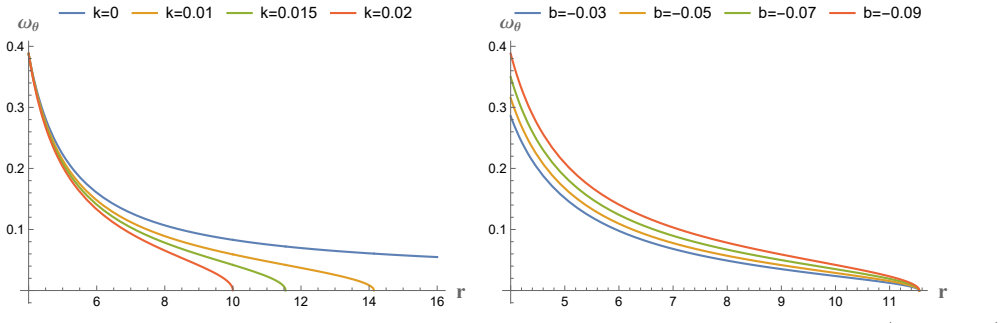
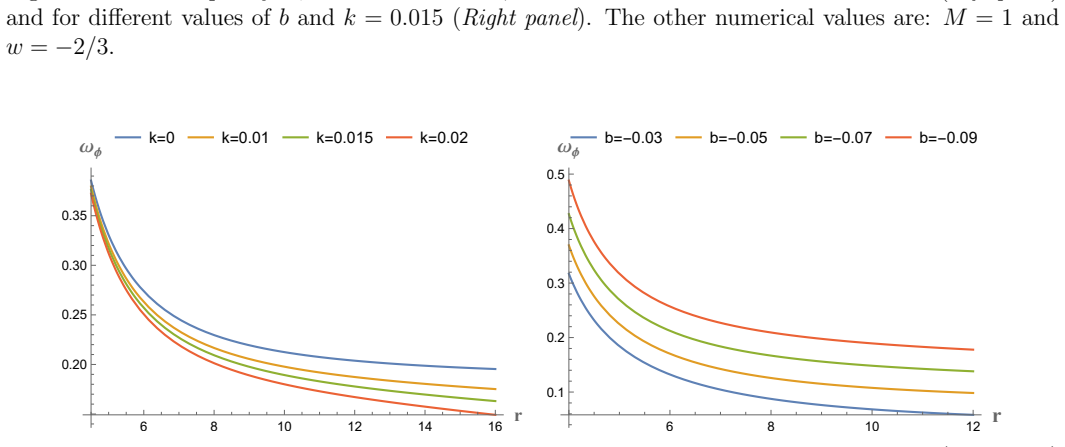
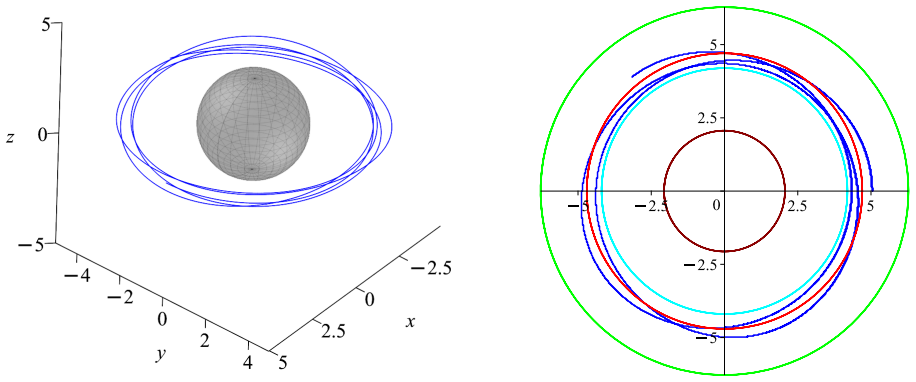
We investigate the motion of charged particles evolving around a magnetized Kiselev black hole, in the weak magnetic field approximation. The effective potential allows us to study the bound motion and the stable circular orbits. We analyze the impact of combined quintessence and magnetic fields on the epicyclic frequencies. Finally, we examine the periapsis shift and gravitational Larmor precession pointing out differences from the Ernst or Kiselev spacetimes.
Editorial analysis
A structured set of objections, weighed in public.
Referee Report
Summary. The manuscript investigates the motion of charged particles around a weakly magnetized Kiselev black hole using the effective potential in the weak magnetic field approximation. It analyzes bound motion and stable circular orbits, examines the combined effects of quintessence and magnetic fields on epicyclic frequencies, and computes the periapsis shift and gravitational Larmor precession, highlighting differences from the pure Ernst and pure Kiselev spacetimes.
Significance. If the perturbative ordering holds, the work provides a concrete calculation of how quintessence and weak magnetic fields jointly modify orbital frequencies and precession effects in a black-hole spacetime, offering potential benchmarks for accretion-disk modeling or tests of modified gravity with electromagnetic fields.
major comments (1)
- [Abstract and effective-potential section] The central results on epicyclic frequencies, periapsis shift, and Larmor precession rest on a first-order expansion in the magnetic field strength B while holding the Kiselev parameter fixed. No explicit bound on B (relative to the quintessence parameter or horizon scale) is supplied to guarantee that the magnetic correction remains sub-dominant throughout the radial domain used for the plotted frequencies and shifts; without this, the claimed separation from the pure Ernst and pure Kiselev cases cannot be verified.
Simulated Author's Rebuttal
We thank the referee for the thorough review and insightful comment. We address the major point below and will revise the manuscript to strengthen the presentation of the approximation's validity.
read point-by-point responses
-
Referee: [Abstract and effective-potential section] The central results on epicyclic frequencies, periapsis shift, and Larmor precession rest on a first-order expansion in the magnetic field strength B while holding the Kiselev parameter fixed. No explicit bound on B (relative to the quintessence parameter or horizon scale) is supplied to guarantee that the magnetic correction remains sub-dominant throughout the radial domain used for the plotted frequencies and shifts; without this, the claimed separation from the pure Ernst and pure Kiselev cases cannot be verified.
Authors: We agree that an explicit bound on B is needed to rigorously justify the first-order expansion and to confirm the separation from the pure Ernst and pure Kiselev limits. In the revised manuscript we will insert a new paragraph immediately after the effective-potential derivation that states the perturbative ordering condition B ≪ (r_h/r)^2 (1 − 2M/r − α r) (with α the quintessence parameter and r_h the horizon radius) and verifies numerically that this inequality holds throughout the radial intervals shown in the frequency and precession plots. This addition will make the domain of validity transparent and strengthen the comparison with the limiting cases. revision: yes
Circularity Check
No circularity: direct perturbative derivation from metric and Lorentz force
full rationale
The manuscript starts from the Kiselev metric plus a weak uniform magnetic field, constructs the effective potential for charged test particles, locates circular orbits, and extracts epicyclic frequencies from the second derivatives of that potential. Periapsis shift and Larmor precession follow from the same first-order expansions. No parameter is fitted to a subset of results and then re-used as a prediction; the weak-field ordering is an explicit input assumption rather than an output. No self-citation is invoked to justify uniqueness or to smuggle an ansatz. The derivation chain therefore remains independent of its own results.
Axiom & Free-Parameter Ledger
axioms (2)
- domain assumption Kiselev metric with quintessence parameter is the background spacetime
- domain assumption Weak magnetic field approximation holds
Lean theorems connected to this paper
-
IndisputableMonolith/Cost/FunctionalEquationwashburn_uniqueness_aczel unclear?
unclearRelation between the paper passage and the cited Recognition theorem.
We investigate the motion of charged particles evolving around a magnetized Kiselev black hole, in the weak magnetic field approximation. The effective potential allows us to study the bound motion and the stable circular orbits. We analyze the impact of combined quintessence and magnetic fields on the epicyclic frequencies.
-
IndisputableMonolith/Foundation/DimensionForcingalexander_duality_circle_linking unclear?
unclearRelation between the paper passage and the cited Recognition theorem.
the expressions of ω_r, ω_θ and ω_ϕ as functions of r
What do these tags mean?
- matches
- The paper's claim is directly supported by a theorem in the formal canon.
- supports
- The theorem supports part of the paper's argument, but the paper may add assumptions or extra steps.
- extends
- The paper goes beyond the formal theorem; the theorem is a base layer rather than the whole result.
- uses
- The paper appears to rely on the theorem as machinery.
- contradicts
- The paper's claim conflicts with a theorem or certificate in the canon.
- unclear
- Pith found a possible connection, but the passage is too broad, indirect, or ambiguous to say the theorem truly supports the claim.
Reference graph
Works this paper leans on
-
[1]
Chandrasekhar,The Mathematical Theory of Black Holes(Oxford University Press, Oxford, 1983)
S. Chandrasekhar,The Mathematical Theory of Black Holes(Oxford University Press, Oxford, 1983)
work page 1983
-
[2]
R. D. Blandford and R. L. Znajek, Mon. Not. Roy. Astron. Soc.179, 433-456 (1977) doi:10.1093/mnras/179.3.433
-
[3]
R. A. Daly, Astrophys. J.886, 37 (2019) doi:10.3847/1538-4357/ab35e6 [arXiv:1905.11319 [astro- ph.HE]]
-
[4]
M. Y. Piotrovich, A. G. Mikhailov, S. D. Buliga and T. M. Natsvlishvili, Mon. Not. Roy. Astron. Soc.495, no.1, 614-620 (2020) doi:10.1093/mnras/staa1268 [arXiv:2004.07075 [astro-ph.HE]]
-
[5]
R. Beck and R. Wielebinski, doi:10.1007/978-94-007-5612-0 13 [arXiv:1302.5663 [astro-ph.GA]]
-
[6]
V. P. Frolov and A. A. Shoom, Phys. Rev. D82, 084034 (2010) doi:10.1103/PhysRevD.82.084034 [arXiv:1008.2985 [gr-qc]]
work page internal anchor Pith review Pith/arXiv arXiv doi:10.1103/physrevd.82.084034 2010
-
[7]
F. J. Ernst, J. Math. Phys.17, no.1, 54-56 (1976) doi:10.1063/1.522781
-
[8]
Y. K. Lim, Phys. Rev. D91, no.2, 024048 (2015) doi:10.1103/PhysRevD.91.024048 [arXiv:1502.00722 [gr-qc]]
work page internal anchor Pith review Pith/arXiv arXiv doi:10.1103/physrevd.91.024048 2015
-
[9]
M. Koloˇ s, Z. Stuchl´ ık and A. Tursunov, Class. Quant. Grav.32, no.16, 165009 (2015) doi:10.1088/0264-9381/32/16/165009 [arXiv:1506.06799 [gr-qc]]
work page internal anchor Pith review Pith/arXiv arXiv doi:10.1088/0264-9381/32/16/165009 2015
-
[10]
A. M. Al Zahrani, V. P. Frolov and A. A. Shoom, Phys. Rev. D87, no.8, 084043 (2013) doi:10.1103/PhysRevD.87.084043 [arXiv:1301.4633 [gr-qc]]
work page internal anchor Pith review Pith/arXiv arXiv doi:10.1103/physrevd.87.084043 2013
-
[11]
S. Kenzhebayeva, S. Toktarbay, A. Tursunov and M. Koloˇ s, Phys. Rev. D109, no.6, 063005 (2024) doi:10.1103/PhysRevD.109.063005 [arXiv:2402.16529 [astro-ph.HE]]
-
[12]
C. L. Polo and H. S. Singh, J. Astrophys. Astron.46, no.2, 88 (2025) doi:10.1007/s12036-025- 10116-1
-
[13]
K. J. Taylor and A. Ritz, Class. Quant. Grav.42, no.21, 215003 (2025) doi:10.1088/1361- 6382/ae0be3 [arXiv:2505.11629 [gr-qc]]
-
[14]
A. G. Riesset al.[Supernova Search Team], Astron. J.116, 1009-1038 (1998) doi:10.1086/300499 [arXiv:astro-ph/9805201 [astro-ph]]
work page internal anchor Pith review Pith/arXiv arXiv doi:10.1086/300499 1998
-
[15]
Measurements of Omega and Lambda from 42 High-Redshift Supernovae
S. Perlmutteret al.[Supernova Cosmology Project], Astrophys. J.517, 565-586 (1999) doi:10.1086/307221 [arXiv:astro-ph/9812133 [astro-ph]]. 31
work page internal anchor Pith review Pith/arXiv arXiv doi:10.1086/307221 1999
-
[16]
V. V. Kiselev, Class. Quant. Grav.20, 1187-1198 (2003) doi:10.1088/0264-9381/20/6/310 [arXiv:gr- qc/0210040 [gr-qc]]
-
[17]
M. A. Dariescu, C. Dariescu, V. Lungu and C. Stelea, Phys. Rev. D106, no.6, 064017 (2022) doi:10.1103/PhysRevD.106.064017 [arXiv:2206.12876 [gr-qc]]
-
[18]
Schwarzschild black hole surrounded by quintessence: Null geodesics
S. Fernando, Gen. Rel. Grav.44, 1857-1879 (2012) doi:10.1007/s10714-012-1368-x [arXiv:1202.1502 [gr-qc]]
work page internal anchor Pith review Pith/arXiv arXiv doi:10.1007/s10714-012-1368-x 2012
-
[19]
Nariai black holes with quintessence
S. Fernando, Mod. Phys. Lett. A28, 1350189 (2013) doi:10.1142/S0217732313501897 [arXiv:1408.5064 [gr-qc]]
work page internal anchor Pith review Pith/arXiv arXiv doi:10.1142/s0217732313501897 2013
-
[20]
K. K. J. Rodrigue, M. Saleh, B. B. Thomas and T. C. Kofane, Gen. Rel. Grav.50, no.5, 52 (2018) doi:10.1007/s10714-018-2367-3
-
[21]
M. M. Gohain, K. Bhuyan, R. Borgohain, T. Gogoi, K. Bhuyan and P. Phukon, Nucl. Phys. B 1018, 117073 (2025) doi:10.1016/j.nuclphysb.2025.117073 [arXiv:2412.06252 [gr-qc]]
-
[22]
A. Errehymy, Phys. Lett. B870, 139945 (2025) doi:10.1016/j.physletb.2025.139945
-
[23]
M. A. Dariescu, V. Lungu, C. Dariescu and C. Stelea, Phys. Rev. D109, no.2, 024021 (2024) doi:10.1103/PhysRevD.109.024021 [arXiv:2311.11356 [gr-qc]]
-
[24]
M. Dariescu and V. Lungu, Eur. Phys. J. Plus140, no.6, 476 (2025) doi:10.1140/epjp/s13360-025- 06435-5
-
[25]
Shadow of the rotating black hole with quintessential energy in the presence of the plasma
A. Abdujabbarov, B. Toshmatov, Z. Stuchl´ ık and B. Ahmedov, Int. J. Mod. Phys. D26, no.06, 1750051 (2016) doi:10.1142/S0218271817500511 [arXiv:1512.05206 [gr-qc]]
work page internal anchor Pith review Pith/arXiv arXiv doi:10.1142/s0218271817500511 2016
-
[26]
J. Rayimbaev, B. Majeed, M. Jamil, K. Jusufi and A. Wang, Phys. Dark Univ.35, 100930 (2022) doi:10.1016/j.dark.2021.100930 [arXiv:2202.11509 [gr-qc]]
-
[27]
On magnetized anisotropic stars
C. Stelea, M. A. Dariescu and C. Dariescu, Phys. Rev. D97, no.10, 104059 (2018) doi:10.1103/PhysRevD.97.104059 [arXiv:1804.08075 [gr-qc]]
work page internal anchor Pith review Pith/arXiv arXiv doi:10.1103/physrevd.97.104059 2018
-
[28]
C. Stelea, M. A. Dariescu and C. Dariescu, Phys. Rev. D108, no.8, 084034 (2023) doi:10.1103/PhysRevD.108.084034 [arXiv:1810.02235 [gr-qc]]
-
[29]
V. Lungu, M. A. Dariescu and C. Stelea, Phys. Rev. D111, no.6, 064014 (2025) doi:10.1103/PhysRevD.111.064014 [arXiv:2405.14420 [gr-qc]]
-
[30]
A. N. Aliev and D. V. Galtsov, Sov. Phys. Usp.32, 75 (1989) doi:10.1070/PU1989v032n01ABEH002677
-
[31]
L. O. Villegas, E. Ramirez-Codiz, V. Jaramillo, J. C. Degollado, C. Moreno, D. N´ u˜ nez and F. J. Romero-Cruz, JCAP08, 007 (2023) doi:10.1088/1475-7516/2023/08/007 [arXiv:2211.10464 [gr-qc]]. 32
-
[32]
V. Lungu, Eur. Phys. J. Plus140, no.6, 493 (2025) doi:10.1140/epjp/s13360-025-06462-2 [arXiv:2504.04905 [gr-qc]]
-
[33]
M. A. Abramowicz, T. Bulik, M. Bursa and W. Kluzniak, Astron. Astrophys.404, L21 (2003) doi:10.1051/0004-6361:20030737 [arXiv:astro-ph/0206490 [astro-ph]]
work page internal anchor Pith review Pith/arXiv arXiv doi:10.1051/0004-6361:20030737 2003
-
[34]
Can Lorentz invariance violation af- fect the sensitivity of deep underground neutrino experiment?
C. Chakraborty and P. Majumdar, Eur. Phys. J. C83, no.8, 714 (2023) doi:10.1140/epjc/s10052- 023-11858-4 [arXiv:2210.17162 [gr-qc]]. 33
discussion (0)
Sign in with ORCID, Apple, or X to comment. Anyone can read and Pith papers without signing in.