REVIEW 50 references
Skyrmion-vortex pairs form stable bound states in ferromagnetic superconductors: a magnetization–gauge mode with l_m > λ gives long-range attraction for χ=π, and vortex repulsion dominates at intermediate scales if ξ_s < λ < l_m.
Reviewed by Pith at T0; open to challenge. T0 means a machine referee read the full paper against a public rubric. the ladder, T0–T4 →
T0 review · deepseek-v4-flash
2026-08-03 10:46 UTC pith:3BKJL2PZ
load-bearing objection Solid new analysis of skyrmion-vortex interactions with a clear length-scale mechanism; the conclusions are conditional on the fixed-length magnetization limit, which is a real gap but not a fatal one.
Interactions of composite magnetic skyrmion-superconducting vortex pairs in ferromagnetic superconductors
The pith
A machine-rendered reading of the paper's core claim, the machinery that carries it, and where it could break.
Core claim
Linearizing the coupled field equations about the uniform ground state gives asymptotic profiles with three decay lengths: ξ_s = 1/sqrt(2bu²) for the order parameter, λ = 1/(qu) for the gauge field, and l_m = 1/sqrt(q²u²−1) for a mixed magnetization–gauge mode. The two-pair interaction energy contains vortex–vortex terms, a Zeeman term, and a skyrmion term ∝ cos χ; minimizing over relative isorotation selects χ = π. In that channel the mixed mode is strictly attractive with decay l_m, and qu > 1 implies l_m > λ, so the long-range interaction is attractive. When ξ_s < λ < l_m (b > q²/2), intermediate distances are repulsive, giving a finite-distance bound state – the paper's central result, a
What carries the argument
The central object is the magnetization–gauge mixed mode: the coupled fluctuations of in-plane magnetization n = f(r)e_θ and out-of-plane gauge field A_z. Linearizing the Zeeman-coupled free energy yields two coupled ODEs whose decaying solutions share the decay length l_m = 1/sqrt(q²u²−1), longer than the penetration depth λ = 1/(qu) for qu>1. This mode produces the attractive long-range tail and the orientation dependence: rotating one skyrmion's in-plane magnetization by χ rotates its contribution by cos χ, making χ = π the attractive channel. The supporting machinery is the source method: asymptotic fields are reproduced by a linear theory with external sources, and cross-terms between t
Load-bearing premise
The claim assumes the magnetization is locked to a fixed length |m| = m0, freezing out longitudinal (amplitude) modes; allowing |m| to vary would introduce an additional coherence length that could change the decay-length ordering and possibly flip the sign of the long-range SVP interaction.
What would settle it
Run a two-SVP relaxation in the same model but with the full magnetization potential α|m|² + β|m|⁴ (no fixed-length constraint) for parameters satisfying ξ_s < λ < l_m and χ = π, and measure the energy as a function of separation. If the long-range force is not attractive, or the bound state disappears, the paper's central claim is refuted; a positive result would strengthen it.
If this is right
- In the regime b > q²/2, two SVPs experience a non-monotonic force — repulsive at intermediate separations, attractive at large separations — so the system has a finite-distance bound state and can form clusters.
- The interaction energy is minimized at relative isorotation χ = π and maximized at χ = 0, so the binding between SVPs can be controlled by rotating one skyrmion's in-plane magnetization.
- Because l_m > λ whenever qu > 1, the long-range tail of the interaction is determined by the mixed magnetization–gauge mode; this fixes the characteristic spacing in any SVP lattice or cluster.
- The bound-state condition maps to the superconducting parameters as b > q²/2, meaning the crossover from repulsive to clustering behavior is set by the ratio of the GL quartic coefficient to the square of the charge.
- For qu ≤ 1 the mixed-mode decay length is not real, so the paper's long-range-attraction mechanism shuts off and the SVP interaction reverts to vortex-dominated behavior.
Where Pith is reading between the lines
- If longitudinal (amplitude) fluctuations of the magnetization are restored, a fourth decay length appears; depending on its size relative to l_m and λ, it could shorten or even reverse the long-range attraction, so the bound-state claim is specifically tied to the fixed-length limit.
- The same three-scale competition should appear in thin-film heterostructures with the Pearl screening length replacing the bulk λ; tuning film thickness would then be an experimental knob for the bound-state condition.
- The χ-dependent cos term suggests an analogy to baby-Skyrme interaction networks: an array of SVPs with individually oriented skyrmions could act as an orientation-programmable assembly, potentially useful for positioning Majorana-zero-mode platforms.
- A straightforward numerical test is to relax two separated SVPs with unconstrained magnetization amplitude and compare binding energy to the fixed-length result; if the bound state persists, the mechanism is robust, and if not, the nonlinear-sigma-model limit is essential.
Editorial analysis
A structured set of objections, weighed in public.
Circularity Check
No circularity: the asymptotic interaction sign follows from the model's own decay-length hierarchy, not from fitted amplitudes or self-citations.
full rationale
The paper's derivation is self-contained. The asymptotic fields (48) are obtained by linearizing the paper's own energy functional (35) and solving the resulting coupled equations (36)-(38). The decay lengths in (47) follow directly from the model parameters, and the sign of the long-range SVP-SVP interaction is determined by comparing these lengths — specifically l_m > λ for qu > 1 — rather than by the numerical amplitudes c_ψ, c_A, c_m, which enter only as positive prefactors of Yukawa terms. The numerical single-SVP solution is used to extract amplitudes and to verify the asymptotic forms, not to impose the attraction. The SVP-SVP bound state is also independently confirmed by direct numerical relaxation with E_SVP-SVP - 2E_SVP < 0. The fixed-length magnetization constraint is an explicitly stated modeling assumption, and the paper itself notes the absence of a longitudinal amplitude mode [43]; this is a scope condition or physical limitation, not a circular reduction. Self-citations [29] and [41] are contextual or auxiliary and do not carry the central claim. No equation is reduced to itself by construction, and no fitted parameter is renamed as a prediction.
Axiom & Free-Parameter Ledger
free parameters (1)
- Asymptotic amplitudes c_ψ, c_A, c_m =
determined numerically from the single-SVP solution
axioms (5)
- domain assumption Magnetization is constrained to fixed length |m|=m0 (nonlinear sigma model limit), freezing longitudinal modes.
- domain assumption Zeeman coupling is the only interaction between magnetization and the electromagnetic field; spin-flip scattering is neglected.
- domain assumption The Bloch skyrmion ansatz gives the lowest-energy SVP; Néel and anti-skyrmions are neglected.
- domain assumption The regime qu > 1, so the mixed-mode decay length l_m is real.
- standard math Green's function (51) for the 2D Klein-Gordon operator and Bessel function identities.
read the original abstract
We study composite topological excitations in ferromagnetic superconductors consisting of bound states of magnetic spin textures (skyrmions) and superconducting vortices. Using a Ginzburg--Landau framework with Zeeman coupling between the magnetization and superconducting magnetic field, we demonstrate that skyrmion-vortex pairs (SVPs) form energetically stable bound states. By analyzing their asymptotic interactions, we identify regimes in which SVPs exhibit both short-range repulsion and long-range attraction, leading to clustering phenomena. Our results provide a field-theoretical basis for understanding suggest pathways for controlling hybrid topological matter through long-range interactions.
Figures



Reference graph
Works this paper leans on
-
[1]
Ginzburg, Ferromagnetic superconductors, Sov
V. Ginzburg, Ferromagnetic superconductors, Sov. Phys. JETP4, 153 (1957)
1957
-
[2]
Tachiki, H
M. Tachiki, H. Matsumoto, and H. Umezawa, Mixed state in magnetic superconductors, Phys. Rev. B20, 1915 (1979)
1915
-
[3]
E. I. Blount and C. M. Varma, Electromagnetic effects near the superconductor-to-ferromagnet transition, Phys. Rev. Lett.42, 1079 (1979)
1979
-
[4]
H. S. Greenside, E. I. Blount, and C. M. Varma, Possible coexisting superconducting and magnetic states, Phys. Rev. Lett.46, 49 (1981)
1981
-
[5]
E. S. Andriyakhina and I. S. Burmistrov, Interaction of a N´ eel-type skyrmion with a superconducting vortex, Phys. Rev. B103, 174519 (2021)
2021
-
[6]
S. S. Pershoguba, S. Nakosai, and A. V. Balatsky, Skyrmion-induced bound states in a superconductor, Phys. Rev. B94, 064513 (2016)
2016
-
[7]
S. M. Dahir, A. F. Volkov, and I. M. Eremin, Interac- tion of Skyrmions and Pearl Vortices in Superconductor- Chiral Ferromagnet Heterostructures, Phys. Rev. Lett. 122, 097001 (2019)
2019
-
[8]
G. M. Genkin, V. V. Skuzovatkin, and I. D. Tok- man, Magnetization of the ferromagnetic-superconductor structures, J. Magn. Magn. Mater130, 51 (1994)
1994
-
[9]
Derendorf, A
P. Derendorf, A. F. Volkov, and I. M. Eremin, Su- perluminal propagation of composite collective modes in superconductor-ferromagnet heterostructures, Phys. Rev. B110, 144502 (2024)
2024
-
[10]
K. M. D. Hals, M. Schecter, and M. S. Rudner, Compos- ite topological excitations in ferromagnet-superconductor heterostructures, Phys. Rev. Lett.117, 017001 (2016)
2016
-
[11]
R. M. Menezes, J. F. S. Neto, C. C. d. S. Silva, and M. V. Miloˇ sevi´ c, Manipulation of magnetic skyrmions by superconducting vortices in ferromagnet-superconductor heterostructures, Phys. Rev. B100, 014431 (2019)
2019
-
[12]
Del-Valle, S
N. Del-Valle, S. Agramunt-Puig, A. Sanchez, and C. Navau, Imprinting skyrmions in thin films by ferro- magnetic and superconducting templates, Appl. Phys. Lett.107, 133103 (2015)
2015
-
[13]
A. P. Petrovi´ c, M. Raju, X. Y. Tee, A. Louat, I. Maggio- Aprile, R. M. Menezes, M. J. Wyszy´ nski, N. K. Duong, M. Reznikov, C. Renner, M. V. Miloˇ sevi´ c, and C. Panagopoulos, Skyrmion-(anti)vortex coupling in a chiral magnet-superconductor heterostructure, Phys. Rev. Lett.126, 117205 (2021)
2021
-
[14]
Y.-J. Xie, A. Qian, B. He, Y.-B. Wu, S. Wang, B. Xu, G. Yu, X. Han, and X. G. Qiu, Visual- ization of skyrmion-superconducting vortex pairs in 10 (a) (b) FIG. 5: Comparison of composite skyrmion-mulitvortex configurations in the different regimes. Shown here is a 6-vortex configuration coinciding with a single Block skyrmion. The parameters for the magnet...
2024
-
[15]
Mukherjee and A
S. Mukherjee and A. Lahiri, Skyrmion-vortex hybrid and spin wave solutions in ferromagnetic superconductors, SciPost Phys.19, 022 (2025)
2025
-
[16]
S. Rex, I. V. Gornyi, and A. D. Mirlin, Majorana bound states in magnetic skyrmions imposed onto a supercon- ductor, Phys. Rev. B100, 064504 (2019)
2019
-
[17]
Nothhelfer, S
J. Nothhelfer, S. A. D ´ ıaz, S. Kessler, T. Meng, M. Rizzi, K. M. D. Hals, and K. Everschor-Sitte, Steering majorana braiding via skyrmion-vortex pairs: A scalable platform, Phys. Rev. B105, 224509 (2022)
2022
-
[18]
Garnier, A
M. Garnier, A. Mesaros, and P. Simon, Topological su- perconductivity with deformable magnetic skyrmions, Commun. Phys.2, 126 (2019)
2019
-
[19]
Pearl, Current distribution in superconducting films carrying quantized fluxoids, Appl
J. Pearl, Current distribution in superconducting films carrying quantized fluxoids, Appl. Phys. Lett.5, 65 (1964)
1964
-
[20]
S. S. Apostoloff, E. S. Andriyakhina, P. A. Vorobyev, O. A. Tretiakov, and I. S. Burmistrov, Chirality inversion 11 and radius blowup of a N´ eel-type skyrmion by a Pearl vortex, Phys. Rev. B107, L220409 (2023)
2023
-
[21]
S. S. Apostoloff, E. S. Andriyakhina, and I. S. Bur- mistrov, Deformation of a N´ eel-type skyrmion in a weak inhomogeneous magnetic field: Magnetization ansatz and interaction with a pearl vortex, Phys. Rev. B109, 104406 (2024)
2024
-
[22]
Speight and T
M. Speight and T. Winyard, Short-range intervortex forces, Phys. Rev. D112, 055024 (2025)
2025
-
[23]
J. M. Speight, Static intervortex forces, Phys. Rev. D55, 3830 (1997)
1997
-
[24]
N. S. Manton and J. M. Speight, Asymptotic interactions of critically coupled vortices, Commun. Math. Phys.236, 535 (2003)
2003
-
[25]
L. M. A. Bettencourt and R. J. Rivers, Interactions be- tween U(1) cosmic strings: An analytical study, Phys. Rev. D51, 1842 (1995)
1995
-
[26]
Fujikura, S
K. Fujikura, S. Li, and M. Yamaguchi, Interactions be- tween several types of cosmic strings, J. High Energ. Phys.12, 115
-
[27]
Barkman, A
M. Barkman, A. Samoilenka, T. Winyard, and E. Babaev, Ring solitons and soliton sacks in imbalanced fermionic systems, Phys. Rev. Res.2, 043282 (2020)
2020
-
[28]
Speight and T
M. Speight and T. Winyard, Intervortex forces in competing-order superconductors, Phys. Rev. B103, 014514 (2021)
2021
-
[29]
P. Leask, Anyon bound states and hybrid superconduc- tivity (2025), arXiv:2510.04830 [cond-mat.supr-con]
Pith/arXiv arXiv 2025
-
[30]
Barton-Singer and B
B. Barton-Singer and B. J. Schroers, Stability and asymptotic interactions of chiral magnetic skyrmions in a tilted magnetic field, SciPost Phys.15, 011 (2023)
2023
-
[31]
N. S. Manton, B. J. Schroers, and M. A. Singer, The in- teraction energy of well-separated skyrme solitons, Com- mun. Math. Phys.245, 123 (2004)
2004
-
[32]
B. M. A. G. Piette, B. J. Schroers, and W. J. Zakrzewski, Multisolitons in a two-dimensional skyrme model, Z. Phys. C65, 165 (1995)
1995
-
[33]
J¨ aykk¨ a and M
J. J¨ aykk¨ a and M. Speight, Easy plane baby skyrmions, Phys. Rev. D82, 125030 (2010)
2010
-
[34]
Liu, Y.-B
Y. Liu, Y.-B. Liu, Z.-T. Tang, H. Jiang, Z.-C. Wang, A. Ablimit, W.-H. Jiao, Q. Tao, C.-M. Feng, Z.-A. Xu, and G.-H. Cao, Superconductivity and ferromagnetism in hole-doped RbEuFe 4As4, Phys. Rev. B93, 214503 (2016)
2016
-
[35]
Nandi, W
S. Nandi, W. T. Jin, Y. Xiao, Y. Su, S. Price, D. K. Shukla, J. Strempfer, H. S. Jeevan, P. Gegenwart, and T. Br¨ uckel, Coexistence of superconductivity and fer- romagnetism in P-doped EuFe 2As2, Phys. Rev. B89, 014512 (2014)
2014
-
[36]
Devizorova, S
Z. Devizorova, S. Mironov, and A. Buzdin, Theory of magnetic domain phases in ferromagnetic superconduc- tors, Phys. Rev. Lett.122, 117002 (2019)
2019
-
[37]
S.-Z. Lin, L. N. Bulaevskii, and C. D. Batista, Vortex dynamics in ferromagnetic superconductors: Vortex clus- ters, domain walls, and enhanced viscosity, Phys. Rev. B 86, 180506 (2012)
2012
-
[38]
H. B. Nielsen and P. Olesen, Vortex-line models for dual strings, Nucl. Phys. B61, 45 (1973)
1973
-
[39]
M. B. Hindmarsh and T. W. B. Kibble, Cosmic strings, Rep. Prog. Phys.58, 477 (1995)
1995
-
[40]
Bogdanov and A
A. Bogdanov and A. Hubert, Thermodynamically stable magnetic vortex states in magnetic crystals, J. Magn. Magn. Mater.138, 255 (1994)
1994
-
[41]
Leask and M
P. Leask and M. Speight, Demagnetization in micro- magnetics: Magnetostatic self-interactions of bulk chiral magnetic skyrmions, Phys. Rev. B , (2025)
2025
-
[42]
2: A bound state of composite SVPs, where each SVP experiences short-range repulsion and long-range attrac- tion
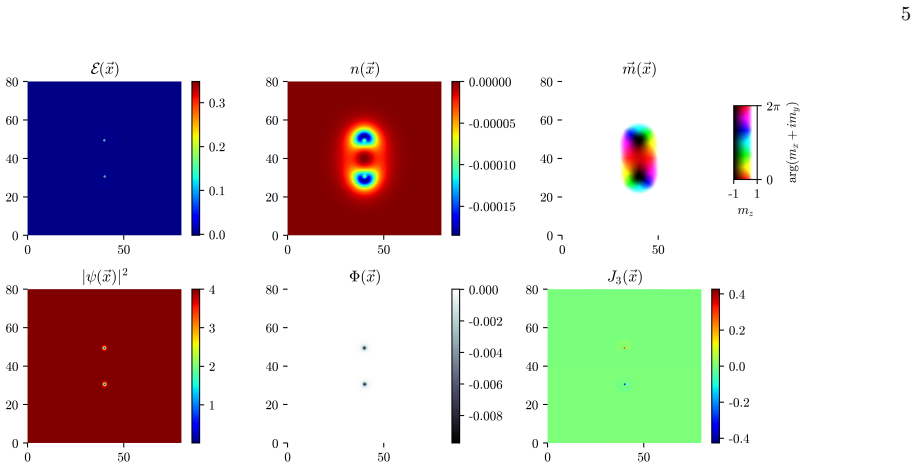
to obtain a superconductingk-vortex, ψ(⃗ x) = kY i=1 ψi(⃗ x−⃗ xi), ⃗A(⃗ x) = kX i=1 ⃗Ai(⃗ x−⃗ xi).(28) 5 FIG. 2: A bound state of composite SVPs, where each SVP experiences short-range repulsion and long-range attrac- tion. The parameters used here area=−4, b= 1 andβ=−α= 1, which gives the vacuum valuesm 2 0 = 1 and u2 = 4. The associated decay length for...
2022
-
[43]
Abrikosov, The magnetic properties of superconduct- ing alloys, J
A. Abrikosov, The magnetic properties of superconduct- ing alloys, J. Phys. Chem. Solids.2, 199 (1957)
1957
-
[44]
Kosevich, B
A. Kosevich, B. Ivanov, and A. Kovalev, Magnetic soli- tons, Phys. Rep.194, 117 (1990)
1990
-
[45]
Babaev and M
E. Babaev and M. Speight, Semi-Meissner state and nei- ther type-I nor type-II superconductivity in multicompo- nent superconductors, Phys. Rev. B72, 180502 (2005)
2005
-
[46]
Babaev, Vortices with fractional flux in two-gap super- conductors and in extended Faddeev model, Phys
E. Babaev, Vortices with fractional flux in two-gap super- conductors and in extended Faddeev model, Phys. Rev. Lett.89, 067001 (2002)
2002
-
[47]
Babaev, J
E. Babaev, J. Carlstr¨ om, and M. Speight, Type-1.5 Su- perconducting State from an Intrinsic Proximity Effect in Two-Band Superconductors, Phys. Rev. Lett.105, 067003 (2010)
2010
-
[48]
Carlstr¨ om, E
J. Carlstr¨ om, E. Babaev, and M. Speight, Type-1.5 su- perconductivity in multiband systems: Effects of inter- band couplings, Phys. Rev. B83, 174509 (2011)
2011
-
[49]
Babaev, J
E. Babaev, J. Carlstr¨ om, M. Silaev, and J. Speight, Type- 1.5 superconductivity in multicomponent systems, Phys- ica C Supercond.533, 20 (2017)
2017
-
[50]
Babaev and M
E. Babaev and M. Silaev, Type-1.5 superconductivity in multiband and other multicomponent systems, J. Super- cond. Nov. Magn.26, 2045 (2013)
2045
discussion (0)
Sign in with ORCID, Apple, or X to comment. Anyone can read and Pith papers without signing in.