REVIEW 4 major objections 5 minor 10 references
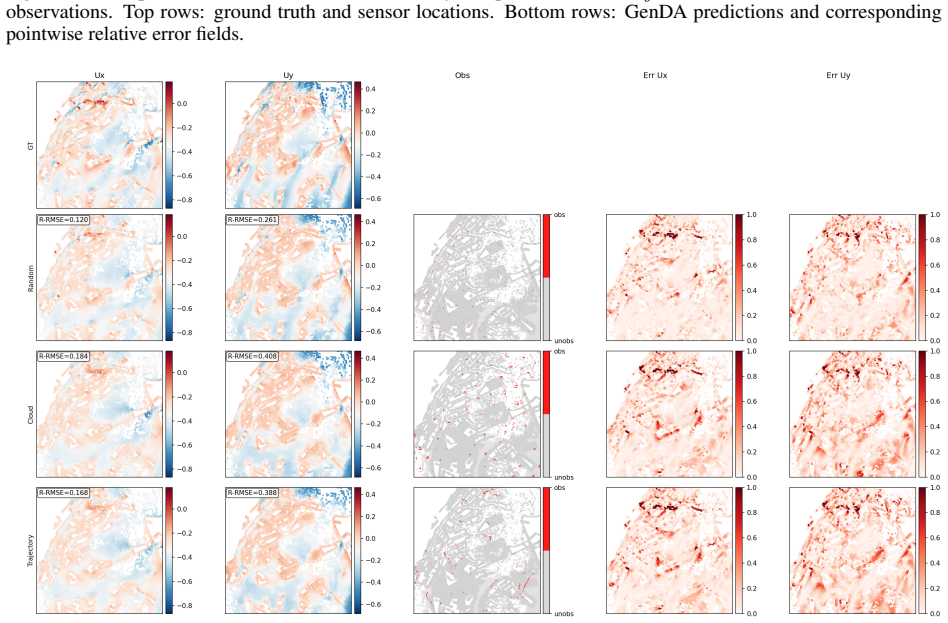
GenDA, a graph-based diffusion model with classifier-free guidance, reconstructs high-resolution urban wind fields on unstructured meshes from sparse sensors, cutting relative error by 25–57% and raising structural similarity by 23–33% over
Reviewed by Pith at T0; open to challenge. T0 means a machine referee read the full paper against a public rubric. the ladder, T0–T4 →
T0 review · deepseek-v4-flash
2026-08-03 09:59 UTC pith:BKFIJ6DG
load-bearing objection GenDA is a solid, genuinely new empirical contribution to urban wind reconstruction from sparse sensors, with a real limitation around noiseless observations and one suspicious baseline row that needs clarification. the 4 major comments →
GenDA: Generative Data Assimilation on Complex Urban Areas via Classifier-Free Diffusion Guidance
The pith
A machine-rendered reading of the paper's core claim, the machinery that carries it, and where it could break.
Core claim
The paper's central claim is that classifier-free guidance, trained with sensor dropout, is an effective approximate posterior sampler for the inverse problem of velocity-field reconstruction on an unstructured mesh. By learning both an unconditional denoiser (geometry-conditioned prior over plausible flows) and a sensor-conditioned denoiser, and blending them at inference with a guidance weight γ, GenDA samples from a tempered posterior in which γ controls the influence of observations. This formulation, combined with a multiscale graph architecture that passes messages on the fine mesh and a coarsened latent mesh, yields obstacle-aware reconstructions that outperform supervised GNN baselin
What carries the argument
The key machinery is a multiscale graph diffusion denoiser built on two coupled meshes: the original high-resolution mesh (where sensor readings and predictions live) and a ~5×-decimated coarsened mesh that enables efficient long-range message passing while preserving building footprints. Classifier-free guidance—trained by randomly dropping sensor inputs with probability 0.1—produces two denoisers whose difference acts as an observation-driven score correction, with the guidance weight γ playing the role of an inverse temperature on the observation likelihood. This lets the network blend a learned geometry-aware flow prior with sparse measurements at every diffusion step.
Load-bearing premise
The load-bearing premise is that treating two held-out altitude slices of the same Bristol simulation as 'unseen geometries' is a valid test of generalization; if real city-to-city transfer or realistic sensor noise is introduced, the reported improvements are not established.
What would settle it
Run the exact same training and evaluation protocol on a genuinely different urban domain (e.g., a new city's RANS simulation or a materially different building layout) and with realistically noisy sensor readings; if the 25–57% relative-error reduction over supervised GNN and reduced-order baselines does not persist, the geometry-generalization and real-deployability claims collapse.
If this is right
- Urban wind fields can be reconstructed at practical accuracy from as little as ~0.1% spatial sensor coverage, enabling sparse, low-cost sensing networks.
- The same trained model handles fixed sensors, dense clusters, and mobile trajectory observations without retraining, supporting vehicle-mounted sensing.
- Because sampling is generative, the framework outputs an ensemble of plausible fields, enabling uncertainty quantification for air-quality and pedestrian-comfort assessments.
- The approach removes the need for linearized reduced-order bases or adjoint solvers, offering a tractable path to data assimilation in geometrically complex domains.
- The authors argue the formulation extends directly to volumetric (3D) domains and to other physical fields, suggesting a general paradigm for sparse-observation inverse problems.
Where Pith is reading between the lines
- The 'unseen geometry' claim is tested only on two horizontal altitude slices of the same Bristol RANS simulation; a stronger test would involve a different city, a different building layout, or a geometrically distinct mesh, so the headline generalization should be read as altitude-slice generalization until proven broader.
- The observation model is noiseless (sensor values are taken directly from the ground truth, despite Eq. (1) defining a noise term η), so real-world sensor noise may require re-tuning γ or explicitly modeling noise; a testable extension is to inject realistic noise and measure degradation.
- The guidance weight γ is fixed at 2.0 across all experiments; adaptive or per-case tuning of γ could further improve the sparse-observation regime, where the paper shows the largest relative gains.
- The classifier-free-guidance-as-tempered-posterior interpretation could be transferred to other mesh-based inverse problems, such as pollutant dispersion or temperature fields, but that transfer is the present paper's speculation, not a demonstrated result.
Editorial analysis
A structured set of objections, weighed in public.
Referee Report
Summary. The paper proposes GenDA, a multiscale graph-based diffusion model with classifier-free guidance for reconstructing urban wind fields on unstructured meshes from sparse sensor observations. The method is presented as generative data assimilation: an unconditional branch learns a geometry-aware prior, a sensor-conditioned branch injects observational constraints, and classifier-free guidance is interpreted as tempered posterior sampling. The model is trained on horizontal slices of a RANS simulation of a Bristol neighborhood and evaluated on two held-out altitude slices, wind directions, and sensor configurations. The authors report that GenDA reduces RRMSE by 25–57% and improves SSIM by 23–33% relative to supervised GNN baselines and a low-cost SVD data-assimilation baseline, while also showing robustness to clustered and trajectory-based sensor placements.
Significance. If the empirical claims hold, GenDA would be a useful contribution to generative data assimilation on complex unstructured domains, with the notable practical strengths of handling variable sensor counts and layouts without retraining, producing ensembles, and operating on irregular meshes. The paper is empirically grounded: metrics are defined carefully, baselines include both learned and classical methods, and ablations on the guidance weight and observation density are provided. However, the central generalization and noise-robustness claims rest on currently incomplete evidence: the 'unseen geometry' setting is limited to altitude slices of the same simulation, and the evaluation uses noiseless observations despite a noise term in the problem formulation. These gaps need to be addressed before the reported gains can be considered established.
major comments (4)
- [Section 2.2 / Appendix B.3] Eq. (1) defines observations as y = H(u*) + eta, but Appendix B.3 states that sensor values are 'assigned from the ground-truth field' with no noise added, and all evaluations use the clean reference. Thus the measurement-noise term in the problem formulation is never exercised. Since GenDA is framed as data assimilation, the claimed 25–57% RRMSE reductions are only demonstrated in the zero-noise limit. Please add experiments with realistic additive sensor noise (at least a few SNR levels, with noise injected at the observed nodes) and report whether the relative improvements over MGN/MS-MGN/LCSVD persist.
- [Table 1, LCSVD rows] The LCSVD baseline reports numerically identical metrics for 3000 and 8000 observations: RRMSE 0.354±0.124, SSIM 0.834±0.050, and MAC 0.918 in both rows (with only the final decimal of the MAC standard deviation differing). A data-assimilation baseline should depend on the number of assimilated observations, or the authors must explain why this particular LCSVD implementation is observation-count invariant. As written, this raises concerns about the correctness of the baseline and weakens the high-density comparison.
- [Abstract / Appendix A] The abstract and introduction claim generalization to 'unseen geometries' and 'mesh resolutions,' but the test set consists of two horizontal slices (z=35, 40 m) from the same Bristol RANS simulation, at essentially the same mesh resolution as the training slices (Table 3). This is a meaningful held-out setting within one urban geometry, but it is not 'unseen geometry' in the broader sense implied by the text, and no resolution variation is tested. Please adjust the claims to match the evidence, or add a genuinely different geometry/layout to support the stronger generalization statement.
- [Section 2.2, Eqs. (4)–(5)] The interpretation of classifier-free guidance as sampling from the tempered posterior p(u|G)p(y|u)^gamma is stated without derivation or empirical verification. If this is intended as a heuristic interpretation, it should be labeled clearly as such, and the subsequent conclusions should not rely on the equivalence. If the 'posterior sampling' claim is meant literally, provide a formal argument or a controlled test (e.g., a linear-Gaussian case where the posterior is known) showing that the CFG-modified denoiser indeed produces samples from the stated distribution.
minor comments (5)
- [Acknowledgments] Typo: 'acknoledges' should be 'acknowledges'.
- [Appendix B.3] The value of eps in Eq. (21) is not specified; a small epsilon is used to avoid division by zero, but the choice may affect MAC values, especially in low-velocity regions.
- [Section 3.1 / Table 1] The reported standard deviations appear to overlap between GenDA and LCSVD at 300 observations (e.g., RRMSE 0.310±0.095 vs 0.360±0.127). Reporting paired significance tests or confidence intervals would strengthen the claim of improvement.
- [Appendix C.1] The text says 'excessively large gamma ... suggests overfitting to sparse or noisy measurements,' but no noisy measurements are used anywhere in the paper. Consider rewording to avoid implying noise was tested.
- [Abstract] The abstract mentions 'mesh resolutions' among the generalization dimensions, but the paper does not vary mesh resolution in the experiments. Remove or support this claim.
Circularity Check
No load-bearing circularity: CFG-as-posterior is expressly interpretive, and the main empirical gains are measured against external baselines on held-out slices.
full rationale
Walking the derivation chain, the paper does not attempt to prove that classifier-free guidance equals Bayes posterior sampling. Eq. (3) decomposes the posterior score, Eq. (4) defines the guided denoiser, and Eq. (5) says the guided update 'can be interpreted as sampling from a tempered posterior' — an interpretation, not a derived identity. No equation in the paper reduces to its inputs by construction. The empirical claim (Table 1) is benchmarked against MeshGraphNet, MS-MGN, and LCSVD on two held-out altitude slices, so the reported RRMSE/SSIM improvements are not forced by a fitted parameter or by the problem definition. The only self-citation is [Giral et al., 2025], used as background for the geometry-conditioned prior ('Building on the concept of geometry-conditioned priors [Giral et al., 2025]'); this is not load-bearing because the sensor-conditioned branch and multiscale graph are independently evaluated against external baselines. A real limitation exists — Eq. (1) defines observation noise eta, but Appendix B.3 assigns sensor values 'from the ground-truth field' with no noise added — but this is an evaluation-protocol gap, not a circular reduction. Likewise, calling different altitude slices of the same Bristol simulation 'unseen geometries' is a dataset limitation, not definitional circularity. Accordingly, the analysis finds no circular step and assigns score 2 only for the minor, non-load-bearing self-citation.
Axiom & Free-Parameter Ledger
free parameters (4)
- classifier-free guidance weight gamma =
2.0
- dataset velocity scale sigma_data =
0.2757
- number of sampling steps T =
20
- sensor dropout probability p_uc =
0.1
axioms (5)
- standard math Score-based diffusion denoisers trained with a denoising objective approximate the score of the data distribution (EDM/Karras framework).
- domain assumption The 2D horizontal slices and steady RANS mean fields are a valid proxy for urban wind flows at each altitude.
- ad hoc to paper Classifier-free guidance with gamma=2 produces samples from a tempered posterior p(u|G)p(y|u)^gamma.
- domain assumption Observation noise eta in Eq. (1) is taken as zero in all experiments.
- domain assumption Altitude slices z=35 and z=40 are sufficiently different geometries to count as 'unseen geometries'.
read the original abstract
Urban wind flow reconstruction is essential for assessing air quality, heat dispersion, and pedestrian comfort, yet remains challenging when only sparse sensor data are available. We propose GenDA, a generative data assimilation framework that reconstructs high-resolution wind fields on unstructured meshes from limited observations. The model employs a multiscale graph-based diffusion architecture trained on computational fluid dynamics (CFD) simulations and interprets classifier-free guidance as a learned posterior reconstruction mechanism: the unconditional branch learns a geometry-aware flow prior, while the sensor-conditioned branch injects observational constraints during sampling. This formulation enables obstacle-aware reconstruction and generalization to held-out mesh geometries, wind directions, and sensor configurations within the studied urban-flow setting, without retraining. We consider both sparse fixed sensors and trajectory-based observations using the same reconstruction procedure. When evaluated against supervised graph neural network (GNN) baselines and classical reduced-order data assimilation methods, GenDA reduces the relative root-mean-square error (RRMSE) by 25-57% and increases the structural similarity index (SSIM) by 23-33% across the tested meshes. Experiments are conducted on Reynolds-averaged Navier-Stokes (RANS) simulations of a real urban neighborhood in Bristol, United Kingdom, at a characteristic Reynolds number of $\mathrm{Re}\approx2\times10^{7}$, featuring complex building geometry and irregular terrain. The proposed framework provides a scalable path toward generative, geometry-aware data assimilation for environmental monitoring in complex domains.
Figures


Reference graph
Works this paper leans on
-
[2]
Mingjian Chen, Xu Tan, Bohan Li, Yanqing Liu, Tao Qin, Sheng Zhao, and Tie-Yan Liu
URLhttps://arxiv.org/abs/2510.25625. Mingjian Chen, Xu Tan, Bohan Li, Yanqing Liu, Tao Qin, Sheng Zhao, and Tie-Yan Liu. Adaspeech: Adaptive text to speech for custom voice.arXiv preprint arXiv:2103.00993,
-
[4]
Huanxiang Gao, Gang Hu, Dongqin Zhang, Wenjun Jiang, KT Tse, KCS Kwok, and Ahsan Kareem
doi:10.1016/j.cma.2024.117654. Huanxiang Gao, Gang Hu, Dongqin Zhang, Wenjun Jiang, KT Tse, KCS Kwok, and Ahsan Kareem. Urban wind field prediction based on sparse sensors and physics-informed graph-assisted auto-encoder.Computer-Aided Civil and Infrastructure Engineering, 39(10):1409–1430,
arXiv 2024
-
[5]
Paul Jeanney, Ashton Hetherington, Shady E Ahmed, David Lanceta, Susana Saiz, José Miguel Perez, and Soledad Le Clainche. Ensemble kalman filter for data assimilation coupled with low-resolution computations techniques applied in fluid dynamics.arXiv preprint arXiv:2507.00539,
-
[6]
Tobias Pfaff, Meire Fortunato, Alvaro Sanchez-Gonzalez, and Peter W
URL https://arxiv.org/abs/2509.08752. Tobias Pfaff, Meire Fortunato, Alvaro Sanchez-Gonzalez, and Peter W. Battaglia. Learning mesh-based simulation with graph networks. InInternational Conference on Learning Representations (ICLR),
-
[7]
Original
Further details on the base simulation database are available at modelair.eu. To construct a 2D dataset suitable for our graph-based diffusion model, we extract horizontal slices from the 3D domain at six altitudes (z={15,20,28,35,40,45} m). Each slice intersects the 3D geometry differently, producing a unique 2D unstructured mesh that captures specific b...
1992
-
[10]
[2022], simplified to two mesh levels: the original mesh (index o) and the reduced mesh (index r)
The notation follows that of MultiScale MeshGraphNets Fortunato et al. [2022], simplified to two mesh levels: the original mesh (index o) and the reduced mesh (index r). Each of the four subnetworks ( o2o, o2r, r2r, r2o) follows an encode–process–decodestructure similar to MeshGraphNets Pfaff et al. [2021]. Each mesh level l∈ {o, r}defines a graph Gl = (V...
2022
-
[2021]
Abhijeet Vishwasrao, Sai Bharath Chandra Gutha, Andres Cremades, Klas Wijk, Aakash Patil, Catherine Gorle, Beverley J McKeon, Hossein Azizpour, and Ricardo Vinuesa. Diff-SPORT: Diffusion-based sensor placement optimization and reconstruction of turbulent flows in urban environments.arXiv preprint arXiv:2506.00214,
-
[2022]
Multiscale mesh- graphnets.arXiv preprint arXiv:2210.00612,
Meire Fortunato, Tobias Pfaff, Alvaro Sanchez-Gonzalez, Peter Wirnsberger, and Peter Battaglia. Multiscale mesh- graphnets.arXiv preprint arXiv:2210.00612,
-
[2024]
William J Schroeder, Jonathan A Zarge, and William E Lorensen
doi:10.1038/s41586-024-08252-9. William J Schroeder, Jonathan A Zarge, and William E Lorensen. Decimation of triangle meshes.ACM SIGGRAPH Computer Graphics, 26(2):65–70,
-
[2025]
URLhttps://arxiv.org/abs/2510.19971. Guillermo Barragán, Ashton Hetherington, Arindam Sengupta, Rodrigo Abadía-Heredia, Jesús Garicano-Mena, and Soledad Le Clainche. Hybrinet-hybrid neural network-based framework for multi-parametric database generation, enhancement, and forecasting,
discussion (0)
Sign in with ORCID, Apple, or X to comment. Anyone can read and Pith papers without signing in.