REVIEW 3 major objections 5 minor 39 references
The paper shows that the underestimation of PbTiO3's Curie temperature in first-principles simulations comes from the intrinsic limits of the PBEsol exchange-correlation functional, not from machine-learning force-field fitting, and that wi
Reviewed by Pith at T0; open to challenge. T0 means a machine referee read the full paper against a public rubric. the ladder, T0–T4 →
T0 review · deepseek-v4-flash
2026-08-03 09:36 UTC pith:SNPXOM6W
load-bearing objection Solid central result—Tc underestimation is a functional problem, not a fitting problem—but the specific 600 K PBEsol limit rests on unvalidated qNEP extrapolation and needs scrutiny. the 3 major comments →
Disentangling the Discrepancy Between Theoretical and Experimental Curie Temperatures in Ferroelectric PbTiO₃
The pith
A machine-rendered reading of the paper's core claim, the machinery that carries it, and where it could break.
Core claim
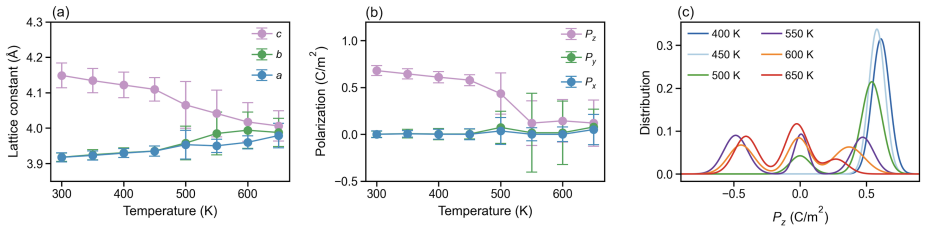
The persistent underestimation of Tc in ferroelectric PbTiO3 originates primarily from intrinsic limitations of the PBEsol exchange-correlation functional, not from inaccuracies in the machine-learned force field. A deep-neural-network potential trained on diverse density-functional data reproduces the ab initio potential energy surface faithfully, giving the same Tc of about 500 K in a 4x4x4 supercell as direct AIMD. Increasing supercell size with short-range local models raises Tc to about 650 K, but this apparent improvement is a fortuitous cancellation of errors: local descriptors truncate electrostatics and artificially stiffen the lattice. When long-range electrostatics are explicitly
What carries the argument
The argument hinges on comparing two classes of machine-learned potentials: a short-range model whose descriptors encode only local atomic environments, and a long-range variant that augments the short-range network with environment-dependent partial charges to compute explicit Coulomb interactions (a latent-charge model). The long-range model is the load-bearing instrument: it removes the artificial stiffening caused by electrostatic truncation and allows the paper to read off the functional's converged transition temperature in large supercells.
Load-bearing premise
The 600 K result assumes that the latent-charge long-range model, trained on 320-atom supercells, remains accurate in 12x12x12 supercells and truly represents the infinite-size PBEsol potential energy surface; if its long-range electrostatics drift at larger sizes, the 600 K limit is an artifact.
What would settle it
Run constant-pressure ab initio molecular dynamics with PBEsol on an 8x8x8 or larger supercell (thousands of atoms) for sufficiently long trajectories near the expected transition: if the polarization order parameter disappears above about 650 K, the 600 K limit is wrong. Alternatively, perform the same 12x12x12 simulation with a hybrid functional; if Tc rises substantially beyond 600 K, the attribution to the exchange-correlation functional is supported, while if it stays near 600 K, the latent-charge model's extrapolation is suspect.
If this is right
- Machine-learned potentials trained on diverse DFT data will faithfully reproduce the training functional's transition temperature, so fitting error is not the cause of the experimental gap in PbTiO3.
- Short-range potentials systematically accumulate force errors as the supercell grows, while potentials with explicit long-range electrostatics remain accurate across sizes.
- The 600 K value represents the PBEsol limit for PbTiO3, so closing the gap to 760 K requires improved exchange-correlation functionals beyond the generalized gradient approximation.
- Small supercells (320 atoms) suppress Tc by roughly 100 K compared to the converged limit, so finite-size convergence must be checked in ferroelectric phase-transition simulations.
- Accurate finite-temperature predictions need high-quality training data, large simulation cells, and explicit treatment of long-range interactions.
Where Pith is reading between the lines
- If the latent-charge model transfers as claimed, the same decomposition of errors (functional, model, finite-size) could be applied to other displacive ferroelectrics such as BaTiO3, where similar Tc underestimations have been reported.
- The 600 K versus 760 K gap quantifies how much phase-transition physics is missing from semilocal DFT; a hybrid-functional AIMD in a comparably large cell would directly test whether the residual gap is indeed the functional's responsibility.
- The result warns that matching experimental Tc with a local machine-learned potential is not evidence of accuracy; a model with larger test-set errors may appear more accurate for the transition temperature.
- The observation that a long-range model achieves even lower errors for large supercells than for the 320-atom training cell suggests that finite-size artifacts in small cells are a separate challenge that explicit electrostatics resolves naturally.
Editorial analysis
A structured set of objections, weighed in public.
Referee Report
Summary. The paper uses NPT AIMD (320-atom supercell, PBEsol) and MLFF benchmark simulations to explain why computed Curie temperatures of PbTiO3 fall below the experimental 760 K. AIMD and a previously trained DP model both give Tc ≈ 500 K at 320 atoms, which the authors interpret as showing that the MLFF fitting is not the cause of the underestimation. DP simulations for larger supercells show Tc increasing to about 650 K. To probe the role of long-range electrostatics, the authors train NEP and qNEP models and find, in 12×12×12 supercells, that short-range NEP gives Tc ≈ 650 K while qNEP with explicit latent-charge electrostatics gives Tc ≈ 600 K. They conclude that 600 K is the true thermodynamic limit of PBEsol for PbTiO3, and that the better agreement of short-range models arises from a fortuitous cancellation of errors.
Significance. If the conclusions hold, the paper makes a useful contribution by separating three sources of error in first-principles Tc predictions: MLFF fitting error, finite-size effects, and exchange-correlation functional error. The qualitative attribution of the underestimation to PBEsol is well supported by the direct agreement between AIMD and an independently trained DP model. The work also has practical value: the AIMD trajectories and trained models are made publicly available, and the paper offers a clear warning that agreement with experiment can result from error cancellation. However, the quantitative claim that 600 K is the true PBEsol thermodynamic limit rests on qNEP simulations whose validation is currently incomplete, so that part of the paper is conditional rather than established.
major comments (3)
- [§III.E (Fig. 5)] There is an internal inconsistency in the reported small-supercell Tc. Sections III.A–C and Figs. 1–3 report Tc ≈ 500 K from AIMD and DP at 320 atoms, but §III.E states that the small supercell gives 450 K when comparing with the 650 K large-cell result. The magnitude of the finite-size shift therefore changes depending on which value is used. This inconsistency is load-bearing for the finite-size convergence narrative and must be corrected and reconciled.
- [§III.F (Fig. 6)] The claim that 600 K is the true thermodynamic limit of PBEsol is not yet supported by the evidence presented. The only validation of qNEP shown in Fig. 6a is force RMSE against DFT on supercells of increasing size. Force RMSE is a local, zero-temperature metric; the Curie temperature is controlled by the free-energy difference between ferroelectric and paraelectric phases, including anharmonic contributions that a low force RMSE does not guarantee. The latent-charge model is not validated against any DFT charge or electrostatic reference, and no direct comparison of qNEP to AIMD at the 320-atom size is provided. Moreover, only a single 12×12×12 supercell is used for qNEP; there is no size-convergence series for Tc and no statistical uncertainty estimate. I request additional evidence: qNEP versus AIMD at 320 atoms for c/a and polarization distributions, a Tc convergence series (e.g., 8×
- [§III.D (Fig. 4c)] The validation of DP_AIMD is circular: the model is trained exclusively on AIMD trajectory configurations and then compared to those same AIMD results. This demonstrates that the model can fit and reproduce its training data, but it does not demonstrate transferability or independent accuracy. This does not undermine the central argument, because the main DP model is trained on the DPGEN dataset and is compared to separate AIMD configurations, but the text should explicitly distinguish these two cases so that DP_AIMD is not presented as independent validation.
minor comments (5)
- [§II.B] The NEP and qNEP models are not described with the same level of detail as the DP model. Hyperparameters, descriptor settings, training-set sizes, and simulation protocols (thermostat, barostat, equilibration time, production length) for the NEP/qNEP MD runs in Fig. 6b should be given, either in the text or in the repository.
- [Fig. 5a] The curves for different supercell sizes are not labeled directly; a legend identifying 4×4×4, 6×6×6, 8×8×8, and 10×10×10 is needed. Error bars on c/a and on the inferred Tc values would also help assess the convergence claim.
- [Fig. 6b] The figure reports Tc for NEP and qNEP but no statistical uncertainty or simulation-length information is provided. At minimum, the number of independent runs and the length of the production trajectories should be stated, since Tc is extracted from curves without error bars.
- [§III.A] The sentence 'To the best of our knowledge, this represents the largest AIMD study of PbTiO3 to date' is a strong claim. It can be retained if a literature search has been performed, but a citation to the prior largest study would make the claim verifiable.
- [Abstract/§IV] The word 'conclusively' in the conclusion is stronger than the evidence supports, particularly given the incomplete qNEP validation. Softer wording would be more appropriate.
Circularity Check
One validation is circular (DP_AIMD trained and tested on the same AIMD trajectory); the central PBEsol-attribution is not circular.
specific steps
-
fitted input called prediction
[Section III.D (Data Sampling and Model Robustness), Fig. 4c]
"we trained a separate DP model, denoted DP AIMD, using only the configurations from the AIMD trajectory. Despite the narrower scope of the training data, the DP AIMD model accurately reproduces the temperature-dependent evolution of polarization (P z) and tetragonality (c/a) as computed by AIMD (Fig. 4c)."
The model is trained on configurations drawn from the same AIMD trajectory that supplies the comparison data. Therefore DP_AIMD's agreement with AIMD is an in-sample reconstruction, not an out-of-sample prediction; a flexible MLFF is expected to interpolate its training set. The paper uses this agreement to conclude that AIMD-only sampling is adequate, but the target quantities (Pz, c/a) are computed from the same data used to fit the model, so the conclusion is self-confirming. This step is not the main evidence for the PBEsol-limitation conclusion, which rests on the DPGEN-trained DP model evaluated on held-out AIMD configurations.
full rationale
The only circular step I can exhibit by quoting the paper is the DP_AIMD validation in Sec. III.D: a model trained on the AIMD trajectory is compared against that same trajectory's Pz and c/a. This is a real but non-central circularity. The central attribution of the low Tc to PBEsol is not circular: the 320-atom AIMD is a direct DFT calculation, and the DPGEN-trained DP model is evaluated on AIMD configurations explicitly described as not in the training set, giving an out-of-sample benchmark. The finite-size and long-range conclusions are also not circular, though they involve extrapolation. Two non-circularity concerns lower confidence: (1) the 600 K 'true PBEsol limit' rests on qNEP simulations at 12x12x12 with no direct AIMD at that size, and force RMSE alone does not validate the free-energy surface controlling Tc; (2) the small-supercell Tc is reported as ~500 K in Secs. III.A-C but appears as 450 K in Sec. III.E. These are correctness/robustness issues, not definitional reductions. No self-citation chain, uniqueness import, or ansatz smuggling is load-bearing. Overall: one partial circular validation, but the central derivation remains independent.
Axiom & Free-Parameter Ledger
free parameters (1)
- MLFF parameters (DP/NEP/qNEP weights and latent charges)
axioms (4)
- domain assumption PBEsol is the appropriate exchange-correlation functional; the discrepancy with experiment is attributed to it without testing alternative functionals.
- domain assumption The machine-learning force fields generalize to larger supercells (up to 12×12×12) and qNEP correctly captures long-range electrostatics.
- domain assumption The finite-size scaling of Tc is converged by L=8 (local DP) or L=12 (long-range qNEP), and no further size increase would materially change the result.
- domain assumption The transition temperature can be reliably determined from the onset of polarization switching in AIMD or from c/a vs temperature curves.
read the original abstract
Accurately predicting the Curie temperature ($T_c$) of ferroelectrics from first principles remains a major challenge, as theoretical estimates often fall significantly below experimental values. In this work, we investigate the origin of these discrepancies in the prototypical ferroelectric PbTiO$_3$ by performing extensive constant-pressure ab initio molecular dynamics (AIMD) simulations and benchmarking them against classical molecular dynamics (MD) using machine learning force fields (MLFFs) derived from first-principles data. Our results show that the underestimation of $T_c$ primarily stems from the limitations of the exchange-correlation functional, rather than inaccuracies in the MLFF fitting. We uncover a critical interplay between finite-size effects and the range of interatomic interactions: although short-range MLFFs appear to yield better agreement with experimental $T_c$, this improvement results from a fortuitous cancellation of errors. Incorporating explicit long-range interactions improves accuracy for larger supercells but ultimately leads to lower predicted $T_c$ values. These findings highlight that accurate finite-temperature predictions require not only high-quality training data and sufficiently large simulation cells, but also the explicit treatment of long-range interactions and improved exchange-correlation functionals.
Figures



Reference graph
Works this paper leans on
-
[1]
M. E. Lines and A. M. Glass,Principles and Applications of Ferroelectrics and Related Mate- rials(Clarendon Press, Oxford, 1977)
1977
-
[2]
Zhang and F
S. Zhang and F. Yu, Piezoelectric materials for high temperature sensors, J. Am. Ceram. Soc. 94, 3153 (2011)
2011
-
[3]
Cochran, Crystal stability and the theory of ferroelectricity, Phys
W. Cochran, Crystal stability and the theory of ferroelectricity, Phys. Rev. Lett.3, 412 (1959)
1959
-
[4]
S. C. Abrahams, S. K. Kurtz, and P. B. Jamieson, Atomic displacement relationship to curie temperature and spontaneous polarization in displacive ferroelectrics, Phys. Rev.172, 551 (1968)
1968
-
[5]
J. F. Scott, Applications of modern ferroelectrics, Science315, 954 (2007)
2007
-
[6]
H. Pan, F. Li, Y. Liu, Q. Zhang, M. Wang, S. Lan, Y. Zheng, J. Ma, L. Gu, Y. Shen, P. Yu, S. Zhang, L.-Q. Chen, Y.-H. Lin, and C.-W. Nan, Ultrahigh–energy density lead-free dielectric films via polymorphic nanodomain design, Science365, 578 (2019)
2019
-
[7]
Y. Liu, Y. Zhang, J. Wang, C. Yang, H. Wang, J. L. MacManus-Driscoll, H. Yang, P. A. van Aken, W. Li, and C.-W. Nan, Ultrahigh capacitive energy storage through dendritic nanopolar design, Science388, 211 (2025)
2025
-
[8]
Zhong, D
W. Zhong, D. Vanderbilt, and K. M. Rabe, Phase transitions in BaTiO 3 from first principles, Phys. Rev. Lett.73, 1861 (1994)
1994
-
[9]
Ghosez and J
P. Ghosez and J. Junquera, Modeling of ferroelectric oxide perovskites: From first to second principles, Annu. Rev. Condens. Matter Phys.13, 325 (2022)
2022
-
[10]
Srinivasan, R
V. Srinivasan, R. Gebauer, R. Resta, and R. Car, PbTiO 3 at finite temperature: An ab-initio molecular dynamics study, AIP Conf. Proc.677, 168 (2003). 13
2003
-
[11]
H. Fang, Y. Wang, S. Shang, and Z.-K. Liu, Nature of ferroelectric-paraelectric phase transi- tion and origin of negative thermal expansion in PbTiO 3, Phys. Rev. B91, 024104 (2015)
2015
-
[12]
P. V. Balachandran, D. Xue, and T. Lookman, Structure–curie temperature relationships in BaTiO 3-based ferroelectric perovskites: Anomalous behavior of (Ba,Cd)TiO 3 from DFT, statistical inference, and experiments, Phys. Rev. B93, 144111 (2016)
2016
-
[13]
Grinberg and A
I. Grinberg and A. M. Rappe, NonmonotonicT c trends in Bi-based ferroelectric perovskite solid solutions, Phys. Rev. Lett.98, 037603 (2007)
2007
-
[14]
A. P. Bart´ ok, M. C. Payne, R. Kondor, and G. Cs´ anyi, Gaussian approximation potentials: The accuracy of quantum mechanics, without the electrons, Phys. Rev. Lett.104, 136403 (2010)
2010
-
[15]
Zhang, J
L. Zhang, J. Han, H. Wang, R. Car, and W. E, Deep potential molecular dynamics: A scalable model with the accuracy of quantum mechanics, Phys. Rev. Lett.120, 143001 (2018)
2018
-
[16]
K. Xu, H. Bu, S. Pan, E. Lindgren, Y. Wu, Y. Wang, J. Liu, K. Song, B. Xu, Y. Li, T. Hainer, L. Svensson, J. Wiktor, R. Zhao, H. Huang, C. Qian, S. Zhang, Z. Zeng, B. Zhang, B. Tang, Y. Xiao, Z. Yan, J. Shi, Z. Liang, J. Wang, T. Liang, S. Cao, Y. Wang, P. Ying, N. Xu, C. Chen, Y. Zhang, Z. Chen, X. Wu, W. Jiang, E. Berger, Y. Li, S. Chen, A. J. Gabourie,...
2025
-
[17]
Podryabinkin, K
E. Podryabinkin, K. Garifullin, A. Shapeev, and I. Novikov, MLIP-3: Active learning on atomic environments with moment tensor potentials, J. Chem. Phys.159, 084112 (2023)
2023
-
[18]
J. Wu, J. Yang, L. Ma, L. Zhang, and S. Liu, Modular development of deep potential for complex solid solutions, Phys. Rev. B107, 144102 (2023)
2023
-
[19]
J. Wu, J. Yang, Y.-J. Liu, D. Zhang, Y. Yang, Y. Zhang, L. Zhang, and S. Liu, Universal interatomic potential for perovskite oxides, Phys. Rev. B108, L180104 (2023)
2023
-
[20]
Y. Shi, R. He, B. Zhang, and Z. Zhong, Revisiting the phase diagram and piezoelectricity of lead zirconate titanate from first principles, Phys. Rev. B109, 174104 (2024)
2024
-
[21]
S. Liu, I. Grinberg, H. Takenaka, and A. M. Rappe, Reinterpretation of the bond-valence model with bond-order formalism: An improved bond-valence-based interatomic potential for PbTiO3, Phys. Rev. B88, 104102 (2013). 14
2013
-
[22]
Gindele, A
O. Gindele, A. Kimmel, M. G. Cain, and D. Duffy, Shell model force field for lead zirconate titanate Pb(Zr1−xTix)O3, J. Phys. Chem. C119, 17784 (2015)
2015
-
[23]
T. D. K¨ uhne, M. Iannuzzi, M. Del Ben, V. V. Rybkin, P. Seewald, F. Stein, T. Laino, R. Z. Khaliullin, O. Sch¨ utt, F. Schiffmann, D. Golze, J. Wilhelm, S. Chulkov, M. H. Bani- Hashemian, V. Weber, U. Borˇ stnik, M. Taillefumier, A. S. Jakobovits, A. Lazzaro, H. Pabst, T. M¨ uller, R. Schade, M. Guidon, S. Andermatt, N. Holmberg, G. K. Schenter, A. Hehn,...
2020
-
[24]
Goedecker, M
S. Goedecker, M. Teter, and J. Hutter, Separable dual-space gaussian pseudopotentials, Phys. Rev. B54, 1703 (1996)
1996
-
[25]
Hartwigsen, S
C. Hartwigsen, S. Goedecker, and J. Hutter, Relativistic separable dual-space gaussian pseu- dopotentials from h to rn, Phys. Rev. B58, 3641 (1998)
1998
-
[26]
Bussi, D
G. Bussi, D. Donadio, and M. Parrinello, Canonical sampling through velocity rescaling, J. Chem. Phys.126, 014101 (2007)
2007
-
[27]
G. J. Martyna, D. J. Tobias, and M. L. Klein, Constant pressure molecular dynamics algo- rithms, J. Chem. Phys.101, 4177 (1994)
1994
-
[28]
J. P. Perdew, A. Ruzsinszky, G. I. Csonka, O. A. Vydrov, G. E. Scuseria, L. A. Constantin, X. Zhou, and K. Burke, Restoring the density-gradient expansion for exchange in solids and surfaces, Phys. Rev. Lett.100, 136406 (2008)
2008
-
[29]
Wu and R
Z. Wu and R. E. Cohen, More accurate generalized gradient approximation for solids, Phys. Rev. B73, 235116 (2006)
2006
-
[30]
J. Wu, Y. Zhang, L. Zhang, and S. Liu, Deep learning of accurate force field of ferroelectric HfO2, Phys. Rev. B103, 024108 (2021)
2021
-
[31]
J. Wu, L. Bai, J. Huang, L. Ma, J. Liu, and S. Liu, Accurate force field of two-dimensional ferroelectrics from deep learning, Phys. Rev. B104, 174107 (2021)
2021
-
[32]
J. Zeng, D. Zhang, A. Peng, X. Zhang, S. He, Y. Wang, X. Liu, H. Bi, Y. Li, C. Cai, C. Zhang, Y. Du, J.-X. Zhu, P. Mo, Z. Huang, Q. Zeng, S. Shi, X. Qin, Z. Yu, C. Luo, Y. Ding, Y.-P. Liu, R. Shi, Z. Wang, S. L. Bore, J. Chang, Z. Deng, Z. Ding, S. Han, W. Jiang, G. Ke, Z. Liu, D. Lu, K. Muraoka, H. Oliaei, A. K. Singh, H. Que, W. Xu, Z. Xu, Y.-B. Zhuang,...
2025
-
[33]
T. Liang, K. Xu, E. Lindgren, Z. Chen, R. Zhao, J. Liu, E. Berger, B. Tang, B. Zhang, Y. Wang, K. Song, P. Ying, N. Xu, H. Dong, S. Chen, P. Erhart, Z. Fan, T. Ala-Nissila, and J. Xu, NEP89: Universal neuroevolution potential for inorganic and organic materials across 89 elements, arXiv preprint , arXiv:2504.21286 (2025)
Pith/arXiv arXiv 2025
-
[34]
Cheng, Latent ewald summation for machine learning of long-range interactions, npj Com- put
B. Cheng, Latent ewald summation for machine learning of long-range interactions, npj Com- put. Mater.11, 80 (2025)
2025
-
[35]
D. Kim, X. Wang, S. Vargas, P. Zhong, D. S. King, T. J. Inizan, and B. Cheng, A uni- versal augmentation framework for long-range electrostatics in machine learning interatomic potentials, J. Chem. Theory Comput.21, 12709 (2025)
2025
-
[36]
https://github.com/MoseyQAQ/PbTiO3-AIMD-benchmark, Available online
-
[37]
D. Li, J. Yang, X. Chen, L. Yu, and S. Liu, Are foundational atomistic models reliable for finite-temperature molecular dynamics?, J. Phys. Chem. C129, 21538 (2025)
2025
-
[38]
Zhang, H
Y. Zhang, H. Wang, W. Chen, J. Zeng, L. Zhang, H. Wang, and W. E, DP-GEN: A concurrent learning platform for the generation of reliable deep learning based potential energy models, Comput. Phys. Commun.253, 107206 (2020)
2020
-
[39]
Zhang, J
L. Zhang, J. Han, H. Wang, W. A. Saidi, R. Car, and E. Weinan, End-to-end symmetry preserving inter-atomic potential energy model for finite and extended systems, inProceedings of the 32nd International Conference on Neural Information Processing Systems, NIPS’18 (Curran Associates Inc., Red Hook, NY, USA, 2018) pp. 4441–4451. 16 FIG. 1. Time evolution of...
2018
discussion (0)
Sign in with ORCID, Apple, or X to comment. Anyone can read and Pith papers without signing in.