REVIEW 4 major objections 5 minor 49 references
A semantic-vector model with a tunable coupling constant can drive massive discussion platforms to consensus or to maximum dissent.
Reviewed by Pith at T0; open to challenge. T0 means a machine referee read the full paper against a public rubric. the ladder, T0–T4 →
T0 review · deepseek-v4-flash
2026-08-03 09:22 UTC pith:2JDKGMRH
load-bearing objection Promising O(N)-on-semantic-vectors idea, but the claimed phases are transient outcomes of a non-ergodic copying process, not equilibria. the 4 major comments →
Generating consensus and dissent on massive discussion platforms with a semantic-vector model
The pith
A machine-rendered reading of the paper's core claim, the machinery that carries it, and where it could break.
Core claim
The central discovery is that a d=2 O(N) model, equipped with a non-ergodic heat-bath dynamics that only proposes existing neighbor responses, exhibits two sharply distinct phases selected by the sign of the coupling β. At positive β the system orders ferromagnetically: all semantic vectors align and only one response survives, so the lattice reaches global consensus. At negative β it orders antiferromagnetically: two (or more) responses persist in a checkerboard pattern that maximizes the semantic distance between neighbors, a state of maximum dissent. Because the proposal set is restricted to states already present among neighbors, the dynamics can break the continuous symmetry that the Ho
What carries the argument
The central object is the Hamiltonian H = −Σ_{n,μ} φ(i_n)·φ(i_{n+μ}) on a square lattice with periodic boundary conditions, where φ(i_n) is the normalized semantic vector of user n's response. Its work is to quantify the local semantic agreement of each node with its four neighbors; minimizing it drives the lattice toward consensus, while maximizing it (negative β) drives the checkerboard. The dynamics are a heat-bath Markov process whose proposals are restricted to the current responses of the node's neighbors plus its own response, making the transition matrix non-ergodic in the O(N) configuration space — exactly the property that lets the system order in d=2 despite the Mermin-Wagner-Hohe
Load-bearing premise
The entire consensus/dissent phase behavior depends on the dynamics being restricted to copying only the responses that already exist among a node's neighbors; if participants could introduce genuinely new ideas during the process, or if the system had to explore the full space of possible semantic vectors, the clean phases would not appear.
What would settle it
Run the same simulation but, at each step, allow the chosen node to propose a brand-new semantic vector (drawn, say, from the initial empirical distribution) with probability ε > 0, while keeping β fixed positive; if for any small ε the living-response count l_v stops falling to 1 and the semantic energy no longer approaches −1, the restricted-proposal assumption is the load-bearing element and the consensus claim fails under realistic open-ended discussion.
If this is right
- Platform operators can tune β to steer a large discussion toward a single consensus answer or toward a maximally diverse set of alternatives, without imposing any external judgment about which answers are correct.
- The model eliminates the nonlocal frequency-counting mechanism of earlier collective-intelligence experiments: copying and extinction emerge naturally from local semantic comparisons, and semantically equivalent but textually different responses are treated as similar.
- A consensus-dissent annealing cycle (starting at negative β and ending at positive β) converges faster than starting from high temperature, suggesting an efficient protocol for first exploring diverse answers and then settling on one.
- The sign of β offers a principled way to study the cohesion-diversity tradeoff in collective intelligence, connecting it to ferromagnetic and antiferromagnetic order in statistical physics.
- If implemented in a real platform, the only quantity needed per interaction is the scalar product between the semantic vectors of a node and its neighbors, which is computationally cheap relative to querying a large language model.
Where Pith is reading between the lines
- The non-ergodic move set is a double-edged sword in practice: the clean phases rely on participants being unable to introduce genuinely new ideas. A testable extension would inject novel proposals with small probability ε and measure how the consensus/dissent transition degrades as ε increases.
- The antiferromagnetic checkerboard phase is a concrete mechanism for 'diversity on demand': if the goal is to sample a broad idea space (as in crowdsourcing or ideation contests), running the platform at negative β could maintain a spread of maximally different responses while still winnowing near-duplicates.
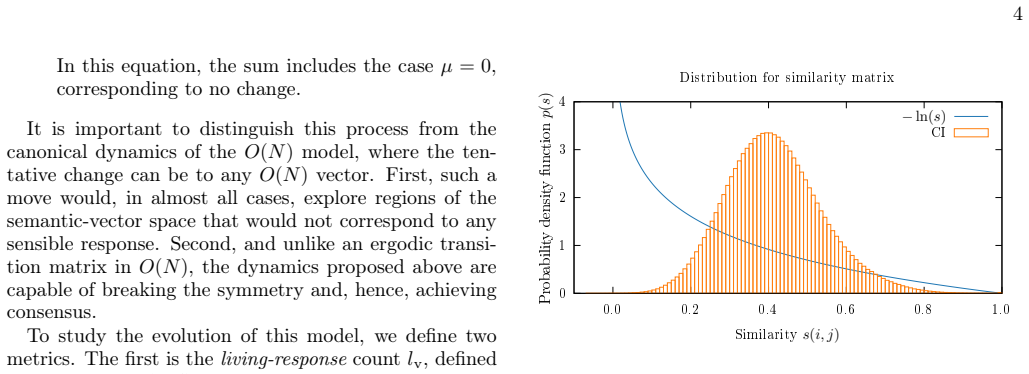
- The dependence of the consensus phase on the similarity distribution (the paper shows the CI embedding distribution converges faster than a synthetic −ln(s) distribution) suggests that the embedding model's geometry, not just β, controls the dynamics; comparing different embedding models could reveal which vector properties matter.
- One could map the coupling β onto a user-facing incentive (e.g., rewards for agreement vs. rewards for novelty) and test whether human behavior approximates the heat-bath accept/reject rule; if it does, the model becomes a behavioral design tool rather than just a simulation.
Editorial analysis
A structured set of objections, weighed in public.
Referee Report
Summary. The manuscript proposes a local, semantics-based dynamical model for collective-intelligence platforms. Text responses are embedded into unit vectors; a 2D square lattice with nearest-neighbor interactions and the O(N) Hamiltonian (Eq. 2) defines an energy. A heat-bath Markov process (Eq. 5) allows a node only to keep its response or copy one of its four neighbors' responses. Simulated annealing with β>0 is reported to drive the system to global consensus (l_v=1, e_s=-1), while β<0 produces a checkerboard-like state with two responses (maximum dissent). Results are illustrated for a synthetic product distribution and for embeddings of >5000 real CI responses. The authors conclude that the coupling β controls the cohesion-diversity tradeoff.
Significance. If the reported control were robust, this would be a useful step toward scalable, local, semantics-aware mechanisms for consensus/dissent management on discussion platforms, avoiding the nonlocal frequency counts of earlier work. Strengths include a concrete Hamiltonian formulation, local updates, comparison against real embedding data, and explicit reliance on a non-equilibrium dynamics to circumvent the Hohenberg-Mermin-Wagner obstruction. The main limitation is that the demonstrated phases are finite-time transients of a copying-only process; the connection to true equilibrium phases and to human innovation is not established.
major comments (4)
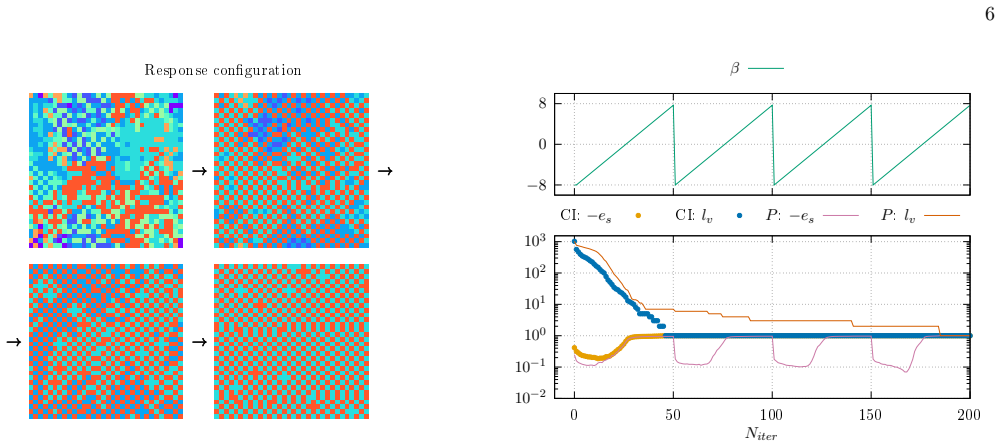
- [Sec. III, Eq. (5); Sec. IV, Figs. 2 and 5] The paper claims that β<0 leads to an 'equilibrium' state with l_v=2 in a checkerboard (Fig. 5), but the dynamics can never reach a nontrivial stationary state: because the proposal set contains only neighbor responses, l_v is nonincreasing and global consensus (l_v=1) is an absorbing state for every finite β. From a checkerboard with two responses, the last holder of one response may copy a neighbor, eliminating that response with positive probability. Thus the l_v=2 configuration is at best a long-lived transient or metastable state selected by the 500-iteration annealing schedule, not an equilibrium of the Markov chain. The conclusion 'generate maximum dissent for β<0' therefore needs qualification or a rigorous argument (e.g., exponential absorption time as V→∞ or a quasi-stationary analysis).
- [Sec. IV, Figs. 2, 5, 8] All reported results are 'typical' single trajectories ('Example of evolution'), despite the statement that simulations were repeated 10 times. No error bars, ensemble averages, or per-repetition scatter are shown, and the lattice size V is never specified. Consequently the reader cannot assess whether the apparent consensus/dissent separation is statistically robust or whether it depends on L and on the random seed. Please report means and standard deviations (or individual curves) over the 10 repetitions for both l_v and e_s, at least for one lattice size, and state V in the text/captions.
- [Sec. II vs Sec. III, step 2] The CI setup of Sec. II explicitly gives participants the option to 'formulate a new one' (new response), whereas the model's move set (Sec. III, step 2) only permits copying a neighbor's response or keeping one's own. The restricted proposal is defended as a way to avoid exploring meaningless O(N) vectors, but it also removes the innovation channel that is central to collective intelligence. As a result, the model cannot address the emergence of genuinely new ideas, and the β<0 'dissent' phase is essentially a sorting of the initial finite response set. The manuscript should state this limitation clearly and discuss whether an innovation mechanism (e.g., occasional injection of new responses) would alter the reported phases.
- [Sec. IV, Fig. 1 and Eq. (8)] The synthetic similarity distribution p(s)=-ln(s) is the distribution of the product of two independent uniform [0,1] variables, not the overlap distribution of random unit vectors in high dimension (which is approximately Gaussian centered at zero). The O(N) model's Hamiltonian, Eq. (2), assumes normalized vectors, but the synthetic test uses a distribution that is strictly positive, similar to the empirical CI distribution. This choice is an unvalidated ad hoc input; since the central simulations use it to establish generic behavior, please justify it or replace it with the empirical distribution of scalar products from the embedding model over a large random corpus.
minor comments (5)
- [Title] Typographical spacing: 'with anO(N)semantic-vector model' should read 'with an O(N) semantic-vector model'.
- [Eq. (6)] The dot product notation is missing: φ(n)φ(n+µ) should be φ(n)·φ(n+µ), consistent with Eq. (2).
- [Eq. (5)] The denominator is said to include µ=0, but Eq. (4) defines ∆H only for copying a neighbor. Please state explicitly that ∆H=0 for the 'keep current response' option, and clarify the index ν vs µ.
- [Fig. 2 caption] The left y-axis mixes l_v (an integer count) and -e_s (a continuous energy). Using a shared log scale without separate axes is confusing; consider dual axes or normalized quantities.
- [Reference [43]] The author name appears as 'van Saarlos'; the standard spelling is 'van Saarloos'. Please verify.
Circularity Check
The central consensus/dissent result is the ground state of the Hamiltonian the paper itself defines; the non-ergodic move set makes it an annealing demonstration rather than an independent prediction.
specific steps
-
self definitional
[Sec. III, Eq. (2) and surrounding text; Sec. V Conclusions]
"We can define an energy for this system, which will be lowest when the alignment between semantic vectors is maximum (consensus) and increase when dissenting responses coexist. ... We show that with this model we can generate consensus for β > 0, where all nodes in the lattice share the same response, and we can generate maximum dissent for β < 0, where responses are placed in a checkerboard pattern."
H in Eq. (2) is −Σ φ_n·φ_{n+μ}, so complete consensus (all φ equal, dot products = 1) is by definition the global minimum of H, and on a bipartite square lattice a checkerboard of near-orthogonal responses is the low-energy configuration that minimizes Σ φ_i·φ_j. The heat-bath acceptances in Eq. (5) are proportional to exp(−βΔH), so β>0 preferentially drives the system to the pre-defined aligned ground state and β<0 to the pre-defined staggered ground state. The announced 'result' is therefore a restatement of the model's own energy landscape plus the sign of β, not an independent prediction of consensus or dissent.
full rationale
The principal derivation chain is: define H so that alignment = low energy; run a heat-bath dynamics that only proposes neighbor/current responses; observe that the dynamics reaches the low-energy states. The reduction is exact: the final consensus/dissent configurations are the minima of the H in Eq. (2), so the paper's headline finding is built into the input Hamiltonian. This is partial, not total, circularity: the use of real embedding data (Arctic Embed, CI responses from Appendix A), the choice of annealing schedules, and the comparison between the CI and P(X·Y) similarity distributions provide independent empirical content, and no parameter is fitted to the target consensus/dissent outcome. However, the paper's own Sec. III states 'Note that under our proposed dynamic, this metric can only decrease' and admits the process is non-ergodic and does not sample the canonical O(N) distribution; the absorbing-state and finite-time character of the phases is a modeling limitation that should be judged as correctness risk rather than circularity. Self-citations ([36], [34]) are used for background/comparison and are not load-bearing for the model's derivation, so no self-citation circularity is present.
Axiom & Free-Parameter Ledger
free parameters (2)
- β (inverse-temperature/coupling schedule) =
1→8, −1→−8, −8→8 across 50 steps
- Simulation length and annealing steps =
500 iterations, 50 β-steps, 10 repeats
axioms (3)
- domain assumption Pretrained Arctic Embed 2.0 dot products provide a valid semantic-similarity measure for CI responses, with all pairwise similarities positive.
- ad hoc to paper The restricted heat-bath dynamics, which only proposes existing neighbor responses, is a legitimate implementation of the O(N) Hamiltonian and can break the continuous symmetry despite Hohenberg-Mermin-Wagner.
- ad hoc to paper The synthetic similarity distribution p(s) = -ln(s) represents the overlap distribution of the O(N) vector model.
read the original abstract
Reaching consensus on massive discussion networks is critical for reducing noise and achieving optimal collective outcomes. However, the natural tendency of humans to preserve their initial ideas constrains the emergence of global solutions. To address this, Collective Intelligence (CI) platforms facilitate the discovery of globally superior solutions. We introduce a dynamical system based on the standard $O(N)$ model to drive the aggregation of semantically similar ideas. The system consists of users represented as nodes in a $d=2$ lattice with nearest-neighbor interactions, where their ideas are represented by semantic vectors computed with a pretrained embedding model. We analyze the system's equilibrium states as a function of the coupling parameter $\beta$. Our results show that $\beta > 0$ drives the system toward a ferromagnetic-like phase (global consensus), while $\beta < 0$ induces an antiferromagnetic-like state (maximum dissent), where users maximize semantic distance from their neighbors. This framework offers a controllable method for managing the tradeoff between cohesion and diversity in CI platforms.
Figures



Reference graph
Works this paper leans on
-
[1]
The choice can be sequential or random
We choose a usernin the network. The choice can be sequential or random
-
[2]
If the node retains its response, the change in energy is∆H= 0
For a given noden, the set of new allowed states is restricted to the current responses possessed by its four nearest neighbors{i n+µ}, plus its current state. If the node retains its response, the change in energy is∆H= 0. If the node copies the re- sponsei n+ν from a specific neighborν, the change in energy is given by ∆H=− "X µ ϕ(in+ν)·ϕ(i n+µ)− X µ ϕ(...
-
[3]
Several choices for the transition matrix are possi- ble, such as the standard Metropolis rule
Use∆Hto decide whether to accept the new state. Several choices for the transition matrix are possi- ble, such as the standard Metropolis rule. We em- ploy the heat-bath algorithm due to its efficiency in handling small discrete state spaces. The prob- ability of choosing responsein+ν is, then, P(i n →i n+ν) = exp (−β∆H(in →i n+ν))P µ exp (−β∆H(in →i n+µ)...
-
[4]
M. Perc, J. J. Jordan, D. G. Rand, Z. Wang, S. Boc- caletti, and A. Szolnoki, Statistical physics of human co- operation, Phys. Rep.687, 1 (2017)
2017
-
[5]
Jusup, P
M. Jusup, P. Holme, K. Kanazawa, M. Takayasu, I. Romić, Z. Wang, S. Geček, T. Lipić, B. Podobnik, L. Wang, W. Luo, T. Klanjšček, J. Fan, S. Boccaletti, and M. Perc, Social physics, Phys. Rep.948, 1 (2022)
2022
-
[6]
Bollobás and O
B. Bollobás and O. Riordan,Percolation(Cambridge University Press, Cambridge, 2006)
2006
-
[7]
Amirkhani and A
A. Amirkhani and A. Barshooi, Consensus in multi-agent systems: a review, Artif. Intell. Rev.55, 3897–3935 (2022)
2022
-
[8]
M. C. Marchetti, J. F. Joanny, S. Ramaswamy, T. B. Liverpool, J. Prost, M. Rao, and R. A. Simha, Hydrody- namics of soft active matter, Rev. Mod. Phys.85, 1143 (2013). 8
2013
-
[9]
van Saarlos, V
W. van Saarlos, V. Vitelli, and Z. Zeravcic,Soft Matter (Princeton University Press, Princeton, 2024)
2024
-
[10]
Vicsek, A
T. Vicsek, A. Czirók, E. Ben-Jacob, I. Cohen, and O. Shochet, Phys. Rev. Lett.75, 1226 (1995)
1995
-
[11]
Ballerini, N
M. Ballerini, N. Cabibbo, R. Candelier, A. Cavagna, E. Cisbani, I. Giardina, V. Lecomte, A. Orlandi, G. Parisi, A. Procaccini, M. Viale, and V. Zdravkovic, Proc. Natl. Acad. Sci. USA105, 1232 (2008)
2008
-
[12]
Cavagna and I
A. Cavagna and I. Giardina, Bird flocks as condensed matter, Annu. Rev. Condens. Matt. Phys.5, 183 (2014)
2014
-
[13]
H. P. Zhang, A. Be’er, E.-L. Florin, and H. L. Swinney, Collective motion and density fluctua- tions in bacterial colonies, PNAS107, 13626 (2010), https://www.pnas.org/doi/pdf/10.1073/pnas.1001651107
-
[14]
Ginelli, F
F. Ginelli, F. Peruani, M.-H. Pillot, H. Chaté, G. Ther- aulaz, and R. Bon, Intermittent collective dynamics emerge from conflicting imperatives in sheep herds, PNAS112, 12729 (2015)
2015
-
[15]
Toner, Y
J. Toner, Y. Tu, and S. Ramaswamy, Hydrodynamics and phases of flocks, Annals of Physics318, 170 (2005), special Issue
2005
-
[16]
Jülicher, K
F. Jülicher, K. Kruse, J. Prost, and J.-F. Joanny, Active behavior of the cytoskeleton, Phys. Rep.449, 3 (2007), nonequilibrium physics: From complex fluids to biologi- cal systems III. Living systems
2007
-
[17]
Vicsek and A
T. Vicsek and A. Zafeiris, Collective motion, Phys. Rep. 517, 71 (2012)
2012
-
[18]
Doostmohammadi, J
A. Doostmohammadi, J. Ignés-Mullol, J. Yeomans, and F. Sagués, Active nematics, Nat. Comm.9, 3246 (2018)
2018
-
[19]
Baconnier, O
P. Baconnier, O. Dauchot, V. Démery, G. Düring, S. Henkes, C. Huepe, and A. Shee, Self-aligning polar active matter, Rev. Mod. Phys.97, 015007 (2025)
2025
-
[20]
Y. Duan, J. Agudo-Canalejo, R. Golestanian, and B. Mahault, Dynamical pattern formation without self- attraction in quorum-sensing active matter: The inter- play between nonreciprocity and motility, Phys. Rev. Lett.131, 148301 (2023)
2023
-
[21]
Lefranc, A
T. Lefranc, A. Dinelli, C. Fernández-Rico, R. P. A. Dul- lens, J. Tailleur, and D. Bartolo, Synthetic quorum sens- ing and absorbing phase transitions in colloidal active matter, Phys. Rev. X15, 031050 (2025)
2025
-
[22]
M. E. Cates and J. Tailleur, Motility-induced phase sep- aration, Annu. Rev. Condens. Matt. Phys.6, 219 (2015)
2015
-
[23]
M. B. Miller and B. L. Bassler, Quorum sensing in bac- teria, Annu. Rev. Microbiol.55, 165 (2001)
2001
-
[24]
G. Liu, A. Patch, F. Bahar, D. Yllanes, R. D. Welch, M. C. Marchetti, S. Thutupalli, and J. W. Shaevitz, Self- driven phase transitions driveMyxococcus xanthusfruit- ing body formation, Phys. Rev. Lett.122, 248102 (2019)
2019
-
[25]
H. Zhao, A. Košmrlj, and S. S. Datta, Chemotactic motility-induced phase separation, Phys. Rev. Lett.131, 118301 (2023)
2023
-
[26]
Karamouzas, B
I. Karamouzas, B. Skinner, and S. J. Guy, Universal power law governing pedestrian interactions, Phys. Rev. Lett.113, 238701 (2014)
2014
-
[27]
J. L. Silverberg, M. Bierbaum, J. P. Sethna, and I. Co- hen, Collective motion of humans in mosh and circle pits at heavy metal concerts, Phys. Rev. Lett.110, 228701 (2013)
2013
-
[28]
Fruchart, R
M. Fruchart, R. Hanai, P. Littlewood, and V. Vitelli, Non-reciprocal phase transitions, Nature592, 363–369 (2021)
2021
-
[29]
Z. You, A. Baskaran, and M. C. Marchetti, Nonreciproc- ity as a generic route to traveling states, PNAS117, 19767 (2020)
2020
-
[30]
A. V. Ivlev, J. Bartnick, M. Heinen, C.-R. Du, V. Nosenko, and H. Löwen, Statistical mechanics where newton’s third law is broken, Phys. Rev. X5, 011035 (2015)
2015
-
[31]
D.Martin, D.Seara, Y.Avni, M.Fruchart,andV.Vitelli, Transition to collective motion in nonreciprocal active matter: Coarse graining agent-based models into fluctu- ating hydrodynamics, Phys. Rev. X15, 041015 (2025)
2025
-
[32]
Hong and S
H. Hong and S. H. Strogatz, Kuramoto model of coupled oscillators with positive and negative coupling parame- ters: An example of conformist and contrarian oscilla- tors, Phys. Rev. Lett.106, 054102 (2011)
2011
-
[33]
Guttal and I
V. Guttal and I. D. Couzin, Social interactions, informa- tion use, and the evolution of collective migration, Pro- ceedings of the National Academy of Sciences107, 16172 (2010)
2010
-
[34]
I. D. Couzin, C. C. Ioannou, G. Demirel, T. Gross, C. J. Torney, A. Hartnett, L. Conradt, S. A. Levin, and N. E. Leonard, Uninformed individuals promote demo- cratic consensus in animal groups, Science334, 1578 (2011)
2011
-
[35]
Yllanes, M
D. Yllanes, M. Leoni, and M. C. Marchetti, How many dissenters does it take to disorder a flock?, New J. Phys. 19, 103026 (2017)
2017
-
[36]
A. W. Woolley and I. Aggarwal, Collective intelligence and group learning, inThe Oxford Handbook of Group and Organizational Learning(Oxford University Press, 2020)
2020
-
[37]
S. Orejudo, J. Cano-Escoriaza, A. B. Cebollero-Salinas, P. Bautista, J. Clemente-Gallardo, A. Rivero, P. Rivero, and A. Tarancón, Evolutionary emergence of collective intelligence in large groups of students, Front. Psychol. 13, 10.3389/fpsyg.2022.848048 (2022)
arXiv 2022
-
[38]
Cebollero-Salinas, J
A. Cebollero-Salinas, J. Cano-Escoriaza, and S. Orejudo, Social networks, emotions, and education: Design and validation of e-COM, a scale of socio-emotional interac- tion competencies among adolescents, Sustainability14, 2566 (2022)
2022
-
[39]
García-Egea, A
T. García-Egea, A. Rivero, A. Tarancón, and C. Tarancón, The physics of collective human in- telligence and opinion propagation on the lattice, Phys. Lett. A522, 129767 (2024)
2024
-
[40]
A. Vaswani, N. Shazeer, N. Parmar, J. Uszkoreit, L. Jones, A. N. Gomez, L. Kaiser, and I. Polosukhin, At- tention is all you need (2023), arXiv:1706.03762 [cs.CL]
Pith/arXiv arXiv 2023
-
[41]
A. Conneau, K. Khandelwal, N. Goyal, V. Chaudhary, G. Wenzek, F. Guzmán, E. Grave, M. Ott, L. Zettle- moyer, and V. Stoyanov, Unsupervised cross-lingual rep- resentation learning at scale (2020), arXiv:1911.02116 [cs.CL]
Pith/arXiv arXiv 2020
-
[42]
Cardy,Scaling and Renormalization in Statistical Field Theory(Cambridge University Press, Cambridge, 1996)
J. Cardy,Scaling and Renormalization in Statistical Field Theory(Cambridge University Press, Cambridge, 1996)
1996
-
[43]
Zinn-Justin,Quantum Field Theory and Critical Phe- nomena, 4th ed
J. Zinn-Justin,Quantum Field Theory and Critical Phe- nomena, 4th ed. (Clarendon Press, Oxford, 2005)
2005
-
[44]
N. D. Mermin and H. Wagner, Absence of ferromag- netism or antiferromagnetism in one- or two-dimensional isotropic Heisenberg models, Phys. Rev. Lett.17, 1133 (1966)
1966
-
[45]
P. C. Hohenberg, Existence of long-range order in one and two dimensions, Phys. Rev.158, 383 (1967)
1967
-
[46]
Long-range interactions are the other way around the Hohenberg-Mermin-Wagner theorem [46]. This is the case, for instance, of thermalized elastic membranes, 9 where a flat phase is possible because in-plane phonons couple with height fluctuations, causing the bending rigidity to be renormalized [47]. In this work, however, we are interested in local inter...
-
[47]
[45]https://huggingface.co/Snowflake/ snowflake-arctic-embed-l-v2.0
P.Yu, L.Merrick, G.Nuti,andD.Campos,Arctic-embed 2.0: Multilingual retrieval without compromise (2024), arXiv:2412.04506 [cs.CL]. [45]https://huggingface.co/Snowflake/ snowflake-arctic-embed-l-v2.0
Pith/arXiv arXiv 2024
-
[48]
Halperin, On the Hohenberg–Mermin–Wagner the- orem and its limitations, J
B. Halperin, On the Hohenberg–Mermin–Wagner the- orem and its limitations, J. Stat. Phys.175, 521–529 (2019)
2019
-
[49]
D. R. Nelson and L. Peliti, Fluctuations in membranes with crystalline and hexatic order, J. Phys. France48, 1085 (1987)
1987
discussion (0)
Sign in with ORCID, Apple, or X to comment. Anyone can read and Pith papers without signing in.