Carrier-envelope phase and pulse shape effects on vacuum pair production in asymmetric electric fields with bell-shaped envelopes
Pith reviewed 2026-05-16 11:53 UTC · model grok-4.3
The pith
Asymmetric electric pulses with tuned carrier-envelope phase can increase vacuum pair production by two to three orders of magnitude.
A machine-rendered reading of the paper's core claim, the machinery that carries it, and where it could break.
Core claim
Pair production in vacuum under asymmetric electric fields with bell-shaped envelopes shows extreme sensitivity to temporal asymmetry and envelope type. The density of produced pairs is enhanced by two to three orders of magnitude for specific choices of field parameters including carrier-envelope phase. Multiphoton pair production dominates the Schwinger mechanism for long falling-pulse asymmetry, while short falling pulses with flat-topped profiles further increase production.
What carries the argument
Numerical solution of the quantum Vlasov equation for the pair production rate, combined with turning-point analysis using regularization for non-analytic electric fields.
If this is right
- The total number of produced pairs per unit volume increases dramatically with optimized asymmetry and phase.
- Multiphoton processes take over from Schwinger tunneling in long falling asymmetric pulses.
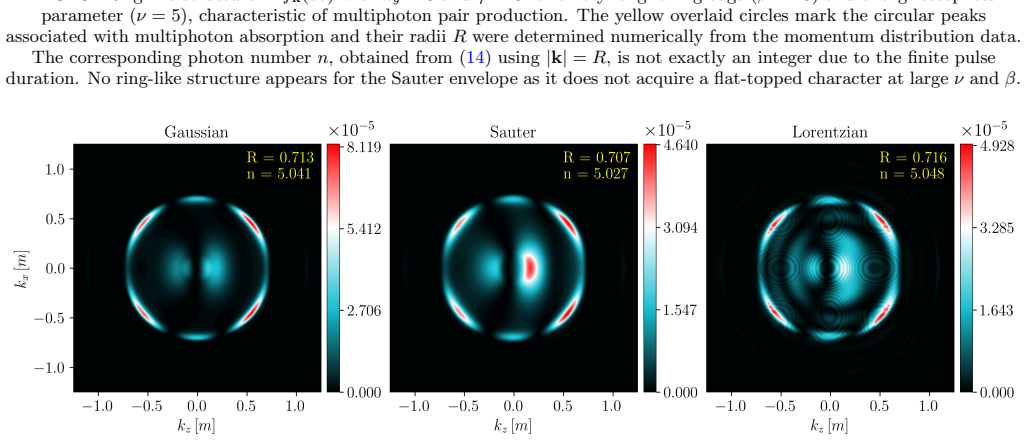
- Different envelopes (Gaussian, Lorentzian, Sauter) lead to qualitatively different momentum distributions.
- Flat-topped profiles in short falling pulses facilitate higher pair yields.
Where Pith is reading between the lines
- These results could guide the design of laser pulses to achieve observable pair production at lower intensities.
- Control via carrier-envelope phase might enable precision studies of strong-field quantum electrodynamics.
- Similar parameter tuning could apply to other nonlinear vacuum effects like photon-photon scattering.
Load-bearing premise
The regularization scheme in the turning-point analysis for non-analytic electric fields accurately reflects the behavior seen in the full numerical solution of the quantum Vlasov equation.
What would settle it
Numerical computation of the pair density for a specific asymmetric Lorentzian pulse with varying carrier-envelope phase and direct comparison to the turning-point predictions would test if the qualitative explanations hold.
Figures




read the original abstract
We investigate the combined effects of carrier-envelope phase and laser pulse shape on electron-positron pair production in the presence of an external time-dependent asymmetric electric field by solving the quantum Vlasov equation. We analyze how the pulse asymmetry, the envelope type (Gaussian, Lorentzian and Sauter), and the carrier-envelope phase jointly influence the momentum distribution and the total number of produced pairs per unit volume. Our results show that pair production exhibits extreme sensitivity to both the degree of temporal asymmetry and the steepness of the envelope on either side of the pulse. These effects are qualitatively explained through a turning-point analysis for the non-analytic electric field using a regularization scheme. We observe that multiphoton pair production dominates the Schwinger mechanism in the case of a long falling-pulse asymmetry. For a short falling pulse with a flat-topped profile, pair production is further facilitated. We demonstrate that the density of produced pairs can be enhanced by two to three orders of magnitude by choosing certain field parameters.
Editorial analysis
A structured set of objections, weighed in public.
Referee Report
Summary. The manuscript numerically solves the quantum Vlasov equation to study electron-positron pair production in time-dependent asymmetric electric fields with Gaussian, Lorentzian, and Sauter bell-shaped envelopes. It examines the joint influence of pulse asymmetry ratio, envelope steepness, and carrier-envelope phase on the momentum spectrum and total pair density per unit volume. The central result is that suitable choices of these parameters yield a two-to-three-order-of-magnitude enhancement in pair density, with multiphoton processes dominating for long falling-pulse asymmetry and further facilitation for short flat-top profiles; the enhancement is qualitatively attributed to a turning-point analysis that employs an unspecified regularization scheme for non-analytic fields.
Significance. If the numerical results prove robust, the work demonstrates substantial parametric control over vacuum pair production, which could guide optimization of future high-intensity laser experiments targeting the Schwinger or multiphoton regimes. The direct, parameter-free numerical approach using the standard quantum Vlasov equation is a clear strength, as the field amplitude, duration, asymmetry ratio, and CEP are varied externally without fitted quantities. The qualitative turning-point interpretation adds insight but requires validation to be fully convincing.
major comments (2)
- [Turning-point analysis section] Turning-point analysis section: the regularization scheme for non-analytic electric fields is not specified in detail, and no direct quantitative comparison is presented between the turning-point predictions and the full Vlasov numerical solutions for the same parameters. This is load-bearing for the interpretation because the headline claim attributes the 2–3 order enhancement specifically to temporal asymmetry and envelope steepness, which the turning-point analysis is invoked to explain (especially the dominance of multiphoton over Schwinger contributions in the long falling-pulse case).
- [Numerical results section] Numerical results section: the reported pair densities and momentum distributions lack any convergence tests, grid-resolution studies, or error estimates. Given that the central claim rests on orders-of-magnitude changes driven by changes in asymmetry and envelope type, demonstration that the Vlasov solver is stable and accurate to better than the reported enhancement factor is required.
minor comments (1)
- [Abstract] Abstract: the range of field amplitudes E0 and pulse durations used to obtain the quoted enhancements should be stated explicitly so readers can assess the regime.
Simulated Author's Rebuttal
We thank the referee for the careful reading and constructive comments on our manuscript. We have revised the manuscript to address the concerns about the turning-point analysis and numerical convergence.
read point-by-point responses
-
Referee: Turning-point analysis section: the regularization scheme for non-analytic electric fields is not specified in detail, and no direct quantitative comparison is presented between the turning-point predictions and the full Vlasov numerical solutions for the same parameters. This is load-bearing for the interpretation because the headline claim attributes the 2–3 order enhancement specifically to temporal asymmetry and envelope steepness, which the turning-point analysis is invoked to explain (especially the dominance of multiphoton over Schwinger contributions in the long falling-pulse case).
Authors: We agree that additional detail is required. In the revised manuscript we have expanded the turning-point section to fully specify the regularization procedure applied to the non-analytic fields. We have also added a direct quantitative comparison of pair-production rates obtained from the turning-point method and the numerical Vlasov solutions for representative parameter values; the comparison supports the qualitative attribution of the observed enhancements to temporal asymmetry and envelope steepness. revision: yes
-
Referee: Numerical results section: the reported pair densities and momentum distributions lack any convergence tests, grid-resolution studies, or error estimates. Given that the central claim rests on orders-of-magnitude changes driven by changes in asymmetry and envelope type, demonstration that the Vlasov solver is stable and accurate to better than the reported enhancement factor is required.
Authors: We acknowledge the need for explicit numerical validation. The revised manuscript includes a new subsection on numerical methods that reports convergence tests with respect to momentum-space grid resolution, time-step size, and spatial discretization. Error estimates are provided showing that numerical uncertainties remain well below the reported two-to-three-order-of-magnitude enhancements, confirming the robustness of the results. revision: yes
Circularity Check
No significant circularity: direct numerical Vlasov integration with external parameters
full rationale
The central results (pair density, momentum spectra, 2-3 order enhancement) are obtained by solving the quantum Vlasov equation numerically for externally chosen field parameters (amplitude, duration, asymmetry, CEP, envelope type). No parameter is fitted to the output quantities and then relabeled as a prediction. The turning-point analysis is invoked only for qualitative interpretation after the numerics, not to derive the quantitative claims. No self-citation chain or ansatz is load-bearing for the reported enhancements. The derivation chain is therefore self-contained against the stated numerical method.
Axiom & Free-Parameter Ledger
free parameters (3)
- field amplitude E0
- pulse duration and asymmetry ratio
- carrier-envelope phase
axioms (2)
- domain assumption The quantum Vlasov equation accurately describes pair production in a classical time-dependent electric field
- ad hoc to paper A regularization scheme can be applied to the turning-point analysis for non-analytic fields without altering the qualitative conclusions
Lean theorems connected to this paper
-
IndisputableMonolith/Cost/FunctionalEquation.leanwashburn_uniqueness_aczel unclear?
unclearRelation between the paper passage and the cited Recognition theorem.
We investigate the combined effects of carrier-envelope phase and laser pulse shape on electron-positron pair production... by solving the quantum Vlasov equation... turning-point analysis for the non-analytic electric field using a regularization scheme.
-
IndisputableMonolith/Foundation/AlexanderDuality.leanalexander_duality_circle_linking unclear?
unclearRelation between the paper passage and the cited Recognition theorem.
The turning points t_i of the equivalent scattering potential are defined by Ω_k(t_i)=0... fk(∞)≈∑e^{-2K_i} + interference terms
What do these tags mean?
- matches
- The paper's claim is directly supported by a theorem in the formal canon.
- supports
- The theorem supports part of the paper's argument, but the paper may add assumptions or extra steps.
- extends
- The paper goes beyond the formal theorem; the theorem is a base layer rather than the whole result.
- uses
- The paper appears to rely on the theorem as machinery.
- contradicts
- The paper's claim conflicts with a theorem or certificate in the canon.
- unclear
- Pith found a possible connection, but the passage is too broad, indirect, or ambiguous to say the theorem truly supports the claim.
Reference graph
Works this paper leans on
-
[1]
may enable experimental investigations of QED vac- uum decay into electron-positron pairs in the near future. The non-perturbative non-equilibrium process of electron-positron pair production has been studied using a variety of approaches, including the WKB approxima- tion [10], effective Lagrangian techniques [11], worldline instanton methods [12], the W...
work page internal anchor Pith review Pith/arXiv arXiv 2026
-
[2]
P. A. M. Dirac, The quantum theory of the electron, Pro- ceedings of the Royal Society of London. Series A, Con- taining Papers of a Mathematical and Physical Character 117, 610 (1928)
work page 1928
-
[3]
F. Sauter, On the behavior of an electron in a homoge- neous electric field in dirac’s relativistic theory, Z. Phys 69, 742 (1931)
work page 1931
-
[4]
Schwinger, On gauge invariance and vacuum polariza- tion, Physical Review82, 664 (1951)
J. Schwinger, On gauge invariance and vacuum polariza- tion, Physical Review82, 664 (1951)
work page 1951
-
[5]
D. Strickland and G. Mourou, Compression of amplified chirped optical pulses, Optics communications55, 447 (1985)
work page 1985
-
[6]
J. W. Yoon, Y. G. Kim, I. W. Choi, J. H. Sung, H. W. Lee, S. K. Lee, and C. H. Nam, Realization of laser in- tensity over 1023 w/cm2, Optica8, 630 (2021). [6]https://www.eli-laser.eu/. [7]https://www.xfel.eu/
work page 2021
-
[7]
A. Ringwald, Pair production from vacuum at the focus of an x-ray free electron laser, Physics Letters B510, 107 (2001)
work page 2001
-
[8]
E. Khazanov, A. Shaykin, I. Kostyukov, V. Ginzburg, I. Mukhin, I. Yakovlev, A. Soloviev, I. Kuznetsov, S. Mironov, A. Korzhimanov,et al., exawatt center for extreme light studies, High Power Laser Science and En- gineering11, e78 (2023)
work page 2023
-
[9]
V. Popov, Pair production in a variable external field (quasiclassical approximation), Soviet Journal of Exper- imental and Theoretical Physics34, 709 (1972)
work page 1972
-
[10]
G. Dunneet al., From fields to strings: circumnavigat- ing theoretical physics, Heisenberg–Euler Effective La- grangians: Basics and Extensions1, 445 (2005)
work page 2005
-
[11]
G. V. Dunne and C. Schubert, Worldline instantons and pair production in inhomogenous fields, Physical Re- view D-Particles, Fields, Gravitation, and Cosmology72, 105004 (2005)
work page 2005
-
[12]
O. Olugh, Z.-L. Li, B.-S. Xie, and R. Alkofer, Pair pro- 12 duction in differently polarized electric fields with fre- quency chirps, Physical Review D99, 036003 (2019)
work page 2019
-
[13]
N.-Z. Chen, O. Amat, L.-N. Hu, H.-H. Fan, and B.-S. Xie, Asymmetric pulse effects on pair production in chirped electric fields, Physical Review D109, 076015 (2024)
work page 2024
-
[14]
Hebenstreit,Schwinger effect in inhomogeneous elec- tric fields, Ph.D
F. Hebenstreit,Schwinger effect in inhomogeneous elec- tric fields, Ph.D. thesis, University of Graz (2011)
work page 2011
-
[15]
Blinne,Electron positron pair production in strong electric fields, Ph.D
A. Blinne,Electron positron pair production in strong electric fields, Ph.D. thesis, University of Jena (2016)
work page 2016
-
[16]
Z. Li, D. Lu, and B. Xie, Effects of electric field polariza- tions on pair production, Physical Review D92, 085001 (2015)
work page 2015
- [17]
-
[18]
R. Alkofer, M. Hecht, C. D. Roberts, S. Schmidt, and D. Vinnik, Pair creation and an x-ray free electron laser, Physical Review Letters87, 193902 (2001)
work page 2001
-
[19]
D. Blaschke, A. Prozorkevich, C. Roberts, S. Schmidt, and S. Smolyansky, Pair production and optical lasers, Physical review letters96, 140402 (2006)
work page 2006
-
[20]
M. Orthaber, F. Hebenstreit, and R. Alkofer, Momentum spectra for dynamically assisted schwinger pair produc- tion, Physics Letters B698, 80 (2011)
work page 2011
-
[21]
G. R. Mocken, M. Ruf, C. M¨ uller, and C. H. Keitel, Non- perturbative multiphoton electron-positron–pair creation in laser fields, Physical Review A—Atomic, Molecular, and Optical Physics81, 022122 (2010)
work page 2010
-
[22]
M. Ruf, G. R. Mocken, C. M¨ uller, K. Z. Hatsagortsyan, and C. H. Keitel, Pair production in laser fields oscillating in space and time, Physical review letters102, 080402 (2009)
work page 2009
-
[23]
C. Kohlf¨ urst, H. Gies, and R. Alkofer, Effective mass sig- natures in multiphoton pair production, Physical Review Letters112, 050402 (2014)
work page 2014
-
[24]
F. Hebenstreit, R. Alkofer, G. V. Dunne, and H. Gies, Momentum signatures for schwinger pair production in short laser pulses with a subcycle structure, Physical re- view letters102, 150404 (2009)
work page 2009
-
[25]
R. Sch¨ utzhold, H. Gies, and G. Dunne, Dynamically as- sisted schwinger mechanism, Physical review letters101, 130404 (2008)
work page 2008
-
[26]
A. Nuriman, B.-S. Xie, Z.-L. Li, and D. Sayipjamal, En- hanced electron–positron pair creation by dynamically assisted combinational fields, Physics Letters B717, 465 (2012)
work page 2012
- [27]
-
[28]
L.-J. Li, M. Mohamedsedik, and B.-S. Xie, Enhanced dy- namically assisted pair production in spatial inhomoge- neous electric fields with the frequency chirping, Physical Review D104, 036015 (2021)
work page 2021
-
[29]
C. K. Dumlu, Schwinger vacuum pair production in chirped laser pulses, Physical Review D—Particles, Fields, Gravitation, and Cosmology82, 045007 (2010)
work page 2010
- [30]
-
[31]
C. Gong, Z. Li, B. Xie, and Y. Li, Electron-positron pair production in frequency modulated laser fields, Physical Review D101, 016008 (2020)
work page 2020
-
[32]
O. Oluk, B.-S. Xie, M. A. Bake, and S. Dulat, Electron- positron pair production in a strong asymmetric laser electric field, Frontiers of Physics9, 157 (2014)
work page 2014
-
[33]
O. Olugh, Z.-L. Li, and B.-S. Xie, Asymmetric pulse ef- fects on pair production in polarized electric fields, High Power Laser Science and Engineering8, e38 (2020)
work page 2020
-
[34]
J. C. Bloch, V. Mizerny, A. Prozorkevich, C. D. Roberts, S. Schmidt, S. Smolyansky, and D. Vinnik, Pair cre- ation: Back reactions and damping, Physical Review D 60, 116011 (1999)
work page 1999
-
[35]
N. Tanji, Dynamical view of pair creation in uniform elec- tric and magnetic fields, Annals of Physics324, 1691 (2009)
work page 2009
-
[36]
S. Smolyansky, V. Mizerny, D. Vinnik, A. Prozorkevich, and V. Toneev, The non-equilibrium distribution func- tion of particles and anti-particles created in strong fields, inProgress in Nonequilibrium Green’s Functions(World Scientific, 2000) pp. 375–382
work page 2000
- [37]
-
[38]
C. Roberts, S. Schmidt, and D. Vinnik, Quantum effects with an x-ray free-electron laser, Physical review letters 89, 153901 (2002)
work page 2002
-
[39]
M. Prakapenia and G. Vereshchagin, Pauli blocking ef- fects on pair creation in strong electric field, Physical Review D108, 013002 (2023)
work page 2023
- [40]
-
[41]
Keldysh, Ionization in the field of a strong electromag- netic wave, Sov
L. Keldysh, Ionization in the field of a strong electromag- netic wave, Sov. Phys. JETP20, 1307 (1965)
work page 1965
-
[42]
E. Br´ ezin and C. Itzykson, Pair production in vacuum by an alternating field, Physical Review D2, 1191 (1970)
work page 1970
-
[43]
V. S. Popov, Tunnel and multiphoton ionization of atoms and ions in a strong laser field (keldysh theory), Phys. Usp.47, 855 (2004)
work page 2004
-
[44]
I. Aleksandrov, D. Sevostyanov, and V. Shabaev, Schwinger particle production: rapid switch off of the external field versus dynamical assistance, Physical Re- view D111, 016010 (2025)
work page 2025
-
[45]
N. Abdukerim, Z.-L. Li, and B.-S. Xie, Effects of laser pulse shape and carrier envelope phase on pair produc- tion, Physics Letters B726, 820 (2013)
work page 2013
-
[46]
A. Otto, H. Oppitz, and B. K¨ ampfer, Assisted vacuum decay by time-dependent electric fields, The European Physical Journal A54, 23 (2018)
work page 2018
-
[47]
A. D. Panferov, S. A. Smolyansky, A. Otto, B. K¨ ampfer, D. B. Blaschke, and L. Juchnowski, Assisted dynamical schwinger effect: pair production in a pulsed bifrequent field, The European Physical Journal D70, 56 (2016)
work page 2016
-
[48]
Braset al., (2025), arXiv:2505.24488 [hep-ph]
J. Braset al., (2025), arXiv:2505.24488 [hep-ph]
-
[49]
M. Mohamedsedik, L.-J. Li, L. Wang, O. Amat, L.-N. Hu, and B. Xie, Phase effect on and symmetry of pair pro- duction in inhomogeneous electric fields with chirping, The European Physical Journal Plus138, 316 (2023)
work page 2023
-
[50]
M. Mohamedsedik, L.-J. Li, and B. Xie, Schwinger pair production in inhomogeneous electric fields with symmet- rical frequency chirp, Physical Review D104, 016009 (2021)
work page 2021
-
[51]
C. K. Dumlu and G. V. Dunne, Interference effects in schwinger vacuum pair production for time-dependent laser pulses, Physical Review D—Particles, Fields, Grav- itation, and Cosmology83, 065028 (2011). 13
work page 2011
-
[52]
H. Taya, T. Fujimori, T. Misumi, M. Nitta, and N. Sakai, Exact wkb analysis of the vacuum pair production by time-dependent electric fields, Journal of High Energy Physics2021, 1 (2021)
work page 2021
-
[53]
E. Akkermans and G. V. Dunne, Ramsey fringes and time-domain multiple-slit interference from vacuum, Physical Review Letters108, 030401 (2012)
work page 2012
-
[54]
Z.-L. Li, D. Lu, and B.-S. Xie, Multiple-slit interfer- ence effect in the time domain for boson pair production, Physical Review D89, 067701 (2014)
work page 2014
-
[55]
C. K. Dumlu and G. V. Dunne, Complex worldline in- stantons and quantum interference in vacuum pair pro- duction, Physical Review D—Particles, Fields, Gravita- tion, and Cosmology84, 125023 (2011)
work page 2011
discussion (0)
Sign in with ORCID, Apple, or X to comment. Anyone can read and Pith papers without signing in.