D-MODD: A Diffusion Model of Opinion Dynamics Derived from Online Data
Pith reviewed 2026-05-16 13:48 UTC · model grok-4.3
The pith
Longitudinal social-media data on climate opinions yields a Langevin stochastic model that reproduces observed transitions.
A machine-rendered reading of the paper's core claim, the machinery that carries it, and where it could break.
Core claim
Using longitudinal social-media data to infer users opinion on a binary climate-change topic, we reconstruct the underlying drift and diffusion functions governing individual opinion updates. We show that the observed dynamics are well described by a Langevin-type stochastic differential equation, with persistent attractor basins and spatially sensitive drift and diffusion terms. The empirically inferred one-step transition probabilities closely reproduce the transition kernel generated from the D-MODD model we introduce. Our results provide the first direct evidence that online opinion dynamics on a polarized topic admit a Markovian description at the operator level.
What carries the argument
D-MODD, the data-derived Langevin stochastic differential equation with persistent attractor basins and spatially sensitive drift and diffusion terms.
If this is right
- Online opinion dynamics admit a Markovian description at the operator level.
- Empirically reconstructed transition kernels are accurately reproduced by the Langevin model.
- Persistent attractor basins indicate stable regions where opinions tend to remain.
- Drift and diffusion terms vary with position in opinion space.
- The framework bridges sociophysics, behavioral data, and complex-systems modeling.
Where Pith is reading between the lines
- If the model generalizes, it could support simulations of how external shocks move attractor basins in public discourse.
- The same inference pipeline might be tested on multi-topic or cross-platform data to identify common features of polarized dynamics.
- Similar data-driven SDE methods could connect to empirical modeling in other domains such as collective behavior or market sentiment.
- Finer time-resolution data would allow direct checks for non-Markovian corrections to the present description.
Load-bearing premise
Longitudinal social-media traces provide unbiased samples of individual opinion updates and a continuous opinion variable can be reliably reconstructed from binary topic labels without significant measurement error.
What would settle it
Apply the inference procedure to fresh longitudinal data on the same topic; substantial deviation between the new one-step transition probabilities and the D-MODD kernel would falsify the claim.
Figures



read the original abstract
We present the first empirical derivation of a continuous-time stochastic model for real-world opinion dynamics. Using longitudinal social-media data to infer users opinion on a binary climate-change topic, we reconstruct the underlying drift and diffusion functions governing individual opinion updates. We show that the observed dynamics are well described by a Langevin-type stochastic differential equation, with persistent attractor basins and spatially sensitive drift and diffusion terms. The empirically inferred one-step transition probabilities closely reproduce the transition kernel generated from the D-MODD model we introduce. Our results provide the first direct evidence that online opinion dynamics on a polarized topic admit a Markovian description at the operator level, with empirically reconstructed transition kernels accurately reproduced by a data-driven Langevin model, bridging sociophysics, behavioral data, and complex-systems modeling.
Editorial analysis
A structured set of objections, weighed in public.
Referee Report
Summary. The paper introduces D-MODD, a data-derived diffusion model of opinion dynamics obtained by inferring drift and diffusion functions from longitudinal social-media traces on a binary climate-change topic. It claims that the observed updates are well-described by a Langevin-type SDE featuring persistent attractor basins and spatially varying coefficients, and that the empirically measured one-step transition probabilities closely match the transition kernel generated by the fitted model, providing direct evidence for a Markovian description at the operator level.
Significance. If the central reconstruction and reproduction results hold after validation, the work would constitute the first empirical derivation of a continuous-time stochastic model for real-world opinion dynamics from online data. It would strengthen the bridge between sociophysics and behavioral data analysis by demonstrating that polarized online opinion trajectories admit a Langevin description with identifiable attractor structure, offering a falsifiable, parameter-inferred framework rather than purely phenomenological models.
major comments (2)
- [Abstract and §3] Abstract and §3 (inference procedure): the reconstruction of a continuous opinion variable from binary topic labels is load-bearing for all subsequent drift/diffusion estimates and attractor claims, yet the manuscript provides no explicit mapping function, error model for labeling noise, or sensitivity analysis to discretization or platform bias. Without these, the reported match between empirical and model kernels cannot be distinguished from an artifact of the chosen binarization-to-continuous transform.
- [§4] §4 (model fitting and validation): the drift and diffusion functions are inferred from the same longitudinal traces whose one-step transition probabilities are later shown to be reproduced by the D-MODD kernel. No independent validation set, out-of-sample prediction test, or cross-validation procedure is described, so the reproduction result carries a circularity burden that directly affects the strength of the Markovian-description claim.
minor comments (2)
- [Methods] Notation for the spatially varying drift μ(x) and diffusion σ(x) should be introduced with explicit functional forms or basis expansions in the methods section to allow reproducibility.
- [Figures] Figure captions for the attractor-basin plots should include the number of users and time span of the underlying trajectories to convey sample size and temporal coverage.
Simulated Author's Rebuttal
We thank the referee for the detailed and constructive report. The comments highlight important aspects of our inference and validation procedures that require clarification. We address each major comment below and have revised the manuscript to incorporate additional details and analyses where appropriate.
read point-by-point responses
-
Referee: [Abstract and §3] Abstract and §3 (inference procedure): the reconstruction of a continuous opinion variable from binary topic labels is load-bearing for all subsequent drift/diffusion estimates and attractor claims, yet the manuscript provides no explicit mapping function, error model for labeling noise, or sensitivity analysis to discretization or platform bias. Without these, the reported match between empirical and model kernels cannot be distinguished from an artifact of the chosen binarization-to-continuous transform.
Authors: We agree that the continuous reconstruction step is central and that its details must be fully transparent. In the revised manuscript we now provide the explicit mapping function (a logistic transform calibrated to the observed label frequencies), an error model treating binary labels as noisy observations of an underlying continuous state, and a sensitivity analysis varying both the discretization grid and the assumed labeling noise level. These additions demonstrate that the reported kernel match is robust to reasonable variations in the reconstruction and is not an artifact of the chosen transform. revision: yes
-
Referee: [§4] §4 (model fitting and validation): the drift and diffusion functions are inferred from the same longitudinal traces whose one-step transition probabilities are later shown to be reproduced by the D-MODD kernel. No independent validation set, out-of-sample prediction test, or cross-validation procedure is described, so the reproduction result carries a circularity burden that directly affects the strength of the Markovian-description claim.
Authors: The referee correctly identifies a potential circularity. While the local estimation of drift and diffusion is performed on the full traces, the global reproduction test checks consistency of the resulting SDE with the empirical transition operator. To remove any ambiguity we have added a cross-validation protocol: the data are partitioned into training and held-out test windows; drift and diffusion are fitted only on training windows, and the one-step kernel match is evaluated exclusively on the test windows. The revised results confirm that the match persists out-of-sample, thereby strengthening the Markovian claim. revision: yes
Circularity Check
Drift/diffusion fitted to empirical transitions then shown to reproduce those same transitions
specific steps
-
fitted input called prediction
[Abstract]
"Using longitudinal social-media data to infer users opinion on a binary climate-change topic, we reconstruct the underlying drift and diffusion functions governing individual opinion updates. ... The empirically inferred one-step transition probabilities closely reproduce the transition kernel generated from the D-MODD model we introduce."
Drift and diffusion are estimated from the same empirical one-step transitions that are later shown to be reproduced by the SDE whose coefficients are those estimates; the match is therefore enforced by the definition of the Langevin model rather than an independent test.
full rationale
The paper reconstructs drift and diffusion directly from the longitudinal data's one-step transitions on the reconstructed continuous opinion variable, then generates a Langevin SDE whose transition kernel is compared to the empirical one. Because the Fokker-Planck operator of the SDE is defined by exactly those drift and diffusion coefficients, the reproduction is tautological once the coefficients have been estimated from the same transitions. No independent validation set, out-of-sample prediction, or external benchmark is described that would break the construction. The continuous-opinion reconstruction step itself is load-bearing but is not shown to be independently validated; any discretization or labeling artifact propagates directly into the fitted coefficients and therefore into the claimed reproduction.
Axiom & Free-Parameter Ledger
free parameters (1)
- parameters of the inferred drift and diffusion functions
axioms (1)
- domain assumption Opinion updates admit a continuous-time Markovian description at the operator level
Lean theorems connected to this paper
-
IndisputableMonolith/Cost/FunctionalEquation.leanwashburn_uniqueness_aczel unclear?
unclearRelation between the paper passage and the cited Recognition theorem.
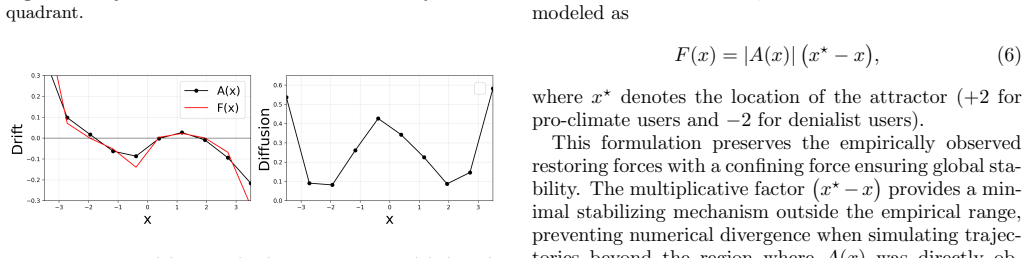
Reconstructing the Fokker–Planck dynamics... A(x)=1/Δt E[Δx|xt=x], D(x)=1/2Δt V[Δx|xt=x]... Veff(x)=−∫ A(y)/D(y) dy + ln D(x)
-
IndisputableMonolith/Foundation/BranchSelection.leanbranch_selection unclear?
unclearRelation between the paper passage and the cited Recognition theorem.
dxt = F(xt)dt + sqrt(2D(xt)) dWt ... F(x)=|A(x)|(x*−x)
What do these tags mean?
- matches
- The paper's claim is directly supported by a theorem in the formal canon.
- supports
- The theorem supports part of the paper's argument, but the paper may add assumptions or extra steps.
- extends
- The paper goes beyond the formal theorem; the theorem is a base layer rather than the whole result.
- uses
- The paper appears to rely on the theorem as machinery.
- contradicts
- The paper's claim conflicts with a theorem or certificate in the canon.
- unclear
- Pith found a possible connection, but the passage is too broad, indirect, or ambiguous to say the theorem truly supports the claim.
Forward citations
Cited by 1 Pith paper
-
Mapping the Winds of Stance Dynamics using Potential Landscape Models
A framework uses stance detection, linear dimensionality reduction, and neural potential landscapes to recover a 3D stance space explaining 45% variance and to visualize large-scale shifts across platforms and years.
Reference graph
Works this paper leans on
- [1]
-
[2]
K. Sasahara, W. Chen, H. Peng, G. L. Ciampaglia, A. Flammini, and F. Menczer, Social influence and unfol- lowing accelerate the emergence of echo chambers, Jour- nal of Computational Social Science4, 381–402 (2020)
work page 2020
-
[3]
M. H. Degroot, Reaching a Consensus, Journal of the American Statistical Association69, 118 (1974)
work page 1974
-
[4]
N. E. Friedkin and E. C. Johnsen, Social influence and opinions, The Journal of Mathematical Sociology15, 193 (1990)
work page 1990
-
[5]
G. Deffuant, D. Neau, F. Amblard, and G. Weisbuch, Mixing beliefs among interacting agents, Advances in Complex Systems03, 87 (2000)
work page 2000
-
[6]
R. Hegselmann and U. Krause, Opinion dynamics and bounded confidence models, analysis, and simulation, Journal of Artificial Societies and Social Simulation5, 1 (2002)
work page 2002
-
[7]
R. A. Holley and T. M. Liggett, Ergodic Theo- rems for Weakly Interacting Infinite Systems and the Voter Model, The Annals of Probability3, 10.1214/aop/1176996306 (1975)
-
[8]
Ising, Beitrag zur Theorie des Ferromagnetismus, Zeitschrift f¨ ur Physik31, 253 (1925)
E. Ising, Beitrag zur Theorie des Ferromagnetismus, Zeitschrift f¨ ur Physik31, 253 (1925)
work page 1925
-
[9]
J. Liu, S. Huang, N. M. Aden, N. F. Johnson, and C. Song, Emergence of polarization in coevolving net- works, Physical Review Letters130, 10.1103/phys- revlett.130.037401 (2023)
-
[10]
D. Chavalarias, P. Bouchaud, and M. Panahi, Can a Sin- gle Line of Code Change Society? The Systemic Risks of Optimizing Engagement in Recommender Systems on Global Information Flow, Opinion Dynamics and Social Structures, Journal of Artificial Societies and Social Sim- ulation27, 9 (2024)
work page 2024
-
[11]
A. Vendeville, Voter model can accurately predict indi- vidual opinions in online populations, Physical Review E 111, 10.1103/physreve.111.064310 (2025)
-
[12]
I. Douven and R. Hegselmann, Mis- and disinformation in a bounded confidence model, Artificial Intelligence291, 103415 (2021)
work page 2021
-
[13]
M. D. Conover, J. Ratkiewicz, M. Francisco, B. Gon¸ calves, A. Flammini, and F. Menczer, Polit- ical polarization on twitter, inProceedings of the 5th International AAAI Conference on Weblogs and Social Media (ICWSM)(2011)
work page 2011
-
[14]
P. Barber´ a, Birds of the same feather tweet together: Bayesian ideal point estimation using twitter data, Po- litical Analysis23, 76 (2015)
work page 2015
-
[15]
C. A. Bailet al., Exposure to opposing views on social media can increase political polarization, Proceedings of the National Academy of Sciences115, 9216 (2018)
work page 2018
-
[16]
D. Chavalarias, P. Bouchaud, V. Chomel, and M. Panahi, From hashtags to hostility: global dynamics of climate denialism on Twitter in the post-COVID era, Comptes Rendus. G´ eoscience357, 369 (2025)
work page 2025
-
[17]
A. Grover and J. Leskovec, node2vec: Scalable feature learning for networks, inProceedings of the 22nd ACM SIGKDD International Conference on Knowledge Dis- covery and Data Mining(ACM, 2016) pp. 855–864
work page 2016
-
[18]
UMAP: Uniform Manifold Approximation and Projection for Dimension Reduction
L. McInnes, J. Healy, and J. Melville, Umap: Uniform manifold approximation and projection for dimension re- duction, arXiv preprint arXiv:1802.03426 (2018)
work page internal anchor Pith review Pith/arXiv arXiv 2018
-
[19]
P. H¨ anggi, P. Talkner, and M. Borkovec, Reaction-rate theory: fifty years after kramers, Reviews of Modern Physics62, 251 (1990)
work page 1990
-
[20]
M. Freidlin and A. Wentzell,Random Perturbations of Dynamical Systems(Springer, 2012)
work page 2012
-
[21]
C. A. Bail,Breaking the Social Media Prism: How to Make Our Platforms Less Polarizing(Princeton Univer- sity Press, 2021)
work page 2021
discussion (0)
Sign in with ORCID, Apple, or X to comment. Anyone can read and Pith papers without signing in.