REVIEW 4 major objections 4 minor 2 cited by
DataStates-LLM: Scalable Checkpointing for Transformer Models Using Composable State Providers
T0 review · 4 major / 4 minor · reviewed 2026-08-03 · deepseek-v4-flash
Pith's one-line read DataStates-LLM claims LLM checkpointing can be 3–4.2x faster by overlapping lazy GPU-to-host copies with the forward and backward passes, cutting end-to-end training time by up to 2.2x.
desk verdict Genuine systems contribution to LLM checkpointing; the safety claim needs a restore experiment before I'd trust it. read the letter →
The pith
A machine-rendered reading of the paper's core claim, the machinery that carries it, and where it could break.
The reading
What carries the argument
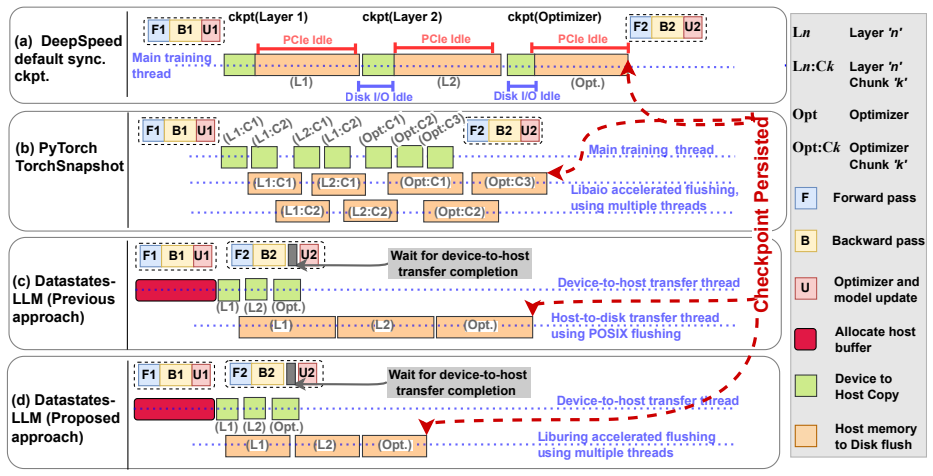
The load-bearing object is the state provider: a lightweight abstraction that sits between the training runtime and the I/O engine and exposes any piece of checkpoint state as an iterator of byte chunks. Providers differ per data structure—contiguous tensors are memory views that need no serialization, while Python objects are serialized to chunks—and can be composed hierarchically into one stream, letting the engine read from GPU and host at the same time. The second mechanism is lazy non-blocking capture: copies start at checkpoint request time, overlap with forward/backward, and are awaited only before the optimizer update. Together they let the engine keep PCIe, host memory, and storage
What would settle it
Run a training loop in which a forward or backward hook performs an in-place update on a parameter, checkpoint with DataStates-LLM, restart, and compare restored weights and loss to a run without the hook; divergence would disprove the immutability premise. Separately, kill a process while the host-to-file flush is in flight and attempt to resume; a failed restart would show the overlap gains do not yet produce crash-safe checkpoints.
Extended reading notes
Core claim
The central claim is that checkpoint capture in LLM training can be made nearly free by exploiting the update-phase structure of the training loop. Because forward and backward passes do not modify model or optimizer shards, DataStates-LLM issues non-blocking device-to-host copies at checkpoint time and lets the training iteration proceed; it waits only when the optimizer update is about to write over state that is still being copied. Composable state providers give each shard a stream-oriented interface—yielding chunks with known offsets, memory tier, and serialization needs—so the data movement engine can coalesce fragmented shards, overlap serialization of small objects with bulk tensor w
Load-bearing premise
Everything rests on the claim that model parameters and optimizer state are modified only in the optimizer update and never during forward/backward; if user code or a non-standard optimizer writes to that state during the copy window, the background copies can capture a torn checkpoint.
Editorial extensions
If this is right
- Per-iteration checkpointing becomes practical: in the 7B stress test, writing a checkpoint every 2 iterations completes 50 training iterations in 195 seconds, comparable to a baseline that checkpoints only every 10 iterations.
- Larger models benefit more: longer forward/backward phases give more slack for asynchronous staging, so aggregate checkpoint throughput scales with model size and node count rather than plateauing.
- The state-provider abstraction makes the I/O path independent of data type, so new object kinds or future data-reduction techniques (differential checkpointing, compression) can be added without redesigning the movement engine.
- Strong scaling of data parallelism remains efficient: even as per-rank checkpoint size shrinks under optimizer sharding, the engine keeps throughput near-uniform by amortizing fixed serialization and header costs.
Reading between the lines
- Editorial inference: the same lazy-capture discipline should generalize to any state updated infrequently in bulk, such as learning-rate schedules, EMA copies, or batch-normalization statistics, provided the update boundary is known.
- Editorial inference: the resilience benefit is not fully established until restart correctness is tested with a node failure during the host-to-file flush, since the paper evaluates overlap and throughput but not crash consistency.
- Editorial inference: a simple guard—detecting writes to pages currently being staged, or an optional explicit barrier before in-place user ops—would make the immutability assumption robust to hooks, weight tying, and non-standard optimizers.
Editorial analysis
A structured set of objections, weighed in public.
Referee Report
Summary. The paper proposes DataStates-LLM, an asynchronous checkpointing engine for DeepSpeed-based LLM training that targets what the authors call 3D checkpoint heterogeneity: GPU- vs host-resident state, tensor vs Python-object data, and the many shards produced by 3D parallelism. The key design ideas are: (i) pre-allocated pinned host buffers that coalesce per-rank shards; (ii) lazy non-blocking GPU-to-host copies issued during the forward/backward passes, relying on the immutability of model/optimizer state in those phases; (iii) composable state providers that expose streams of bytes to a data-movement engine and thereby overlap serialization of metadata with bulk tensor I/O; and (iv) multi-threaded liburing/O_DIRECT flushing to a parallel file system. The evaluation uses BLOOM/Llama-style models from 3B to 70B on up to 256 A100 GPUs, comparing against DeepSpeed default, TorchSnapshot, and the authors' prior engine (DataStates-LLM-Old). The paper claims 3x-4.2x checkpoint-throughput improvement and 1.3x-2.2x end-to-end training-time reduction, and includes ablation studies and a per-node I/O microbenchmark.
Significance. If the correctness gap is addressed, the lazy immutability insight is a valuable systems contribution: it maps checkpoint capture onto existing iteration phases, avoids blocking device-to-host transfers, and provides a clean state-provider abstraction for heterogeneous data. The paper also has concrete strengths: the evaluation is at a realistic scale (256 GPUs), the source code is referenced, and the ablation against the authors' own prior engine helps isolate the new mechanisms. However, the paper currently validates only performance and not restart safety, so its motivating use cases — resilience, rollback, suspend/resume — are not established. The performance advantage is plausible from the figures, but it is entangled with a metric definition that measures training stall rather than data-movement throughput, and the headline speedup range is not consistently reported.
major comments (4)
- [§ I, § VI-D1, Fig. 7] The central quantitative claim is not stated consistently. The contributions and conclusion claim a 3x-4.2x improvement over TorchSnapshot and the authors' prior work, while the abstract says 'up to 4x'. Fig. 7 shows DataStates-LLM versus TorchSnapshot ranging from about 2.0x at 70B (515.0/252.2) to about 9.5x at 7B (111.4/11.7), and versus DataStates-LLM-Old ranging from about 1.2x to 6.2x. The paper should report per-configuration numbers, state exactly which baseline pairing is used for the headline range, and give a central statistic (geomean or median) with repeated-run variances. With no error bars and only 15-iteration runs, precise ratios such as '4.2x' are not supported.
- [§ VI-C3] The 'effective checkpoint throughput' metric is defined as global checkpoint size divided by the time the training is blocked by checkpointing. Since DataStates-LLM deliberately hides D2H copies and host-to-file flushes inside forward/backward passes, a small denominator is exactly its intended effect. The metric therefore measures training stall, not checkpoint I/O throughput, and it biases the comparison in favor of lazy asynchronous engines. Please also report aggregate bytes actually written to the PFS per second, host-cache occupancy/backlog, and PCIe/PFS bandwidth utilization; otherwise the '3x-4.2x throughput' claim conflates overlap with true I/O throughput.
- [§ V-A2, § V-A5, § VI] No experiment validates that a checkpoint saved by DataStates-LLM can actually restore training. There is no crash/restart test, no loss or accuracy comparison before and after restore, no failure injection during the host-to-PFS flush window, and no check that a file set is globally consistent across ranks. The hybrid fixed-offset/log-structured layout with a trailing metadata header (§ V-A5) is not accompanied by a reader-side commit/validation protocol that distinguishes a complete checkpoint from a partial one, nor is there a versioning mechanism to prevent per-rank files originating from different logical iterations from being assembled into a globally inconsistent checkpoint. Since resilience and rollback are the motivating use cases, this is a load-bearing omission.
- [§ V-A2] The lazy-capture correctness argument depends entirely on the claim that model and optimizer shards on each GPU are immutable during forward and backward passes and updated only in bulk. The paper does not state how this is enforced or detected. Common training patterns — in-place normalization or activation hooks, parameter sharing/tying, non-standard optimizers with in-place operations, or host-side/offloaded state updates — can mutate tensors while asynchronous D2H copies are in flight, producing torn checkpoints. The paper should either specify a detection/handling mechanism or precisely document the supported programming model for which the immutability guarantee holds.
minor comments (4)
- [§ V-A2, § V-A5] Typos: 'remains immutable' should be 'remain immutable'; 'checkpoint throughout' should be 'checkpoint throughput'. Please also make the terminology consistent: the contributions say 'streamlined multi-tier kernel-accelerated I/O engine', while § V-A5 refers to 'overlapping I/O with serialization'.
- [Fig. 7, Fig. 13] Figure 7's caption says 'Aggregate checkpointing throughput' but the text defines 'effective checkpoint throughput' based on blocked time. Clarify the caption and axis label. In Figure 13, the x-axis label 'Checkpoint Freq. [Num of ckpts. created]' is confusing: the numeric labels 1,2,3,... appear to denote checkpoint interval in iterations while the bracket values denote the number of checkpoints created; re-label the axis.
- [Table III] Table III reports per-sub-operation times for one rank, but it is not clear which of these times are on the critical path and which are background/overlapped. Since the 'Times in blue' note depends on color, please make the distinction explicit in the table (e.g., with a 'Blocking' vs 'Overlapped' column) and add the DataStates-LLM-Old row to support the ablation claim.
- [§ VI-A, § VI-C] The evaluation reports no repetitions, error bars, or statistical summary. At least a small number of repeats for the headline configurations (e.g., 7B and 70B with per-iteration checkpoints) would make the reported speedups and the claim of 'no I/O tail' more robust.
Circularity Check
No significant circularity: the central claims are benchmark-derived and the design rests on measured phase behavior; only minor non-load-bearing self-citations appear.
full rationale
The claimed derivation chain starts from an empirical observation, not from the conclusion: § IV-B measures that forward/backward dominate iteration time and states in § V-A2 that “the model and optimizer shards on each GPU remains immutable during the forward pass and the backward pass, and are updated later in bulk.” The lazy capture design follows from that property, and the key performance numbers are experimental comparisons: “We demonstrate a 3×–4.2× improvement in checkpointing throughput and a 1.3×–2.2× reduction in end-to-end training time compared with TorchSnapshot, a state-of-the-art approach, and with our own previous work” (§ I). The self-comparison against DataStates-LLM-Old (§ VI-B3, “Our prior DataStates-LLM engine [10]”) is an incremental-systems baseline, not a citation used to prove the new design; no uniqueness theorem or ansatz is imported from the cited prior work. No parameter is fitted to a reported outcome, and the “3D heterogeneity” framing is an organizational description rather than a renamed result used as proof. The paper leaves restart/crash-consistency untested, but that is a correctness/validation gap, not circularity. Thus the only self-citation-related observation is minor and non-load-bearing, yielding a low non-circularity score of 2.
Assumptions & free parameters
free parameters (1)
- Host-side pinned buffer capacity (host cache per node) =
80 GB per node in evaluation; user-tunable
assumptions (4)
- domain assumption Model parameters and optimizer state are immutable during forward and backward passes, and mutated only during the optimizer update phase.
- domain assumption GPU-to-host DMA transfers and host-to-storage flushes do not meaningfully contend with training communication because they use separate hardware paths (copy engine, PCIe vs NVLink/RDMA).
- ad hoc to paper The hybrid fixed-offset, concurrent log-structured append format with a final metadata header yields a recoverable persistent checkpoint.
- ad hoc to paper A bounded pinned host cache of 80 GB per node is sufficient to keep the producer-consumer pipeline running at the evaluated checkpoint frequencies.
invented entities (1)
-
Composable state providers (SPs)
Cite this review
Pith. "Pith review of DataStates-LLM: Scalable Checkpointing for Transformer Models Using Composable State Providers." pith.science (2026). https://pith.science/paper/UHKNGPOK
@misc{pith2026260116956,
  author       = {Pith},
  title        = {Pith review of: DataStates-LLM: Scalable Checkpointing for Transformer Models Using Composable State Providers},
  year         = {2026},
  howpublished = {\url{https://pith.science/paper/UHKNGPOK}},
  note         = {Machine review of arXiv:2601.16956}
}
abstract
The rapid growth of Large Transformer-based models, specifically Large Language Models (LLMs), now scaling to trillions of parameters, has necessitated training across thousands of GPUs using complex hybrid parallelism strategies (e.g., data, tensor, and pipeline parallelism). Checkpointing this massive, distributed state is critical for a wide range of use cases, such as resilience, suspend-resume, investigating undesirable training trajectories, and explaining model evolution. However, existing checkpointing solutions typically treat model state as opaque binary blobs, ignoring the ``3D heterogeneity'' of the underlying data structures--varying by memory location (GPU vs. Host), number of ``logical'' objects sharded and split across multiple files, data types (tensors vs. Python objects), and their serialization requirements. This results in significant runtime overheads due to blocking device-to-host transfers, data-oblivious serialization, and storage I/O contention. In this paper, we introduce DataStates-LLM, a novel checkpointing architecture that leverages State Providers to decouple state abstraction from data movement. DataStates-LLM exploits the immutability of model parameters during the forward and backward passes to perform ``lazy'', non-blocking asynchronous snapshots. By introducing State Providers, we efficiently coalesce fragmented, heterogeneous shards and overlap the serialization of metadata with bulk tensor I/O. We evaluate DataStates-LLM on models up to 70B parameters on 256 A100-40GB GPUs. Our results demonstrate that DataStates-LLM achieves up to 4$\times$ higher checkpointing throughput and reduces end-to-end training time by up to 2.2$\times$ compared to state-of-the-art solutions, effectively mitigating the serialization and heterogeneity bottlenecks in extreme-scale LLM training.
Figures



Figures from the paper (4 more)


Forward citations
Cited by 2 Pith papers
-
ReCoVer: Resilient LLM Pre-Training System via Fault-Tolerant Collective and Versatile Workload
ReCoVer uses fault-tolerant collectives, in-step recovery, and dynamic microbatch redistribution to maintain training trajectory equivalence under GPU failures, delivering 2.23x higher effective throughput than checkp...
-
ReCoVer: Resilient LLM Pre-Training System via Fault-Tolerant Collective and Versatile Workload
ReCoVer maintains constant microbatch counts per iteration via fault-tolerant collectives, in-step recovery, and versatile workload redistribution to preserve training trajectory on up to 512 GPUs despite losing 256, ...
Reference graph
Works this paper leans on
-
[1]
J. Gottweis, W.-H. Weng, A. Daryin, T. Tu, A. Palepuet al., “Towards an ai co-scientist,” 2025. [Online]. Available: https: //arxiv.org/abs/2502.18864
arXiv 2025
-
[2]
Scaling llama 3 training with efficient parallelism strategies,
W. Chu, X. Xie, J. Yu, J. Wang, A. Phanishayeeet al., “Scaling llama 3 training with efficient parallelism strategies,” inThe Annual International Symposium on Computer Architecture, ser. ISCA ’25. ACM, 2025, p. 1703–1716
2025
-
[3]
BLOOM: A 176B-Parameter Open-Access Multilingual Language Model,
B. Workshop, T. L. Scao, A. Fan, C. Akiki, E. Pavlick, S. Ili ´cet al., “BLOOM: A 176B-Parameter Open-Access Multilingual Language Model,” Jun. 2023
2023
-
[4]
DeepSpeed: System Optimizations Enable Training Deep Learning Models with Over 100 Billion Parameters,
J. Rasley, S. Rajbhandari, O. Ruwase, and Y . He, “DeepSpeed: System Optimizations Enable Training Deep Learning Models with Over 100 Billion Parameters,” inSIGKDD International Conference on Knowl- edge Discovery & Data Mining (KDD’20). ACM, Aug. 2020
2020
-
[5]
Pytorch fsdp: experiences on scaling fully sharded data parallel,
Y . Zhao, A. Gu, R. Varma, L. Luo, C.-C. Huanget al., “Pytorch fsdp: experiences on scaling fully sharded data parallel,”arXiv preprint arXiv:2304.11277, 2023
arXiv 2023
-
[6]
Robust llm training infrastructure at bytedance,
B. Wan, G. Liu, Z. Song, J. Wang, Y . Zhanget al., “Robust llm training infrastructure at bytedance,” inThe ACM SIGOPS 31st Symposium on Operating Systems Principles, ser. SOSP ’25. ACM, 2025
2025
-
[7]
Unicron: Economizing self-healing llm training at scale,
T. He, X. Li, Z. Wang, K. Qian, J. Xu, W. Yu, and J. Zhou, “Unicron: Economizing self-healing llm training at scale,” 2023
2023
-
[8]
Spike no more: Stabilizing the pre-training of large language models,
S. Takase, S. Kiyono, S. Kobayashi, and J. Suzuki, “Spike no more: Stabilizing the pre-training of large language models,”arXiv preprint arXiv:2312.16903, 2023
arXiv 2023
Show all 38 references
-
[9]
Fastpersist: Ac- celerating model checkpointing in deep learning,
G. Wang, O. Ruwase, B. Xie, and Y . He, “Fastpersist: Ac- celerating model checkpointing in deep learning,”arXiv preprint arXiv:2406.13768, 2024
2024 arXiv
-
[10]
Datastates-llm: Lazy asynchronous checkpointing for large language models,
A. Maurya, R. Underwood, M. M. Rafique, F. Cappello, and B. Nicolae, “Datastates-llm: Lazy asynchronous checkpointing for large language models,” inThe International Symposium on High-Performance Parallel and Distributed Computing (HPDC’24), 2024, pp. 227–239
2024
-
[11]
Welcome to the torchsnapshot documentation,
PyTorch, “Welcome to the torchsnapshot documentation,” https:// pytorch.org/torchsnapshot/stable/, 2024
2024
-
[12]
CheckFreq: Frequent, Fine-Grained DNN checkpointing,
J. Mohan, A. Phanishayee, and V . Chidambaram, “CheckFreq: Frequent, Fine-Grained DNN checkpointing,” inFAST’21: The 19th USENIX Conference on File and Storage Technologies. Boston, USA: USENIX Association, Feb. 2021, pp. 203–216
2021
-
[13]
Gemini: Fast failure recovery in distributed training with in-memory checkpoints,
Z. Wang, Z. Jia, S. Zheng, Z. Zhang, X. Fu, T. S. E. Ng, and Y . Wang, “Gemini: Fast failure recovery in distributed training with in-memory checkpoints,” inThe 29th Symposium on Operating Systems Principles, ser. SOSP’23. ACM, 2023, p. 364–381
2023
-
[14]
DeepFreeze: Towards Scalable Asynchronous Checkpointing of Deep Learning Models,
B. Nicolae, J. Li, J. M. Wozniak, G. Bosilca, M. Dorier, and F. Cappello, “DeepFreeze: Towards Scalable Asynchronous Checkpointing of Deep Learning Models,” inCCGrid’20: The 20th International Symposium on Cluster, Cloud and Internet Computing. Melbourne, Australia: IEEE/ACM, ...
2020
-
[15]
Reliable and efficient in-memory fault tolerance of large language model pretraining,
Y . Wang, S. Shi, X. He, Z. Tang, X. Pan, Y . Zheng, X. Wu, A. C. Zhou, B. He, and X. Chu, “Reliable and efficient in-memory fault tolerance of large language model pretraining,” 2023
2023
-
[16]
Optimize Checkpoint Performance for Large Models - Azure Machine Learning,
Microsoft, “Optimize Checkpoint Performance for Large Models - Azure Machine Learning,” https://learn.microsoft.com/en-us/azure/ machine-learning/reference-checkpoint-performance-for-large-models
-
[17]
Zero- infinity: breaking the gpu memory wall for extreme scale deep learning,
S. Rajbhandari, O. Ruwase, J. Rasley, S. Smith, and Y . He, “Zero- infinity: breaking the gpu memory wall for extreme scale deep learning,” inThe International Conference for High Performance Computing, Networking, Storage and Analysis (SC’21). Missouri: ACM, 2021
2021
-
[18]
Megatron-LM: Training Multi-Billion Parameter Language Mod- els Using Model Parallelism,
M. Shoeybi, M. Patwary, R. Puri, P. LeGresley, J. Casper, and B. Catan- zaro, “Megatron-LM: Training Multi-Billion Parameter Language Mod- els Using Model Parallelism,” Mar. 2020
2020
-
[19]
ZeRO: Memory Optimizations Toward Training Trillion Parameter Models,
S. Rajbhandari, J. Rasley, O. Ruwase, and Y . He, “ZeRO: Memory Optimizations Toward Training Trillion Parameter Models,” May 2020
2020
-
[20]
Understanding llm checkpoint/restore i/o strategies and patterns,
M. Gossman, A. Maurya, B. Nicolae, and J. C. Calhoun, “Understanding llm checkpoint/restore i/o strategies and patterns,” inSCA/HPCAsia Workshops, Jan. 2026
2026
-
[21]
A cost-efficient failure-tolerant scheme for distributed dnn training,
M. Chen, Y . Hua, R. Bai, and J. Huang, “A cost-efficient failure-tolerant scheme for distributed dnn training,” inICCD’23: Proceedings of the International Conference on Computer Design. Milan, Italy: IEEE, 2023, pp. 150–157
2023
-
[22]
Transom: An efficient fault-tolerant system for training llms,
B. Wu, L. Xia, Q. Li, K. Li, X. Chenet al., “Transom: An efficient fault-tolerant system for training llms,” 2023
2023
-
[23]
Berkeley lab checkpoint/restart (blcr) for linux clusters,
P. H. Hargrove and J. C. Duell, “Berkeley lab checkpoint/restart (blcr) for linux clusters,”IOP Publishing, vol. 46, no. 1, p. 494, 2006
2006
-
[24]
Checuda: A checkpoint/restart tool for cuda applications,
H. Takizawa, K. Sato, K. Komatsu, and H. Kobayashi, “Checuda: A checkpoint/restart tool for cuda applications,” inThe International Conference on Parallel and Distributed Computing, Applications and Technologies (PDCAT’09). IEEE, 2009
2009
-
[25]
VeloC: Towards High Performance Adaptive Asynchronous Check- pointing at Large Scale,
B. Nicolae, A. Moody, E. Gonsiorowski, K. Mohror, and F. Cappello, “VeloC: Towards High Performance Adaptive Asynchronous Check- pointing at Large Scale,” inIPDPS’19: IEEE International Parallel and Distributed Processing Symposium. Rio de Janeiro, Brazil: IEEE, May 2019, pp. 911–920
2019
-
[26]
Towards Efficient Cache Allocation for High-Frequency Checkpointing,
A. Maurya, B. Nicolae, M. M. Rafique, A. M. Elsayed, T. Tonellot, and F. Cappello, “Towards Efficient Cache Allocation for High-Frequency Checkpointing,” inHiPC’22: The 29th IEEE International Conference on High Performance Computing, Data, and Analytics. Bangalore, India: IEE...
2022
-
[27]
GPU-Enabled Asynchronous Multi-level Checkpoint Caching and Prefetching,
A. Maurya, M. Rafique, T. Tonellot, H. AlSalem, F. Cappello, and B. Nicolae, “GPU-Enabled Asynchronous Multi-level Checkpoint Caching and Prefetching,” inThe 32nd International Symposium on High-Performance Parallel and Distributed Computing (HPDC’23). Orlando, USA: ACM, 2023
2023
-
[28]
Checkpoint restart support for heterogeneous hpc applications,
K. Parasyris, K. Keller, L. Bautista-Gomez, and O. Unsal, “Checkpoint restart support for heterogeneous hpc applications,” inCCGRID’20: The International Symposium on Cluster, Cloud and Internet Computing (CCGRID). Melbourne, Australia: IEEE/ACM, 2020, pp. 242–251
2020
-
[29]
Adios 2: The adaptable input output system. a framework for high-performance data management,
W. F. Godoy, N. Podhorszki, R. Wang, C. Atkins, G. Eisenhauer, J. Gu, P. Davis, J. Choi, K. Germaschewski, K. Hucket al., “Adios 2: The adaptable input output system. a framework for high-performance data management,”SoftwareX, vol. 12, p. 100561, 2020
2020
-
[30]
An overview of gradient descent optimization algorithms,
S. Ruder, “An overview of gradient descent optimization algorithms,”
-
[31]
Adam: A method for stochastic optimization,
D. P. Kingma and J. Ba, “Adam: A method for stochastic optimization,”
-
[32]
Mixed precision training,
P. Micikevicius, S. Narang, J. Alben, G. Diamos, E. Elsen, D. Garcia, B. Ginsburg, M. Houston, O. Kuchaiev, G. Venkatesh, and H. Wu, “Mixed precision training,” 2018. [Online]. Available: https://arxiv.org/abs/1710.03740
2018 arXiv
-
[33]
Available: https://arxiv.org/abs/1412.6980
[Online]. Available: https://arxiv.org/abs/1412.6980
-
[34]
Polaris,
Argonne Leadership Computing Facility, “Polaris,” https://www.alcf.anl. gov/polaris, 2025
2025
-
[35]
Asynccheckpointio– pytorch lightning,
PyTorch-Lightning, “Asynccheckpointio– pytorch lightning,” 2024, https://lightning.ai/docs/pytorch/stable/api/lightning.pytorch.plugins.io. AsyncCheckpointIO.html
2024
-
[36]
Llama 2: Open Foundation and Fine-Tuned Chat Models,
H. Touvron, L. Martin, K. Stone, P. Albert, A. Almahairiet al., “Llama 2: Open Foundation and Fine-Tuned Chat Models,” Jul. 2023
2023
-
[37]
Lustre: Building a file system for 1000-node clusters,
P. Schwanet al., “Lustre: Building a file system for 1000-node clusters,” inProceedings of the 2003 Linux symposium, vol. 2003. Ontario, Canada: Linux symposium, 2003, pp. 380–386
2003
-
[2017]
Available: https://arxiv.org/abs/1609.04747
[Online]. Available: https://arxiv.org/abs/1609.04747
Reviewed August 3, 2026 · model on record in the stance chip above.
Discussion (0). Sign in to comment.