REVIEW 6 minor 48 references
The entanglement entropy of any block of a pure state is exactly equal to minus one half the sum of all entanglement hyperlinks crossing its boundary.
Reviewed by Pith at T0; open to challenge. T0 means a machine referee read the full paper against a public rubric. the ladder, T0–T4 →
T0 review · deepseek-v4-flash
2026-08-03 08:07 UTC pith:RBD2TOZI
load-bearing objection A clean, honest paper that recasts the familiar inclusion-exclusion interaction information as an exact 'edge reconstruction' of pure-state entropies; the central identity is correct, and the conjectures are clearly marked.
The hyperlink representation of entanglement and the inclusion-exclusion principle
The pith
A machine-rendered reading of the paper's core claim, the machinery that carries it, and where it could break.
Core claim
The central result is a closed, exact identity: for any pure state and any block A, the entanglement entropy S_A equals −1/2 times the sum of all entanglement hyperlinks J_I whose index set I contains sites on both sides of the boundary. Each hyperlink is defined by the inclusion–exclusion formula J_I = ∑_{B⊆I} (−1)^{|I|−|B|} S_B, so it measures multipartite correlations not reducible to lower-order terms. The identity follows from Möbius inversion of that expansion together with the pure-state symmetry S_A = S_Ā and the vanishing entropy of the whole system; it is exact, not an approximation. A companion coarse-graining theorem shows that a hyperlink joining coarse blocks equals the sum of
What carries the argument
The entanglement hyperlink J_I, defined for any subset I of sites by J_I = ∑_{B⊆I} (−1)^{|I|−|B|} S_B, is the paper's central object; it is a generalized mutual information whose sign signals redundancy or synergy. The proof machinery is Möbius inversion on the subset lattice: inverting Eq. (5) gives the bulk reconstruction S_A = ∑_{I⊆A} J_I, and combining it with the pure-state constraint S_Ω=0 yields the edge reconstruction S_A = −1/2 ∑_{I∈A:Ā} J_I (Eq. 20). The coarse-graining theorem (Eq. 23) expresses hyperlinks of coarse blocks as sums of the fine-grained hyperlinks that cross all boundaries, unifying the reconstruction. The conjectural even-legged reconstruction (Eq. B2) introduces le
Load-bearing premise
The exact boundary-sum identity is proven, but the paper's simplified even-legged reconstruction rests on the untested conjecture that prefactors Λ_{2l,p} exist and remain independent of system size; this has been verified only up to nine sites, and if it fails, the simplified reconstruction collapses.
What would settle it
Take a generic pure state on ten sites, compute all EHLs from Eq. (5), and test whether Eq. (B2) with the leg-factors from Eq. (B5) reproduces every block entropy; any mismatch would disprove the even-legged reconstruction conjecture.
If this is right
- Every block of a pure state has its entanglement entropy computed exactly by summing boundary-crossing hyperlinks, upgrading the old approximate link representation to an equality.
- Any hyperlink crossing a factorized bipartition vanishes, so hyperlinks can be used to detect and quantify how close a state is to a product across a given cut.
- The coarse-graining theorem implies that exact reconstruction works for arbitrary partitions into blocks, not just single-site complements.
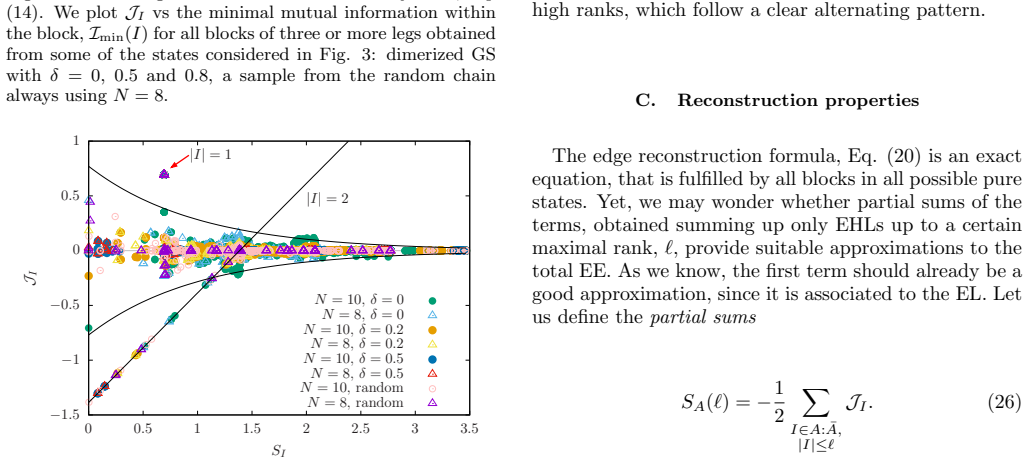
- Numerical evidence on free-fermion ground states supports the factorization and monogamy conjectures: small minimal entropy entails small highest-rank hyperlink, and high block entropy correlates with low internal hyperlink magnitude.
- If the even-legged reconstruction conjecture is correct, the number of independent entanglement quantities matches the 2^{N-1}-1 independent entropies of a pure state, and odd-legged hyperlinks become redundant.
Where Pith is reading between the lines
- The exact boundary-sum identity suggests a direct route to area-law bounds: if one can bound the sum of crossing hyperlinks for a Hamiltonian ground state, one immediately bounds the entropy; the paper does not pursue this, but it is a natural next step.
- The conjectured even-legged reduction implies that all odd-order inclusion–exclusion combinations (odd-legged hyperlinks) are determined by even ones, which would significantly constrain the space of pure-state entropy functions and sharpen the distinction between holographic and generic states.
- One could test the factorization conjecture quantitatively by deriving a Lipschitz-type bound |J_Ω| ≤ C · S_min and checking whether the constant C is universal; the paper only gives a continuity heuristic.
- The observed alternating sign pattern of high-rank hyperlinks in free-fermion chains suggests a possible extension of monogamy constraints to even/odd ranks, testable on holographic states where the entropy cone is known.
Editorial analysis
A structured set of objections, weighed in public.
Referee Report
Summary. The paper introduces entanglement hyperlinks (EHLs), defined by inclusion-exclusion combinations of entanglement entropies over subsets of a multipartite pure state (Eq. 5). The main result is an exact 'edge reconstruction' identity (Eq. 20): the entropy of any block A equals -1/2 times the sum of all EHLs crossing the A-Ā boundary. This is derived from a 'bulk reconstruction' formula (Eq. 18) that is the Möbius inverse of the EHL definition, together with the purity conditions S_Ω=0 and S_A=S_Ā. The paper also proves a factorization theorem (EHLs crossing zero-entropy partitions vanish, Eq. 11), a coarse-graining theorem (Eq. 23), and presents numerical evidence for three conjectures: continuity of factorization (Eqs. 13-14), monogamy (Eq. 15), and an even-legged edge reconstruction with size-independent leg factors (Eq. B2).
Significance. The central claim, Eq. (20), is an exact algebraic identity requiring only purity and standard entropy additivity; it is a rigorous counterpart to the previously approximate link representation. The coarse-graining theorem (Eq. 23) is a clean and useful generalization. The paper is careful to label the even-legged reconstruction and the continuity-based factorization claims as conjectures, supported only by small-system numerics, so the reader can separate established results from speculative extensions. The derivations are parameter-free and the proof sketches in Appendix A are standard. If the conjectures are set aside, the paper provides a sound framework for expressing bipartite entanglement in terms of multipartite correlation measures; the main limitation is that the exact identities, while elegant, are essentially a reorganization of the definitions rather than an independent predictive scheme.
minor comments (6)
- [Appendix A, Eq. (10)] The factorization theorem as stated in Eq. (10) (I(I1,I2)=0 ⇒ J_I=0) is not actually proven in Appendix A. The additivity argument there assumes S_A=0 and proves the corollary Eq. (11). Please add the short proof using S_A = S_{A∩I1} + S_{A∩I2} when the reduced state on I1∪I2 is product.
- [Appendix A, Eq. (23)] The coarse-graining theorem is demonstrated explicitly for K=2 and K=3, with the general case left as 'not hard to write.' Please provide a complete induction or a more formal statement that the general case follows by the same inclusion-exclusion decomposition.
- [Notation, Eqs. (2)-(5)] The symbol J is used for both the approximate entanglement links (Eq. 2) and the EHLs (Eq. 5), with a sign difference. This is confusing; consider using a different symbol (e.g., L_{ij}) for the two-legged links.
- [Figure 2 caption] The caption mislabels the subfigures: three-legged EHLs appear in panels (b) and (c), not (c) and (d); four-legged EHLs appear in (d) and (e). Please correct.
- [Eq. (27)] The notation for the average of S_A(ℓ) is inconsistent: the text refers to \bar{S(ℓ)} but the equation shows S(ℓ) without a bar. Please clarify the definition of the correlation coefficient.
- [Throughout] Minor typos: 'expessions' in Sec. IV; 'informations' in the abstract (should be 'information'); inconsistent spelling of 'Möbius'/'Moebius'. Also, Fig. 3 and Fig. 4 have no error bars for the random-chain data; adding error bars would strengthen the numerical support.
Circularity Check
No significant circularity: central identity is a self-contained Möbius inversion plus purity constraint; conjectures are labeled and non-load-bearing.
full rationale
The central derivation is self-contained. EHLs are defined by the inclusion-exclusion formula, Eq. (5). The bulk reconstruction, Eq. (18), is obtained by the standard Möbius inversion theorem on the Boolean lattice (cited to ref. [16]), not by assuming the target result; it is the exact inverse transform of the definition. The edge reconstruction, Eq. (20), combines Eq. (18) with the pure-state constraints S_Omega=0 and S_A=S_\bar A, and the coarse-graining theorem, Eq. (23), is proved from Eq. (18). No parameter is fitted to force Eq. (20); it is exact for every pure state. The factorization theorem, Eq. (11), depends only on the additivity property (A1) for exactly factorized pure states and a combinatorial cancellation; no external results are load-bearing. The conjectural extensions — the factorization/convergence conjectures Eqs. (13)-(14), the monogamy conjecture Eq. (15), and the even-legged reconstruction Eq. (B2) — are all explicitly labeled as conjectures, are checked numerically rather than asserted as theorems, and are not needed for the main exact identity. Several earlier papers by the same authors are cited for motivation and computational techniques, but none of the central theorems reduces to those citations. No circular step meets the standard of a quoted equation reducing to its own input.
Axiom & Free-Parameter Ledger
free parameters (1)
- Leg-factors Λ_{2l,p} =
Λ_{2,1}=-1/2; Λ_{4,1}=1/4; Λ_{4,2}=1/2; Λ_{6,1}=-1/2; Λ_{6,2}=-1; Λ_{6,3}=-5/4; Λ_{8,1}=17/8; Λ_{8,2}=17/4; Λ_{8,3}=47/8
axioms (3)
- standard math Möbius inversion / inclusion-exclusion for functions on the Boolean lattice
- domain assumption Pure state condition: S_Ω=0 and S_A=S_Ā
- domain assumption Additivity of entropy under a factorized partition (Eq. A1)
invented entities (1)
-
Entanglement hyperlinks (EHLs) J_I
independent evidence
read the original abstract
The entanglement entropy (EE) of any bipartition of a pure state can be approximately expressed as a sum of entanglement links (ELs). In this work, we introduce their exact extension, i.e. the entanglement hyperlinks (EHLs), a type of generalized mutual informations defined through the inclusion-exclusion principle, each of which captures contributions to the multipartite entanglement that are not reducible to lower-order terms. We show that any EHL crossing a factorized partition must vanish, and that the EHLs between any set of blocks can be expressed as a sum of all the EHLs that join all of them. This last result allows us to provide an exact representation of the EE of any block of a pure state, from the sum of the EHLs which cross its boundary. In order to illustrate their rich structure, we discuss some explicit numerical examples using ground states of local Hamiltonians. The EHLs thus provide a remarkable tool to characterize multipartite entanglement in quantum information theory and quantum many-body physics.
Figures




Reference graph
Works this paper leans on
-
[1]
Bulk reconstruction The inclusion-exclusion expression can be straightfor- wardly inverted using the Moebius formula [16]. Let f:P(Ω)→Rbe a real function over all subsets of Ω, and let us define another function g(A) = X B⊆A (−1)|B|−|A|f(B),(16) 4 (a) J13 J14 J15 J23 J24 J25 1 2 3 4 5 (b) J134 J135 J145 J234 J235 J245 1 2 3 4 5 (c) J123 J125 J124 1 2 3 4 ...
-
[2]
Edge reconstruction Since a pure state has zero entropy, we have for any blockAthat 0 = X I JI = X I⊆A JI + X I⊆ ¯A JI + X I∈A: ¯A JI ,(19) i.e. we have decomposed the set of EHLs into three groups: those completely contained inA, those com- pletely contained in ¯A, and thosecrossingthe boundary betweenAand ¯Aand which, therefore, have nonzero in- tersect...
2024
-
[3]
III A, an EHL vanishes whenever it crosses a factorized boundary
F actorization theorems As it was discussed in Sec. III A, an EHL vanishes whenever it crosses a factorized boundary. First of all, we should be aware that, ifS A = 0, then for any other blockBwe have SB =S B∩A +S B∩ ¯A.(A1) Let us now consider an EHLJ I which crosses the boundary betweenAand ¯A, i.e.Ihas non-empty intersections both withAand ¯A. We need ...
-
[4]
Coarse-graining theorem As claimed in the main text, the EHL of a set of coarse-grained blocks within the system may be obtained summing all EHLs of the fine-grained partition which have at least one leg in each of the coarse-grained parties, Eq. (23). Again, this is merely a consequence of the bulk-reconstruction formula, i.e., Moebius inversion formula ...
-
[5]
Adesso, N
G. Adesso, N. Datta, M.J.W. Hall, T. Sagawa,Shannon ’s information theory 70 years on: applications in classical and quantum physics, J. Phys. A: Math. Phys.52, 320201 11 (2019)
2019
-
[6]
M´ ezard, A
M. M´ ezard, A. Montanari,Information, physics and com- putation, Oxford University Press (2009)
2009
-
[7]
Horodecki, P
R. Horodecki, P. Horodecki, M. Horodecki, K. Horodecki, Quantum entanglement, Rev. Mod. Phys.81, 865 (2009)
2009
-
[8]
Horodecki, J
M. Horodecki, J. Oppenheim, A. Winter,Partial quan- tum information, Nature436, 673 (2005)
2005
-
[9]
Singha Roy, S.N
S. Singha Roy, S.N. Santalla, J. Rodr ´ ıguez-Laguna, G. Sierra,Entanglement as geometry and flow, Phys. Rev. B101, 195134 (2020)
2020
-
[10]
Eisert, M
J. Eisert, M. Cramer, M.B. Plenio,Area laws for the entanglement entropy - a review, Rev. Mod. Phys.82, 277 (2010)
2010
-
[11]
Singha Roy, S.N
S. Singha Roy, S.N. Santalla, G. Sierra, J. Rodr ´ ıguez- Laguna,Link representation of the entanglement en- tropies for all bipartitions, J. Phys. A: Math. Theor.54, 305301 (2021)
2021
-
[12]
Santalla, G
S.N. Santalla, G. Ram ´ ırez, S. Singha Roy, G. Sierra, J. Rodr ´ ıguez-Laguna,Entanglement links and the quasipar- ticle picture, Phys. Rev. B107, L121114 (2023)
2023
-
[13]
M. Ma, Y. Li, J. Shang,Multipartite entanglement mea- sures: a review, Fundamental Research5, 2489 (2025)
2025
-
[14]
Kumar,Multiparty quantum mutual information: an alternative definition, Phys
A. Kumar,Multiparty quantum mutual information: an alternative definition, Phys. Rev. A96, 012332 (2017)
2017
-
[15]
Kumar,Family of quantum mutual information in multiparty quantum systems, Phys
A. Kumar,Family of quantum mutual information in multiparty quantum systems, Phys. Lett. A529, 130091 (2024)
2024
-
[16]
Sazim, P
S. Sazim, P. Agrawal,Quantum mutual information and quantumness vectors for multiqubit systems, Quant. Inf. Proc.19, 216 (2020)
2020
-
[17]
Y. Guo, L. Huang,Complete monogamy of multipartite quantum mutual information, Phys. Rev. A107, 042409 (2023)
2023
-
[18]
Q. Han, L. Gou, S. Wang, R. Zhang,Local interaction in- formation and local quantum mutual information in mul- tiparty systems, J. Stat. Phys.192, 52 (2025)
2025
-
[19]
Allenby, A
R.B.J.T. Allenby, A. Slomson,How to count. An in- troduction to Combinatorics, 2nd edition, CRC Press (2011)
2011
-
[20]
Mazur,Combinatorics
D.R. Mazur,Combinatorics. A guided Tour, The Math- ematical Association of America (2010)
2010
-
[21]
McGill,Multivariate information transmission, Psychometrika19, 97 (1954)
W.J. McGill,Multivariate information transmission, Psychometrika19, 97 (1954)
1954
-
[22]
Ting,On the amount of information, Theory Probab
H.K. Ting,On the amount of information, Theory Probab. Appl.7, 439 (1966)
1966
-
[23]
Sakaguchi,Interaction information in multivariate probability distributions, Kodai Math.Sem
M. Sakaguchi,Interaction information in multivariate probability distributions, Kodai Math.Sem. Rep.19, 147 (1967)
1967
-
[24]
Yeung,Information theory and network coding, Springer (2007)
R.W. Yeung,Information theory and network coding, Springer (2007)
2007
-
[25]
LeVine, H
M. LeVine, H. Weinstein,NbIT - A new information theory-based analysis of allosteric mechanisms reveals residues that underlie function in the leucine transporter LeuT, PLOS Comp. Biol.10, e1003603 (2014)
2014
-
[26]
Pandey, S
B. Pandey, S. Sarkar,How much a galaxy knows about its large-scale environment?: An information theoretic perspective, MNRAS467, L6 (2017)
2017
-
[27]
Varley, M
T.F. Varley, M. Pope, J. Faskowitz, O. Sporns,Multivari- ate information theory uncovers synergistic subsystems of the human cerebral cortex, Comm. Biol.6, 451 (2023)
2023
-
[28]
P.L. Williams, R.D. Beer,Nonnegative decomposition of multivariate information, ArXiv:1004.2515 (2010)
Pith/arXiv arXiv 2010
-
[29]
Varley,Information theory for complex systems sci- entists: What, why, and how, Phys
T.F. Varley,Information theory for complex systems sci- entists: What, why, and how, Phys. Rep.1148, 1 (2025)
2025
-
[30]
Kitaev, J
A. Kitaev, J. Preskill,Topological entanglement entropy, Phys. Rev. Lett.96, 110404 (2006)
2006
-
[31]
Dhar, A.K
H.S. Dhar, A.K. Pal, D. Rakshit, A. Sen(De), U. Sen, Monogamy of quantum correlations – a review, in Fran- chini F.F. et al,Lectures on General Quantum Correla- tions and their Applications, Springer (2017)
2017
-
[32]
B. Chen, B. Czech, Z.Z. Wang,Quantum information in holographic duality, Rep. Prog. Phys.85, 046001 (2022)
2022
-
[33]
Takayanagi,Essay: emergent holographic spacetime from quantum information, Phys
T. Takayanagi,Essay: emergent holographic spacetime from quantum information, Phys. Rev. Lett.134, 240001 (2025)
2025
-
[34]
Casini, M
H. Casini, M. Huerta,Remarks on the entanglement en- tropy for disconnected regions, JHEP3, 048 (2009)
2009
-
[35]
Hayden, M
P. Hayden, M. Headrick, A. Maloney,Holographic mutual information is monogamous, Phys. Rev. D87, 046003 (2013)
2013
-
[36]
N. Bao, S. Nezami, H. Ooguri, B. Stoica, J. Sully, M. Walter,The holographic entropy cone, JHEP 2015, 130 (2015)
2015
-
[37]
Mirabi, M
S. Mirabi, M. Reza Tanhayi, R. Vazirian,On the monogamy of holographic n-partite information, Phys. Rev. D93, 104049 (2016)
2016
-
[38]
N. Bao, N. Cheng, S. Hern´ andez-Cuenca, V.P. Su,The quantum entropy cone of hypergraphs, SciPost Phys.9, 067 (2020)
2020
-
[39]
N. Bao, N. Cheng, S. Hern´ andez-Cuenca, V.P. Su,Topo- logical link models of multipartite entanglement, Quan- tum6, 741 (2022)
2022
-
[40]
X.X. Ju, T.Z. Lai, Y.W. Sun, Y.T. Wang,Holographic n-partite information in hyperscaling violating geometry, JHEP8, 064 (2023)
2023
-
[41]
Kvorning, L
T.K. Kvorning, L. Herviou, J.H. Bandarson,Time- evolution of local information: thermalization dynamics of local observables, SciPost Phys.13, 080 (2022)
2022
-
[42]
Artiaco, T.K
C. Artiaco, T.K. Kvorning, D.A. Ch´ avez, L. Herviou, J.H. Bardarson,Universal Characterization of Quantum Many-Body States through Local Information, Phys. Rev. Lett.134, 190401 (2025)
2025
-
[43]
Bauer, B
N.P. Bauer, B. Trauzettel, T.K. Kvorning, J.H. Bardar- son, C. Artiaco,Local Information Flow in Quantum Quench Dynamics, Phys. Rev. A112, 022221 (2025)
2025
- [44]
-
[45]
Both conventions are easily related: the signs of the odd-ranked EHLs coincide, while the even-ranked ones must be changed
We should stress that some references use the opposite convention, making the sign of the single-party entropies positive. Both conventions are easily related: the signs of the odd-ranked EHLs coincide, while the even-ranked ones must be changed
-
[46]
Peschel,Calculation of reduced density matrices from correlation functions,J
I. Peschel,Calculation of reduced density matrices from correlation functions,J. Phys. A36, L205 (2003)
2003
-
[47]
Asb´ oth, L
J. Asb´ oth, L. Oroszl´ any, A. P´ alyi,A short course on topological insulators, Springer (2016)
2016
-
[48]
Ram ´ ırez, J
G. Ram ´ ırez, J. Rodr ´ ıguez-Laguna, G. Sierra,Entangle- ment in low-energy states of the random-hopping model, J. Stat. Mech. P07003 (2014)
2014
discussion (0)
Sign in with ORCID, Apple, or X to comment. Anyone can read and Pith papers without signing in.