REVIEW 4 major objections 6 minor 5 cited by
Metric Anything claims that metric depth estimation finally scales: roughly 20M heterogeneous image-depth pairs produce steady accuracy gains and transfer across depth completion, monocular depth, camera calibration, 3D reconstruction, and
Reviewed by Pith at T0; open to challenge. T0 means a machine referee read the full paper against a public rubric. the ladder, T0–T4 →
T0 review · deepseek-v4-flash
2026-08-03 06:43 UTC pith:NUPJRV7L
load-bearing objection Promising scaling idea for metric depth, but the metricity of the 20M labels is unverified and one hyperparameter is tuned on an evaluation set; deserves a real referee but needs major fixes. the 4 major comments →
MetricAnything: Scaling Metric Depth Pretraining with Noisy Heterogeneous Sources
The pith
A machine-rendered reading of the paper's core claim, the machinery that carries it, and where it could break.
Core claim
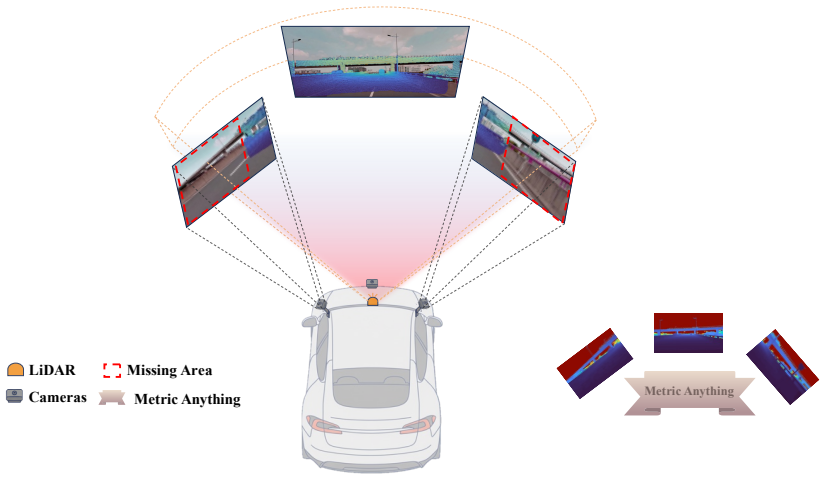
The discovery, on the paper's own terms, is that the heterogeneity and noise that kept metric depth data from scaling can be absorbed by a single universal interface: the Sparse Metric Prompt, a randomly masked depth map. With roughly 20M such image-prompt pairs, the pretrained model exhibits a monotonic improvement in zero-shot accuracy as data grows, and the trend carries through distillation to a prompt-free student. The authors take this as evidence that metric depth estimation obeys the same scaling behavior as relative depth and other vision foundation tasks, and that a single pretrained metric representation can serve depth completion, monocular depth, camera calibration, 3D reconstru
What carries the argument
Sparse Metric Prompt—a depth map randomly subsampled to 2,000-40,000 valid pixels per image (about 1% of pixels), then regularized through pixel-wise depth scale alignment and global metric depth recovery against a prior depth prediction so that all data sources share one input format. The prompt is injected through a lightweight conditioned dense-prediction head (about 5% extra parameters), leaving the vision-transformer backbone untouched. Pretraining uses a robust MAE loss that discards the top 20% largest-error pixels per image to tolerate sensor and reconstruction noise. The teacher is distilled into a prompt-free student with a distance-balanced inverse-depth loss, which keeps near-fie
Load-bearing premise
The claim assumes every aggregated source can be converted to per-pixel metric depth from known calibration and that residual errors are pixel-level noise, because the training loss actively discards the largest-error pixels; if a major source carries a systematic scale or calibration bias, the learned metric scale is corrupted instead of cleaned.
What would settle it
Take one large reconstructed source, multiply all its depth values by a fixed 15% scale, retrain at full data scale, and measure zero-shot relative error on several held-out datasets. If the model's error is sharply worse, the robust loss is absorbing source-level bias rather than pixel noise, and the scaling claim would not hold for arbitrary heterogeneous sources. A lighter version: report per-source residual histograms against a high-precision reference and look for a depth-ratio peak tied to a single source.
If this is right
- Data quality trade-offs shift: a large, noisy, diverse collection can outperform a small clean one for metric depth, so future work can mine existing 3D datasets instead of curating small ones.
- The pretrained prompt-conditional model is usable out of the box for depth completion and super-resolution across different prompt densities and unseen sensors, including radar.
- The distilled student inherits metric scale without prompts, enabling monocular metric depth, focal-length recovery, and monocular 3D point-map prediction in camera-unknown settings.
- The same visual encoder can be reused as a frozen backbone for vision-language models and robot policies, implying metric 3D pretraining is a general spatial representation rather than a task-specific module.
- Zero-shot behavior on unseen camera configurations, night and rainy conditions, and panoramic/fisheye imagery follows directly from learning heterogeneous sources instead of modeling any one sensor.
Where Pith is reading between the lines
- The paper does not audit per-source quality; a direct consequence of its argument is that source diversity, not just raw count, drives the scaling curve, and a per-source diagnostic would reveal whether any single reconstruction corpus dominates the gain.
- Because the student is trained on teacher pseudo-labels from a unified model, the framework implies a self-improving loop—using student outputs as new pseudo-labels and retraining—which the authors do not test but is a natural next step.
- The success with radar, an unseen and extremely sparse sensor, suggests the same interface may extend to other sparse modalities such as event cameras or time-of-flight arrays, a testable prediction.
- The vision-language results imply the encoder stores recoverable metric scale; an untested but plausible extension is using it for egocentric distance estimation in embodied navigation, where fine-grained metric errors may matter more than in the benchmarks shown.
Editorial analysis
A structured set of objections, weighed in public.
Referee Report
Summary. The paper proposes Metric Anything, a pretraining framework for metric depth estimation that aggregates roughly 20M image–depth pairs from reconstructed, captured, and rendered 3D data. The method uses randomly masked depth maps as "Sparse Metric Prompts" to train a depth-conditioned teacher, which is then distilled into a prompt-free student with a distance-balanced inverse-depth loss. The authors claim, for the first time, a clear scaling trend in metric depth pretraining, and report state-of-the-art zero-shot results across depth completion/super-resolution, radar–camera fusion, monocular depth estimation, camera intrinsics recovery, multi-view metric 3D reconstruction, VLA planning, and MLLM spatial reasoning. The paper emphasizes a minimalist, data-driven paradigm with no task-specific prompt engineering.
Significance. If the central claim holds, the paper would establish a valuable scaling route for metric depth estimation, analogous to progress in relative depth. The work is substantial in empirical scope: it aggregates a very large heterogeneous dataset, demonstrates a monotonic trend with data size, and evaluates across many downstream tasks. The paper also ships an open-source release, which is a concrete strength. The main scientific value lies in the scaling claim and in the demonstration that a simple random-mask prompt can unify heterogeneous sources. However, the current evidence for the scaling claim rests on a single benchmark, and at least one hyperparameter appears to have been tuned on an evaluation dataset, which tempers the strength of the reported SOTA results.
major comments (4)
- [Sec. 5.7 / Tab. 15 (right) and Tabs. 5–6] The student-loss hyperparameter C is selected on DIODE (Tab. 15, right), and DIODE also appears as an evaluation benchmark in the monocular geometry estimation tables (Tabs. 5 and 6). This contradicts the strict zero-shot protocol claimed in Sec. 4.2.1, where the six datasets are stated to be unused for hyper-parameter tuning. The DIODE rows in Tabs. 5–6 are therefore not trustworthy as zero-shot results, and the average ranks that include them are inflated. Please retune C on a held-out set disjoint from all evaluation benchmarks, or remove DIODE from the evaluation tables.
- [Sec. 5.1 / Fig. 2a] The central scaling claim is supported only by δ1 accuracy on Middlebury (Fig. 2a), with no error bars, no multiple training runs, and no description of whether the data fractions are nested or independently sampled. A single benchmark without variance does not establish a 'clear scaling trend' robustly, especially given the noise inherent in heterogeneous data. Please report scaling curves on at least two or three benchmarks, include multiple seeds or confidence intervals, and clarify the subset construction.
- [Sec. 3.1 and Eq. (8)] The metric premise of the entire method is asserted but not audited. Section 3.1 includes 'reconstructed 3D data' from SfM, SLAM, MVS, and stereo, whose outputs are not automatically metric; monocular SfM is scale-ambiguous, SLAM can drift, and stereo requires known baselines. The robust MAE loss in Eq. (8) drops only the top-20% per-image largest errors, which cannot correct a coherent per-source scale or offset error. The prompt preparation step (Sec. 3.2) aligns prompts to sampled depth values but does not correct systematic source-level bias in the target G. Please provide a dataset manifest with per-source scale verification, or independent checks (e.g., comparison against LiDAR or known camera trajectories), to substantiate the claim that all 20M pairs are metric along the camera z-axis.
- [Sec. 3.3] The prompt-free student is trained entirely on teacher-generated pseudo-labels. This is circular in the sense that any systematic metric error in the teacher (e.g., from the unverified sources above) is inherited by the student. The student results therefore cannot be used as evidence that the aggregated data are metric. This is not a flaw per se, but it means the student's SOTA numbers do not independently validate the metric premise; they only show consistency with the teacher.
minor comments (6)
- [Sec. 7.3] Typo: 'MoGo-2' should be 'MoGe-2' (the method referenced in [110]).
- [Sec. 5.7] The text refers to 'Eq.14' when describing the balance weight C; the correct reference is Eq. (5).
- [Sec. 9] Typo: 'metric depth trick' should be 'metric depth track.'
- [Sec. 4.2.3] The term 'boundaris' should be 'boundaries' in the section heading and text.
- [Sec. 4.2.6 and Fig. 12] The benchmark is called VSI-Bench in the text and table, but 'VIS Benchmark' appears in Fig. 12; please make the naming consistent.
- [References] Reference [36] and [35] appear to be the same paper; please deduplicate.
Circularity Check
No significant circularity: the central scaling claim is empirically evaluated on external benchmarks and not forced by construction.
full rationale
Whether the ~20M-pair pretraining yields metric depth is an empirical question, and the paper's own evidence is not constructed from its inputs. The teacher is trained directly on aggregated ground-truth depth maps (Eq. 1, Sec. 3.1) with MAE/SSI-MAGE losses; the sparse prompt is a random mask of the target, so no prediction is fitted to an external quantity and then renamed. The reported scaling trend (Fig. 2a) is evaluated zero-shot on Middlebury for models trained on increasing data fractions, and downstream prompt tasks use held-out datasets (NYUv2, ETH3D, KITTI, nuScenes), so the central numbers are externally anchored. The prompt-free student is distilled from teacher pseudo-labels (Sec. 3.3); this is a self-referential training loop, but the paper's central scaling claim is not derived from the student—it comes from the teacher's zero-shot curve. The only self-citation found, See3D [68], is used for auxiliary PDSA/GMDR prompt alignment; it is not a uniqueness theorem or an unvalidated load-bearing reduction, and the same prompt preparation is at most an implementation detail rather than a step that forces the central result. The Limitations section admits the architecture's own scalability is unexplored, which undercuts the breadth of the scaling claim but is not a circularity.
Axiom & Free-Parameter Ledger
free parameters (6)
- Distance-balanced loss hyperparameter C =
400
- Teacher loss weights alpha, beta =
alpha=15, beta=5
- Student loss weights gamma, delta =
gamma=10, delta=2
- Robust MAE top-n drop =
20%
- Sparse prompt sample count N =
2,000-40,000
- Data mix proportions =
unreported
axioms (5)
- domain assumption All aggregated 3D sources can be converted to per-pixel metric depth via known calibration and have valid metric scale.
- domain assumption The pre-trained depth model DepthPro [10] provides a reliable prior P_d for prompt preparation, and PDSA/GMDR preserve metric consistency.
- domain assumption Teacher-generated pseudo-labels are accurate across near and far ranges and do not propagate teacher systematic errors.
- domain assumption Training and evaluation sets have no shared origin, as asserted for the zero-shot protocol.
- ad hoc to paper Random sparse masking provides a universal interface that decouples spatial reasoning from sensor and camera bias.
invented entities (1)
-
Sparse Metric Prompt
no independent evidence
read the original abstract
Scaling has powered recent advances in vision foundation models, yet extending this paradigm to metric depth estimation remains challenging due to heterogeneous sensor noise, camera-dependent biases, and metric ambiguity in noisy cross-source 3D data. We introduce Metric Anything, a simple and scalable pretraining framework that learns metric depth from noisy, diverse 3D sources without manually engineered prompts, camera-specific modeling, or task-specific architectures. Central to our approach is the Sparse Metric Prompt, created by randomly masking depth maps, which serves as a universal interface that decouples spatial reasoning from sensor and camera biases. Using about 20M image-depth pairs spanning reconstructed, captured, and rendered 3D data across 10000 camera models, we demonstrate-for the first time-a clear scaling trend in the metric depth track. The pretrained model excels at prompt-driven tasks such as depth completion, super-resolution and Radar-camera fusion, while its distilled prompt-free student achieves state-of-the-art results on monocular depth estimation, camera intrinsics recovery, single/multi-view metric 3D reconstruction, and VLA planning. We also show that using pretrained ViT of Metric Anything as a visual encoder significantly boosts Multimodal Large Language Model capabilities in spatial intelligence. These results show that metric depth estimation can benefit from the same scaling laws that drive modern foundation models, establishing a new path toward scalable and efficient real-world metric perception. We open-source MetricAnything at http://metric-anything.github.io/metric-anything-io/ to support community research.
Figures




Forward citations
Cited by 5 Pith papers
-
DrivingDepth: Sparse-Prompted Pixel-wise Scale Correction for Driving Depth Estimation
DrivingDepth achieves SOTA metric depth on nuScenes by residual pixel-wise scale correction on frozen foundation models using sparse LiDAR prompts, preserving geometric consistency.
-
Any to Full: Prompting Depth Anything for Depth Completion in One Stage
Any2Full reformulates depth completion as one-stage scale-prompting of a pretrained monocular depth estimator, yielding domain-general, pattern-agnostic dense metric depth with lower error and higher speed than prior methods.
-
SUFLECA: Scaling Up Feature Learning for CAD-to-image Alignment
SUFLECA achieves state-of-the-art single-image CAD-to-image alignment by scaling NOC-supervised feature learning to 674K images and adding geometrically consistent correspondence filtering.
-
X-Lens: Real-Time Metric Depth Estimation with Heterogeneous Cameras
A 0.04B-parameter feed-forward model estimates metric depth from variable calibrated fisheye and pinhole views using calibration tokens and Jacobian distortion bias, with a new multi-view synthetic dataset.
-
X-Lens: Real-Time Metric Depth Estimation with Heterogeneous Cameras
X-Lens fuses arbitrary calibrated fisheye and pinhole views into real-time metric depth at 41 FPS with a 0.04B-parameter model and a new 266K-frame synthetic dataset.
Reference graph
Works this paper leans on
-
[1]
Mapillary planet-scale depth dataset
Manuel López Antequera, Pau Gargallo, Markus Hofinger, Samuel Rota Bulo, Yubin Kuang, and Peter Kontschieder. Mapillary planet-scale depth dataset. InEuropean Conference on Computer Vision, pages 589–604. Springer, 2020
2020
-
[2]
Apollo synthetic dataset, 2019
Baidu Apollo. Apollo synthetic dataset, 2019. Accessed: 2025-6-12
2019
-
[3]
Qwen2.5-vl technical report.ArXiv, abs/2502.13923, 2025
Shuai Bai, Keqin Chen, Xuejing Liu, Jialin Wang, Wenbin Ge, Sibo Song, Kai Dang, Peng Wang, Shijie Wang, Jun Tang, Humen Zhong, Yuanzhi Zhu, Mingkun Yang, Zhaohai Li, Jianqiang Wan, Pengfei Wang, Wei Ding, Zheren Fu, Yiheng Xu, Jiabo Ye, Xi Zhang, Tianbao Xie, Zesen Cheng, Hang Zhang, Zhibo Yang, Haiyang Xu, and Junyang Lin. Qwen2.5-vl technical report.Ar...
Pith/arXiv arXiv 2025
-
[4]
Gilad Baruch, Zhuoyuan Chen, Afshin Dehghan, Tal Dimry, Yuri Feigin, Peter Fu, Thomas Gebauer, Bran- don Joffe, Daniel Kurz, Arik Schwartz, et al. Arkitscenes: A diverse real-world dataset for 3d indoor scene understanding using mobile rgb-d data.arXiv preprint arXiv:2111.08897, 2021
Pith/arXiv arXiv 2021
-
[5]
Uasol, a large-scale high-resolution outdoor stereo dataset.Scientific data, 6(1):162, 2019
Zuria Bauer, Francisco Gomez-Donoso, Edmanuel Cruz, Sergio Orts-Escolano, and Miguel Cazorla. Uasol, a large-scale high-resolution outdoor stereo dataset.Scientific data, 6(1):162, 2019
2019
-
[6]
Adabins: Depth estimation using adaptive bins
Shariq Farooq Bhat, Ibraheem Alhashim, and Peter Wonka. Adabins: Depth estimation using adaptive bins. InProceedings of the IEEE/CVF conference on computer vision and pattern recognition, pages 4009–4018, 2021
2021
-
[7]
Localbins: Improving depth estimation by learning local distributions
Shariq Farooq Bhat, Ibraheem Alhashim, and Peter Wonka. Localbins: Improving depth estimation by learning local distributions. InEuropean Conference on Computer Vision, pages 480–496. Springer, 2022
2022
-
[8]
Zoedepth: Zero-shot transfer by combining relative and metric depth, 2023
Shariq Farooq Bhat, Reiner Birkl, Diana Wofk, Peter Wonka, and Matthias Müller. Zoedepth: Zero-shot transfer by combining relative and metric depth, 2023
2023
-
[9]
Vineet Bhat, Yu-Hsiang Lan, Prashanth Krishnamurthy, Ramesh Karri, and Farshad Khorrami. 3d cavla: Leveraging depth and 3d context to generalize vision language action models for unseen tasks.arXiv preprint arXiv:2505.05800, 2025
arXiv 2025
-
[10]
Richter, and Vladlen Koltun
Aleksei Bochkovskii, Amaël Delaunoy, Hugo Germain, Marcel Santos, Yichao Zhou, Stephan R. Richter, and Vladlen Koltun. Depth pro: Sharp monocular metric depth in less than a second. InInternational Conference on Learning Representations, 2025. 33
2025
-
[11]
A naturalistic open source movie for optical flow evaluation
Daniel J Butler, Jonas Wulff, Garrett B Stanley, and Michael J Black. A naturalistic open source movie for optical flow evaluation. InEuropean conference on computer vision, pages 611–625. Springer, 2012
2012
-
[12]
nuscenes: A multimodal dataset for autonomous driving
Holger Caesar, Varun Bankiti, Alex H Lang, Sourabh V ora, Venice Erin Liong, Qiang Xu, Anush Krishnan, Yu Pan, Giancarlo Baldan, and Oscar Beijbom. nuscenes: A multimodal dataset for autonomous driving. In Proceedings of the IEEE/CVF conference on computer vision and pattern recognition, pages 11621–11631, 2020
2020
-
[13]
Worldvla: Towards autoregressive action world model.arXiv preprint arXiv:2506.21539, 2025
Jun Cen, Chaohui Yu, Hangjie Yuan, Yuming Jiang, Siteng Huang, Jiayan Guo, Xin Li, Yibing Song, Hao Luo, Fan Wang, et al. Worldvla: Towards autoregressive action world model.arXiv preprint arXiv:2506.21539, 2025
Pith/arXiv arXiv 2025
-
[14]
Matterport3d: Learning from rgb-d data in indoor environments
Angel Chang, Angela Dai, Thomas Funkhouser, Maciej Halber, Matthias Niessner, Manolis Savva, Shuran Song, Andy Zeng, and Yinda Zhang. Matterport3d: Learning from rgb-d data in indoor environments. International Conference on 3D Vision (3DV), 2017
2017
-
[15]
Single-image depth perception in the wild.Advances in neural information processing systems, 29, 2016
Weifeng Chen, Zhao Fu, Dawei Yang, and Jia Deng. Single-image depth perception in the wild.Advances in neural information processing systems, 29, 2016
2016
-
[16]
Oasis: A large- scale dataset for single image 3d in the wild
Weifeng Chen, Shengyi Qian, David Fan, Noriyuki Kojima, Max Hamilton, and Jia Deng. Oasis: A large- scale dataset for single image 3d in the wild. InProceedings of the IEEE/CVF Conference on Computer Vision and Pattern Recognition (CVPR), June 2020
2020
-
[17]
Internvl: Scaling up vision foundation models and aligning for generic visual- linguistic tasks
Zhe Chen, Jiannan Wu, Wenhai Wang, Weijie Su, Guo Chen, Sen Xing, Muyan Zhong, Qinglong Zhang, Xizhou Zhu, Lewei Lu, et al. Internvl: Scaling up vision foundation models and aligning for generic visual- linguistic tasks. InProceedings of the IEEE/CVF Conference on Computer Vision and Pattern Recognition, pages 24185–24198, 2024
2024
-
[18]
Cspn++: Learning context and resource aware convolutional spatial propagation networks for depth completion
Xinjing Cheng, Peng Wang, Chenye Guan, and Ruigang Yang. Cspn++: Learning context and resource aware convolutional spatial propagation networks for depth completion. InAAAI, 2020
2020
-
[19]
Learning depth with convolutional spatial propagation network.TPAMI, 2019
Xinjing Cheng, Peng Wang, and Ruigang Yang. Learning depth with convolutional spatial propagation network.TPAMI, 2019
2019
-
[20]
The cityscapes dataset for semantic urban scene understanding
Marius Cordts, Mohamed Omran, Sebastian Ramos, Timo Rehfeld, Markus Enzweiler, Rodrigo Benenson, Uwe Franke, Stefan Roth, and Bernt Schiele. The cityscapes dataset for semantic urban scene understanding. InProceedings of the IEEE conference on computer vision and pattern recognition, pages 3213–3223, 2016
2016
-
[21]
Scannet: Richly-annotated 3d reconstructions of indoor scenes
Angela Dai, Angel X Chang, Manolis Savva, Maciej Halber, Thomas Funkhouser, and Matthias Nießner. Scannet: Richly-annotated 3d reconstructions of indoor scenes. InProceedings of the IEEE conference on computer vision and pattern recognition, pages 5828–5839, 2017
2017
-
[22]
Fu, Stefano Ermon, Atri Rudra, and Christopher Ré
Tri Dao, Daniel Y . Fu, Stefano Ermon, Atri Rudra, and Christopher Ré. FlashAttention: Fast and memory-efficient exact attention with IO-awareness. InAdvances in Neural Information Processing Systems (NeurIPS), 2022
2022
-
[23]
An image is worth 16x16 words: Transformers for image recognition at scale.ICLR, 2021
Alexey Dosovitskiy, Lucas Beyer, Alexander Kolesnikov, Dirk Weissenborn, Xiaohua Zhai, Thomas Un- terthiner, Mostafa Dehghani, Matthias Minderer, Georg Heigold, Sylvain Gelly, Jakob Uszkoreit, and Neil Houlsby. An image is worth 16x16 words: Transformers for image recognition at scale.ICLR, 2021
2021
-
[24]
Predicting depth, surface normals and semantic labels with a common multi- scale convolutional architecture
David Eigen and Rob Fergus. Predicting depth, surface normals and semantic labels with a common multi- scale convolutional architecture. InProceedings of the IEEE international conference on computer vision, pages 2650–2658, 2015
2015
-
[25]
Depth map prediction from a single image using a multi- scale deep network.Advances in neural information processing systems, 27, 2014
David Eigen, Christian Puhrsch, and Rob Fergus. Depth map prediction from a single image using a multi- scale deep network.Advances in neural information processing systems, 27, 2014
2014
-
[26]
Mid-air: A multi-modal dataset for extremely low altitude drone flights
Michael Fonder and Marc Van Droogenbroeck. Mid-air: A multi-modal dataset for extremely low altitude drone flights. InProceedings of the IEEE/CVF conference on computer vision and pattern recognition workshops, pages 0–0, 2019
2019
-
[27]
Deep ordinal regres- sion network for monocular depth estimation
Huan Fu, Mingming Gong, Chaohui Wang, Kayhan Batmanghelich, and Dacheng Tao. Deep ordinal regres- sion network for monocular depth estimation. InProceedings of the IEEE conference on computer vision and pattern recognition, pages 2002–2011, 2018
2002
-
[28]
Virtual worlds as proxy for multi-object tracking analysis
Adrien Gaidon, Qiao Wang, Yohann Cabon, and Eleonora Vig. Virtual worlds as proxy for multi-object tracking analysis. InProceedings of the IEEE conference on computer vision and pattern recognition, pages 4340–4349, 2016
2016
-
[29]
R4dyn: Exploring radar for self-supervised monocular depth estimation of dynamic scenes
Stefano Gasperini, Patrick Koch, Vinzenz Dallabetta, Nassir Navab, Benjamin Busam, and Federico Tombari. R4dyn: Exploring radar for self-supervised monocular depth estimation of dynamic scenes. In 2021 International Conference on 3D Vision (3DV), pages 751–760. IEEE, 2021. 34
2021
-
[30]
Dsec: A stereo event camera dataset for driving scenarios.IEEE Robotics and Automation Letters, 6(3):4947–4954, 2021
Mathias Gehrig, Willem Aarents, Daniel Gehrig, and Davide Scaramuzza. Dsec: A stereo event camera dataset for driving scenarios.IEEE Robotics and Automation Letters, 6(3):4947–4954, 2021
2021
-
[31]
Are we ready for autonomous driving.The KITTI vision benchmark suite
A Geiger, P Lenz, and R Urtasun. Are we ready for autonomous driving.The KITTI vision benchmark suite. InCVPR, 2:5, 2012
2012
-
[32]
Digging into self-supervised monocular depth estimation
Clément Godard, Oisin Mac Aodha, Michael Firman, and Gabriel J Brostow. Digging into self-supervised monocular depth estimation. InProceedings of the IEEE/CVF international conference on computer vision, pages 3828–3838, 2019
2019
-
[33]
All for one, and one for all: Urbansyn dataset, the third musketeer of synthetic driving scenes.Neurocomputing, 637:130038, 2025
Jose L Gómez, Manuel Silva, Antonio Seoane, Agnès Borrás, Mario Noriega, Germán Ros, Jose A Iglesias- Guitian, and Antonio M López. All for one, and one for all: Urbansyn dataset, the third musketeer of synthetic driving scenes.Neurocomputing, 637:130038, 2025
2025
-
[34]
3d packing for self- supervised monocular depth estimation
Vitor Guizilini, Rares Ambrus, Sudeep Pillai, Allan Raventos, and Adrien Gaidon. 3d packing for self- supervised monocular depth estimation. InProceedings of the IEEE/CVF conference on computer vision and pattern recognition, pages 2485–2494, 2020
2020
-
[36]
Towards zero-shot scale- aware monocular depth estimation
Vitor Guizilini, Igor Vasiljevic, Dian Chen, Rares , Ambrus, , and Adrien Gaidon. Towards zero-shot scale- aware monocular depth estimation. InProceedings of the IEEE/CVF International Conference on Computer Vision, pages 9233–9243, 2023
2023
-
[37]
John Houston, Guido Zuidhof, Luca Bergamini, Yawei Ye, Long Chen, Ashesh Jain, Sammy Omari, Vladimir Iglovikov, and Peter Ondruska. One thousand and one hours: Self-driving motion prediction dataset.arXiv preprint arXiv:2006.14480, 2020
Pith/arXiv arXiv 2006
-
[38]
Mu Hu, Wei Yin, Chi Zhang, Zhipeng Cai, Xiaoxiao Long, Hao Chen, Kaixuan Wang, Gang Yu, Chunhua Shen, and Shaojie Shen. Metric3d v2: A versatile monocular geometric foundation model for zero-shot met- ric depth and surface normal estimation.IEEE Transactions on Pattern Analysis and Machine Intelligence, 2024
2024
-
[39]
Chi-Pin Huang, Yueh-Hua Wu, Min-Hung Chen, Yu-Chiang Frank Wang, and Fu-En Yang. Thinkact: Vision-language-action reasoning via reinforced visual latent planning.arXiv preprint arXiv:2507.16815, 2025
Pith/arXiv arXiv 2025
-
[40]
Deepmvs: Learning multi-view stereopsis
Po-Han Huang, Kevin Matzen, Johannes Kopf, Narendra Ahuja, and Jia-Bin Huang. Deepmvs: Learning multi-view stereopsis. InProceedings of the IEEE conference on computer vision and pattern recognition, pages 2821–2830, 2018
2018
-
[41]
Chia-Yu Hung, Qi Sun, Pengfei Hong, Amir Zadeh, Chuan Li, U Tan, Navonil Majumder, Soujanya Poria, et al. Nora: A small open-sourced generalist vision language action model for embodied tasks.arXiv preprint arXiv:2504.19854, 2025
Pith/arXiv arXiv 2025
-
[42]
Gpt-4o system card.arXiv preprint arXiv:2410.21276, 2024
Aaron Hurst, Adam Lerer, Adam P Goucher, Adam Perelman, Aditya Ramesh, Aidan Clark, AJ Ostrow, Akila Welihinda, Alan Hayes, Alec Radford, et al. Gpt-4o system card.arXiv preprint arXiv:2410.21276, 2024
Pith/arXiv arXiv 2024
-
[43]
Perspective fields for single image camera calibration
Linyi Jin, Jianming Zhang, Yannick Hold-Geoffroy, Oliver Wang, Kevin Blackburn-Matzen, Matthew Sticha, and David F Fouhey. Perspective fields for single image camera calibration. InProceedings of the IEEE/CVF Conference on Computer Vision and Pattern Recognition, pages 17307–17316, 2023
2023
-
[44]
Repurposing diffusion-based image generators for monocular depth estimation
Bingxin Ke, Anton Obukhov, Shengyu Huang, Nando Metzger, Rodrigo Caye Daudt, and Konrad Schindler. Repurposing diffusion-based image generators for monocular depth estimation. InProceedings of the IEEE/CVF Conference on Computer Vision and Pattern Recognition, pages 9492–9502, 2024
2024
-
[45]
MapA- nything: Universal feed-forward metric 3D reconstruction, 2025
Nikhil Keetha, Norman Müller, Johannes Schönberger, Lorenzo Porzi, Yuchen Zhang, Tobias Fischer, Arno Knapitsch, Duncan Zauss, Ethan Weber, Nelson Antunes, Jonathon Luiten, Manuel Lopez-Antequera, Samuel Rota Bulò, Christian Richardt, Deva Ramanan, Sebastian Scherer, and Peter Kontschieder. MapA- nything: Universal feed-forward metric 3D reconstruction, 2...
Pith/arXiv arXiv 2025
-
[46]
Openvla: An open-source vision-language-action model.arXiv preprint arXiv:2406.09246, 2024
Moo Jin Kim, Karl Pertsch, Siddharth Karamcheti, Ted Xiao, Ashwin Balakrishna, Suraj Nair, Rafael Rafailov, Ethan Foster, Grace Lam, Pannag Sanketi, et al. Openvla: An open-source vision-language-action model.arXiv preprint arXiv:2406.09246, 2024
Pith/arXiv arXiv 2024
-
[47]
Segment anything
Alexander Kirillov, Eric Mintun, Nikhila Ravi, Hanzi Mao, Chloe Rolland, Laura Gustafson, Tete Xiao, Spencer Whitehead, Alexander C Berg, Wan-Yen Lo, et al. Segment anything. InProceedings of the IEEE/CVF international conference on computer vision, pages 4015–4026, 2023. 35
2023
-
[48]
Evaluation of cnn-based single- image depth estimation methods
Tobias Koch, Lukas Liebel, Friedrich Fraundorfer, and Marco Korner. Evaluation of cnn-based single- image depth estimation methods. InProceedings of the European Conference on Computer Vision (ECCV) Workshops, pages 0–0, 2018
2018
-
[49]
Pulling things out of perspective
Lubor Ladicky, Jianbo Shi, and Marc Pollefeys. Pulling things out of perspective. InProceedings of the IEEE conference on computer vision and pattern recognition, pages 89–96, 2014
2014
-
[50]
Deeper depth prediction with fully convolutional residual networks
Iro Laina, Christian Rupprecht, Vasileios Belagiannis, Federico Tombari, and Nassir Navab. Deeper depth prediction with fully convolutional residual networks. In2016 Fourth international conference on 3D vision (3DV), pages 239–248. IEEE, 2016
2016
-
[51]
Molmoact: Action reasoning models that can reason in space.arXiv preprint arXiv:2508.07917, 2025
Jason Lee, Jiafei Duan, Haoquan Fang, Yuquan Deng, Shuo Liu, Boyang Li, Bohan Fang, Jieyu Zhang, Yi Ru Wang, Sangho Lee, et al. Molmoact: Action reasoning models that can reason in space.arXiv preprint arXiv:2508.07917, 2025
Pith/arXiv arXiv 2025
-
[52]
Grounding image matching in 3d with mast3r
Vincent Leroy, Yohann Cabon, and Jérôme Revaud. Grounding image matching in 3d with mast3r. In European Conference on Computer Vision, pages 71–91. Springer, 2024
2024
-
[53]
Llava-onevision: Easy visual task transfer.arXiv preprint arXiv:2408.03326, 2024
Bo Li, Yuanhan Zhang, Dong Guo, Renrui Zhang, Feng Li, Hao Zhang, Kaichen Zhang, Yanwei Li, Ziwei Liu, and Chunyuan Li. Llava-onevision: Easy visual task transfer.arXiv preprint arXiv:2408.03326, 2024
Pith/arXiv arXiv 2024
-
[54]
Radarcam-depth: Radar-camera fusion for depth estimation with learned metric scale
Han Li, Yukai Ma, Yaqing Gu, Kewei Hu, Yong Liu, and Xingxing Zuo. Radarcam-depth: Radar-camera fusion for depth estimation with learned metric scale. In2024 IEEE International Conference on Robotics and Automation (ICRA), pages 10665–10672. IEEE, 2024
2024
-
[55]
Sparse beats dense: Rethinking supervision in radar-camera depth completion
Huadong Li, Minhao Jing, Wang Jin, Shichao Dong, Jiajun Liang, Haoqiang Fan, and Renhe Ji. Sparse beats dense: Rethinking supervision in radar-camera depth completion. InEuropean Conference on Computer Vision, pages 127–143. Springer, 2024
2024
-
[56]
Matrixcity: A large-scale city dataset for city-scale neural rendering and beyond
Yixuan Li, Lihan Jiang, Linning Xu, Yuanbo Xiangli, Zhenzhi Wang, Dahua Lin, and Bo Dai. Matrixcity: A large-scale city dataset for city-scale neural rendering and beyond. InProceedings of the IEEE/CVF International Conference on Computer Vision, pages 3205–3215, 2023
2023
-
[57]
Megadepth: Learning single-view depth prediction from internet photos
Zhengqi Li and Noah Snavely. Megadepth: Learning single-view depth prediction from internet photos. In Proceedings of the IEEE conference on computer vision and pattern recognition, pages 2041–2050, 2018
2041
-
[58]
Patchfusion: An end-to-end tile-based framework for high-resolution monocular metric depth estimation
Zhenyu Li, Shariq Farooq Bhat, and Peter Wonka. Patchfusion: An end-to-end tile-based framework for high-resolution monocular metric depth estimation. InProceedings of the IEEE/CVF Conference on Com- puter Vision and Pattern Recognition, pages 10016–10025, 2024
2024
-
[59]
Chen, Zhenyu Li, Guang Shi, Jiashi Feng, and Bingyi Kang
Haotong Lin, Sili Chen, Jun Hao Liew, Donny Y . Chen, Zhenyu Li, Guang Shi, Jiashi Feng, and Bingyi Kang. Depth anything 3: Recovering the visual space from any views.arXiv preprint arXiv:2511.10647, 2025
Pith/arXiv arXiv 2025
-
[60]
Prompting depth anything for 4k resolution accurate metric depth estimation
Haotong Lin, Sida Peng, Jingxiao Chen, Songyou Peng, Jiaming Sun, Minghuan Liu, Hujun Bao, Jiashi Feng, Xiaowei Zhou, and Bingyi Kang. Prompting depth anything for 4k resolution accurate metric depth estimation. InCVPR, 2025
2025
-
[61]
Vila: On pre-training for visual language models.2024 IEEE/CVF Conference on Computer Vision and Pattern Recognition (CVPR), pages 26679–26689, 2023
Ji Lin, Hongxu Yin, Wei Ping, Yao Lu, Pavlo Molchanov, Andrew Tao, Huizi Mao, Jan Kautz, Mohammad Shoeybi, and Song Han. Vila: On pre-training for visual language models.2024 IEEE/CVF Conference on Computer Vision and Pattern Recognition (CVPR), pages 26679–26689, 2023
2024
-
[62]
Depth estimation from monocular images and sparse radar data
Juan-Ting Lin, Dengxin Dai, and Luc Van Gool. Depth estimation from monocular images and sparse radar data. in 2020 ieee. InRSJ International Conference on Intelligent Robots and Systems (IROS), pages 10233–10240, 2020
2020
-
[63]
Libero: Bench- marking knowledge transfer for lifelong robot learning.Advances in Neural Information Processing Sys- tems, 36:44776–44791, 2023
Bo Liu, Yifeng Zhu, Chongkai Gao, Yihao Feng, Qiang Liu, Yuke Zhu, and Peter Stone. Libero: Bench- marking knowledge transfer for lifelong robot learning.Advances in Neural Information Processing Sys- tems, 36:44776–44791, 2023
2023
-
[64]
Depthlab: From partial to complete.arXiv preprint arXiv:2412.18153, 2024
Zhiheng Liu, Ka Leong Cheng, Qiuyu Wang, Shuzhe Wang, Hao Ouyang, Bin Tan, Kai Zhu, Yujun Shen, Qifeng Chen, and Ping Luo. Depthlab: From partial to complete.arXiv preprint arXiv:2412.18153, 2024
arXiv 2024
-
[65]
Depth estimation from monocular images and sparse radar using deep ordinal regression network
Chen-Chou Lo and Patrick Vandewalle. Depth estimation from monocular images and sparse radar using deep ordinal regression network. In2021 IEEE International Conference on Image Processing (ICIP), pages 3343–3347. IEEE, 2021
2021
-
[66]
Rcdpt: Radar-camera fusion dense prediction transformer
Chen-Chou Lo and Patrick Vandewalle. Rcdpt: Radar-camera fusion dense prediction transformer. In ICASSP 2023-2023 IEEE International Conference on Acoustics, Speech and Signal Processing (ICASSP), pages 1–5. IEEE, 2023. 36
2023
-
[67]
Radar-camera pixel depth association for depth completion
Yunfei Long, Daniel Morris, Xiaoming Liu, Marcos Castro, Punarjay Chakravarty, and Praveen Narayanan. Radar-camera pixel depth association for depth completion. InProceedings of the IEEE/CVF Conference on Computer Vision and Pattern Recognition, pages 12507–12516, 2021
2021
-
[68]
You see it, you got it: Learning 3d creation on pose-free videos at scale
Baorui Ma, Huachen Gao, Haoge Deng, Zhengxiong Luo, Tiejun Huang, Lulu Tang, and Xinlong Wang. You see it, you got it: Learning 3d creation on pose-free videos at scale. InProceedings of the Computer Vision and Pattern Recognition Conference, pages 2016–2029, 2025
2016
-
[69]
Spring: A high- resolution high-detail dataset and benchmark for scene flow, optical flow and stereo
Lukas Mehl, Jenny Schmalfuss, Azin Jahedi, Yaroslava Nalivayko, and Andrés Bruhn. Spring: A high- resolution high-detail dataset and benchmark for scene flow, optical flow and stereo. InProceedings of the IEEE/CVF Conference on Computer Vision and Pattern Recognition, pages 4981–4991, 2023
2023
-
[70]
Dinov2: Learning robust visual features without supervision.arXiv preprint arXiv:2304.07193, 2023
Maxime Oquab, Timothée Darcet, Théo Moutakanni, Huy V o, Marc Szafraniec, Vasil Khalidov, Pierre Fernandez, Daniel Haziza, Francisco Massa, Alaaeldin El-Nouby, et al. Dinov2: Learning robust visual features without supervision.arXiv preprint arXiv:2304.07193, 2023
Pith/arXiv arXiv 2023
-
[71]
Depth prompting for sensor-agnostic depth estimation
Jin-Hwi Park, Chanhwi Jeong, Junoh Lee, and Hae-Gon Jeon. Depth prompting for sensor-agnostic depth estimation. InCVPR, 2024
2024
-
[72]
Scalable diffusion models with transformers
William Peebles and Saining Xie. Scalable diffusion models with transformers. InProceedings of the IEEE/CVF international conference on computer vision, pages 4195–4205, 2023
2023
-
[73]
Karl Pertsch, Kyle Stachowicz, Brian Ichter, Danny Driess, Suraj Nair, Quan Vuong, Oier Mees, Chelsea Finn, and Sergey Levine. Fast: Efficient action tokenization for vision-language-action models.arXiv preprint arXiv:2501.09747, 2025
Pith/arXiv arXiv 2025
-
[74]
Luigi Piccinelli, Christos Sakaridis, Yung-Hsu Yang, Mattia Segu, Siyuan Li, Wim Abbeloos, and Luc Van Gool. Unidepthv2: Universal monocular metric depth estimation made simpler.arXiv preprint arXiv:2502.20110, 2025
Pith/arXiv arXiv 2025
-
[75]
Unidepth: Universal monocular metric depth estimation
Luigi Piccinelli, Yung-Hsu Yang, Christos Sakaridis, Mattia Segu, Siyuan Li, Luc Van Gool, and Fisher Yu. Unidepth: Universal monocular metric depth estimation. InProceedings of the IEEE/CVF Conference on Computer Vision and Pattern Recognition, pages 10106–10116, 2024
2024
-
[76]
Spatialvla: Exploring spatial representations for visual-language-action model
Delin Qu, Haoming Song, Qizhi Chen, Yuanqi Yao, Xinyi Ye, Yan Ding, Zhigang Wang, JiaYuan Gu, Bin Zhao, Dong Wang, et al. Spatialvla: Exploring spatial representations for visual-language-action model. arXiv preprint arXiv:2501.15830, 2025
Pith/arXiv arXiv 2025
-
[77]
Learning transferable visual models from natural language supervision
Alec Radford, Jong Wook Kim, Chris Hallacy, Aditya Ramesh, Gabriel Goh, Sandhini Agarwal, Girish Sastry, Amanda Askell, Pamela Mishkin, Jack Clark, et al. Learning transferable visual models from natural language supervision. InInternational conference on machine learning, pages 8748–8763. PmLR, 2021
2021
-
[78]
Santhosh K Ramakrishnan, Aaron Gokaslan, Erik Wijmans, Oleksandr Maksymets, Alex Clegg, John Turner, Eric Undersander, Wojciech Galuba, Andrew Westbury, Angel X Chang, et al. Habitat-matterport 3d dataset (hm3d): 1000 large-scale 3d environments for embodied ai.arXiv preprint arXiv:2109.08238, 2021
Pith/arXiv arXiv 2021
-
[79]
Zero-shot text-to-image generation
Aditya Ramesh, Mikhail Pavlov, Gabriel Goh, Scott Gray, Chelsea V oss, Alec Radford, Mark Chen, and Ilya Sutskever. Zero-shot text-to-image generation. InInternational conference on machine learning, pages 8821–8831. Pmlr, 2021
2021
-
[80]
Booster: a benchmark for depth from images of specular and transparent surfaces.IEEE Transactions on Pattern Analysis and Machine Intelligence, 46(1):85–102, 2023
Pierluigi Zama Ramirez, Alex Costanzino, Fabio Tosi, Matteo Poggi, Samuele Salti, Stefano Mattoccia, and Luigi Di Stefano. Booster: a benchmark for depth from images of specular and transparent surfaces.IEEE Transactions on Pattern Analysis and Machine Intelligence, 46(1):85–102, 2023
2023
-
[81]
Vision transformers for dense prediction
René Ranftl, Alexey Bochkovskiy, and Vladlen Koltun. Vision transformers for dense prediction. InPro- ceedings of the IEEE/CVF international conference on computer vision, pages 12179–12188, 2021
2021
discussion (0)
Sign in with ORCID, Apple, or X to comment. Anyone can read and Pith papers without signing in.