REVIEW 4 major objections 5 minor 1 cited by
Deliberately corrupted video features, used as contrast during decoding, reduce hallucinated outputs from frozen video-language models.
Reviewed by Pith at T0; open to challenge. T0 means a machine referee read the full paper against a public rubric. the ladder, T0–T4 →
T0 review · deepseek-v4-flash
2026-08-03 06:31 UTC pith:KY6JLRFO
load-bearing objection The full-text SSCD method is a plausible new idea that deserves scrutiny, but the abstract doesn't match the body, the key mechanism is unvalidated, and the lack of error bars/code makes the empirical claims provisional. the 4 major comments →
Enhancing Video Representations with Spatiotemporal-Semantic Residual to Mitigate Hallucinations in Video Large Multimodal Models
The pith
A machine-rendered reading of the paper's core claim, the machinery that carries it, and where it could break.
Core claim
The paper's central discovery is that a trained residual perturbation can convert a faithful video representation into a 'hallucination-prone' one, and that this negative representation is a useful control signal: subtracting its logits during decoding removes hallucinated content while keeping grounded content. The authors formalize hallucination-proneness in two ways. First, they break spatiotemporal consistency by minimizing a random-walk cycle-consistency score over a graph of video tokens, deliberately making cross-frame transitions less predictable. Second, they break semantic consistency by minimizing conditional mutual information between the perturbed visual tokens and the ground-tr
What carries the argument
The Spatiotemporal-Semantic Disruptor (SSD) is the load-bearing component: a small MLP that outputs a residual added to frozen video features. Training optimizes a combined loss: (1) a spatiotemporal disruption loss, computed as the average log cycle-consistency score of palindromic random walks on the spatiotemporal graph (Eq. 10-11), which the paper minimizes to weaken long-range self-consistency; and (2) a semantic disruption loss, the negative log-likelihood of the ground-truth answer under the negative features (Eq. 12-15), standing in for conditional mutual information. At inference, the trained disruptor produces negative features in one forward pass; contrastive decoding (Eq. 17-19)
Load-bearing premise
The whole scheme rests on the assumption that the cycle-consistency and conditional-mutual-information objectives produce negative features that are specifically 'hallucination-prone' in a way that matters to the LLM—if they only add arbitrary noise, the contrastive decoding might still appear to work but the explanation would be wrong.
What would settle it
Train the disruptor with the two loss terms replaced by random Gaussian noise or by frame shuffling, while keeping the same contrastive decoding. If hallucination reduction on a held-out benchmark stays at the same level, the learned spatiotemporal and semantic objectives are not the operative cause of the improvement.
If this is right
- Frozen video-LLMs can be made less hallucination-prone by adding a small trainable residual disruptor and switching to contrastive decoding, without any modification to the backbone or its training data.
- Because the negative features come from the same forward pass (a single extra lightweight MLP), the method avoids the multi-sample or extra-forward-pass latency of prior contrastive-decoding interventions.
- On the two backbones tested, the method either improves or roughly preserves performance on general QA and reasoning benchmarks, suggesting hallucination reduction need not come at the cost of overall capability.
- The two objectives are complementary rather than redundant: ablations show spatiotemporal disruption alone gives a clear gain, and adding semantic disruption yields a further improvement on event-level hallucination benchmarks.
- If the characterization is right, 'hallucination-prone features' are not a pathology of the LLM alone but a manipulable property of the video representation, opening a new axis for diagnosis and control.
Where Pith is reading between the lines
- The paper does not prove that low cycle-consistency specifically corresponds to hallucination; a testable extension would compare the learned disruptor against simpler corruptions (frame shuffling, Gaussian noise, feature dropout) to see whether the random-walk objective is doing the work or whether any strong perturbation suffices.
- The semantic disruption term requires ground-truth answers during training; a natural extension is to train with only the question or with self-generated answers, and check whether the hallucination-mitigation effect survives, which would determine how much supervision the method really needs.
- The contrastive strength is tuned separately per backbone and the paper notes sensitivity to it; an adaptive schedule that scales the strength by, say, the model's uncertainty or the divergence between the two distributions could make the method more portable across architectures and tasks.
- The method's success raises the possibility that similar residual-disruption contrastive decoding could be applied to other failure modes (e.g., object hallucination in images, or temporal ordering errors) by defining the right consistency objective for that modality.
Editorial analysis
A structured set of objections, weighed in public.
Referee Report
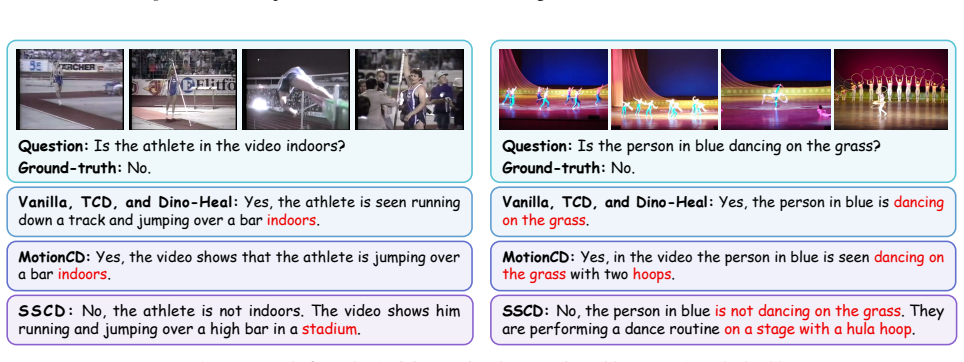
Summary. The paper proposes SSCD (also called ViSSRes in the abstract), a decoding-time intervention for Video Large Multimodal Models. A lightweight residual disruptor is trained on ShareGPT4Video captions to produce negative video features by (i) minimizing a random-walk cycle-consistency score that is intended to break spatiotemporal coherence and (ii) minimizing the conditional mutual information / log-likelihood of the correct answer under the negative features to weaken semantic alignment. At inference, the logits from these negative features are subtracted from the original logits under an adaptive plausibility constraint (Eqs. 17–19). Experiments on VideoHallucer, EventHallusion, VideoHallu, ActivityNet-QA, and MMVU compare against TCD, MotionCD, and Dino-Heal, reporting overall improvements on hallucination benchmarks and mixed results on general understanding benchmarks.
Significance. If the mechanism is valid, the approach offers a promising lightweight, frozen-backbone intervention for reducing video hallucination without retraining the VLM. The paper includes evaluations on multiple standard benchmarks and ablates the two disruption objectives. A strength is that the disruptor is trained on external captions and tested on separate benchmarks, so the design is not circular in the strong sense. However, the core hypothesis that disrupting spatiotemporal cycle consistency produces features that induce hallucinations is not empirically validated, and the reported results are weakened by hyperparameter selection on the same benchmarks used for final evaluation and by the absence of statistical confidence measures.
major comments (4)
- [§4.1, Eq. 10–11] The central premise is that low cycle-consistency in the random-walk objective corresponds to hallucination-prone video features, but no theoretical or empirical evidence supports this. The paper never shows that minimizing the palindromic walk return probability degrades visual information in a way that induces hallucinations, as opposed to simply adding noise. The ablation in Table 4 is ambiguous: on LLaVA-NeXT, adding S1 alone improves Overall by only 2.2 points (48.7→50.9) and actually lowers Entire (46.5→44.7). A control condition with generic feature corruption (e.g., Gaussian noise or frame shuffling) is needed to attribute the gain to spatiotemporal disruption rather than residual perturbation.
- [§5.1 and Figures 2–3] Hyperparameters λ, α, and β are selected through ablations on MMVU (Direct subset) and EventHallusion, which are exactly the benchmarks reported in the final results (Tables 1 and 3). This constitutes tuning on the evaluation sets and can inflate the reported gains. The authors should either use a separate validation set (e.g., a held-out split of the training data or a different benchmark) or demonstrate that the results are stable across a range of hyperparameter values without choosing the best on the evaluation benchmarks. At minimum, the hyperparameter selection procedure must be disclosed as a limitation.
- [Abstract vs. full text] The abstract claims that the method 'reduces the hallucination rate of LLaVA-NeXT-Video on EventHallusion by 40.69% and improves video understanding on MMVU by 18.36% under the CoT setting.' These numbers do not appear anywhere in the full text. Table 1 shows EventHallusion Overall for LLaVA-NeXT-Video moving from 48.7 to 51.3 (an absolute improvement of 2.6 points, or roughly 5% relative on the hallucination rate), and Table 3 shows MMVU CoT moving from 30.5 to 30.1 (a decrease). The abstract also claims 'a single forward pass' at inference, but Eq. 17–19 explicitly require evaluating the LLM on both the original and negative visual features, i.e., two forward passes. These discrepancies must be corrected or thoroughly explained.
- [§5.2, Tables 1–3] No error bars, confidence intervals, or significance tests are reported. Many differences are small (e.g., Table 3: LLaVA-NeXT ActivityNet-QA Accuracy 53.3 vs. 53.3; MMVU Direct 31.3 vs. 31.1). Because the disruptor training involves stochastic optimization, results should be reported over multiple random seeds (at least 3) with mean and standard deviation. Without this, it is not possible to assess whether the observed improvements are reliable or within noise.
minor comments (5)
- [General] The method name is inconsistent: the abstract and the provided arXiv title use 'ViSSRes', while the full manuscript uses 'SSCD'. Please harmonize the terminology and ensure the title matches the manuscript content.
- [Figure 2] The caption and y-axis label refer to 'Overall Accuracy', but the plot is for the direct multiple-choice subset of MMVU; clarify the exact metric and setting.
- [§2.1] The citation 'Gao et al., 2025b' (the first author's own work on mental manipulation detection) seems out of place in the related work on video LLMs; consider replacing it with a more representative reference for LLM backbones.
- [§4.2, Eq. 15] The semantic disruption loss minimizes the log-likelihood of the correct answer. If the negative features become very poor, the probability can saturate near zero, potentially causing numerical instability or vanishing gradients. Please discuss or add a small floor.
- [Table 1] There are formatting issues, such as missing spaces in several rows (e.g., '9.526.0' and '29.859.644.1'). Please correct the typesetting.
Circularity Check
No circular derivation; only an incidental non-load-bearing self-citation and validation caveats.
full rationale
The derivation chain is not circular. The disruptor M is trained on 3,000 random ShareGPT4Video instances with two objectives: the spatiotemporal cycle-consistency loss L_T (Eq. 11) and the semantic negative-log-likelihood loss L_S (Eq. 15), while the LLM backbone and projector are frozen. Evaluation is performed on disjoint external benchmarks (VideoHallucer, EventHallusion, VideoHallu, ActivityNet-QA, MMVU); no benchmark label is used to fit the disruptor. Eq. 15 trains negative features to reduce p_theta(Y | Z_v^neg) for the ground-truth caption, and Eq. 17 subtracts those negative logits during decoding; this is the designed mechanism of contrastive decoding, not a tautology, because the reported hallucination reductions are empirical outcomes that could have failed. The weakest point is Section 4.1's assertion that low cycle-consistency 'steer[s] them toward hallucination-prone states during decoding'—this is an unvalidated proxy assumption and a correctness risk, but not a circular reduction, since no equation forces the benchmark improvement. A further validation concern is that alpha and beta are ablated on EventHallusion (Figure 3) and then used in the Table 1 results, which is test-set hyperparameter selection rather than constructional circularity. The only self-citation (Gao et al., 2025b in Section 2.1) is an incidental reference in a general list of LLM works and is not load-bearing. There is no imported uniqueness theorem, no ansatz smuggled through self-citation, and no renaming of a known result as a derivation. The abstract's claimed 40.69% and 18.36% improvements do not obviously match Tables 1 and 3, but that is a reporting/correctness issue, not circularity.
Axiom & Free-Parameter Ledger
free parameters (5)
- τ (transition temperature, Eq. 7) =
0.07
- λ (loss weight, Eq. 16) =
5
- α (contrastive strength, Eq. 17) =
0.8 for Video-LLaVA, 0.4 for LLaVA-NeXT
- β (plausibility truncation, Eq. 18) =
0.1
- learning rate =
1e-6 (Video-LLaVA), 5e-6 (LLaVA-NeXT)
axioms (5)
- ad hoc to paper Disrupting spatiotemporal cycle consistency of video features yields negative features that induce hallucinations.
- domain assumption Minimizing the frozen LLM's log-likelihood of the ground-truth answer under negative features approximates minimizing conditional mutual information.
- domain assumption Contrastive decoding with a plausibility constraint suppresses hallucinated tokens without degrading general abilities.
- domain assumption A Markov random walk over frame-level token affinities faithfully models the spatiotemporal consistency that matters for hallucination.
- domain assumption A disruptor trained to lower the likelihood of training captions will disrupt semantic alignment for unseen questions.
invented entities (2)
-
Spatiotemporal-Semantic Disruptor (M)
no independent evidence
-
Negative video features H_v^neg
no independent evidence
read the original abstract
Although Video Large Multimodal Models have achieved strong performance in video understanding, they still suffer from hallucination. Existing inference-time intervention methods usually modify videos under the contrastive decoding framework, but their heuristic designs bring limited improvements and increase inference latency. To address these issues, we propose ViSSRes, an inference-time intervention method that enhances video representations through a lightweight MLP-style network. Specifically, we use a contrastive random walk approach to characterize the spatiotemporal consistency of video representations, and introduce conditional mutual information to associate video representations with the model's semantic understanding. With the model backbone kept frozen, ViSSRes learns residuals for video representations and optimizes them from both spatiotemporal and semantic consistency perspectives. During inference, ViSSRes requires only a single forward pass and introduces no substantial additional inference cost. Experiments show that ViSSRes reduces the hallucination rate of LLaVA-NeXT-Video on EventHallusion by 40.69% and improves video understanding on MMVU by 18.36% under the CoT setting, demonstrating its effectiveness in mitigating hallucinations.
Figures



Forward citations
Cited by 1 Pith paper
-
Tracking the Truth: Object-Centric Spatio-Temporal Monitoring for Video Large Language Models
STEMO-Bench evaluates intermediate spatio-temporal reasoning in video MLLMs via object-centric facts, and STEMO-Track improves consistency by chunk-wise trajectory construction and aggregation.
Reference graph
Works this paper leans on
-
[4]
Fang, H., Zhou, C., Kong, J., Gao, K., Chen, B., Liang, T., Ma, G., and Xia, S.-T. Grounding language with vision: A conditional mutual information calibrated decoding strat- egy for reducing hallucinations in lvlms.arXiv preprint arXiv:2505.19678,
-
[5]
Gao, H., Qu, J., Tang, J., Bi, B., Liu, Y ., Chen, H., Liang, L., Su, L., and Huang, Q. Exploring hallucination of large multimodal models in video understanding: Benchmark, analysis and mitigation.arXiv preprint arXiv:2503.19622, 2025a. Gao, P., Han, J., Zhang, R., Lin, Z., Geng, S., Zhou, A., Zhang, W., Lu, P., He, C., Yue, X., et al. Llama-adapter v2: ...
-
[6]
Gao, Y ., Bao, H., Zhang, T., Li, B., Wang, Z., and Chen, W. Mentalmac: Enhancing large language models for detect- ing mental manipulation via multi-task anti-curriculum distillation.arXiv preprint arXiv:2505.15255, 2025b. Gunjal, A., Yin, J., and Bas, E. Detecting and prevent- ing hallucinations in large vision language models. In Proceedings of the AAA...
-
[7]
Huang, H., Chen, H., Wu, S., Luo, M., Fu, J., Du, X., Zhang, H., and Fei, H. Vistadpo: Video hierarchical spatial-temporal direct preference optimization for large video models.arXiv preprint arXiv:2504.13122,
-
[8]
H., Jo, Y ., and Seo, M
Lee, S., Park, S. H., Jo, Y ., and Seo, M. V olcano: Mitigating multimodal hallucination through self-feedback guided revision. In2024 Conference of the North American Chapter of the Association for Computational Linguistics: Human Language Technologies, NAACL 2024, pp. 391–
2024
-
[10]
Mitigating hallucination in large multi-modal models via robust instruction tuning
Liu, F., Lin, K., Li, L., Wang, J., Yacoob, Y ., and Wang, L. Mitigating hallucination in large multi-modal models via robust instruction tuning. InThe Twelfth International Conference on Learning Representations, 2024a. Liu, Y ., Li, S., Liu, Y ., Wang, Y ., Ren, S., Li, L., Chen, S., Sun, X., and Hou, L. Tempcompass: Do video llms really understand vide...
Pith/arXiv arXiv 2024
-
[11]
Poppi, T., Uzkent, B., Garg, A., Porto, L., Kessler, G., Yang, Y ., Cornia, M., Baraldi, L., Cucchiara, R., and Schiffers, F. Countervid: Counterfactual video generation for mitigat- ing action and temporal hallucinations in video-language models.arXiv preprint arXiv:2601.04778,
-
[12]
Sun, Y ., Zhang, M., Li, F., Hong, G., and Yang, M. Smart- sight: Mitigating hallucination in video-llms without com- promising video understanding via temporal attention collapse.arXiv preprint arXiv:2512.18671,
-
[14]
Wang, Y ., Wang, Y ., Zhao, D., Xie, C., and Zheng, Z. Videohallucer: Evaluating intrinsic and extrinsic halluci- nations in large video-language models.arXiv preprint arXiv:2406.16338,
-
[15]
Wu, C.-H., Chang, K.-P., Sheng, Y .-Y ., Chung, H.-K., Wang, K.-C., and Wang, Y .-C. F. Season: Mitigating temporal hallucination in video large language models via self-diagnostic contrastive decoding.arXiv preprint arXiv:2512.04643, 2025a. 10 Mitigating Hallucinations in Video Large Language Models via Spatiotemporal-Semantic Contrastive Decoding Wu, Z....
-
[17]
Yuan, J., Cui, Z., Wang, H., Gao, Y ., Zhou, Y ., and Naseem, U. Kardia-r1: Unleashing llms to reason to- ward understanding and empathy for emotional support via rubric-as-judge reinforcement learning.arXiv preprint arXiv:2512.01282, 2025a. Yuan, J., Du, D., Zhang, H., Di, Z., and Naseem, U. Re- versal of thought: Enhancing large language models with pre...
-
[18]
Video-llama: An instruction- tuned audio-visual language model for video understand- ing
Zhang, H., Li, X., and Bing, L. Video-llama: An instruction- tuned audio-visual language model for video understand- ing. InProceedings of the 2023 Conference on Empir- ical Methods in Natural Language Processing: System Demonstrations, pp. 543–553,
2023
-
[19]
Eventhallusion: Diagnosing event hallucinations in video llms.arXiv preprint arXiv:2409.16597, 2024a
Zhang, J., Jiao, Y ., Chen, S., Zhao, N., Tan, Z., Li, H., and Chen, J. Eventhallusion: Diagnosing event hallucinations in video llms.arXiv preprint arXiv:2409.16597, 2024a. Zhang, S., Fang, Q., Yang, Z., and Feng, Y . Llava-mini: Effi- cient image and video large multimodal models with one vision token. InThe Thirteenth International Conference on Learni...
-
[20]
j., Gui, L., Fu, D., Feng, J., Liu, Z., and Li, C
Zhang, Y ., Li, B., Liu, h., Lee, Y . j., Gui, L., Fu, D., Feng, J., Liu, Z., and Li, C. Llava-next: A strong zero-shot video understanding model, April 2024b. URL https://llava-vl.github.io/ blog/2024-04-30-llava-next-video/. Zhao, S., Wang, Y ., Yang, Z., and Cai, D. Region mutual information loss for semantic segmentation.Advances in Neural Information...
2024
-
[21]
Zhao, S., Yuan, J., Wu, J., Wang, Z., Yang, G., and Naseem, U. Can pruning improve reasoning? revisiting long-cot compression with capability in mind for better reasoning. arXiv preprint arXiv:2505.14582, 2025a. Zhao, Y ., Zhang, H., Xie, L., Hu, T., Gan, G., Long, Y ., Hu, Z., Chen, W., Li, C., Xu, Z., Wang, C., Shangguan, Z., Liang, Z., Liu, Y ., Zhao, ...
-
[22]
Layernorm Linear GeLU Linear GeLU Linear Tanh Layernorm Linear GeLU Linear GeLU Linear Tanh Figure 6.Overview of the architecture of SSD
Notably, this learnable component constitutes only a small portion of the VideoLLM’s total parameters, resulting in minimal computational overhead. Layernorm Linear GeLU Linear GeLU Linear Tanh Layernorm Linear GeLU Linear GeLU Linear Tanh Figure 6.Overview of the architecture of SSD. B. Evaluation and Benchmarks VideoHallucer EvaluationVideoHallucer comp...
2024
-
[2017]
Wang, H., Wang, S., Zhong, Y ., Yang, Z., Wang, J., Cui, Z., Yuan, J., Han, Y ., Liu, M., and Ma, Y . Affordance- r1: Reinforcement learning for generalizable affordance reasoning in multimodal large language model.arXiv preprint arXiv:2508.06206,
-
[2019]
Helpd: Mitigating hallucination of lvlms by hierarchical feedback learning with vision-enhanced penalty decoding
Yuan, F., Qin, C., Xu, X., and Li, P. Helpd: Mitigating hallucination of lvlms by hierarchical feedback learning with vision-enhanced penalty decoding. InProceedings of the 2024 Conference on Empirical Methods in Natural Language Processing, pp. 1768–1785,
2024
-
[2022]
Li, Z., Shi, H., Gao, Y ., Liu, D., Wang, Z., Chen, Y ., Liu, T., Zhao, L., Wang, H., and Metaxas, D. N. The hidden life of tokens: Reducing hallucination of large vision-language models via visual information steering. InForty-second International Conference on Machine Learning, 2025b. Li, Z., Wu, X., Shi, G., Qin, Y ., Du, H., Liu, F., Zhou, T., Manocha...
2024
-
[2023]
Cai, J., Zhou, W., Zhang, Z., Hong, J., Zhan, N., and Li, H. Mitigating hallucination in videollms via temporal-aware activation engineering.arXiv preprint arXiv:2505.12826,
-
[2024]
Chen, W., Yan, X., Wen, B., Yang, F., Gao, T., Zhang, D., and Chen, L. Decoupling contrastive decoding: Robust hallucination mitigation in multimodal large language models.arXiv preprint arXiv:2504.08809,
-
[2025]
Ding, X., Zhang, K., Han, J., Hong, L., Xu, H., and Li, X. Pami-vdpo: Mitigating video hallucinations by prompt- aware multi-instance video preference learning.arXiv preprint arXiv:2504.05810,
discussion (0)
Sign in with ORCID, Apple, or X to comment. Anyone can read and Pith papers without signing in.