REVIEW 4 major objections 5 minor 1 cited by
MEnvAgent automates construction of verifiable, executable test environments across ten programming languages, beating the strongest baseline on quality while using 43% less time.
Reviewed by Pith at T0; open to challenge. T0 means a machine referee read the full paper against a public rubric. the ladder, T0–T4 →
An automated multi-agent pipeline constructs and reuses executable Docker environments for verifiable software-engineering tasks across 10 languages, and fine-tuning on its 3,005-task dataset improves several code models.
T0 review reviewed 2026-08-03 challenge →
load-bearing objection The environment-construction work is genuinely useful, but the SFT utility claim is not yet believable until the decontamination footnote becomes an actual overlap analysis. the 4 major comments →
MEnvAgent: Scalable Polyglot Environment Construction for Verifiable Software Engineering
The pith
A machine-rendered reading of the paper's core claim, the machinery that carries it, and where it could break.
The reading
Core claim
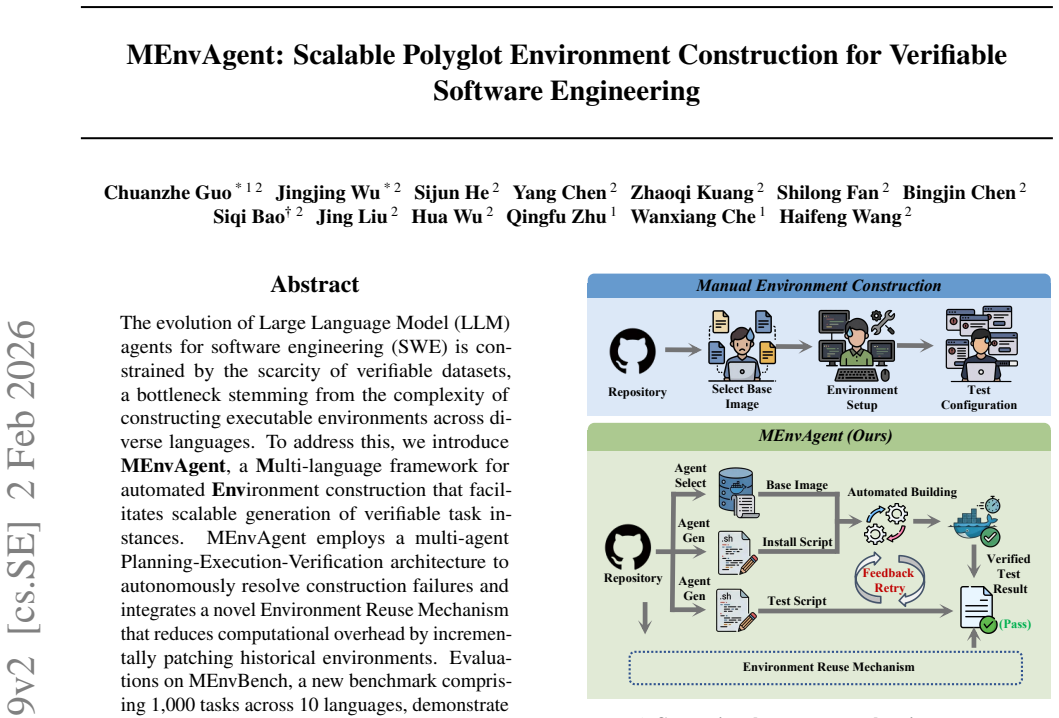
The central claim is that environment construction is an automatable, scalable engineering task, not a manual craft. Formally, given a repository snapshot, an issue, and a fix-plus-test patch, the goal is to find a base image, a build process, and a test configuration satisfying a Fail-to-Pass criterion: the unfixed repository fails the tests, the fixed repository passes them. MEnvAgent turns this into a closed loop of specialized agents that draft a build plan, execute it in a container, diagnose failures, and iterate, and it adds an Environment Reuse Mechanism that retrieves the most compatible historical environment and synthesizes incremental patch commands to adapt it. Evaluated on MEnv
What carries the argument
The load-bearing mechanism is the pairing of a multi-agent Planning-Execution-Verification loop with an Environment Reuse Mechanism. The loop uses four roles—repository analysis, environment setup, test configuration, and execution/verification—to formulate a build script, run it in a container, attribute failures to missing dependencies or bad test commands, and feed diagnostics back to planning for another iteration. The reuse mechanism maintains a pool of verified environments, retrieves the most similar one by version consistency (preferring the exact repository version, then the nearest newer environment on the assumption of backward compatibility), and has an EnvPatch agent generate an
Load-bearing premise
The training-data utility claim — that the reported performance gains come from the dataset itself — rests on the assumption that MEnvData-SWE does not overlap with the evaluation benchmarks; the paper states that a git-log manipulation issue was rectified to prevent leakage, but it does not describe the rectification or any contamination audit.
What would settle it
Cross-reference MEnvData-SWE instance IDs and base-commit hashes against the evaluation benchmark instances; if a nontrivial fraction overlap, the SFT gains do not demonstrate transfer to unseen tasks. Alternatively, re-run the exact SFT recipe on a purge of MEnvData-SWE with all such overlaps removed and re-evaluate — if the gains disappear, the leakage explanation wins.
If this is right
- Verifiable environment construction stops being the manual, Python-centric bottleneck; the same pipeline can generate executable SWE tasks in Go, Rust, Java, JavaScript, and five more languages.
- The reuse mechanism's benefit compounds with scale: reuse success rises from near zero to 39% as the per-repository pool grows from 1 to 10 instances, so builders become cheaper as they run longer.
- Execution-verified multilingual trajectories are a sufficient training signal: fine-tuning on them yields consistent resolved-rate gains across dense and MoE model families, not just one architecture.
- A 1,000-task, 10-language execution-based benchmark now exists to compare environment-construction frameworks directly on F2P, PASS, and time cost.
- If the training data holds up, the distinction between synthetic mutation-based datasets and real issue-PR data blurs: real issues plus a cheap automated builder can supply large-scale verification signals without manual curation.
Where Pith is reading between the lines
- The 8.6% F2P edge is measured on MEnvBench, whose 20 repositories per language were sampled from the same pool that populates the reuse pool; an independent third-party run on freshly collected repositories (post-dataset) would test whether the advantage reflects the mechanism or benefits from construction history shared with the evaluation set.
- The backward-compatibility heuristic (newer environment supports older dependencies) may degrade for ecosystems with frequent breaking changes, such as fast-moving JavaScript/npm toolchains; comparing per-language reuse success would reveal where the assumption holds.
- The SFT recipe uses only ~4k trajectories and a 128k context window; if decontamination holds, this is cheap enough to suggest a routine loop—build environments, collect trajectories, fine-tune, re-evaluate—potentially replacing larger synthetic-data pipelines. This is an inference, not a claim in the paper.
- The Fail-to-Pass criterion verifies environment correctness, but it does not verify that the task itself is well-specified for an agent (e.g., ambiguous issue text); a natural extension is to combine MEnvAgent with an LLM-based issue-quality filter to score task solvability before building.
Editorial analysis
A structured set of objections, weighed in public.
Referee Report
Summary. The paper proposes MEnvAgent, a multi-agent Planning-Execution-Verification framework that automatically constructs executable Docker environments for repository-level software-engineering tasks. The task is formalized as finding a (base image, build script, test configuration) triple that satisfies a Fail-to-Pass (F2P) criterion. The paper introduces MEnvBench, a 1,000-task, 10-language benchmark; reports that MEnvAgent improves F2P by 8.6% and reduces time cost by 43% relative to SWE-Factory; and constructs MEnvData-SWE, a 3,005-instance polyglot dataset with 3,872 trajectories. Fine-tuning on those trajectories yields consistent gains on SWE-bench Verified and SWE-bench Multilingual.
Significance. If the headline empirical claims hold, this is a substantial contribution: automated polyglot environment construction with a reuse mechanism could lower the cost of building verifiable SWE benchmarks and training data. The paper has notable strengths: the F2P verification protocol is explicit, evaluation is execution-based, the reuse ablation is informative, per-language and cost breakdowns are provided, and the code/benchmark/dataset are promised publicly. However, two load-bearing issues currently prevent the claims from being accepted: the strongest baseline comparison is against a SWE-Factory variant whose 10-language extension is unexplained, and the SFT utility claim rests on missing decontamination evidence. These are correctable within the manuscript's scope, so the paper warrants a major revision rather than rejection.
major comments (4)
- [§5, Table 2; §7; Table 12] The SWE-Factory baseline is described in Related Work as supporting four programming languages, yet Table 9 reports it on all 10 MEnvBench languages, and Table 12 lists it with only one language. No extension, adapter, or per-language configuration is described. Because the headline 8.6% F2P gain and 43% time reduction are measured against this baseline, the comparison is load-bearing. Please provide the exact code/config used to run SWE-Factory on the six non-original languages, or restrict headline conclusions to its supported subset.
- [§6.3, Table 4, Table 11, footnote 1] The SFT utility claim is not protected from train/evaluation contamination. MEnvData-SWE contains 477 Python instances from 192 Python repositories (Table 11), and SWE-bench Verified is drawn from popular Python repositories. The footnote about fixing a 'git log manipulation issue' addresses an evaluation-harness concern, not overlap between MEnvData-SWE training trajectories and SWE-bench evaluation tasks. The reported gains (e.g., Qwen2.5-Coder-32B from 7.5% to 54.6% on SWE-bench Verified) could partly reflect memorization if any training instance shares a repository, issue, or proximal commit with an evaluation task. Please report a repo/issue/commit-level overlap analysis and a deduplication procedure; if residual overlap remains, retrain or explicitly caveat the results.
- [§5, Table 2] All construction experiments use a single temperature-0.5 run with no repeated trials, confidence intervals, or order-effect analysis. The reuse mechanism's time cost depends on the accumulation order of the environment pool, so the reported 3574s vs 6266s average may be order-sensitive. The headline F2P and time figures should be accompanied by variance estimates or a stated justification for why run-to-run variation is negligible.
- [§3.2, Eq. (4), Algorithm 1] The reuse mechanism is underspecified at the point where a historical environment Ssim is adapted to a new repository snapshot R. Eq. (4) assumes the final state Snew contains the target snapshot, but the paper does not define how the repository code in Ssim is checked out, replaced, or combined with the incremental dependency patch ΔP. The case study (Fig. 7) only adds a dependency and does not exercise a version change across snapshots, although MEnvBench explicitly includes tasks from distinct historical versions (Sec. 4.2). Please specify the environment state representation and the exact operations performed by EnvPatchAgent to bring the target repository snapshot into the reused environment.
minor comments (5)
- [Appendix D.2, Fig. 8] The issue-quality prompt says that a solution that cannot be implemented should receive a score no higher than 5, but the pipeline retains instances with score ≥5. This means a 5-scored unimplementable issue survives the filter. Clarify the effective threshold or adjust the scoring rule.
- [References and §A.1] 'SWE-bench Multilingual (Yang et al., 2025c)' points to the SWE-Smith paper, and SWE-Smith is referenced twice as Yang et al. 2025b and 2025c. Please correct the citation mapping and remove the duplication.
- [§6.3 and Appendix G] The rejection-sampling protocol for trajectory collection is not described: number of rollout attempts per instance, selection criteria, and filtering steps are needed for reproducibility.
- [Fig. 3] The x-axis labels repeat in each subplot and the overlapping text makes the scatter plots difficult to read. Consider a single legend and clearer per-language markers.
- [Appendix G.6] The text says training uses 'approximately 4k instances' while Table 11 reports 3,872 trajectories. State the exact number used and whether multiple trajectories per instance were included.
Circularity Check
No significant circularity: the central environment-construction and SFT-utility claims are evaluated against execution-based benchmarks and external baselines; the only flagged limitation (data-leakage footnote) is a contamination concern, not a circular derivation.
full rationale
Reviewing the claimed derivation chain, I find no step that reduces to its own inputs. The central comparison (Table 2, Section 5) measures MEnvAgent and baselines on MEnvBench, whose task contexts are sampled from GitHub issue-PR pairs (Sections 4.1-4.2, Appendix D) and evaluated with execution-based PASS/F2P criteria (Eqs. 1-2); the F2P criterion is the objective of the environment-construction task, not a fitted parameter, and nothing in the paper states that MEnvBench environments were built by MEnvAgent itself. The reuse-mechanism ablation (Section 6.1, Table 3, Figure 4) isolates components against a scratch baseline and reports measured time and pass rates, again an empirical comparison rather than a definitional equivalence. The SFT utility claim (Section 6.3, Table 4) is validated on external benchmarks (SWE-bench Verified and SWE-bench Multilingual), so the reported gains are not a self-fulfilling fit to MEnvData-SWE. No load-bearing self-citations appear: SWE-Factory (Guo et al., 2025) is cited as an external baseline, and its author list does not overlap with the present paper's authors. The only notable limitation is Footnote 1's 'git log manipulation issue' for data leakage, which is a contamination concern (no overlap audit or deduplication procedure is provided) rather than circularity: even if residual overlap inflated the SFT numbers, that would be data leakage, not a derivation that equals its inputs. Accordingly, the score is 0.
Axiom & Free-Parameter Ledger
free parameters (4)
- Issue quality threshold =
5
- Maximum construction iterations =
5
- MEnvBench sampling density =
5 instances per repository (10 languages x 20 repositories)
- Candidate pool filters =
>1,000 stars; >200 forks/issues/PRs; >60% primary language
axioms (5)
- domain assumption Backward compatibility: newer verified environments support older dependencies, so retrieving the newest environment for a repository minimizes adaptation cost.
- domain assumption F2P executability (Eq. 2) is sufficient for task validity: tests are assumed non-flaky and faithfully encode the issue.
- domain assumption Extracted test_patch and fix_patch from issue-linked PRs correctly represent the issue's failure and resolution.
- domain assumption LLM-based issue quality scoring (DeepSeek-V3.2) with threshold 5 reliably identifies solvable, unambiguous issues.
- ad hoc to paper The authors' git-log rectification fully removed data leakage between MEnvData-SWE and SWE-bench evaluation sets.
Cite this review
Pith. "Pith review of MEnvAgent: Scalable Polyglot Environment Construction for Verifiable Software Engineering." pith.science (2026). https://pith.science/paper/V4L6R3ZO
@misc{pith2026260122859,
  author       = {Pith},
  title        = {Pith review of: MEnvAgent: Scalable Polyglot Environment Construction for Verifiable Software Engineering},
  year         = {2026},
  howpublished = {\url{https://pith.science/paper/V4L6R3ZO}},
  note         = {Machine review of arXiv:2601.22859}
}
read the original abstract
The evolution of Large Language Model (LLM) agents for software engineering (SWE) is constrained by the scarcity of verifiable datasets, a bottleneck stemming from the complexity of constructing executable environments across diverse languages. To address this, we introduce MEnvAgent, a Multi-language framework for automated Environment construction that facilitates scalable generation of verifiable task instances. MEnvAgent employs a multi-agent Planning-Execution-Verification architecture to autonomously resolve construction failures and integrates a novel Environment Reuse Mechanism that reduces computational overhead by incrementally patching historical environments. Evaluations on MEnvBench, a new benchmark comprising 1,000 tasks across 10 languages, demonstrate that MEnvAgent outperforms baselines, improving Fail-to-Pass (F2P) rates by 8.6% while reducing time costs by 43%. Additionally, we demonstrate the utility of MEnvAgent by constructing MEnvData-SWE, the largest open-source polyglot dataset of realistic verifiable Docker environments to date, alongside solution trajectories that enable consistent performance gains on SWE tasks across a wide range of models. Our code, benchmark, and dataset are available at https://github.com/ernie-research/MEnvAgent.
Figures


Forward citations
Cited by 1 Pith paper
-
From Question Answering to Task Completion: A Survey on Agent System and Harness Design
Survey framing LLM agents as model-plus-harness systems, decomposing harness responsibilities, mapping them to tasks, and highlighting open challenges in evaluation, safety, and co-evolution.
Reference graph
Works this paper leans on
-
[1]
Project Summary:From Repository Analysis Agent
-
[2]
Build Plan:Selected Base Image (B) and the complete Setup Script (P) containing installation commands
Feedback:Diagnosis from Verification Agent (in retry loops). Build Plan:Selected Base Image (B) and the complete Setup Script (P) containing installation commands. Test Configuration Agent 1. Project Summary:To identify test frameworks
-
[3]
URL https: //aclanthology.org/2025.acl-long.839/
doi: 10.18653/v1/2025.acl-long.839. URL https: //aclanthology.org/2025.acl-long.839/. Milliken, L., Kang, S., and Yoo, S. Beyond pip install: Eval- uating llm agents for the automated installation of python projects. In2025 IEEE International Conference on Soft- ware Analysis, Evolution and Reengineering (SANER), pp. 1–11. IEEE, 2025. OpenAI. Introducing ...
arXiv 2025
-
[5]
Association for Computational Linguistics. ISBN 979-8-89176-256-5. doi: 10.18653/v1/2025.findings-acl
-
[7]
URL https://openreview.net/forum? id=MhBZzkz4h9. Zeng, A., Lv, X., Zheng, Q., Hou, Z., Chen, B., Xie, C., Wang, C., Yin, D., Zeng, H., Zhang, J., et al. Glm-4.5: Agentic, reasoning, and coding (arc) foundation models. arXiv preprint arXiv:2508.06471, 2025. Zhang, K., Li, J., Li, G., Shi, X., and Jin, Z. Codeagent: Enhancing code generation with tool-integ...
Pith/arXiv arXiv 2025
-
[10]
Setup Script (P):To align test commands with installed binaries
-
[11]
Test Script (T ):Executable commands to trigger the repository’s test suite, including necessary environment variables
Feedback:Diagnosis from Verification Agent (in retry loops). Test Script (T ):Executable commands to trigger the repository’s test suite, including necessary environment variables. Environment Execution Agent
-
[12]
Base Image (B):Docker image context
-
[13]
Runtime Environment (S):A built container instance (if successful)
Setup Script (P):Commands to execute. Runtime Environment (S):A built container instance (if successful). Execution Logs: stdout/stderr streams (if failed). Verification Agent 1. Environment (S):The built container
-
[14]
Test Script (T):Commands to validate correctness
-
[15]
Result:Boolean success status
-
[16]
Missing Dependency
Diagnosis:Error attribution report (e.g., “Missing Dependency”) used as Feedback for planning agents. EnvPatchAgent (Reuse Mechanism)
-
[17]
Target Repository (R)
-
[18]
Similar Env (Ssim):Retrieved historical env
-
[19]
error category
Feedback:From verification failure inS sim. Incremental Patch (∆P):A sequence of commands to adaptS sim to satisfyR’s requirements. D. MEnvBench Construction Details To ensure the high quality and reproducibility of MEnvBench, we implemented a rigorous data acquisition pipeline. This pipeline, which also serves as the foundation for the MEnvData-SWE datas...
-
[20]
(2) Lack of reproduction steps: No operation flow or runnable code to reproduce the issue
Major Deductions (Violating any item results in a 5-point deduction): • Key Information Missing:(1) Lack of expected results: No description of correct behavior/output; for data processing, missing input examples and expected/error outputs. (2) Lack of reproduction steps: No operation flow or runnable code to reproduce the issue. (3) Missing version info:...
-
[21]
category
Common Deductions (Deduct points based on severity): • Unclear Description:(1) Mixed problems: Single Issue contains multiple unrelated problems or logical contradictions. (2) Undefined terminology: Uses unexplained jargon or abbreviations. (3) Unquantified requirements: Uses vague descriptions (e.g., ”reasonable defaults”, ”user-friendly”, ”faster”) with...
2018
-
[22]
The outcome must be aFailure, confirming that the reported issue is reproducible within the environment
Reproduction Phase (Fail):The test script is executed in the environment with only theTest Patchapplied (simulating the buggy state). The outcome must be aFailure, confirming that the reported issue is reproducible within the environment
-
[23]
The outcome must be aSuccess, confirming that the provided patch effectively resolves the issue
Verification Phase (Pass):The test script is executed in the environment with both theTest Patchand theFix Patch applied (simulating the fixed state). The outcome must be aSuccess, confirming that the provided patch effectively resolves the issue. Only instances that survive this rigorous pipeline are included in the final dataset, guaranteeing that every...
-
[62]
URL https://aclanthology.org/2025. findings-acl.62/. Yang, J., Jimenez, C. E., Wettig, A., Lieret, K., Yao, S., Narasimhan, K. R., and Press, O. SWE-agent: Agent- computer interfaces enable automated software engineer- ing. InThe Thirty-eighth Annual Conference on Neural 10 MEnvAgent: Scalable Polyglot Environment Construction for Verifiable Software Engi...
Pith/arXiv arXiv 2025
-
[702]
URL https://aclanthology.org/2024. emnlp-main.702/. Bouzenia, I. and Pradel, M. You name it, i run it: An llm agent to execute tests of arbitrary projects.Proceedings of the ACM on Software Engineering, 2(ISSTA):1054–1076, 2025. Chowdhury, N., Aung, J., Shern, C. J., Jaffe, O., Sherburn, D., Starace, G., Mays, E., Dias, R., Aljubeh, M., Glaese, M., Jimene...
arXiv 2024
-
[2024]
Kuang, J., Li, Y ., Zhang, X., Li, Y ., Yin, D., Sun, X., Shen, Y ., and Yu, P
URL https://openreview.net/forum? id=VTF8yNQM66. Kuang, J., Li, Y ., Zhang, X., Li, Y ., Yin, D., Sun, X., Shen, Y ., and Yu, P. S. Process-level trajectory evaluation for environment configuration in software engineering agents. arXiv preprint arXiv:2510.25694, 2025. Li, W., Zhang, X., Guo, Z., Mao, S., Luo, W., Peng, G., Huang, Y ., Wang, H., and Li, S....
arXiv 2025
-
[2025]
URL https://openreview.net/forum? id=sf1u3vTRjm. Team, K., Bai, Y ., Bao, Y ., Chen, G., Chen, J., Chen, N., Chen, R., Chen, Y ., Chen, Y ., Chen, Y ., et al. Kimi k2: Open agentic intelligence.arXiv preprint arXiv:2507.20534, 2025. Vergopoulos, K., Mueller, M. N., and Vechev, M. Auto- mated benchmark generation for repository-level coding tasks. InICLR 2...
Pith/arXiv arXiv 2025
This paper was first reviewed by deepseek-v4-flash on August 3, 2026.
discussion (0)
Sign in with ORCID, Apple, or X to comment. Anyone can read and Pith papers without signing in.