REVIEW 4 major objections 5 minor 29 references
A sparse set of internal features controls which language an LLM starts in, and steering those features can make Hindi or Spanish the default without retraining.
Reviewed by Pith at T0; open to challenge. T0 means a machine referee read the full paper against a public rubric. the ladder, T0–T4 →
T0 review · deepseek-v4-flash
2026-08-03 05:50 UTC pith:TP7XPQ2B
load-bearing objection A methodologically careful but empirically unproven steering recipe: the pipeline is new and the controls are thoughtful, but the headline numbers are reported without error bars, the main metric is the optimized objective, and the matched-prompt assumption is load-bearing and unchecked. the 4 major comments →
Neural FOXP2 -- Language Specific Neuron Steering for Targeted Language Improvement in LLMs
The pith
A machine-rendered reading of the paper's core claim, the machinery that carries it, and where it could break.
Core claim
The core claim is hypothesis H_LN: there exists a small set of internal units or circuitry whose intervention predictably changes the model's output language while preserving task semantics. The paper operationalizes this as controlling an early-step language advantage functional ΔM, the difference in probability mass the model assigns to target-language versus English token sets at the first few decoding steps. The discovery is that, on LLaMA-3 8B, this defaultness behaves like a localized, low-rank control signal: a compact support of SAE features that are both language-selective and causally lift target-language mass, a steering subspace recovered from SVD of matched English-to-target act
What carries the argument
The central object is the language-neuron set Nℓt: a sparse collection of dictionary features discovered by per-layer sparse autoencoders, where each feature is scored by the product of matched-pair selectivity (how much more it fires on target-language prompts than English prompts) and causal lift slope (how much a small push on that feature raises the early-step defaultness measure ΔM). The geometry is carried by the language-shift matrix ΔZ, built from paired feature-code differences between matched English and target prompts, and its layerwise SVD; the dominant right singular vectors define the steering subspace S and the eigengap/effective-rank spectra pick a contiguous intervention win
Load-bearing premise
The whole pipeline assumes that the parallel prompts in English, Hindi, and Spanish differ only in language, so that any activation difference or steering direction extracted from them reflects language identity rather than content, topic, register, or translation quality.
What would settle it
Take a set of meaning units and deliberately mismatch the translations so that the Hindi prompt describes different content than the English prompt; if the pipeline still produces the same defaultness gains and the SVD top directions remain sharp, the steering is exploiting content shift rather than a language circuit. Conversely, verifying with back-translation agreement and formality matching that gains persist only for semantically tight pairs would confirm the claim.
If this is right
- If language defaultness is a sparse, low-rank control circuit, then multilingual models can serve multiple languages from a single frozen checkpoint by switching the edit, reducing the need for per-language fine-tuned models.
- A one-scalar intensity knob can continuously dial from no-edit to strong defaultness within a calibrated safety envelope, giving practitioners a measurable trade-off between language preference and utility regression.
- The causal tests—random-feature edits fail, ablating the discovered support collapses gains, editing outside the window is weaker, and cross-language leakage stays small—imply the effect is specific to the identified circuit rather than generic perturbation.
- The method is best suited to mid-to-high resource languages already encoded in parametric memory but suppressed by the English prior; it does not create competence for low-resource languages.
- The approach reframes some multilingual gaps as routing problems: a model may under-utilize an existing language channel, and inference-time steering can amplify that channel without continued pretraining.
Where Pith is reading between the lines
- An editor inference: if the circuit claim extends beyond Hindi and Spanish, the same localization-and-steering recipe could be used to control other early-commitment defaults, such as register, formality, or output-format choices, wherever a matched-pair contrast can be constructed.
- An editor inference: the matched-meaning assumption predicts a falsifiable diagnostic—if the SVD spectrum stays sharp when prompt pairs are mismatched in content, then the discovered directions encode topic rather than language; a careful reader could run that control cheaply before trusting the circuit interpretation.
- An editor inference: the paper's separation of localization (where) from geometry (how) suggests a possible cross-lingual transfer test—whether a support and steering subspace discovered for Hindi can, after re-validation, partially transfer to typologically or script-related languages, which would strengthen the claim of a shared control mechanism.
- An editor inference: the emphasis on first-token commitment implies that the technique is most robust for short-form, instruction-light interactions, and that long-form or domain-heavy prompts may dilute the effect; deployment evaluations should stratify by prompt length and domain.
Editorial analysis
A structured set of objections, weighed in public.
Referee Report
Summary. The paper proposes Neural FOXP2, a three-stage inference-time intervention for shifting an LLM's 'language defaultness' from English to a target language (Hindi or Spanish). Stage I trains per-layer SAE dictionaries and ranks features by matched-pair selectivity and causal logit-mass lift to identify a sparse 'language neuron' set N. Stage II forms English-to-target activation-difference matrices, performs per-layer SVD, and selects a low-rank steering subspace plus a contiguous intervention window W. Stage III applies a signed, sparse activation shift in dictionary space, pushing toward target-language directions and suppressing an English attractor. The abstract and introduction claim that on LLaMA-3 8B the method improves Hindi and Spanish performance across MT, QA, NLI, and summarization. The empirical content is a single table (Table 1) reporting deltas for defaultness channels, leakage, stability, and task utility, along with extensive but largely prospective discussion of methodology, limitations, and reproducibility protocols.
Significance. If the empirical claims were solid, the paper would be significant: it would provide evidence for a sparse, low-rank, causally controllable language-selection circuit in a large multilingual LM, with a practical inference-time knob for default-language control. The paper also ships a commendably detailed protocol for reproducibility—pinned hashes, hook-site identity tests, token-set sensitivity audits, bootstrap subspace stability, and qualitative failure taxonomy—which is a strength. However, the central empirical assertion is not actually supported by the manuscript as written. The headline gains are described prospectively ('expected to improve', Section 3), Table 1 reports no confidence intervals or significance tests, and the outcome metric ΔM is exactly the quantity the pipeline optimizes at several stages. The matched-meaning-unit assumption that underlies the language-attribution is explicitly acknowledged in the limitations as a potential source of content leakage, but no verification is provided. These issues are load-bearing for both the mechanistic hypothesis and the practical claim.
major comments (4)
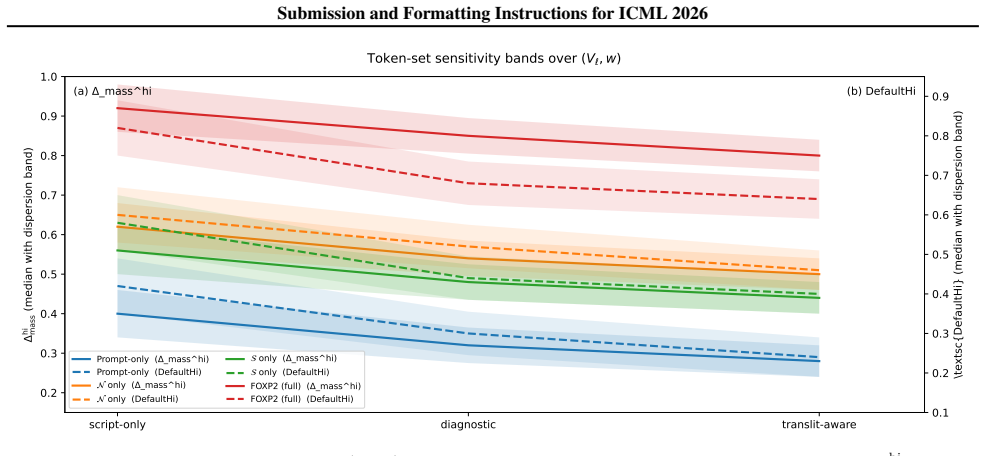
- [Section 3 / Table 1] The paper's central empirical claim is not supported by reported results. Section 3 states that 'Across metrics, FOXP2 is expected to improve both Δmass and Δlid' (prospective), and Table 1 presents only deltas with absolute means, without error bars, confidence intervals, or significance tests. No standard task-level scores (BLEU, EM, ROUGE, accuracy) are reported, despite the abstract's claim of improvement across translation, QA, NLI, and summarization. The 'TaskΔS' column is a single scalar with no task breakdown. As written, the table cannot be distinguished from placeholder or indicative numbers, and the abstract overstates what the body establishes.
- [Section 2.1.2, 2.1.3, 2.3; Table 1] There is a circularity problem in the headline outcome. The defaultness gain ΔM is used in Stage I to score features (LiftSlope, Eq. in 2.1.2), to set the per-layer support size K by lift saturation (2.1.3), and in Stage III to select edit magnitudes λ, β by maximizing Δgain on Dweak (2.3). The main Table 1 then reports Δmass, Δlid, and Δgain as evidence. This is not an independent evaluation of the hypothesis; it is a fit of the pipeline to the same objective. At minimum, the paper would need a holdout objective (e.g., human-judged natural start, or downstream task metrics on unseen tasks/languages) that is not optimized during steering.
- [Section 2.1 Init-3, Section 2.2 II-1, Section 5.2, L4] The matched meaning-unit equivalence is unverified and is load-bearing for the mechanistic claim. Both selectivity (Eq. 'Matched-pair selectivity') and the language-shift matrix ΔZ (II-1) are computed from parallel prompts (x_en, x_hi, x_es) assumed to differ only in language. The paper specifies no back-translation agreement, human parity check, or register/entity matching. Section 5.2's low-rank interpretation treats ε as noise ('ε_k') without reporting its magnitude, and Limitation L4 explicitly states that 'mismatched same meaning pairs leak task/content differences into ΔZ, corrupting the SVD directions.' If the pairs diverge in topic or content, the SVD directions and the entire steering subspace encode those spurious axes, so the empirical gains could be content-shift artifacts rather than language control. A concrete test would be to report residual norms ||ε|| relative to ||ΔZ||
- [Reproducibility Statement, R12, Appendix references] The reproducibility protocols are extensive, but they do not compensate for the absence of actual results. The Reproducibility Statement contains an explicit placeholder '( ???)' and multiple references are incomplete (e.g., '?', 'Turner et al., 2024; ?'). More importantly, the paper does not report that any of the promised reproducibility checks (null-edit identity test, token-set sensitivity bands, entropy-matched controls, bootstrap CIs) were actually run. The frequently-asked-questions and troubleshooting sections describe what 'we would do' (e.g., FAQ A: 'If correlation is weak, we change what we headline') rather than reporting what was done. As a journal submission, this is a proposal or position paper lacking empirical validation, not a completed research report.
minor comments (5)
- [Figure 2 caption] The y-axis label reads 'Mean M M Across Target Languages' — likely a typo for 'Mean ΔM'.
- [Throughout] The method is described as using SAEs in the abstract and Stage I, but Section 2.1 repeatedly refers to a 'V AE/autoencoder' and 'V AE dictionary'. The notation is inconsistent and should be unified.
- [Table 1] The table is visually dense and hard to parse. Consider separating defaultness, leakage, stability, and utility into sub-tables, and adding bootstrap confidence intervals or at least standard deviations.
- [Section 1 / Figure 3] Figure 3 is illustrative and schematic, but the three panels are not referenced in the main text in a way that connects them to specific empirical claims. Clarify whether these are actual data projections or conceptual diagrams.
- [References] Several references have inconsistent year/venue formatting (e.g., Tang et al. 2024a/2024b, Turner et al. 2023/2024, Gao et al. duplicate Cunningham et al.). Please reconcile.
Circularity Check
No load-bearing circularity: the pipeline optimizes Δgain, but the reproducibility protocol separates the optimization set (Dweak) from the headline evaluation set (Dneutral), and external task/utility and ablation checks provide independent content.
full rationale
Stage I selects features by LiftSlope on ΔM over Dweak (Sec 2.1.2), sets support size by lift saturation on the same quantity (Sec 2.1.3), and Stage III tunes λ on a dev set to maximize Δgain (Sec 2.3). If the headline Δgain were measured on the same prompts, it would be the training objective reported as a prediction. However, the paper's reproducibility protocol explicitly separates Dweak (used for causal lift and gain) from Dneutral (used for headline reporting), and R3.2 states: 'We store explicit train/val/test splits and guarantee id-disjointness across roles.' Taken at face value, the reported Table 1 gains are out-of-sample, not fitted. The more serious scientific concern is the unverified matched meaning-unit equivalence (Init-3; L4/R8: 'mismatched same meaning pairs leak task/content differences into ΔZ, corrupting the SVD directions'). That is a confound that could make the steering directions encode content axes, but it is a validity threat rather than a circular reduction: the paper does not define the result as identical to its input by construction. There is no self-citation chain, no imported uniqueness theorem, and no citation-smuggled ansatz; the SAE/dictionary and LAPE references are external. The paper's own extensive limitations and troubleshooting sections further specify conditions under which the claims fail, which is inconsistent with a derivation that is circular by design. Score 1 reflects the unresolved ambiguity about whether the reported Δgain is computed on the same distribution used for tuning, not a demonstrated circular step.
Axiom & Free-Parameter Ledger
free parameters (5)
- Edit magnitudes lambda_l, beta_l =
grid search: lambda in {0, lambda, 2lambda}, rho in {0, 0.5, 1}
- Top-K language-neuron budget per layer =
set by lift saturation on Dweak
- Steering rank r_l =
effective rank + eigengap heuristic
- Intervention window W =
contiguous band maximizing sum Mass*Stab
- Token-set construction thresholds =
e.g., tau_hi=0.6, tau_spec=2.0/1.5, tau_H=1.5, f_min=50
axioms (5)
- domain assumption Language identity and defaultness are readable in residual-stream activations at the last prompt token and the first 1-3 decoding steps.
- domain assumption Matched meaning-unit prompts (same meaning in English/Hindi/Spanish) isolate language identity from topic and content.
- domain assumption SAE/VAE dictionary features are more monosemantic and causally stable intervention targets than raw neurons.
- ad hoc to paper English-to-target activation differences across matched meanings share a common low-dimensional subspace (dz_tilde ≈ sum alpha_i v_i + epsilon).
- standard math Layerwise SVD and effective-rank/eigengap diagnostics identify the dominant control subspace.
invented entities (2)
-
Language neurons (language-specific SAE feature coordinates)
no independent evidence
-
Language defaultness (early-step mass advantage Delta M)
no independent evidence
read the original abstract
LLMs are multilingual by training, yet their lingua franca is often English, reflecting English language dominance in pretraining. Other languages remain in parametric memory but are systematically suppressed. We argue that language defaultness is governed by a sparse, low-rank control circuit, language neurons, that can be mechanistically isolated and safely steered. We introduce Neural FOXP2, that makes a chosen language (Hindi or Spanish) primary in a model by steering language-specific neurons. Neural FOXP2 proceeds in three stages: (i) Localize: We train per-layer SAEs so each activation decomposes into a small set of active feature components. For every feature, we quantify English vs. Hindi/Spanish selectivity overall logit-mass lift toward the target-language token set. Tracing the top-ranked features back to their strongest contributing units yields a compact language-neuron set. (ii) Steering directions: We localize controllable language-shift geometry via a spectral low-rank analysis. For each layer, we build English to target activation-difference matrices and perform layerwise SVD to extract the dominant singular directions governing language change. The eigengap and effective-rank spectra identify a compact steering subspace and an empirically chosen intervention window (where these directions are strongest and most stable). (iii) Steer: We apply a signed, sparse activation shift targeted to the language neurons. Concretely, within low to mid layers we add a positive steering along the target-language dominant directions and a compensating negative shift toward the null space for the English neurons, yielding controllable target-language defaultness.
Figures




Reference graph
Works this paper leans on
-
[1]
XQuAD : A cross-lingual question answering dataset
Artetxe, M., Ruder, S., and Yogatama, D. XQuAD : A cross-lingual question answering dataset. In Proceedings of the 57th Annual Meeting of the Association for Computational Linguistics (ACL), 2020. URL https://arxiv.org/abs/1910.11856
Pith/arXiv arXiv 2020
-
[2]
Towards monosemanticity: Decomposing language models with dictionary learning
Bricken, T., Templeton, A., Batson, J., Chen, B., Jermyn, A., Conerly, T., Turner, N., Anil, C., Denison, C., Askell, A., Lasenby, R., Wu, L., Kravec, S., Schiefer, N., Maxwell, T., Joseph, N., Hatfield-Dodds, Z., Tamkin, A., Nguyen, K., McLean, C., Burke, L., Hume, T., Carter, S., Henighan, T., and Olah, C. Towards monosemanticity: Decomposing language m...
2023
-
[3]
R., Schwenk, H., and Stoyanov, V
Conneau, A., Rinott, R., Lample, G., Williams, A., Bowman, S. R., Schwenk, H., and Stoyanov, V. XNLI : Evaluating cross-lingual sentence representations. In Proceedings of the 2018 Conference on Empirical Methods in Natural Language Processing (EMNLP), 2018. URL https://arxiv.org/abs/1809.05053
Pith/arXiv arXiv 2018
-
[4]
Cunningham, H., Ewart, A., Riggs, L., Huben, R., and Sharkey, L. D. Sparse autoencoders find highly interpretable features in language models. arXiv preprint arXiv:2309.08600, 2023. doi:10.48550/arXiv.2309.08600. URL https://arxiv.org/abs/2309.08600
-
[5]
Llm.int8(): 8-bit matrix multiplication for transformers at scale
Dettmers, T., Lewis, M., Belkada, Y., and Zettlemoyer, L. Llm.int8(): 8-bit matrix multiplication for transformers at scale. arXiv preprint arXiv:2208.07339, 2022. doi:10.48550/arXiv.2208.07339. URL https://arxiv.org/abs/2208.07339
-
[7]
Elhage, N., Hume, T., Olsson, C., Schiefer, N., Henighan, T., Askell, A., Bai, Y., Chen, A., Conerly, T., DasSarma, N., Drain, D., Ganguli, D., Hatfield-Dodds, Z., Hernandez, D., Jones, A., Kernion, J., Lovitt, L., Nanda, N., Ndousse, K., Joseph, N., Martin, B., McCandlish, S., Olah, C., Shlegeris, B., Thorisson, K., and Kaplan, J. Toy models of superposi...
-
[8]
Gao, L. et al. Sparse autoencoders find highly interpretable features in language models. arXiv preprint arXiv:2309.08600, 2023
Pith/arXiv arXiv 2023
-
[9]
S., Mubasshir, K., Li, Y.-F., Shahriyar, R., Hossain, M
Hasan, T., Bhattacharjee, A., Islam, M. S., Mubasshir, K., Li, Y.-F., Shahriyar, R., Hossain, M. S. A., and Iqbal, A. XL - Sum : Large-scale multilingual abstractive summarization for 44 languages. In Findings of the Association for Computational Linguistics: ACL-IJCNLP 2021 , 2021. URL https://arxiv.org/abs/2106.13822
Pith/arXiv arXiv 2021
-
[10]
M., Kocisk \'y , T., Grefenstette, E., Espeholt, L., Kay, W., Suleyman, M., and Blunsom, P
Hermann, K. M., Kocisk \'y , T., Grefenstette, E., Espeholt, L., Kay, W., Suleyman, M., and Blunsom, P. Teaching machines to read and comprehend. Advances in Neural Information Processing Systems, 28, 2015. URL https://proceedings.neurips.cc/paper/2015/hash/afdec7005cc9f14302cd0474fd0f3c96-Abstract.html
2015
-
[11]
Kojima, T., Okimura, I., Iwasawa, Y., Yanaka, H., and Matsuo, Y. On the multilingual ability of decoder-based pre-trained language models: Finding and controlling language-specific neurons. In Proceedings of the 2024 Conference of the North American Chapter of the Association for Computational Linguistics: Human Language Technologies (Volume 1: Long Paper...
-
[12]
On the multilingual ability of decoder-based pre-trained language models: Finding and controlling language-specific neurons, 2024 b
Kojima, T., Okimura, I., Iwasawa, Y., Yanaka, H., and Matsuo, Y. On the multilingual ability of decoder-based pre-trained language models: Finding and controlling language-specific neurons, 2024 b
2024
-
[13]
Locating and editing factual associations in gpt
Meng, K., Bau, D., Andonian, A., and Belinkov, Y. Locating and editing factual associations in gpt. In Advances in Neural Information Processing Systems, 2022. doi:10.48550/arXiv.2202.05262. URL https://arxiv.org/abs/2202.05262
-
[14]
Meta llama 3
Meta AI . Meta llama 3. Blog post, 2024 a . URL https://ai.meta.com/blog/meta-llama-3/
2024
-
[15]
Meta-llama-3-8b model card
Meta AI . Meta-llama-3-8b model card. Hugging Face model card, 2024 b . URL https://huggingface.co/meta-llama/Meta-Llama-3-8B
2024
-
[16]
Panickssery, N. et al. Steering L lama 2 via contrastive activation addition. arXiv preprint arXiv:2312.06681, 2023
Pith/arXiv arXiv 2023
-
[17]
Squad: 100,000+ questions for machine comprehension of text
Rajpurkar, P., Zhang, J., Lopyrev, K., and Liang, P. Squad: 100,000+ questions for machine comprehension of text. In Proceedings of the 2016 Conference on Empirical Methods in Natural Language Processing (EMNLP), pp.\ 2383--2392. Association for Computational Linguistics, 2016. doi:10.18653/v1/D16-1264. URL https://aclanthology.org/D16-1264/
-
[18]
Rimsky, N. et al. Steering L lama 2 via contrastive activation addition, 2024
2024
-
[19]
Trust region policy optimization
Schulman, J., Wolski, F., Dhariwal, P., Radford, A., and Klimov, O. Trust region policy optimization. In International Conference on Machine Learning (ICML), 2015. arXiv:1502.05477
Pith/arXiv arXiv 2015
-
[20]
Shani, N. and Basirat, A. Language dominance in multilingual large language models. In Proceedings of the 8th BlackboxNLP Workshop: Analyzing and Interpreting Neural Networks for NLP, pp.\ 137--148, Suzhou, China, November 2025. Association for Computational Linguistics. ISBN 979-8-89176-346-3. doi:10.18653/v1/2025.blackboxnlp-1.7. URL https://aclantholog...
-
[21]
D., Ng, A., and Potts, C
Socher, R., Perelygin, A., Wu, J., Chuang, J., Manning, C. D., Ng, A., and Potts, C. Recursive deep models for semantic compositionality over a sentiment treebank. In Proceedings of the 2013 Conference on Empirical Methods in Natural Language Processing (EMNLP), pp.\ 1631--1642, 2013. URL https://aclanthology.org/D13-1170/
2013
-
[22]
Language-specific neurons: The key to multilingual capabilities in large language models, 2024 a
Tang, L., Laban, P., and Ravichandran, D. Language-specific neurons: The key to multilingual capabilities in large language models, 2024 a
2024
-
[23]
Language-specific neurons: The key to multilingual capabilities in large language models
Tang, T., Luo, W., Huang, H., Zhang, D., Wang, X., Zhao, X., Wei, F., and Wen, J.-R. Language-specific neurons: The key to multilingual capabilities in large language models. In Ku, L.-W., Martins, A., and Srikumar, V. (eds.), Proceedings of the 62nd Annual Meeting of the Association for Computational Linguistics (Volume 1: Long Papers), pp.\ 5701--5715, ...
-
[24]
R., Cross, J., C elebi, O., Elbayad, M., Heafield, K., He, T., Guzm \'a n, F., et al
Team, N., Costa-juss \`a , M. R., Cross, J., C elebi, O., Elbayad, M., Heafield, K., He, T., Guzm \'a n, F., et al. The FLORES -200 evaluation benchmark for low-resource and multilingual machine translation. arXiv preprint arXiv:2207.04672, 2022. URL https://arxiv.org/abs/2207.04672
Pith/arXiv arXiv 2022
-
[25]
Activation addition: Steering language models without fine-tuning
Turner, A., Thiergart, L., Leech, G., Udell, M., and Olah, C. Activation addition: Steering language models without fine-tuning. arXiv preprint arXiv:2404.04871, 2024. URL https://arxiv.org/abs/2404.04871
Pith/arXiv arXiv 2024
-
[26]
Turner, A. et al. Activation addition: Steering language models without optimization. arXiv preprint arXiv:2308.10248, 2023
Pith/arXiv arXiv 2023
-
[27]
Williams, A., Nangia, N., and Bowman, S. R. A broad-coverage challenge corpus for sentence understanding through inference. In Proceedings of the 2018 Conference of the North American Chapter of the Association for Computational Linguistics: Human Language Technologies (NAACL-HLT), pp.\ 1112--1122. Association for Computational Linguistics, 2018. doi:10.1...
-
[28]
Yu, M., Wang, D., Shan, Q., Reed, C. J., and Wan, A. The super weight in large language models. arXiv preprint arXiv:2411.07191, 2024. doi:10.48550/arXiv.2411.07191. URL https://arxiv.org/abs/2411.07191
-
[29]
Zhang, F. and Nanda, N. Towards best practices of activation patching in language models: Metrics and methods. arXiv preprint arXiv:2309.16042, 2023. doi:10.48550/arXiv.2309.16042. URL https://arxiv.org/abs/2309.16042
-
[30]
write newline
" write newline "" before.all 'output.state := FUNCTION n.dashify 't := "" t empty not t #1 #1 substring "-" = t #1 #2 substring "--" = not "--" * t #2 global.max substring 't := t #1 #1 substring "-" = "-" * t #2 global.max substring 't := while if t #1 #1 substring * t #2 global.max substring 't := if while FUNCTION format.date year duplicate empty "emp...
discussion (0)
Sign in with ORCID, Apple, or X to comment. Anyone can read and Pith papers without signing in.