REVIEW 4 major objections 5 minor 8 references
Preference-based learning selects experiments 70–71% better than standard baselines.
Reviewed by Pith at T0; open to challenge. T0 means a machine referee read the full paper against a public rubric. the ladder, T0–T4 →
T0 review · deepseek-v4-flash
2026-08-03 05:21 UTC pith:JJC6A6A2
load-bearing objection New DPO-for-experimental-design paper with a credible equal-budget synthetic win, but the PPO comparison is episode-mismatched and the abstract oversells. the 4 major comments →
Active Causal Experimentalist (ACE): Learning Intervention Strategies via Direct Preference Optimization
The pith
A machine-rendered reading of the paper's core claim, the machinery that carries it, and where it could break.
Core claim
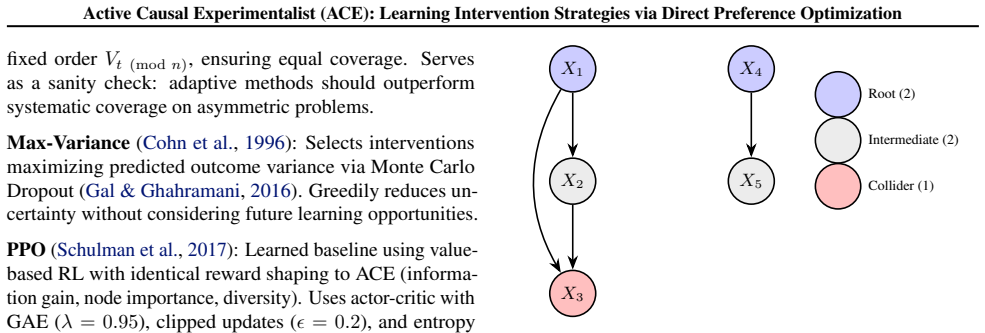
On the paper's own terms, ACE formulates causal mechanism estimation as a sequential decision problem and trains a policy using Direct Preference Optimization on pairwise preferences between intervention candidates. The reward combines simulated information gain from a cloned-learner lookahead, node importance based on current per-node losses, and exploration diversity. Across a synthetic 5-node SCM, a 15-node collider-dense SCM, coupled Duffing oscillators, and Phillips-curve economic data, the policy achieves a median total MSE of 0.61 versus 2.06–2.10 for baselines at the same intervention budget, a 70–71% improvement with p < 0.001 and Cohen's d around 2. The central discovery is that pr
What carries the argument
The load-bearing machinery is the DPO-trained experimentalist policy combined with a cloned-learner lookahead: the policy generates K candidate interventions, simulates each on a cloned copy of the learner to estimate information gain ΔL, executes the best candidate, and updates via pairwise preference comparisons between best and worst candidates. The key identity is the preference-invariance property: if rewards scale by a time-varying factor f(t), the relative ordering of candidates is unchanged, so DPO sidesteps the non-stationary reward problem that destabilizes value-based critics. This lets the policy learn to allocate interventions strategically rather than merely reacting to local u
Load-bearing premise
The paper's results stand or fall on whether the information gain computed by retraining a cloned learner on simulated intervention data accurately predicts the actual reduction in prediction error that will occur when that intervention is executed in the real environment.
What would settle it
Run ACE on a small SCM where the optimal intervention sequence can be computed by exhaustive search; if the policy's chosen sequence deviates from the optimum and increases final loss, the lookahead proxy is biased. Alternatively, replace the cloned-learner simulation with a deliberately mis-specified proxy (e.g., a linear approximation of a nonlinear mechanism) and check whether DPO's preference labels reverse the true ordering of interventions; if preferences reverse under reward scaling, the stated invariance fails.
If this is right
- ACE-style policies could cut the number of costly experiments needed to identify mechanisms in drug discovery, materials science, and simulation-driven design, since the policy learns to concentrate interventions on high-value targets.
- The preference-invariance insight extends beyond causal discovery to any sequential experimental setting where rewards diminish over time, such as adaptive clinical trials or A/B testing pipelines.
- The method transfers from live controlled interventions to retrospective data selection, as the Phillips-curve experiments demonstrate, enabling efficient sampling of historical observational archives.
- Because the learned collider-parent strategy matches formal causal theory, preference learning can serve as a complement to theory, offering a way to validate or discover principled strategies empirically.
- Value-based reinforcement learning, whose critic struggles with rewards that shrink by orders of magnitude, appears to be a poor fit for this domain; future active-learning systems may favor preference-based updates.
Where Pith is reading between the lines
- The reported 70–71% improvement is measured against simple baselines; how ACE compares to more specialized state-of-the-art active causal discovery algorithms is an open, natural next test.
- If the cloned-learner lookahead reliably approximates true information gain, the policy could be trained in simulation and deployed on physical experiments where real interventions are expensive, carrying the learned strategy across domains.
- The emergent 99.8% concentration on collider parents suggests a diagnostic for reward or architecture mis-specification: if a learned policy fails to focus on hard multi-parent mechanisms, the learner may be overparameterized or the reward poorly calibrated.
- A testable extension is to vary the noise distribution or add heterogeneous mechanism difficulties to see whether the preference-invariance property holds when preference reversals occur under reward scaling; if reversals appear, the invariance argument needs qualification.
Editorial analysis
A structured set of objections, weighed in public.
Referee Report
Summary. The paper proposes ACE, an experimental-design policy for causal mechanism estimation in known-structure SCMs. At each step, an LLM policy (Qwen2.5-1.5B) proposes K candidate interventions, a cloned learner simulates each candidate to estimate the information gain ΔL, the best candidate is executed, and the policy is updated with DPO using preference pairs derived from a reward R = ΔL + αw + γD. The central quantitative claim is a 70–71% median loss reduction over Random, Round-Robin, and Max-Variance baselines at a matched budget of 171 episodes on a 5-node synthetic SCM (p < 0.001). The paper also reports qualitative applications to coupled Duffing oscillators and Phillips-curve data, an ablation study, an emergent strategy of concentrating interventions on collider parents, and a comparison with PPO that is used to argue that preference-based learning outperforms value-based RL.
Significance. If the main claims hold, the paper makes a useful empirical contribution: it shows that a DPO-trained candidate generator combined with cloned-learner lookahead can allocate interventions substantially better than simple static policies on a synthetic mechanism-estimation task, and that the learned strategy matches the theoretically sensible 'intervene on all collider parents' pattern. The equal-budget comparison against three non-learned baselines on the 5-node benchmark is the strongest part of the paper and is a falsifiable, reproducible design. However, the paper's significance is currently limited by three issues: the DPO-vs-PPO comparison is not at equal budget; the abstract's 70–71% claim is extended to physics and economics domains where no baseline comparisons are reported; and the cloned-learner ΔL proxy is not validated. These issues are fixable within the manuscript's scope, but they need to be addressed before the headline claims are credible.
major comments (4)
- [§5.2 and Table 1] The central comparison between DPO and value-based RL is not matched in budget. PPO is reported only at 100 episodes (Table 1, 'fewer episodes' block), whereas ACE is compared at its average convergence point of 171 episodes. The '68% median improvement' and Cohen's d = -2.46 in §5.2 therefore conflate algorithm choice with training budget. Since Contribution 3 ('preference-based learning substantially outperforms value-based reinforcement learning') is a load-bearing claim, PPO must be run at 171 episodes (or to per-node convergence) with the same seeds and reward signal, and equal-budget results reported. If PPO is unstable or needs more episodes, that should be shown with learning curves rather than inferred from an unmatched comparison.
- [Abstract; §4.3–§4.4] The abstract states that ACE achieves 70–71% improvement over baselines at equal intervention budgets across physics simulations and economic data, with p < 0.001 and Cohen's d ≈ 2. The Duffing oscillator experiment (§4.3) reports only ACE's final coupling error with no baselines, no equal-budget comparison, and no significance test. The Phillips curve section (§4.4) is qualitative, with no numeric loss or baseline comparison. The 70–71% figure is established only on the 5-node synthetic benchmark. The claims should either be supported by matched baselines in these domains or explicitly restricted to the synthetic benchmark.
- [§3.2, Eq. (7), Figure 2] Both the greedy selection c* = argmax_c ΔL(c) and the DPO preference labels are derived from ΔL estimated by simulating candidates on a cloned learner. The paper provides no validation—analytic or empirical—that this cloned-learner lookahead is a reliable proxy for the actual reduction in learner loss after executing c*. If the lookahead is biased, the policy is trained to optimize a systematically incorrect signal, and the subsequent evaluation on held-out MSE may not rescue the training signal. Please add a calibration analysis comparing predicted ΔL with realized loss reduction over episodes and candidate types, or provide a bound/justification for the approximation. This is load-bearing for both the learned-strategy claim and the DPO-vs-PPO conclusion.
- [§4.1, Table 1] The headline equal-budget result rests on N=5 runs with one acknowledged outlier (seed 789). The paper reports 'p < 0.001' and median improvements but does not specify the test statistic, degrees of freedom, or treatment of the outlier; the reported mean ± SD for ACE (0.92 ± 0.73) makes the central estimate sensitive to a single seed. Please report per-seed losses, the paired-test statistic (on means, medians, or ranks), and the 95% CIs for the improvement rather than only for individual losses. This is necessary to substantiate the abstract's p < 0.001 claim.
minor comments (5)
- [§4.1] The 'random proposals with lookahead' baseline (2.10 ± 0.11) is described but not included in Table 1 and lacks N, CI, and significance testing; it should be added to the table or removed.
- [Table 2] The 'DPO Training' ablation uses a 'custom transformer' rather than the Qwen2.5-1.5B policy used in ACE; the DPO contribution is not isolated with the same architecture. The 'Diversity Reward' and 'DPO Training' rows report identical means/SDs, which is suspicious.
- [§3.3] The grid search over α and γ on a 'held-out validation SCM' is not described (range, criterion, results); report it or cite a supplement.
- [§4.2] The 15-node 'Scaling Considerations' section describes no experiments and is explicitly left to future work; the abstract's 'synthetic benchmarks' plural should be made accurate.
- [General] No code or data availability statement is provided; for reproducibility of the RL/DPO pipeline, this should be added. Also, 'V olcker' in §4.4 contains a misplaced space.
Circularity Check
No significant circularity: the derivation is self-contained; training signal and evaluation are distinct.
full rationale
ACE's derivation is self-contained. DPO preferences are generated from the explicit reward R = ΔL + αw + γD (Eq. 7), but this reward is a training/selection signal; the reported outcome is held-out prediction MSE (§3.6.1), which is not used to define R except through the generic ΔL progress proxy. The collider-parent strategy is not hard-coded: nothing in R names colliders, parents, or X3; the policy's 99.8% concentration emerges from the interaction loop and is verified post hoc from intervention statistics. The random-lookahead ablation (§4.1) controls for the greedy arg-max selection, isolating the learned proposal distribution. There are no load-bearing self-citations or imported uniqueness theorems: DPO (Rafailov et al. 2023) and Pearl's framework are external, standard references. The manuscript's own limitations (Sec. 7) concern statistical power, and Sec. 5.2's PPO-vs-ACE comparison uses unequal episode budgets (100 vs 171), but these are methodological confounds, not circular reductions; no equation or fitted parameter is equivalent to the claim by construction.
Axiom & Free-Parameter Ledger
free parameters (5)
- alpha (reward weight for node importance) =
0.1
- gamma (reward weight for diversity) =
0.05
- beta (DPO temperature) =
0.1
- K (number of candidate interventions per step) =
4
- tau_i (per-node convergence thresholds) =
unspecified
axioms (6)
- domain assumption The true causal graph G is known; only mechanisms f_i need to be estimated.
- domain assumption The oracle environment faithfully samples interventional distributions P(V | do(V_i = x)) following Pearl semantics.
- domain assumption Simulating a candidate intervention on a cloned learner gives an unbiased estimate of future learning progress ΔL.
- domain assumption For the Phillips curve experiment, selecting historical time periods is an adequate proxy for causal intervention.
- standard math DPO's Bradley-Terry preference model and KL-regularized objective correctly approximate the intended reward optimization.
- domain assumption 2-layer MLPs with 64 ReLU units are sufficient to represent the mechanisms in the SCMs.
Cite this review
Pith. "Pith review of Active Causal Experimentalist (ACE): Learning Intervention Strategies via Direct Preference Optimization." pith.science (2026). https://pith.science/paper/JJC6A6A2
@misc{pith2026260202451,
  author       = {Pith},
  title        = {Pith review of: Active Causal Experimentalist (ACE): Learning Intervention Strategies via Direct Preference Optimization},
  year         = {2026},
  howpublished = {\url{https://pith.science/paper/JJC6A6A2}},
  note         = {Machine review of arXiv:2602.02451}
}
read the original abstract
Discovering causal relationships requires controlled experiments, but experimentalists face a sequential decision problem: each intervention reveals information that should inform what to try next. Traditional approaches such as random sampling, greedy information maximization, and round-robin coverage treat each decision in isolation, unable to learn adaptive strategies from experience. We propose Active Causal Experimentalist (ACE), which learns experimental design as a sequential policy. Our key insight is that while absolute information gains diminish as knowledge accumulates (making value-based RL unstable), relative comparisons between candidate interventions remain meaningful throughout. ACE exploits this via Direct Preference Optimization, learning from pairwise intervention comparisons rather than non-stationary reward magnitudes. Across synthetic benchmarks, physics simulations, and economic data, ACE achieves 70-71% improvement over baselines at equal intervention budgets (p < 0.001, Cohen's d ~ 2). Notably, the learned policy autonomously discovers that collider mechanisms require concentrated interventions on parent variables, a theoretically-grounded strategy that emerges purely from experience. This suggests preference-based learning can recover principled experimental strategies, complementing theory with learned domain adaptation.
Figures




Reference graph
Works this paper leans on
-
[1]
Auto-bench: An automated benchmark for scientific discovery in LLMs.arXiv preprint arXiv:2502.15224,
Chen, T., Anumasa, S., Lin, B., Shah, V ., Goyal, A., and Liu, D. Auto-bench: An automated benchmark for scientific discovery in LLMs.arXiv preprint arXiv:2502.15224,
-
[5]
Proximal policy optimization algorithms
Schulman, J., Wolski, F., Dhariwal, P., Radford, A., and Klimov, O. Proximal policy optimization algorithms. arXiv preprint arXiv:1707.06347,
-
[7]
T., Wang, W., Bai, J., Wang, Z., and Song, Y
Zheng, T., Deng, Z., Tsang, H. T., Wang, W., Bai, J., Wang, Z., and Song, Y . From automation to autonomy: A survey on large language models in scientific discov- ery. InProceedings of the 2025 Conference on Empiri- cal Methods in Natural Language Processing (EMNLP),
2025
-
[2015]
A comprehensive sur- vey of direct preference optimization.arXiv preprint arXiv:2410.15595,
Xiao, W., Wang, Q., et al. A comprehensive sur- vey of direct preference optimization.arXiv preprint arXiv:2410.15595,
-
[2016]
Y ., Goodyear, L., Bhatia, A., Li, L., Bhaskar, A., Zaman, M., and Goodman, N
Gandhi, K., Li, M. Y ., Goodyear, L., Bhatia, A., Li, L., Bhaskar, A., Zaman, M., and Goodman, N. D. Box- ingGym: Benchmarking progress in automated exper- imental design and model discovery.arXiv preprint arXiv:2501.01540,
-
[2021]
Mukherjee, S., Zhang, M., Flaxman, S., and V ollmer, S. J. Graph agnostic causal Bayesian optimisation.arXiv preprint arXiv:2411.03028,
-
[2024]
doi: 10.1214/23-STS915. Sauter, A. W. M., Botteghi, N., Acar, E., and Plaat, A. CORE: Towards scalable and efficient causal discovery with reinforcement learning. InProceedings of the 23rd International Conference on Autonomous Agents and Multiagent Systems (AAMAS), pp. 1664–1672,
-
[2025]
emnlp-main.895/
URL https://aclanthology.org/2025. emnlp-main.895/. 9
2025
discussion (0)
Sign in with ORCID, Apple, or X to comment. Anyone can read and Pith papers without signing in.