REVIEW 3 major objections 5 minor 1 cited by
One hybridized band carries interlayer magnetism in Fe1/3TaS2
Reviewed by Pith at T0; open to challenge. T0 means a machine referee read the full paper against a public rubric. the ladder, T0–T4 →
In Fe1/3TaS2, intercalated Fe hybridizes with Ta d-states to form a spin-polarized band that disperses along the out-of-plane direction and crosses the Fermi level, providing the interlayer magnetic-exchange channel.
T0 review reviewed 2026-08-04 challenge →
load-bearing objection A plausible, well-documented claim that Fe intercalation creates a kz-dispersive hybridized band mediating interlayer exchange, but the SX-ARPES 3D fermiology hinges on an unverified interference interpretation. the 3 major comments →
Emergent 3D Fermiology and Magnetism in an Intercalated Van der Waals System
The pith
A machine-rendered reading of the paper's core claim, the machinery that carries it, and where it could break.
The reading
Core claim
On the paper's own terms, the central discovery is that Fe intercalation into 2H-TaS2 generates a spin-polarized, kz-dispersive Fe-d–Ta-d hybridized band crossing the Fermi level, and that this band is the microscopic carrier of interlayer magnetic exchange. The band's out-of-plane hopping t* sets the size of the interlayer coupling Jz, which the authors compute as a function of lattice parameter c, finding Jz an order of magnitude larger than in CrI3 and tunable in sign by changing the Fe orbital occupancy. This mechanism, they argue, explains why a purely atomic multiplet picture fails—the Fe moment is reduced by partial delocalization—and provides a general framework for interlayer coupli
What carries the argument
The central object is the Fe-dz2–Ta-dz2 hybridized band: a spin-minority band that acquires pronounced out-of-plane (kz) dispersion because the Fe intercalant sits in the van der Waals gap and hybridizes with Ta-dz2 orbitals, giving a finite interlayer hopping t*. The paper models the out-of-plane dispersion with one-dimensional chains (a monoatomic chain for pristine TaS2, a two-site chain for Fe1/3TaS2) to account for the matrix-element interference that makes the measured kz periodicity four times the lattice periodicity, and connects t* to the interlayer exchange through an RKKY-type spin-susceptibility formula chi(qz) = sum_k |M|^2 (f(epsilon_k)-f(epsilon_{k+qz}))/(epsilon_{k+qz}-epsilo
Load-bearing premise
The load-bearing premise is that the fourfold kz periodicity observed in soft-X-ray ARPES is a quantum-interference matrix-element effect and not a real band-structure periodicity, and that the calculated spin polarization of the band is real even though it was never measured directly.
What would settle it
Spin-resolved ARPES at the Γ point tuned to the hybridized band would settle the spin part: DFT predicts the spin-minority branch occupied and the spin-majority branch unoccupied near Γ; observing both branches occupied, or no spin splitting, would overturn the 'spin-polarized band' claim. Separately, a measurement of the kz dispersion using a different photon-energy range or an independent probe of the Fermi-surface volume (e.g., quantum oscillations) would show whether the closed 3D sheets are genuine band structure or matrix-element ghosts.
If this is right
- Interlayer magnetic coupling in Fe1/3TaS2 is carried by the itinerant hybridized band, not by localized Fe moments alone, so the interlayer exchange strength tracks the out-of-plane hopping t*.
- Compressing the c-axis lattice parameter should strengthen Jz, giving a direct route to tune interlayer magnetism by pressure or epitaxial strain.
- The breakdown of the atomic picture explains the measured saturation magnetization (~4 μB) being lower than the atomic Fe2+ value (~5 μB) as delocalization of Fe-d electrons.
- Because the mechanism only needs a metallic van der Waals host and symmetry-allowed out-of-plane hybridization, it should apply broadly to other intercalated TMDs, including Co, Cr, and Ni intercalants, and to phenomena like A-type antiferromagnetism and altermagnetism in this family.
- The same qz-dependent susceptibility argument predicts that hosts with no out-of-plane dispersion have suppressed interlayer exchange, clarifying when 2D-like magnetism persists.
Where Pith is reading between the lines
- If the mechanism is generic, the orbital character of the intercalant becomes a design rule: intercalants with strong out-of-plane d-orbital lobes should produce stronger interlayer coupling than those without, a prediction testable by comparing Fe, Co, Cr, and Ni intercalates.
- The paper's computed relation Jz ~ (t*)² suggests a quantitative, testable scaling under uniaxial stress: compressing c should raise the ordering temperature and possibly flip the sign of interlayer coupling if the orbital occupancy shifts, which could be checked with magnetometry under pressure.
- The anisotropic 'semi-Dirac' dispersion (linear along kz, parabolic in-plane) noted in the supplement implies unusual transport and magneto-response, such as anisotropic Landau levels, which the paper does not explore.
- A clean monolayer of Fe1/3TaS2 should lose the itinerant interlayer channel; comparing the magnetic transition temperature of bulk versus few-layer flakes would isolate the contribution of this band from purely two-dimensional exchange.
Editorial analysis
A structured set of objections, weighed in public.
Referee Report
Summary. The paper studies Fe-intercalated TaS2 (Fe1/3TaS2) using a combination of MOKE, LEED, XAS/RIXS, ARPES/SX-ARPES, and DFT+U/SOC calculations. The authors argue that intercalation produces a spin-polarized, kz-dispersive Fe–Ta hybridized band that crosses the Fermi level and provides an itinerant channel for interlayer magnetic exchange. They further propose that this mechanism, which goes beyond a purely atomic/local-moment picture, controls the interlayer coupling Jz and explains the observed magnetic dimensionality. The main experimental evidence for the kz-dispersive band is a fourfold kz periodicity in soft-X-ray ARPES, which they attribute to quantum interference effects rather than to a true band-structure periodicity. The paper concludes that intercalant-induced itinerancy offers a general framework for engineering interlayer magnetism in intercalated van der Waals materials.
Significance. If the central claim is correct, it would provide a concrete microscopic mechanism for interlayer exchange in intercalated TMDs, linking electronic dimensionality and magnetism in a way that goes beyond simple local-moment/RKKY pictures. The paper's strengths are its multi-probe experimental approach (MOKE, LEED, XAS/RIXS, ARPES/SX-ARPES) and the internal consistency between DFT and several observables. The 1D models for kz interference and the occupation-matrix control of the DFT solution are valuable technical contributions. However, the direct experimental evidence for the kz-dispersive, spin-polarized band is weaker than the abstract suggests: the kz periodicity is explained by an unverified interference interpretation, and spin polarization is never measured directly. Eq. (2) is presented as the interlayer susceptibility but is not evaluated against the DFT-computed Jz. These issues make the paper scientifically important but in need of substantial revision before the claims are supported.
major comments (3)
- [Section D, Fig. 4, SI Fig. S3] The central experimental evidence for a kz-dispersive band crossing EF is the fourfold kz periodicity of the SX-ARPES signal. The paper states that this periodicity 'cannot be captured by band structure calculations' and ascribes it to quantum interference plus a geometric effect of Fe. However, no quantitative fit of the measured kz-dependent intensity to the proposed interference model is shown. The 1D model in Fig. S3 reproduces the modulation only qualitatively (Γ* vs A*), and the intensity simulation in Fig. 4b uses a simplified matrix element with a small set of orbitals. Because this periodic modulation is the only observable from which the 3D sheets are reconstructed, the claim that ARPES demonstrates the 3D band requires a quantitative simulation of the SX-ARPES intensity along kz (including final-state matrix elements) that is compared directly with the measured line cuts. As w
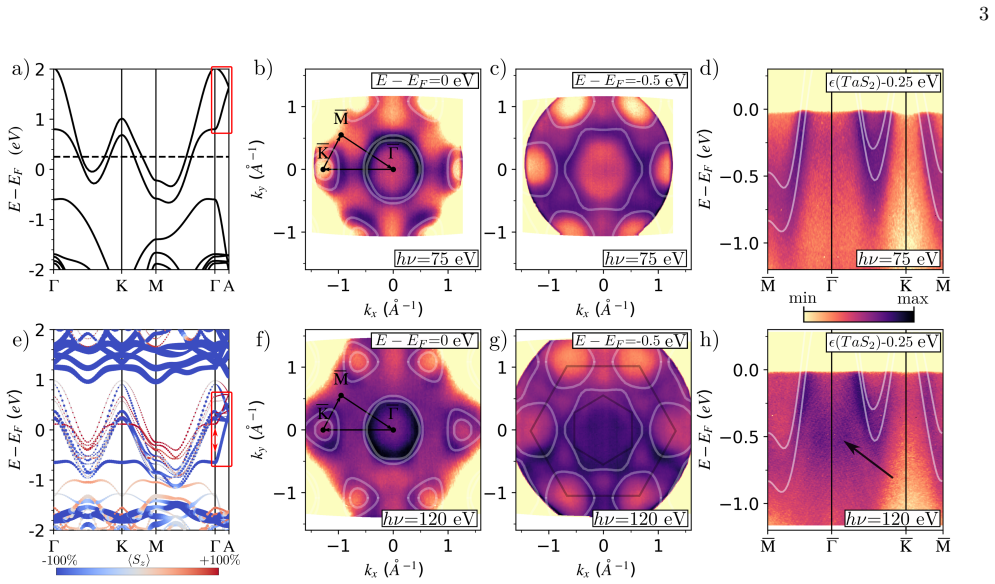
- [Section D, Figs. 3c and S6] The band is labeled 'spin-polarized' on the basis of DFT only; no spin-resolved ARPES or XMCD is presented. The colormap in Fig. 3c is computed from ⟨Sz⟩, not measured. The sentence 'DFT and ARPES demonstrate that Fe intercalation generates a spin-polarized ... band' therefore overstates the experimental support. The ARPES data are consistent with DFT spin splitting, but they do not demonstrate spin polarization. This is load-bearing because the spin-polarized label is featured in the abstract and is part of the proposed exchange mechanism. The authors should either add spin-resolved data or reformulate the claim as 'DFT predicts, and ARPES is consistent with, a spin-polarized band.'
- [Section E, Eq. (2), Fig. 5] The connection between the kz-dispersive band and the interlayer exchange Jz is established only by the concurrent increase of t* and Jz with decreasing c, as shown in Fig. 5. Eq. (2) is presented as the interlayer spin susceptibility but is not evaluated; no calculation of χ(qz) from the DFT band structure is provided. Moreover, the DFT-computed Jz and the identification of the mediating band come from the same occupation-matrix-controlled DFT (with fitted U, alpha_mix, and orbital control), so the correlation in Fig. 5 is not independent evidence for the proposed causality. A more direct test would be to compute Jz with the hybridized band removed or with its interlayer hopping suppressed (e.g., via a Wannier/TB model) and to compare with Eq. (2). Without such a test, the mechanism is plausible but not quantitatively demonstrated.
minor comments (5)
- [Section B] The text refers to the LEED pattern as 'Fig. 1b', but Fig. 1b shows MOKE curves; the LEED pattern is in Fig. 1c. Please correct the cross-reference.
- [SI Sec. II.C] The SX-ARPES energy resolution is stated as 'varied between 50 and 100 eV'; this should presumably be meV. Please correct.
- [Section D, Fig. 3] The comparison between ARPES and DFT uses rigid shifts of 0.25 eV and 0.1 eV without discussion of the uncertainty in these shifts. Specifying the sensitivity of the claimed crossing to the shift magnitude would strengthen the comparison.
- [SI Eq. (1)] The matrix element M is defined as a sum over sublattice projections but the phase convention and orbital phases are not specified. A precise definition is needed to reproduce the interference calculations.
- [Section C, Fig. S1] The multiplet-calculated saturation magnetization (≈5 μB) is compared with the experimental ≈4 μB to support the breakdown of the atomic picture. It would be helpful to state an error bar for the experimental value and to discuss whether covalency (rather than itinerancy) could explain the reduction.
Circularity Check
No significant circularity: the central DFT/ARPES claim is independently supported; only minor methodological self-citations appear.
full rationale
The paper's derivation chain is largely self-contained. The central claim—that Fe intercalation generates a spin-polarized, kz-dispersive itinerant band crossing the Fermi level and mediating interlayer exchange—is supported by independent legs: (i) PBE+U+SOC DFT with a linear-response U (4.42 eV) and occupation-matrix control identifies the band and its kz dispersion; (ii) ARPES at 75 and 120 eV shows extra spectral weight absent in pristine TaS2, with intensity simulations using matrix-element interference; (iii) SX-ARPES maps show features absent in the host, and a 1D two-site model accounts for the observed fourfold kz periodicity; (iv) interlayer coupling Jz is computed by total-energy differences and correlated with the hopping t* extracted from the same DFT dispersion. No fitted parameter is renamed as a prediction: the multiplet model is fit to XAS/RIXS, and the subsequently computed magnetic anisotropy is a consistency check (with a noted m_sat discrepancy), not a forced output. The most vulnerable step is the SX-ARPES interpretation of the fourfold kz periodicity as a quantum-interference matrix-element effect rather than a true band-structure or superlattice periodicity; the paper explicitly states this periodicity cannot be captured by band-structure calculations. This is a genuine correctness/validity risk, and the absence of spin-resolved ARPES means the 'spin-polarized' attribute rests on DFT. But it is not circular: the interference model is not obtained by fitting the target 3D dispersion, and the same band is independently present in conventional ARPES and DFT. Self-citations ([43] for the matrix-element method and doubled-period effect, [52] for occupation-matrix control) are methodological precedents; they are supported by independent references ([48]) and standard methods, and are not the sole load-bearing justification. Therefore no step reduces by construction to its inputs; score 2 reflects only minor self-citation.
Axiom & Free-Parameter Ledger
free parameters (6)
- U_eff for Fe-3d (DFT+U) =
4.42 eV
- alpha_mix in VASP =
0.22
- Multiplet model parameters =
Slater F2,4/G1,3 scaled to 75%/65% of HF; SOC scaled to 50%; orbital energies e'_g=-0.2 eV, a1g=0, e_g=0.7 eV
- Rigid band shift for 2H-TaS2 comparison =
0.25 eV
- Rigid band shift for Fe1/3TaS2 PBE+U+SOC =
0.1 eV
- Inner potential V0 for kz conversion =
10 eV
axioms (5)
- domain assumption PBE+U+SOC with U=4.42 eV, alpha_mix=0.22, and occupation-matrix control reproduces the ground-state orbital configuration and magnetic moment of Fe1/3TaS2.
- domain assumption Multiplet model in D3d symmetry with nominal Fe2+ 3d6 filling describes the local XAS/RIXS spectra and local magnetic response.
- ad hoc to paper The fourfold kz periodicity in SX-ARPES is a quantum-interference matrix-element effect, not a real superlattice periodicity.
- domain assumption The Lindhard-type spin susceptibility of Eq. (2) with the kz-dispersive band describes interlayer exchange J_z.
- domain assumption HSE06/PBE band structures of host 2H-TaS2, rigidly shifted by 0.25 eV (and 0.1 eV for PBE+U), represent the Fe-doped host electronic structure.
Cite this review
Pith. "Pith review of Emergent 3D Fermiology and Magnetism in an Intercalated Van der Waals System." pith.science (2026). https://pith.science/paper/NTUYHDGG
@misc{pith2026260203457,
  author       = {Pith},
  title        = {Pith review of: Emergent 3D Fermiology and Magnetism in an Intercalated Van der Waals System},
  year         = {2026},
  howpublished = {\url{https://pith.science/paper/NTUYHDGG}},
  note         = {Machine review of arXiv:2602.03457}
}
abstract
Intercalation of magnetic atoms into van der Waals materials provides a versatile platform for tailoring unconventional magnetic properties. However, its impact on electronic dimensionality and exchange mechanisms remains poorly understood. Using Fe-intercalated TaS$_2$ as a model system, we combine X-ray absorption and resonant inelastic scattering with angle-resolved photoemission and first-principles calculations to reveal that intercalation reshapes the host electronic structure. We identify a spin-polarized intercalant-host hybridized band with pronounced out-of-plane dispersion crossing the Fermi level, providing an itinerant channel for interlayer magnetic exchange. This mechanism explains the breakdown of a purely atomic picture and establishes a direct link between lattice geometry, electronic dispersion, and magnetic order. Our findings demonstrate that intercalant-induced itinerancy enables tunable interlayer coupling in otherwise layered magnets, offering a general microscopic framework for engineering magnetic dimensionality in a broad class of intercalated vdW materials.
Figures



Forward citations
Cited by 1 Pith paper
-
Ligand-mediated Origin of Altermagnetic Spin-Splitting
First-principles and tight-binding analysis shows ligand-assisted coupling dominates altermagnetic spin-splitting in Co1/4NbSe2.
Reference graph
Works this paper leans on
-
[1]
Skyrmion crystal from RKKY interaction me- diated by 2D electron gas,
Zhentao Wang, Ying Su, Shi-Zeng Lin, and Cristian D. Batista, “Skyrmion crystal from RKKY interaction me- diated by 2D electron gas,” Physical Review Letters124 (2020), 10.1103/physrevlett.124.207201
-
[2]
Itinerant electron-driven chiral magnetic ordering and spontaneous quantum Hall effect in triangular lattice models,
Ivar Martin and C. D. Batista, “Itinerant electron-driven chiral magnetic ordering and spontaneous quantum Hall effect in triangular lattice models,” Phys. Rev. Lett.101, 156402 (2008)
2008
-
[3]
Topological superconductivity in a van der Waals heterostructure,
Shawulienu Kezilebieke, Md Nurul Huda, Viliam Vaˇ no, Markus Aapro, Somesh C. Ganguli, Orlando J. Silveira, Szczepan G/suppress lodzik, Adam S. Foster, Teemu Ojanen, and Peter Liljeroth, “Topological superconductivity in a van der Waals heterostructure,” Nature588, 424–428 (2020)
2020
-
[4]
Observation of Majo- rana fermions in ferromagnetic atomic chains on a super- conductor,
Stevan Nadj-Perge, Ilya K. Drozdov, Jian Li, Hua Chen, Sangjun Jeon, Jungpil Seo, Allan H. MacDonald, B. An- drei Bernevig, and Ali Yazdani, “Observation of Majo- rana fermions in ferromagnetic atomic chains on a super- conductor,” Science346, 602–607 (2014)
2014
-
[5]
Artificial heavy fermions in a van der Waals heterostructure,
Viliam Vaˇ no, Mohammad Amini, Somesh C. Ganguli, Guangze Chen, Jose L. Lado, Shawulienu Kezilebieke, and Peter Liljeroth, “Artificial heavy fermions in a van der Waals heterostructure,” Nature599, 582–586 (2021)
2021
-
[6]
Two-dimensional heavy fermions in the van der Waals metal CeSiI,
Victoria A. Posey, Simon Turkel, Mehdi Rezaee, Aravind Devarakonda, Asish K. Kundu, Chin Shen Ong, Morgan Thinel, Daniel G. Chica, Rocco A. Vitalone, Ran Jing, Suheng Xu, David R. Needell, Elena Meirzadeh, Mar- galit L. Feuer, Apoorv Jindal, Xiaomeng Cui, Tonica Valla, Patrik Thunstr¨ om, Turgut Yilmaz, Elio Vescovo, David Graf, Xiaoyang Zhu, Allen Scheie...
2024
-
[7]
Highly tun- able magnetic phases in transition-metal dichalcogenide Fe1/3+δNbS2,
Shan Wu, Zhijun Xu, Shannon C. Haley, Sophie F. We- ber, Arani Acharya, Eran Maniv, Yiming Qiu, A. A. Aczel, Nicholas S. Settineri, Jeffrey B. Neaton, James G. Analytis, and Robert J. Birgeneau, “Highly tun- able magnetic phases in transition-metal dichalcogenide Fe1/3+δNbS2,” Phys. Rev. X12, 021003 (2022)
2022
-
[8]
Three- state nematicity in the triangular lattice antiferromagnet Fe1/3NbS2,
Arielle Little, Changmin Lee, Caolan John, Spencer Doyle, Eran Maniv, Nityan L. Nair, Wenqin Chen, Dy- lan Rees, J¨ orn W. F. Venderbos, Rafael M. Fernan- des, James G. Analytis, and Joseph Orenstein, “Three- state nematicity in the triangular lattice antiferromagnet Fe1/3NbS2,” Nature Materials19, 1062–1067 (2020)
2020
-
[9]
Electrical switching in a magnetically intercalated transition metal dichalcogenide,
Nityan L. Nair, Eran Maniv, Caolan John, Spencer Doyle, J. Orenstein, and James G. Analytis, “Electrical switching in a magnetically intercalated transition metal dichalcogenide,” Nature Materials19, 153–157 (2019)
2019
-
[10]
Sponta- neous topological Hall effect induced by non-coplanar an- tiferromagnetic order in intercalated van der Waals ma- terials,
H. Takagi, R. Takagi, S. Minami, T. Nomoto, K. Ohishi, M.-T. Suzuki, Y. Yanagi, M. Hirayama, N. D. Khanh, K. Karube, H. Saito, D. Hashizume, R. Kiyanagi, Y. Tokura, R. Arita, T. Nakajima, and S. Seki, “Sponta- neous topological Hall effect induced by non-coplanar an- tiferromagnetic order in intercalated van der Waals ma- terials,” Nature Physics19, 961–9...
2023
-
[11]
Pyeongjae Park, Woonghee Cho, Chaebin Kim, Yeochan An, Yoon-Gu Kang, Maxim Avdeev, Romain Sibille, Kazuki Iida, Ryoichi Kajimoto, Ki Hoon Lee, Woori Ju, En-Jin Cho, Han-Jin Noh, Myung Joon Han, Shang- Shun Zhang, Cristian D. Batista, and Je-Geun Park, “Tetrahedral triple-Q magnetic ordering and large spon- taneous Hall conductivity in the metallic triangu...
-
[12]
Pingfan Gu, Yuxuan Peng, Shiqi Yang, Huan Wang, Shenyong Ye, Hanwen Wang, Yanping Li, Tianlong Xia, Jinbo Yang, and Yu Ye, “Probing the anomalous Hall transport and magnetic reversal of quasi-two-dimensional antiferromagnet Co 1/3NbS2,” Nature Communications 16(2025), 10.1038/s41467-025-59690-6
-
[13]
Current-driven col- lective control of helical spin texture in van der Waals antiferromagnet,
Kai-Xuan Zhang, Suik Cheon, Hyuncheol Kim, Pyeong- jae Park, Yeochan An, Suhan Son, Jingyuan Cui, Jihoon Keum, Joonyoung Choi, Younjung Jo, Hwiin Ju, Jong- Seok Lee, Youjin Lee, Maxim Avdeev, Armin Kleibert, Hyun-Woo Lee, and Je-Geun Park, “Current-driven col- lective control of helical spin texture in van der Waals antiferromagnet,” Phys. Rev. Lett.134, ...
2025
-
[14]
Chiral magnetic soliton lattice on a chiral helimagnet,
Y. Togawa, T. Koyama, K. Takayanagi, S. Mori, Y. Kousaka, J. Akimitsu, S. Nishihara, K. Inoue, A. S. Ovchinnikov, and J. Kishine, “Chiral magnetic soliton lattice on a chiral helimagnet,” Phys. Rev. Lett.108, 107202 (2012)
2012
-
[15]
Giant tunability of superlattice excitations in chiral Cr 1/3TaS2,
J. L. Musfeldt, Y. Gu, J. T. Haraldsen, K. Du, P. Yapa, J. Yang, D. G. Mandrus, S. W. Cheong, and Z. Liu, “Giant tunability of superlattice excitations in chiral Cr 1/3TaS2,” npj Quantum Materials10(2025), 10.1038/s41535-025-00734-x
-
[16]
Electronic structure of the chiral helimagnet and 3d- intercalated transition metal dichalcogenide Cr1/3Nbs2,
N. Sirica, S.-K. Mo, F. Bondino, I. Pis, S. Nappini, P. Vilmercati, J. Yi, Z. Gai, P. C. Snijders, P. K. Das, I. Vobornik, N. Ghimire, M. R. Koehler, L. Li, D. Sap- kota, D. S. Parker, D. G. Mandrus, and N. Mannella, “Electronic structure of the chiral helimagnet and 3d- intercalated transition metal dichalcogenide Cr1/3Nbs2,” Phys. Rev. B94, 075141 (2016)
2016
-
[17]
Guolin Zheng, Maoyuan Wang, Xiangde Zhu, Cheng Tan, Jie Wang, Sultan Albarakati, Nuriyah Aloufi, Meri Algarni, Lawrence Farrar, Min Wu, Yugui Yao, Min- gliang Tian, Jianhui Zhou, and Lan Wang, “Tailoring Dzyaloshinskii–Moriya interaction in a transition metal dichalcogenide by dual-intercalation,” Nature Communi- cations12(2021), 10.1038/s41467-021-23658-z
-
[18]
RKKY ferromagnetism with Ising-like spin states in intercalated Fe 1/4TaS2,
K.-T. Ko, Kyoo Kim, Sung Baek Kim, H.-D. Kim, J.- Y. Kim, B. I. Min, J.-H. Park, F.-H. Chang, H.-J. Lin, A. Tanaka, and S-W. Cheong, “RKKY ferromagnetism with Ising-like spin states in intercalated Fe 1/4TaS2,” Phys. Rev. Lett.107, 247201 (2011)
2011
-
[19]
Electrical control of topological 3Q state in intercalated van der Waals antiferromagnet Cox-TaS2,
Junghyun Kim, Kai-Xuan Zhang, Pyeongjae Park, Woonghee Cho, Hyuncheol Kim, Han-Jin Noh, and Je- Geun Park, “Electrical control of topological 3Q state in intercalated van der Waals antiferromagnet Cox-TaS2,” (2024)
2024
-
[20]
Tunable chiral and nematic states in the triple-Q anti- ferromagnet Co1/3TaS2,
Erik Kirstein, Pyeongjae Park, Woonghee Cho, Cris- tian D. Batista, Je-Geun Park, and Scott A. Crooker, “Tunable chiral and nematic states in the triple-Q anti- ferromagnet Co1/3TaS2,” (2025)
2025
-
[21]
Observation of altermagnetic spin splitting in an intercalated transition 10 metal dichalcogenide,
Milo Sprague, Mazharul Islam Mondal, Anup Prad- han Sakhya, Resham Babu Regmi, Surasree Sadhukhan, Arun K. Kumay, Himanshu Sheokand, Igor I. Mazin, Nir- mal J. Ghimire, and Madhab Neupane, “Observation of altermagnetic spin splitting in an intercalated transition 10 metal dichalcogenide,” (2025)
2025
-
[22]
Optical switching in a layered altermagnet,
Alessandro De Vita, Chiara Bigi, Davide Romanin, Matthew D. Watson, Vincent Polewczyk, Marta Zonno, Fran¸ cois Bertran, My Bang Petersen, Federico Motti, Giovanni Vinai, Manuel Tuniz, Federico Cilento, Mario Cuoco, Brian M. Andersen, Andreas Kreisel, Lu- ciano Jacopo D’Onofrio, Oliver J. Clark, Mark T. Ed- monds, Christopher Candelora, Muxian Xu, Siyu Che...
2025
-
[23]
Discovery of magnetic-field-tunable density waves in a layered alter- magnet,
Christopher Candelora, Muxian Xu, Siyu Cheng, Alessandro De Vita, Davide Romanin, Chiara Bigi, My Bang Petersen, Alexander LaFleur, Matteo Ca- landra, Jill Miwa, Younghun Hwang, Ziqiang Wang, Federico Mazzola, and Ilija Zeljkovic, “Discovery of magnetic-field-tunable density waves in a layered alter- magnet,” (2025)
2025
-
[24]
Non-relativistic spin splitting above and below the fermi level in ag-wave altermagnet,
Nicholas Dale, Omar A. Ashour, Marc Vila, Resham B. Regmi, Justin Fox, Cameron W. Johnson, Alexei Fe- dorov, Alexander Stibor, Nirmal J. Ghimire, and Sin´ ead M. Griffin, “Non-relativistic spin splitting above and below the fermi level in ag-wave altermagnet,” (2024)
2024
-
[25]
Preparation and physical properties of FexTaS2 (0.15 x 0.50) compounds,
H. Narita, H. Ikuta, H. Hinode, T. Uchida, T. Ohtani, and M. Wakihara, “Preparation and physical properties of FexTaS2 (0.15 x 0.50) compounds,” Journal of Solid State Chemistry108, 148–151 (1994)
1994
-
[26]
Magnetotransport and superconductivity in dilute Fe alloys of NbSe 2, TaSe 2, and TaS 2,
D. A. Whitney, R. M. Fleming, and R. V. Coleman, “Magnetotransport and superconductivity in dilute Fe alloys of NbSe 2, TaSe 2, and TaS 2,” Phys. Rev. B15, 3405–3423 (1977)
1977
-
[27]
Superconduc- tivity in dilute alloys of TaS 2 with Fe,
Robert M. Fleming and R. V. Coleman, “Superconduc- tivity in dilute alloys of TaS 2 with Fe,” Phys. Rev. Lett. 34, 1502–1505 (1975)
1975
-
[28]
Ferromagnetism in metallic inter- calated compounds FexTaS2 (0.20x0.34),
M. Eibsch¨ utz, S. Mahajan, F. J. DiSalvo, G. W. Hull, and J. V. Waszczak, “Ferromagnetism in metallic inter- calated compounds FexTaS2 (0.20x0.34),” Journal of Ap- plied Physics52, 2098–2100 (1981)
2098
-
[29]
3d transition-metal in- tercalates of the niobium and tantalum dichalcogenides. I. magnetic properties,
S. S. P. Parkin and R. H. Friend, “3d transition-metal in- tercalates of the niobium and tantalum dichalcogenides. I. magnetic properties,” Philosophical Magazine B41, 65–93 (1980)
1980
-
[30]
3d transition-metal in- tercalates of the niobium and tantalum dichalcogenides. II. transport properties,
S. S. P. Parkin and R. H. Friend, “3d transition-metal in- tercalates of the niobium and tantalum dichalcogenides. II. transport properties,” Philosophical Magazine B41, 95–112 (1980)
1980
-
[31]
Color theorems, chiral domain topology, and magnetic properties of Fe xTaS2,
Yoichi Horibe, Junjie Yang, Yong-Heum Cho, Xuan Luo, Sung Baek Kim, Yoon Seok Oh, Fei-Ting Huang, Toshihiro Asada, Makoto Tanimura, Dalyoung Jeong, and Sang-Wook Cheong, “Color theorems, chiral domain topology, and magnetic properties of Fe xTaS2,” Jour- nal of the American Chemical Society136, 8368–8373 (2014)
2014
-
[32]
Air-stable 2D intrin- sic ferromagnetic Ta 3FeS6 with four months durability,
Jianwei Su, Mingshan Wang, Guiheng Liu, Huiqiao Li, Junbo Han, and Tianyou Zhai, “Air-stable 2D intrin- sic ferromagnetic Ta 3FeS6 with four months durability,” Advanced Science7(2020), 10.1002/advs.202001722
-
[33]
Very large magnetoresistance in Fe 0.28TaS2 single crystals,
Will J. Hardy, Chih-Wei Chen, A. Marcinkova, Heng Ji, Jairo Sinova, D. Natelson, and E. Morosan, “Very large magnetoresistance in Fe 0.28TaS2 single crystals,” Phys. Rev. B91, 054426 (2015)
2015
-
[34]
Anisotropic magnetoresistance effect of intercalated ferromag- net FeTa 3S6,
Ying-Qing Miao, Jun-Jie Guo, Zi-Yan Luo, Mian-Zeng Zhong, Bo Li, Xi-Guang Wang, Yao-Zhuang Nie, Qing-Lin Xia, and Guang-Hua Guo, “Anisotropic magnetoresistance effect of intercalated ferromag- net FeTa 3S6,” Frontiers in Physics10(2022), 10.3389/fphy.2022.847402
arXiv 2022
-
[35]
Hard ferromagnetism down to the thinnest limit of iron- intercalated tantalum disulfide,
Samra Husremovi´ c, Catherine K. Groschner, Katherine Inzani, Isaac M. Craig, Karen C. Bustillo, Peter Er- cius, Nathanael P. Kazmierczak, Jacob Syndikus, Made- line Van Winkle, Shaul Aloni, Takashi Taniguchi, Kenji Watanabe, Sin´ ead M. Griffin, and D. Kwabena Bediako, “Hard ferromagnetism down to the thinnest limit of iron- intercalated tantalum disulfi...
2022
-
[36]
Critical behavior and phase di- agram of layered ferromagnetic feta 3s6 single crystals,
Azizur Rahman, Majeed Ur Rehman, Maryam Kiani, Hongze Zhao, Jianlin Wang, Yalin Lu, Keqing Ruan, Rucheng Dai, Zhongping Wang, Lei Zhang, Jian Wang, and Zengming Zhang, “Critical behavior and phase di- agram of layered ferromagnetic feta 3s6 single crystals,” Phys. Rev. B105, 144413 (2022)
2022
-
[37]
Structure of 2H-TaS 2,
A. Meetsma, G. A. Wiegers, R. J. Haange, and J. L. de Boer, “Structure of 2H-TaS 2,” Acta Crystallograph- ica Section C Crystal Structure Communications46, 1598–1599 (1990)
1990
-
[39]
Correlations of crystallographic defects and anisotropy with magnetotransport properties in fe xtas2 single crystals (0.23≤x≤0.35),
Chih-Wei Chen, Shalinee Chikara, Vivien S. Zapf, and E. Morosan, “Correlations of crystallographic defects and anisotropy with magnetotransport properties in fe xtas2 single crystals (0.23≤x≤0.35),” Phys. Rev. B94, 054406 (2016)
2016
-
[40]
Emergence of Kondo lattice behavior in a van der Waals itinerant ferromagnet, Fe 3GeTe2,
Yun Zhang, Haiyan Lu, Xiegang Zhu, Shiyong Tan, Wei Feng, Qin Liu, Wen Zhang, Qiuyun Chen, Yi Liu, Xue- bing Luo, Donghua Xie, Lizhu Luo, Zhengjun Zhang, and Xinchun Lai, “Emergence of Kondo lattice behavior in a van der Waals itinerant ferromagnet, Fe 3GeTe2,” Science Advances4(2018), 10.1126/sciadv.aao6791
-
[41]
Charge doping into spin minority states mediates doubling of Tc in ferromagnetic CrGeTe3,
Liam Trzaska, Lei Qiao, Matthew D. Watson, Monica Ciomaga Hatnean, Igor Markovi´ c, Edgar Abarca Morales, Tommaso Antonelli, Cephise Cacho, Geetha Balakrishnan, Wei Ren, Silvia Picozzi, and Phil D. C. King, “Charge doping into spin minority states mediates doubling of Tc in ferromagnetic CrGeTe3,” npj 2D Materials and Applications9(2025), 10.1038/s41699- ...
doi:10.1038/s41699- 2025
-
[42]
Electrical tuning of the magnetic properties of two- dimensional magnets: Cr 2Ge2Te6,
Guido Menichetti, Matteo Calandra, and Marco Polini, “Electrical tuning of the magnetic properties of two- dimensional magnets: Cr 2Ge2Te6,” Phys. Rev. B109, 205139 (2024)
2024
-
[43]
Darkness in interlayer and charge density wave states of 2H-TaS 2,
Luigi Camerano, Dario Mastrippolito, Debora Pierucci, Ji Dai, Massimo Tallarida, Luca Ottaviano, Gianni Pro- feta, and Federico Bisti, “Darkness in interlayer and charge density wave states of 2H-TaS 2,” Phys. Rev. B 111, L121112 (2025)
2025
-
[44]
Orbital selectivity causing anisotropy and particle-hole asymmetry in the charge 11 density wave gap of 2H-TaS 2,
J. Zhao, K. Wijayaratne, A. Butler, J. Yang, C. D. Malli- akas, D. Y. Chung, D. Louca, M. G. Kanatzidis, J. van Wezel, and U. Chatterjee, “Orbital selectivity causing anisotropy and particle-hole asymmetry in the charge 11 density wave gap of 2H-TaS 2,” Phys. Rev. B96, 125103 (2017)
2017
-
[45]
Prob- ing enhanced superconductivity in van der Waals poly- types of VxTaS2,
Wojciech R. Pudelko, Huanlong Liu, Francesco Petocchi, Hang Li, Eduardo Bonini Guedes, Julia K¨ uspert, Karin von Arx, Qisi Wang, Ron Cohn Wagner, Craig M. Pol- ley, Mats Leandersson, Jacek Osiecki, Balasubramanian Thiagarajan, Milan Radovi´ c, Philipp Werner, Andreas Schilling, Johan Chang, and Nicholas C. Plumb, “Prob- ing enhanced superconductivity in ...
2024
-
[46]
Enhanced superconductivity upon weakening of charge density wave transport in 2h-tas2 in the two-dimensional limit,
Yafang Yang, Shiang Fang, Valla Fatemi, Jonathan Ruh- man, Efr´ en Navarro-Moratalla, Kenji Watanabe, Takashi Taniguchi, Efthimios Kaxiras, and Pablo Jarillo-Herrero, “Enhanced superconductivity upon weakening of charge density wave transport in 2h-tas2 in the two-dimensional limit,” Phys. Rev. B98, 035203 (2018)
2018
-
[47]
Magnetoelastic coupling in in- tercalated transition metal dichalcogenides,
A. Kar, R. Basak, Xue Li, A. Korshunov, D. Subires, J. Phillips, C. Y. Lim, Feng Zhou, Linxuan Song, Wen- hong Wang, Yong-Chang Lau, G. Garbarino, P. Gar- giani, Y. Zhao, C. Plueckthun, S. Francoual, A. Jana, I. Vobornik, T. Valla, A. Rajapitamahuni, James G. Analytis, Robert J. Birgeneau, E. Vescovo, A. Bosak, J. Dai, M. Tallarida, A. Frano, V. Pardo, S....
-
[48]
Probing the interlayer coupling in 2H-NbS 2 via soft x-ray angle-resolved photoemission spectroscopy,
D. Huang, H. Nakamura, K. K¨ uster, U. Wedig, N. B. M. Schr¨ oter, V. N. Strocov, U. Starke, and H. Takagi, “Probing the interlayer coupling in 2H-NbS 2 via soft x-ray angle-resolved photoemission spectroscopy,” Phys. Rev. B105, 245145 (2022)
2022
-
[49]
Interplay between interlayer exchange and stacking in CrI3 bilayers,
D. Soriano, C. Cardoso, and J. Fern´ andez-Rossier, “Interplay between interlayer exchange and stacking in CrI3 bilayers,” Solid State Communications299, 113662 (2019)
2019
-
[50]
Stability of oxygen point defects in uo 2 by first-principles DFT+ucalculations: Occupation ma- trix control and jahn-teller distortion,
Boris Dorado, G´ erald Jomard, Michel Freyss, and Mar- jorie Bertolus, “Stability of oxygen point defects in uo 2 by first-principles DFT+ucalculations: Occupation ma- trix control and jahn-teller distortion,” Phys. Rev. B82, 035114 (2010)
2010
-
[52]
Symmetry break- ing in vanadium trihalides,
Luigi Camerano and Gianni Profeta, “Symmetry break- ing in vanadium trihalides,” 2D Materials11, 025027 (2024)
2024
-
[53]
Magnetic interactions in intercalated transition metal dichalcogenides: A study based onab initiomodel con- struction,
Tatsuto Hatanaka, Takuya Nomoto, and Ryotaro Arita, “Magnetic interactions in intercalated transition metal dichalcogenides: A study based onab initiomodel con- struction,” Phys. Rev. B107, 184429 (2023). 1 Supplemental material and supporting information for Emergent 3D Fermiology and Magnetism in an Intercalated Van der Waals System Luigi Cameranoa,b, E...
2023
-
[54]
Ab initio molecular dynamics for liquid metals,
G. Kresse and J. Hafner, “Ab initio molecular dynamics for liquid metals,” Phys. Rev. B47, 558–561 (1993)
1993
-
[55]
From ultrasoft pseudopotentials to the projector augmented-wave method,
G. Kresse and D. Joubert, “From ultrasoft pseudopotentials to the projector augmented-wave method,” Phys. Rev. B59, 1758–1775 (1999)
1999
-
[56]
Generalized gradient approximation made simple,
John P. Perdew, Kieron Burke, and Matthias Ernzerhof, “Generalized gradient approximation made simple,” Phys. Rev. Lett.77, 3865–3868 (1996)
1996
-
[57]
Linear response approach to the calculation of the effective interaction parameters in the LDA + U method,
Matteo Cococcioni and Stefano de Gironcoli, “Linear response approach to the calculation of the effective interaction parameters in the LDA + U method,” Phys. Rev. B71, 035105 (2005)
2005
-
[58]
Yiwei Hu, Qiaoyan Hao, Baichuan Zhu, Biao Li, Zhan Gao, Yan Wang, and Kaibin Tang, “Toward exploring the structure of monolayer to few-layer TaS 2 by efficient ultrasound-free exfoliation,” Nanoscale Research Letters13(2018), 10.1186/s11671-018-2439-z
-
[59]
J Dijkstra, P J Zijlema, C F van Bruggen, C Haas, and R A de Groot, “Band-structure calculations of Fe 1/3TaS2 and Mn 1/3TaS2, and transport and magnetic properties of Fe 0.28TaS2,′′ J ournalof P hysics: CondensedM atter1,6363–6379(1989)
1989
-
[60]
Large anomalous Hall effect and slow relaxation of the magnetization in Fe 1/3TaS2,
Sebastian Mangelsen, Julian Hansen, Peter Adler, Walter Schnelle, Wolfgang Bensch, Sergiy Mankovsky, Svitlana Polesya, and Hubert Ebert, “Large anomalous Hall effect and slow relaxation of the magnetization in Fe 1/3TaS2,” The Journal of Physical Chemistry C124, 24984–24994 (2020)
2020
-
[61]
Influence of the exchange screening parameter on the performance of screened hybrid functionals,
Aliaksandr V. Krukau, Oleg A. Vydrov, Artur F. Izmaylov, and Gustavo E. Scuseria, “Influence of the exchange screening parameter on the performance of screened hybrid functionals,” The Journal of Chemical Physics125(2006), 10.1063/1.2404663
-
[62]
Screened hybrid density functionals applied to solids,
J. Paier, M. Marsman, K. Hummer, G. Kresse, I. C. Gerber, and J. G. ´Angy´ an, “Screened hybrid density functionals applied to solids,” The Journal of Chemical Physics124(2006), 10.1063/1.2187006
-
[63]
Hybrid functionals based on a screened Coulomb potential,
Jochen Heyd, Gustavo E. Scuseria, and Matthias Ernzerhof, “Hybrid functionals based on a screened Coulomb potential,” The Journal of Chemical Physics118, 8207–8215 (2003)
2003
-
[64]
Darkness in interlayer and charge density wave states of 2H-TaS 2,
Luigi Camerano, Dario Mastrippolito, Debora Pierucci, Ji Dai, Massimo Tallarida, Luca Ottaviano, Gianni Profeta, and Federico Bisti, “Darkness in interlayer and charge density wave states of 2H-TaS 2,” Phys. Rev. B111, L121112 (2025)
2025
-
[65]
Ab initio molecular simulations with numeric atom-centered orbitals,
Volker Blum, Ralf Gehrke, Felix Hanke, Paula Havu, Ville Havu, Xinguo Ren, Karsten Reuter, and Matthias Scheffler, “Ab initio molecular simulations with numeric atom-centered orbitals,” Computer Physics Communications180, 2175–2196 (2009)
2009
-
[66]
Resolution-of-identity approach to Hartree–Fock, hybrid density functionals, RPA, MP2 and GW with numeric atom-centered orbital basis functions,
Xinguo Ren, Patrick Rinke, Volker Blum, J¨ urgen Wieferink, Alexandre Tkatchenko, Andrea Sanfilippo, Karsten Reuter, and Matthias Scheffler, “Resolution-of-identity approach to Hartree–Fock, hybrid density functionals, RPA, MP2 and GW with numeric atom-centered orbital basis functions,” New Journal of Physics14, 053020 (2012)
2012
-
[67]
Occupation matrix control of d- and f-electron localisations using dft + u,
Jeremy P. Allen and Graeme W. Watson, “Occupation matrix control of d- and f-electron localisations using dft + u,” Phys. Chem. Chem. Phys.16, 21016–21031 (2014)
2014
-
[68]
Angle-resolved photoemission studies of the cuprate supercon- ductors,
Andrea Damascelli, Zahid Hussain, and Zhi-Xun Shen, “Angle-resolved photoemission studies of the cuprate supercon- ductors,” Rev. Mod. Phys.75, 473–541 (2003)
2003
-
[69]
Angle-resolved photoemission studies of quantum materials,
Jonathan A. Sobota, Yu He, and Zhi-Xun Shen, “Angle-resolved photoemission studies of quantum materials,” Rev. Mod. Phys.93, 025006 (2021)
2021
-
[70]
An experimentalist’s guide to the matrix element in angle resolved photoemission,
Simon Moser, “An experimentalist’s guide to the matrix element in angle resolved photoemission,” Journal of Electron Spectroscopy and Related Phenomena214, 29–52 (2017)
2017
-
[71]
Dark states of electrons in a quantum system with two pairs of sublattices,
Yoonah Chung, Minsu Kim, Yeryn Kim, Seyeong Cha, Joon Woo Park, Jeehong Park, Yeonjin Yi, Dongjoon Song, Jung Hyun Ryu, Kimoon Lee, Timur K. Kim, Cephise Cacho, Jonathan Denlinger, Chris Jozwiak, Eli Rotenberg, Aaron Bostwick, and Keun Su Kim, “Dark states of electrons in a quantum system with two pairs of sublattices,” Nature Physics (2024), 10.1038/s415...
-
[72]
Brillouin-zone-selection effects in graphite photoelectron angular distributions,
Eric L. Shirley, L. J. Terminello, A. Santoni, and F. J. Himpsel, “Brillouin-zone-selection effects in graphite photoelectron angular distributions,” Phys. Rev. B51, 13614–13622 (1995)
1995
-
[73]
Multiplet ligand-field theory using Wannier orbitals,
M. W. Haverkort, M. Zwierzycki, and O. K. Andersen, “Multiplet ligand-field theory using Wannier orbitals,” Phys. Rev. B85, 165113 (2012)
2012
-
[74]
Efficient real-frequency solver for dynamical mean-field theory,
Y. Lu, M. H¨ oppner, O. Gunnarsson, and M. W. Haverkort, “Efficient real-frequency solver for dynamical mean-field theory,” Phys. Rev. B90, 085102 (2014)
2014
-
[75]
Bands, resonances, edge singularities and excitons in core level spectroscopy investigated within the dynamical mean-field theory,
M. W. Haverkort, G. Sangiovanni, P. Hansmann, A. Toschi, Y. Lu, and S. Macke, “Bands, resonances, edge singularities and excitons in core level spectroscopy investigated within the dynamical mean-field theory,” Europhysics Letters108, 57004 (2014)
2014
-
[76]
The SEXTANTS beamline at SOLEIL: a new facility for elastic, inelastic and coherent scattering of soft x-rays,
M Sacchi, N Jaouen, H Popescu, R Gaudemer, J M Tonnerre, S G Chiuzbaian, C F Hague, A Delmotte, J M Dubuisson, G Cauchon, B Lagarde, and F Polack, “The SEXTANTS beamline at SOLEIL: a new facility for elastic, inelastic and coherent scattering of soft x-rays,” J. Phys. Conf. Ser.425, 072018 (2013)
2013
-
[77]
Design and performance of AERHA, a high acceptance high resolution soft x-ray spectrometer,
Sorin G Chiuzb˘ aian, Coryn F Hague, Antoine Avila, Renaud Delaunay, Nicolas Jaouen, Maurizio Sacchi, Fran¸ cois Polack, Muriel Thomasset, Bruno Lagarde, Alessandro Nicolaou,et al., “Design and performance of AERHA, a high acceptance high resolution soft x-ray spectrometer,” Rev, of Sci. Instrum.85, 043108 (2014)
2014
-
[78]
15th SOLEIL Users Meeting,
Alessandro Nicolaou, Victor Pinty, Fabrice Marteau, Jean-Michel Dubuisson, Patrick Rommeluere, Eric Dupuy, Francois Bouvet, Dominique Corruble, Conny Sathe, Marcus Agaker, Jean-Eric Rubensson, Mohamed Nouna, Pascal Goy, Stephan Lorcy, and Christian Herbeaux, “15th SOLEIL Users Meeting,”https://www.synchrotron-soleil.fr/en/file/12497/ 10 download?token=FX_...
2020
-
[79]
Semi-Dirac fermions in a topological metal,
Yinming Shao, Seongphill Moon, A.N. Rudenko, Jie Wang, Jonah Herzog-Arbeitman, Mykhaylo Ozerov, David Graf, Zhiyuan Sun, Raquel Queiroz, Seng Huat Lee, Yanglin Zhu, Zhiqiang Mao, M.I. Katsnelson, B. Andrei Bernevig, Dmitry Smirnov, Andrew J. Millis, and D.N. Basov, “Semi-Dirac fermions in a topological metal,” Physical Review X14(2024), 10.1103/physrevx.14.041057
-
[80]
New magnetic field dependence of Landau levels in a graphenelike structure,
Petra Dietl, Fr´ ed´ eric Pi´ echon, and Gilles Montambaux, “New magnetic field dependence of Landau levels in a graphenelike structure,” Physical Review Letters100(2008), 10.1103/physrevlett.100.236405
-
[81]
Half-metallic semi-Dirac-point generated by quantum confinement in TiO 2/VO2 nanostructures,
Victor Pardo and Warren E. Pickett, “Half-metallic semi-Dirac-point generated by quantum confinement in TiO 2/VO2 nanostructures,” Physical Review Letters102(2009), 10.1103/physrevlett.102.166803
-
[82]
Tight-binding modeling and low-energy behavior of the semi-Dirac point,
S. Banerjee, R. R. P. Singh, V. Pardo, and W. E. Pickett, “Tight-binding modeling and low-energy behavior of the semi-Dirac point,” Physical Review Letters103(2009), 10.1103/physrevlett.103.016402
This paper was first reviewed by deepseek-v4-flash on August 4, 2026.
discussion (0)
Sign in with ORCID, Apple, or X to comment. Anyone can read and Pith papers without signing in.