REVIEW 3 major objections 5 minor 34 references
This paper claims that LoRDO, a distributed low-rank optimizer with a full-rank momentum correction, matches synchronous low-rank DDP in language modeling (perplexity gap under 1%) while reducing communication by roughly 10x.
Reviewed by Pith at T0; open to challenge. T0 means a machine referee read the full paper against a public rubric. the ladder, T0–T4 →
T0 review · deepseek-v4-flash
2026-08-03 04:37 UTC pith:CCIRIJXF
load-bearing objection A genuinely interesting stagnation analysis and fix, but the headline communication savings are computed for the wrong variant and never actually measured. the 3 major comments →
LoRDO: Distributed Low-Rank Optimization with Infrequent Communication
The pith
A machine-rendered reading of the paper's core claim, the machinery that carries it, and where it could break.
Core claim
LoRDO's central claim is that a globally shared low-rank projection, computed by SVD from the aggregated pseudo-gradient at synchronization points, is theoretically superior to per-worker local projections because it uses the full multi-worker batch and produces a more stable basis. However, without correction, that same global projection confines all subsequent updates to one fixed rank-r subspace, so the model stagnates. LoRDO restores full subspace exploration by adding a full-rank quasi-hyperbolic momentum term to each worker's local update, making the aggregated pseudo-gradient full rank again. With this single design change, LoRDO-Global reaches near-parity with synchronous low-rank DD
What carries the argument
The key object is the global projection matrix Q_t, a rank-r orthonormal basis obtained via SVD from the aggregated pseudo-gradient after each K-step synchronization window, applied inside a local Adam-style update. The companion piece is the full-rank quasi-hyperbolic momentum (QHM) term, which adds (1-omega)*G_hat / (mu(sqrt(v)+epsilon)) after the low-rank projection rather than inside the low-rank space. The global projection unifies the workers and lowers the variance of the basis estimate (effective batch size M*B), while the full-rank QHM keeps the pseudo-gradient full rank so the next SVD can refresh the subspace. Momentum rotation into the new basis and local error feedback are suppo
Load-bearing premise
The projection-quality argument assumes transformer gradients have a power-law singular-value spectrum and gradient noise that shrinks like the square root of batch size; if either assumption fails, the claimed advantage of global pseudo-gradient projections over local ones is not established.
What would settle it
Train a 125M model with LoRDO-Global and no full-rank QHM, tracking the mean squared singular value of Q_{t+1}^T Q_t at each synchronization; the paper predicts this stays near 1 and perplexity stagnates, so if the basis keeps rotating and loss keeps decreasing, the stagnation mechanism is wrong.
If this is right
- If the central claim holds, low-rank distributed training can reduce communication by about 10x at 125M-720M scale while keeping perplexity within 1% of low-rank DDP, making pretraining feasible on slower interconnects.
- At low ranks and small per-worker batch sizes, LoRDO-Global is more stable than local projection methods and can outperform DDP by 3.36-4.7% in perplexity, extending feasible training to very memory-constrained hardware.
- Lower ranks are more sensitive to longer synchronization intervals; the full-rank QHM term and higher beta_1 mitigate this sensitivity, giving a practical rule for choosing rank and synchronization frequency together.
- Error feedback and momentum rotation are necessary components: removing either one degrades performance across all tested ranks, so practical implementations must retain both.
- Per-payload communication for LoRDO-Global drops to O(rq) on the uplink with an additional O(pr) for the projection matrix, so the rank controls a concrete memory-communication trade-off.
Where Pith is reading between the lines
- The subspace-stagnation mechanism, if general, suggests that the same full-rank injection trick could be applied to other compressed optimizers (e.g., FFT-based or block-wise subspace estimators), not just SVD-based ones.
- The paper's claim that local projections cause interference under non-IID data is plausible but untested; a natural extension is to compare LoRDO-Global and LoRDO-Local on skewed data shards to see whether the unified basis prevents divergence.
- Because LoRDO-Global's downlink already includes the O(pr) projection matrix, combining it with quantization or sparsification of the full-rank QHM signal could push communication savings further.
- LoRDO-Local's aggregation can recover full rank from worker-specific subspaces, suggesting that diversity across workers may itself aid exploration; isolating that factor would be a useful follow-up.
Editorial analysis
A structured set of objections, weighed in public.
Referee Report
Summary. The paper proposes LoRDO, a framework for low-rank adaptive optimization in the local-update distributed setting. It introduces global projection matrices computed from aggregated pseudo-gradients at synchronization boundaries, argues that purely global low-rank projections restrict the optimization trajectory to a rank-r subspace, and adds a full-rank quasi-hyperbolic momentum term to restore subspace exploration. Experiments on 16M–720M parameter transformers trained on SmolLM2 report near-parity with low-rank DDP (perplexity gap <1%) and claim ~10× communication reduction, plus improved performance in low-memory/low-rank regimes. The paper includes extensive ablations, hyperparameter sweeps, and a discussion of limitations.
Significance. The idea of unifying low-rank optimizers with infrequent synchronization is timely and the stagnation pathology is clearly identified and empirically demonstrated. The full-rank QHM fix is simple and well-motivated, and the 720M experiments suggest the method can match a strong low-rank DDP baseline while reducing synchronization frequency. The paper also provides many ablations (error feedback, momenta rotation, sync frequency, rank sensitivity) which strengthen the empirical contribution. However, the headline communication-efficiency claim is not measured and the provided formulas do not apply to the full-rank QHM variant actually used; the parity claim rests on single runs. If these issues are addressed, this would be a solid contribution.
major comments (3)
- [§3.2, Appendix B.5.3, Table 2] The communication-benefit formulas (Eqs. 22–25 in B.5.3 and the ratios in §3.2) are derived for the no-QHM/low-rank-QHM branches. The main experimental configuration LoRDO-Global uses full-rank QHM (Appendix G.1), which per Table 2 requires up-link O(pq+2rq) and down-link O(pq+pr+2rq). Section B.5.1 even states that with full-rank QHM the communication cost reverts to dense pseudo-gradients. Consequently the abstract's ≈10× reduction is not supported by the stated formulas. The correct per-sync total for full-rank QHM is 2pq+pr+4rq vs. 2pq per step for low-rank DDP; with K=32 this may still yield a large reduction, but it should be derived explicitly and, given Appendix A's admission that no empirical communication results are provided, should be validated by byte-level measurements or at least a careful calculation for the actual variant. The statement in Contribution 2 that this is ach
- [§5.5, Table 1] The parity claim is based on a single run per configuration. The perplexity gap between DDP r=256 (10.34) and LoRDO-Global r=256 (10.41) is 0.07, and downstream accuracy differences are within one point. No error bars, multiple seeds, or statistical significance tests are reported. Since the <1% gap is a headline claim, the authors should either provide repeat runs (at least at 125M/16M scale) to estimate run-to-run variance or explicitly caveat that the difference is within expected noise.
- [§3.1, Eq. (1), Appendix B.8] The claimed theoretical superiority of global projections rests on a power-law singular-value model and noise scaling κ/√B, imported from Xie et al. (2023) and McCandlish et al. (2018). These assumptions are not verified on the transformer gradients in this paper. The empirical Figure 4 is consistent with the predicted trend, which mitigates the concern, but the text should distinguish a heuristic derivation from a proven result, and ideally measure the gradient spectrum / noise scaling to support the 'theoretically superior' claim.
minor comments (5)
- [§5.5] The text states LoRDO reduces the communication overhead of full-rank DDP by ≈25×, while elsewhere the claim is ≈10× relative to low-rank DDP. Specify the baseline for each number to avoid ambiguity.
- [Algorithm 1, line 16] The function µ is used in the full-rank QHM branch but defined only later in §3.2. Define it near the algorithm or add a comment.
- [Figure 2] The caption describes both panels as 125M results, but the text in §5.2 and §5.5 refers to them as if they correspond to different settings. Recheck figure/panel references.
- [Appendix G.3 and G.4] Typo: 'r ∈ {8,16,32,54,128}' should be 'r ∈ {8,16,32,64,128}' in both captions.
- [Table 3] The 'Uplink Time Buffer' column uses '/' for full-rank QHM rows; explain in the caption why the buffer is not needed in that case.
Circularity Check
No significant circularity: the central rank-stagnation and full-rank-QHM claims follow from the paper's own definitions and are empirically benchmarked; the unconfirmed ≈10x communication figure is a validation gap, not a circular reduction.
full rationale
The paper's main theoretical claims are derived from its own equations rather than fitted to its results. The claim that LoRDO-Global restricts the pseudo-gradient to an r-rank subspace follows directly from the definition of the global projection update (Section 3.2, Eq. 21 and Appendix B.3): because Δ_t = Q_t · (1/M) Σ η α, the aggregated signal is in the column space of Q_t, so SVD-based projection updates cannot leave that subspace. This is a mathematical consequence, not a fitted parameter renamed as a prediction. The proposed remedy, full-rank quasi-hyperbolic momentum, is also defined explicitly (Algorithm 1, line 16) and is supported by controlled comparisons against no-QHM and low-rank-QHM variants in Figures 2, 5, and G.1, so the central design claim does not reduce to a self-citation. The instability bound in Eq. (1) relies on explicitly stated external assumptions (power-law singular values from Xie et al., 2023; κ/√B noise scaling from McCandlish et al., 2018) and is used conditionally rather than as an empirical fit. The paper does cite its own prior work (MT-DAO, DES-LOC, Iacob et al. 2026a,b) for the communication-frequency framework and for quasi-hyperbolic momentum context, and these citations are load-bearing in the sense that the paper builds on that framework; however, the formulas are re-derived in Appendix B.5 and the QHM mechanism is independently ablated, so this is not a circular dependence. The abstract's ≈10x communication reduction is computed from the infrequent-communication ratio (Section 3.2, Appendix B.5.3) and is explicitly not empirically confirmed (Appendix A: 'we do not provide empirical results confirming these bounds'). Moreover, Table 2 shows that the full-rank-QHM variant, which is the variant used for the parity results, has up-link O(pq+2rq) and down-link O(pq+pr+2rq), so the claimed reduction may be inconsistent with the actual algorithm's communication pattern. This is a substantive correctness/verification concern, but it is not a case of a prediction being equivalent to its input by construction, so it does not raise the circularity score beyond the minor-self-citation level.
Axiom & Free-Parameter Ledger
free parameters (4)
- rank r =
r=8..256 for ablations, r=256 for the 720M run, r=2048 for full-rank baseline
- QHM mixing coefficient ω =
Best global full-rank QHM ω≈0.97-0.99; best local low-rank QHM ω≈0.90-0.94, per rank
- learning rate η =
Swept over powers of two, transferred via CompleteP parametrization
- synchronization period K =
K = Kx = Ku = Kv = 32 by default
axioms (6)
- domain assumption Gradient singular values follow a power law σ_k = C k^{-α}, α>0
- domain assumption Gradient noise is additive with norm scaling κ/√B
- standard math Davis-Kahan sin Θ theorem
- standard math For a fixed basis Q, any update Qα lies in range(Q), so SVD of the aggregated pseudo-gradient cannot escape range(Q)
- domain assumption Pseudo-gradients carry curvature information that makes them more informative than local stochastic gradients
- domain assumption Empirical trends at 16M/125M transfer to 720M
read the original abstract
Distributed training of foundation models via $\texttt{DDP}$ is limited by interconnect bandwidth. While infrequent communication strategies reduce synchronization frequency, they remain bottlenecked by the memory and communication requirements of optimizer states. Low-rank optimizers can alleviate these constraints; however, in the local-update regime, workers lack access to the full-batch gradients required to compute low-rank projections, which degrades performance. We propose $\texttt{LoRDO}$, a principled framework unifying low-rank optimization with infrequent synchronization. We first demonstrate that, while global projections based on pseudo-gradients are theoretically superior, they permanently restrict the optimization trajectory to a low-rank subspace. To restore subspace exploration, we introduce a full-rank quasi-hyperbolic update. $\texttt{LoRDO}$ achieves near-parity with low-rank $\texttt{DDP}$ in language modeling and downstream tasks at model scales of $125$M--$720$M, while reducing communication by $\approx 10 \times$. Finally, we show that $\texttt{LoRDO}$ improves performance even more in very low-memory settings with small rank/batch size.
Figures




Reference graph
Works this paper leans on
-
[1]
Dion: Dis- tributed orthonormalized updates.arXiv preprint arXiv: 2504.05295,
Ahn, K., Xu, B., Abreu, N., and Langford, J. Dion: Dis- tributed orthonormalized updates.arXiv preprint arXiv: 2504.05295,
-
[2]
(Qm t ⊤Qm t−1)2(ˆ¯vm t−1 −( ˆ¯um t−1)2) + (Qm t ⊤Qm t−1 ˆ¯um t−1)2 Rotate the second moment locally 16:else 17:Q m t =Q m t−1 Maintain stale projection 18:ˆg m t ←Q m⊤ t ( ˆGm t +E m t−1)Low-rank gradient signal with error-feedback 19:E t m ← ˆGm t +E m t−1 −Q m t ˆgm t Compute error feedback 20:u m t ←β 1 ¯ut−1 + (1−β 1)ˆgm t 21:v m t ←β 2¯vt−1 + (1−β 2)...
2024
-
[3]
For full-rank methods, this structure is not possible; as such, it achieves a lower memory overhead traded for an increase in the communication payload size
Specifically, in order to realize the up-link cost savings in Section B.5.1, for the non- and low-rank quasihyperbolic momentum variants, each worker m incurs an additional O(rq) cost to store the accumulated buffer across time between parameter synchronization periods. For full-rank methods, this structure is not possible; as such, it achieves a lower me...
2025
-
[4]
We leave a thorough investigation on the interplay between projecting gradients and pseudo-gradients to future work. E.4. Ablation: Impact on Sparse Communication Although methods implementing communication compression at synchronization intervals are orthogonal to our work, we consider the effect of sparsification to additionally improve the communicatio...
2025
-
[6]
A., Chhaparia, R., Donchev, Y ., Kuncoro, A., Ranzato, M., Szlam, A., and Shen, J
Douillard, A., Feng, Q., Rusu, A. A., Chhaparia, R., Donchev, Y ., Kuncoro, A., Ranzato, M., Szlam, A., and Shen, J. Diloco: Distributed low-communication training 9 LoRDO: Distributed Low-Rank Optimization with Infrequent Communication of language models.arXiv preprint arXiv:2311.08105,
-
[8]
Dubey, A., Jauhri, A., Pandey, A., Kadian, A., Al-Dahle, A., Letman, A., Mathur, A., Schelten, A., Yang, A., Fan, A., Goyal, A., Hartshorn, A., Yang, A., Mitra, A., Sravanku- mar, A., Korenev, A., Hinsvark, A., Rao, A., Zhang, A., Rodriguez, A., Gregerson, A., Spataru, A., Rozi `ere, B., Biron, B., Tang, B., Chern, B., Caucheteux, C., Nayak, C., Bi, C., M...
-
[11]
URL https: //kellerjordan.github.io/posts/muon/. Karimireddy, S. P., Jaggi, M., Kale, S., Mohri, M., Reddi, S. J., Stich, S. U., and Suresh, A. T. Mime: Mimicking centralized stochastic algorithms in federated learning. arXiv preprint arXiv:2008.03606,
Pith/arXiv arXiv 2008
-
[12]
Kim, J., Lee, B., Park, C., Oh, Y ., Kim, B., Yoo, T., Shin, S., Han, D., Shin, J., and Yoo, K. M. Peri-ln: Revisiting layer normalization in the transformer architecture.arXiv preprint arXiv: 2502.02732,
-
[14]
10 LoRDO: Distributed Low-Rank Optimization with Infrequent Communication Modoranu, I.-V ., Safaryan, M., Schultheis, E., Ryabinin, M., Chumachenko, A., and Alistarh, D. Fft-based dynamic subspace selection for low-rank adaptive optimization of large language models.arXiv preprint arXiv:2505.17967,
-
[15]
Peng, B., Quesnelle, J., and Kingma, D. P. Demo: Decoupled momentum optimization.arXiv preprint arXiv:2411.19870,
-
[16]
Qi, J., Zhu, W., Li, L., Wu, M., Wu, Y ., He, W., Gao, X., Zeng, J., and Heinrich, M. Dilocox: A low- communication large-scale training framework for de- centralized cluster.arXiv preprint arXiv:2506.21263,
-
[17]
Com- munication efficient LLM pre-training with sparseloco
Sarfi, A., Th ´erien, B., Lidin, J., and Belilovsky, E. Com- munication efficient LLM pre-training with sparseloco. arXiv preprint arXiv:2508.15706,
-
[19]
Muloco: Muon is a practical inner optimizer for diloco.arXiv preprint arXiv:2505.23725,
Th´erien, B., Huang, X., Rish, I., and Belilovsky, E. Muloco: Muon is a practical inner optimizer for diloco.arXiv preprint arXiv:2505.23725,
-
[20]
Touvron, H., Martin, L., Stone, K., Albert, P., Almahairi, A., Babaei, Y ., Bashlykov, N., Batra, S., Bhargava, P., Bhosale, S., Bikel, D., Blecher, L., Ferrer, C. C., Chen, M., Cucurull, G., Esiobu, D., Fernandes, J., Fu, J., Fu, W., Fuller, B., Gao, C., Goswami, V ., Goyal, N., Hartshorn, A., Hosseini, S., Hou, R., Inan, H., Kardas, M., Kerkez, V ., Kha...
-
[24]
with α= 1.0 . This configuration enables one-shot hyperparameter transfer from small to large models, allowing us to conduct extensive sweeps on the16M variant and reserve compute-intensive scaling experiments for baseline comparisons. Batch sizes and training durations follow contemporary best practices (Zhang et al., 2025). For the 125M and 720M models,...
2025
-
[26]
In Figure 6, we conduct an ablation on using error feedback across ranks and method types for our 16M model scales
during the local optimization procedures for each worker to account for information lost during low-rank compression. In Figure 6, we conduct an ablation on using error feedback across ranks and method types for our 16M model scales. Across all settings, we find error feedback is essential to ensuring good performance, consistent with Seide et al. (2014);...
2014
-
[28]
2000 3000 4000 5000 6000 Steps 30 40 50 60 70 80 90 100Perplexity r = 32 DDP w/o EF (avg 43.7 @ step
2000
-
[29]
2000 3000 4000 5000 6000 Steps 30 40 50 60 70 80Perplexity r = 64 DDP w/o EF (avg 40.0 @ step
2000
-
[30]
2000 3000 4000 5000 6000 Steps 30 35 40 45 50 55 60 65 70Perplexity r = 128 DDP w/o EF (avg 37.2 @ step
2000
-
[31]
2000 3000 4000 5000 6000 Steps 30 35 40 45 50 55 60 65Perplexity r = 256 DDP (avg 35.7 @ step
2000
-
[32]
Across all ranks and model classes, error feedback is essential for optimal performance, corroborating the findings of Seide et al
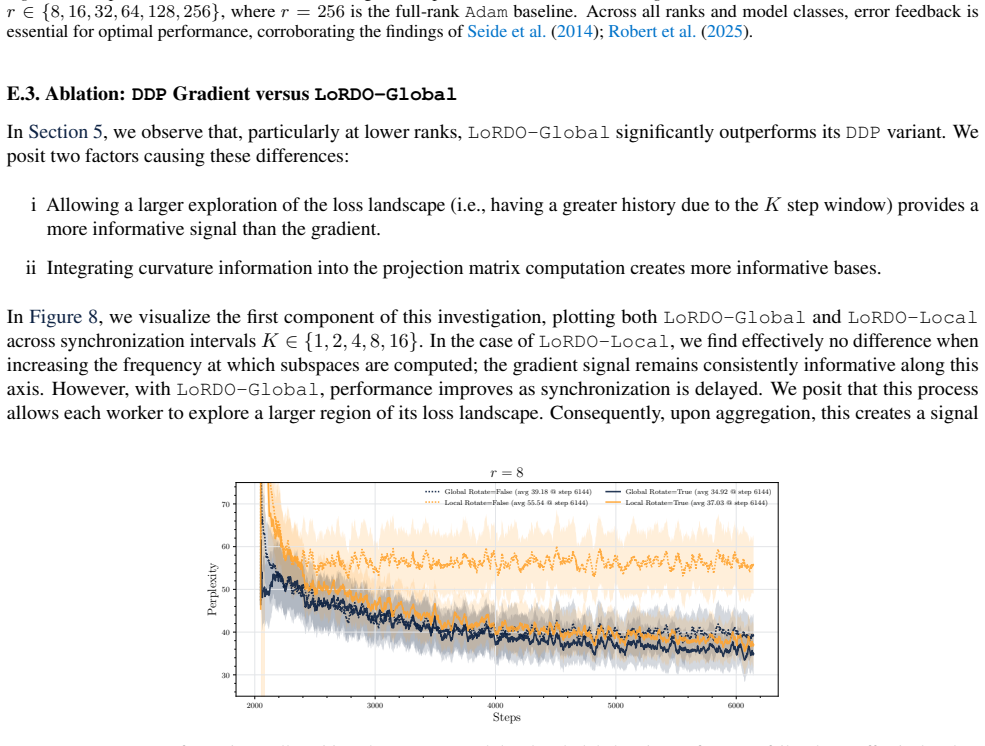
Figure 6.Impact of error feedback used during local optimization for DDP and theglobalandlocalvariants of LoRDO across r∈ {8,16,32,64,128,256} , where r= 256 is the full-rank Adam baseline. Across all ranks and model classes, error feedback is essential for optimal performance, corroborating the findings of Seide et al. (2014); Robert et al. (2025). E.3. ...
2014
-
[34]
also falls into this category by enabling rank-r orthogonalization; however, it typically relies on QR decomposition, which requires execution at every step, incurring significant computational costs that scale with rank (Modoranu et al., 2025). While we primarily discuss SVD-based projections, our framework’s core contribution—handling subspace misalignm...
2025
-
[64]
All models utilize the Warmup-Stable-Decay (WSD) scheduler (H¨agele et al., 2024)
Training steps T are set as multiples of the compute-optimal token budget (Hoffmann et al., 2022): the 16M model is trained for ≈2× the compute-optimal duration, while the 125M and 720M models are trained for ≈2× and ≈1× their respective budgets. All models utilize the Warmup-Stable-Decay (WSD) scheduler (H¨agele et al., 2024). Warmup lengths follow recom...
2022
-
[1970]
DeepSeek-AI, Liu, A., Feng, B., Xue, B., Wang, B., Wu, B., Lu, C., Zhao, C., Deng, C., Zhang, C., Ruan, C., Dai, D., Guo, D., Yang, D., Chen, D., Ji, D., Li, E., Lin, F., Dai, F., Luo, F., Hao, G., Chen, G., Li, G., Zhang, H., Bao, H., Xu, H., Wang, H., Zhang, H., Ding, H., Xin, H., Gao, H., Li, H., Qu, H., Cai, J. L., Liang, J., Guo, J., Ni, J., Li, J., ...
-
[1985]
J., Shen, Y ., Wallis, P., Allen-Zhu, Z., Li, Y ., Wang, S., Wang, L., and Chen, W
Hu, E. J., Shen, Y ., Wallis, P., Allen-Zhu, Z., Li, Y ., Wang, S., Wang, L., and Chen, W. Lora: Low-rank adaptation of large language models. InThe Tenth International Conference on Learning Representations, ICLR 2022, Virtual Event, April 25-29,
2022
-
[2014]
Benchmarking optimizers for large language model pretraining.arXiv preprint arXiv: 2509.01440,
Semenov, A., Pagliardini, M., and Jaggi, M. Benchmarking optimizers for large language model pretraining.arXiv preprint arXiv: 2509.01440,
-
[2017]
B., Lozhkov, A., Bakouch, E., Bl ´azquez, G
Allal, L. B., Lozhkov, A., Bakouch, E., Bl ´azquez, G. M., Penedo, G., Tunstall, L., Marafioti, A., Kydl ´ıcek, H., Lajar´ın, A. P., Srivastav, V ., Lochner, J., Fahlgren, C., Nguyen, X., Fourrier, C., Burtenshaw, B., Larcher, H., Zhao, H., Zakka, C., Morlon, M., Raffel, C., and Wolf, T. Smollm2: When smol goes big - data-centric training of a small langu...
-
[2019]
McCandlish, S., Kaplan, J., Amodei, D., and Team, O. D. An empirical model of large-batch training.arXiv preprint arXiv:1812.06162,
-
[2020]
Charles, Z., Teston, G., Dery, L., Rush, K., Fallen, N., Gar- rett, Z., Szlam, A., and Douillard, A. Communication- efficient language model training scales reliably and robustly: Scaling laws for diloco.arXiv preprint arXiv:2503.09799,
-
[2021]
At first, we consider the setting where we set the number of local stepsKto one
setting). At first, we consider the setting where we set the number of local stepsKto one. This gives the following local update computation when using a low-rank adaptive optimizer: θm t+1 ←θ t −η m t Qm t αm t (2) where θt is the model received by the worker at the previous synchronization boundary. Computing the per-worker pseudo-gradients: ∆m t ←θ t −...
2024
-
[2023]
Douillard, A., Donchev, Y ., Rush, K., Kale, S., Charles, Z., Garrett, Z., Teston, G., Lacey, D., McIlroy, R., Shen, J., Ram ´e, A., Szlam, A., Ranzato, M., and Barham, P. Streaming diloco with overlapping communica- tion: Towards a distributed free lunch.arXiv preprint arXiv:2501.18512,
-
[2024]
Hoffmann, J., Borgeaud, S., Mensch, A., Buchatskaya, E., Cai, T., Rutherford, E., de Las Casas, D., Hendricks, L. A., Welbl, J., Clark, A., Hennigan, T., Noland, E., Millican, K., van den Driessche, G., Damoc, B., Guy, A., Osindero, S., Simonyan, K., Elsen, E., Rae, J. W., Vinyals, O., and Sifre, L. Training compute-optimal large language models.arXiv pre...
-
[2025]
Dey, N., Zhang, B. C., Noci, L., Li, M. B., Bordelon, B., Bergsma, S., Pehlevan, C., Hanin, B., and Hestness, J. Don’t be lazy: Completep enables compute-efficient deep transformers.arXiv preprint arXiv: 2505.01618,
-
[6144]
2000 3000 4000 5000 6000 Steps 30 40 50 60 70 80 90 100 110Perplexity r = 16 DDP w/o EF (avg 47.2 @ step
2000
discussion (0)
Sign in with ORCID, Apple, or X to comment. Anyone can read and Pith papers without signing in.