REVIEW 3 major objections 4 minor 2 cited by
The paper argues that sentence-level machine translation in large language models is carried by a sparse set of attention heads — roughly one percent — split into mostly disjoint 'language heads' that pick the output language and 'translati
Reviewed by Pith at T0; open to challenge. T0 means a machine referee read the full paper against a public rubric. the ladder, T0–T4 →
T0 review · deepseek-v4-flash
2026-08-03 04:30 UTC pith:3G7EPLPY
load-bearing objection Solid empirical MI paper; the sparse-head decomposition mostly holds up, but the corruption-based subtask isolation is cleaner in presentation than in practice. the 3 major comments →
Translation Heads: Disentangling meaning from language in LLM-based machine translation
The pith
A machine-rendered reading of the paper's core claim, the machinery that carries it, and where it could break.
Core claim
The central claim is that LLM sentence-level MT decomposes into two causally separable subtasks, each mediated by its own sparse set of attention heads. Language heads — identified by corrupting demonstration targets into a different language while preserving meaning — control the output language; translation heads — identified by replacing targets with random same-language sentences — control sentence equivalence. Repeatedly, only 5–10 heads out of thousands stand out, the same heads recur across translation directions, and the two groups barely overlap. Steering the average activations of just 1% of each group reproduces translation quality comparable to an explicit instruction (e.g., 33.3
What carries the argument
The central object is the attention head set identified by activation patching with contrastive few-shot prompts. For sentence-level outputs, the paper introduces a KL-divergence criterion to pick the target token position where clean and corrupted prompts diverge most, then patches activations at that position. The identified heads are used to build mean-activation steering vectors (scaled by an amplification factor) that are added to the residual stream, turning an instruction-free prompt into a translation prompt.
Load-bearing premise
The load-bearing premise is that the two corrupted prompt families isolate exactly the two intended subtasks — replacing demonstration targets with another language isolates 'which language to output', and replacing them with random same-language sentences isolates 'preserve meaning'; if those corruptions also shift lexical, syntactic, or difficulty properties, the identified head sets may be conflated.
What would settle it
A decisive check: construct a corruption that swaps every content word of the demonstration targets for same-language synonyms (preserving syntax, length, and target language) and see whether activation patching still isolates the same 'translation heads'; if the head set changes drastically, the claimed equivalence subtask is an artifact of the particular corruption. Alternatively, ablate the top 'language heads' on a direction into English, where the paper reports language heads matter less — if target-language accuracy stays at random-ablation levels but BLEU still collapses, the functional
If this is right
- Translation is mechanistically localized: interventions on ~1% of attention heads are sufficient to elicit or disrupt sentence-level MT, so model editing and steering are viable at this scale.
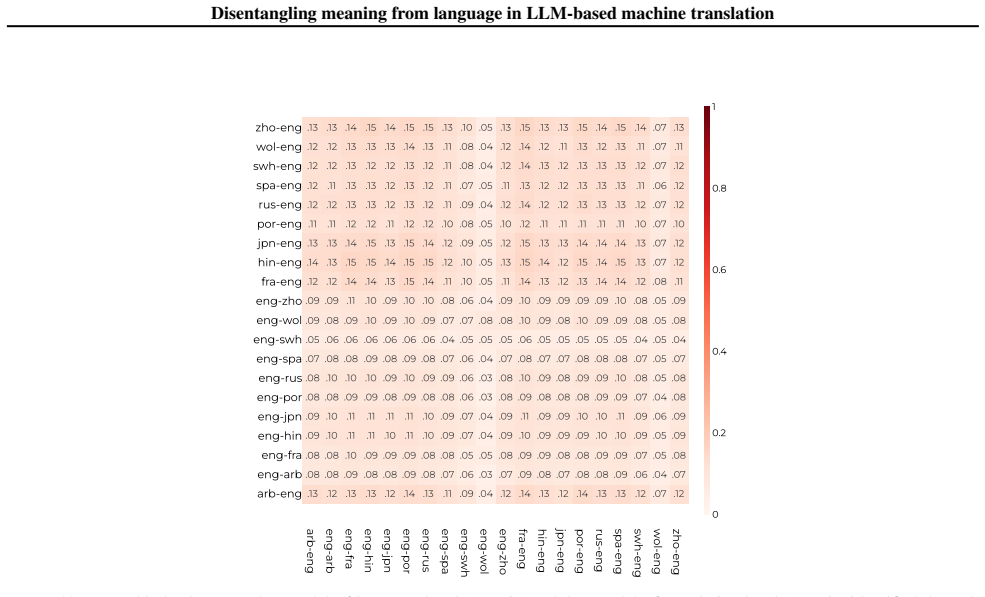
- Language identity and meaning equivalence are separately encoded, with mostly disjoint head sets (Jaccard index ≈0.13), refining the picture of how multilingual LLMs organize translation.
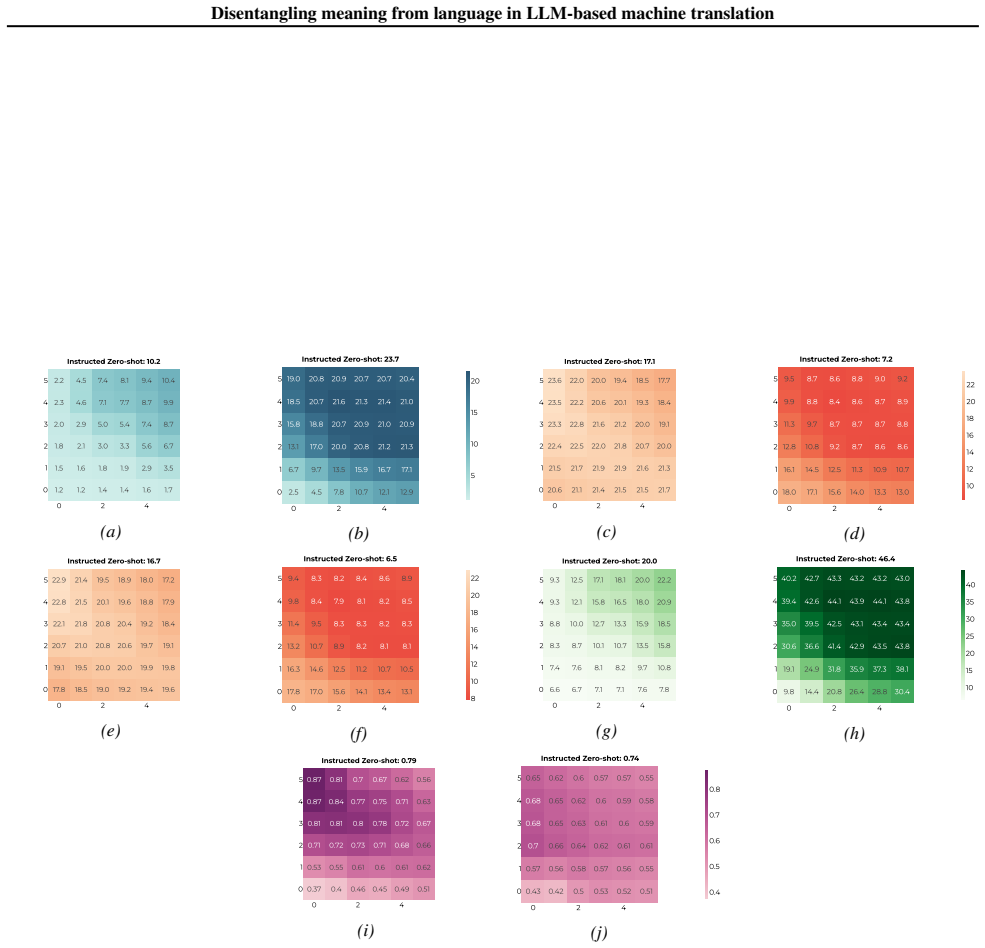
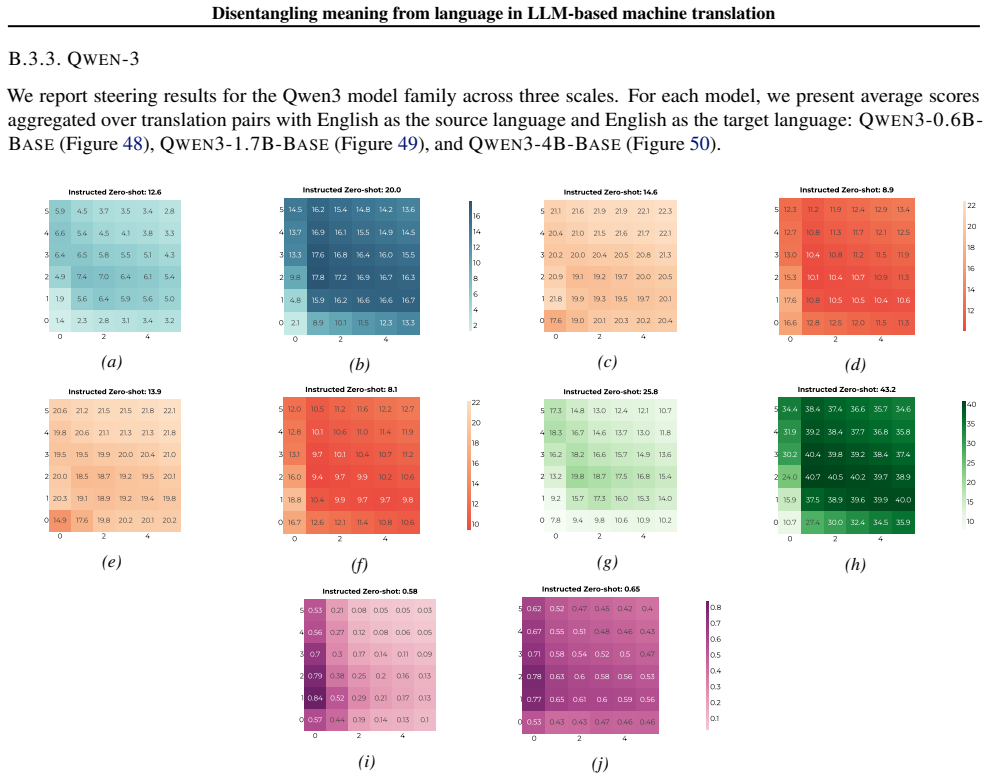
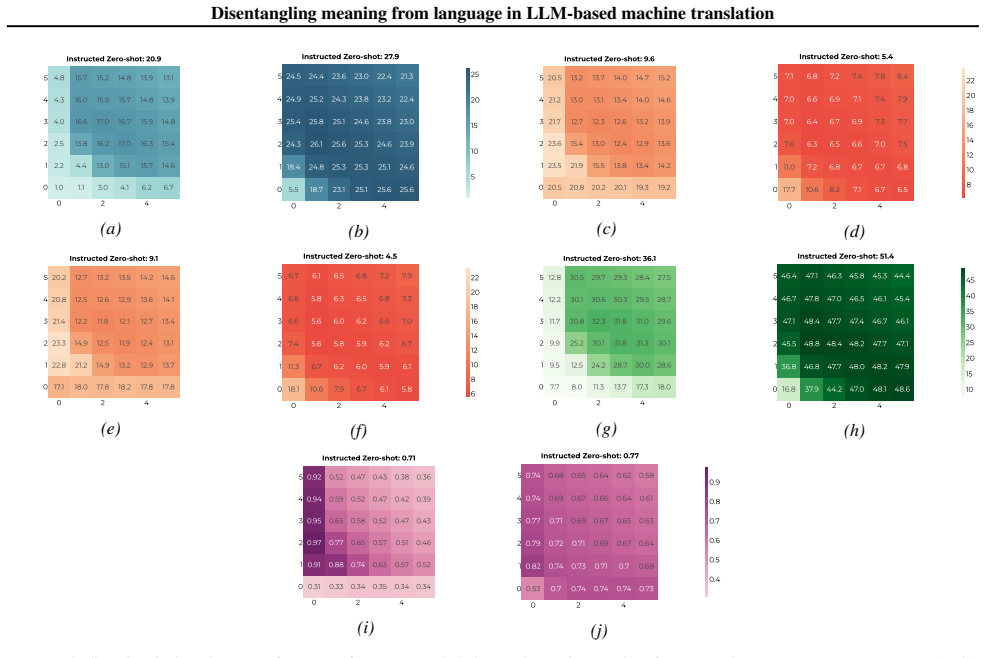
- Instruction-free steering with language and equivalence vectors matches instructed zero-shot prompting (e.g., 33.3 vs 32.6 BLEU for Gemma-3-12B English→X), so prompts may be replaceable by targeted activation control.
- Ablating language heads collapses target-language accuracy when translating out of English, while ablating translation heads degrades meaning; the asymmetry reflects English-centric pretraining.
- Equivalence vectors transfer across translation directions with minimal quality loss, suggesting the meaning-preservation component is largely direction-agnostic.
Where Pith is reading between the lines
- A testable prediction the paper does not make: if the same decomposition holds in other cross-lingual tasks (paraphrase, summarization, code-switching), 'language' and 'content' may be generally separable at the head level.
- The paper's own evidence shows first-token selection identifies similar heads to their KL-based method for larger models; a cheaper identification protocol might be possible, but would need validation on smaller models.
- The contrastive corruptions likely change more than the intended subtask (e.g., lexical statistics, syntactic templates), so the cleanest test of the decomposition would use synthetic corruptions that vary only the target language at constant token distribution; the paper's causal steering partially addresses but does not fully rule out this confound.
- Because language vectors decode to language-associated tokens while equivalence vectors decode to overlapping high-vocabulary tokens, one could attempt to 'retarget' a model into a language it generates poorly by swapping language vectors alone — though the paper's low-resource results suggest this may hit a generation-quality ceiling.
Editorial analysis
A structured set of objections, weighed in public.
Referee Report
Summary. The paper proposes a mechanistic decomposition of sentence-level machine translation in LLMs into two subtasks: target language identification and sentence equivalence. Using activation patching on two corrupted few-shot prompt families — wrong/mixed target languages, and random same-language target sentences — the authors identify roughly 1% of attention heads as specialized per subtask across Gemma-3, Qwen-3, and Llama-3 models and 20 translation directions. Steering these heads with mean-activation vectors under an instruction-free zero-shot prompt yields translation quality close to instructed zero-shot prompting (e.g., 33.3 vs 32.6 BLEU for Gemma-3-12B English→X), while ablating them produces function-specific failures (language switching vs. loss of meaning). Equivalence vectors transfer across directions. The paper also analyzes the effect of shot count, amplification factor, token position, and compares the identified heads with those from prior word-level MT studies.
Significance. If the causal claims hold, the findings are significant for mechanistic interpretability and MT: they provide evidence that a sparse set of attention heads can control an entire sentence-level NLP task, that the heads split into largely disjoint functional groups, and that steering only these heads suffices to elicit translation without instructions. The breadth — three model families, multiple scales, 20 directions, several automatic metrics — and released code are strengths. The causal validation via steering and ablation is the most compelling part and gives the paper real value. However, the semantic interpretation of the two head classes rests on an unexamined assumption that the two corruptions isolate exactly the intended subtasks; the paper would be materially strengthened by control experiments and an explicit limitations discussion.
major comments (3)
- [§3.2, sentence-equivalence corruption c_MT] Replacing each demonstration target with a random same-language sentence removes source–target meaning correspondence, but it also changes target-side lexical/syntactic statistics, discourse coherence, and the ease of inferring a coherent input–output mapping. Activation patching may therefore identify heads that encode 'this prompt is/is not a coherent translation task' rather than 'preserve the source's meaning.' This confound directly underdetermines the central claim that translation heads encode sentence equivalence. The paper provides no control (e.g., permuting Q/A pairs while using genuine translations, or using translations of different source sentences) and no limitations discussion. Please add such controls or explicitly temper the semantic interpretation.
- [§3.2, language-identification corruption c_lang] The text says each demonstration target is replaced by a correct translation in a language selected from the set L, while the Figure 1 caption describes the corruption as 'mixing multiple target languages.' Mixing languages removes cross-demonstration target-language consistency in addition to removing the intended target language, conflating target-language identity with mapping consistency. If the goal is to isolate target-language identification, a cleaner corruption would use a single wrong target language for all demonstrations, or at least report both variants. The causal steering results soften this concern but do not fully resolve the identification confound.
- [§5, Figs. 3–4] The headline 'comparable' claims rest on small BLEU differences (e.g., 33.3 vs 32.6 for Gemma-3-12B English→X) on a single devtest split with greedy decoding. No confidence intervals, bootstrap resampling, or significance tests are reported. With roughly 1,012 sentences, a 0.7 BLEU difference may be within noise. Please provide uncertainty estimates and, if possible, per-direction paired comparisons. This matters because the steering-sufficiency claim is one of the paper's main conclusions.
minor comments (4)
- [General] Typos and small phrasing issues: 'a instruction-free' in the Figure 5 caption; 'ANALISYS' in Appendix B.4.1; 'minimal performance loss performance' in Section 7. The abstract says 'three families' while the setup lists four model families (Gemma-3, Llama-3.2, Llama-2-7B, Qwen-3); clarify the grouping.
- [§5] The text says '5 to 10 heads' and gives '5 out of 1,024' as an example; specify the model and total head count corresponding to each number. The heatmaps in Figures 3–4 are dense; increasing font size and labeling the axes more explicitly would help.
- [§6 / References] The citation 'Anonymous (2025)' appears in the related work and in the head-classification comparison. In a final version this should be de-anonymized or clearly marked as a self-citation, depending on the submission venue's anonymity policy.
- [§3.1] The notation DKL is used without specifying the base (natural log vs log2); the KL values are only used comparatively, but stating the base would be cleaner.
Circularity Check
No circular reduction found: head identification and steering are independently evaluated on held-out devtest; §3.2's corruption confound is a validity concern, not a constructional circularity.
full rationale
The derivation chain is self-contained where circularity could arise. Heads are identified in §3.1–3.2 via activation patching between clean and corrupted few-shot prompts, with the two corruptions defined to target language choice and meaning correspondence. No parameter is fitted on the devtest set: §4 states the dev set is used to identify heads and build steering vectors, while the devtest set is used for evaluation, and the main results fix the amplification factor at α=1, with a sensitivity study in §6 rather than per-direction tuning. The steering vectors are simple averaged clean activations multiplied by the output projection; they are not optimized against the target metric. The central claims — steering 1% of heads approaches instructed zero-shot on BLEU/MetricX and ablations cause function-specific failures — are evaluated against external baselines and random-head controls, so the predictions do not reduce to the quantities used to define the heads. The only potentially self-referential citations are the anonymous companion paper and co-authored in-context-learning/low-resource MT references (Zebaze et al. 2025a,b), but these are used as related work and context, not as the justification for the decomposition or the localization result. There is a genuine validity concern, identified by the skeptical read, that the c_MT corruption changes lexical/syntactic statistics and task coherence along with meaning, so the identified 'translation heads' may encode task coherence rather than sentence equivalence; however, that is an empirical underdetermination, not a circular reduction — no equation makes sentence equivalence identical to the corruption, and the steering/ablation failure modes provide independent, non-tautological evidence. The manuscript's lack of a limitations section noting this confound is a transparency issue but does not constitute circularity.
Axiom & Free-Parameter Ledger
free parameters (3)
- amplification factor α =
1 (default; sensitivity explored from -2 to 20)
- head fraction for steering/ablation =
1% of language heads and 1% of translation heads
- number of in-context demonstrations k =
5 (default)
axioms (4)
- domain assumption Activation patching at attention-head granularity measures a component's causal contribution to the next-token distribution.
- ad hoc to paper The two corrupted prompt families isolate exactly target-language identification and sentence equivalence, respectively.
- domain assumption The FLORES-200 reference translations used for teacher forcing and evaluation are adequate gold translations.
- domain assumption BLEU, MetricX-24, chrF++, and XCOMET scores are meaningful proxies for translation quality in the comparisons made.
read the original abstract
Mechanistic Interpretability (MI) seeks to explain how neural networks implement their capabilities, but the scale of Large Language Models (LLMs) has limited prior MI work in Machine Translation (MT) to word-level analyses. We study sentence-level MT from a mechanistic perspective by analyzing attention heads to understand how LLMs internally encode and distribute translation functions. We decompose MT into two subtasks: producing text in the target language (i.e. target language identification) and preserving the input sentence's meaning (i.e. sentence equivalence). Across three families of open-source models and 20 translation directions, we find that distinct, sparse sets of attention heads specialize in each subtask. Based on this insight, we construct subtask-specific steering vectors and show that modifying just 1% of the relevant heads enables instruction-free MT performance comparable to instruction-based prompting, while ablating these heads selectively disrupts their corresponding translation functions.
Figures










Forward citations
Cited by 2 Pith papers
-
Exploring Language-Agnosticity in Function Vectors: A Case Study in Machine Translation
Translation function vectors extracted from English to one target language improve correct token ranking for translations to multiple other unseen target languages in decoder-only multilingual LLMs.
-
Exploring Language-Agnosticity in Function Vectors: A Case Study in Machine Translation
Translation function vectors extracted from one language direction transfer to unseen target languages, indicating a language-agnostic translation signal in multilingual LLMs.
Reference graph
Works this paper leans on
-
[7]
Wang, W., Li, Z., Lian, D., Ma, C., Song, L., and Wei, Y
URL https://openreview.net/forum? id=NpsVSN6o4ul. Wang, W., Li, Z., Lian, D., Ma, C., Song, L., and Wei, Y . Mitigating the language mismatch and repetition issues in LLM-based machine translation via model editing. In Al-Onaizan, Y ., Bansal, M., and Chen, Y .-N. (eds.),Pro- ceedings of the 2024 Conference on Empirical Methods in 13 Disentangling meaning...
2024
-
[68]
findings-naacl.68/
URL https://aclanthology.org/2025. findings-naacl.68/. Zhang, B., Haddow, B., and Birch, A. Prompting large language model for machine translation: a case study. InProceedings of the 40th International Conference on Machine Learning, ICML’23. JMLR.org, 2023. Zhang, H., Chen, K., Bai, X., Li, X., Xiang, Y ., and Zhang, M. Exploring the translation mechanis...
2025
-
[176]
We will endeavour to cut carbon dioxide emis- sions per unit of GDP by a notable margin by 2020 from the 2005 level,
URL https://aclanthology.org/2024. findings-naacl.176/. Zhu, W., Liu, H., Dong, Q., Xu, J., Huang, S., Kong, L., Chen, J., and Li, L. Multilingual machine translation with large language models: Empirical results and analysis. In Findings of the association for computational linguistics: NAACL 2024, pp. 2765–2781, 2024b. 14 Disentangling meaning from lang...
2024
-
[363]
URL https://aclanthology.org/2020. emnlp-main.363/. Lee, D., Lee, S. C., Yang, C., Baek, Y ., and Choo, J. Explor- ing in-context example generation for machine translation. In Che, W., Nabende, J., Shutova, E., and Pilehvar, M. T. (eds.),Findings of the Association for Computational Linguistics: ACL 2025, pp. 26554–26568, Vienna, Aus- tria, July 2025. As...
doi:10.18653/v1/2025 2020
-
[624]
URL https://aclanthology.org/2023. findings-emnlp.624/. Hendy, A., Abdelrehim, M., Sharaf, A., Raunak, V ., Gabr, M., Matsushita, H., Kim, Y . J., Afify, M., and Awadalla, H. H. How good are gpt models at machine translation? a comprehensive evaluation, 2023. URL https:// arxiv.org/abs/2302.09210. Jiao, W., Wang, W., tse Huang, J., Wang, X., Shi, S., and ...
Pith/arXiv arXiv 2023
-
[879]
URL https://aclanthology.org/2024. emnlp-main.879/. Wendler, C., Veselovsky, V ., Monea, G., and West, R. Do llamas work in English? on the latent language of multi- lingual transformers. In Ku, L.-W., Martins, A., and Sriku- mar, V . (eds.),Proceedings of the 62nd Annual Meeting of the Association for Computational Linguistics (Volume 1: Long Papers), pp...
Pith/arXiv arXiv 2024
-
[1216]
URL https://aclanthology.org/2025. findings-emnlp.1216/. Zebaze, A. R., Sagot, B., and Bawden, R. In-context example selection via similarity search improves low- resource machine translation. In Chiruzzo, L., Ritter, A., and Wang, L. (eds.),Findings of the Association for Computational Linguistics: NAACL 2025, pp. 1222– 1252, Albuquerque, New Mexico, Apr...
-
[2020]
Lauscher, A., Ravishankar, V ., Vuli´c, I., and Glavaš, G
URL https://openreview.net/forum? id=HJeT3yrtDr. Lauscher, A., Ravishankar, V ., Vuli´c, I., and Glavaš, G. From zero to hero: On the limitations of zero-shot language transfer with multilingual Transformers. In Webber, B., Cohn, T., He, Y ., and Liu, Y . (eds.),Pro- ceedings of the 2020 Conference on Empirical Methods in Natural Language Processing (EMNL...
-
[2022]
Papineni, K., Roukos, S., Ward, T., and Zhu, W.-J
https://transformer-circuits.pub/2022/in-context- learning-and-induction-heads/index.html. Papineni, K., Roukos, S., Ward, T., and Zhu, W.-J. Bleu: a method for automatic evaluation of machine translation. In Isabelle, P., Charniak, E., and Lin, D. (eds.),Proceed- ings of the 40th Annual Meeting of the Association for Computational Linguistics, pp. 311–31...
arXiv 2022
-
[2023]
URL https://proceedings.mlr.press/ v202/von-oswald23a.html. Wang, K. R., Variengien, A., Conmy, A., Shlegeris, B., and Steinhardt, J. Interpretability in the wild: a circuit for indi- rect object identification in GPT-2 small. InThe Eleventh International Conference on Learning Representations,
-
[2024]
Tillmann, C., V ogel, S., Ney, H., and Zubiaga, A
URL https://openreview.net/forum? id=tbVWug9f2h. Tillmann, C., V ogel, S., Ney, H., and Zubiaga, A. A DP-based search using monotone alignments in statis- tical translation. In35th Annual Meeting of the As- sociation for Computational Linguistics and 8th Con- ference of the European Chapter of the Association for Computational Linguistics, pp. 289–296, Ma...
arXiv 1997
-
[2025]
Zhao, Y ., Zhang, W., Chen, G., Kawaguchi, K., and Bing, L
URL https://openreview.net/forum? id=3QjESmXftM. Zhao, Y ., Zhang, W., Chen, G., Kawaguchi, K., and Bing, L. How do large language models handle multilingualism? Advances in Neural Information Processing Systems, 37: 15296–15319, 2024. Zhu, W., Liu, H., Dong, Q., Xu, J., Huang, S., Kong, L., Chen, J., and Li, L. Multilingual machine trans- lation with lar...
2024
discussion (0)
Sign in with ORCID, Apple, or X to comment. Anyone can read and Pith papers without signing in.